Astragalus in Traditional Eastern Medicine: A Beginner's Guide
Educational guide to astragalus (Astragalus membranaceus, 黄芪 Huang Qi) — classical TCM context from the Shennong Bencao Jing, the Yu Ping Feng San formula, modern peer-reviewed research (HFrEF, cancer-fatigue, LiverTox safety), and traditional preparations.
Medical Disclaimer: This content is for educational and informational purposes only and is not medical advice. The information presented is not intended to diagnose, treat, cure, or prevent any disease. Always consult a licensed healthcare practitioner before starting any new herbal practice or supplement. Statements regarding traditional herbal use have not been evaluated by the FDA.
Affiliate Disclosure: This article contains affiliate links. We may earn a commission if you purchase through these links, at no additional cost to you. We only recommend products we believe align with our editorial standards.
Few herbs are as deeply embedded in Chinese culinary-medicinal tradition as astragalus — known in Chinese as Huang Qi (黄芪), literally "the yellow leader." It appears in winter soups, herbal teas, classical pharmacy formulas, and increasingly in modern clinical trials investigating heart failure, cancer-related fatigue, and immune function. This guide walks through what classical Traditional Eastern Medicine (TEM) says about astragalus, what modern peer-reviewed research has begun to suggest, how the root is traditionally prepared, and the safety considerations any newcomer deserves to know.
Why Astragalus Has Endured for Two Thousand Years
Astragalus appears as one of the foundational herbs in the Shennong Bencao Jing (神农本草经, Divine Farmer's Materia Medica), compiled around the first to second centuries CE from much older oral traditions. In that classification, astragalus was placed in the superior class — substances classical practitioners considered safe enough for regular use and associated with promoting overall vitality rather than treating acute disease.
The Chinese name Huang Qi (黄芪) translates roughly as "yellow leader" — huang referring to the warm-yellow color of the dried root cross-section, qi connoting leadership or eldership among tonic herbs. The English-language name comes from the Latin genus Astragalus; the specific species used in Chinese medicine is Astragalus membranaceus (also formally written Astragalus mongholicus), distinct from the many other Astragalus species in the legume family that are not used medicinally.
In Chinese policy terms, astragalus has been officially classified as part of the 药食两用 (yào shí liǎng yòng) category — "medicine and food dual use" — through China's National Health Commission listing, alongside other traditional tonics such as ginseng and goji [1]. That regulatory framing reflects how the herb is actually used in daily life across many Chinese households: not as a concentrated extract for acute conditions, but as a small daily addition to soups, congees, and teas.
How Traditional Eastern Medicine Views Astragalus
Within Traditional Chinese Medicine, herbs are described along axes of taste, nature, and channel affinity. Astragalus is classified as follows in classical sources [1]:
- Taste and nature: sweet, slightly warm (味甘, 性微温)
- Channel affinity: Spleen and Lung channels (归脾、肺经)
- Traditional functions: 益气升阳 (tonify qi and raise yang), 固表止汗 (stabilize the exterior and arrest sweating), 利水消肿 (promote diuresis and reduce edema), 托毒生肌 (expel toxin and regenerate tissue)
Translated into modern language, the function classical sources called "tonifying qi" overlaps roughly with what we might describe today as supporting energy, recovery, and resistance to environmental stress — though it is not a precise modern medical category. Practitioners working in this framework describe astragalus as suited to individuals with what classical texts called "qi-deficient constitution" — a pattern often presenting as fatigue, soft voice, low appetite, easy sweating, or frequent susceptibility to colds.
Crucially, the same source emphasizes that astragalus is not appropriate for everyone. Classical practice considers it unsuitable for several pattern types, which we'll cover in detail in the safety section below.
The Classical Formula That Made Astragalus Famous
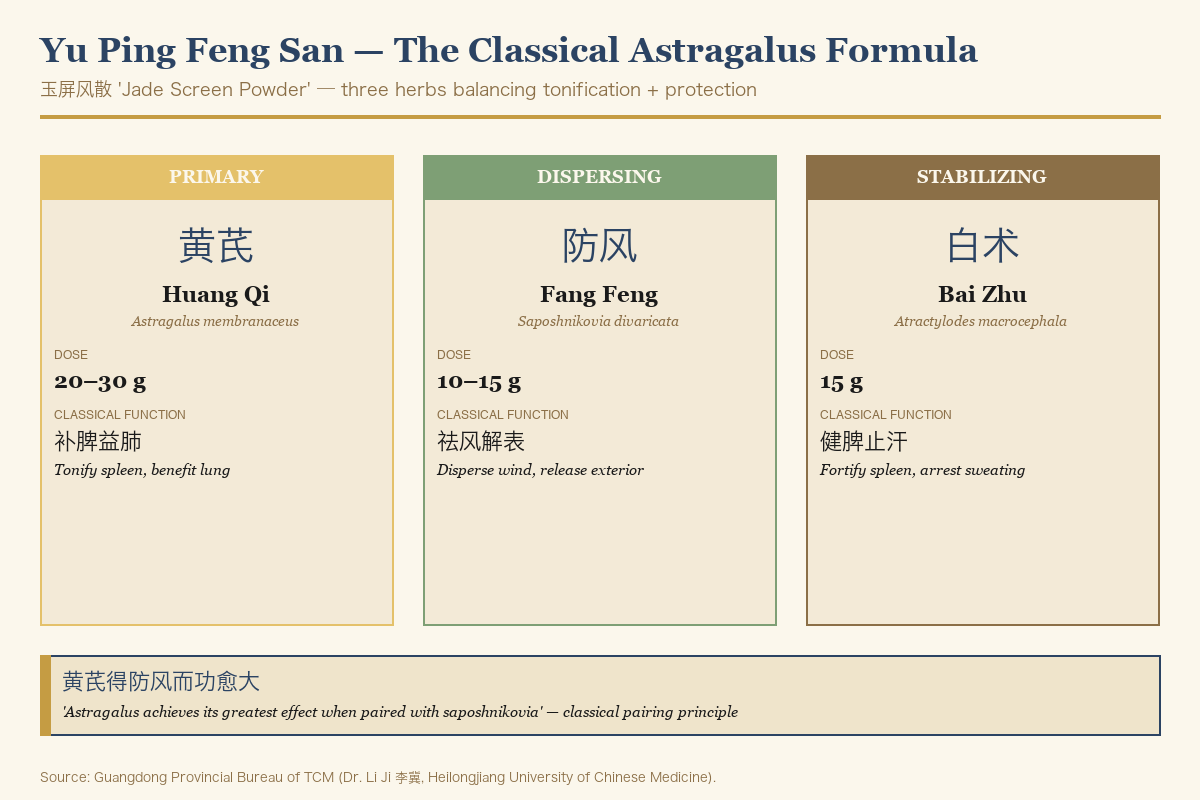
Astragalus rarely appears alone in classical Chinese formulas. Its most influential combination — and the one most cited in both traditional textbooks and modern clinical-trial papers — is Yu Ping Feng San (玉屏风散, "Jade Screen Powder"), a three-herb formula attributed to physician Zhu Danxi in the Yuan dynasty.
According to a classical-application analysis by Dr. Li Ji (李冀), a National Renowned TCM Doctor at Heilongjiang University of Chinese Medicine, published through the Guangdong Provincial Bureau of TCM, the formula composition is [2]:
- 黄芪 (Astragalus): 20–30 g — to "tonify spleen and benefit lung" (补脾益肺)
- 防风 (Saposhnikovia / Fang Feng): 10–15 g — to disperse external pathogenic influences
- 白术 (Atractylodes / Bai Zhu): 15 g — to fortify spleen function and consolidate the surface
The classical pairing principle quoted in the source is "黄芪得防风而功愈大" — astragalus achieves its greatest effect when paired with saposhnikovia. The formula is traditionally indicated for the pattern called 表虚自汗 (weakness of the protective exterior with spontaneous sweating) and has been used historically as a constitutional support for individuals prone to frequent colds [2].
This formula is worth knowing about because most modern clinical trials that report astragalus benefits actually study astragalus as part of multi-herb formulas — not as an isolated single ingredient. That distinction matters when interpreting research.
What Does the Research Say About Astragalus?
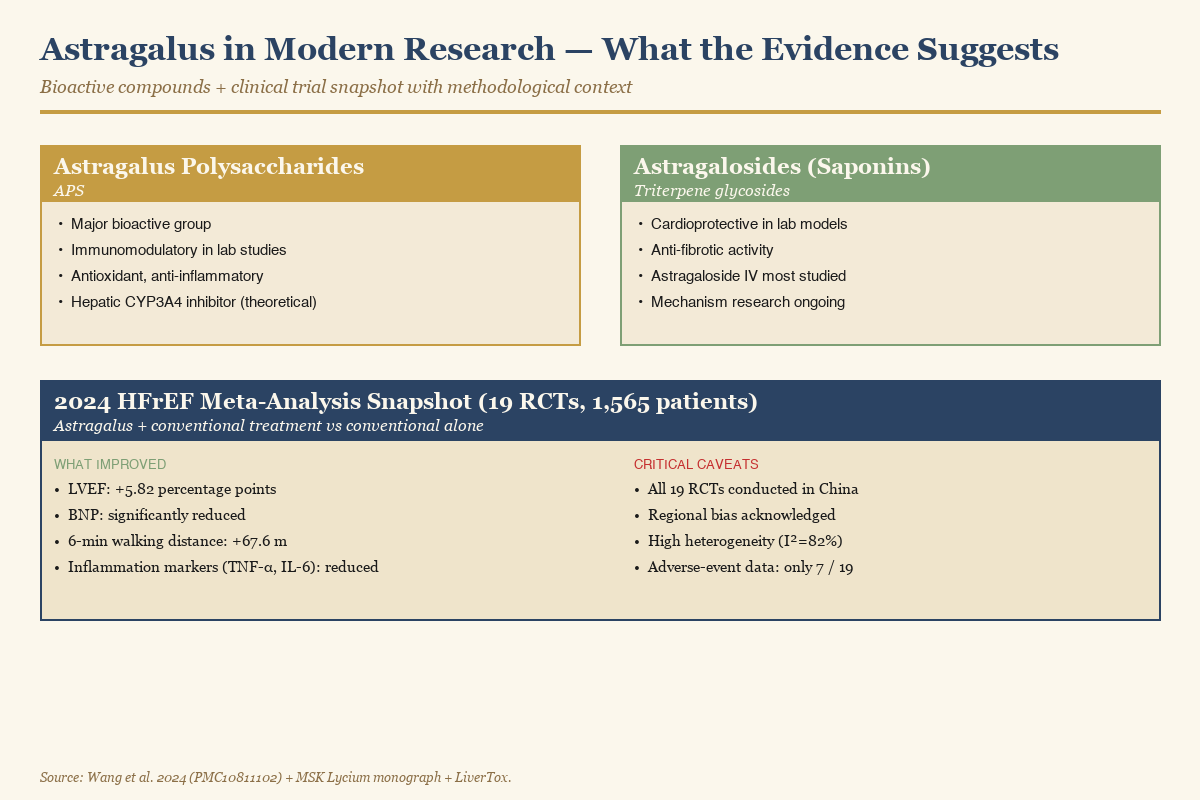
Astragalus is one of the more actively studied TCM herbs in modern clinical research, but the overall evidence picture is uneven. Two main bioactive groups appear in nearly every study: astragalus polysaccharides (APS), and a class of triterpenoid saponins called astragalosides. Memorial Sloan Kettering's monograph summarizes the mechanism work as follows: "polysaccharides, triterpenoid saponins, and flavonoids are the main constituents of astragalus with immunomodulating, antioxidant, anti-inflammatory, and anticancer effects" [3]. The mechanism work is reasonably consistent. The clinical translation is more variable.
Heart failure with reduced ejection fraction (HFrEF). A 2024 systematic review and meta-analysis in Frontiers in Pharmacology, drawing on 19 RCTs with 1,565 patients, found that astragalus combined with conventional treatment significantly improved several echocardiographic and biomarker outcomes versus conventional treatment alone: left ventricular ejection fraction increased (mean difference 5.82 percentage points), left ventricular end-diastolic diameter decreased, brain natriuretic peptide (BNP) decreased, and six-minute walking distance improved [4]. However, the authors flag two crucial methodological caveats: heterogeneity was high (I²=82% for LVEF), and all 19 RCTs were conducted in China. They acknowledge this introduces potential regional bias and stress that "more high-quality investigations" are needed to generalize the findings. Anyone reading marketing copy that claims astragalus is a proven heart-failure remedy in Western patients is reading a stronger claim than the current evidence supports.
Cancer-related fatigue. A 2024 systematic review and meta-analysis indexed on PubMed found that adding astragalus to control treatment was effective in reducing cancer-related fatigue across pooled RCTs. The authors of that same review, however, explicitly note that the efficacy and safety profile "is uncertain" and that more high-quality evidence is needed [5]. The pattern here is consistent with goji and ginseng research: disease-related fatigue (especially in cancer survivors) has the more positive signal; healthy-population effect data are weaker.
Diabetic kidney disease. Multiple meta-analyses have examined adjunctive astragalus for diabetic kidney disease, with reports of short-term reductions in albuminuria, proteinuria, and serum creatinine versus conventional therapy alone. As with the HFrEF work, the same caveats apply: most trials originate from China, methodological quality varies, and findings should be considered preliminary [3].
Liver safety. The NIH LiverTox monograph is notably reassuring on hepatic risk. Among 85 cases of herbal-supplement-related liver injury in a U.S. prospective study (2004–2013), none involved astragalus. LiverTox assigns astragalus a Likelihood Score of E — unlikely cause of clinically apparent liver injury [6].
The honest summary is this: astragalus has plausible biological activity at the mechanism level and some preliminary positive clinical signals, particularly for adjunctive use alongside conventional treatment in specific patient populations. The leap from "biologically interesting" to "clinically proven for general daily use" has not been completed by the evidence base.
How Do People Use Astragalus?
Traditional culinary-medicinal preparations are far more common in everyday Chinese practice than concentrated supplement use. The China Daily authority overview catalogues these common modern usage patterns, with specific dose ranges [1]:
Daily Wellness Tea
5–10 grams of dried astragalus slices steeped in hot water, often repeatedly. Common pairings include Chinese dates (红枣, hong zao) and goji berries (枸杞, gou qi zi) — a combination sometimes called qi-gou-zao tea (黄芪 + 枸杞 + 红枣) and used as a gentle daily tonic, particularly in autumn and winter.
Astragalus in Soups and Broths
Adding 15–30 grams of astragalus slices to chicken or pork bone broth is one of the most common household uses. A classical pairing is astragalus + angelica root (当归) + black-bone chicken, considered a qi-and-blood tonic soup. Another is astragalus + poria (茯苓) + carp, traditionally used for what classical sources called spleen weakness with edema.
Astragalus Congee
Roughly 50 grams of astragalus slices simmered with rice produces a thick, mildly sweet congee. Traditional households often eat this during recovery from illness or in cold seasons.
Higher-Dose Therapeutic Use
The same source notes that under TCM clinical supervision, doses can ramp higher: 50 g/day initially for serious depletion patterns, scaled down to 30 g after about two weeks, and 15 g long-term [1]. These ranges are well above casual culinary use and would not be done without a practitioner's guidance.
Standardized Extracts and Capsules
Modern supplements deliver astragalus polysaccharide (APS) extract in capsule form. As with most herbs studied in food-versus-supplement comparisons, whole-root culinary use tends to be both more pleasant and more closely aligned with the patterns described in classical sources.
Individual responses vary considerably; what works well for one person may not suit another, and personal experimentation under practitioner guidance is always recommended.
Important Limitations and Considerations
Astragalus is one of the safer tonic herbs by clinical standards, but it is not consequence-free. The most important considerations:
- Immunosuppressant medications — Because astragalus may stimulate immune activity, it may reduce the effectiveness of immunosuppressive drugs used in transplant recipients or for certain autoimmune conditions [3]. This is one of the most clinically important interactions to flag.
- Autoimmune conditions — For individuals with autoimmune disorders such as lupus, rheumatoid arthritis, or multiple sclerosis, herbs with immunomodulating activity require practitioner guidance rather than self-experimentation.
- Anticoagulants (warfarin) and blood pressure medications — Possible additive effects on bleeding risk and blood pressure have been flagged by MSK [3]. People on these medications should consult their prescriber before adding astragalus.
- CYP3A4 metabolism — LiverTox notes that astragalus has "inhibitory activity against several CYP enzyme isoforms, particularly CYP3A4," though clinically apparent drug interactions have not been reported [6]. The theoretical concern affects medications metabolized via that pathway — including some statins, antifungals, and others.
- TCM contraindicated patterns — Classical practice does not consider astragalus universally beneficial. Quoted by China Daily, the contraindication list includes 阴虚阳亢 (yin-deficient with yang excess, often presenting as restless heat and dryness), 气滞湿热 (qi-stagnation with damp-heat), 热毒炽盛 (intense heat-toxin patterns), and active fever or infection [1]. The source quote is direct: "黄芪是药不是粮,用之对证则效,用之不当则害人" — astragalus is medicine, not food; used correctly for the matching pattern it works, used incorrectly it harms.
- Hypertension — China Daily explicitly recommends medical supervision for hypertensive patients considering astragalus use [1].
- Acute illness / fever — Traditional practice avoids tonic herbs (including astragalus) during acute febrile illness or active infection, since classical theory views tonics as inappropriate when "pathogenic factors" are still present.
- Pregnancy and breastfeeding — Insufficient high-quality safety data exist for routine recommendation. Most professional sources advise consultation rather than self-experimentation.
- Common adverse effects — Generally uncommon. Large doses may cause mild gastrointestinal upset, nausea, or loose stools [6]. Quality variability between commercial products is a more practical concern than direct toxicity.
- Individual constitution — Some people may experience restlessness, headaches, or warmth-related discomfort when starting astragalus, traditionally interpreted as a sign the herb is not matching the constitution well. Results can vary depending on lifestyle, season, and individual pattern.
These limitations are not meant to discourage exploration. They are the realistic context any reader deserves before forming expectations.
Frequently Asked Questions About Astragalus
Can I take astragalus every day?
Many people incorporate astragalus into daily wellness routines, and traditional Chinese practice often involves consistent, long-term use rather than short bursts. That said, individual responses vary — and anyone with an autoimmune condition, organ transplant, or on immunosuppressant medications should consult a healthcare practitioner before daily use.
Does astragalus interact with any medications?
Yes, potentially. Astragalus may interact with immunosuppressant drugs (such as cyclosporine), anticoagulants, and some diuretics. If you take prescription medications, speak with your doctor before adding astragalus to your routine.
What is astragalus root traditionally used for in TCM?
In Traditional Chinese Medicine, astragalus (Huáng Qí / 黄芪) is classified as a tonic herb that supports the "Wei Qi" — the body's protective energy. Practitioners traditionally use it to tonify the spleen and lung systems, and it appears in classical formulas for general vitality and recovery.
How do people typically prepare astragalus?
The most traditional method is a long simmered decoction — dried root slices simmered in water for 30–60 minutes, often alongside other herbs. Some people add slices directly to soups or broths. Standardised extracts and capsules are also widely available for those who prefer convenience over the traditional preparation ritual.
Is astragalus safe during pregnancy or breastfeeding?
There is insufficient clinical evidence to confirm safety during pregnancy or breastfeeding. As with most herbs in these situations, caution is recommended and consultation with a qualified healthcare provider is essential before use.
A Note on Tracking — Where Health Diary Comes In
Traditional Eastern wellness practice has always emphasized observation over time. Classical practitioners assessed patterns, not isolated symptoms — sleep, digestion, energy levels, sweating, susceptibility to seasonal illness, recovery from exertion. That practice maps surprisingly well onto modern habits like journaling and habit tracking.
For someone curious about astragalus, tracking a few signals over a few weeks is more informative than relying on day-to-day impressions. Useful things to record might include:
- Daily energy levels and afternoon fatigue patterns
- Sleep quality and morning restfulness
- Sweating patterns (spontaneous, exertional, nighttime)
- Frequency of minor seasonal illness over winter
- Digestion and appetite
- Recovery from exercise or workload spikes
Patterns observed across weeks tell a story that any single morning cannot. That principle is older than astragalus itself.
A Soft Closing Note
Astragalus is interesting precisely because it sits between food and medicine — neither a miracle herb nor a marketing invention. Classical Chinese sources positioned it as a constitutional support to be matched to a pattern, not a one-size-fits-all daily supplement. The line quoted earlier — "astragalus is medicine, not food" — is a useful corrective to the wellness-culture habit of treating any traditional herb as a universally beneficial superfood.
If you are curious about traditional wellness practices, the most useful next step is usually slow learning rather than an immediate purchase. Reading reputable sources — peer-reviewed reviews, government TCM authority monographs, classical herbal texts — and observing your own patterns through journaling tend to produce better outcomes than chasing any single ingredient.
Some people explore options like adding a few slices of astragalus to a winter soup as a small ritual; others prefer to focus first on sleep, movement, and food before considering any herb. You can learn more about traditional body constitutions and seasonal wellness rhythms on our companion guides.
About This Article
Written by: Health Diary Editorial Team — a small editorial group researching traditional wellness practices, herbal traditions, and quantified-self methods. Our articles draw on peer-reviewed literature, government health-agency monographs (NIH LiverTox, NCCIH), academic medical centers (MSK Integrative Medicine), and primary native-language sources from provincial Bureaus of Traditional Chinese Medicine.
Editorial review: This article has been reviewed by the Health Diary editorial team for clarity, structure, and adherence to our sourcing standards. It is not a clinical review and should not replace consultation with a licensed healthcare practitioner. When a clinical reviewer is added to this article, attribution will appear here with verifiable credentials.
Reviewed on: June 4, 2026.
Editorial process: All claims about modern evidence are linked inline to peer-reviewed publications or authoritative government or academic medical sources. Where the evidence is preliminary, mixed, or limited — or where significant methodological caveats apply (as with the regional-bias caveat in the HFrEF meta-analysis) — we describe it that way rather than glossing over uncertainty. Native-language Chinese sources from Bureaus of Traditional Chinese Medicine and state-affiliated authoritative media are cited alongside English-language peer-reviewed sources to reflect both the cultural and scientific perspectives on this herb.
References
- China Daily (中国日报网). 药中补气王!药食两用,补气强身 (King of Qi-Tonifying Medicine: Medicine-Food Dual Use). 2019. https://cn.chinadaily.com.cn/a/201901/20/WS5c4513e5a31010568bdc50e5.html
- Guangdong Provincial Bureau of Traditional Chinese Medicine (广东省中医药局). 玉屏风散经验 (Clinical Application Notes on Yu Ping Feng San by Dr. Li Ji 李冀). http://szyyj.gd.gov.cn/zyyfw/dyjc/content/post_4173157.html
- Memorial Sloan Kettering Cancer Center. Astragalus — Integrative Medicine herb monograph. https://www.mskcc.org/cancer-care/integrative-medicine/herbs/astragalus
- Wang Y et al. Effect of Astragalus membranaceus on left ventricular remodeling in heart failure with reduced ejection fraction: a systematic review and meta-analysis. Frontiers in Pharmacology, 2024. PMC10811102. https://pmc.ncbi.nlm.nih.gov/articles/PMC10811102/
- Efficacy of Astragalus Membranaceus (Huang Qi) for Cancer-Related Fatigue: A Systematic Review and Meta-Analysis of Randomized Controlled Studies. 2024. PubMed 40302232. https://pubmed.ncbi.nlm.nih.gov/40302232/
- National Institutes of Health, National Library of Medicine. Astragalus — LiverTox: Clinical and Research Information on Drug-Induced Liver Injury. NBK548582. https://www.ncbi.nlm.nih.gov/books/NBK548582/