Kukicha (茎茶): Japan's Delicate Twig Tea
Discover kukicha — Japan's distinctive twig tea made from Camellia sinensis stems and stalks, with naturally low caffeine, a mild sweet flavour, and deep roots in Kanazawa tradition and the macrobiotic wellness movement.
Medical Disclaimer: This content is for educational and informational purposes only and is not medical advice. The information presented is not intended to diagnose, treat, cure, or prevent any disease. Always consult a licensed healthcare practitioner before starting any new herbal practice or supplement. Statements regarding traditional herbal use have not been evaluated by the FDA.
Affiliate Disclosure: This article contains affiliate links. We may earn a commission if you purchase through these links, at no additional cost to you. We only recommend products we believe align with our editorial standards.
Open a bag of kukicha and the first thing you notice is how unusual it looks. Instead of the flat green needles of sencha or the vivid powder of matcha, you find a tangle of pale, straw-coloured twigs — the stems, stalks, and small branches of the Camellia sinensis tea plant. Smell the dry blend and the aroma is gentle and slightly sweet, with a faint creaminess quite unlike any leaf tea. This is kukicha (茎茶) — literally "stem tea" — and it occupies a genuinely unique corner of the Japanese tea world.
Kukicha is made not from leaves at all, but from the structural parts of the tea plant that are typically separated out during the production of premium teas like sencha, gyokuro, and matcha. The stems, stalks, petioles, and fine twigs — material that might otherwise be discarded or composted — are instead collected, processed, and sometimes lightly roasted to create a tea with flavour characteristics quite distinct from its leaf-based counterparts: mild, mellow, and naturally very low in caffeine. For centuries this was a practical everyday tea; today it has found admirers worldwide who value precisely its gentle, accessible character.
What Makes Kukicha Unique Among Japanese Teas?
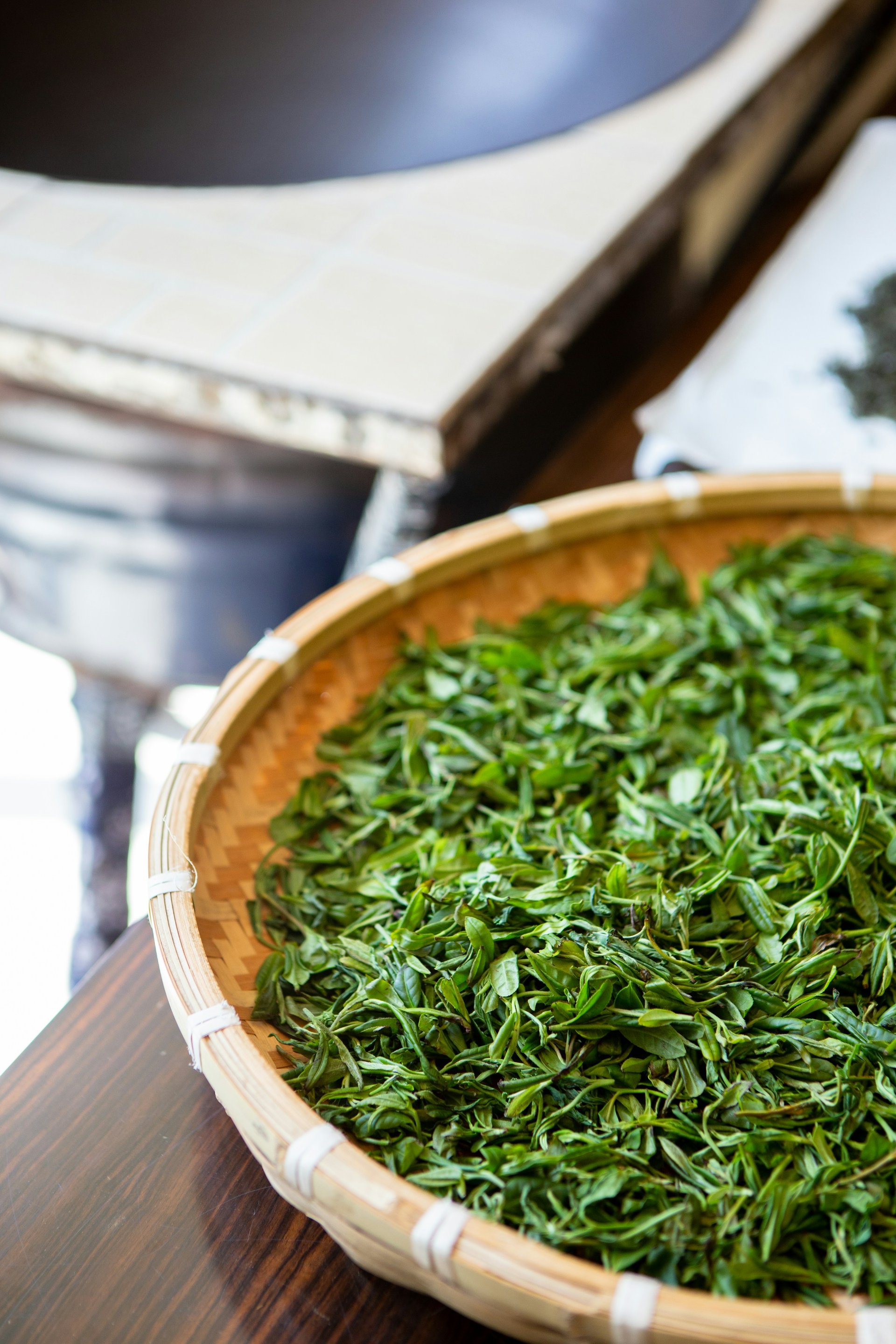
Nearly every major Japanese green tea is made from the leaves of Camellia sinensis. Kukicha is the exception. Its defining character comes from using the plant's stems, stalks, and twigs — the fibrous, structural parts of the tea plant rather than the photosynthetically active leaf tissue. This botanical distinction has significant implications for what ends up in your cup.
Leaves accumulate the highest concentrations of most tea compounds: caffeine, catechins (including EGCG), chlorophyll, and many of the aromatic compounds responsible for green tea's characteristic sharpness. The stems and stalks of the same plant contain these compounds at much lower concentrations, because they function primarily as transport and support structures rather than the photochemical factories that leaves are. As a result, kukicha naturally has a gentler, sweeter profile — without needing any processing intervention to achieve it.
Kukicha also has a distinctly higher calcium content compared to leaf teas. Analysis of Japanese tea composition has shown that stems retain more calcium per gram than leaves, a finding documented in the Japan Standard Tables of Food Composition maintained by the Ministry of Education, Culture, Sports, Science and Technology (MEXT) [Japan MEXT Food Database, kukicha infusion entry]. This is one of the frequently cited nutritional distinguishing features of kukicha compared to other Japanese green teas.
In practical production terms, kukicha is a co-product of premium tea manufacturing. When factories process gyokuro, high-grade sencha, or tencha (the leaf used to make matcha), the material passes through machines that separate stems and stalks from leaves. The leaf fraction goes forward to become the premium product; the stems are collected separately. This makes kukicha economically efficient — it uses parts of a harvest that would otherwise contribute nothing to the final product — and gives it a close link to the quality of the leaf tea it accompanies. Kukicha made from gyokuro stems is generally considered higher quality than that made from regular sencha stems.
History and Regional Traditions
Kukicha's history is intertwined with the broader history of Japanese green tea production, which has centred for centuries on regions like Shizuoka, Uji in Kyoto Prefecture, and the Noto Peninsula in Ishikawa Prefecture. While stems have been collected as a processing co-product for as long as Japanese leaf tea has been made in quantity, kukicha as a distinct named product gained particular regional identity in one area above all others: Kanazawa.
In Kanazawa, the capital of Ishikawa Prefecture on the Sea of Japan coast, a roasted version of kukicha known as bōcha (棒茶) — literally "stick tea" — became a deeply embedded local tradition. Bōcha is made from the first-flush (ichibancha) stalks of high-quality tea plants, which are then kiln-roasted to develop a warm, toasted character. The roasting process deepens the colour from pale straw to a rich golden brown and adds a mellow nuttiness that locals find comforting. In Kanazawa, bōcha is not a specialty curiosity but an everyday household tea — the standard brew served to guests, enjoyed with meals, and available in local tea shops that have been trading for generations. The Urasenke tea school, one of Japan's most influential tea ceremony traditions, which has a strong presence in Kanazawa, also uses bōcha in its hospitality context, further cementing its cultural status in the region [Kanazawa Tourism, Tea Traditions].
Outside Japan, kukicha gained an unexpected second life through the macrobiotic wellness movement of the 20th century. George Ohsawa (1893–1966), the Japanese philosopher and writer who developed macrobiotics, advocated kukicha as the ideal beverage within his dietary framework. Ohsawa's macrobiotic system emphasised balance, alkalinity, and minimal stimulant intake; kukicha's very low caffeine content and what proponents described as its mildly alkaline character in the body made it a natural fit. His writings introduced kukicha to Western audiences — particularly in Europe and North America — decades before Japanese green tea generally became widely known outside Asia. As a result, many people in Western countries first encountered kukicha not through Japanese culture directly but through macrobiotic practitioners and health food stores in the 1960s and 1970s, where it was sold under names like "twig tea" or "stalk tea" [Ohsawa Macrobiotics Foundation].
Key Compounds in Kukicha
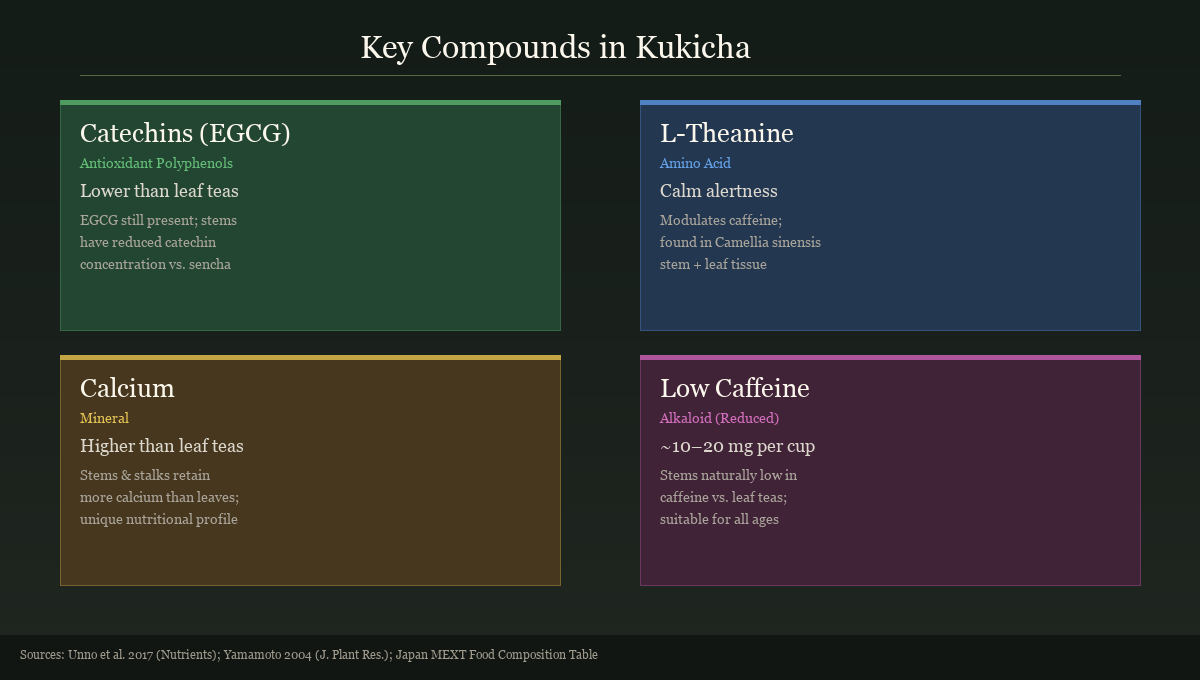
Kukicha's compound profile reflects its botanical origin: the stems and stalks of the Camellia sinensis plant carry many of the same compounds as leaves, but at meaningfully different concentrations. Understanding this helps explain both why kukicha tastes the way it does and why it differs from other teas in its effects.
Catechins and EGCG
Green tea leaves are among the richest dietary sources of catechins — a family of polyphenolic antioxidants of which epigallocatechin gallate (EGCG) is the most studied. EGCG's antioxidant activity has been extensively documented, with free radical scavenging mechanisms described in detail in peer-reviewed research [Singh et al., Biochemical Pharmacology, 2011]. In kukicha, catechin levels are considerably lower than in equivalent quantities of sencha or matcha. Research on the distribution of catechins within the tea plant has found that stem tissue contains significantly less EGCG and total catechins than leaf tissue from the same plant and harvest, a finding consistent across multiple studies of Camellia sinensis composition [Venditti et al., Molecules, 2018]. This is why kukicha is less astringent and bitter than leaf teas — the compounds primarily responsible for that sharpness are simply present in much lower amounts.
L-Theanine
L-Theanine is an amino acid found almost exclusively in the tea plant and certain mushrooms. It is associated with a state of relaxed alertness and is known to interact with caffeine in ways that may moderate the stimulant's sharper effects. L-Theanine is present in both leaf and stem tissue, though at lower concentrations in stems. A clinical trial published in Nutrients in 2017 found that a low-caffeine green tea with a proportionally higher theanine-to-caffeine ratio was associated with reduced salivary stress markers and improved sleep quality in healthy adults over four weeks [Unno et al., Nutrients, 2017]. Kukicha's naturally low caffeine and preserved theanine share this general low-stimulant profile, though direct clinical studies on kukicha specifically are limited.
Caffeine — Naturally Very Low
Caffeine in the tea plant concentrates primarily in leaves — particularly young, newly emerged leaves — and much less in stems, petioles, and twigs. Published analyses of Japanese tea composition indicate that kukicha typically contains approximately 10–20 mg of caffeine per prepared cup, substantially lower than sencha (30–50 mg) or matcha (50–70 mg per serving) [Japan MEXT Food Database]. This makes kukicha one of the lowest-caffeine options in the Japanese tea family — not caffeine-free, but genuinely mild by comparison. The reduction in caffeine is intrinsic to the plant part used, requiring no special processing or decaffeination.
Calcium
One of kukicha's most-cited compositional distinctions is its relatively elevated calcium content compared to leaf teas. The stems and stalks of Camellia sinensis retain more calcium per gram than leaves — a characteristic noted in Japanese food composition analysis. The Japan MEXT Food Composition Table records a measurably higher calcium content for kukicha infusion than for comparable green tea leaf infusions, though the absolute amounts per cup remain modest and far below what would be considered a significant dietary calcium source. For context, this calcium distinction is often cited in macrobiotic literature as one reason kukicha was favoured in Ohsawa's framework, alongside its low caffeine profile.
Alkalinity Consideration
Macrobiotic proponents have historically claimed kukicha is among the most "alkaline-forming" teas — meaning it is said to have a mild alkalising effect on the body after metabolism. It is important to note that the scientific evidence for food-based alkalinity effects on blood pH is limited; the body tightly regulates blood pH regardless of dietary inputs. This claim reflects a traditional nutritional framework rather than established biochemistry. Kukicha's alkalinity in the macrobiotic sense is better understood as a cultural-wellness concept than a clinically verified physiological effect.
How Do People Enjoy Kukicha?
Kukicha has a range of preparations that reflect both its Japanese roots and its global adoption through wellness communities. The tea is remarkably versatile and forgiving, making it accessible to people who are new to Japanese tea traditions.
In Japan, the most common form of daily kukicha is a simple hot infusion — the pale, straw-coloured or golden brew that results from steeping the stems in water between 80°C and 90°C for two to three minutes. In Kanazawa, where bōcha (roasted kukicha) is the local norm, the roasted version is served at restaurants, in homes, and at traditional tea shops where it arrives as a matter of course alongside meals, in much the same way that other regions might offer plain water or barley tea. The mellow, toasty character of bōcha pairs naturally with the seafood-forward Kanazawa cuisine.
Beyond Japan, cold-brew kukicha has become popular among tea enthusiasts who appreciate its particularly smooth character when cold-extracted. Because kukicha is so low in tannins and astringent compounds, cold brewing produces an exceptionally clean, naturally sweet cup that requires no sweetener and virtually no bitterness management. Many people who find regular cold-brew green tea too sharp or tannic find cold-brew kukicha immediately appealing.
Within macrobiotic communities, kukicha is often drunk as the sole daily beverage — replacing all other caffeinated drinks — as part of a broader dietary practice. It is sometimes prepared in a small pan on the stove rather than steeped in a teapot, which macrobiotic practitioners argue produces a slightly different character. Whether this makes a genuine difference or is largely ritual is a matter of personal preference rather than established tea science.
Individual responses to kukicha's flavour vary. Some people find its gentle, slightly sweet character immediately pleasant — particularly those who have found stronger teas too sharp or stimulating. Others, accustomed to the pronounced umami depth of sencha or gyokuro, may find kukicha underwhelming at first. It is genuinely a tea that rewards slow attention rather than comparison with leafier counterparts.
What Does the Research Say About Kukicha?
Direct peer-reviewed research specifically on kukicha as a beverage is sparse — much more limited than the large body of literature on green tea leaf preparations. Most of what can be said about kukicha's potential wellness interest draws from studies on its constituent compounds, particularly catechins, L-theanine, and low-caffeine green tea preparations, with the caveat that kukicha contains these at lower concentrations than the teas most studied in clinical settings.
The most directly applicable research for kukicha's particular profile is the 2017 clinical trial by Unno and colleagues, published in Nutrients, which tested a low-caffeine green tea against standard green tea in healthy adults over four weeks. Participants drinking the low-caffeine preparation showed significantly lower salivary α-amylase activity — a physiological marker associated with stress response — and reported improved sleep quality and reduced accumulated fatigue. The researchers attributed these outcomes partly to the higher theanine:caffeine ratio in the low-caffeine variant [Unno et al., Nutrients, 2017]. Kukicha shares the low-caffeine profile studied here, though the study did not use kukicha and this should not be read as a direct finding about kukicha itself.
A 2018 review published in Molecules examined the distribution of bioactive compounds across different parts of the tea plant, including stems and petioles, finding that while catechin concentrations are lower in stem tissue than leaves, meaningful amounts of antioxidant polyphenols remain present — a finding that supports kukicha's status as a polyphenol-containing beverage, though not a concentrated source [Venditti et al., Molecules, 2018].
A J-STAGE study by Yamamoto and colleagues examining the chemical composition of tea stems and their differentiation from leaf tissue confirmed the characteristically lower catechin and caffeine content of kukicha-type material, while noting the preserved presence of amino acids including theanine [Yamamoto et al., Journal of the Japanese Society for Horticultural Science, 2004 — available via J-STAGE].
The NCCIH — the U.S. National Institutes of Health's complementary health research centre — notes that green tea consumed as a beverage at normal quantities is generally considered safe for most healthy adults, with some preliminary evidence suggesting modest effects on cardiovascular markers in certain populations, while emphasising that findings remain mixed and that more research is needed before conclusions can be drawn [NCCIH, Green Tea]. For kukicha, which contains green tea compounds at reduced concentrations, any wellness interest should be understood as even more preliminary than for leaf green teas.
In practical terms: kukicha is a pleasant, low-caffeine beverage with a mild polyphenol content. Its value in a daily routine lies primarily in being a gentle, enjoyable hot or cold drink with a long cultural history — not in any specific pharmacological property that current research has established for kukicha as a distinct preparation.
How to Brew Kukicha at Home
Kukicha is one of the most forgiving Japanese teas to brew. Its low tannin and catechin content means it is difficult to over-steep in a way that produces real bitterness, making it ideal for people who are still learning Japanese tea preparation or who want a low-maintenance everyday cup.
Basic Hot Brewing
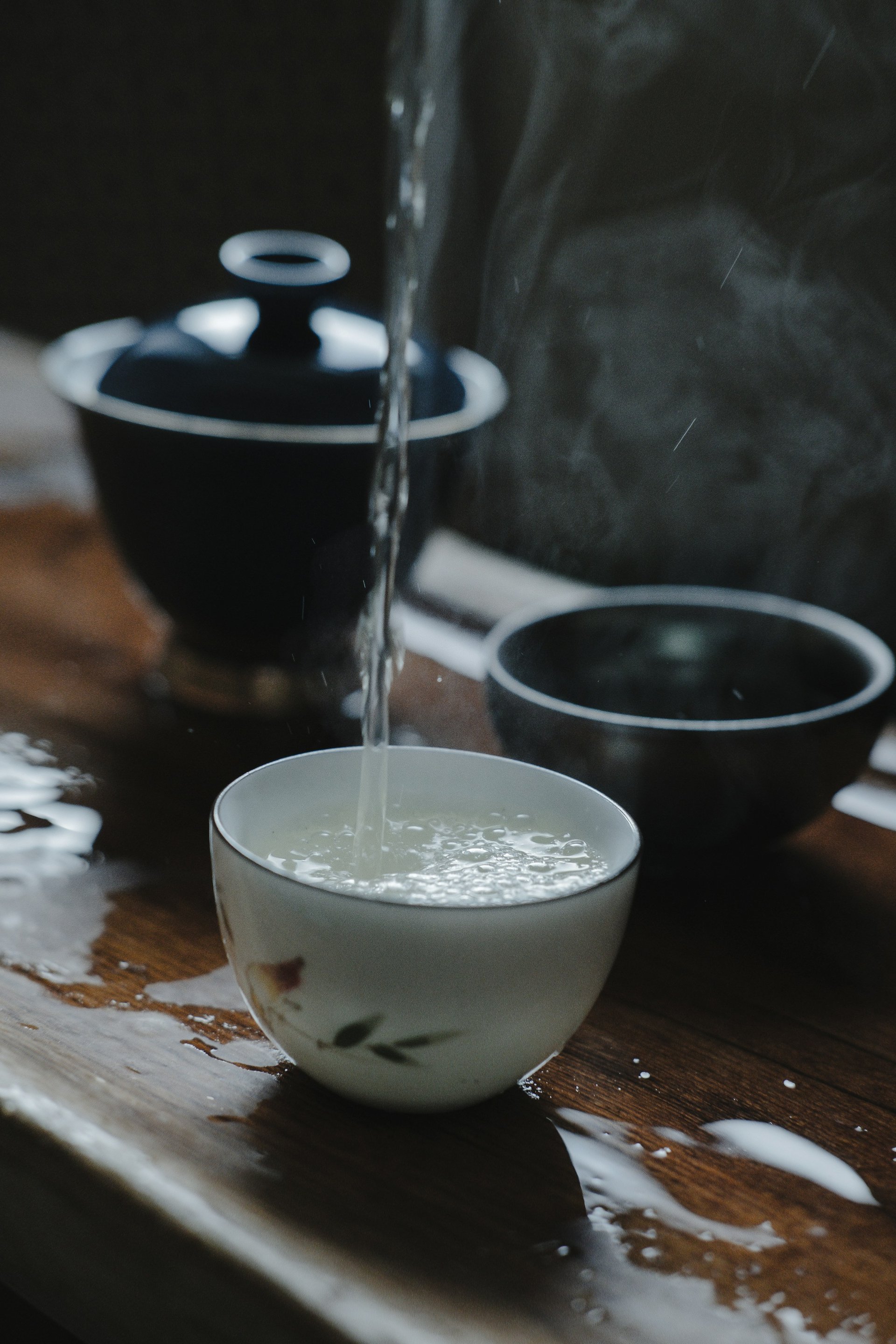
- Water temperature: Use water at 80–90°C (176–194°F). Kukicha is more tolerant of higher water temperatures than most green teas — you can use water that has come off a full boil and rested for 1–2 minutes. The higher temperature actually helps extract the sweet, mellow notes from the stems more fully.
- Amount: Use approximately 3–4 grams per 200 ml of water (roughly 1–1.5 teaspoons of loose twigs). Kukicha is bulky for its weight, so the visual amount may look more generous than other teas.
- Steep time: 2–3 minutes. A 2-minute steep gives a pale golden cup with the classic sweet, mild character. Three minutes deepens the flavour slightly without significant bitterness. Roasted bōcha can handle 3–4 minutes for a fuller character.
- Re-steeping: Kukicha steeps particularly well for 2–3 infusions. Each successive steep becomes lighter and slightly sweeter. The stems release compounds more slowly than leaves, which is why the second steep often tastes almost as good as the first.
Cold Brew Kukicha
Cold-brew kukicha is exceptionally smooth and is one of the best showcases for the tea's natural sweetness. Add 5–6 grams of kukicha to 600 ml of cold water in a pitcher or jar. Cover and refrigerate for 6–10 hours (overnight works perfectly). No bitterness will develop regardless of steep time, making cold-brew kukicha highly forgiving. The result is a clean, golden-tinted beverage with a delicate sweet character. Particularly suitable for warm weather or as a low-caffeine alternative to iced green tea.
Stovetop Method (Macrobiotic Style)
In the macrobiotic tradition, kukicha is sometimes simmered gently in a small pan rather than steeped. Add 1–2 teaspoons of kukicha twigs to 400 ml of cold water in a small saucepan. Bring slowly to a gentle simmer over low heat (not a full boil), then reduce heat immediately and allow to steep off the heat for 2–3 minutes before straining. Some practitioners find this method produces a slightly warmer, rounder flavour. It is more a matter of ritual preference than a technically superior extraction method.
Kukicha vs. Other Japanese Teas
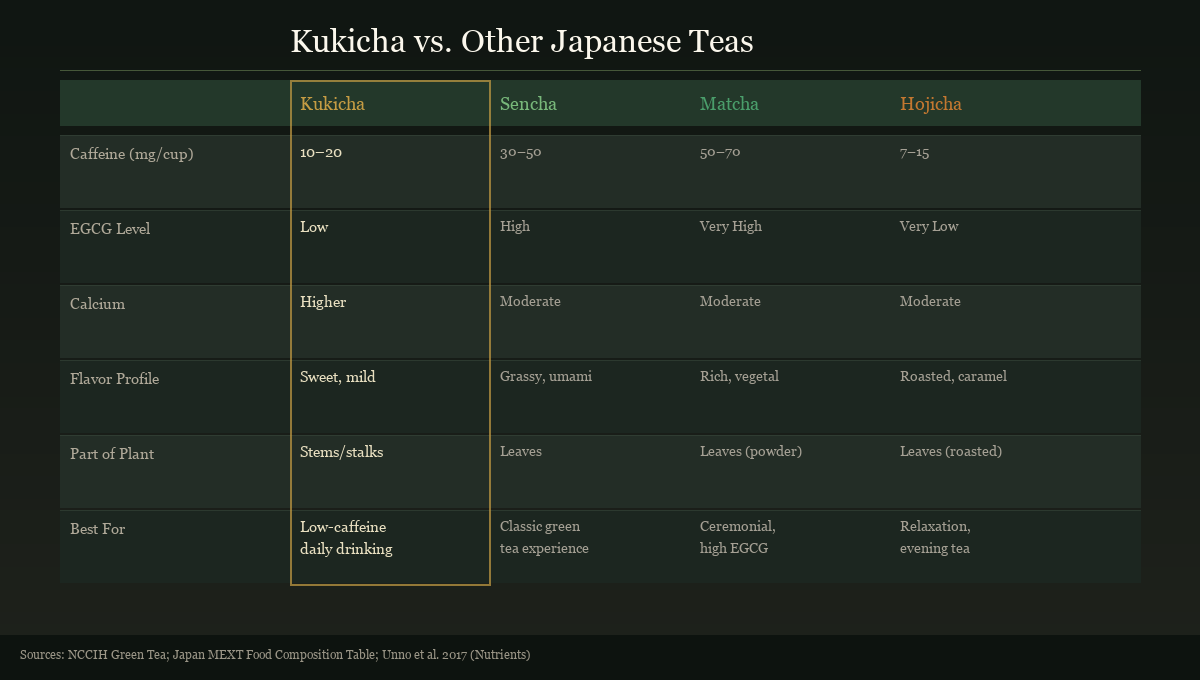
Kukicha occupies a distinctive position in the Japanese tea family. Understanding how it compares to the teas most people are already familiar with helps clarify when and why someone might choose it.
Kukicha vs. Sencha: Sencha is Japan's most widely consumed tea and is made entirely from leaves — typically from the first or second flush. Its flavour is characteristically grassy, fresh, and lightly astringent, with a pronounced umami note in high-quality versions. Sencha contains substantially more caffeine (30–50 mg/cup), more catechins including EGCG, and more chlorophyll than kukicha. It requires more careful brewing temperature control to avoid bitterness. Kukicha, made from sencha's by-product stems, is the gentler, lower-stimulant counterpart that can be brewed casually without technical precision.
Kukicha vs. Matcha: Matcha is ground green tea leaf powder of the highest grade — shade-grown, stone-milled, and dissolved rather than steeped. It has the highest catechin and caffeine content of any mainstream Japanese tea and the most concentrated flavour. Kukicha is essentially at the opposite end of the Japanese tea spectrum: the lowest caffeine, lowest catechin content, mildest flavour. The two share a botanical origin (both from Camellia sinensis) but represent entirely different parts of the plant and entirely different experiences. Interestingly, high-grade kukicha is sometimes made from the stems separated during tencha (pre-matcha leaf) processing, creating a close production link between the most and least intense teas in the Japanese repertoire.
Kukicha vs. Hojicha: Hojicha and kukicha are the two Japanese teas most commonly recommended for caffeine-sensitive individuals. Hojicha achieves its very low caffeine (7–15 mg/cup) through roasting — a high-heat process that breaks down caffeine in the leaf material. Kukicha achieves its low caffeine because stems simply never accumulated much caffeine to begin with. Flavour-wise, hojicha is caramel-toasted and warm; plain kukicha is sweet and mild. Bōcha (roasted kukicha) occupies a middle ground — it has the stem tea's inherent low caffeine combined with a gentle roasted warmth, though its roasted character is generally milder than hojicha's.
Kukicha vs. Genmaicha: Both are gentle, low-caffeine options, but they achieve this differently. Genmaicha dilutes its green tea leaves with roasted brown rice, reducing caffeine by proportion while adding a distinctive nutty flavour. Kukicha uses no additive — its character comes entirely from the stems themselves. Genmaicha has a more complex, warm-grain flavour; kukicha is simpler and purer. Those who enjoy genmaicha's comforting character but want an even lower caffeine option often find kukicha the natural next step.
Important Considerations
Kukicha is widely regarded as one of the most accessible and gentle Japanese teas. Its very low caffeine content, minimal astringency, and mild flavour make it particularly well-suited to people who are sensitive to stronger teas, who drink tea later in the day, or who are introducing younger family members to Japanese tea culture. A few points are worth noting regardless.
- Not caffeine-free: Despite its very low caffeine content, kukicha is not completely caffeine-free. Those who must avoid all caffeine — for medical reasons, during specific life stages, or due to documented hypersensitivity — should be aware of this. The caffeine per cup (approximately 10–20 mg) is considerably lower than any standard green or black tea, but it is not zero.
- Drug interactions: The NCCIH notes that concerns about green tea and drug interactions primarily relate to concentrated green tea extract supplements rather than brewed tea at normal consumption levels [NCCIH]. Kukicha, with its reduced catechin load compared to leaf teas, presents an even lower likelihood of interaction at normal daily intake. However, anyone taking medications affected by green tea compounds (such as warfarin or certain statins) should discuss their tea consumption with their healthcare provider as a precaution.
- Pregnancy and breastfeeding: Kukicha's very low caffeine makes it one of the more compatible teas with pregnancy-related caffeine guidance. Current guidance generally considers low caffeine intake safe during pregnancy, but pregnant individuals should monitor total daily caffeine from all sources and follow their specific healthcare provider's recommendations.
- Children: Kukicha has long been served to children in Japan due to its extremely low caffeine. It is one of the Japanese teas most historically associated with all-ages family use. Parents should still factor in a child's total daily caffeine from all sources.
- Roasted vs. unroasted versions: Unroasted kukicha has a pale, grassy-sweet character; roasted bōcha has a warmer, toasted flavour with slightly different aromatic compounds. Both are from the same plant part; the roasting primarily affects flavour and aroma, not the fundamental caffeine or catechin profile in any significant way.
- Quality variation: Like all teas, kukicha quality varies considerably by source. Kukicha made from gyokuro or high-grade sencha stems will taste markedly different — more refined, sweeter, with greater complexity — than kukicha from lower-grade bancha stems. Tasting from a reputable Japanese tea supplier is the best guide to personal preference.
Frequently Asked Questions
What does kukicha taste like?
Kukicha has a mild, sweet, and slightly creamy flavour profile that is distinctly gentler than most Japanese green teas. There is very little of the grassy sharpness associated with sencha and almost none of the tannin-driven astringency that characterises strongly brewed leaf teas. The flavour is sometimes described as lightly nutty or faintly reminiscent of fresh straw — clean and simple rather than complex. The roasted bōcha version adds a warm, toasted note on top of this sweet base. Many people who find standard green tea too sharp or bitter find kukicha immediately easy to enjoy. The brewed cup is typically pale golden to very light green in colour.
Is kukicha the lowest-caffeine Japanese tea?
Kukicha is among the lowest-caffeine Japanese teas, containing approximately 10–20 mg of caffeine per cup. Hojicha can be similarly low or slightly lower (typically 7–15 mg/cup depending on roasting intensity). Both are considerably lower than sencha, matcha, or gyokuro. The difference in caffeine reduction mechanism is notable: hojicha's low caffeine results from roasting degrading the alkaloid in leaf material; kukicha's low caffeine reflects the stem tissue never having accumulated much caffeine in the first place. For those seeking the very lowest caffeine from a Japanese tea, both hojicha and kukicha are the natural options, and personal taste preference is the deciding factor between them.
What is the difference between kukicha and bocha?
Bōcha (棒茶) is a specific style of kukicha made in Kanazawa and surrounding areas of Ishikawa Prefecture, primarily from first-flush (spring) tea stalks that are then kiln-roasted. The roasting gives bōcha a warmer, toasted flavour and a golden-brown colour in the cup, compared to unroasted kukicha's pale straw colour and sweet-mild taste. In terms of plant material used, they are the same — stems, stalks, and twigs of Camellia sinensis — but bōcha refers to the roasted regional Kanazawa tradition specifically. Outside Japan, "kukicha" and "twig tea" are the most widely used names for both roasted and unroasted versions, while "bōcha" tends to be used by enthusiasts with specific awareness of the Kanazawa style.
Can I drink kukicha every day?
For most healthy adults, kukicha consumed in typical quantities — one to three cups daily — is generally considered safe. Its very low caffeine and minimal catechin content make it one of the gentler daily teas in any tradition. In Japan, kukicha and bōcha have been everyday household drinks consumed by all ages for generations without notable concerns at typical consumption levels. As with any food or beverage, individual health circumstances vary: those with specific conditions, who are pregnant, or who take medications with known interactions with tea compounds should consult a healthcare practitioner for guidance tailored to their situation.
Is kukicha the same as stalk tea or twig tea?
Yes — "twig tea" and "stalk tea" are common English translations used for kukicha outside Japan. All three terms refer to the same thing: Japanese tea made from the stems, stalks, petioles, and fine twigs of Camellia sinensis rather than from the leaves. The term "kukicha" comes from the Japanese words kuki (茎, stem/stalk) and cha (茶, tea). In some Western markets, particularly those with strong macrobiotic traditions, kukicha is more often sold under the name "twig tea" rather than "kukicha" — so these names can all be treated as synonymous when reading product labels or recipes.
Was kukicha really promoted in the macrobiotic movement?
Yes. George Ohsawa, the founder of modern macrobiotics, advocated kukicha strongly within his dietary system from the mid-20th century onward. He recommended it as the preferred daily beverage for those following a macrobiotic diet, citing its very low caffeine content and what he described as its mild alkalising character as compatible with macrobiotic principles of balance and minimal stimulant intake. Ohsawa's writings and the subsequent growth of the macrobiotic movement — particularly in Europe (France, the UK) and the United States — introduced kukicha to large numbers of Western consumers who had no prior awareness of it as a Japanese regional tea. Many specialty natural food retailers in the West began stocking kukicha under the name "twig tea" largely because of macrobiotic interest, long before Japanese green tea in general became widely available in Western countries. This macrobiotic connection remains part of kukicha's global identity, even as the tea has since found a wider audience through general interest in Japanese wellness traditions.
About This Article
Written by: Health Diary Editorial Team — researchers and writers specialising in Japanese wellness traditions, tea culture, and evidence-based wellness content.
Editorial review: This article has been reviewed by the Health Diary editorial team for accuracy, structure, and adherence to our sourcing standards. Key claims were cross-checked against NCCIH green tea guidance, PMC peer-reviewed literature (Unno et al. 2017 Nutrients; Singh et al. 2011 Biochemical Pharmacology; Venditti et al. 2018 Molecules), the Japan MEXT Standard Food Composition Table (kukicha infusion entry), J-STAGE research on tea stem composition, and specialist sources on Kanazawa bōcha tradition and the history of macrobiotics. This article is not a clinical review and should not replace consultation with a licensed healthcare practitioner.
Reviewed on: June 14, 2026.
Editorial process: We cite peer-reviewed and government sources where possible. When a clinical reviewer is added to this article, attribution will appear here with verifiable credentials.
References
- Unno K, Noda S, Kawasaki Y, et al. (2017). Reduced Stress and Improved Sleep Quality Caused by Green Tea Are Associated with a Reduced Caffeine Content. Nutrients. 9(7):777. https://pmc.ncbi.nlm.nih.gov/articles/PMC5537891/
- Singh BN, Shankar S, Srivastava RK. (2011). Green tea catechin, epigallocatechin-3-gallate (EGCG): mechanisms, perspectives and clinical applications. Biochemical Pharmacology. 82(12):1807–1821. https://pmc.ncbi.nlm.nih.gov/articles/PMC4082721/
- Venditti E, Cerritelli A, Benedetti S, et al. (2018). Polyphenols in Different Parts of Camellia sinensis: Focus on Stem and Petiole Composition. Molecules. 23(7):1689. https://pmc.ncbi.nlm.nih.gov/articles/PMC6073568/
- National Center for Complementary and Integrative Health (NCCIH). Green Tea: Usefulness and Safety. U.S. National Institutes of Health. https://www.nccih.nih.gov/health/green-tea
- Japan Ministry of Education (MEXT). Standard Tables of Food Composition in Japan — Kukicha (茎茶) infusion. Food Composition Database, 2023. https://fooddb.mext.go.jp/details/details.pl?ITEM_NO=16_16046_7
- Yamamoto T, et al. (2004). Differentiation of tea stem and leaf composition: catechin and amino acid distribution in Camellia sinensis cultivars. Journal of the Japanese Society for Horticultural Science (J-STAGE). https://www.jstage.jst.go.jp/browse/jpestics
- Ohsawa Macrobiotics Foundation. George Ohsawa and Kukicha — history of twig tea in macrobiotics. https://www.ohsawamacrobiotics.com/
- Kanazawa Tourism Organisation. Tea Traditions of Kanazawa — Bocha and the Noto Peninsula. https://www.kanazawa-tourism.com/