Licorice Root (Gan Cao) in Traditional Eastern Medicine: A Beginner's Guide
Educational guide to licorice root (Glycyrrhiza uralensis, 甘草 Gan Cao) — the 'State Elder' of Chinese herbal medicine. Classical TCM context, the five traditional functions, modern peer-reviewed research, and the critical safety topic of glycyrrhizin-induced pseudoaldosteronism.
Medical Disclaimer: This content is for educational and informational purposes only and is not medical advice. The information presented is not intended to diagnose, treat, cure, or prevent any disease. Always consult a licensed healthcare practitioner before starting any new herbal practice or supplement. Statements regarding traditional herbal use have not been evaluated by the FDA.
Affiliate Disclosure: This article contains affiliate links. We may earn a commission if you purchase through these links, at no additional cost to you. We only recommend products we believe align with our editorial standards.
Of all the herbs in the Chinese pharmacopeia, none has been honored with a title quite like licorice. The Southern Dynasty physician Tao Hongjing called it "国老" (Guo Lao) — "State Elder" or "Imperial Teacher" — a designation usually reserved for the wisest senior advisors of the emperor's court. The Ming Dynasty pharmacologist Li Shizhen elaborated in Bencao Gangmu: "诸药中甘草为君,治七十二种乳石毒,解一千二百草木毒,调和众药有功,故有'国老'之号" — "Among all medicines, licorice is the sovereign; it neutralizes seventy-two mineral toxins, resolves one thousand two hundred botanical toxins, and harmonizes all medicines with great efficacy, hence its title 'State Elder'" [1].
This guide walks through what classical Traditional Eastern Medicine (TEM) says about licorice, what modern peer-reviewed research has begun to suggest, how the root is traditionally prepared, and — importantly — the well-documented safety profile that distinguishes responsible use from casual long-term consumption.
Why Licorice Has Endured for Two Thousand Years
Licorice appears as one of the foundational herbs in the Shennong Bencao Jing (神农本草经, Divine Farmer's Materia Medica), where it was placed in the superior class. The species used in Chinese medicine is Glycyrrhiza uralensis; in European and Middle Eastern herbal traditions, the related species Glycyrrhiza glabra is more common; a third species, G. inflata, also appears in some pharmacopeial sources [2].
The Chinese name Gan Cao (甘草) translates literally as "sweet grass" — a reference to the root's distinctive sweetness, which comes primarily from glycyrrhizin, a compound estimated to be roughly 50 times sweeter than sucrose. That same compound is responsible for both the herb's traditional reputation as a harmonizer of formulas and for its modern safety concerns. We'll cover both sides below.
Cultural status aside, licorice's most striking distinction in classical Chinese practice is how often it appears. The People's Daily article on Tao Hongjing's "国老" title notes that licorice was used in nearly every classical formula, a pattern reflected in the saying that few prescriptions omit it [3]. That ubiquity is not because licorice does any one thing exceptionally well — it is because licorice does several things modestly well, and because its harmonizing role lets it improve the safety and palatability of other ingredients.
How Traditional Eastern Medicine Views Licorice
The Guangdong Provincial Bureau of TCM summarizes licorice's classification as follows [1]:
- Taste and nature: sweet, slightly cool (味甘, 微寒)
- Channel affinity: Heart, Lung, Spleen, and Stomach channels (归心、肺、脾、胃经)
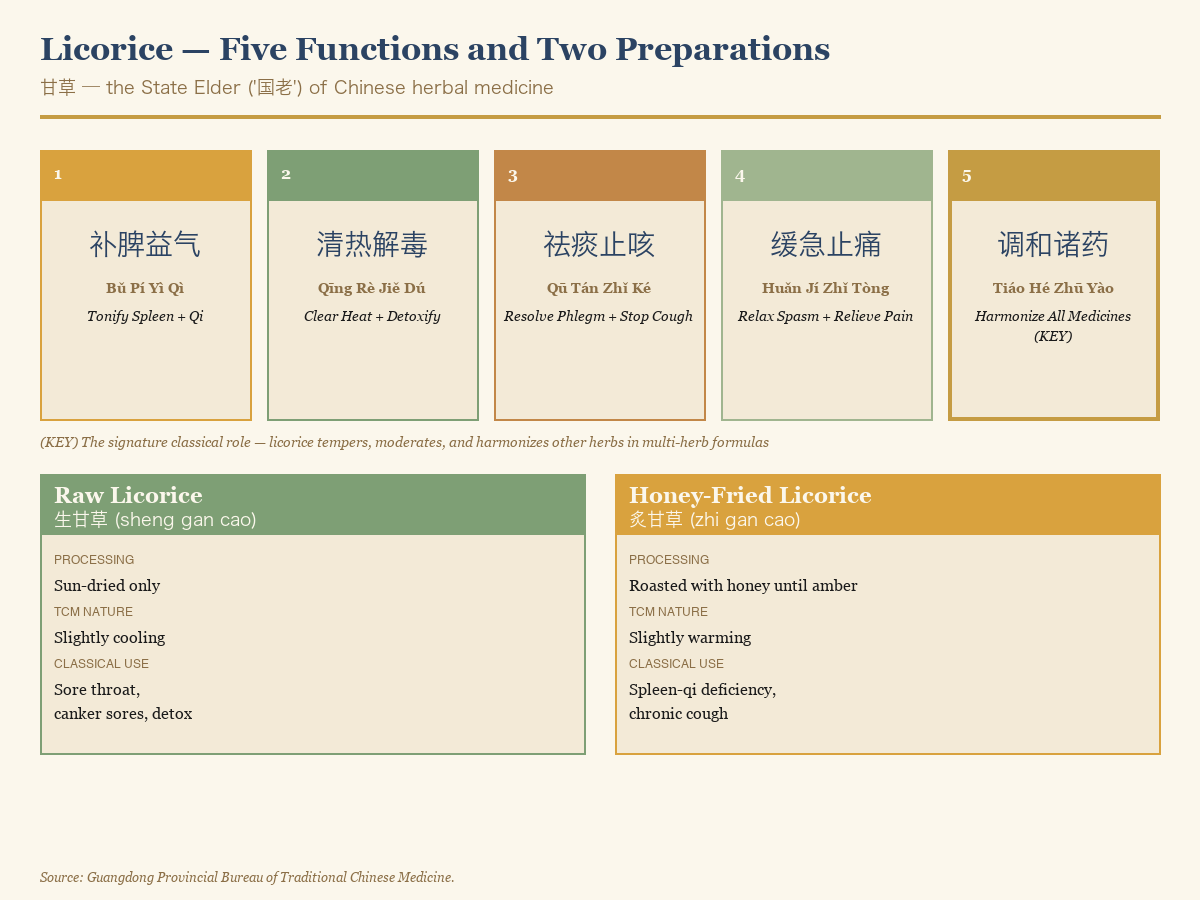
- Five traditional functions: 补脾益气 (tonify spleen + qi), 清热解毒 (clear heat + detoxify), 祛痰止咳 (resolve phlegm + relieve cough), 缓急止痛 (relax spasm + relieve pain), and 调和诸药 (harmonize all medicines)
That last function — tiáo hé zhū yào, "harmonize all medicines" — is the signature classical role. In multi-herb formulas, licorice is added not because it directly addresses the patient's chief complaint but because it moderates the temperatures, tones down toxicities, and improves the palatability of stronger herbs. A formula with a powerful purgative may include licorice to soften the effect; a formula with strong warming herbs may include licorice to prevent stomach irritation; a formula with bitter, harsh tastes is made more drinkable by licorice's sweetness. This harmonizing role is something genuinely uncommon in herbal traditions worldwide.
Raw vs Honey-Fried Licorice — Two Different Herbs in Practice
Classical TCM distinguishes two preparations of the same root — and treats them as functionally different [1]:
- Raw licorice (生甘草, sheng gan cao): sun-dried only. Considered slightly cooling. Used for sore throat, canker sores, and detoxification patterns.
- Honey-fried licorice (炙甘草, zhi gan cao): roasted with honey until amber. Considered warming. Used for spleen-qi deficiency and chronic cough patterns.
Most Western supplement labels do not make this distinction, but it matters in traditional practice — the two forms are not interchangeable.
What Does the Research Say About Licorice Root?
Modern research on licorice has examined a wide range of applications — gastrointestinal, respiratory, hepatic, oncologic, dermatologic — but the overall picture remains preliminary. NCCIH's summary is direct: "There isn't enough high-quality evidence to clearly support its use for any health condition," though preliminary findings exist for canker sores and post-intubation sore throat [2].
A 2024 systematic review and meta-analysis examined licorice formulations (alone or in combination with other herbs) in 15 randomized controlled trials covering 1,367 participants with primary liver disease [4]. The review investigated whether licorice influences liver function enzymes — a research thread that aligns with the traditional 清热解毒 (clear heat, detoxify) framing — though as with most herbal RCT corpora, methodological quality and population homogeneity remain open questions.
MSK's monograph notes that preclinical studies show antibacterial, antiviral, and anticancer activity, and that clinical data are most supportive for dyspepsia, hyperlipidemia, and topical sore-throat prevention [5]. The herb's chemistry is well characterized: glycyrrhizin (the dominant bioactive), liquiritin and liquiritigenin (flavonoids with mild estrogenic activity), and a range of isoflavones and triterpenoid saponins with anti-inflammatory effects.
The honest summary is that licorice has interesting biological activity and a long traditional record, but the modern clinical evidence base — like that for many TCM herbs — is dominated by small or methodologically uneven trials. It is reasonable to consider licorice as a culinary-medicinal ingredient with traditional context; it is harder to defend specific clinical claims at the level of evidence that supports modern conventional drugs.
The Critical Safety Topic — Pseudoaldosteronism
If there is one safety concept anyone using licorice should understand, it is licorice-induced pseudoaldosteronism. The 2021 peer-reviewed narrative review in PMC lays out the mechanism in detail [6].
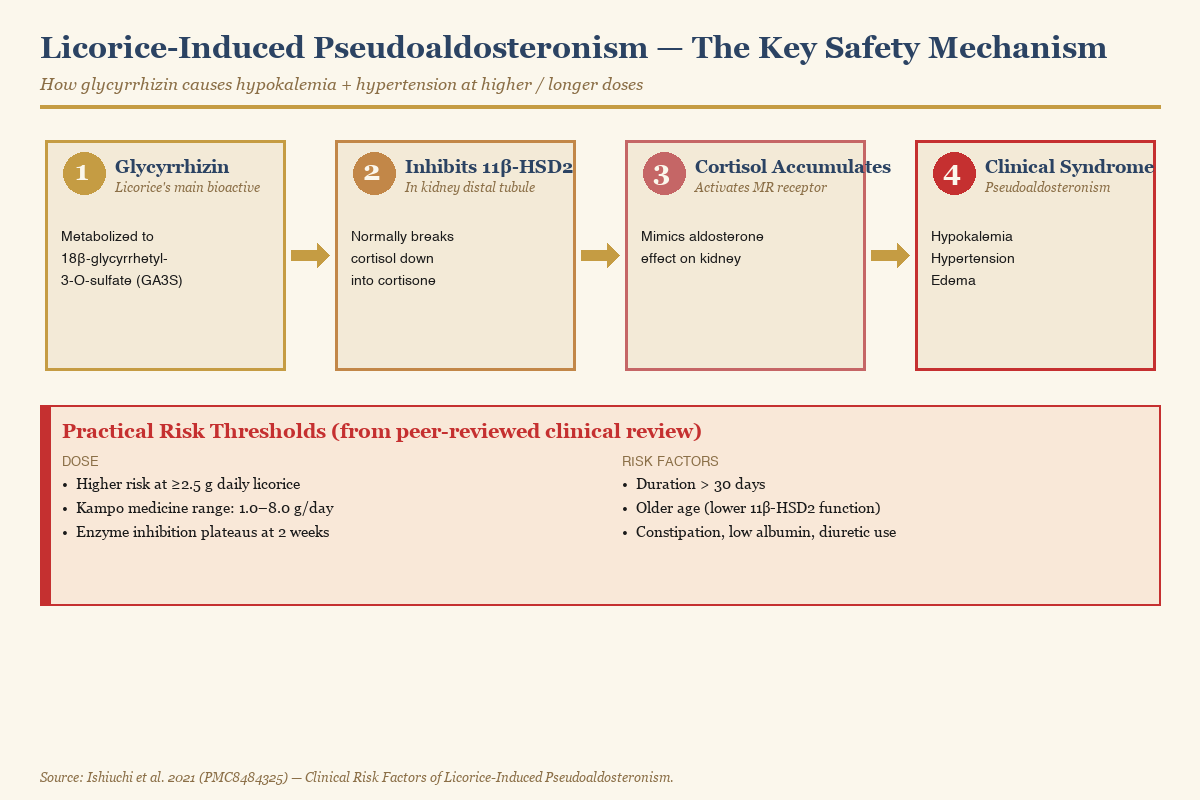
Glycyrrhizin and its metabolites inhibit the enzyme 11β-hydroxysteroid dehydrogenase type 2 (11β-HSD2). This enzyme normally breaks down cortisol into inactive cortisone in the kidneys. When the enzyme is inhibited, cortisol accumulates and activates mineralocorticoid receptors — effectively mimicking aldosterone excess. The clinical result is a syndrome that looks like primary aldosteronism: hypokalemia (low potassium), hypertension, peripheral edema, and suppressed plasma renin activity [6].
The same review identifies specific risk factors:
- Dose threshold: higher risk at licorice products containing approximately ≥2.5 g daily; Kampo medicine doses commonly span 1.0–8.0 g per day
- Duration: 11β-HSD inhibition plateaus after about 2 weeks of consistent intake — cumulative effect with long use
- Population: more than 80% of elderly patients on licorice for over 30 days develop some symptoms
- Comorbidity: older age (reduced enzyme function), constipation (increases metabolite absorption), low serum albumin (more unbound metabolite reaching tissue), and concomitant diuretic use (additive potassium loss)
NCCIH echoes the same concern in plainer language: glycyrrhizin "can cause serious adverse effects, such as irregular heartbeat and cardiac arrest, especially when consumed in large amounts or in the long term" [2]. MSK documents a case report of "severe refractory hypokalaemia with hypertensive crisis and acute pulmonary oedema" from excessive licorice consumption [5].
The good news: most cases resolve after stopping licorice, without specific treatment. The recovery time mirrors the buildup — a few weeks for the body to clear the inhibition.
Deglycyrrhizinated Licorice (DGL) — A Safer Alternative for Some Uses
Because glycyrrhizin is responsible for the pseudoaldosteronism risk, manufacturers have produced deglycyrrhizinated licorice (DGL) by removing most of the glycyrrhizin while retaining other compounds. NCCIH notes DGL products "appear safe for up to 4 months" of use [2]. DGL is often used for stomach and digestive applications where the harmonizing/coating effect is desired without the blood-pressure risk. It is not the same as raw or honey-fried licorice in TCM practice — it is a Western pharmaceutical adaptation.
How Do People Use Licorice Root?
Traditional Chinese culinary-medicinal preparations use licorice in small amounts as part of multi-herb formulas. Familiar daily uses include:
Licorice as Tea or Decoction
A small amount of dried licorice slices — typically 3 to 6 grams of raw licorice — can be steeped or simmered with other herbs such as goji, jujube, or chrysanthemum. Used alone, licorice produces a notably sweet infusion. Daily casual use should remain modest given the cumulative risk profile discussed above.
Licorice in Classical Multi-Herb Formulas
The most authentic use of licorice in TCM is as a small harmonizing addition to a multi-herb formula prepared by a practitioner. In this role, licorice typically appears at lower individual doses (1–3 g) within a larger combination, and the duration is matched to a specific pattern rather than open-ended.
Licorice Candy and Confection
Industrial licorice candy contains highly variable amounts of glycyrrhizin. Regulatory bodies in several countries have issued guidance warning consumers — particularly pregnant individuals, people with hypertension, and older adults — about regular consumption of licorice candy or "natural licorice" sweets. The FDA has historically warned that adults over 40 eating 2 ounces of black licorice daily for two weeks could land in the hospital with cardiac complications.
DGL Chewables and Capsules
Deglycyrrhizinated licorice is sold widely as a chewable tablet or capsule, typically for gastric comfort. Because the glycyrrhizin is largely removed, the pseudoaldosteronism risk is dramatically reduced — though product purity and standardization vary [2].
Individual responses vary considerably; what works well for one person may not suit another, and personal experimentation under practitioner guidance is always recommended.
Important Limitations and Considerations
- Hypertension, heart disease, kidney disease — NCCIH and MSK both flag these as primary contraindications. Even modest licorice intake can be problematic [2][5].
- Diuretic medications — Additive hypokalemia risk. People on furosemide, hydrochlorothiazide, or related medications should be cautious [5].
- Anticoagulants — MSK reports that licorice may reduce warfarin/phenprocoumon effectiveness through enzyme induction, with at least one case report of sudden INR drop [5]. The interaction direction here is unusual — for most TCM herbs, warfarin risk is increased bleeding; with licorice, it is reduced effect.
- Cardiac glycoside medications (digoxin, etc.) — Hypokalemia from licorice potentiates digoxin toxicity. This is a serious interaction [5].
- Corticosteroids — NCCIH notes potential interaction; the underlying mechanisms (cortisol metabolism) are shared, raising the risk of additive effects [2].
- Pregnancy — NCCIH cites specific evidence of concern with weekly consumption around 250 g; pregnant individuals should avoid significant licorice intake [2].
- Hormone-sensitive cancers — Liquiritin and liquiritigenin have mild estrogenic activity; consultation is advisable for those with breast, ovarian, uterine, or prostate cancer history [5].
- "十八反" classical incompatibility — The Guangdong TCM Bureau lists licorice as classically incompatible with 甘遂 (kansui), 大戟 (Peking spurge), 海藻 (sargassum / kelp), and 芫花 (lilac daphne) — meaning these should not be combined in formulas [1]. This list is mostly relevant for those using multi-herb formulas rather than single-herb supplements.
- Damp accumulation / edema patterns — Traditional TCM cautions against licorice in patients with damp-fullness pattern or existing edema, since the herb itself can promote water-sodium retention [1]. Modern pharmacology confirms this aligns with the pseudoaldosteronism mechanism.
- Duration — Even outside formal contraindications, long-term daily licorice use (more than a few weeks) should be approached cautiously and ideally under practitioner supervision.
These limitations are not meant to discourage exploration. They are the realistic context any reader deserves before forming expectations — and licorice is one of the few traditional herbs where the safety information is concrete enough that ignoring it is meaningfully risky.
Frequently Asked Questions About Licorice Root
Can I drink licorice root tea every day?
Short-term use of moderate amounts is generally well tolerated by most healthy adults, but daily long-term consumption is not recommended without medical supervision. The glycyrrhizin compound in licorice root can cause pseudoaldosteronism — a condition involving sodium retention and potassium loss — with prolonged daily use. Individual responses vary considerably, and those with hypertension, heart conditions, or kidney issues should exercise particular caution.
Does licorice root raise blood pressure?
Yes, it can. Glycyrrhizin, the primary active compound, inhibits an enzyme that regulates cortisol metabolism, leading to effects similar to elevated aldosterone. This can cause fluid retention, sodium increase, and potassium loss — all of which may elevate blood pressure. Deglycyrrhizinated licorice (DGL) formulations remove most of this compound and are considered lower risk for this effect.
What is the difference between regular licorice and DGL licorice?
DGL (deglycyrrhizinated licorice) has had the glycyrrhizin largely removed — typically to below 3%. This reduces the blood pressure and hormonal side effects associated with long-term use. DGL products are commonly marketed for digestive support. Regular licorice root retains the full glycyrrhizin content and is the form used in traditional Chinese herbal formulas.
What is licorice root used for in Traditional Chinese Medicine?
In TCM, Gān Cǎo (甘草) is one of the most frequently used herbs in classical formulas — prized as a "harmonising" ingredient that reduces the harshness of other herbs and extends their action. It is also traditionally used to support the spleen and stomach systems and to moderate toxic effects within complex formulas.
Is licorice root safe during pregnancy?
No — licorice root is generally contraindicated during pregnancy. Some research has suggested associations between high licorice consumption during pregnancy and adverse developmental outcomes. Pregnant women should avoid licorice root and consult their healthcare provider about any herbal use.
A Note on Tracking — Where Health Diary Comes In
Traditional Eastern wellness practice has always emphasized observation over time. With licorice in particular, the cumulative-effect issue makes tracking practical: a person consuming small daily amounts may not notice gradual changes until cumulative thresholds are crossed.
For someone using licorice — even in modest culinary amounts — useful things to track might include:
- Blood pressure (especially if there is any baseline elevation)
- Ankle and lower-leg swelling at the end of the day
- Energy levels and any new fatigue
- Sleep quality
- Heart rhythm awareness — palpitations or irregular pulse
- Cumulative duration of use
If any of these markers shift in a concerning direction, that is a signal to pause and check in with a healthcare practitioner — particularly with blood pressure and potassium levels.
A Soft Closing Note
Licorice sits in an interesting position in traditional Chinese herbal medicine: universally present, deeply respected, and yet one of the herbs with the clearest documented safety boundary in modern Western medicine. The classical title "国老" — State Elder — captures its harmonizing diplomatic role in formulas. The modern title might be: an old herb that requires careful dosing and attention to interactions, not a casual daily superfood.
If you are curious about traditional wellness practices, the most useful next step is usually slow learning rather than an immediate purchase. Reading reputable sources — peer-reviewed reviews, government TCM authority monographs, classical herbal texts — and observing your own patterns through journaling tend to produce better outcomes than chasing any single ingredient. For licorice especially, modest occasional use within a balanced multi-herb formula is closer to classical practice than daily concentrated supplementation.
Some people explore options like adding a small amount to a winter herbal tea as a sweetener for stronger herbs; others use DGL chewables for occasional gastric comfort. You can learn more about traditional body constitutions and seasonal wellness rhythms on our companion guides, including our overview of astragalus and angelica root — both herbs that traditionally appear alongside licorice in classical Chinese formulas.
About This Article
Written by: Health Diary Editorial Team — a small editorial group researching traditional wellness practices, herbal traditions, and quantified-self methods. Our articles draw on peer-reviewed literature, government health-agency monographs (NCCIH, NIH), academic medical centers (MSK Integrative Medicine), and primary native-language sources from Bureaus of Traditional Chinese Medicine.
Editorial review: This article has been reviewed by the Health Diary editorial team for clarity, structure, and adherence to our sourcing standards. Key claims were cross-checked against NCCIH, NIH PubMed, and LiverTox where applicable. It is not a clinical review and should not replace consultation with a licensed healthcare practitioner. When a clinical reviewer is added to this article, attribution will appear here with verifiable credentials.
Reviewed on: June 5, 2026.
Editorial process: All claims about modern evidence are linked inline to peer-reviewed publications or authoritative government or academic medical sources. The pseudoaldosteronism mechanism described in the safety section is unusually well documented for a TCM herb — we describe it in clinical detail because the dose threshold, duration threshold, and risk-factor list have practical implications for anyone using licorice. Native-language Chinese sources from Bureaus of Traditional Chinese Medicine are cited alongside English-language peer-reviewed sources to reflect both the cultural and scientific perspectives on this herb.
References
- Guangdong Provincial Bureau of Traditional Chinese Medicine (广东省中医药局). 中药"国老"甘草——解百毒、和诸药、补气虚 (TCM "State Elder" Licorice — Detoxifies, Harmonizes, Tonifies Qi). http://szyyj.gd.gov.cn/zyyfw/ysbj/content/post_3475445.html
- NCCIH. Licorice Root: Usefulness and Safety. National Center for Complementary and Integrative Health, NIH. https://www.nccih.nih.gov/health/licorice-root
- People's Daily Overseas Edition (人民日报海外版). 甘草为何称"国老" (Why is Licorice Called "State Elder"). 2020. http://paper.people.com.cn/rmrbhwb/html/2020-05/01/content_1984872.htm
- Yang R et al. Licorice and liver function in patients with primary liver disease: A systematic review and meta-analysis of RCTs. 2024. PubMed 39079711. https://pubmed.ncbi.nlm.nih.gov/39079711/
- Memorial Sloan Kettering Cancer Center. Licorice — Integrative Medicine herb monograph. https://www.mskcc.org/cancer-care/integrative-medicine/herbs/licorice
- Ishiuchi K et al. Clinical Risk Factors of Licorice-Induced Pseudoaldosteronism Based on Glycyrrhizin-Metabolite Concentrations: A Narrative Review. 2021. PMC8484325. https://pmc.ncbi.nlm.nih.gov/articles/PMC8484325/