Angelica Root (Dang Gui) in Traditional Eastern Medicine: A Beginner's Guide
Educational guide to angelica root (Angelica sinensis, 当归 Dang Gui) — classical TCM blood-tonic context, the famous Dang Gui Bu Xue Tang formula with astragalus, modern peer-reviewed research, traditional preparations, and important safety considerations (bleeding risk, hormone-sensitive cancer caution, pregnancy avoidance).
Medical Disclaimer: This content is for educational and informational purposes only and is not medical advice. The information presented is not intended to diagnose, treat, cure, or prevent any disease. Always consult a licensed healthcare practitioner before starting any new herbal practice or supplement. Statements regarding traditional herbal use have not been evaluated by the FDA.
Affiliate Disclosure: This article contains affiliate links. We may earn a commission if you purchase through these links, at no additional cost to you. We only recommend products we believe align with our editorial standards.
In English-language wellness writing, the root of Angelica sinensis is most often called by its Chinese name Dang Gui (当归) or by the older spelling dong quai. In Chinese culture, this herb carries an extraordinary cultural reputation — Guangdong Provincial Bureau of Traditional Chinese Medicine calls it "血中圣药" ("the supreme medicine for blood") and notes the classical saying 十方九归: nine of every ten traditional formulas contain dang gui [1]. This guide walks through what classical Traditional Eastern Medicine (TEM) says about angelica root, what modern peer-reviewed research has begun to suggest, how the root is traditionally prepared, and — importantly — the safety nuances that distinguish responsible use from marketing claims.
Why Angelica Root Has Endured for Two Thousand Years
Angelica root appears as a major herb in the Shennong Bencao Jing (神农本草经, Divine Farmer's Materia Medica), compiled around the first to second centuries CE. The original classical entry, quoted in modern materials by Beijing Bureau of TCM, lists the herb's traditional indications: 主咳逆上气,温疟寒热, 妇人漏下绝子,诸恶疮疡 — addressing cough and dyspnea, intermittent fevers, abnormal uterine bleeding, fertility concerns, and stubborn wounds [2].
The name Dang Gui (当归) translates literally as "should return" — interpreted in traditional poetic terms as restoring blood to its proper place, and historically associated with the return of women to health after childbirth or menstrual irregularity. Chinese culture has often called dang gui the "female sage herb" (女科之圣药), though that nickname can obscure the fact that the herb is used for both men and women in classical practice — it is a blood and circulation tonic, not a sex-specific remedy.
The species used in Chinese medicine, Angelica sinensis, is distinct from Angelica archangelica (European angelica), Angelica dahurica, and other Angelica species used in other traditions. Most English-language confusion comes from the loose use of the name "angelica."
How Traditional Eastern Medicine Views Dang Gui
Within Traditional Chinese Medicine, herbs are described along axes of taste, nature, and channel affinity. Beijing Bureau of TCM summarizes dang gui's profile as follows [2]:
- Taste and nature: sweet and pungent, warm (味甘、辛,性温)
- Channel affinity: Liver, Heart, and Spleen channels (归肝、心、脾经)
- Traditional functions: 补血调经 (tonify blood, regulate menstruation), 活血止痛 (invigorate blood, relieve pain), 润肠通便 (moisten intestines, relieve dryness-pattern constipation)
The phrase that captures how classical practitioners thought about this herb is "补血活血" — simultaneously tonifying (adding to) blood and invigorating (moving) it. In TCM theory, these are distinct categories of action, and many herbs do one but not the other. Dang gui's dual capacity is part of what made it so widely used.
Practitioners describe dang gui as suited to individuals with what classical texts called "blood deficiency" patterns — often presenting as pale complexion, fatigue, dizziness, scant or irregular menstruation, dry hair and nails, and dryness-pattern constipation. As with all tonic herbs in classical practice, dang gui is not viewed as universally beneficial — we cover the substantial list of TCM contraindications in the safety section below.
The Most Famous Dang Gui Formula — Dang Gui Bu Xue Tang
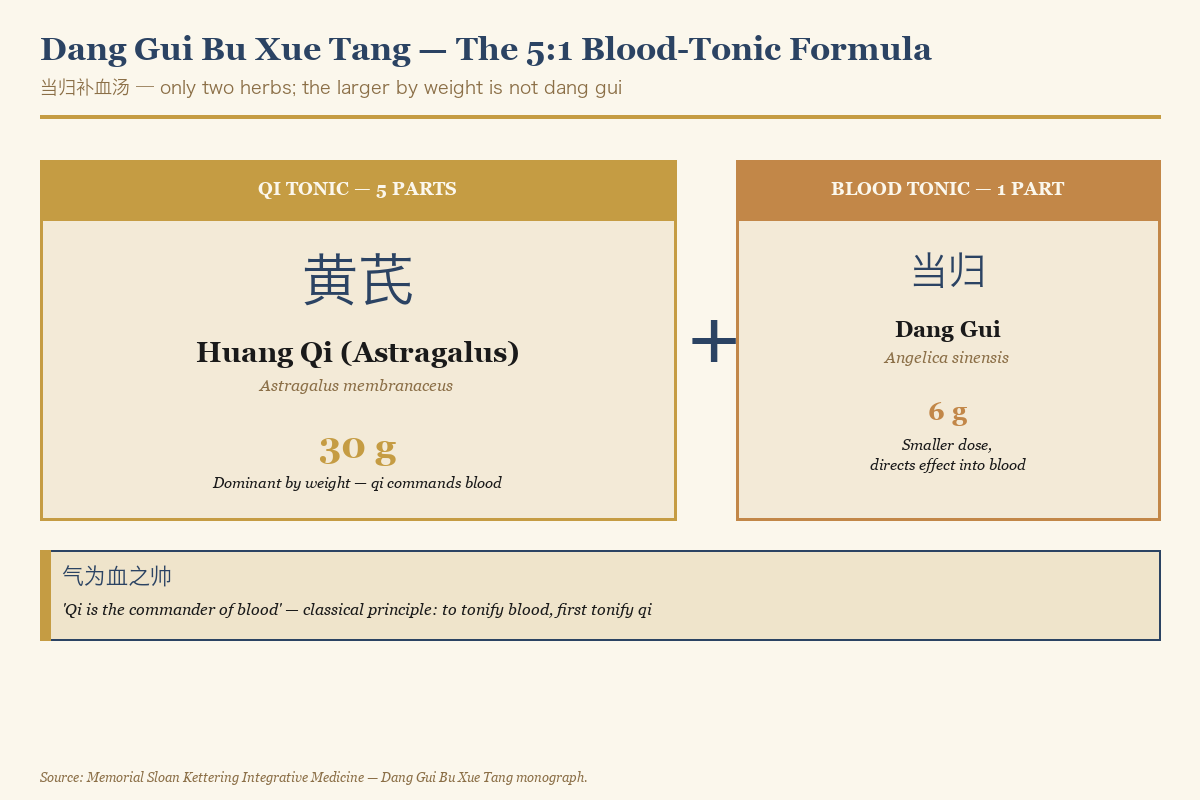
If there is one classical formula every student of Chinese herbal medicine learns first, it is Dang Gui Bu Xue Tang (当归补血汤, "Dang Gui Decoction to Tonify Blood"). Despite the name, the formula contains only two herbs — and the dominant one by weight is not dang gui at all.
According to Memorial Sloan Kettering Cancer Center's monograph on the formula [3], the classical composition pairs:
- Astragali Radix (黄芪 huang qi): the qi tonic — taken at five times the weight of dang gui
- Angelicae Sinensis Radix (当归 dang gui): the blood tonic — at one part by weight
The traditional 5:1 ratio is the formula's signature feature. Classical theory holds that "qi is the commander of blood" — so to tonify blood effectively, one must first tonify the qi that produces and moves it. The astragalus does the heavy lifting; the dang gui directs that effect into the blood. (Readers of our companion guide on astragalus will recognize the same astragalus root as the dominant herb in Yu Ping Feng San — illustrating how one herb can play very different roles depending on the formula partners.)
Modern clinical research on this formula has focused on menopausal vasomotor symptoms, anemia-related conditions, and immune function during chemotherapy [3]. MSK's evaluation is appropriately cautious: "larger studies are needed to expand the evidence surrounding DGBXT." Animal data suggest stimulation of cytotoxic T lymphocytes, natural killer cells, and iron metabolism — but as always, animal mechanism work and human clinical effect are not the same evidence tier.
What Does the Research Say About Angelica Root?
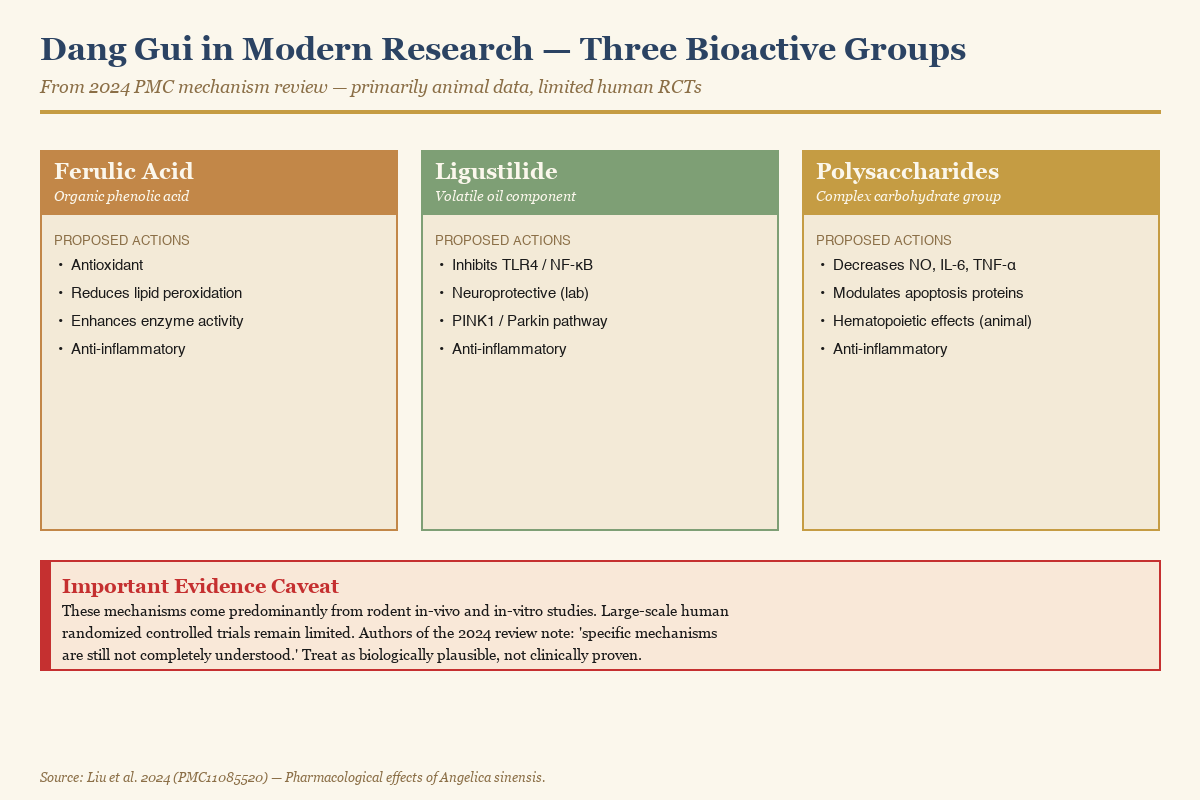
A 2024 mechanism review in PMC identifies three main bioactive groups in dang gui [4]:
- Ferulic acid, an organic phenolic compound with antioxidant activity — reduces lipid peroxidation and free-radical levels in lab models.
- Ligustilide, a volatile-oil component — appears to inhibit TLR4 and NF-κB inflammatory signaling and shows neuroprotective effects via PINK1/Parkin pathways in preclinical models.
- Polysaccharides — decrease secretion of inflammatory factors including nitric oxide, IL-6, and TNF-α, and influence apoptosis-related proteins.
The review describes a coordinated set of proposed mechanisms — anti-inflammatory (NF-κB suppression), antioxidant (SOD and GSH-Px enzyme activity), anti-apoptotic, vascular protective (NO production, endothelial cell support), and hemorheological (improved blood viscosity) — that align broadly with the traditional "blood tonic" framing.
Important caveat from the same review: the evidence is predominantly drawn from rodent in vivo and in vitro studies, with limited human clinical trials [4]. The authors directly state that "the specific mechanisms are still not completely understood" and that the field lacks large-scale randomized controlled trials. Anyone reading marketing copy that claims dang gui is a proven cardiovascular remedy in humans is reading a stronger claim than the current evidence supports.
Beyond cardiovascular work, research has also examined dang gui's effect on menstrual and menopausal symptoms — though MSK notes the menopausal-symptom evidence as "inconclusive" [5]. Hematopoietic effects (red-blood-cell production) have been studied in animal models of blood deficiency, with some evidence of erythropoietin pathway modulation, but human RCT evidence remains limited.
How Do People Use Angelica Root (Dang Gui)?
Traditional Chinese culinary-medicinal preparations are far more common in everyday use than concentrated supplement form. The Guangdong Provincial Bureau of TCM catalogues six common food-therapy preparations [1]:
Dang Gui in Soups and Broths
The most familiar preparation is a slow-simmered chicken or pork soup with a handful of dang gui slices. A common pairing is dang gui + codonopsis (党参) + jujube (红枣) + chicken, sometimes called a qi-blood tonic soup. Another is dang gui + crucian carp + goji + astragalus + ginger, often used in postpartum or winter contexts. A traditional pairing with pork kidney and longan addresses what classical sources called Heart-Spleen pattern deficiency. Soup is gentler and more food-like than concentrated decoction.
Dang Gui Tea or Infusion
A few thin slices of dang gui can be steeped in hot water alone or with goji and red dates. The infusion is mildly bitter and aromatic — distinctive but not overpowering. As with most herbs, casual tea use is closer to traditional food-medicine practice than concentrated supplement dosing.
Dang Gui Powder and Steamed Preparations
The Guangdong source notes dang gui powder taken in warm water, and dang gui mixed into steamed egg or steamed pork patty as gentle daily preparations [1]. The portions in these recipes are small — culinary, not therapeutic-decoction dosing.
Standardized Extracts and Capsules
Modern supplements deliver dang gui as standardized extract or as part of multi-herb formulas (often Dang Gui Bu Xue Tang in capsule form). As with most herbs studied in food-versus-extract comparisons, whole-root culinary use tends to be both gentler and more closely aligned with the patterns described in classical sources. Standardization between commercial extracts varies meaningfully.
Individual responses vary considerably; what works well for one person may not suit another, and personal experimentation under practitioner guidance is always recommended.
Important Limitations and Considerations
Dang gui has a longer and more consequential safety list than many tonic herbs. The most important considerations:
- Pregnancy — AVOID. MSK explicitly warns against dang gui during pregnancy due to miscarriage risk [5]. This is not a "consult your doctor" caveat — it is an avoid-entirely recommendation.
- Breastfeeding — Also flagged for avoidance in MSK's monograph [5].
- Hormone-sensitive cancers — A particularly nuanced area. MSK reports that dang gui showed estrogenic activity in vitro, including stimulating proliferation of MCF-7 breast cancer cells in lab studies, with one study showing it promoted growth of estrogen-receptor-positive breast tumors in a murine model [5]. A 2019 comprehensive review of preclinical evidence acknowledged the ongoing controversy and the conflicting in-vitro versus in-vivo signals [6]. The clinical translation is uncertain, but anyone with hormone-sensitive breast, ovarian, or uterine cancer (or history of these) should consult their oncologist before use rather than relying on supplement-marketing claims.
- Anticoagulants and antiplatelet medications — Dang gui may interact with warfarin and increase bleeding risk [5]. One documented case of subarachnoid hemorrhage has been reported in association with dang gui supplementation. This is one of the more serious adverse events documented for any common tonic herb.
- Surgery — Because of the bleeding-risk concern, discontinuation before any planned surgery is advisable. As with astragalus and ginseng, two weeks before surgery is a common practitioner recommendation.
- Photosensitivity — MSK flags photosensitivity reactions as a documented side effect [5]. Increased sun-burn susceptibility on light skin tones is a practical consequence.
- CYP450 enzyme interactions — Dang gui may influence cytochrome P450 metabolism, which can alter blood levels of various prescription medications [5]. Drug-interaction screening is worth doing if you take regular medication.
- TCM contraindicated patterns — The Guangdong TCM Bureau lists seven groups for whom dang gui is not suitable: people currently with cold or flu symptoms, those with internal heat or yin-deficient yang-excess patterns, individuals with dizziness or hypertension, women during heavy menstrual flow, pregnant women, individuals too weak to absorb tonics, and those with diarrhea/indigestion/easy bloating [1]. Beijing Bureau adds: those with high fever, heavy menstruation, or yin-deficient internal heat [2]. The pattern-based contraindication list is notably longer than English health blogs typically include.
- Common adverse effects — Appetite loss, diarrhea, and bloating are the most commonly reported [5]. Most people tolerate culinary doses well.
- Quality variability — Like all dried-root supplements, dang gui quality varies meaningfully between producers. Origin, processing, and age all matter.
These limitations are not meant to discourage exploration. They are the realistic context any reader deserves before forming expectations about a herb whose evidence base is still developing and whose drug-interaction profile is more significant than some tonic herbs.
Frequently Asked Questions About Angelica Root (Dang Gui)
Is angelica root (dang gui) safe during pregnancy?
No — dang gui is generally contraindicated during pregnancy. Traditional texts and modern herbalists both advise against its use in the first trimester, and many practitioners recommend avoiding it throughout pregnancy altogether due to its effects on uterine muscle tone. Always consult a qualified healthcare provider.
Does dang gui interact with blood thinners?
Yes. Angelica root may enhance the effects of anticoagulant medications such as warfarin, potentially increasing bleeding risk. Anyone on blood-thinning therapy should speak with their doctor before using dang gui in any form.
What is dang gui traditionally used for in Chinese medicine?
In TCM, Dang Gui (当归) is one of the most revered tonic herbs for supporting blood quality and circulation. It appears in classical formulas such as Si Wu Tang (Four Substance Decoction) and Dang Gui Bu Xue Tang, traditionally used in post-menstrual and post-illness recovery contexts.
How do people use angelica root in cooking?
In Chinese cuisine, dang gui root slices are commonly added to slow-cooked soups and broths — particularly chicken or pork-based preparations. The root imparts a distinctive warm, slightly bitter, herbal flavour. It is typically simmered for 30–60 minutes and the slices are not usually eaten directly.
Can men use dang gui too?
Yes — despite its reputation as a "women's herb" in Western herbal circles, dang gui appears in many classical TCM formulas intended for both men and women. Its traditional classification relates to blood tonification and circulation, not exclusively to female physiology. Individual suitability depends on one's constitution; consultation with a TCM practitioner is advisable.
A Note on Tracking — Where Health Diary Comes In
Traditional Eastern wellness practice has always emphasized observation over time. Classical practitioners assessed patterns — sleep, energy, menstrual regularity, complexion, digestion, sensitivity to cold, recovery from exertion. That practice maps surprisingly well onto modern habits like journaling and habit tracking.
For someone curious about dang gui, tracking a few signals over weeks is more informative than relying on day-to-day impressions. Useful things to record might include:
- Energy levels and afternoon fatigue patterns
- Menstrual cycle regularity, duration, and symptoms (for those who menstruate)
- Sleep quality and morning restfulness
- Digestion, appetite, and any bloating
- Cold tolerance and hand/foot warmth
- Skin and hair condition over time
Patterns observed across weeks tell a story that any single morning cannot. That principle is older than dang gui itself.
A Soft Closing Note
Dang gui is one of the most interesting herbs in the Chinese pharmacopeia precisely because it sits at the intersection of food and medicine — appearing in everyday soups and broths as readily as in formal clinical formulas. The "blood-supreme medicine" nickname captures a real cultural status, but the herb is also one with a non-trivial safety profile in modern Western medical contexts, particularly around bleeding risk and hormone-sensitive cancers.
If you are curious about traditional wellness practices, the most useful next step is usually slow learning rather than an immediate purchase. Reading reputable sources — peer-reviewed reviews, government TCM authority monographs, classical herbal texts — and observing your own patterns through journaling tend to produce better outcomes than chasing any single ingredient.
Some people explore options like adding a few slices to a winter soup as a small ritual; others prefer to focus first on sleep, food, and movement. You can learn more about traditional body constitutions and seasonal wellness rhythms on our companion guides, including our overview of astragalus — the qi tonic that pairs with dang gui in the classical Dang Gui Bu Xue Tang formula.
About This Article
Written by: Health Diary Editorial Team — a small editorial group researching traditional wellness practices, herbal traditions, and quantified-self methods. Our articles draw on peer-reviewed literature, government health-agency monographs (NIH, MSK Integrative Medicine), and primary native-language sources from provincial Bureaus of Traditional Chinese Medicine.
Editorial review: This article has been reviewed by the Health Diary editorial team for clarity, structure, and adherence to our sourcing standards. Key claims were cross-checked against NCCIH, NIH PubMed, and LiverTox where applicable. It is not a clinical review and should not replace consultation with a licensed healthcare practitioner. When a clinical reviewer is added to this article, attribution will appear here with verifiable credentials.
Reviewed on: June 4, 2026.
Editorial process: All claims about modern evidence are linked inline to peer-reviewed publications or authoritative government or academic medical sources. Where the evidence is preliminary, mixed, or limited — for example the cardiovascular work that is predominantly animal-data based, or the breast cancer estrogenic activity controversy — we describe it that way rather than glossing over uncertainty. Native-language Chinese sources from Bureaus of Traditional Chinese Medicine are cited alongside English-language peer-reviewed sources to reflect both the cultural and scientific perspectives on this herb.
References
- Guangdong Provincial Bureau of Traditional Chinese Medicine (广东省中医药局). "血中圣药"—当归的功效与食用禁忌,和6款养生食疗方 ("Blood-Supreme Medicine" — Dang Gui Functions, Dietary Cautions, and Six Food-Therapy Recipes). http://szyyj.gd.gov.cn/zyyfw/ysbj/content/post_4337487.html
- Beijing Bureau of Traditional Chinese Medicine (北京市中医药管理局), Gumou Hospital. 药食同源——当归 (Medicine-Food Homology: Dang Gui). 2021. https://zyj.beijing.gov.cn/sy/whkp/202108/t20210816_2469373.html
- Memorial Sloan Kettering Cancer Center. Dang Gui Bu Xue Tang — Integrative Medicine formula monograph. https://www.mskcc.org/cancer-care/integrative-medicine/herbs/dang-gui-bu-xue-tang
- Liu C et al. Research Progress in Pharmacological Effects and Mechanisms of Angelica sinensis against Cardiovascular and Cerebrovascular Diseases. 2024. PMC11085520. https://pmc.ncbi.nlm.nih.gov/articles/PMC11085520/
- Memorial Sloan Kettering Cancer Center. Dong Quai (Angelica sinensis) — Integrative Medicine herb monograph. https://www.mskcc.org/cancer-care/integrative-medicine/herbs/dong-quai
- Lau CB et al. Is Danggui Safe to be Taken by Breast Cancer Patients? — A Skepticism Finally Answered by Comprehensive Preclinical Evidence. 2019. PMC6604035. https://pmc.ncbi.nlm.nih.gov/articles/PMC6604035/