Medical Disclaimer: This content is for educational and informational purposes only and is not medical advice. It is not intended to diagnose, treat, cure, or prevent any disease. Always consult a licensed healthcare practitioner before using herbs, especially if you take medication. Statements regarding traditional herbal use have not been evaluated by the FDA.
Affiliate Disclosure: This article may contain affiliate links. We may earn a commission if you purchase through these links, at no additional cost to you. We only recommend products we believe align with our editorial standards.
Of all the herbs in the Chinese materia medica, none has a stranger origin story than cordyceps. It begins as a fungus that infects a caterpillar high on the Tibetan plateau, slowly consumes it over winter, and in summer sends a slender stalk up through the dead insect's head — hence its poetic Chinese name, "winter worm, summer grass" (冬虫夏草, dōng chóng xià cǎo; Vietnamese đông trùng hạ thảo). It is also one of the most expensive and most misunderstood tonics on earth. This guide untangles what cordyceps actually is, why wild and cultivated forms are so different, and what the evidence really says. It is part of our wider guide to Asian herbal traditions.
What Is Cordyceps?
Cordyceps is not a plant and not a worm — it is a fungus. The classic species, Ophiocordyceps sinensis, is a parasite that infects the larvae of ghost-moth caterpillars living in the soil of the Himalaya and Tibetan plateau at around 4,000–5,000 metres. The fungus overwinters inside the caterpillar (the "winter worm"), kills it, and in summer produces a small club-shaped fruiting body that pushes up out of the ground (the "summer grass") (Chinese reference, 冬虫夏草).
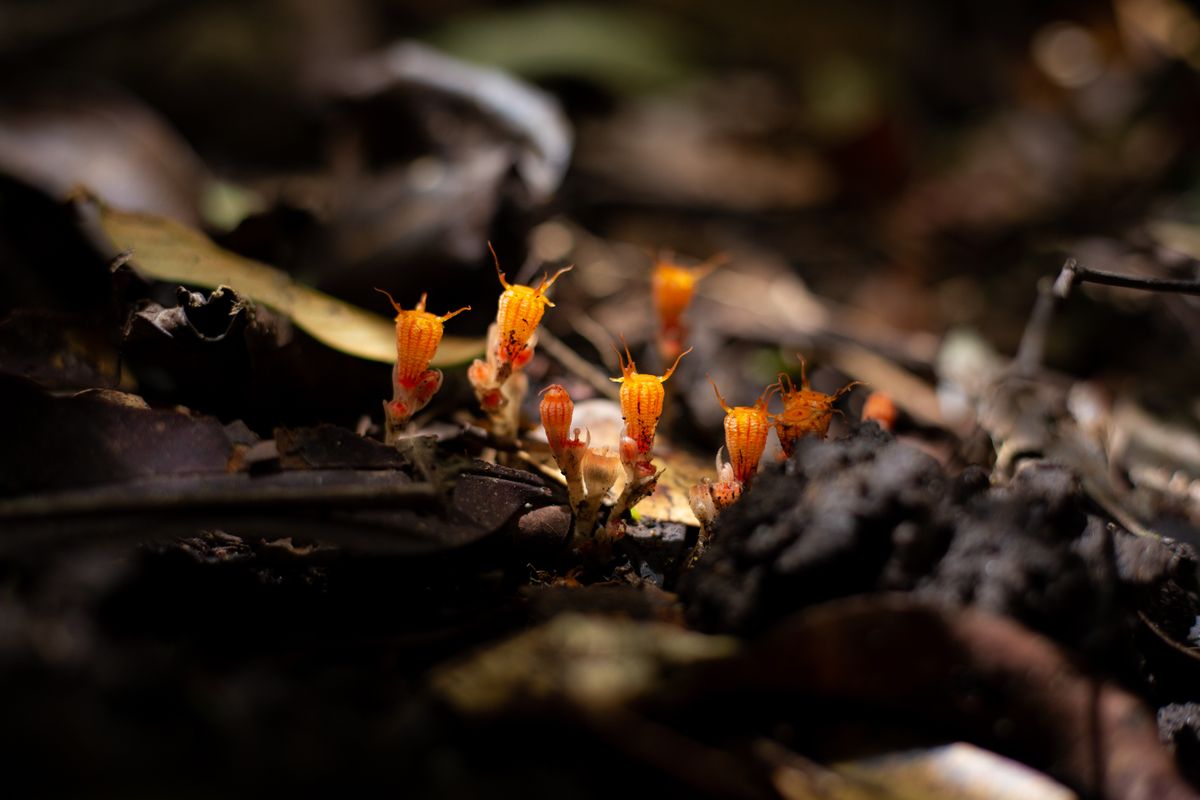
In traditional Chinese medicine this caterpillar-fungus complex is prized as a warming lung-and-kidney tonic — "bổ phế ích thận" / 补肺益肾 — used for chronic cough, fatigue, low stamina, and recovery after illness (Vinmec, đông trùng hạ thảo).
Wild, Cultivated, or Cs-4? The Three Cordyceps
This is the single most important thing to understand, and where most articles go wrong. "Cordyceps" on the market actually refers to three different things:
- Wild Ophiocordyceps sinensis — the true caterpillar fungus from the plateau. Rare, extraordinarily expensive, and impossible to fruit commercially.
- Cultivated Cordyceps militaris — a different but related species, reliably grown on grain or silkworm substrate in weeks rather than years. This is what most affordable "cordyceps" products contain.
- Cs-4 — a fermented mycelium product (the strain Paecilomyces hepiali), developed in China in the 1970s and used in much of the research (Ta et al., 2021).
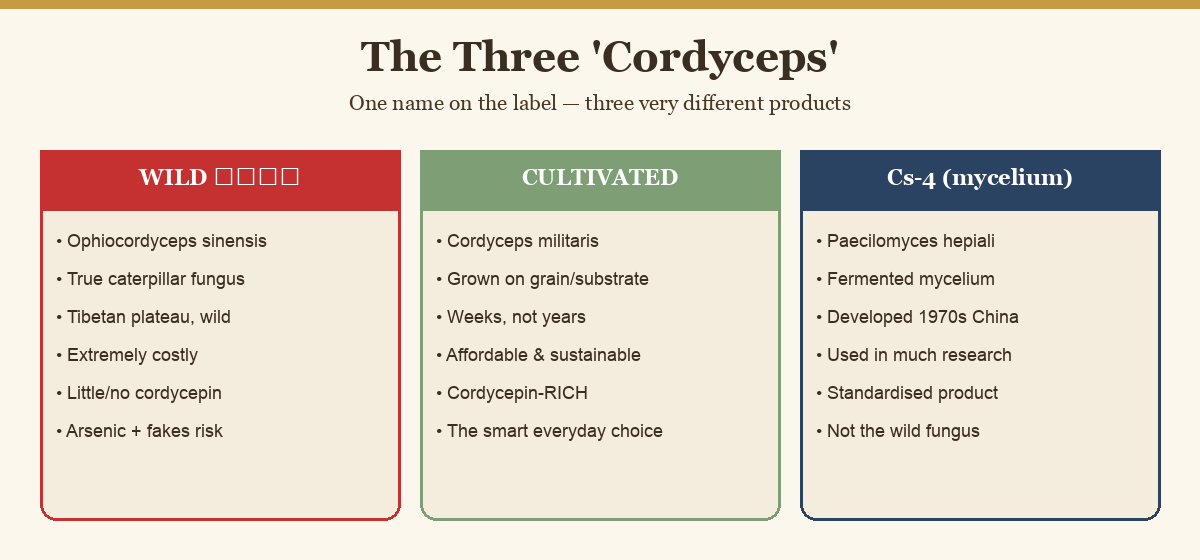
These are not interchangeable. They differ in species, chemistry, price, and the evidence behind them — so knowing which one a product actually contains matters more than the word "cordyceps" on the label.
The Cordycepin Surprise
Cordyceps is famous for a compound called cordycepin (3′-deoxyadenosine), alongside cordycepic acid (mannitol), polysaccharides, and adenosine. Here is the twist most marketing hides: wild O. sinensis actually contains little to no cordycepin — the compound is abundant in the cultivated C. militaris instead (Ta et al., 2021). So when an article touts "the power of cordycepin," it is really describing the cheap cultivated cousin, not the pricey wild caterpillar fungus. It is one of the best arguments for choosing cultivated cordyceps without guilt.
What Does the Research Say?
Cordyceps has been studied for exercise performance, fatigue, immune function, and kidney and lung health — but the human evidence is thin. Reviews of athletic performance find only small, mostly low-quality trials with mixed results, largely using C. militaris or Cs-4 rather than wild fungus (Nutrients review, 2026). Memorial Sloan Kettering's herb database likewise notes that cordyceps is generally well tolerated but that clinical evidence for its many claimed benefits remains limited (MSK, Cordyceps).
You may have heard the legend that a cordyceps tonic powered Chinese women runners to world records in 1993. Treat that as folklore, not evidence: it was never a controlled study, the performances themselves were later questioned, and several of that coach's athletes subsequently failed doping tests. Enjoy cordyceps for its tradition and interest — not as a proven performance drug. Individual responses vary considerably.
Why Wild Cordyceps Is So Expensive — and Why Cultivated Is Smarter
Wild cordyceps is among the most valuable biological commodities on earth, with top grades fetching thousands of US dollars per kilogram (Cannon et al., 2009). That value has a heavy cost: overharvesting and premature collection are degrading the fragile plateau ecosystem, the species is listed as Vulnerable, and sky-high prices fuel widespread adulteration and fakes.
There is also a genuine safety angle. Wild O. sinensis accumulates arsenic from the high-arsenic plateau soil — one analysis found total arsenic several times above typical food limits in wild material, versus far lower levels in cultivated cordyceps (Guo et al., 2018). China even removed cordyceps from its health-food list in 2016 over arsenic concerns. Between sustainability, price, fakes, and contamination, choosing tested cultivated cordyceps is usually the wiser choice — the same responsible logic that applies to dendrobium.
How to Choose Good Cordyceps
Because wild cordyceps is so valuable, the market is full of fakes, blends, and mislabelled "wild" products. A few practical pointers: favour reputable brands that state the exact species (usually Cordyceps militaris) and confirm the product is cultivated; look for third-party testing for heavy metals, especially arsenic; be sceptical of "wild Himalayan" claims at implausibly low prices; and remember that if you are after cordycepin, cultivated C. militaris is the richer source anyway. Paying a premium for the wild caterpillar fungus rarely makes practical sense for everyday wellness.
How Is Cordyceps Used?
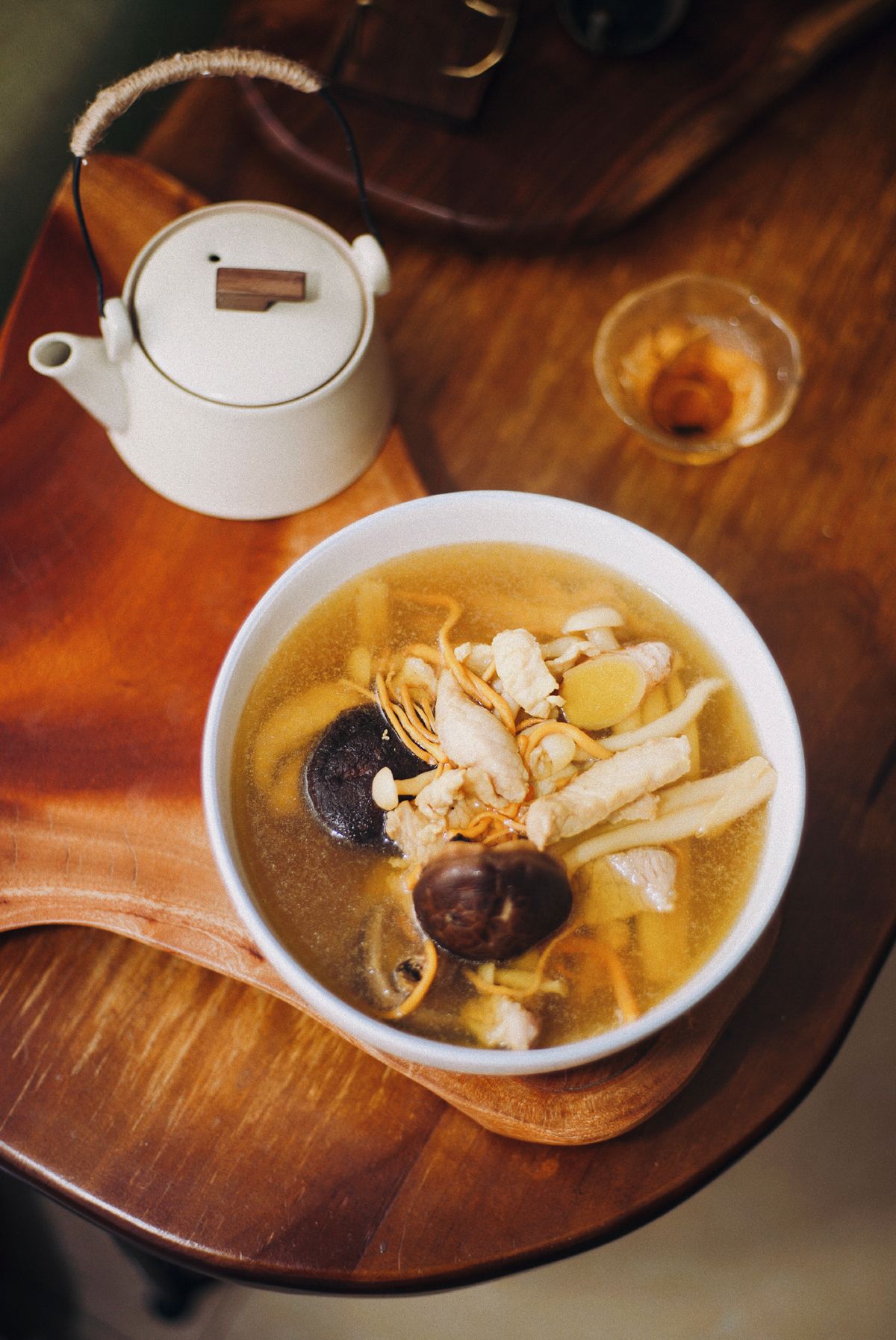
Traditionally, cordyceps is simmered in tonic soups and broths (often with chicken or duck), steeped as a tea, or taken as a powder or capsule. Vietnamese health sources suggest typical amounts around 1,000–3,000 mg of dried cordyceps a day, taken in the morning to avoid over-stimulation at night (Vinmec). For the broader tradition of tonic cooking, see our guide to traditional Asian soups and broths.
Is Cordyceps Safe?
- Generally well tolerated, with mild digestive upset the most common complaint (MSK).
- Blood thinners. Cordyceps may inhibit platelet aggregation; use caution with anticoagulant/antiplatelet drugs (a bleeding case report exists with warfarin) (MSK).
- Diabetes medication. It may add to blood-sugar-lowering effects, so monitor if you take such drugs (MSK).
- Immune conditions. Because it may stimulate the immune system, those with autoimmune disease or on immunosuppressants should be cautious (MSK).
- Pregnancy, contamination, quality. Avoid in pregnancy due to insufficient data, and buy tested cultivated products to limit arsenic and adulteration risk (Guo et al., 2018).
Frequently Asked Questions
Is cordyceps a worm or a mushroom?
A fungus. Wild cordyceps infects a caterpillar and sprouts a stalk from it — the "winter worm, summer grass" — but the medicinal material is fungal, not animal.
What is the difference between wild and cultivated cordyceps?
Wild Ophiocordyceps sinensis is the rare, pricey plateau caterpillar fungus; cultivated Cordyceps militaris and fermented Cs-4 are sustainable substitutes. Cultivated C. militaris actually contains far more cordycepin.
Does cordyceps improve athletic performance?
The evidence is weak — small, mostly low-quality trials with mixed results. The famous 1993 runners story is anecdotal, not proof.
Is wild cordyceps worth the high price?
Usually not for most people: it is often adulterated, can carry elevated arsenic, and is environmentally unsustainable. Tested cultivated cordyceps is generally the smarter choice.
Who should avoid cordyceps?
Pregnant or breastfeeding women, people on blood thinners, diabetes medication, or immunosuppressants, and anyone with autoimmune disease should consult a clinician first.
The Bottom Line
Cordyceps is one of the most fascinating and most oversold herbs in the Asian tradition — a caterpillar-infecting fungus turned luxury tonic. Once you understand the three forms, the cordycepin twist, and the real issues of price, fakes, arsenic, and sustainability, the practical takeaway is clear: skip the mystique of the wild caterpillar fungus and choose a tested, cultivated product. Enjoy it as a traditional tonic with genuinely interesting chemistry — not as a proven remedy. For more, explore our traditional wellness practices guide.
Editorial Review
Written by: Health Diary Editorial Team — writers and researchers focused on making traditional Asian wellness knowledge clear, accurate, and culturally grounded.
Editorial review: This article has been reviewed by the Health Diary editorial team for clarity, structure, and adherence to our sourcing standards. Claims were cross-checked against MSK's herb database, peer-reviewed reviews, and native-language sources; we take particular care to separate wild O. sinensis, cultivated C. militaris and Cs-4, and to flag the arsenic and sustainability issues. It is not a clinical review and should not replace consultation with a licensed healthcare practitioner.
Reviewed on: August 5, 2026.
References
- Memorial Sloan Kettering. About Herbs — Cordyceps. https://www.mskcc.org/cancer-care/integrative-medicine/herbs/cordyceps
- Ta A, Zhang W-H, Xu Q. Cultivated Cordyceps: A Tale of Two Treasured Mushrooms. Chinese Medicine and Culture. 2021. https://kclpure.kcl.ac.uk/portal/en/publications/cultivated-cordyceps-a-tale-of-two-treasured-mushrooms/
- Guo L-X, et al. Novel Arsenic Markers for Discriminating Wild and Cultivated Cordyceps. Molecules. 2018. https://pmc.ncbi.nlm.nih.gov/articles/PMC6278644/
- Current Evidence of Ergogenic and Post-Exercise Recovery Effects of Cordyceps militaris in Humans — A Narrative Review. Nutrients. 2026. https://www.mdpi.com/2072-6643/18/5/781
- Cannon PF, et al. Steps towards sustainable harvest of Ophiocordyceps sinensis in Bhutan. Biodiversity and Conservation. 2009. https://link.springer.com/article/10.1007/s10531-009-9587-5
- 冬虫夏草 — 中文维基百科 (winter worm summer grass; cordycepin note; 2016 arsenic warning). https://zh.wikipedia.org/wiki/冬虫夏草
- Đông trùng hạ thảo: lưu ý khi sử dụng — Vinmec. https://www.vinmec.com/vie/bai-viet/dong-trung-ha-thao-luu-y-khi-su-dung-de-tranh-cac-tac-dung-phu-vi