

Traditional Asian Herbal Teas: The Complete Guide to Tea & Tisane
A complete guide to the traditional herbal teas and tisanes of China, Japan, Korea, and Vietnam — their history, key varieties, preparation, and what research suggests.
Medical Disclaimer: This content is for educational and informational purposes only and is not medical advice. It reflects traditional Chinese, Japanese, Korean, and Vietnamese cultural practices and folk wellness traditions and is not intended to diagnose, treat, cure, or prevent any disease. Always consult a licensed healthcare practitioner before starting any new herbal practice, dietary change, or supplement. Statements regarding traditional tea use have not been evaluated by the FDA.
Affiliate Disclosure: This article may contain affiliate links. We may earn a commission if you purchase through these links, at no additional cost to you. We only recommend products we believe align with our editorial standards.
Across East and Southeast Asia, a warm cup has meant far more than a drink. For nearly two thousand years, tea has been a medicine cabinet, a social ritual, a marker of hospitality, and a quiet daily pause. From the misty tea gardens of the Chinese south to the whisked bowls of a Japanese ceremony, the roasted-barley pots of a Korean kitchen, and the lotus-scented cups of Hanoi, the region has produced one of the richest tea cultures on earth.
This guide is the hub for our whole collection of Asian tea writing. It maps the big picture — what these teas actually are, where they came from, how the four great traditions differ, what modern research does and does not say, and how they are prepared — then points you toward deeper guides on individual teas. Think of it as a doorway rather than a destination.
What Counts as a "Traditional Asian Herbal Tea"?
The first thing worth clearing up is a naming habit that confuses almost everyone. In everyday English, we call anything steeped in hot water "tea." Botanically, that is not quite right — and the distinction shapes everything else in this article.
True tea comes from a single plant: Camellia sinensis. Green, white, yellow, oolong, black (called "red tea" in China), and dark teas such as pu-erh are all the same species. What separates them is processing — how much the leaf is withered, oxidised, and fired — not what plant they come from. True teas naturally contain caffeine, catechins (including EGCG), and an amino acid called L-theanine.
A herbal "tea" is more accurately a tisane or infusion: any drink steeped from a plant that is not Camellia sinensis — a flower, root, seed, fruit, or leaf. Chrysanthemum, goji berry, roasted barley, artichoke, and citron all make tisanes. As the Cleveland Clinic puts it plainly, herbal teas are made from herbs, spices, and other plants and differ from true teas, so different herbs carry different traditional uses (Cleveland Clinic, herbal teas). Most tisanes are naturally caffeine-free.
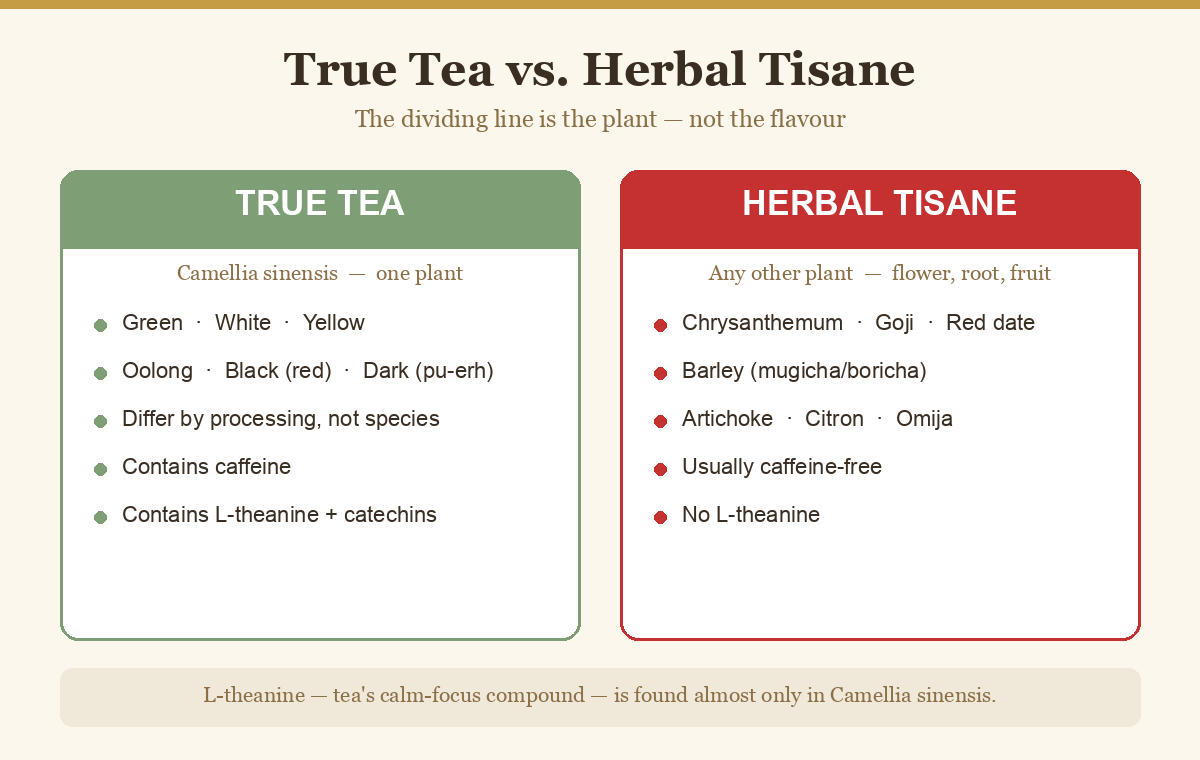
Here is the nuance most articles miss: L-theanine — the compound behind tea's famous "calm alertness" — is found almost only in Camellia sinensis. So the relaxed-yet-focused feeling associated with green tea, matcha, or genmaicha comes from the tea plant itself and cannot be assumed for a caffeine-free flower or barley tisane. Keeping the two families straight makes the rest of the region's tea culture far easier to understand. For a country-by-country overview in a shorter format, our traditional Asian herbal teas guide is a companion to this hub.
Where Did Asia's Tea Traditions Begin?
Chinese legend credits the mythical emperor Shennong (神农) with discovering tea when a leaf drifted into his boiling water. Whatever the truth of the story, it captures a real historical arc: tea began as a medicinal and ritual plant and slowly became a cornerstone of everyday culture.
The turning point was the Tang dynasty, when the scholar Lu Yu wrote the Cha Jing (茶经, "The Classic of Tea") around 760–780 CE — the world's first monograph devoted to tea. It codified how tea was grown, processed, brewed, and appreciated, and it drew tea decisively into the realm of art and philosophy (Lu Yu, Cha Jing). Chinese-language scholarship notes that the three-volume, ten-chapter text distilled tea knowledge from dozens of earlier classics — including medicinal and health uses — and expressed an ethic of "disciplined, frugal virtue" (精行俭德) (Song Shilei, 2023).
From China, tea travelled. The Japanese monk Eisai returned from Song China in 1191 with tea seeds and the powdered-tea (碾茶, tencha) method, and in 1211 wrote Kissa Yōjōki (喫茶養生記, "Drinking Tea for Health"), Japan's first tea treatise, which framed tea as a medicine nourishing the body's organs and famously called it an "elixir of life" (CHANOYU, Kissa Yōjōki). Korea received tea during the Three Kingdoms and Silla periods, where it grew into Buddhist ritual and later the Confucian etiquette of darye (Encyclopedia of Korean Culture). Vietnam, meanwhile, developed a deep indigenous green-tea (chè) culture of its own. You can follow each thread in our dedicated pillars on Chinese herbal traditions, Japanese herbal traditions, Korean herbal traditions, and Vietnamese herbal traditions.
China — The Fountainhead of Tea and Tisane
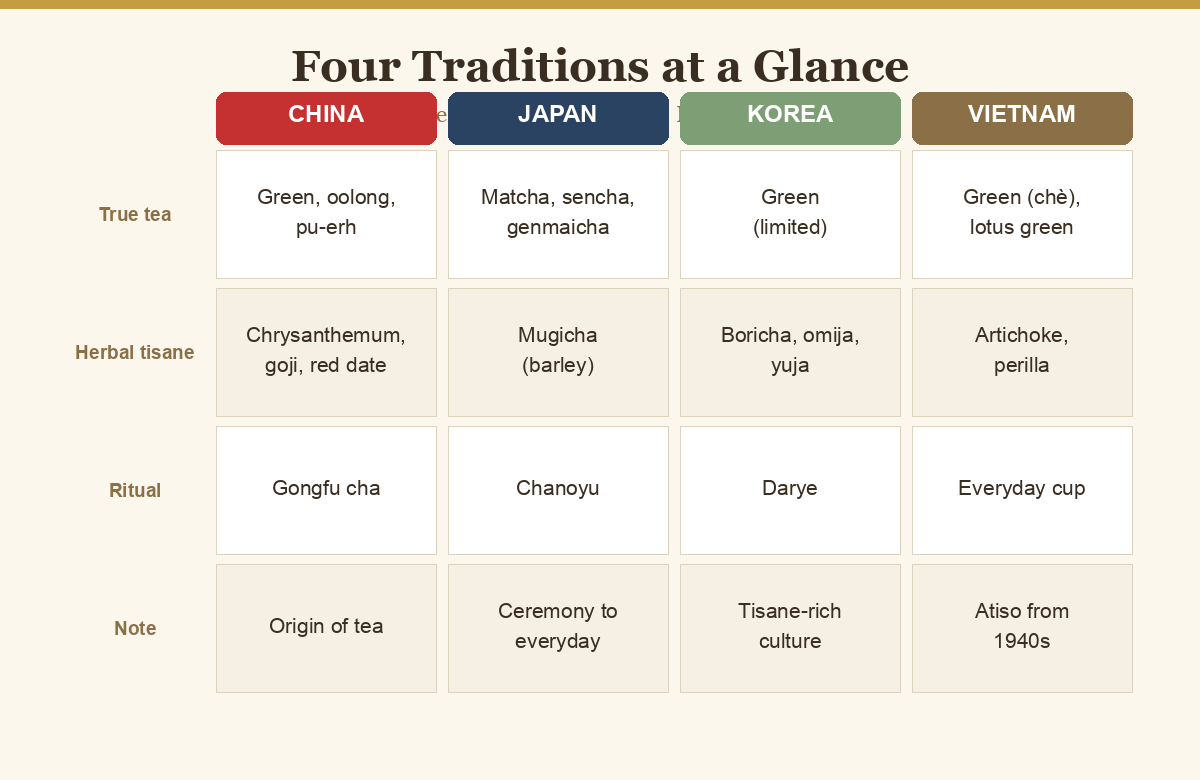
China is where both families begin. It gave the world true tea — the green, oolong, and dark teas still central to daily life — and an equally vast tradition of flower, fruit, and root tisanes woven into the logic of traditional Chinese wellness. Many of these tisanes are understood through the lens of yin and yang and the five elements, with drinks classified as "warming" or "cooling" rather than by vitamins.
On the true-tea side alone, Chinese variety is staggering: fresh, grassy green teas from Zhejiang and Anhui; fragrant, half-oxidised oolongs from Fujian and Guangdong; and earthy, aged dark teas such as pu-erh from Yunnan, prized for mellowing over years of storage. These are the teas most often brewed in the attentive, many-infusion style described later in this guide. But it is the tisane tradition — the "flower and fruit teas," or huācháo — that gives Chinese tea culture its everyday, homemade character, and it is where the region's herbal imagination is most visible.
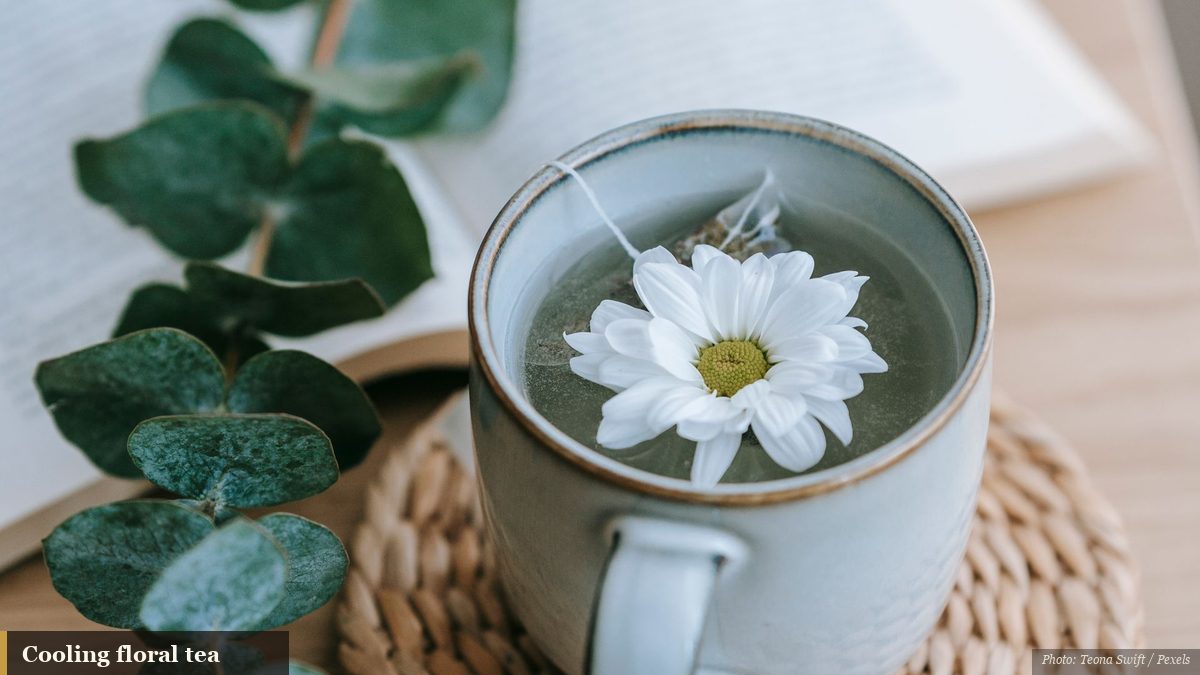
Among the best-loved Chinese tisanes are chrysanthemum flower tea (菊花茶), traditionally sipped as a "cooling" summer drink; its phytochemistry and long history in Chinese practice are reviewed in the botanical literature (Shahrajabian et al.). Equally iconic is goji berry tea (枸杞), the ruby-red infusion whose carotenoids and polysaccharides have drawn preclinical research interest (Lycium barbarum review, 2024), along with red date (jujube) tea, the colour-shifting butterfly pea flower tea, warming ginger tea, and delicate lotus tea. For a deeper dive on two staples, see our complete guide to goji berry and complete guide to ginger, or the beginner's overview of chrysanthemum in traditional Eastern medicine.
One drink beautifully blurs the tea-versus-tisane line: eight-treasure tea (八宝茶, ba bao cha), a Northwestern speciality that combines green tea with dried flowers, fruit, nuts, and rock sugar in a single lidded cup. It is a reminder that, in real kitchens, the boundary between "tea" and "herbal infusion" is a spectrum, not a wall.
Japan — From Ceremony to Everyday Cup
Japan took the Chinese tea seed and grew a culture of remarkable refinement around it. At the pinnacle sits matcha, the stone-ground powdered green tea whisked into the meditative Japanese tea ceremony (茶の湯, chanoyu). But everyday Japanese tea life is broad and unpretentious.
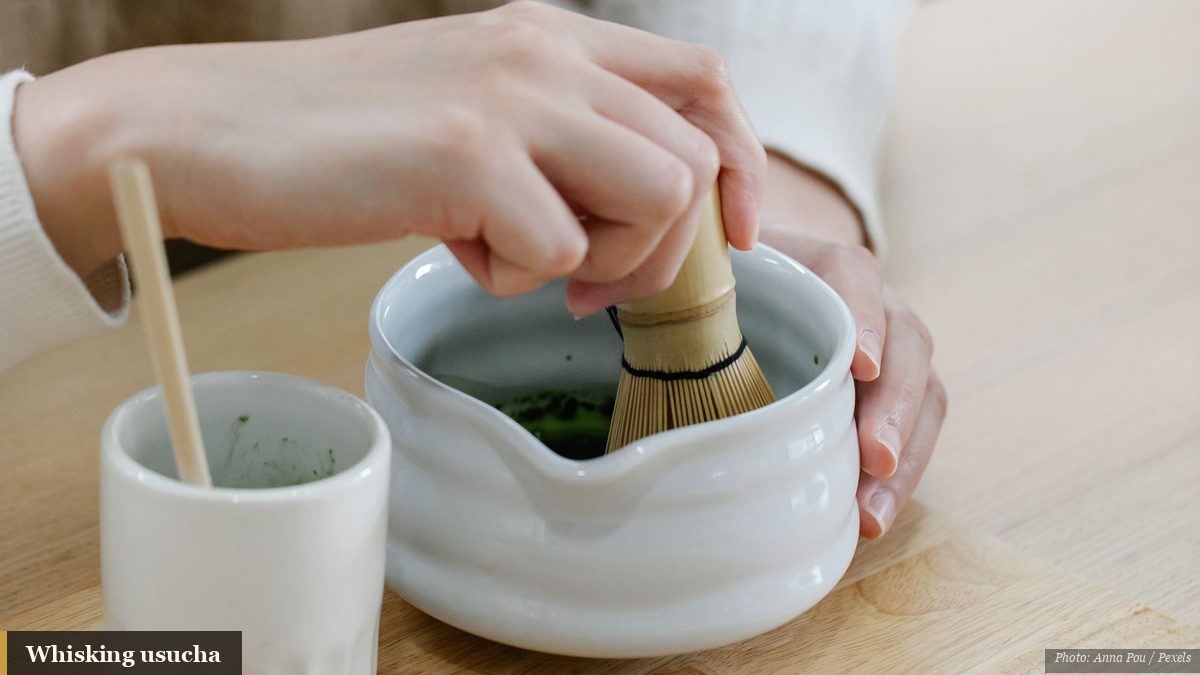
Most Japanese true teas are green and steamed rather than pan-fired. Sencha is the everyday staple; genmaicha blends green tea with toasted brown rice for a nutty cup; kukicha is brewed from stems and twigs; and hojicha is roasted until amber and low in caffeine, making it a popular evening choice — our complete guide to hojicha and hojicha versus green tea comparison go further. It is worth flagging that genmaicha, kukicha, and matcha are all still true teas — they contain caffeine and L-theanine despite their roasted or grainy character.
Japan also drinks genuine tisanes. Mugicha (麦茶), a roasted-barley infusion served ice-cold in summer, is caffeine-free and gentle enough to be a household drink for children and expectant mothers alike. The whole story of Japan's tea plant, from Eisai's era onward, sits within our Japanese herbal traditions pillar, and the ceremony's mindful roots connect to the meditation traditions of Asia.
Korea — Grains, Citron, and the Way of Tea
Korea's tea story has a distinctive twist. Because cultivation of the tea plant was limited and, in some eras, discouraged, Korea developed an unusually rich culture of non-Camellia infusions — a "tea tradition without much tea plant," documented in Korean-language scholarship (Encyclopedia of Korean Culture). Our Korean tea culture guide covers this landscape in detail.
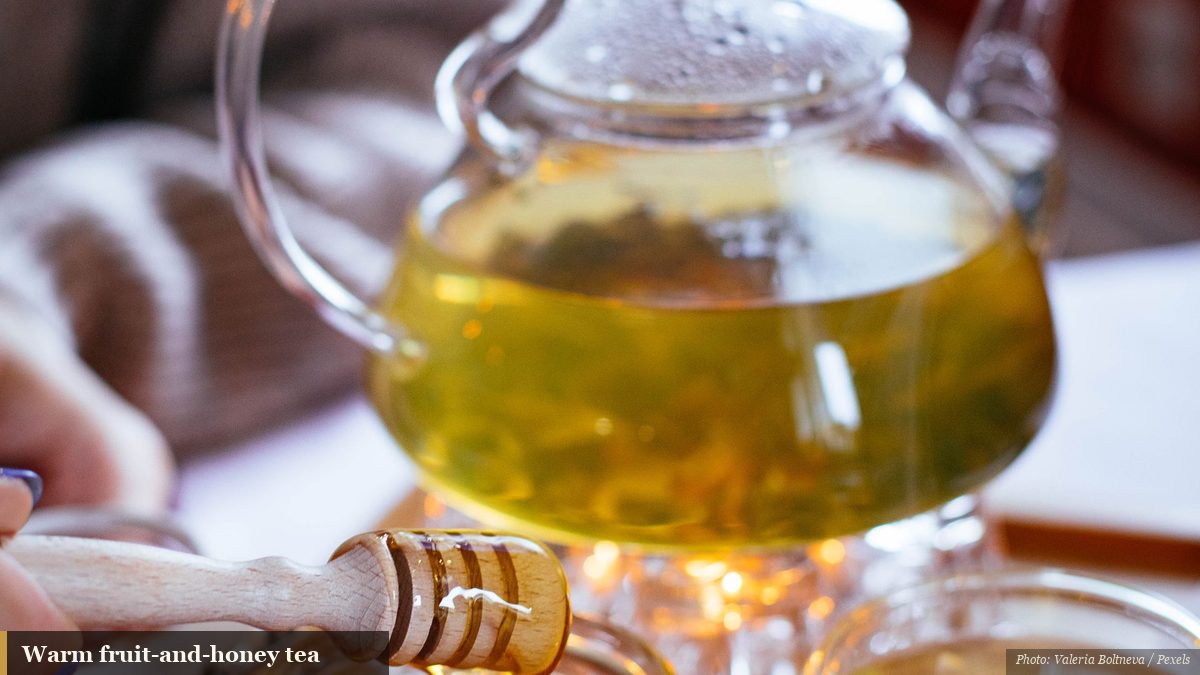
The everyday Korean cup is often boricha (보리차), a roasted-barley tisane so common it frequently replaces plain water at the table — caffeine-free and mild. In winter, many families reach for yuja-cha (유자차), a fragrant citron marmalade stirred into hot water, described more fully in our look at yuja as a Korean winter citron. Another signature is omija tea (오미자차), brewed from the "five-flavour" schisandra berry that tastes sweet, sour, bitter, salty, and pungent at once. Overlaying all of it is darye (다례), the Korean "tea rite" that prizes simplicity, moderation, and respect.
Vietnam — Lotus, Artichoke, and Everyday Herbal Cups
Vietnam pairs an ancient, everyday green-tea habit with a small collection of beloved herbal cups, all part of the wider Vietnamese herbal tradition. At the refined end is trà sen, lotus-scented green tea layered with fresh lotus stamens — historically a labour-intensive luxury associated with Hanoi.
The most surprising entry is Vietnamese artichoke tea (trà atiso). Unlike the millennia-old Chinese and Japanese lineages, artichoke arrived with the French in the 1940s and flourished in the cool highlands around Đà Lạt. A Vietnamese provincial health-department source notes the plant's flavonoids, such as apigenin and luteolin, and its traditional association with liver and digestive wellness (Bắc Giang Dept. of Health). Rounding out the everyday repertoire is perilla leaf tea (tía tô), a fragrant herbal infusion common in Vietnamese homes.
What Does Modern Research Say About Tea and Tisanes?
This is where care matters most. Traditional use is a cultural record, not a clinical result — and the science, while genuinely interesting, is more modest than marketing suggests.
Tea polyphenols (EGCG and catechins). Reviews describe green-tea polyphenols as active antioxidant and anti-inflammatory compounds, and population studies have associated regular tea drinking with lower rates of some metabolic and cardiovascular conditions (Khan & Mukhtar, 2018). Mechanistic work maps how EGCG behaves in the body (IJMS, 2023). The key caveat: these are associations and mechanisms, not proof that a cup of tea changes health outcomes.
L-theanine and caffeine (the true-tea combination). The best-supported functional finding is that L-theanine together with caffeine may modestly improve attention and mood, with the effect strongest a couple of hours after drinking. A 2025 systematic review and meta-analysis of randomised trials reached exactly this conclusion — while stressing that effects are small, sleep evidence is inconclusive, and trial doses often exceeded what a single cup provides (Payne et al., 2025). Earlier reviews of green tea and cognition point the same direction and credit a synergy of constituents rather than any single compound (Mancini et al., 2017), and a small trial in older adults with mild cognitive difficulty found a green-tea-plus-L-theanine supplement helped memory and attention (Park et al., 2011).
Herbal tisane compounds. Chrysanthemum, goji, and artichoke show antioxidant and organ-specific signals largely in laboratory and small human studies; they are part of long wellness traditions but are not established clinical therapies (chrysanthemum review). Read this whole area with the words "may," "preliminary," and "associated with" firmly in mind. Individual responses vary considerably; what one person notices, another may not.
One distinction is worth carrying through all of it: a brewed cup is not a concentrated extract. Much of the alarming — and much of the miraculous — language online actually refers to high-dose supplements and standardised extracts, not to a pot of tea. Memorial Sloan Kettering draws this line explicitly, noting that green tea as a beverage is generally well tolerated while concentrated extracts behave quite differently and carry greater risk (MSK, Green Tea). When you read a study or a headline, it is always worth asking whether it looked at a drink or a capsule, because the answer changes what it means for your afternoon cup.
How Are These Teas Traditionally Prepared?
Preparation is where Asian tea culture becomes an art. Each tradition turns brewing into a form of attention that many people find as valuable as the drink itself, echoing the calm of the region's relaxation tea traditions and tea rituals.
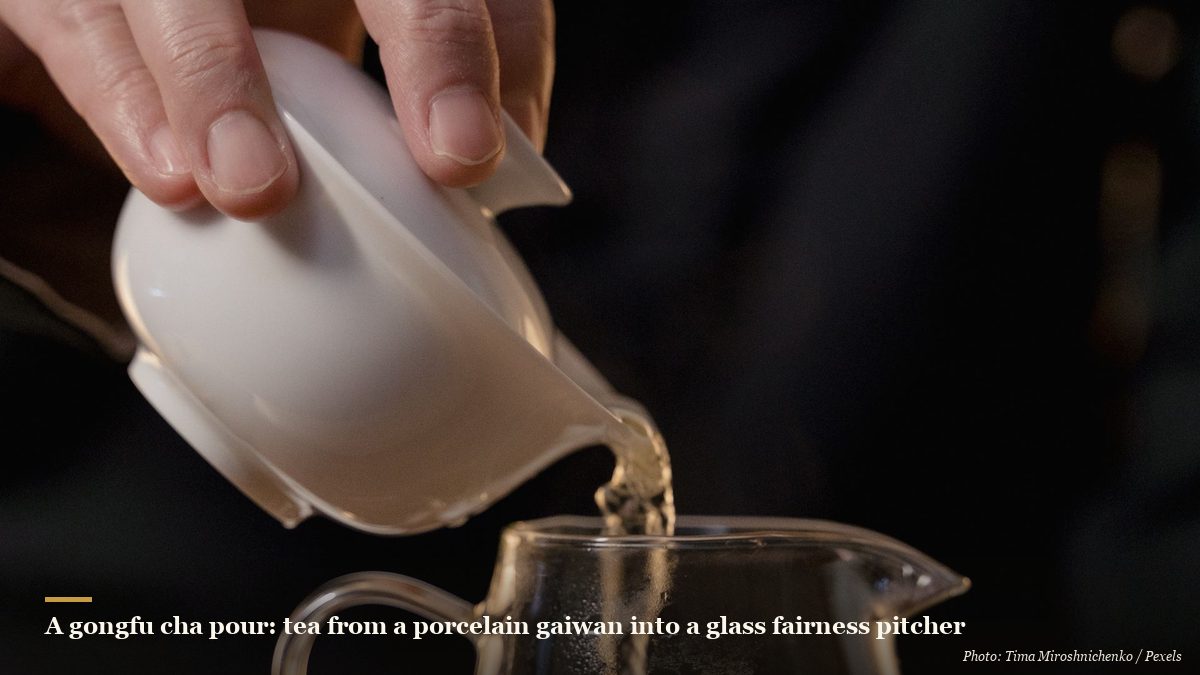
In China, gongfu cha (功夫茶, "tea made with skill and effort") uses a small pot or gaiwan, a high ratio of leaf to water, and many short, successive infusions, so drinkers can follow how a tea's flavour evolves cup by cup. In Japan, chanoyu (茶の湯) turns whisked matcha into a choreographed ceremony rooted in Zen, organised around harmony, respect, purity, and tranquillity. In Korea, darye (다례) emphasises simplicity and moderation, appreciating tea with all five senses. Everyday brewing is humbler — a handful of chrysanthemum flowers or a spoon of citron marmalade in a mug — but the underlying idea of a mindful pause carries through, as our guide to daily herbal tea rituals and the seasonal cups in our Asian herbal tea culture guide both show.
If you are brewing at home, a few gentle rules of thumb travel across most of these traditions. Delicate green teas such as sencha are happiest with water well below boiling — roughly 70–80°C — since scalding water can turn them bitter; a brief steep of one to two minutes is usually plenty. Roasted and stalk teas such as hojicha and kukicha, and most robust tisanes such as chrysanthemum, goji, or barley, are more forgiving and take hotter, longer steeps. Whisked matcha is a category of its own, sifted and beaten with a bamboo whisk rather than steeped. None of this needs special equipment to start — a mug, a strainer, and a little attention are enough. Individual experiences vary considerably; the "right" method is simply the one you enjoy returning to.
Important Limitations and Considerations
Even a gentle cup deserves a few honest cautions.
- Caffeine varies widely. Matcha delivers the most caffeine per serving, followed by other green teas, while tisanes such as mugicha, boricha, chrysanthemum, and artichoke are naturally caffeine-free. If you are sensitive, lean toward the tisanes or roasted teas such as hojicha.
- Documented medication interactions. Green tea can lower the blood levels and effectiveness of certain drugs, including the beta-blocker nadolol and the statin atorvastatin, according to NCCIH (NCCIH, Green Tea). If you take prescription medicine, check with a pharmacist first.
- Beverage is not the same as extract. Memorial Sloan Kettering notes that brewed green tea is generally well tolerated, but concentrated green-tea extracts and supplements are far stronger and carry rare liver signals and greater interaction risk (MSK, Green Tea).
- Pregnancy and breastfeeding. Health authorities suggest keeping total daily caffeine within recommended limits during pregnancy, and some catechins may compete with folate absorption, so space true tea away from prenatal vitamins and speak with your provider.
- "Natural" is not the same as risk-free. Berries such as goji and schisandra have their own interaction profiles, and herb quality varies by source.
Frequently Asked Questions
Is herbal tea real tea?
Not in the botanical sense. Only drinks made from Camellia sinensis — green, white, oolong, black, and dark teas — are "true tea." Herbal teas such as chrysanthemum, goji, or barley are more accurately called tisanes or infusions, because they come from other plants entirely (Cleveland Clinic).
Are Asian herbal teas caffeine-free?
The tisanes usually are — mugicha, boricha, chrysanthemum, artichoke, and citron teas contain no caffeine. But true teas such as green tea, sencha, matcha, and lotus-scented green tea do contain caffeine, with matcha among the highest per serving.
What is the healthiest Asian tea?
There is no single "healthiest" cup. Green tea has the most research behind it, thanks to its polyphenols and L-theanine, but the best choice depends on your goals, your caffeine tolerance, and simple enjoyment. A caffeine-free tisane may suit an evening far better than a strong matcha. Individual responses vary considerably.
What does L-theanine actually do?
L-theanine is an amino acid found almost only in the tea plant. Studies suggest that, paired with caffeine, it may produce a modest, short-lived improvement in attention and a calmer sense of focus (Payne et al., 2025). Because it is nearly unique to Camellia sinensis, caffeine-free herbal tisanes do not provide it.
Can I drink green tea while pregnant?
Many people enjoy green tea in moderation during pregnancy, as long as total daily caffeine stays within recommended limits. Because catechins may affect folate absorption, it is wise to separate tea from prenatal vitamins and to confirm your plan with your healthcare provider.
Does green tea interact with medications?
It can. NCCIH documents reduced effectiveness of the beta-blocker nadolol and the statin atorvastatin among tea drinkers, and concentrated extracts pose a higher risk than a brewed cup (NCCIH). If you take any prescription medication, ask a pharmacist before making tea a daily habit.
A Note on Tracking Your Tea Practice
One of the quiet pleasures of tea is how naturally it becomes a rhythm — a morning green tea, an afternoon chrysanthemum cup, a roasted hojicha before bed. If you enjoy noticing patterns, a simple daily note on which teas you reach for, and how each afternoon feels, can turn casual drinking into a gentle self-study. Our reader quiz can help you find where to start, and our guides to bedtime herbal teas, cooling herbal teas, and seasonal cups for spring, summer, autumn, and winter can point you toward the right cup for the moment.
A Soft Closing Note
The tea traditions of China, Japan, Korea, and Vietnam were never really about a single miracle leaf. They are about attention, hospitality, and the small daily ritual of pausing to make something warm with care. Whether you are drawn to the discipline of gongfu cha, the serenity of chanoyu, the everyday comfort of a barley tisane, or the fragrance of lotus green tea, the invitation is the same: slow down, taste closely, and let a familiar cup become a small anchor in the day. To keep exploring, wander into our country-by-country tea map, our ginseng tea preparation guide, or the wider world of Asian food therapy and healthy aging traditions.
About This Article
Written by: Health Diary Editorial Team — writers and researchers focused on making traditional Asian wellness knowledge clear, accurate, and culturally grounded.
Editorial review: This article has been reviewed by the Health Diary editorial team for clarity, structure, and adherence to our sourcing standards. Key claims were cross-checked against NCCIH, NIH PubMed, Memorial Sloan Kettering, and peer-reviewed reviews where applicable. It is not a clinical review and should not replace consultation with a licensed healthcare practitioner.
Reviewed on: August 3, 2026.
Editorial process: We cite peer-reviewed and government sources where possible, and we present traditional practices as cultural and historical knowledge rather than medical advice. When a clinical reviewer is added to this article, attribution will appear here with verifiable credentials.
References
- Khan N, Mukhtar H. Tea Polyphenols in Promotion of Human Health. Nutrients. 2018;11(1):39. https://pubmed.ncbi.nlm.nih.gov/30585192/
- Payne ER, Aceves-Martins M, Dubost J, Greyling A, de Roos B. Effects of Tea or l-Theanine plus Caffeine on Cognition, Sleep, and Mood: A Systematic Review and Meta-Analysis of RCTs. Nutrition Reviews. 2025;83(10):1873. https://academic.oup.com/nutritionreviews/article/83/10/1873/8123998
- Mancini E, et al. Green tea effects on cognition, mood and human brain function: A systematic review. Phytomedicine. 2017. https://www.sciencedirect.com/science/article/abs/pii/S0944711317300867
- Park SK, et al. A combination of green tea extract and l-theanine improves memory and attention in subjects with mild cognitive impairment. Journal of Medical Food. 2011;14(4). https://pubmed.ncbi.nlm.nih.gov/21303262/
- Therapeutic Effects of Green Tea Polyphenol EGCG. International Journal of Molecular Sciences. 2023;24(1):340. https://www.mdpi.com/1422-0067/24/1/340
- Shahrajabian MH, et al. A review of chrysanthemum, the eastern queen in traditional Chinese medicine. Applied Ecology and Environmental Research. https://aloki.hu/pdf/1706_1335513369.pdf
- Lycium barbarum for Health and Longevity: A Review of Its Biological Significance. Nutraceuticals. 2024;5(2):35. https://www.mdpi.com/2673-4168/5/2/35
- National Center for Complementary and Integrative Health (NCCIH). Green Tea: Usefulness and Safety. https://www.nccih.nih.gov/health/green-tea
- Memorial Sloan Kettering Cancer Center. Green Tea — About Herbs. https://www.mskcc.org/cancer-care/integrative-medicine/herbs/green-tea
- Cleveland Clinic. Teas for Health. https://health.clevelandclinic.org/teas-for-health
- Lu Yu. The Classic of Tea (茶经). c. 760–780 CE. https://en.wikipedia.org/wiki/The_Classic_of_Tea
- Song Shilei. Lu Yu's Cha Jing and Tang-dynasty tea culture (陆羽《茶经》与唐代茶文化). 2023. http://www.chinawriter.com.cn/n1/2023/0506/c442005-32679683.html
- CHANOYU (e-cha.co.jp). Kissa Yōjōki (喫茶養生記) and Eisai. https://www.e-cha.co.jp/contents/kissa_yojoki/
- Encyclopedia of Korean Culture (한국민족문화대백과사전). 차 (Tea). Academy of Korean Studies. https://encykorea.aks.ac.kr/Article/E0055116
- Sở Y tế Bắc Giang. Trà atiso — công dụng. https://syt.bacgiang.gov.vn/chi-tiet-tin-tuc/-/asset_publisher/6CWBO9WiZqsQ/content/tra-atiso-than-duoc-tu-thien-nhien-voi-nhieu-cong-dung


