

Traditional Tea Rituals of Asia: Gongfu Cha, Chanoyu, Darye and Beyond
Explore traditional tea rituals across Asia — Chinese gongfu cha, Japanese chanoyu, Korean darye, and everyday Vietnamese tea — and how brewing tea slowly became a mindful practice.
Medical Disclaimer: This content is for educational and informational purposes only and is not medical advice. The information presented is not intended to diagnose, treat, cure, or prevent any disease. Always consult a licensed healthcare practitioner before starting any new herbal practice or supplement. Statements regarding traditional herbal use have not been evaluated by the FDA.
Affiliate Disclosure: This article contains affiliate links. We may earn a commission if you purchase through these links, at no additional cost to you. We only recommend products we believe align with our editorial standards.
In much of Asia, the most interesting thing about tea is not the leaf in the cup but the way it is prepared. Long before "mindfulness" became a wellness buzzword, tea houses in China, tea rooms in Japan, quiet studies in Korea, and family courtyards in Vietnam had already turned brewing into a deliberate, unhurried ritual — a small ceremony repeated day after day.
This article is about that ritual dimension: not which tea to drink, but how the brewing and serving of tea became a practice of attention. We will walk through four living traditions — Chinese gongfu cha, Japanese chanoyu, Korean darye, and everyday Vietnamese tea — looking at their steps, their vessels, and the spirit behind them, and why so many people describe making tea slowly as one of the calmest moments of their day.
What Makes a Tea Ritual Different from Simply Drinking Tea?
Drinking tea is something you can do while answering email. A tea ritual is different in one essential way: the preparation is the point, not an obstacle on the way to the drink. Measuring the leaves, heating the water, warming the pot, and waiting are all treated as parts of the experience worth paying attention to.
Vessels mark the shift. A ritual tends to use specific, tactile equipment — a small unglazed clay teapot, a lidded bowl, a whisk, tiny cups held in both hands — rather than a mug and a bag. Handling these objects slows the body down and gives the hands something deliberate to do; traditional tea cultures across East Asia treat the weight, warmth, and texture of a well-made vessel as part of the calm the ritual offers.
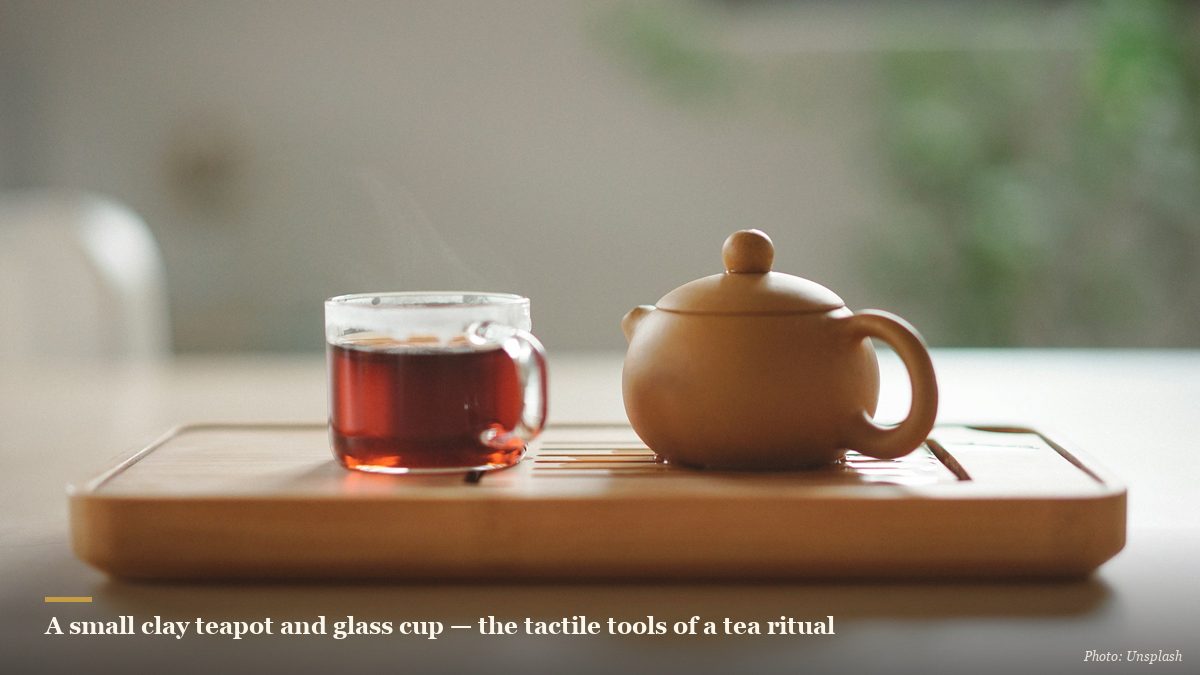
The other marker is intention. A tea ritual sets aside a defined pocket of time and fills it with a single, sensory task — close to what modern researchers mean by focused, present-moment attention. Whether performed formally in a tea room or informally at a kitchen counter, it reframes an ordinary habit as a moment of intentional rest.
Gongfu Cha: China's Ritual of Skill and Attention
The Chinese approach most associated with careful, repeated brewing is gongfu cha (工夫茶). The name is telling: gongfu (the same word rendered "kung fu") means skill earned through time and patient effort. Gongfu cha is not a single grand ceremony but a daily craft of getting the most out of a leaf through many short, attentive infusions.
China's reverence for the art of tea reaches back to the Tang-dynasty scholar Lu Yu (陸羽), honored as the "Sage of Tea." His Cha Jing (茶經, the Classic of Tea) — the world's first monograph devoted to tea — set out its cultivation, appraisal, tools, and brewing, and first framed tea as a dao: a practice whose surface is technique but whose heart is a settled, unclouded mind. [1] That twofold idea — outward skill, inward quiet — still describes gongfu cha today.
The vessels are compact and purposeful: a small Yixing zisha (purple-clay) teapot or a porcelain gaiwan (a lidded bowl), a cha hai or "fairness pitcher" to even out the brew, and thimble-sized cups. A typical session moves through a recognizable sequence:
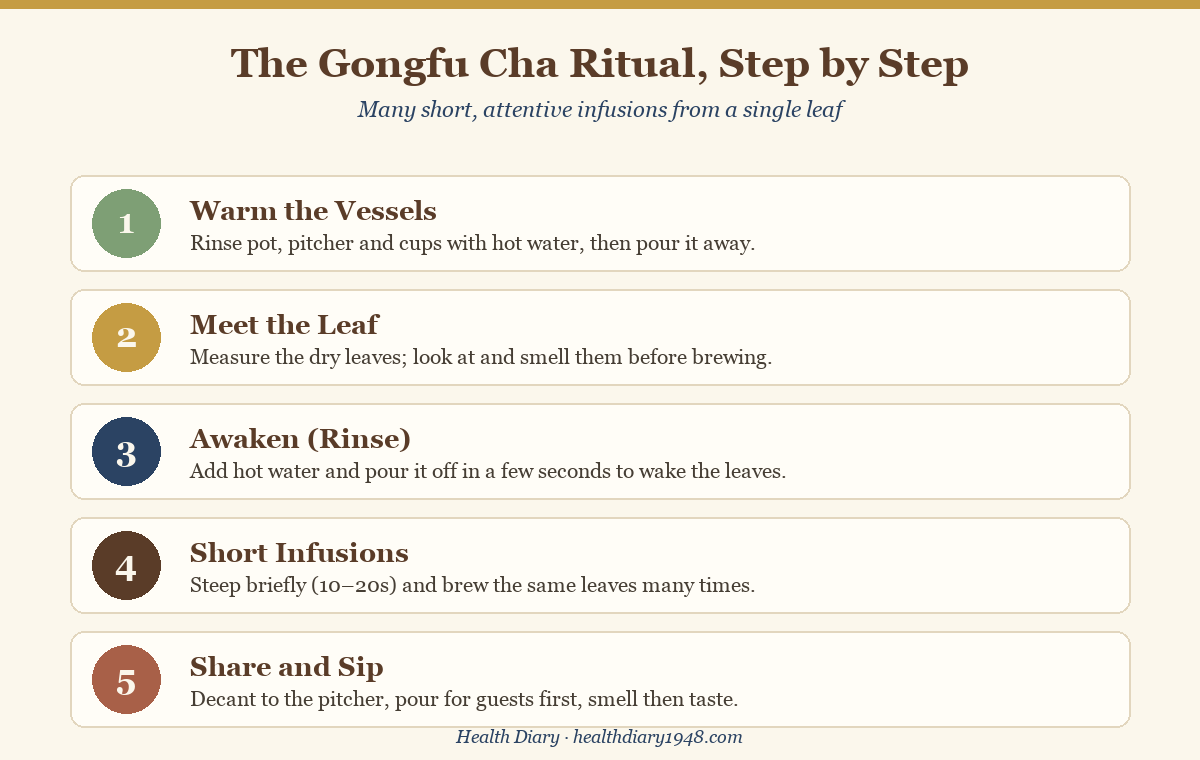
- Warm the vessels. Hot water is poured through the pot, pitcher, and cups, then discarded — cleaning them and bringing them up to temperature.
- Meet the leaf. The dry leaves are measured and often offered to guests to look at and smell before brewing.
- Awaken the leaves. A quick rinse of hot water is added and poured off within a few seconds, waking tightly rolled oolong or pu-erh.
- Short infusions. The first steep is brief — often ten to twenty seconds — and the same leaves are brewed many times, each cup a little different from the last.
- Share and sip. Tea is decanted into the pitcher, poured for guests first, and appreciated by aroma before taste.
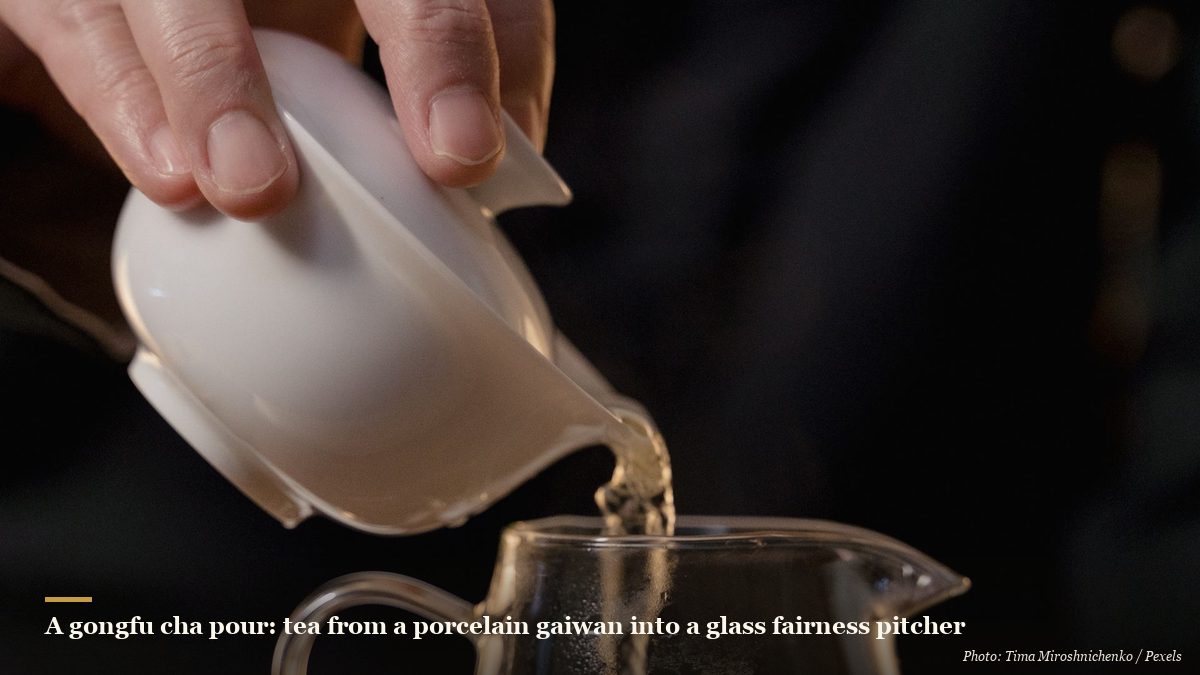
Because each infusion lasts only seconds, the person brewing stays continuously engaged — pouring, watching, decanting, serving. Enthusiasts often describe gongfu cha as a kind of "moving meditation": there is no idle moment in which the mind can wander far before the next small task calls it back.
What Are the Four Principles of the Japanese Tea Ceremony?
If gongfu cha is a ritual of skill, the Japanese tea ceremony — chanoyu, or chado, "the way of tea" — is a ritual of philosophy. Its guiding spirit was distilled in the 16th century by the tea master Sen no Rikyū into four characters still learned by every student today: 和敬清寂, wa-kei-sei-jaku. [2]
- Wa (和) — harmony between host, guests, the utensils, and the season, with ego and status set aside.
- Kei (敬) — respect, a full attention given to every person, object, and gesture in the room.
- Sei (清) — purity, meaning both physical cleanliness and an uncluttered, clear mind.
- Jaku (寂) — tranquility, the quiet that is said to arrive only once the first three are truly present.
These principles grew from Rikyū's wabi-cha — a stripped-down, rustic style that prized a plain bowl and a simple room over ornament. The core preparation, the hira-temae, is a precise sequence of unhurried movements built around whisking powdered matcha in a chawan (tea bowl) with a chasen (bamboo whisk). The formality is not the goal in itself; it is a scaffold that keeps the mind on the present bowl of tea rather than on the day's worries. More than drinking, chado is described as a discipline that teaches patience, attention, and appreciation for simplicity.
Korean Darye: Tea as Quiet Cultivation
Korea's tradition, darye (다례, "tea etiquette"), shares the meditative roots of its neighbors but wears them more lightly. During the Buddhist Goryeo era, tea became a tool for cultivating the mind, and later Confucian scholars would brew it in quiet studies while reading the classics or contemplating a garden. Darye is understood as both etiquette and a form of self-cultivation (수양). [3]
What distinguishes Korean darye is its relaxed, comfortable atmosphere. It is deliberately less rigid than the Japanese ceremony or the exacting Chinese tea arts; its center of gravity is graceful hospitality and consideration for others rather than exact procedure. The host offers tea and refreshments with care, and the shared pause — unhurried, courteous, gently attentive — is itself the practice. For many, that gentleness is the appeal: a ritual that cultivates calm through kindness rather than strictness.
Vietnam's Everyday Tea Ritual
Not every tea ritual happens in a formal room. In Vietnam, tea (trà, or chè in the north) is woven into daily and social life so thoroughly that its ceremony is almost invisible — yet it is a ritual all the same. A guest arriving at a Vietnamese home is offered tea before almost anything else; a small clay or porcelain pot and a cluster of tiny cups appear, and conversation slows to the rhythm of pouring and refilling.
Two forms anchor the tradition. The everyday one is chè xanh (or chè tươi) — fresh green tea leaves steeped in a larger pot and shared communally in the countryside and at roadside stops. The more refined one uses a small clay teapot and thimble cups in a manner close to gongfu cha, a legacy of centuries of exchange with China. In both, the gesture is the same: the host serves guests first, cups are kept warm and topped up, and no one is in a hurry to finish — hospitality turned into a daily micro-ritual of slowing down.
How Can You Turn a Daily Cup of Tea into a Mindful Ritual?
You do not need a tea room or years of training to borrow the spirit of these traditions. The common thread running through all four is simple: give the preparation your full attention. A few practical ideas:
- Let the wait be the ritual. Instead of starting a timer and walking away, stay with the process — heating the water, warming the cup, watching the color deepen. The slow steep mirrors the deceleration you are looking for.
- Go screen-free for one cup. Genuine mental rest is hard to reach while taking in a stream of information. A cup of tea drunk without a phone in hand is a categorically different experience from one drunk mid-scroll.
- Add a few slow breaths. While the tea steeps, take three to five slow, deliberate breaths and let the aroma register. Engaging the senses is part of what makes the pause feel restful.
- Use a vessel you enjoy holding. A ceramic or clay cup, warm in both hands, changes the texture of the moment in a way a paper cup never will.
- Serve someone else. Borrow the hospitality at the heart of darye and Vietnamese tea: pouring for another person is a small, grounding act of attention.
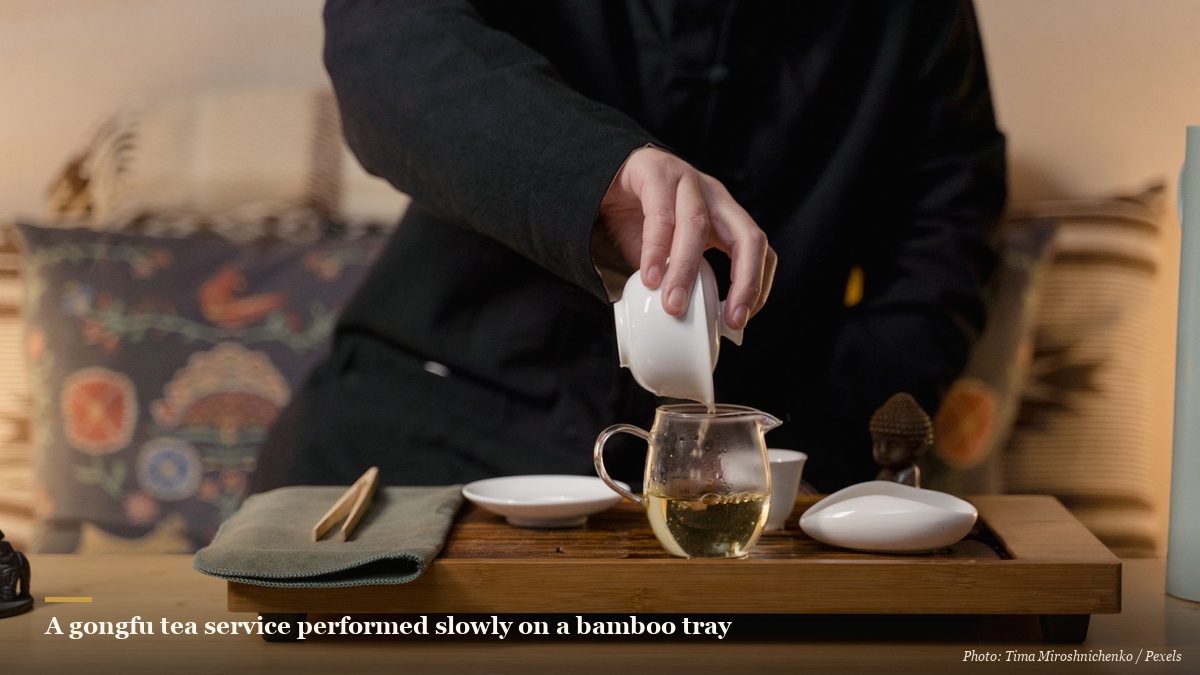
None of this requires special expertise. It reframes a habit you already have as a few minutes of intentional presence — exactly what the Asian tea traditions have offered for centuries. Individual experiences vary considerably; what feels calming to one person may feel forced to another, so it is worth experimenting gently to find a rhythm that suits you.
What Does the Research Say About Tea Rituals and Calm?
The traditions describe the tea ritual as quieting the mind; modern research on this specific question is still early and small, and should be read as preliminary rather than proof. A 2026 feasibility study in Cureus introduced a simplified 20-minute Japanese tea ceremony to ten palliative-care staff and measured anxiety with the State-Trait Anxiety Inventory. State-anxiety scores decreased on average, and most participants described immersion in the ritual, sensory calm, and welcome distraction. Crucially, the authors stress that the study "provides no evidence regarding the tea ceremony's therapeutic efficacy" — without a control group, the change could reflect rest, expectation, or simply a break from work. [4]
A separate small study of the Japanese tea ceremony measured heart-rate variability and reported a decrease in heart-rate tone after the tea was drunk, which the researchers interpreted as a shift toward a more relaxed autonomic state. [7] These are the kinds of early physiological signals that make the topic interesting, not settled.
There is also a plausible mechanism that has little to do with the leaf. Research on mindfulness practices has associated focused, present-moment attention with decreased rumination — the looping, worried thinking that fuels perceived stress. [5] A slow, sensory-rich ritual is one very ordinary way to occupy attention fully, so part of whatever calm people feel may come from the practice of brewing as much as from anything in the cup. The National Center for Complementary and Integrative Health notes that while herbal teas are part of complementary health traditions worldwide, the evidence for specific effects remains mixed and varies by preparation. [6]
Important Limitations and Considerations
A tea ritual is a cultural and sensory practice, not a treatment, and a few practical cautions are worth keeping in mind:
- Caffeine. Many of these rituals use real tea (green, oolong, pu-erh, matcha), which contains caffeine. Matcha in particular delivers whole powdered leaf. Those sensitive to caffeine, or brewing in the evening, may prefer caffeine-free herbal infusions or lighter steeps.
- Hot water and burns. Ritual brewing involves near-boiling water and small vessels. Handle pots and kettles carefully, especially around children.
- Medications and health conditions. Tea can interact with certain medications, and some herbal ingredients are not suitable for everyone. If you take prescription drugs, are pregnant or breastfeeding, or have a health condition, speak with a licensed healthcare practitioner before making a new tea a daily habit.
- Quality and sourcing vary. Leaf quality, freshness, and processing differ widely between products, and so does what ends up in your cup.
- Individual response varies. A ritual that feels deeply calming to one person may not suit another. Approach it as a pleasant practice to explore, not a guaranteed outcome.
Individual responses vary considerably; what works well for one person may not suit another, and personal experimentation under practitioner guidance is always recommended.
Frequently Asked Questions
What is the difference between gongfu cha and the Japanese tea ceremony?
Gongfu cha is a Chinese method of brewing loose-leaf tea through many short infusions in a small clay pot or gaiwan, prized for skill and for drawing changing flavors from one leaf. The Japanese tea ceremony (chanoyu) is a formalized ritual centered on whisking powdered matcha in a bowl, guided by the four principles of harmony, respect, purity, and tranquility. Both treat preparation as a mindful practice, but gongfu cha emphasizes craft while chanoyu emphasizes philosophy and precise form.
Do I need special equipment to practice a tea ritual at home?
No. Special vessels — a clay teapot, a gaiwan, a matcha bowl and whisk — deepen the experience, but the spirit of the ritual is about attention, not gear. A cup you enjoy holding, water heated with care, and a few minutes without distractions are enough to begin. Many people add traditional tools gradually.
Is a tea ritual the same as meditation?
Not exactly, though they overlap. A tea ritual gives your attention a concrete, sensory task — measuring, pouring, watching, sipping — which many people find easier to stay with than seated meditation. Traditions like Japanese chado and Korean darye grew alongside Buddhist and Confucian practice and share meditation's emphasis on presence. Individual experiences vary.
Which tea is best for a calming ritual?
There is no single answer, and the calm may come as much from the ritual as from the leaf. Lighter oolongs, aged pu-erh, and gentle green teas suit slow gongfu-style brewing; matcha suits a whisking ritual; caffeine-free herbal infusions suit the evening. Choose by flavor and by how the tea makes you feel.
Where does the tradition of tea as a mindful ritual come from?
Its roots run deep across East Asia. In China, the Tang-dynasty scholar Lu Yu framed tea as a dao — a practice of both skill and inner cultivation — in his eighth-century Classic of Tea. In Japan, Sen no Rikyū shaped the tea ceremony and its four guiding principles in the 16th century. In Korea, darye developed as tea etiquette and self-cultivation, and in Vietnam everyday tea became a ritual of hospitality. Each culture arrived at a similar idea: that preparing tea slowly is a way to steady the mind.
A Note on Slowing Down
What these traditions share is not a claim about health but an invitation to attention. Whether you are counting seconds over a gaiwan, whisking a bowl of matcha, or simply pouring for a guest, the tea ritual asks you to be fully present for a few minutes — and presence is something many people find in short supply. If you are curious which traditional tea style might suit your temperament and daily rhythm, you can explore that in a light, reflective way and let it guide where you begin.
A Soft Closing Note
Traditional tea rituals are living practices, not products — shaped by centuries of local knowledge across China, Japan, Korea, and Vietnam. Their value lies less in what is in the cup than in how the cup is made: slowly, attentively, and often in the company of others. You do not need to master a ceremony to borrow its spirit. Set aside a few unhurried minutes, give the brewing your full attention, and let the ordinary act of making tea become a small, steadying ritual of its own.
About This Article
Written by: Health Diary Editorial Team — specialists in traditional Asian wellness research, tea culture, and mindful practice.
Editorial review: This article has been reviewed by the Health Diary editorial team for clarity, structure, and adherence to our sourcing standards. Key claims were cross-checked against NCCIH, NIH PubMed, and peer-reviewed literature, as well as native-language Chinese, Japanese, and Korean sources on tea tradition. It is not a clinical review and should not replace consultation with a licensed healthcare practitioner.
Reviewed on: July 15, 2026.
Editorial process: We cite peer-reviewed and government sources where possible. When a clinical reviewer is added to this article, attribution will appear here with verifiable credentials.
This article explores traditional tea rituals as a cultural and mindfulness practice. It is not medical advice.
References
- The News Lens. "中國茶文化與茶藝發展(上):茶聖陸羽的《茶經》,是茶文化形成的重要標誌." thenewslens.com/article/159736 (Chinese-language source on Lu Yu's Classic of Tea)
- 茶の湯スタイル (Japan Chanoyu). "茶道の心・精神を学ぶ→和敬清寂(四規)と利休七則." japan-chanoyu.com/spirit (Japanese-language source on wa-kei-sei-jaku)
- Sogang University News. "[차(茶) 기획] ③ 예절의 맛, 한국 전통 다례의 기본부터 그 과정까지." scc.sogang.ac.kr (Korean-language source on darye)
- Nishikori, et al. "A Simplified Tea Ceremony Experience for Palliative Care Staff: A Feasibility and Acceptability Study." Cureus, 2026. PMC12872583
- "Cultivating multiple aspects of attention through mindfulness meditation accounts for psychological well-being through decreased rumination." PubMed, 2015. PubMed 26170728
- National Center for Complementary and Integrative Health (NCCIH). "Tea." U.S. Department of Health and Human Services. nccih.nih.gov/health/tea
- "Study of the Effects of Japanese Tea Ceremony Will Give the Peace of Mind of Guests." academia.edu


