Meditation Traditions of Asia: From Chan to Zen and Beyond
Trace Asia's meditation traditions — Chan in China, Zen in Japan, Seon in Korea, and Vietnamese Thiền — plus seated, walking, and moving styles and what research says.
Medical Disclaimer: This content is for educational and informational purposes only and is not medical advice. The information presented is not intended to diagnose, treat, cure, or prevent any disease or mental health condition. Meditation is not a replacement for mental health care — if you are living with significant anxiety, depression, trauma-related symptoms, or another psychological difficulty, please work with a licensed mental health professional and discuss any new practice with them first. Statements regarding traditional practices have not been evaluated by the FDA.
Affiliate Disclosure: This article contains affiliate links. We may earn a commission if you purchase through these links, at no additional cost to you. We only recommend products we believe align with our editorial standards.
Before dawn in a Japanese Sōtō temple, practitioners sit facing the wall in silence. In the Korean mountains, temple-stay visitors sit with a single unanswerable question. In a Vietnamese monastery, even walking becomes a form of attention. Different countries, different centuries — yet all one family of meditation traditions that began in India, took root in China, and branched across East and Southeast Asia.
This article follows that river. Continuing the Stress & Balance series opened by our qigong beginner's guide, we trace how Chan took shape in China, became Zen in Japan and Seon in Korea, and flowered into Thiền in Vietnam — with an honest look at what research has and has not found.
What Are Meditation Traditions?
"Meditation" is an umbrella word. The U.S. National Center for Complementary and Integrative Health calls it a variety of practices that focus on mind and body integration, with a history "that goes back thousands of years" — many techniques "began in Eastern traditions." A tradition is more than a technique: it carries teachers and lineages, ethics, architecture, tea, poetry, and centuries of insight into what a wandering mind does when asked to sit still.
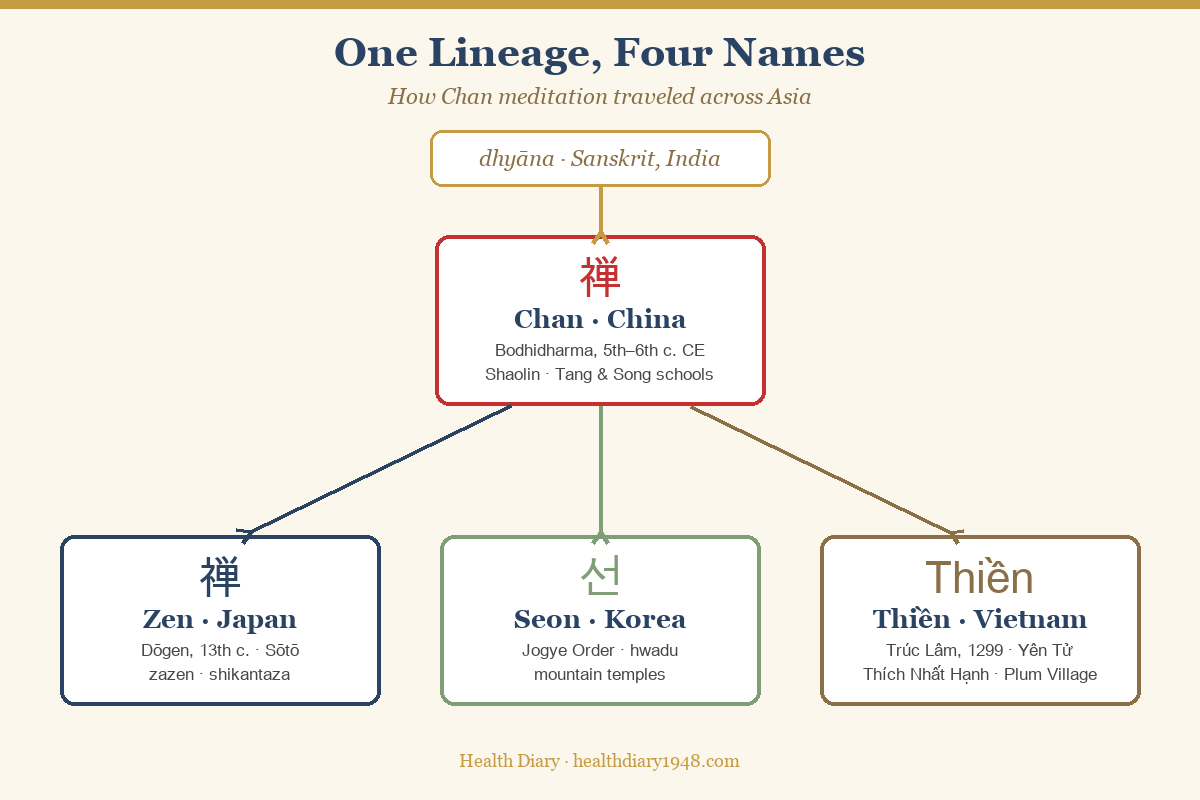
In East Asia, the central lineage is literally named after meditation. The character 禅 — chan — abbreviates an old transliteration of the Sanskrit dhyāna, "meditative absorption." Read it in Japanese and you get Zen; in Korean, Seon; in Vietnamese, Thiền. Four names, one word — and one conviction that direct experience, cultivated in stillness, matters more than reading about it.

Chan in China: Where the River Begins
Chan traces itself to Bodhidharma, a semi-legendary fifth-or-sixth-century monk who, in the classical accounts, arrived from the "Western Regions" — Central Asia or South India — and settled near the Shaolin Monastery in Henan. The story most told about him is disarmingly simple: he sat. Dōgen's meditation manual Fukanzazengi invokes Bodhidharma, who "sat facing a wall for nine years after coming to China" though already awakened — sitting not as a means to an end, but as the end expressed.
A word of honest history: the claim that Bodhidharma invented Shaolin kung fu is largely legend — the story of the monk teaching boxing first appeared in a 1907 serialized novel. What the record shows is a school growing up in Tang and Song China around a radical idea: awakening lives not in scriptures or rituals but in the direct activity of one's own mind — chopping wood, carrying water, above all sitting.
China's meditative culture also flowed into the body: the breath-led arts in our qigong and tai chi guides grew from the same soil — a thread we pick up below.
Zen in Japan: Dōgen and the Art of Just Sitting
In 1223, the young monk Dōgen (1200–1253) sailed to Song China searching for authentic practice. He found it under Zen Master Tendō Nyojō, returned home, and founded Eiheiji monastery and the Sōtō school, today among Japan's largest Buddhist institutions. Its central practice is zazen, seated meditation; its purest form bears a wonderfully plain name: shikantaza.
Per the Center for Soto Zen Studies, the expression is vernacular Chinese: shikan, "to be solely concerned about," plus taza, "to sit" — shikantaza is "to be solely concerned about just sitting". No mantra, no visualization, no goal. Dōgen recorded his teacher's blunt instruction: zazen is "body-mind dropping off... Just single-minded sitting alone." Practice and realization were one act, not two stages — "to suppose that practice and realization are not one is a view of those outside the way."
Zen's fingerprints mark all of Japanese culture: raked rock gardens, temple architecture, and most famously the tea room — the meditative choreography of the Japanese tea ceremony. The same unhurried attention runs through Japanese healthy aging traditions and Japan's broader Kampo-influenced wellness culture.

Seon in Korea: Questions, Mountains, and Temple Stays
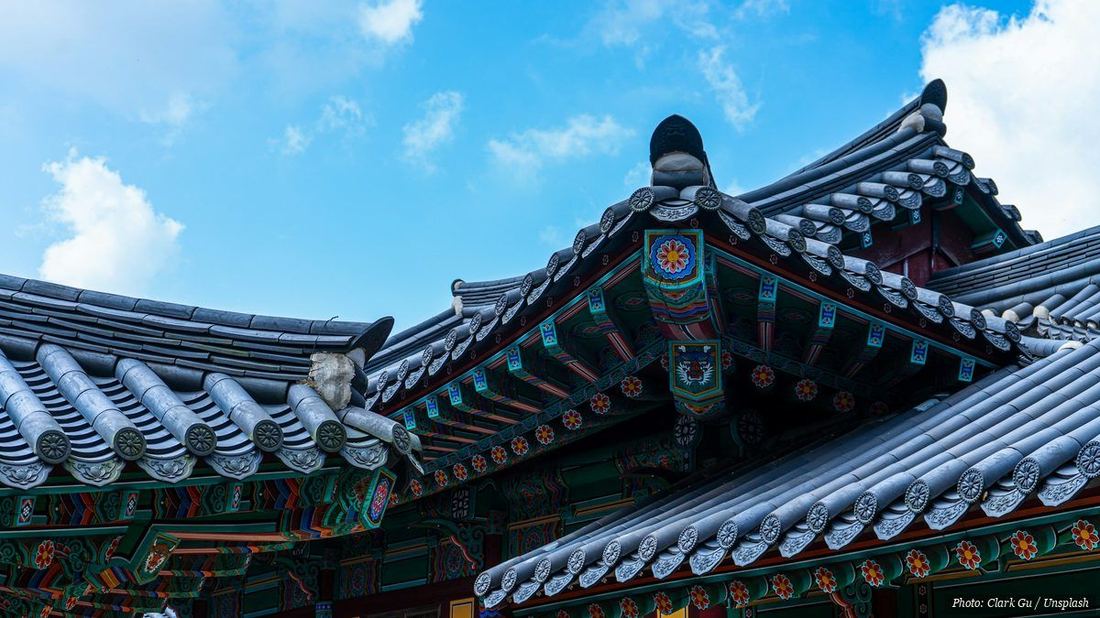
Korea received the meditation school from Tang China and made it its own. Seon, preserved chiefly by the Jogye Order, is famous for ganhwa Seon — sitting with a single condensed question, a hwadu, such as "What is this?" The question is not solved like a riddle; it is held until conceptual thinking exhausts itself. Seon also kept a strong mountain-monastery culture, its great temples reached by pine-forest trails.
For modern readers, Korea's door is remarkably open. The Jogye Order's official Templestay program (템플스테이), run by the Cultural Corps of Korean Buddhism, invites anyone — beginners included — to spend a day or several nights in a working temple: guided meditation, tea conversations with monks (chadam, 차담), monastic meals (balu gongyang, 발우공양), early-morning chanting, the 108 prostrations. Tea and meditation have been companions in Korea for centuries, a pairing explored in our Korean tea culture guide.
Thiền in Vietnam: An Emperor's School and a Global Teacher
Vietnam's lineage produced history's most unusual founder: a reigning emperor. Trần Nhân Tông (1258–1308) led Đại Việt through two Mongol invasions, then abdicated, ordained in 1299, and withdrew to Yên Tử mountain to found the Trúc Lâm ("Bamboo Grove") Zen school. According to the Trần Nhân Tông Institute at Vietnam National University, Trúc Lâm unified the earlier Vietnamese Zen lineages into one national school for the first time, led by its Three Patriarchs: Trần Nhân Tông, Pháp Loa, Huyền Quang.
Trúc Lâm's signature idea is cư trần lạc đạo — "dwelling in the world, delighting in the Way": the practitioner finds the Buddha in his or her own mind amid ordinary duties. It is a strikingly practical vision, kin to the unhurried habits in our guide to Vietnamese longevity traditions.
Seven centuries later, that engaged spirit found a global voice in Thiền master Thích Nhất Hạnh (1926–2022), who carried Vietnamese mindfulness to the West from the early 1970s and founded the Plum Village community in France. He made meditation radically portable: mindful breathing as "a stable solid ground that is always there for us," walking synchronized to the breath, even eating as practice. Much of what the world now calls "mindfulness" bears this Vietnamese imprint.
Seated, Walking, or Moving: Which Style Is Which?
Across the four countries, methods sort into a few recognizable families:
- Seated meditation — the backbone: Japanese zazen, Korean hwadu sitting, and Vietnamese tọa thiền, sharing upright posture, settled breathing, and sustained attention.
- Walking meditation — slow formal walking (kinhin) punctuates long sittings in Zen monasteries; in the Plum Village tradition, mindful walking is a complete practice in itself.
- Moving meditation — China's contribution: qigong and tai chi pair flowing movement with regulated breath and gathered attention — meditation in motion.
- Breath-centered practice — the common denominator of nearly every method above, traced region by region in our guide to breathing traditions across Asia.
No family is "better"; they suit different temperaments. Someone who finds long sitting difficult may prefer walking or moving forms; someone who craves stillness may settle naturally onto the cushion.
What Does Modern Research Say About Meditation?
Three decades of research in one line: promising for stress-related outcomes, preliminary and mixed for most everything else.
Stress, anxiety, and mood. The most-cited review is the 2014 Goyal meta-analysis in JAMA Internal Medicine (47 randomized trials, 3,515 participants): mindfulness meditation programs produced small-to-moderate improvements in anxiety, depression, and pain versus nonspecific controls — but no clear superiority over active comparators such as exercise or established therapies. NCCIH notes a 2018 analysis in which mindfulness-based approaches performed about as well as evidence-based therapies, while cautioning that many trials are short and uneven in quality.
Physiology. Japanese researchers have measured beginners on the cushion: in a small study presented to the Japanese Psychological Association, twenty students who attended five zazen sessions showed lower salivary cortisol and improved tension, confusion, and depression mood scores after sitting — an intriguing pilot signal, not proof.
Safety. Meditation is generally well tolerated, but not free of downsides. A 2020 systematic review in Acta Psychiatrica Scandinavica (83 studies, ~6,700 meditators) found that roughly 8 percent of participants reported an adverse event — most commonly increased anxiety, low mood, or unusual cognitive experiences, with higher rates in intensive settings. This is why the traditions themselves insist on teachers, gradual pacing, and community.
In short: a low-cost practice many find steadying, with modest measured effects — deserving the same sensible caution as anything that works with the mind.
How Some People Explore These Traditions Today
A few patterns repeat among newcomers:
- Starting small. Five to ten minutes most days outlasts heroic hour-long sessions abandoned within a week.
- Borrowing a structure. A Zen center, meditation group, or Korean temple stay provides posture guidance, pacing, and other humans — things no app fully replaces.
- Trying more than one family. A restless sitter may find walking meditation or a morning qigong set suits them better than the cushion.
- Anchoring practice to a ritual. Some sit after morning tea; others fold a short session into the evening wind-down alongside Asia's nighttime wellness habits and traditional sleep practices, or pair sitting with a warm cup from our relaxation tea traditions.
- Keeping the frame gentle. In all these cultures, meditation lives inside a larger fabric of unhurried daily routines — a way of living attentively, not a productivity hack.
Individual responses vary considerably; a style that grounds one person may unsettle another, and unhurried experimentation under a qualified teacher's guidance is always recommended.
Important Limitations and Considerations
Meditation's gentleness is real; so are its limits:
- It is not mental health treatment. Meditation should never replace therapy, prescribed medication, or professional care — NCCIH's guidance is explicit on this point.
- Trauma and psychiatric conditions deserve extra care. A meaningful minority of practitioners report increased anxiety, low mood, or disturbing experiences, particularly in intensive settings such as long silent retreats — the deep end of the pool, where beginners need not start. Anyone with a trauma history or psychiatric condition should practice only with their mental health professional's knowledge and under an experienced teacher.
- Teacher quality varies. There is no universal credential. Established lineages — Sōtō or Rinzai centers, Jogye temple programs, Plum Village communities — offer accountability an anonymous online course may not.
- Posture has limits. Cross-legged sitting is not required; chairs are used in temples across Asia. Joint or back pain is a signal to adjust, not endure.
- Evidence is modest. Measured benefits are small to moderate, many studies short and unblinded; marketing claims often outrun the science.
- Respect the depth. These are living religious traditions for millions; one can practice secularly while acknowledging where it came from.
Individual experiences vary considerably.
Frequently Asked Questions
What is the difference between Chan, Zen, Seon, and Thiền?
They are four pronunciations of one Chinese character, 禅 — one meditation lineage in four cultures. The core of sustained seated attention is shared; the flavors differ, from Japan's silent shikantaza to Korea's question-holding hwadu to Vietnam's engaged, in-the-world style.
Do I have to be Buddhist to practice meditation?
No. Temple stays, Zen centers, and mindfulness communities welcome practitioners of any faith or none, and many people practice purely as a secular exercise in attention — though basic respect for the traditions' Buddhist origins makes the experience richer.
How long should a beginner meditate each day?
Most teachers suggest five to ten minutes daily, growing slowly, rather than long sessions immediately. In every tradition described here, consistency matters far more than duration.
Can meditation be harmful?
For most people it is well tolerated, but a 2020 systematic review found roughly 8 percent of practitioners reported unwanted effects such as increased anxiety or low mood, more often in intensive settings. Anyone with a trauma history or psychiatric condition should involve their mental health professional before starting.
A Note on Tracking Your Practice
Every tradition here treats meditation as a long, quiet accumulation — a natural fit for simple tracking. Some note practice days in a paper journal; others use a wellness diary app such as Health Diary to log sitting or walking minutes alongside sleep, mood, and stress. Over a month, your own record becomes more informative than any headline.
A Gentle Closing Note
A monk faces a wall in Henan. An emperor climbs a Vietnamese mountain. A visitor sips tea with a monk before dawn. Across fifteen centuries, Asia's meditation traditions keep making the same modest offer: sit down, breathe, pay attention to this moment. If this survey has made you curious, let your first step be small — a few quiet minutes tomorrow morning, or a look at the breathing practices beneath them all. The river is long; entering at the shallow end is perfectly fine.
About This Article
Written by: Health Diary Editorial Team — writers with backgrounds in cultural wellness, contemplative traditions, and traditional health practices across Asia.
Editorial review: This article has been reviewed by the Health Diary editorial team for clarity, structure, and adherence to our sourcing standards. Key claims were cross-checked against NCCIH, peer-reviewed systematic reviews, and official tradition sources (Center for Soto Zen Studies, Templestay, the Trần Nhân Tông Institute, Plum Village). It is not a clinical review and should not replace consultation with a licensed healthcare or mental health practitioner.
Reviewed on: July 16, 2026.
Editorial process: We cite peer-reviewed and government sources where possible. When a clinical reviewer is added to this article, attribution will appear here with verifiable credentials.
References
- NCCIH. Meditation and Mindfulness: Effectiveness and Safety. nccih.nih.gov
- Goyal, M., et al. (2014). Meditation Programs for Psychological Stress and Well-being: A Systematic Review and Meta-analysis. JAMA Internal Medicine, 174(3), 357–368. jamanetwork.com
- Farias, M., Maraldi, E., Wallenkampf, K. C., & Lucchetti, G. (2020). Adverse events in meditation practices and meditation-based therapies: a systematic review. Acta Psychiatrica Scandinavica, 142(5), 374–393. doi:10.1111/acps.13225
- Sugawara, K. Shikantaza (Just Sitting). Center for Soto Zen Studies, Sōtōshū. sotozen.com
- Viện Trần Nhân Tông, Đại học Quốc gia Hà Nội. Trần Nhân Tông với thiền phái Trúc Lâm Yên Tử. tnti.vnu.edu.vn
- 鈴木常元, 廣瀨弘文, 望月大仙 (2020). 坐禅の心理生理的効果―坐禅初心者による検討―. 日本心理学会第84回大会発表論文集. J-STAGE
- 한국불교문화사업단 (Cultural Corps of Korean Buddhism). 템플스테이 (Templestay). templestay.com
- Plum Village. Mindfulness Practice. plumvillage.org
This article explores traditional contemplative practices for educational purposes. It is not medical or mental health advice.