Tai Chi for Beginners: A Guide to This Moving Tradition
Learn tai chi basics: what taijiquan (太极拳) is, its Chen Village origins, the five major styles, core principles, tai chi vs qigong, and the beginner-friendly 24-form.
Medical Disclaimer: This content is for educational and informational purposes only and is not medical advice or exercise instruction. The information presented is not intended to diagnose, treat, cure, or prevent any disease. Movement descriptions in this article are cultural illustrations only — always learn tai chi from a qualified instructor, and consult a licensed healthcare practitioner before starting any new movement or wellness practice. Statements regarding traditional practices have not been evaluated by the FDA.
Affiliate Disclosure: This article contains affiliate links. We may earn a commission if you purchase through these links, at no additional cost to you. We only recommend products we believe align with our editorial standards.
Watch a group practicing tai chi in a morning park and the first thing you notice is what is missing: hurry. Arms float, weight shifts, the whole body turns as one — so slowly the movement seems almost still. This is taijiquan (太极拳), carrying centuries of legend, and inscribed by UNESCO as Intangible Cultural Heritage in December 2020.
This guide continues our Stress & Balance series, following our companion piece on qigong basics: what tai chi is, where it came from, its five styles, the form beginners learn first, and what research has — and has not — found, connected to the wider world of traditional Asian wellness routines.
What Is Tai Chi?
The full name, taijiquan, joins taiji (太极) — the "supreme ultimate," the Chinese image of yin and yang endlessly turning into each other — with quan (拳), "fist." At its root, tai chi is a martial art built on yielding and balance rather than raw force — though most people today practice it for very different reasons.
The U.S. National Center for Complementary and Integrative Health (NCCIH) describes tai chi as "a series of slow gentle movements and physical postures, a meditative state of mind, and controlled breathing." China's official heritage listing puts it more poetically: an art that is 柔和、缓慢、轻灵 — soft, slow, light and agile — cultivating the inner and outer person together. The same yin-yang framework runs through acupuncture, herbal practice, and the Chinese longevity traditions we have explored elsewhere; taken literally or not, the lived experience is concrete — slow, continuous, mindful movement paired with unhurried breathing.
Where Did Tai Chi Come From?
Two origin stories circulate. The romantic one credits Zhang Sanfeng (张三丰), a semi-legendary Wudang Daoist said to have conceived the art watching a snake evade a crane — softness defeating force; historians treat this as later legend.
The documented trail leads to Chenjiagou (陈家沟), a village in Wen County, Henan, where in the seventeenth century a garrison officer named Chen Wangting (陈王廷) is credited with codifying the earliest routines of what became Chen-style tai chi. China's martial arts authorities formally recognized Chenjiagou as the art's birthplace in 2007, and the official heritage listing behind the December 2020 UNESCO inscription traces its roots to that village, while noting scholars still debate deeper origins.
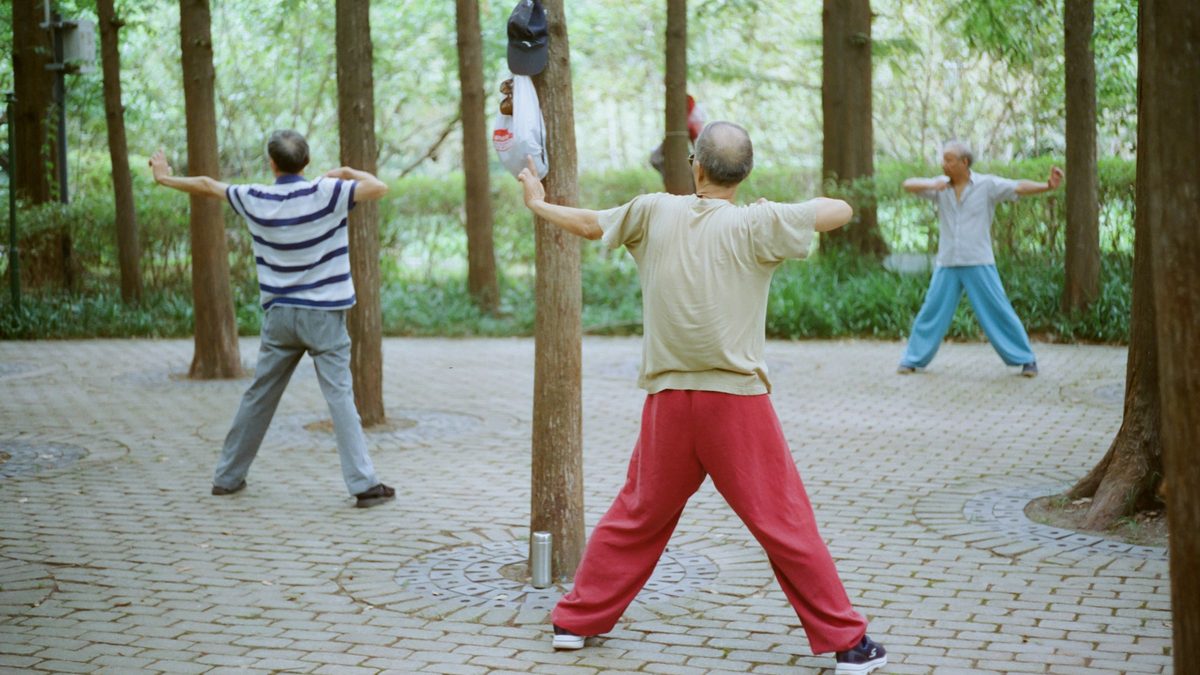
From Chenjiagou the art spread through families and students — a Chen student named Yang Luchan carried it to Beijing in the nineteenth century and founded the Yang style, others followed — until tai chi became a family of related styles practiced in parks from Zhengzhou to Toronto.
What Are the Five Major Styles of Tai Chi?
Most beginner guides name five family styles; China's heritage listing actually records six schools, including the lesser-known He style (和式). The major lineages:
- Chen (陈式) — the oldest, from Chenjiagou. Coiling "silk-reeling" movements alternate with sudden bursts of speed; low stances make it the most demanding.
- Yang (杨式) — founded by Yang Luchan. Large, open, evenly paced movements in an unbroken flow; the most practiced style worldwide and the base of most beginner classes.
- Wu (吴式) — developed from Yang style by Wu Quanyou and his son Wu Jianquan. A compact frame with a characteristic slight forward lean.
- Wǔ / Hao (武式) — founded by Wu Yuxiang (a different family name, same romanized spelling). Small, precise, internally focused — tai chi distilled to essentials.
- Sun (孙式) — created by Sun Lutang, blending tai chi with two other internal arts. Higher stances and agile stepping make it comparatively gentle on the knees.
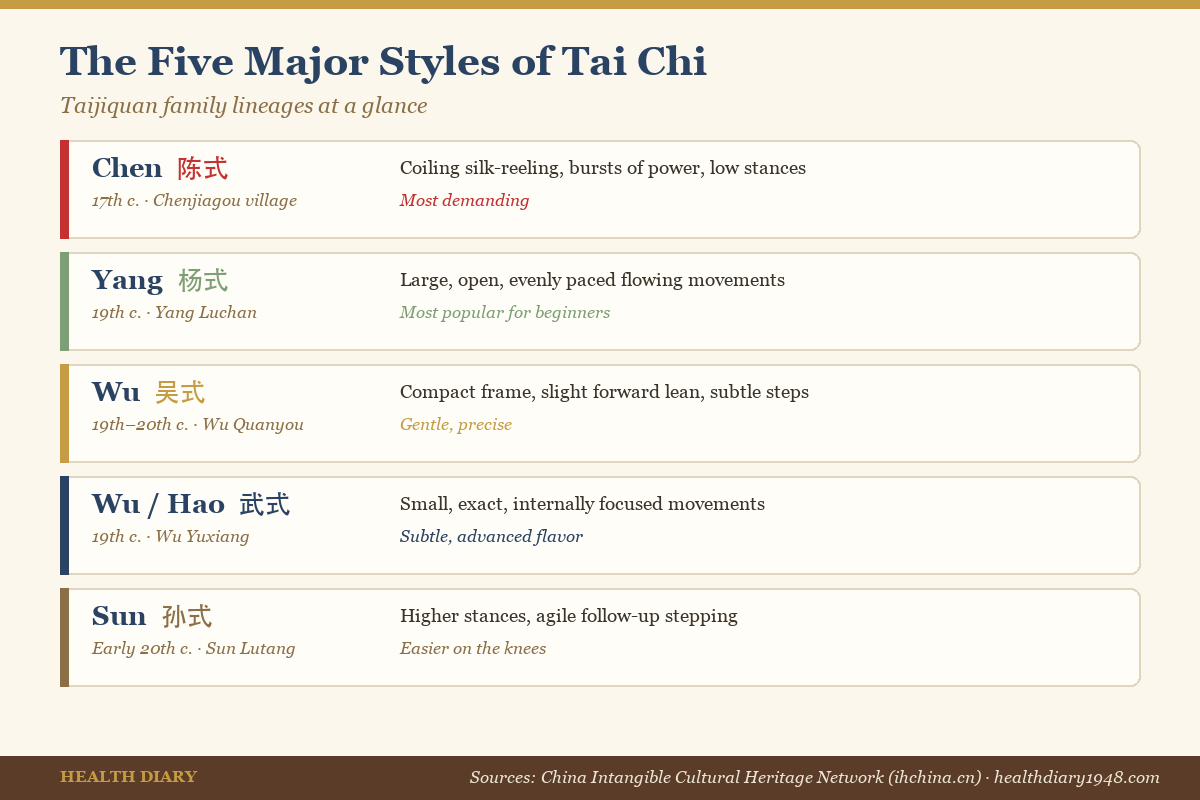
The practical takeaway: most beginners start with a Yang-style form — a good place to begin.
The Core Principles: Slow, Continuous, Relaxed
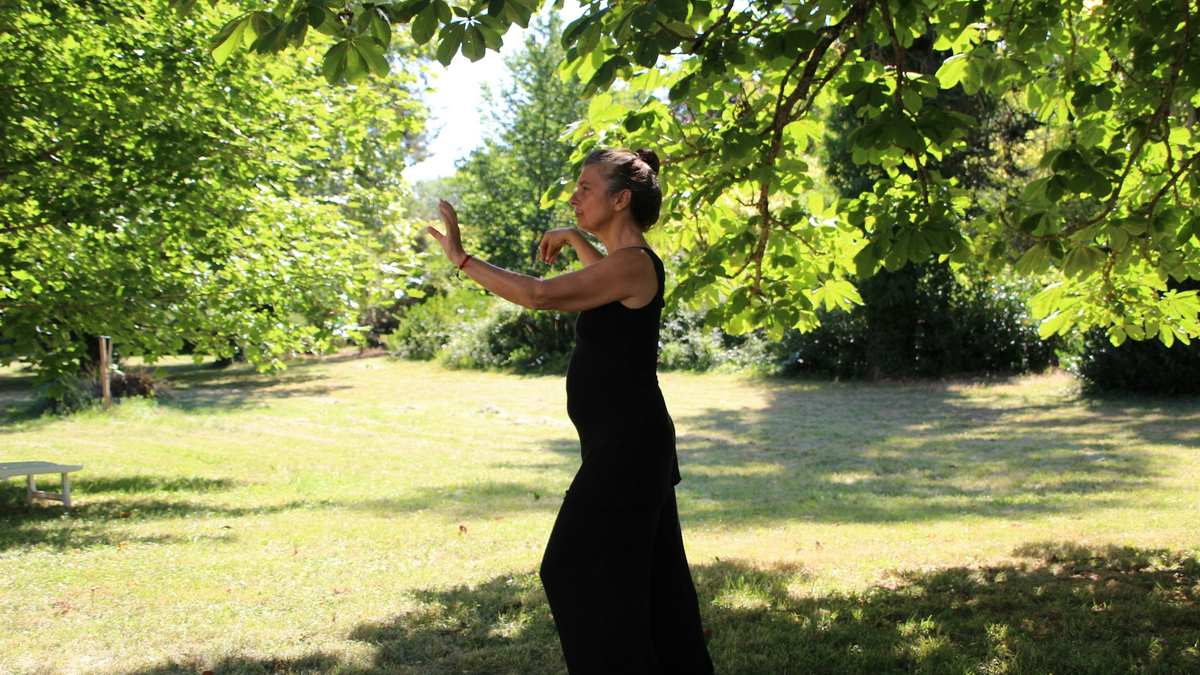
Whatever the style, a few principles make tai chi feel unlike other movement practices:
- Slowness with continuity. Movements never stop and never rush; each posture flows into the next. Classical writing compares the sequence to reeling silk from a cocoon — pull too fast and the thread snaps.
- Weight awareness. Weight shifts deliberately from leg to leg — the practitioner always knows which leg is "full" and which is "empty" — one reason researchers keep studying tai chi for balance.
- Song (松) — active relaxation. Released rather than limp: shoulders down, joints unlocked, no unnecessary tension. Harvard Health captures the result: movements "usually circular and never forced, the muscles are relaxed rather than tensed".
- The mind leads. Attention stays with movement and breath — why tai chi is so often called moving meditation, a physical cousin of Asian meditation traditions, with breathing habits that echo the region's traditional breathing practices.
What Is the Difference Between Tai Chi and Qigong?
The two arts share parks and often teachers. The simplest distinction:
- Qigong is the broad umbrella of Chinese breath-and-movement exercises — hundreds of sets, many short and repetitive, built purely around posture, breathing, and attention.
- Tai chi is a specific internal martial art whose forms are longer choreographed sequences — commonly 24 to 108 postures — with martial meaning behind every gesture.
A common teacher's summary: all tai chi contains qigong, but not all qigong is tai chi. Qigong sets are faster to memorize; a tai chi form takes months to learn and years to refine — which many practitioners consider its charm.
Which Tai Chi Form Should a Beginner Learn?
Ask at almost any community class and the answer is the same: the 24-form simplified tai chi (二十四式简化太极拳), often just called "the 24." In 1956, China's State Physical Culture and Sports Commission gathered senior teachers to distill the long Yang-style sequence into twenty-four movements chosen for learnability — the country's first unified national teaching form. As a Nanjing University of Chinese Medicine course page puts it, the result was 内容更精炼,动作更规范 — more distilled in content, more standardized in movement. A full round takes five to six minutes and needs nothing beyond flat shoes and loose clothing.
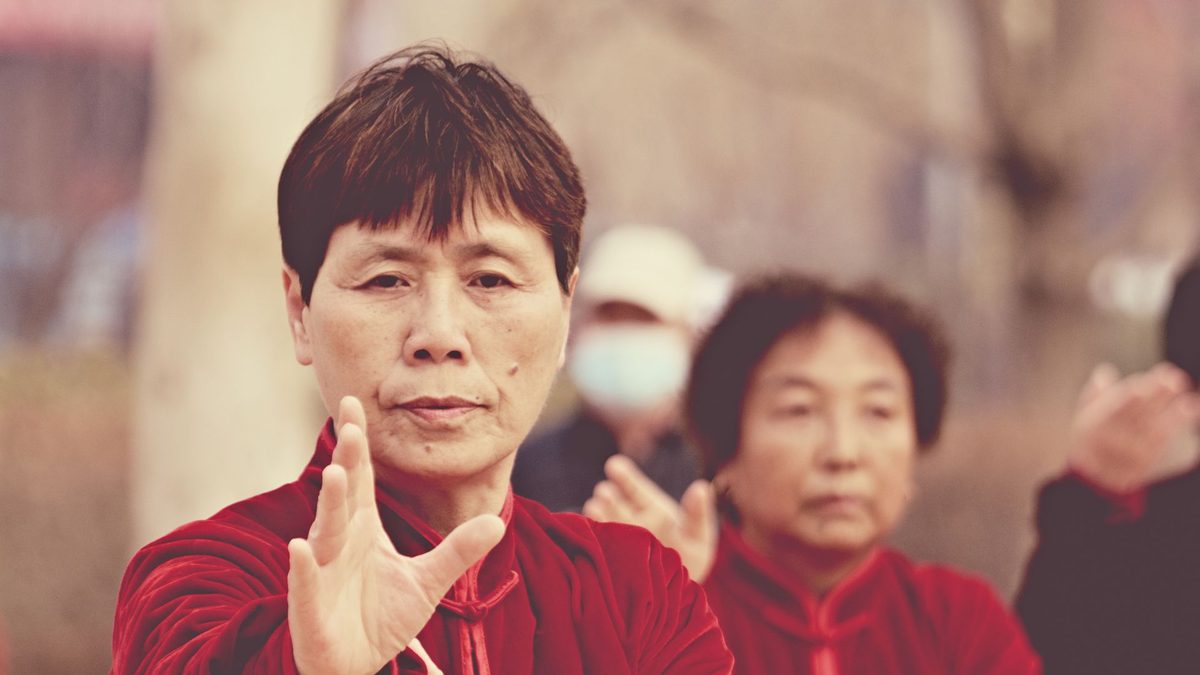
To give a flavor of how the form opens — as cultural description, not exercise instruction — the first movements are traditionally pictured this way:
- Commencing (起势) — standing quietly, the arms float up to shoulder height and settle back down, as if pressing on still water.
- "Parting the Wild Horse's Mane" (野马分鬃) — the weight shifts to one leg while the arms open diagonally, one high and one low, repeating side to side while stepping forward.
- "White Crane Spreads Its Wings" (白鹤亮翅) — the body settles back onto one leg as one arm rises and the other lowers, like a crane lifting its wings.
Written descriptions cannot convey the timing, alignment, or weight transfer that make these movements what they are. If they intrigue you, the right next step is a class with a qualified instructor, not imitation from text or videos.
What Does Modern Research Suggest About Tai Chi?
Tai chi is among the most-studied traditional movement practices; the honest summary is encouraging in places, preliminary in most.
Balance and falls in older adults. This is the strongest area. NCCIH reports that a 2019 review found tai chi may reduce the rate of falls by about 19 percent and the number of people who fall by about 20 percent — while grading much of the evidence low-certainty. A 2023 meta-analysis pooling 24 randomized trials in adults over 60 found roughly 24 percent fewer fallers among practitioners and consistent gains on standard balance tests, with larger benefits at three or more sessions per week — while flagging high heterogeneity.
Stress and mood. The picture here is more modest. A 2024 systematic review covering 11 randomized trials found lower perceived stress compared with doing nothing — a small-to-moderate effect — but no advantage over ordinary exercise, and no significant changes in cortisol, blood pressure, or heart rate. The authors called for larger, more rigorous trials.
Safety. In a 2019 meta-analysis of 24 studies cited by NCCIH, adverse events were similar to other or no interventions and mostly minor — the occasional musculoskeletal ache. Slow, regular practice appears to be a well-tolerated habit — most credibly for balance in later life — while bigger claims await better trials.
How Some People Begin a Tai Chi Practice
A few patterns repeat across classes worldwide:
- Teacher first, videos second. With no standard global license for tai chi instruction, Harvard Health's advice is practical: observe a class first and pick a teacher who adapts postures to individual health concerns.
- Give it twelve weeks. A form reveals itself slowly; Harvard Health suggests about twelve weeks of regular practice before judging the fit.
- Short and daily beats long and rarely. Two or three rounds of the 24-form make a realistic daily session — the same unhurried spirit found in Japanese healthy aging traditions.
- Pair it with existing rituals. Some people bookend the day with movement and a warm cup from the relaxation tea traditions of Asia; others fold a slow evening round into their wind-down alongside the region's traditional sleep practices.
- Keep expectations quiet. Practitioners describe the reward in small words — steadier, calmer, more settled — a vocabulary that fits both the evidence and the tradition.
Individual responses vary considerably; what feels calming and sustainable for one person may not suit another, and gentle experimentation under a qualified instructor's guidance is always recommended.
Important Limitations and Considerations
Tai chi is gentle, but honest cautions belong in any beginner's guide:
- It is not a treatment. Tai chi should never replace medical care, prescribed medication, or physical therapy. If you are managing a health condition, talk with your healthcare provider first.
- Knees and joints. Tai chi is practiced with continuously bent knees, and some styles use low stances. People with knee, hip, or lower-back concerns should tell their instructor, keep stances high, and stop at any sharp pain. Sun style's higher stances, or chair-adapted classes, are common accommodations.
- Balance and dizziness. The slow weight shifts can challenge people who already have significant balance problems, low blood pressure, or medications that cause dizziness. Practicing near a wall or sturdy chair — or starting seated — is a sensible precaution, and Harvard Health advises checking with your medical care team in these situations.
- Pregnancy. NCCIH notes there are no published studies on tai chi's safety during pregnancy; consult your healthcare provider before beginning.
- Evidence limitations. Much of the research is preliminary, trials are hard to blind, and study quality is uneven. Approach strong marketing claims with healthy skepticism.
- Instructor quality varies. With no unified certification, credentials range from decades of lineage training to a weekend course. Ask about a teacher's background, and be wary of anyone promising specific medical outcomes.
Individual experiences vary considerably.
Frequently Asked Questions
Is tai chi hard to learn for a complete beginner?
The movements are gentle, but memorizing a full form takes patience — most people need a few months of weekly classes to learn the 24-form. Teachers regard the slow learning curve as part of the practice; short daily repetition makes the biggest difference.
Which tai chi style is best for beginners?
Most beginners start with Yang style through the standardized 24-form — its large, even, flowing movements are the most forgiving. Sun style, with higher stances, is often suggested for knee concerns. In practice, the best style is the one taught well near you.
How long should a beginner practice tai chi each day?
A round of the 24-form takes five to six minutes, so ten to fifteen minutes daily is a realistic rhythm. Consistency matters more than duration, and research on balance suggests practicing several times a week. Individual experiences vary considerably.
Is tai chi a religious practice?
Not inherently. Tai chi draws its vocabulary from Daoist philosophy — yin and yang, softness overcoming hardness — but the health-oriented forms taught in parks and community centers are secular sequences practiced simply as mindful movement.
A Note on Tracking Your Practice
Because tai chi works through consistency rather than intensity, the most useful beginner habit is simply noticing: days practiced, how steady you felt, how sleep and stress moved over a season. Some people keep a paper journal; others use a wellness diary app such as Health Diary to log practice days alongside sleep and mood notes. Patterns you can see are easier to keep.
A Gentle Closing Note
Tai chi asks for very little and gives back slowly — in a sense, the whole lesson. A patch of ground, flat shoes, a few unhurried minutes, and a form that keeps teaching for years. Let your first step be modest: watch a class in a park, notice the silence, and see whether the pace appeals to you. If slow traditions speak to you more broadly, our guides to traditional relaxation practices across Asia and calming herbs in Asian traditions continue the same quiet conversation.
About This Article
Written by: Health Diary Editorial Team — a group of writers with backgrounds in cultural wellness, movement traditions, and traditional health practices from across Asia.
Editorial review: This article has been reviewed by the Health Diary editorial team for clarity, structure, and adherence to our sourcing standards. Key claims were cross-checked against NCCIH, peer-reviewed systematic reviews, and official Chinese cultural-heritage sources. It is not a clinical review and should not replace consultation with a licensed healthcare practitioner or qualified instructor.
Reviewed on: July 16, 2026.
Editorial process: We cite peer-reviewed and government sources where possible. When a clinical reviewer is added to this article, attribution will appear here with verifiable credentials.
References
- National Center for Complementary and Integrative Health (NCCIH). Tai Chi: What You Need To Know. https://www.nccih.nih.gov/health/tai-chi-what-you-need-to-know
- Chen, W., et al. (2023). Tai Chi for fall prevention and balance improvement in older adults: a systematic review and meta-analysis of randomized controlled trials. Frontiers in Public Health, 11, 1236050. https://www.frontiersin.org/journals/public-health/articles/10.3389/fpubh.2023.1236050/full
- Kraft, J., Waibl, P. J., & Meissner, K. (2024). Stress reduction through taiji: a systematic review and meta-analysis. BMC Complementary Medicine and Therapies, 24, 210. https://bmccomplementmedtherapies.biomedcentral.com/articles/10.1186/s12906-024-04493-3
- 中国非物质文化遗产网 (China Intangible Cultural Heritage Network). 中国入选联合国教科文组织非物质文化遗产名录(名册)项目之太极拳 [Taijiquan — China's UNESCO Intangible Cultural Heritage inscription]. https://www.ihchina.cn/xgzx_details/24352.html
- 南京中医药大学体育部 (Department of Physical Education, Nanjing University of Chinese Medicine). (2024). 24式太极拳 [24-Form Tai Chi]. https://tyb.njucm.edu.cn/2024/0523/c2683a127467/page.htm
- Harvard Health Publishing, Harvard Medical School. The health benefits of tai chi. https://www.health.harvard.edu/staying-healthy/the-health-benefits-of-tai-chi
This article explores a traditional movement practice for educational purposes. It is not medical advice or exercise instruction.