Traditional Sleep Practices Across Asia: Ancient Wisdom for Better Rest
Explore traditional sleep practices from China, Japan, Korea, and Vietnam — from inemuri napping and futon culture to Huangdi Neijing sleep philosophy, yo bedding, and Vietnamese siesta traditions.
Medical Disclaimer: This content is for educational and informational purposes only and is not medical advice. The information presented is not intended to diagnose, treat, cure, or prevent any disease. Always consult a licensed healthcare practitioner before starting any new wellness practice. Statements regarding traditional cultural sleep habits have not been evaluated by the FDA.
Affiliate Disclosure: This article contains affiliate links. We may earn a commission if you purchase through these links, at no additional cost to you. We only recommend products we believe align with our editorial standards.
Sleep is one of humanity's most universal experiences — yet the way different cultures approach it varies remarkably. Across Asia, sleep has long been treated not merely as a biological necessity but as a cultural practice woven into daily rhythms, seasonal patterns, and household traditions. From the napping culture of Japan to the bedtime philosophies found in ancient Chinese texts, from Korea's floor-sleeping heritage to the beloved afternoon rest in Vietnam, each tradition offers a distinct lens through which rest is understood and honored.
This article explores the rich tapestry of traditional sleep folk practices across four Asian cultures. Rather than prescribing any approach as medically superior, it invites curiosity about how different societies have thought about rest — and what those traditions might teach us about our own relationship with sleep.
Chinese Sleep Traditions: Aligning Rest with Nature
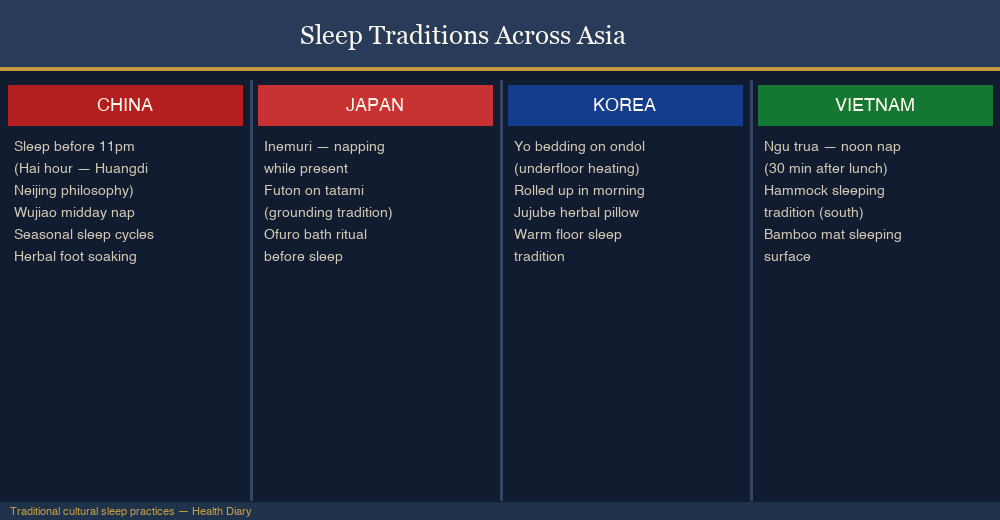
Among the oldest written references to sleep in Chinese culture is the Huangdi Neijing (Yellow Emperor's Classic of Internal Medicine), a foundational text of Chinese wellness philosophy composed over two millennia ago. Within its pages, sleep is discussed not as passive unconsciousness but as an active phase of restoration — a time for blood to return to the liver and for yin energy to replenish itself.
One of the most well-known folk beliefs rooted in this tradition is the idea that falling asleep before 11 PM — the hour known in the twelve-earthly-branches time system as the hai hour (亥时, roughly 21:00–23:00) — allows the gallbladder and liver to complete their natural cycles of detoxification and renewal. Research published in the Journal of Traditional Chinese Medicine has explored how the concept of yin-yang cycles maps onto circadian rhythm ideas, noting that the Neijing divides the day into phases corresponding to organ activity and seasonal energy flows.
Chinese folk tradition also holds that sleep needs shift with the seasons. The classical treatise recommends longer sleep in winter — rising later to conserve yang energy against the cold — and shorter, earlier sleep in summer when yang is abundant. While these remain cultural folk practices rather than clinically proven prescriptions, they reflect a thoughtful engagement with the body's relationship to natural light and temperature cycles.
A beloved everyday sleep-related habit in Chinese folk culture is the wujiao (午觉) — a 30-minute midday nap taken after lunch. This practice is so deeply embedded that it has historically been written into employment contracts in many regions. The 2022 China Healthy Sleep Survey White Paper found that over 60% of respondents in several provinces reported taking frequent midday naps, reflecting the cultural normalization of daytime rest as productive rather than lazy.
Another folk habit associated with pre-sleep care in China is pao jiao (泡脚) — soaking the feet in warm water, often infused with herbs such as mugwort, ginger, or wormwood, before bedtime. This tradition is said to draw excess warmth downward, calm the mind, and ease the transition into sleep. The earliest references to foot health in the context of wellness appear in texts attributed to Sun Si Miao (541–682 CE), who outlined seasonal variations in foot care as part of holistic health maintenance.
Individual responses to any folk practice vary considerably; what works well for one person may not suit another.
Japanese Sleep Culture: Inemuri and Futon Traditions
Japan offers one of the most distinctive approaches to sleep in the world — one that paradoxically combines a culture of sleep deprivation with a culturally accepted practice of napping in public. This practice, known as inemuri (居眠り), literally translates as "sleeping while present." It refers to the act of dozing off on trains, in meetings, or at one's desk — not as a sign of laziness, but as evidence that one has worked so diligently as to become exhausted.
Cambridge University anthropologist Brigitte Steger documented inemuri across a wide range of Japanese social contexts, finding that it carries social meaning tied to status and effort. Senior figures in organizations tend to enjoy more freedom to inemuri, as their naps are read as earned rest rather than negligence. A 2025 review published in Children (Basel) by Dr. Jun Kohyama examined how Japan's Bushido-influenced cultural values — which historically valorized self-sacrifice and asceticism — have shaped attitudes toward sleep, with the cultural norm of minimizing sleep persisting in contemporary Japanese society despite its potential health consequences.
A cross-cultural study published in PLOS ONE (Cheung et al., 2021) found that Japanese university students slept approximately 47 minutes less per day than their European-Canadian peers, yet napped roughly 15 minutes longer. Interestingly, Japanese participants also perceived a weaker connection between sleep and health — suggesting that cultural framing shapes not just behavior but beliefs about rest itself.
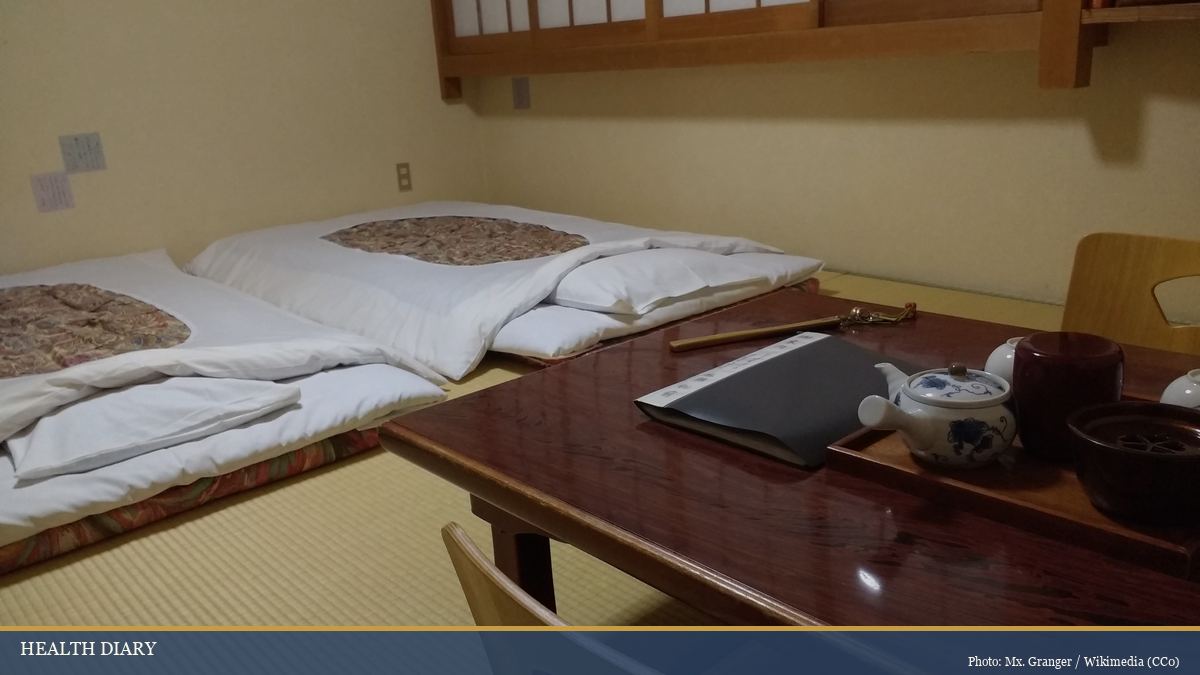
The traditional Japanese sleeping surface — the futon — offers another window into Japanese sleep culture. Rather than a raised bed frame, a futon is a foldable mattress placed directly on a tatami mat (woven rush-grass flooring). This sleeping-close-to-the-floor tradition is practical as well as cultural: the tatami's natural materials regulate moisture and temperature, the low sleeping position reduces fall risk, and storing the futon each morning transforms the sleeping area into a living space — embodying the wabi-sabi principle of simplicity and impermanence.
The Japanese evening bathing ritual, known as ofuro (お風呂), is also deeply intertwined with sleep preparation. A hot soak of 15–30 minutes, followed by natural cooling, activates the parasympathetic nervous system and gradually lowers core body temperature — a physiological shift that research from Osaka City University has associated with faster sleep onset and improved sleep sensation, particularly in cooler months. Individual experiences with this practice vary widely.
Korean Sleep Traditions: Yo Bedding and Ondol
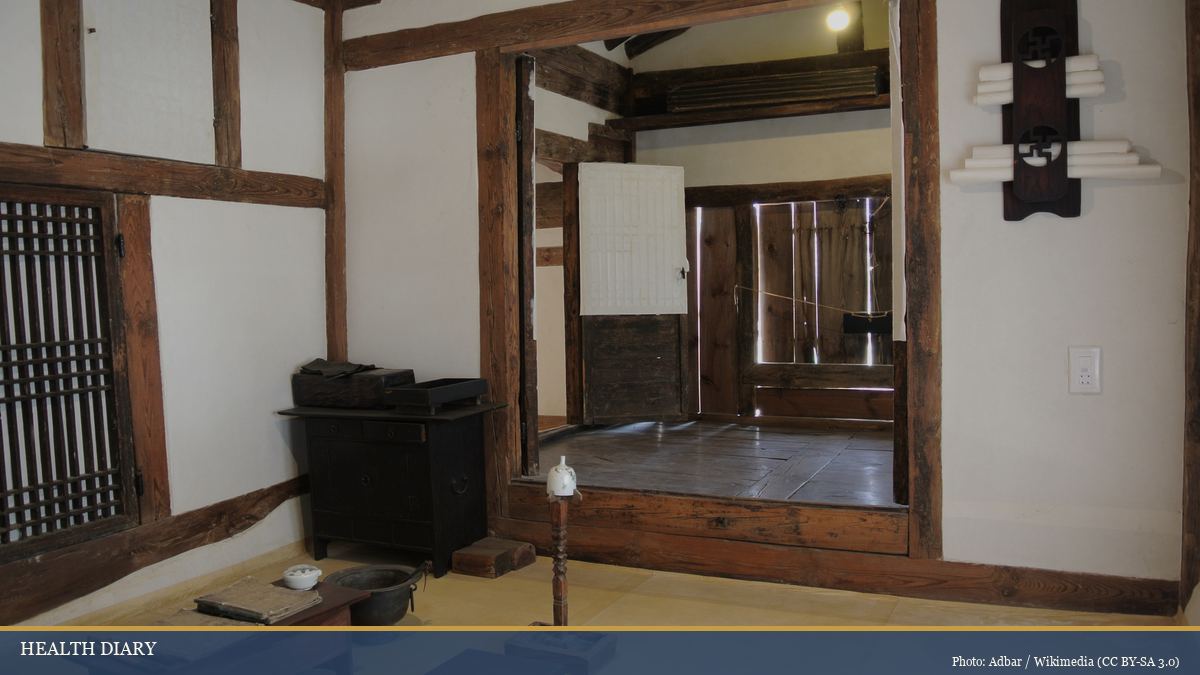
Korean sleeping culture cannot be understood without reference to ondol (온돌) — a system of underfloor heating that has been part of Korean homes for approximately 2,000 years. Traditionally, the floor was heated by channeling hot air or smoke through stone flues beneath the living space, creating a gentle, even warmth rising from the ground. In this context, sleeping close to the floor was not just practical — it was the most comfortable option available.
The traditional Korean sleeping set consists of a yo (요) — a thin, foldable floor mattress — and an ibul (이불) quilted blanket. Each morning, the yo and ibul are neatly folded and stored away, transforming the sleeping room back into a multipurpose living space. This daily ritual of setting up and putting away one's bed reflects a cultural relationship with sleep as a purposeful, bounded activity rather than a permanent state.
The warmth of ondol floor heating offers a particular sensory experience: the heat rises gently and evenly from below, warming the body without drying the air, and many Koreans — particularly older generations — describe the sensation as uniquely restful. Cultural accounts describe how the regulated warmth of the ondol floor may help relax muscles and ease the body into sleep, though this remains a folk understanding rather than a clinical claim.
Korean folk tradition also includes the use of herbal pillows — small cushions stuffed with dried jujube (대추, daechu), dried artemisia (쑥, ssuk), or chrysanthemum flowers — whose gentle fragrance was traditionally believed to calm the mind and ease nighttime restlessness. The practice of stuffing pillows with aromatic herbs is found across many traditional cultures and reflects a sensory approach to sleep preparation.
Individual responses to traditional sleep environments vary considerably; personal comfort and preference always play a significant role.
Vietnamese Sleep Traditions: The Siesta Culture
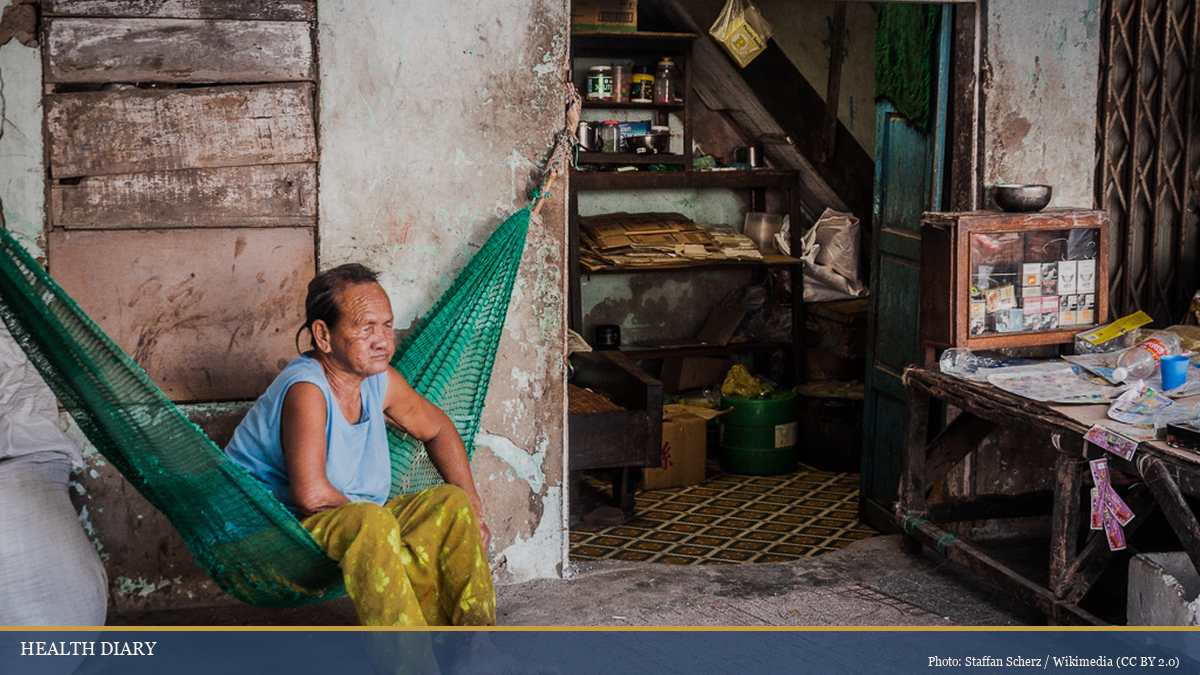
In Vietnam, the midday nap — ngủ trưa (literally "noon sleep") — is a deeply embedded social norm that cuts across urban and rural settings, offices and homes, northern and southern regions. After the main lunch meal, a period of rest ranging from 20 to 45 minutes is considered natural and even necessary, particularly during the hotter months.
The origins of this tradition are rooted in Vietnam's agricultural history. Farmers working under intense midday heat developed the habit of resting during the hottest hours before returning to the fields in the cooler afternoon. As Vietnam urbanized, the practice persisted: many offices dim their lights after lunch, and it is common to see workers resting at their desks, on folded arms, on mats under desks, or in dedicated rest areas. VnExpress International has documented the cultural phenomenon of ngủ trưa surprising foreign visitors accustomed to afternoon alertness as a professional standard.
In southern Vietnam, the hammock holds a special place in sleep culture. Slung between posts in a garden, courtyard, or open veranda, the hammock is an afternoon nap staple — its gentle swaying and elevation off the ground offering coolness and airflow in the tropical heat. The hammock tradition reflects an adaptive response to climate, embodying the Vietnamese principle of living in harmony with natural conditions rather than against them.
Traditional Vietnamese sleeping surfaces also include woven bamboo mats (chiếu) laid on wooden bed frames — materials chosen for their coolness and breathability in a humid climate. The bamboo mat, like the Korean yo and the Japanese futon, represents a culturally specific answer to the question of what makes a good sleeping surface.
What Did Traditional Asian Bedrooms Look Like?
Across Asian sleep traditions, certain environmental themes recur: minimal decoration, natural materials, and attention to temperature and air quality. The Japanese bedroom aesthetic often reflects wabi-sabi principles — simplicity, impermanence, and an appreciation of natural textures. A traditional Japanese sleeping space might contain only the futon on tatami, a low lamp, and perhaps a small shelf — the visual quietness of the room intended to support mental quietness at the end of the day.
Chinese folk wisdom about bedroom arrangement draws on feng shui principles — ensuring that clutter does not accumulate in the sleeping space, that the bed is positioned away from direct drafts, and that the room remains a place of rest rather than work or stimulation. While feng shui is a complex traditional practice with many interpretations, its application to bedroom design consistently emphasizes calm, order, and natural energy flow.
Natural materials appear across all four traditions: bamboo, cotton, natural wood, rush grass. These materials were chosen partly out of necessity and partly because of their functional qualities — breathability, temperature regulation, sensory comfort. Modern sleep research has increasingly supported the value of breathable, natural-fiber bedding for thermal regulation during sleep, offering an interesting parallel to practices that developed independently across Asia over many centuries.
How Do Traditional Asian Cultures Wind Down for Sleep?
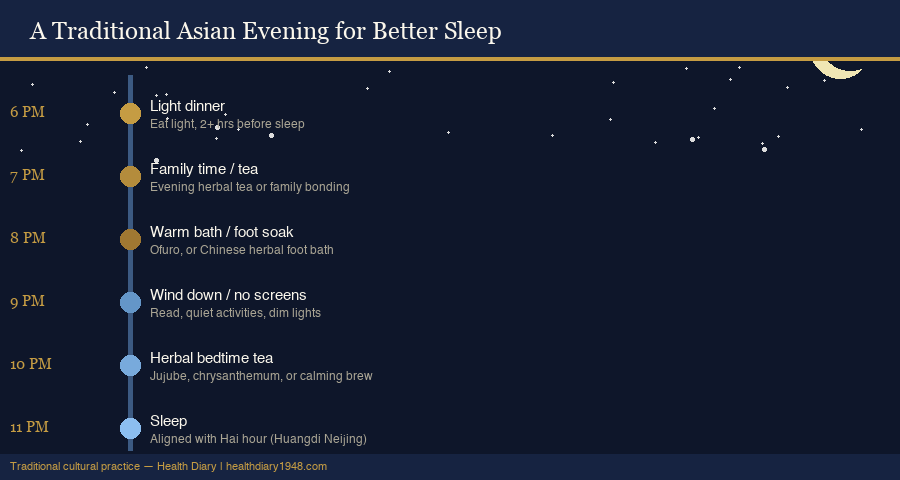
Perhaps the most tangible takeaway from Asian sleep traditions is the idea of an intentional evening transition — a gradual winding down of the day's activity that signals to the body and mind that rest is approaching.
In Chinese folk practice, this transition often includes a warm herbal foot soak (pao jiao) in the hour before bed, with water infused with mugwort, ginger, or other warming herbs. The act is both sensory and symbolic — a deliberate closing of the day.
In Japan, the ofuro bath serves a similar transitional function. The hot soak raises core body temperature temporarily; as it falls afterward, the body receives a natural signal to initiate sleep. This physiological mechanism aligns with what sleep researchers describe as temperature-induced sleep onset.
Korean folk tradition includes an evening tea ritual — often boricha (barley tea) or a mild herbal brew — as part of the family's closing routine. The act of brewing and sharing tea in the evening creates a shared rhythm of winding down.
In Vietnamese tradition, the evening meal tends to be lighter than the midday meal, with the family gathering for quiet conversation before the household settles. The concept of buổi tối bình yên — a peaceful evening — is culturally valued as a precondition for good rest.
Individual experiences with evening routines vary considerably. What promotes relaxation for one person may be neutral or unhelpful for another.
Frequently Asked Questions
What is inemuri and is it really accepted in Japanese workplaces?
Inemuri refers to the Japanese folk practice of napping while present — dozing off briefly in public spaces like trains, meetings, or offices. Anthropological research, including the work of Brigitte Steger of Cambridge University, documents that inemuri has long been culturally accepted in Japan as a sign of hard work and dedication rather than laziness. That said, acceptance varies by workplace and generation, and Japan also has high rates of sleep deprivation, suggesting that inemuri often compensates for insufficient nighttime rest rather than replacing it.
What does the Huangdi Neijing say about sleep?
The Huangdi Neijing (Yellow Emperor's Classic of Internal Medicine) is an ancient Chinese text that discusses sleep in the context of yin-yang energy cycles. It recommends sleeping before the hai hour (around 11 PM) to allow yin energy and organ function to restore, and it suggests adjusting sleep duration seasonally — more sleep in winter, less in summer. These are traditional folk philosophical guidelines, not clinical prescriptions, and reflect a broader view of health as harmony with natural cycles.
Why do Koreans traditionally sleep on the floor?
Korean floor sleeping developed in direct relationship to the ondol underfloor heating system, which has been part of Korean homes for roughly 2,000 years. The warm floor made sleeping at ground level the most comfortable option. Traditional yo (foldable mattress) and ibul (quilted blanket) bedding is designed for floor use and is stored away each morning, transforming the sleeping space into a living area. Many Koreans today use variations of this system, though Western-style beds have also become common.
Is the Vietnamese noon nap (ngu trua) practiced widely today?
Yes, ngủ trưa remains a widespread cultural habit in Vietnam, particularly in offices, schools, and homes across both urban and rural areas. A 30-minute rest after lunch is considered normal and socially acceptable. Some workplaces provide designated rest areas. The practice originated in agricultural communities resting during peak midday heat and has persisted into modern Vietnamese life as a deeply embedded cultural norm.
What are traditional herbal pillows in Korean culture?
Traditional Korean herbal pillows (약초 베개, yakcho bege) are small cushions filled with dried aromatic plants such as jujube seeds, artemisia (mugwort), or chrysanthemum flowers. The mild fragrance is traditionally associated with calming the mind and promoting restful sleep. This is a folk practice with roots in pre-modern Korean household customs, not a clinically evaluated intervention. Individual responses to aromatic sleep aids vary considerably.
Can I try these Asian sleep traditions at home?
Many of these folk habits are straightforward to explore: having a lighter evening meal, taking a warm bath or foot soak before bed, reducing screen use in the evening, and creating a minimal, calm sleeping environment are all low-risk lifestyle adjustments that many people find personally helpful. These are cultural traditions, not medical recommendations. If you have a sleep condition or health concern, consult a licensed healthcare practitioner before making significant changes to your sleep routine.
About This Article
Written by: Health Diary Editorial Team — a group of writers with backgrounds in cultural wellness, food history, and traditional health practices from across Asia.
Editorial review: This article has been reviewed by the Health Diary editorial team for clarity, structure, and adherence to our sourcing standards. Key claims were cross-checked against PMC/PubMed, PLOS ONE, and cultural anthropology references where applicable. It is not a clinical review and should not replace consultation with a licensed healthcare practitioner.
Reviewed on: June 16, 2026.
Editorial process: We cite peer-reviewed and government sources where possible. When a clinical reviewer is added to this article, attribution will appear here with verifiable credentials.
References
- Kohyama, J. (2025). Cultural Approaches to Addressing Sleep Deprivation and Improving Sleep Health in Japan: Sleep Issues Among Children and Adolescents Rooted in Self-Sacrifice and Asceticism. Children (Basel), 12(5), 566. https://pmc.ncbi.nlm.nih.gov/articles/PMC12110608/
- Cheung, B. Y., Takemura, K., Ou, C., Gale, A., & Heine, S. J. (2021). Considering cross-cultural differences in sleep duration between Japanese and Canadian university students. PLOS ONE, 16(4), e0250671. https://journals.plos.org/plosone/article
- Human biological rhythm in traditional Chinese medicine. (2016). Journal of Traditional Chinese Medicine Sciences. https://www.sciencedirect.com/science/article/pii/S2095754816301028
- Nippon.com. (2022). A Dip a Day: The Surprising Health Benefits of the Japanese Bath. https://www.nippon.com/en/japan-topics/g00883/
- VnExpress International. (2022). Vietnamese siesta culture opens foreigners' eyes. https://e.vnexpress.net/news/news/vietnam-s-siesta-culture-eye-opening-for-foreigners-4607443.html
- Korea Daddy. (2023). Korea Ondol Guide: Sleeping on a Heated Floor and Why It Works. https://koreadaddy.com/korea-ondol-heated-floor-sleeping/
- Tatler Asia. (2023). 8 sleep practices and rituals across Asia for better rest and wellness. https://www.tatlerasia.com/lifestyle/wellbeing/sleep-habits-rest-rituals-asia
This article explores traditional cultural approaches to sleep. It is not medical advice.