Japanese Healthy Aging Traditions: Lessons from Okinawa and Beyond
Explore the traditional practices behind Japan's remarkable longevity — from the Okinawa diet and hara hachi bu to ikigai, forest bathing, and fermented food traditions.
Medical Disclaimer: This content is for educational and informational purposes only and is not medical advice. The information presented is not intended to diagnose, treat, cure, or prevent any disease. Always consult a licensed healthcare practitioner before starting any new wellness practice or dietary change. Statements regarding traditional practices have not been evaluated by the FDA.
Affiliate Disclosure: This article contains affiliate links. We may earn a commission if you purchase through these links, at no additional cost to you. We only recommend products we believe align with our editorial standards.
Japan consistently ranks among the world's longest-lived nations. Japanese women hold the global record for life expectancy at 87.1 years — a distinction maintained for more than 40 consecutive years according to WHO data. And within Japan, the island prefecture of Okinawa has long fascinated researchers for its extraordinary concentration of centenarians. Historically, Okinawa boasted more people aged 100 and over per capita than virtually any other place on Earth, earning its place as one of Dan Buettner's original five Blue Zones — regions identified by National Geographic researchers as having unusually high rates of healthy longevity.
What explains this remarkable pattern? Researchers have spent decades examining the question, and the emerging picture is richly complex: traditional food patterns, cultural attitudes toward eating, deeply rooted social connections, purposeful daily rhythms, and an almost instinctive relationship with nature all appear to weave together into a lifestyle that historically supported graceful, active aging well into the ninth and tenth decades of life. This article explores those traditions — not as a prescription, but as a lens through which we might understand what has historically accompanied long, healthy life in Japan.
The Okinawa Diet: Traditional Foods of Japan's Centenarians
The most studied aspect of Okinawan longevity is diet. A landmark 2007 analysis by Willcox, Willcox, Todoriki, and colleagues, drawing on six decades of archived population data, found that elderly Okinawans had maintained low caloric intake, low body mass index, and a dietary pattern strikingly different from post-World War II Western norms. Their findings, published in the Annals of the New York Academy of Sciences, supported the hypothesis that caloric restriction combined with high nutrient density may be associated with extended healthy lifespan in humans.
A subsequent paper by Willcox DC and colleagues, published in the Journal of the American College of Nutrition (2009), characterized the traditional Okinawan dietary pattern as "a low-calorie, nutrient-dense, antioxidant-rich dietary pattern low in glycemic load." Several traditional foods appear prominently in the historical record:
- Sweet potato (imo): Before rice became widely adopted, sweet potato — particularly the purple and yellow varieties — provided the majority of calories in the traditional Okinawan diet. Orange-yellow root vegetables like sweet potato are calorie-poor but rich in antioxidants and phytonutrients.
- Bitter melon (goya): A distinctive staple of Okinawan cooking, bitter melon is traditionally stir-fried and consumed regularly. Its inclusion in folk wellness traditions across East Asia reflects centuries of cultural use.
- Seaweed and konbu (kelp): Sea vegetables such as hijiki, wakame, and konbu have been dietary staples in coastal Japanese communities for generations, contributing minerals and fiber to daily meals.
- Soy-based foods: Tofu, miso, edamame, and natto (fermented soybeans) form an important protein source in the traditional Japanese diet — and some, like natto, carry additional associations in the research literature with bone and cardiovascular wellness (discussed in the fermented foods section below).
- Minimal meat intake (pre-1940s): Historical records suggest that in the traditional Okinawan diet prior to World War II, pork and other meats were consumed sparingly, often reserved for festivals and special occasions rather than as daily fare.
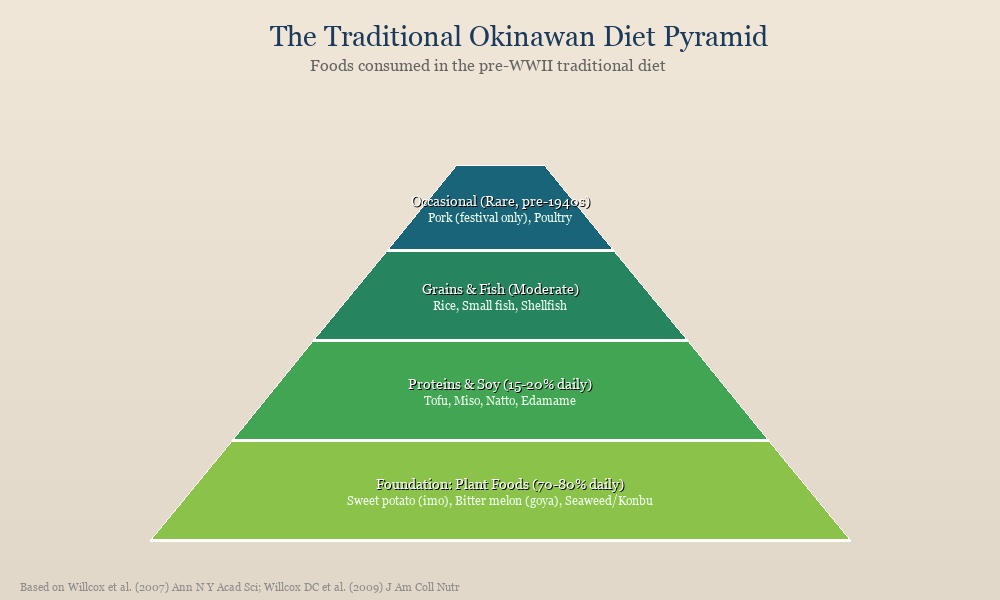
Importantly, researchers note that after World War II, Okinawan dietary patterns began shifting significantly toward Western foods, and subsequent generations have shown a corresponding change in health metrics. This historical context is important: the longevity associations are linked to the traditional pre-modernization diet, not necessarily contemporary eating habits on the islands.
What Is Hara Hachi Bu and How Does It Support Longevity?
Perhaps no traditional Japanese wellness practice has captured more attention in longevity research than hara hachi bu — a Confucian-influenced saying that translates roughly as "eat until you are eight parts (out of ten) full." The practice traces its roots to moral teachings that arrived in the Ryukyu Islands from China and gradually became embedded in daily domestic life over several centuries.
The practical effect of hara hachi bu is a natural reduction in caloric intake — research on Okinawan centenarian cohorts documented daily consumption of approximately 1,800 to 1,900 calories, significantly below Western averages, while nutritional status remained excellent. The biological rationale is straightforward: the satiety signal from the stomach reaches the brain with a delay of roughly 15–20 minutes, meaning that pausing at a point of moderate fullness — rather than waiting for complete satiation — consistently results in lower total food consumption.
The Blue Zones research team, working with Okinawan communities, documented this practice as one of the lifestyle factors most consistently associated with the region's historically high centenarian rates. For those interested in exploring mindful eating traditions, hara hachi bu represents one of the oldest culturally embedded examples of intentional moderation. Individual responses to any dietary approach vary considerably, and what works well within one cultural context may need thoughtful adaptation in another.
Ikigai: Purpose and Healthy Aging
Ikigai — loosely translated as "a reason for being" or "a sense of life worth living" — is a concept deeply embedded in Japanese culture. Unlike Western notions of retirement as withdrawal from purpose, Japanese wellness traditions have long emphasized maintaining meaningful engagement throughout life as a natural part of healthy aging.
A landmark prospective cohort study by Sone and colleagues (2008), published in Psychosomatic Medicine and known as the Ohsaki Study, followed 43,391 Japanese adults over seven years. Those who reported not having a sense of ikigai showed a significantly higher risk of all-cause mortality (hazard ratio 1.5, 95% CI 1.3–1.7) compared to those who did. The association was particularly notable for cardiovascular disease mortality.
More recently, a 2022 longitudinal analysis by Okuzono and colleagues, published in The Lancet Regional Health — Western Pacific, found that Japanese older adults with ikigai showed a 31% lower risk of developing functional disability and a 36% lower risk of dementia over a three-year follow-up period. Participants also showed decreased depressive symptoms and greater social participation.

Central to Okinawan ikigai traditions is the concept of moai — small, committed community networks that form in childhood and persist across an entire lifetime. These groups of typically five individuals provide mutual aid — emotional, practical, and social — across all of life's seasons. Researchers studying Blue Zone communities describe moai as a fundamental social infrastructure, with the consistent, reliable presence of close social bonds throughout life being associated with better health outcomes in the broader literature. Individual responses to community practices vary, of course, and the strength of social connection is just one factor among many in the complex story of healthy aging.
Shinrin-Yoku: Forest Bathing Traditions
The term shinrin-yoku — meaning "forest bath" — was coined in 1982 by Tomohide Akiyama of Japan's Ministry of Agriculture, Forestry and Fisheries as a formal public health concept. While the term itself is modern, it gives name to something that Japanese culture has long practiced informally: the deliberate immersion of one's senses in natural forested environments as a restorative activity.
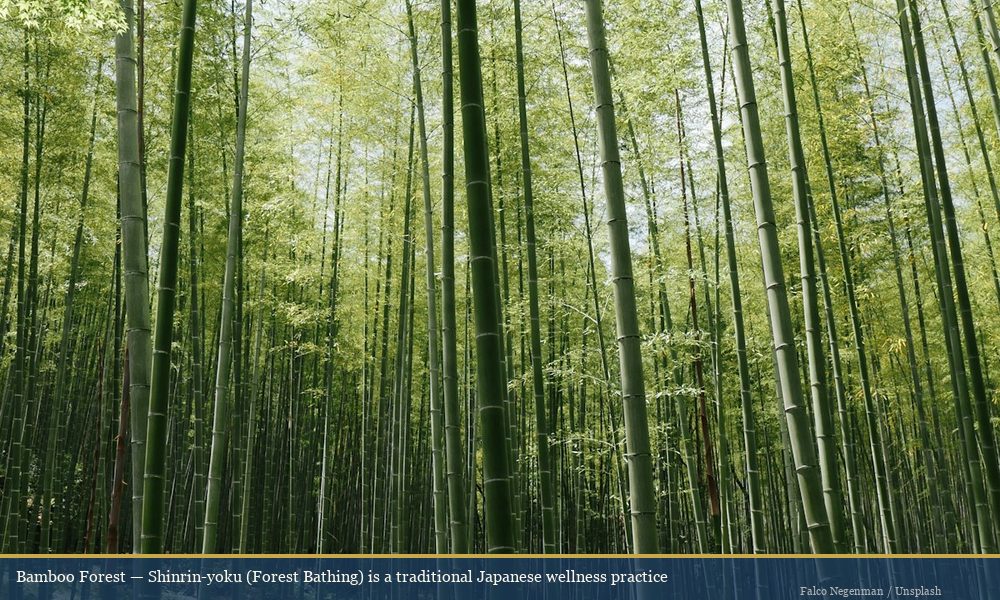
Decades of subsequent research have explored the physiological correlates of time spent in forest environments. A frequently cited 2010 study by Li Q., published in Environmental Health and Preventive Medicine (PMID: 19568839), found that participants who spent three-day, two-night periods in forest settings showed increased natural killer (NK) cell activity and elevated intracellular levels of anti-cancer proteins compared to urban control environments. Reduced urinary adrenaline concentrations suggested a measurable shift in stress response.
A 2022 review published in Environmental Health and Preventive Medicine (PMC9665958), covering decades of shinrin-yoku research, concluded that forest environments are associated with reductions in cortisol levels, blood pressure, and heart rate, alongside improvements in mood and vigor scores. Researchers attribute some of these effects to phytoncides — volatile organic compounds released by trees — as well as to the broader sensory qualities of natural environments.
For the Japanese, forest bathing has traditionally not been a formal exercise but an informal cultural practice: walking in wooded areas, sitting quietly under trees, listening to water and birdsong. Many older Japanese communities maintain this relationship with nature as an unremarkable part of daily or weekly rhythm. Individual experiences of nature immersion vary, and the research, while suggestive, continues to develop.
How Do Japanese Morning Tea Rituals Support Wellness?
Japan's relationship with green tea — particularly sencha and matcha — is inseparable from its wellness traditions. Tea in Japanese culture is not merely a beverage; it is a daily ritual that structures time, invites mindfulness, and provides a moment of quiet in the rhythm of the day.
From a research perspective, green tea contains catechins — particularly epigallocatechin gallate (EGCG) — along with L-theanine, a naturally occurring amino acid associated with relaxed alertness. Epidemiological studies have linked green tea consumption in Japanese populations with various health associations, though researchers consistently note that tea is just one element within a larger lifestyle context.
Beyond tea, traditional Japanese daily rhythms have historically included gentle morning movement practices such as rajio taiso (radio calisthenics) — a decades-old national tradition of simple morning stretches performed to music broadcast by NHK Radio, practiced widely in communities and workplaces. Evening practices in many traditional households involved deliberate wind-down rituals: warm baths, quiet reading, and early sleep times. These daily rhythm structures are thought by some researchers to benefit circadian rhythms, though individual experiences vary considerably.
Traditional Japanese Fermented Foods for Gut Health
Fermented foods have been central to Japanese cuisine for centuries. The most prominent include:
- Miso: A fermented soybean paste used as the base for the ubiquitous miso soup consumed at Japanese breakfasts and throughout the day. Miso introduces live beneficial cultures alongside umami-rich amino acids.
- Natto: Perhaps the most culturally distinctive of Japan's fermented foods, natto (fermented whole soybeans) is known for its pungent aroma and sticky texture. It is the richest dietary source of menaquinone-7 (MK-7), a form of vitamin K2. A 2025 meta-analysis published in Frontiers in Nutrition (PMC12699326) found that habitual natto consumption in Japanese populations was associated with elevated serum MK-7 levels and improved measures of osteocalcin carboxylation, a marker of bone health.
- Tsukemono (pickled vegetables): Traditional Japanese pickles made from vegetables like daikon, cucumber, and cabbage using salt, rice bran, vinegar, or miso. These provide both probiotic cultures and prebiotic fiber.
- Umeboshi: Salt-pickled plums with a sour, intensely flavored profile that has made them a folk wellness staple in Japan for centuries. Used traditionally as a digestive aid and as part of the standard Japanese breakfast.
Research published in News-Medical.net (2024), summarizing recent nutritional science on the traditional Japanese diet (washoku), noted associations between Japan's fermented, fiber-rich dietary pattern and markers of gut microbiome diversity, which some researchers have linked to healthy aging trajectories. Research on centenarians at Keio University's Center for Centenarian Medical Research, summarized in a 2023 paper in the Japanese Journal of Nutrition and Dietetics (J-STAGE, Vol. 44, No. 4), found that gut microbiota profiles may represent a distinguishing characteristic of those who age with exceptional health — a research direction with much still to be explored.
Individual responses to fermented foods vary considerably — digestive tolerance, microbial starting points, and other dietary factors all influence outcomes. As always, significant dietary changes are best made in conversation with a qualified healthcare provider.
Japan vs World: Longevity by the Numbers
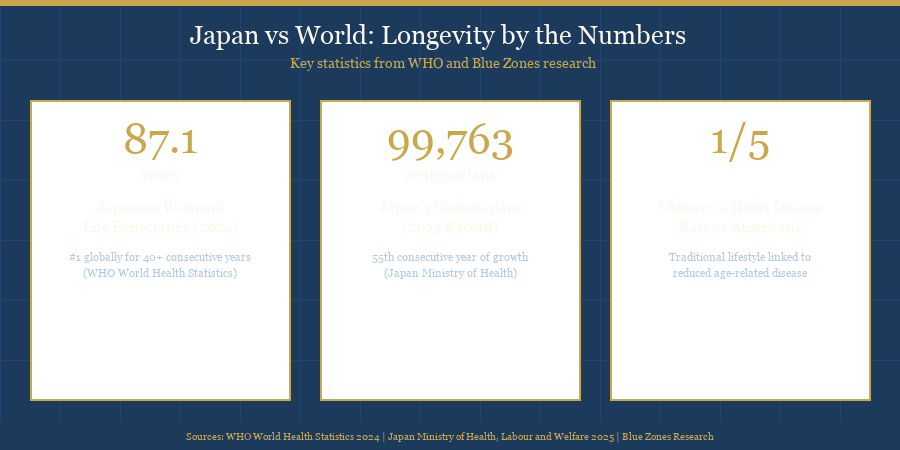
It is worth grounding this discussion in data. As of 2024, Japan's women hold the world's highest life expectancy at 87.1 years — a distinction maintained for more than four decades (WHO World Health Statistics 2024). Japan's centenarian population reached a record 99,763 in 2025, the 55th consecutive year of growth (Japan Ministry of Health, Labour and Welfare). And historically, Okinawa's rates of cardiovascular disease and certain cancers have been substantially lower than those seen in Western populations — research from the Blue Zones expeditions documented that Okinawans historically experienced approximately one-fifth the heart disease and one-third the rate of dementia compared to Americans.
These figures do not exist in isolation. Japan also maintains universal healthcare access, high levels of educational attainment, and a food culture that has historically prioritized vegetables, fish, and fermented foods over heavily processed items. Longevity is almost certainly multifactorial. But the traditional practices described in this article appear, based on the available research, to be associated with — rather than merely coincidental to — Japan's exceptional health outcomes.
Frequently Asked Questions
What is hara hachi bu and how does it relate to longevity?
Hara hachi bu is a traditional Okinawan-Japanese practice of stopping eating when approximately 80% full, rooted in Confucian dietary teachings. Research on Okinawan centenarian cohorts has historically associated this habit with lower daily caloric intake and a lower BMI compared to Western populations. The biological mechanism involves the delay between eating and satiety signaling reaching the brain. Individual experiences vary, and those with specific health conditions should consult a healthcare provider before making significant dietary changes.
What is ikigai and does it really affect health?
Ikigai is a Japanese concept meaning "a sense of life worth living" — a feeling of purpose and meaningful engagement. The Ohsaki Study (Sone et al., 2008) followed over 43,000 Japanese adults and found that those without a sense of ikigai had a 50% higher risk of all-cause mortality over seven years. A 2022 Lancet Regional Health paper found associations between ikigai and lower risks of functional disability and dementia. These are observational associations, not proof of causation, and individual experiences vary widely.
Is shinrin-yoku (forest bathing) supported by research?
Multiple studies, including research by Li Q. (2010) on immune function and broader reviews published through 2022, have found associations between time in forested environments and measurable physiological changes — including reduced stress hormones, lower blood pressure, and improved mood. The research base is growing, though most studies are relatively small and the mechanisms are still being explored. Forest bathing is generally considered a low-risk wellness practice for most people, though individual responses vary.
What makes the traditional Okinawan diet different?
The pre-WWII traditional Okinawan diet was characterized by high consumption of sweet potatoes, bitter melon, tofu, seaweed, and soy products, with very low intake of meat and processed foods. Research has described it as "low-calorie, nutrient-dense, and antioxidant-rich with a low glycemic load" (Willcox DC et al., 2009). It is important to note that contemporary Okinawan diets have shifted significantly, and researchers caution against conflating modern eating habits with the historical pattern associated with longevity.
What is a moai and how does social connection relate to longevity?
Moai are small, lifelong community networks — typically five people — that form in Okinawan communities during childhood and persist across entire lifetimes, providing mutual emotional and practical aid. Broader research on social connection consistently finds associations between strong social bonds and better health outcomes, including reduced mortality risk. The specific contribution of moai to Okinawan longevity is difficult to isolate, but the broader literature on social determinants of health is substantial.
Can I practice these Japanese traditions outside Japan?
Many of these practices — mindful eating, time in nature, maintaining purposeful social connections, incorporating fermented foods like miso and natto, and daily movement rituals — can be adapted to life outside Japan. Whether they will produce the same health associations in different cultural, dietary, and healthcare contexts is unknown. Individual responses vary considerably, and adopting any wellness practice works best as part of a holistic approach discussed with a qualified healthcare provider.
About This Article
Written by: Health Diary Editorial Team — specialists in traditional Asian wellness research and health communication.
Editorial review: This article has been reviewed by the Health Diary editorial team for clarity, structure, and adherence to our sourcing standards. Key claims were cross-checked against NCCIH, NIH PubMed, WHO, and J-STAGE peer-reviewed sources where applicable. It is not a clinical review and should not replace consultation with a licensed healthcare practitioner.
Reviewed on: June 16, 2026.
Editorial process: We cite peer-reviewed and government sources where possible. When a clinical reviewer is added to this article, attribution will appear here with verifiable credentials.
References
- Willcox BJ, Willcox DC, Todoriki H, et al. Caloric restriction, the traditional Okinawan diet, and healthy aging: the diet of the world's longest-lived people and its potential impact on morbidity and life span. Ann N Y Acad Sci. 2007;1114:434-455. https://pubmed.ncbi.nlm.nih.gov/17986602/
- Willcox DC, Willcox BJ, Todoriki H, Suzuki M. The Okinawan diet: health implications of a low-calorie, nutrient-dense, antioxidant-rich dietary pattern low in glycemic load. J Am Coll Nutr. 2009;28(sup4):500S-516S. https://www.tandfonline.com/doi/abs/10.1080/07315724.2009.10718117
- Sone T, Nakaya N, Ohmori K, et al. Sense of life worth living (ikigai) and mortality in Japan: Ohsaki Study. Psychosom Med. 2008;70(6):709-715. doi:10.1097/PSY.0b013e31817e7e64. https://journals.lww.com/bsam
- Okuzono SS, Shiba K, Kim ES, et al. Ikigai and subsequent health and wellbeing among Japanese older adults: longitudinal outcome-wide analysis. Lancet Reg Health West Pac. 2022;21:100391. https://pmc.ncbi.nlm.nih.gov/articles/PMC8814687/
- Li Q. Effect of forest bathing trips on human immune function. Environ Health Prev Med. 2010;15(1):9-17. https://pubmed.ncbi.nlm.nih.gov/19568839/
- Li Q, Ochiai H, Ochiai T, et al. Effects of forest environment (Shinrin-yoku/Forest bathing) on health promotion and disease prevention. Environ Health Prev Med. 2022;27:43. https://pmc.ncbi.nlm.nih.gov/articles/PMC9665958/
- Arai Y. Centenarians and super-elderly: healthy longevity and diet from research perspectives [in Japanese]. Jpn J Nutr Diet. 2023;44(4):135-142. https://www.jstage.jst.go.jp/article/jjscnut/44/4/44_135/_article/
- Habitual natto intake elevates serum MK-7 levels, enhances osteocalcin carboxylation, and supports bone density: a meta-analysis of Japanese evidence. Front Nutr. 2025. https://pmc.ncbi.nlm.nih.gov/articles/PMC12699326/
- Blue Zones. Okinawa, Japan. https://www.bluezones.com/explorations/okinawa-japan/
- Japan Ministry of Health, Labour and Welfare. Report on centenarian population 2025. https://www.newsonair.gov.in/japans-centenarian-population-hits-record-99763
This article is for educational purposes only and reflects traditional cultural practices. It does not constitute medical advice. Consult a qualified healthcare provider before making changes to your diet or lifestyle.