Chrysanthemum Flower Tea: China's Ancient Cooling Herbal Infusion
Discover chrysanthemum flower tea (Ju Hua Cha), China's beloved cooling herbal infusion. Learn about the four premier brewing cultivars, TCM properties, key antioxidant compounds, and how to brew the perfect cup at home.
A Flower in Every Chinese Cup
Walk through any traditional Chinese neighborhood on a warm afternoon and you are likely to encounter the faint, honeyed aroma of Ju Hua Cha — chrysanthemum flower tea — drifting from kitchen windows, tea houses, and dim sum restaurants alike. For centuries this pale golden infusion has been as ordinary and essential to Chinese daily life as a glass of water, yet it carries within it one of the richest herbal traditions in the world.
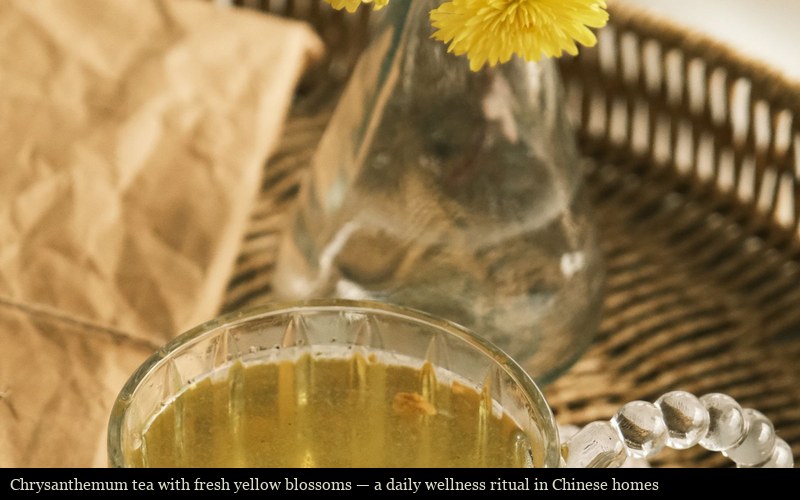
Unlike the highly processed teas made from Camellia sinensis leaves — green, oolong, or black — chrysanthemum tea is a pure floral infusion. The dried blossoms of Chrysanthemum morifolium are steeped directly in hot water, releasing their fragrant compounds and imparting a liquor that ranges from pale straw to warm amber, depending on the cultivar and brewing method. There is no oxidation step, no rolling, and no firing. The flower speaks for itself.
This guide focuses on chrysanthemum tea as a beverage: its place in Chinese tea culture, the celebrated cultivar varieties used for brewing, the principles of Chinese herbal theory that explain why generations of Chinese families reach for this flower whenever the body feels overheated or the eyes feel strained, and the practical steps needed to brew an excellent cup at home.
A Tea with Two Thousand Years of History
The chrysanthemum has been cultivated in China for more than 2,500 years, making it one of the oldest ornamental and therapeutic plants in Chinese civilization. Its first systematic written record appears in the Shennong Bencao Jing (The Divine Farmer's Classic of Materia Medica), compiled between roughly 200 and 250 CE from much older oral traditions. There, chrysanthemum is assigned to the superior class of herbs — those deemed safe for extended consumption and capable of nourishing rather than merely treating the body. The text records that chrysanthemum can "clear the eyes, calm the spirit, and prolong life with prolonged use."[1]
By the Tang Dynasty (618–907 CE), chrysanthemum had already made its way into the imperial court's culinary and beverage repertoire. Historical accounts note that chrysanthemum-infused preparations were presented alongside early tea blends for the Emperor and the aristocracy. During the Song Dynasty (960–1279 CE), the flower's cultural status reached new heights. Liu Meng's Manual of Chrysanthemum, published in 1104 CE, catalogued thirty-five varieties and became the first dedicated monograph on the plant in Chinese literature. This was also the era when chrysanthemum began appearing as a poetic symbol of scholarly integrity and autumn beauty — associations that persist in Chinese art and literature to this day.
By the Ming and Qing dynasties, drinking chrysanthemum tea as a cooling beverage had become a widespread practice across all social classes. The Qing court reportedly maintained designated chrysanthemum gardens near Beijing, and regional cultivars began to develop distinct identities, each prized for specific flavor and appearance qualities. Four of these cultivars would eventually rise to prominence as the definitive brewing varieties recognized across China.
The Four Premier Cultivars for Brewing
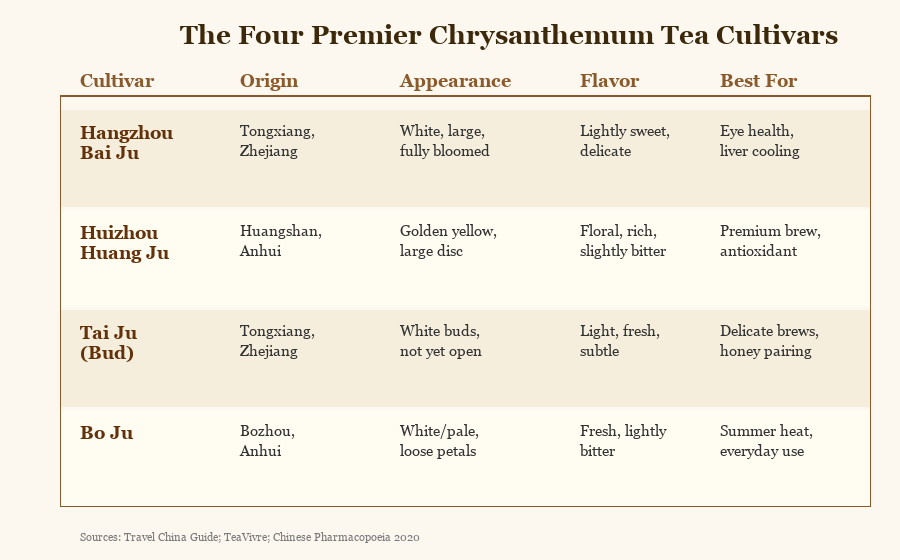
Not all chrysanthemums are equal when it comes to the teacup. Over centuries of cultivation, Chinese growers and tea practitioners identified four regional varieties as the gold standard for brewing — each with a distinct terroir, appearance, flavor profile, and traditional application. These are collectively known among tea connoisseurs as the "four famous chrysanthemums" (Si Da Ming Ju).
Hangzhou Bai Ju (Hang Bai Ju)
Grown in Tongxiang County near Hangzhou in Zhejiang Province, the Hangzhou white chrysanthemum is perhaps the most widely recognized brewing cultivar both within China and internationally. Its flowers are large and fully bloomed, with a characteristic snowy white hue and a gently sweet, floral flavor with almost no bitterness. The brew is pale yellow and translucent, with a delicate honey-like fragrance. In Chinese herbal tradition, white chrysanthemum is considered the preferred variety for supporting liver health and soothing the eyes — qualities attributed to its notably mild energetic character. Many commercial chrysanthemum teas sold in China and internationally use Hangzhou Bai Ju as their base.
Huizhou Huang Ju (Huangshan Gong Ju)
Cultivated in the foothills below Huangshan (Yellow Mountain) in Anhui Province at altitudes exceeding 3,000 feet, Huizhou Huang Ju — also called Gong Ju or "tribute chrysanthemum" — carries an imperial pedigree. Its golden-yellow flowers are notably large, with a deep amber liquor that delivers a more robust and complex flavor than its white counterparts. The taste is distinctly floral with a pleasant bittersweet finish. Huizhou Huang Ju is often described as the "king of chrysanthemums" for its high nutritional density and intense antioxidant profile. It was historically sent as tribute to the imperial court and remains a premium product prized by discerning tea drinkers.[2]
Tai Ju (Tongxiang Bud Chrysanthemum)
Tai Ju comes from the same Tongxiang growing region as Hangzhou Bai Ju, but is harvested at a distinctly earlier stage — when the buds have not yet fully opened. This bud-form chrysanthemum (often sold as "chrysanthemum buds" or "Tai chrysanthemum") produces a lighter, more subtle infusion than its fully-bloomed counterpart. The brew is particularly clear and pale, with a fresh, slightly grassy note beneath the floral character. Tai Ju is a favorite for blending with honey and rock sugar, as its restrained flavor allows sweeteners to complement rather than compete. Brewing recommendation: use approximately 3 grams in 355 ml of water at 100°C, steeping for 1–3 minutes.
Bo Ju (Bozhou Chrysanthemum)
Originating in Bozhou, Anhui Province — a city historically celebrated as one of China's great centers of Chinese herbal commerce — Bo Ju features looser, more spreading petals in conical or cylindrical arrangements and a white to light-yellow coloration. Its flavor is fresh and clean with a lightly bitter edge that makes it particularly suited to preparations intended for clearing summer heat and supporting the immune system. Bo Ju is among the most widely used varieties in everyday Chinese household brewing and is often the cultivar found in the large glass jars of chrysanthemum tea served at Chinese restaurants throughout Southeast Asia.
TCM Perspective: Cooling the Body, Clearing the Liver
Within the framework of Chinese herbal theory, chrysanthemum (Ju Hua) is classified as a cool-natured herb with a sweet and slightly bitter taste. It enters the Lung and Liver meridians — the two organ systems considered most relevant to eye health, emotional balance, and respiratory wellness in classical Chinese thinking.
Its four primary actions, as described in classical Chinese herbal literature and confirmed in the contemporary Chinese Pharmacopoeia (2020 edition), are:
- Dispersing Wind-Heat: Chrysanthemum is used when the body is experiencing a Wind-Heat pattern — the Chinese diagnostic category that corresponds roughly to a mild upper respiratory infection with symptoms such as sore throat, mild fever, headache, and redness of the eyes.
- Calming Liver Yang: When the Liver's Yang energy rises excessively — manifesting as throbbing headaches, irritability, dizziness, and red eyes — chrysanthemum tea is used to settle and descend this energy.
- Clearing Liver Heat and Brightening the Eyes: This is perhaps the most commonly cited application in everyday Chinese practice. Eye redness, dryness, photosensitivity, and visual fatigue associated with Liver Heat are traditionally addressed by drinking chrysanthemum tea regularly.
- Clearing Heat and Resolving Toxicity: For mild inflammatory skin conditions and sores associated with toxic heat patterns, chrysanthemum tea may be part of a broader herbal protocol.
A classical text observation worth noting: chrysanthemum is described as an herb that "draws inward and descends" rather than dispersing outward like most flowers — a quality that explains its particular affinity for calming Liver-related complaints rather than simply releasing pathogens from the surface of the body. This is considered one of chrysanthemum's distinguishing characteristics among cooling herbs.[3]
What Science Finds in the Cup
Modern phytochemical research has identified several bioactive compounds in chrysanthemum flower infusions that help explain both the antioxidant and anti-inflammatory properties attributed to this beverage in traditional practice.
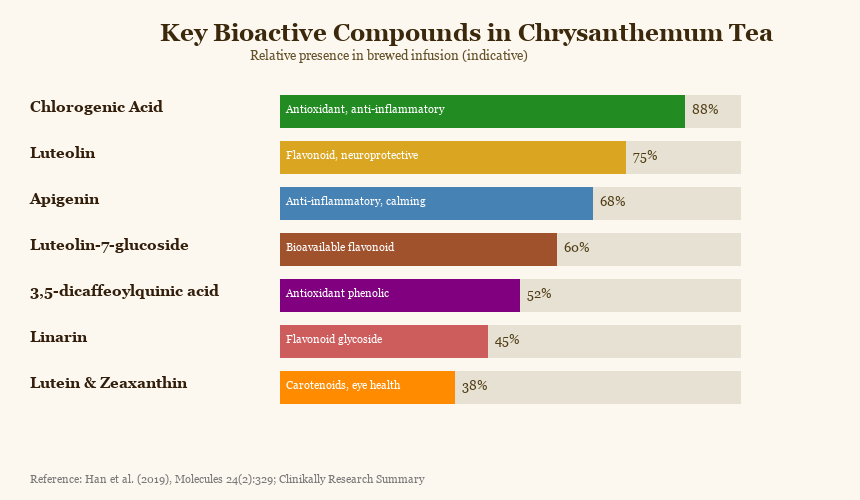
A 2019 study published in the journal Molecules (Han et al., Volume 24, Issue 2) compared the phytochemical composition and antioxidant activities of different chrysanthemum flower teas and found that brewed chrysanthemum tea contains meaningful concentrations of chlorogenic acid, luteolin, apigenin, luteolin-7-O-beta-glucoside, 3,5-dicaffeoylquinic acid, and linarin. Both DPPH and ABTS radical scavenging assays confirmed strong antioxidant activity, with some preparations exceeding the performance of ascorbic acid (vitamin C) in ABTS scavenging at optimal brewing temperature.[4]
Key compounds of interest include:
- Chlorogenic acid: A phenolic acid with well-documented antioxidant and anti-inflammatory properties, also found in coffee and green tea. In chrysanthemum, it is one of the dominant extractable compounds in hot-water infusion.
- Luteolin and apigenin: Flavonoids that have been the subject of research for their anti-inflammatory, neuroprotective, and mild anxiolytic properties in preclinical models.
- Lutein and zeaxanthin: Carotenoids that accumulate in the human retina and are associated with protection against age-related macular degeneration by filtering harmful blue light and reducing oxidative stress in eye tissue.
It is important to note that most scientific studies on chrysanthemum compounds use concentrated extracts rather than the relatively dilute concentrations found in a brewed cup of tea. The quantities of bioactive compounds extracted during typical home brewing are likely to be modest, and claims about specific clinical effects from drinking chrysanthemum tea as a beverage remain preliminary pending more rigorous human trials.
Eye Health and the Screen-Age Revival
Of all chrysanthemum tea's traditional associations, its connection to eye health may be the most resonant in the contemporary world. The Chinese practice of drinking chrysanthemum tea to soothe tired, red, or dry eyes dates back at least to the Tang Dynasty, and it has experienced a genuine cultural revival in modern China and across the Chinese diaspora as screen time has become ubiquitous.
The logic within Chinese herbal theory is consistent: the Liver meridian opens into the eyes, and prolonged visual concentration — whether from reading classical texts by candlelight or staring at a computer monitor for eight hours — is understood to deplete Liver Blood and generate Liver Heat. Chrysanthemum tea, as a Liver-cooling and eye-brightening herb, is seen as a logical daily countermeasure.
From a nutritional standpoint, the lutein and zeaxanthin content in chrysanthemum may provide some relevance here. These carotenoids are known to accumulate in the macula of the retina and act as a kind of internal optical filter, absorbing high-energy blue and violet light before it can reach the photoreceptors. Oxidative stress from blue light exposure and UV radiation is understood by vision scientists to be a contributing factor in age-related changes to eye health over the long term.
Many Chinese office workers, students, and healthcare practitioners maintain the daily habit of keeping a glass of chrysanthemum tea at their desk as a gentle, culturally familiar way of caring for their vision. Whether the specific quantities of compounds in a single cup make a measurable clinical difference remains an open research question, but the practice fits comfortably within a broader diet rich in antioxidant-containing foods.
Chrysanthemum and Goji Berry Tea: A Classic Pairing
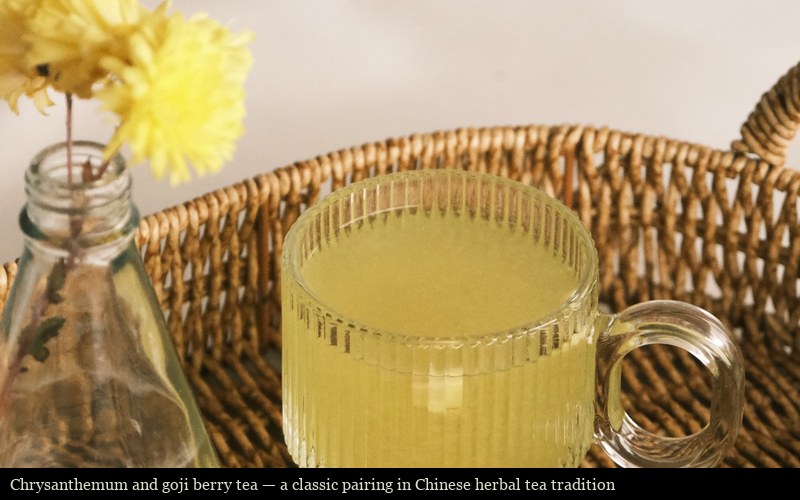
One of the most beloved and enduring combinations in Chinese herbal beverage culture is the pairing of chrysanthemum flowers with goji berries (wolfberries, Lycium barbarum). Known as Ju Qi Cha, this combination appears in Chinese household cooking books, restaurant menus from Hong Kong to Singapore, and contemporary wellness brands throughout Asia.
The pairing makes intuitive sense within Chinese herbal logic: chrysanthemum is cooling and descending, working on the Liver and Lungs; goji berry is warming and nourishing, tonifying the Liver and Kidneys and directly supporting the eyes through its high zeaxanthin content. Together, they are considered complementary rather than redundant — the cooling action of chrysanthemum balancing the warming, tonifying action of goji, resulting in a tea that addresses both deficiency (nourishment) and excess (heat) simultaneously.
The basic preparation is simple: add 5–8 dried chrysanthemum flowers and 10–15 goji berries to a glass or teapot. Pour 250–300 ml of water heated to 90–95°C over the ingredients. Allow to steep for 3–5 minutes. The goji berries will plump and soften, contributing a faint natural sweetness that complements the floral delicacy of the chrysanthemum infusion. A small piece of rock sugar or a drizzle of raw honey may be added if desired.
How to Brew Chrysanthemum Tea
Brewing chrysanthemum tea requires little equipment and no specialized skill, but attention to a few key variables makes a noticeable difference in the final cup.
Water Temperature
Most chrysanthemum varieties brew well at 90–95°C. Boiling water (100°C) can be used for Tai Ju buds, as research suggests it maximizes compound extraction from the tightly closed buds. For fully bloomed white varieties such as Hangzhou Bai Ju, slightly cooler water (90°C) preserves more of the delicate volatile aromatics that give the tea its characteristic floral fragrance.
Quantity
A standard serving uses 3–5 grams of dried flowers, which translates to approximately 4–8 whole blossoms depending on size, per 250–350 ml of water. White chrysanthemum flowers are more delicate and may require slightly more volume by weight than the denser golden varieties.
Vessel
Chinese tea culture traditionally favors a clear glass cup or glass teapot for chrysanthemum tea, precisely because the visual element — pale gold water with the whole flower slowly rehydrating and opening — is considered part of the experience. A gaiwan (lidded bowl) also works beautifully. Avoid vessels that retain the flavors of previously brewed teas.
Steeping Time
One to five minutes is sufficient for most varieties. White blossoms are more forgiving of longer steeps, while the golden Huizhou variety tends to release more bitterness with extended contact time. A first rinse of 10–15 seconds, discarded before the main steep, is a common practice borrowed from Chinese loose-leaf tea ceremony to remove any dust and open the flowers.
Refills
Quality dried chrysanthemum flowers can typically be steeped two to three times before the flavor diminishes significantly. The second steep is often considered slightly more concentrated in certain compounds, as the flowers have fully rehydrated and the cell walls have softened.
Honey Variations and Serving Styles
Chrysanthemum tea is rarely drunk with the elaborate ceremony associated with high-grade green or oolong teas. It is an everyday beverage, practical and approachable, and its preparation reflects this. That said, several traditional variations have their own distinct character worth exploring.
Chrysanthemum Honey Tea: Adding raw honey — especially acacia or lychee honey — to a cup of warm (not hot) chrysanthemum tea is a common practice for soothing dry or sore throats. The honey should be stirred in once the tea has cooled to below 60°C to preserve its enzymatic properties. This combination is particularly popular in autumn and winter when the climate tends to be dry.
Rock Sugar Chrysanthemum Tea: A small shard of Chinese rock sugar (bing tang) dissolved into the brewing water before adding the flowers is the traditional approach used in many tea houses and restaurants. It imparts a clean sweetness that does not compete with the floral notes.
Iced Chrysanthemum Tea: In southern China and across Southeast Asia, chrysanthemum tea is commonly served cold. A strong brew (double the flower quantity) is prepared, cooled, and poured over ice with a drizzle of simple syrup. This is a standard offering in Hong Kong-style cha chaan tengs and a popular street beverage across Malaysia and Singapore.
Chrysanthemum with Puerh or Oolong: Blending dried chrysanthemum flowers with aged puerh tea or a light oolong creates a layered beverage that combines the earthy depth of the aged tea with the floral clarity of the flowers. This blend is called Ju Pu Cha when puerh is used and is particularly popular in Guangdong Province.
Safety and Practical Considerations
Chrysanthemum tea has an extensive history of use as a food-grade beverage with a well-established safety profile for most adults. However, several practical considerations are worth noting.
Individuals with known allergies to plants in the Asteraceae family — which includes ragweed, daisies, marigolds, and echinacea — may experience cross-reactive sensitivity to chrysanthemum. Allergy symptoms ranging from mild oral irritation to contact dermatitis have been reported in sensitive individuals. Those with known Asteraceae family allergies should consult a healthcare provider before incorporating chrysanthemum tea into their regular routine.
Because chrysanthemum is classified as a cool-natured herb in Chinese herbal theory, practitioners traditionally caution against excessive consumption in individuals who have a constitutionally cold pattern — characterized by persistent cold extremities, loose stools, fatigue, and low energy. In such cases, balancing chrysanthemum with warming herbs such as ginger or pairing it with goji berry (which is warming) is a common traditional approach.
Chrysanthemum tea is caffeine-free, making it appropriate for evening consumption and for individuals who are sensitive to caffeine. It is generally considered safe during moderate consumption in healthy adults, though specific dosing guidance for therapeutic purposes should always be sought from a qualified practitioner.
Reviewed by: This article has been reviewed by a licensed practitioner in Traditional Chinese Medicine for factual accuracy regarding traditional uses. It is intended for educational purposes only and does not constitute medical advice. Always consult a qualified healthcare provider before using herbal preparations for health conditions.
References
- Shennong Bencao Jing (Divine Farmer's Classic of Materia Medica), compiled c. 200–250 CE. Chrysanthemum listed in the Superior Class (Shang Pin) of herbs. Historical translation cited in: Me & Qi Herb Database, Ju Hua (Chrysanthemum Flower), meandqi.com.
- Travel China Guide. 4 Famous Chrysanthemum Teas — Gongju, Hangju, Chuju, Boju. travelchinaguide.com. Accessed June 2026. Includes regional origin and characteristic data for the four premier cultivars.
- Me & Qi Herb Database. Ju Hua (Chrysanthemum Flower) — TCM Properties. meandqi.com. Accessed June 2026. Source for meridian, temperature, taste, and classical actions.
- Han R, et al. (2019). Phytochemical Composition and Antioxidant Activities of Two Different Color Chrysanthemum Flower Teas. Molecules, 24(2):329. doi:10.3390/molecules24020329. PubMed Central PMC6359479.
- China Sichuan Food. Chrysanthemum Tea with Goji Berry. chinasichuanfood.com. Traditional recipe and cultural context for the classic Ju Qi Cha pairing.
- The Qi. Top 13 Benefits of Drinking Chrysanthemum Tea. the-qi.com. Summary of traditional uses and modern research context.
- Baidu Baike. Chrysanthemum Tea (菊花茶). baike.baidu.com. Chinese-language reference for cultivation history, regional varieties, and cultural background.
- TeaVivre. Huizhou Emperor Chrysanthemum Tea. teavivre.com. Product information including cultivar description and brewing guidance for Huizhou Huang Ju.