Herbal Tea Culture in Asia: Meaning, Family, and Hospitality
How herbal tea culture shapes hospitality, family, and daily life across China, Japan, Korea, and Vietnam — the meaning behind the cup.
Medical Disclaimer: This content is for educational and informational purposes only and is not medical advice. The information presented is not intended to diagnose, treat, cure, or prevent any disease. Always consult a licensed healthcare practitioner before starting any new herbal practice or supplement. Statements regarding traditional herbal use have not been evaluated by the FDA.
Affiliate Disclosure: This article contains affiliate links. We may earn a commission if you purchase through these links, at no additional cost to you. We only recommend products we believe align with our editorial standards.
Across much of Asia, the first thing a guest receives at the door is not a menu or a handshake but a warm cup of tea. It is offered before conversation begins, poured again before it runs dry, and lingered over long after the reason for the visit has been settled. To understand herbal tea culture in Asia is to look past the leaves in the pot and toward something older: a shared language of welcome, respect, and belonging that has been steeping for well over a thousand years.
This guide is about that language — the meaning of tea rather than the mechanics of brewing it: how tea became the heart of hospitality, what it symbolizes, and how its customs quietly differ between China, Japan, Korea, and Vietnam.
Why Tea Became the Heart of Asian Hospitality
Tea did not begin as a ceremony; it began as an ordinary drink that people gradually surrounded with meaning. In China, the Tang-dynasty scholar Lu Yu wrote The Classic of Tea (Cha Jing) around the eighth century — the first known monograph devoted entirely to tea. His work helped lift tea from a simple beverage into a cultural and even spiritual practice, whose spirit spread into poetry, painting, religion, and traditional medicine across East Asia.
From China, tea travelled outward. Japanese records describe monks and envoys returning from Tang China with tea; the earliest surviving account, dated 815 CE in the Nihon Kōki, tells of a monk serving tea to Emperor Saga. In Korea it took root among the royal court and Buddhist temples more than a millennium ago, and in Vietnam it grew so ordinary that it needed no occasion at all.
What united these traditions was not a single recipe but a single instinct: that offering tea is a way of offering care. This is why, in 2022, UNESCO inscribed China's “traditional tea processing techniques and associated social practices” on its Representative List of Intangible Cultural Heritage, explicitly recognizing tea's role in greeting guests, weddings, and family gatherings — not just its flavour.
What Does Tea Symbolize in Asian Cultures?
Ask why tea matters and you rarely get an answer about taste. You get an answer about values. In Chinese thought, tea has long been associated with purity, humility, and harmony. Confucian tradition treated the act of serving tea as a way to honour elders and smooth relationships — the phrase “offering tea as a courtesy to honour one's seniors” captures a whole ethic in a single gesture. Daoist sensibilities added another layer: tea as a moment of quiet, of returning to what is natural and unhurried.
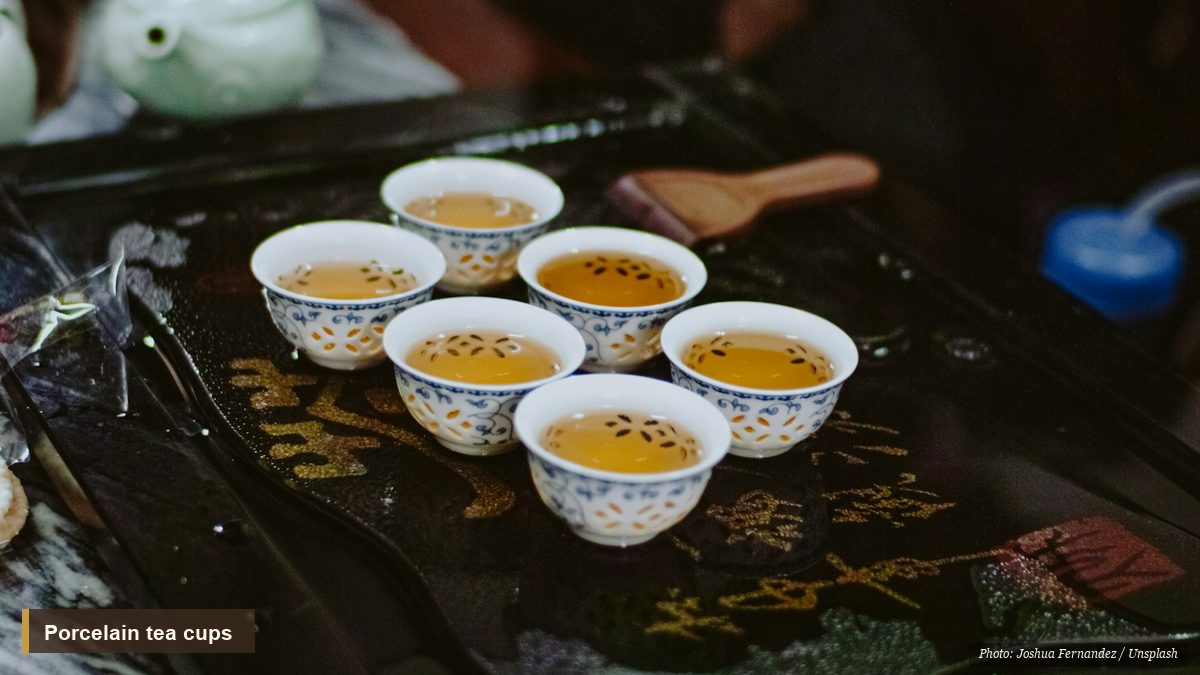
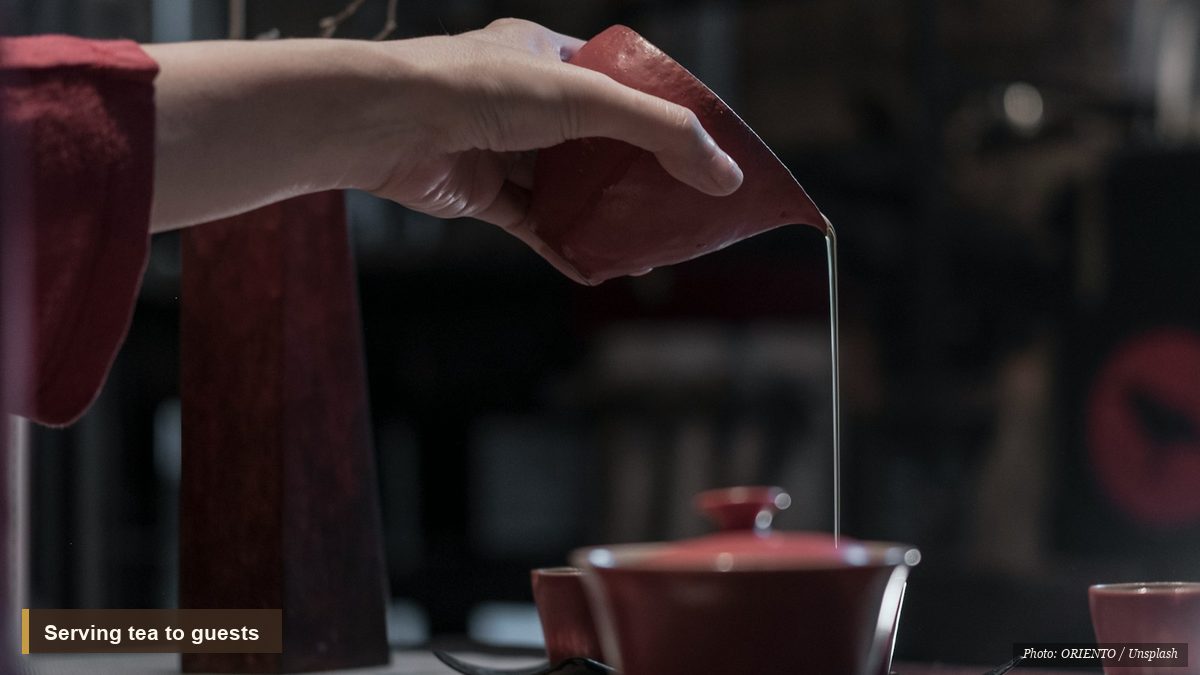
These symbols are not abstract; they show up in the hands. In the Chaoshan gongfu tradition of southern China, tea is served in a set of three small cups arranged so they can be read as heaven, earth, and humanity — a whole cosmology folded into a tea tray. Younger family members pour for elders first. A guest's cup is never allowed to sit empty. Each habit turns a drink into a message about who matters and how people belong together. The symbolism travels differently in each country, but the underlying grammar rhymes: tea stands for respect offered outward and calm cultivated inward.
How Do Tea Customs Differ Across China, Japan, Korea, and Vietnam?
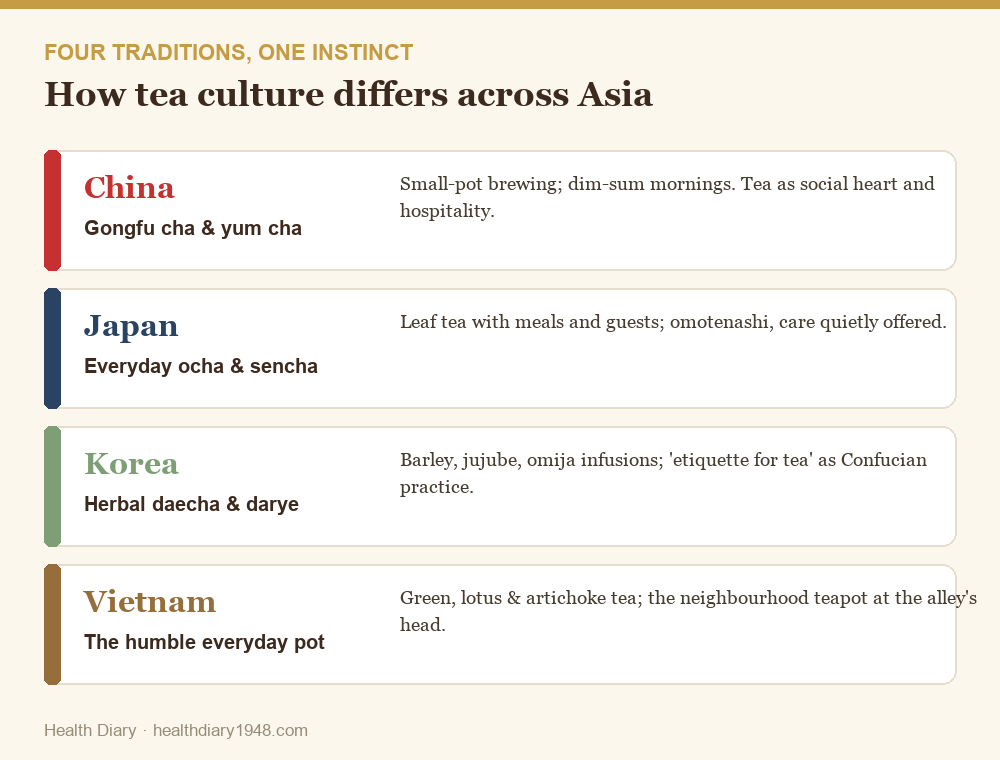
If the meaning of tea is shared, its manners are wonderfully local. Four traditions show how the same instinct branches into different everyday lives.
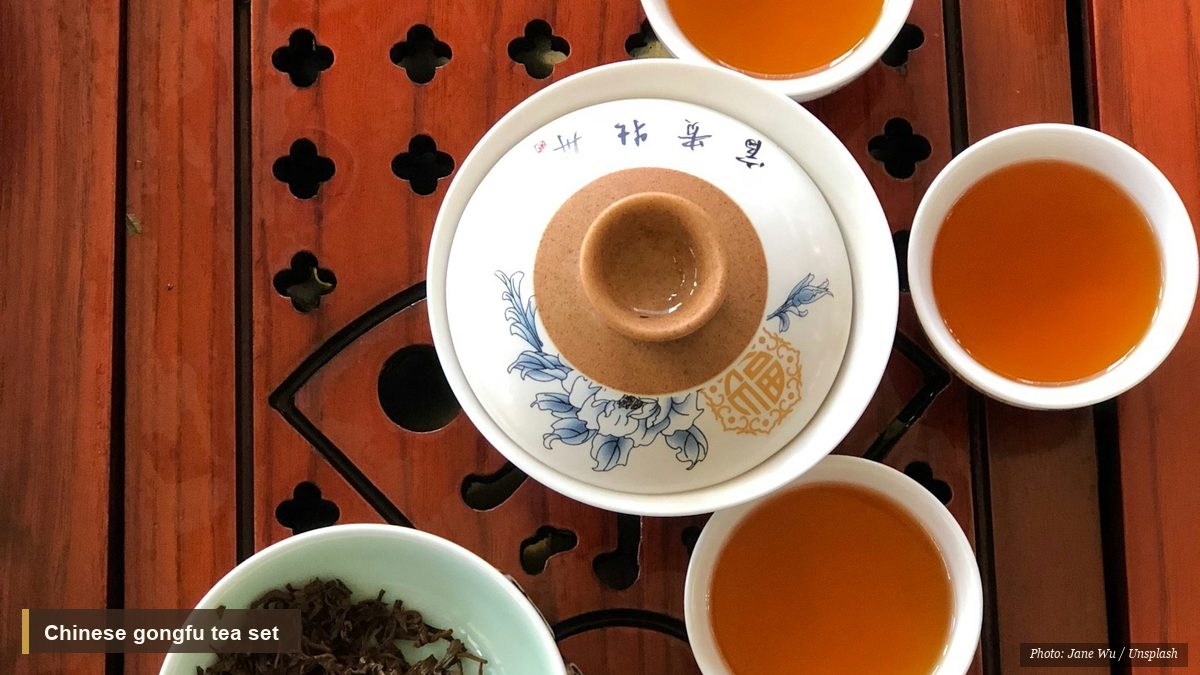
China — gongfu cha and yum cha. China holds the world's oldest tea culture, and it spans two very different moods. Gongfu cha is the attentive, small-pot style in which the same leaves are brewed many short times, each infusion tasted and discussed; Chaozhou Gongfu Cha is itself listed by UNESCO. Yum cha — literally “drink tea” — is its sociable cousin, the Cantonese morning of tea and dim sum where the pot on the table is the reason the family gathered at all.
Japan — everyday ocha. Outside the famous matcha ceremony (chanoyu), most Japanese tea life is quieter and greener. Leaf teas such as sencha accompany meals, welcome visitors, and punctuate the workday. Offering a cup to a guest is a small act of omotenashi, the culture of wholehearted hospitality — care expressed without being announced.
Korea — herbal daecha and darye. Korean tea is, in the words of Korea's own cultural agency, “mostly herbal.” Alongside leaf tea, Koreans drink daecha — infusions of barley, corn, jujube, ginseng, or omija berry. The word darye, “etiquette for tea,” has been kept for over a thousand years; during the Joseon dynasty, seonbi scholars practised it as a Confucian discipline of humility and self-cultivation.
Vietnam — the humble everyday pot. Vietnamese tea culture is famously unpretentious. A hot cup is the first thing offered to any visitor, and daily life leans on modest infusions — trà xanh (green tea), trà vối, artichoke tea (trà atiso), and fragrant lotus tea (trà sen). Perhaps the most telling image is the ấm trà đầu ngõ, the communal teapot at the head of the alley where neighbours pause, share news, and belong.
Tea, Family, and the Rhythms of Festival and Ceremony
Tea's cultural weight is clearest at life's thresholds. In many Chinese and Vietnamese weddings, the couple serves tea to their parents and elders in a formal tea ceremony — a gesture of gratitude and a public entry into a wider family. At Lunar New Year, tea is poured for visiting relatives and, in some homes, offered at the ancestral altar as a quiet greeting to those who came before.
These moments explain why tea customs feel so durable: they are attached not to convenience but to memory. A grandmother's particular pot, the order in which cups are handed round, the pause before the first sip — these are inherited rather than invented. Yet tea culture is not frozen. Researchers describe East Asian tea traditions as continually “reinvented,” reshaped by each generation from temple to teahouse to the bubble-tea counter. The meaning endures even as the setting changes.
What Does Modern Research Say About Herbal Tea?
Because so much of tea culture is bound up with well-being, it is worth asking what science actually observes — carefully, because the honest answer is “early and mixed.”
For true tea from Camellia sinensis, the U.S. National Center for Complementary and Integrative Health notes that polyphenols are thought to be behind many of the effects traditionally attributed to tea. The evidence, however, is modest: NCCIH states that “limited evidence currently available suggests that both green and black tea might have beneficial effects on some heart disease risk factors,” while cautioning that green tea “has not been shown to be effective for weight loss” and that human cancer studies remain inconclusive. In other words, tradition runs far ahead of proof.
Herbal teas — infusions of flowers, roots, fruits, and leaves other than the tea plant — are a vast and under-studied field, yet their cultural depth is well documented. A 2023 ethnobotanical survey in Guangxi, China, recorded 155 herbal-tea species from 49 plant families in a single region, noting that such teas “play a crucial role” in helping people cope with heat and humidity across generations of daily practice. That is a portrait of living tradition and use — not a claim of proven medical effect. Much of what draws people to herbal tea, in the end — warmth, ritual, a pause in the day, the company it invites — has value that no laboratory needs to certify.
How Do People Weave Herbal Tea Into Daily Life Today?
For most people, herbal tea culture is less about grand ceremony than about small, repeatable moments. Some brew a pot of barley or lotus tea in the morning and refill it through the day; others keep an evening ritual — a caffeine-free infusion such as chrysanthemum or jujube while the house winds down. Many simply keep a kettle ready for whoever knocks, honouring the old instinct that a guest should never be met empty-handed.
A gentle way to begin is with one tradition rather than all four: a slow gongfu-style session with a single oolong, the Vietnamese habit of offering tea before conversation, or a Korean-style roasted barley tea to sip with meals. Pay attention less to doing it “correctly” and more to what the pause itself adds to your day.
Individual responses vary considerably; what works well for one person may not suit another, and personal experimentation under practitioner guidance is always recommended.
Important Limitations and Considerations
Tea is woven so casually into daily life that it is easy to forget it is still a botanical preparation. A few cautions are worth keeping in mind.
- Caffeine. Teas from Camellia sinensis (green, black, oolong, sencha, matcha) contain caffeine, which can affect sleep, heart rate, and anxiety in sensitive people. Many herbal infusions are caffeine-free, but not all — check before assuming.
- Drug interactions. Herbal ingredients can interact with medications. Ginseng, licorice, and other common tea botanicals may affect blood pressure, blood sugar, or blood-thinning drugs. If you take prescription medication, ask a pharmacist or physician first.
- Pregnancy and breastfeeding. Some herbs are not advised during pregnancy or nursing. Caffeine intake is also often limited during pregnancy. Seek professional guidance before making any herbal tea a daily habit.
- Children. Herbal teas that are fine for adults are not automatically appropriate for infants or young children; consult a paediatrician.
- Quality and quantity. Potency, purity, and contamination vary widely between products and sources. Even beneficial polyphenols, consumed far beyond typical amounts, have been linked to digestive upset. Moderation and reputable sourcing matter.
- Individual variation. Bodies differ. A tea that soothes one person may unsettle another. Individual experiences vary considerably.
Frequently Asked Questions
What is the difference between herbal tea and “true” tea?
“True” tea — green, black, oolong, white, and matcha — comes from the leaves of one plant, Camellia sinensis, and contains caffeine. Herbal teas, sometimes called tisanes, are infusions of other plants: flowers, roots, fruits, seeds, and leaves such as chrysanthemum, barley, jujube, or lotus. Most are naturally caffeine-free, though a few, like some ginseng blends, are more stimulating.
Which country has the oldest tea culture in Asia?
China is generally recognized as the birthplace of tea culture, with written traditions stretching back well over a thousand years, including Lu Yu's eighth-century Classic of Tea. Tea then spread to Japan, Korea, and Vietnam, where each culture developed its own distinct customs and meanings.
Why is tea offered to guests in so many Asian homes?
Offering tea is a widely shared symbol of welcome, respect, and care. In Confucian-influenced cultures it also signals honour toward elders and a wish for harmony. The gesture matters as much as the drink — which is why a host often refills a guest's cup before it empties.
Can I drink herbal tea every day?
Many people enjoy mild herbal teas daily as part of an ordinary routine, and traditional cultures often favour moderate, consistent use. That said, individual responses vary, and some herbs interact with medications or are unsuitable during pregnancy. If you plan to drink a specific herbal tea every day, it is wise to check with a healthcare practitioner first.
What does traditional tea culture actually involve besides drinking?
Quite a lot. It can include the order in which cups are served, the symbolism of the vessels, seasonal choices of tea, wedding and New Year tea ceremonies, and the simple etiquette of pouring for others before yourself. In many traditions the social ritual — not the beverage — is the point.
A Note on Tracking Your Own Tea Rituals
One quiet pleasure of building a tea habit is noticing how it shapes your day — which infusion suits the morning, how a shared pot changes a conversation. Keeping a light record of what you brew, when, and how it felt can turn a scattered habit into a personal tradition of your own. If you are curious where to start, you can explore options like a short quiz to discover which Asian tea tradition best matches your temperament and daily rhythm, then let that guide your first pot. The goal is not to master every ceremony but to find the one that feels like yours.
A Closing Note on Tea and Belonging
Strip away the cultivars and the ceremonies and what remains is astonishingly consistent across Asia: tea is how people say you are welcome here. It slows a room, honours a guest, marks a season, and carries the memory of everyone who poured before. Whether it arrives as a Chaoshan gongfu cup, a bowl of Japanese sencha, a Korean cup of roasted barley, or a Vietnamese pot at the head of the alley, the message is the same — and worth keeping warm.
About This Article
Written by: Health Diary Editorial Team — a group of wellness researchers and writers focused on traditional Eastern wellness traditions, herbal culture, and responsible, well-sourced health education.
Editorial review: This article has been reviewed by the Health Diary editorial team for clarity, structure, and adherence to our sourcing standards. Key claims were cross-checked against NCCIH, NIH PubMed, and UNESCO cultural-heritage records where applicable. It is not a clinical review and should not replace consultation with a licensed healthcare practitioner.
Reviewed on: July 15, 2026.
Editorial process: We cite peer-reviewed and government sources where possible. When a clinical reviewer is added to this article, attribution will appear here with verifiable credentials.
References
- National Center for Complementary and Integrative Health (NCCIH), NIH. Tea. https://www.nccih.nih.gov/health/tea
- Huang Y, et al. Ethnobotanical study on herbal tea drinks in Guangxi, China. Journal of Ethnobiology and Ethnomedicine, 2023. https://pmc.ncbi.nlm.nih.gov/articles/PMC10064729/
- Reinventing a Tradition: East Asian Tea Cultures in the Contemporary World. Asian Journal of Social Science, 2022;50(3). https://www.sciencedirect.com/journal/asian-journal-of-social-science/vol/50/issue/3
- UNESCO. Traditional tea processing techniques and associated social practices in China (inscribed 2022). https://ich.unesco.org/en/RL/...
- 中国文化研究院 (Chinese Culture Institute). “茶”是礼貌大使? https://chiculture.org.hk/sc/china-five-thousand-years/657
- お茶百科 (Ocha Encyclopedia). 日本でのお茶の歴史. https://www.ocha.tv/history/japanese_tea_history/
- Korea.net (Republic of Korea). Tea culture in Korea. https://www.korea.net/...
- Báo Nhân Dân. Thấp thoáng văn hóa trà Việt. https://nhandan.vn/thap-thoang-van-hoa-tra-viet-post684614.html