Hojicha: Japan's Roasted Evening Tea from Kyoto
Discover hojicha, the roasted Japanese green tea from 1920s Kyoto with nutty caramel aroma, very low caffeine (~7–15 mg/cup), and unique pyrazine compounds linked to evening relaxation.
Medical Disclaimer: This content is for educational and informational purposes only and is not medical advice. The information presented is not intended to diagnose, treat, cure, or prevent any disease. Always consult a licensed healthcare practitioner before starting any new herbal practice or supplement. Statements regarding traditional herbal use have not been evaluated by the FDA.
Affiliate Disclosure: This article contains affiliate links. We may earn a commission if you purchase through these links, at no additional cost to you. We only recommend products we believe align with our editorial standards.
Imagine lifting a cup of tea and catching a scent that instantly recalls autumn mornings — warm caramel, toasted grain, a whisper of nuts. No sharp green grassiness, no tannic bite. Just something deeply comforting, the kind of aroma that slows the breath without any effort. That is hojicha (ほうじ茶), Japan's roasted green tea, and it has been doing exactly this since a resourceful tea merchant in 1920s Kyoto discovered that fire could turn leftover tea leaves and stems into something remarkable.
Hojicha is often overshadowed by its more famous Japanese cousin, matcha — yet it holds a quietly devoted following across Japan and is rapidly gaining international recognition. Unlike matcha's ceremonial weight or sencha's grassy brightness, hojicha occupies a different space: the everyday cup, the after-dinner ritual, the tea served to children and elders in Japanese households because its caffeine content is exceptionally low. Understanding hojicha means understanding a philosophy of thrift, warmth, and the unexpected alchemy of heat.
From Thrift to Tradition: The Origin of Hojicha
Hojicha is a relative newcomer to the Japanese tea world. While green tea cultivation in Japan stretches back centuries, hojicha's story begins in Kyoto in the 1920s. At the time, tea merchants dealing in bancha — the lower-grade tea made from later-harvest leaves, stems, and twigs — faced a practical problem: leftover material that was difficult to sell [Hojicha Co., historical record].
Rather than discard this material, a Kyoto merchant tried roasting it over charcoal in a porcelain pot. The heat transformed the pale, slightly bitter leaves into something entirely new: reddish-brown, deeply aromatic, smooth on the palate. Customers who smelled the roasting aroma drifting from the shop were drawn in. The experiment succeeded beyond expectation, and neighboring tea houses quickly adopted the practice.
This origin story carries a distinctly Japanese aesthetic quality — the same ethos as mottainai (もったいない), the cultural principle of avoiding waste. What began as a solution to surplus inventory became one of Japan's most beloved daily teas. By mid-century, hojicha had spread from Kyoto across the country, served in homes, restaurants, and eventually in hospitals — where its low caffeine profile and gentle taste made it a standard offering for patients of all ages.
Kyoto remains closely associated with premium hojicha production. The Uji region near Kyoto, famous for its high-grade tea cultivation, produces hojicha varieties that are considered particularly refined — some made from first-flush sencha leaves rather than bancha, yielding a lighter, more nuanced roast. Ippodo Tea, a Kyoto tea merchant founded in 1717, offers several hojicha varieties that represent this tradition of elevating humble materials into something worth savoring.
What Makes Hojicha Different from Green Tea?
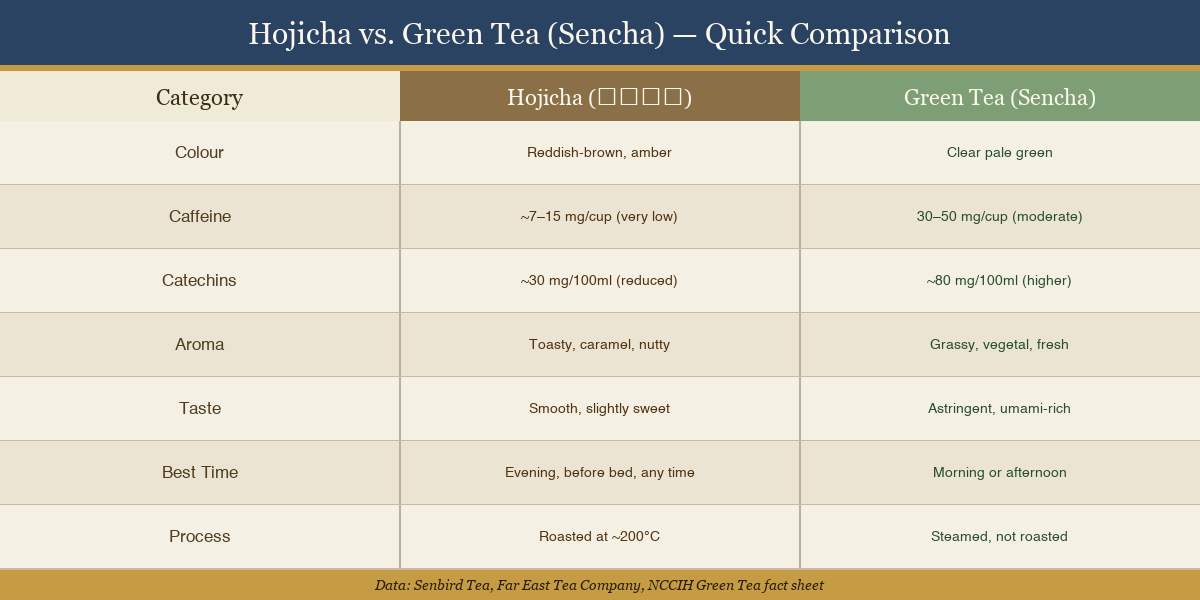
At its core, hojicha is green tea that has been roasted. The same Camellia sinensis plant, the same leaves — but subjected to temperatures of approximately 200°C for several minutes in a rotating drum roaster. That single step of roasting changes nearly everything about the tea's character.
Unroasted green teas like sencha are steamed immediately after harvest to halt oxidation, preserving the fresh, grassy flavour compounds and the green colour. Hojicha skips that fresh-preservation goal entirely. The roasting process intentionally transforms the leaf, replacing the vegetative, chlorophyll-driven notes with entirely new aroma compounds born of heat [Far East Tea Company].
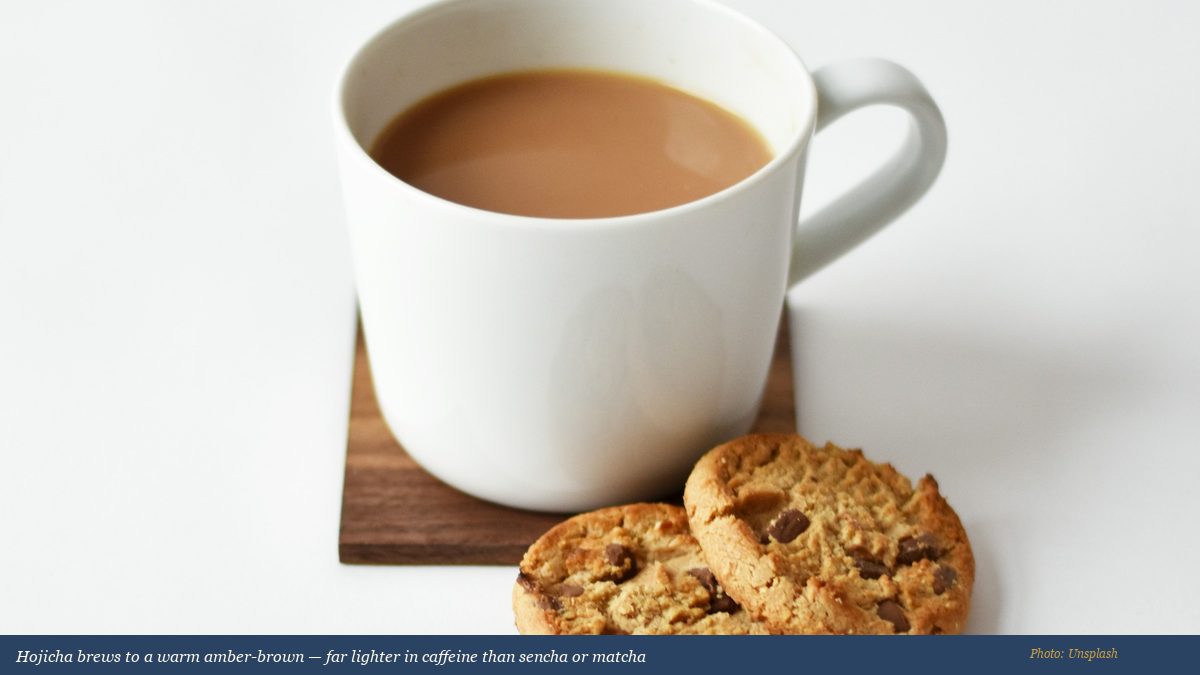
The result is a tea that looks nothing like green tea. Hojicha brews to a warm amber or reddish-brown colour — sometimes almost the shade of a light oolong or even a pale coffee. Its aroma is firmly in the roasted-grain family: caramel, nuts, a faint chocolate undertone. The taste is smooth rather than astringent, with very little of the bitterness that can make some green teas challenging for sensitive palates.
Perhaps the most practically significant difference is caffeine. Where sencha typically contains 30–50 mg of caffeine per cup and matcha can reach 35–70 mg, a standard cup of hojicha contains roughly 7–15 mg — a fraction of the amount [Senbird Tea]. This positions hojicha uniquely among Japanese teas as genuinely appropriate for evening consumption, for children, and for individuals who are sensitive to caffeine.
The Chemistry of Roasting: What Heat Does to Tea
The transformation that roasting performs on green tea leaves is a rich subject in food chemistry. Two key processes explain most of what happens: the Maillard reaction and the sublimation of caffeine.
Pyrazines and the Maillard Reaction
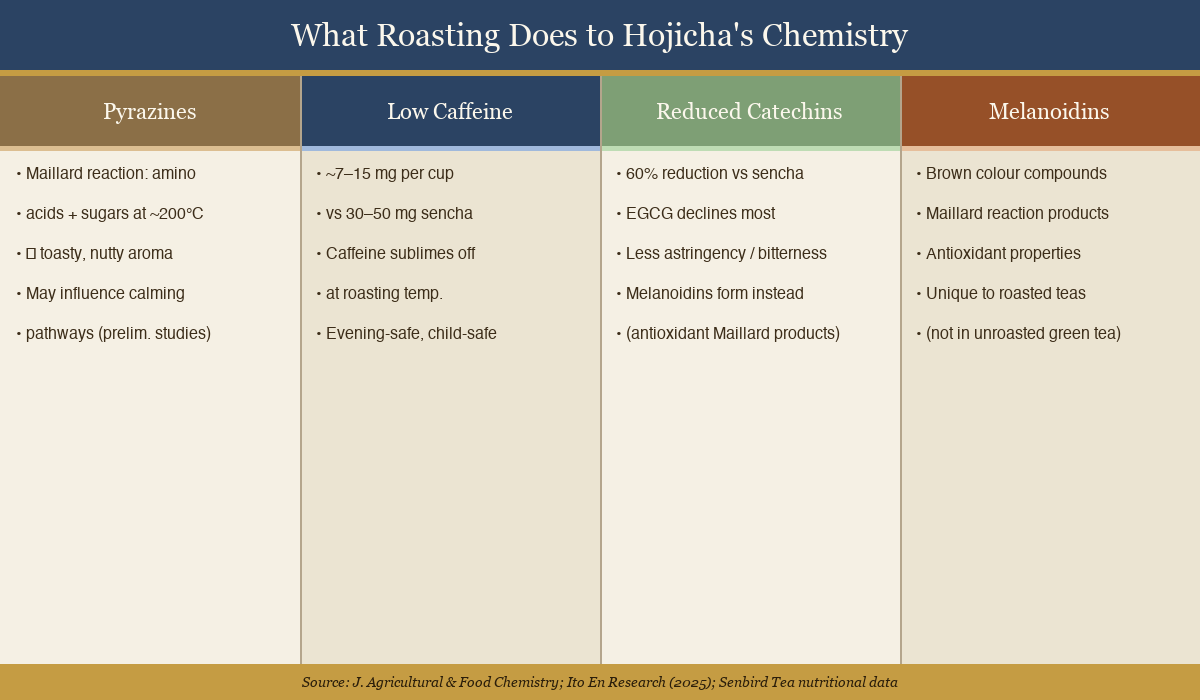
When tea leaves are heated to approximately 200°C, amino acids and reducing sugars present in the leaf begin reacting with each other in what chemists call the Maillard reaction — the same fundamental process that browns toast, sears meat, and roasts coffee beans [Maga, J. Agricultural and Food Chemistry]. Among the most important products of this reaction in the context of hojicha are a family of volatile aromatic compounds called pyrazines.
Pyrazines are responsible for the characteristic toasty, nutty, slightly caramel notes that make hojicha immediately recognizable. Research published in the Journal of Agricultural and Food Chemistry has documented the formation of alkylpyrazines and trimethylpyrazines from amino acid-sugar Maillard systems at roasting temperatures, alongside pyrrole compounds that add depth to the aroma profile [Amrani-Hemaimi et al., J. Agricultural and Food Chemistry].
Foundational Japanese research — a 1970 study on hojicha volatile components published on J-STAGE — identified a suite of carbonyl compounds unique to the roasted tea, including furfural and 2-acetylfuran, confirming that roasting creates wholly new chemical classes absent in unroasted sencha or bancha [Tea Science (茶業研究報告), J-STAGE, 1970].
More recently, in 2025, Ito En — one of Japan's largest tea companies — published research findings indicating that hojicha's aroma and its primary pyrazine compounds (particularly 2,3,5-trimethylpyrazine) appeared to suppress sympathetic nervous system activity while enhancing parasympathetic response in a study of 20 healthy adults. Participants showed decreased oxygenated hemoglobin in the prefrontal cortex — a marker associated with reduced mental arousal — and reported reduced tension and increased comfort after aroma exposure [Ito En Co., Research Announcement, 2025]. This is preliminary evidence from a single company study and requires independent replication; it should not be interpreted as a clinical claim about hojicha treating anxiety or sleep disorders.
Caffeine Reduction
Caffeine is a relatively volatile molecule. At sustained roasting temperatures, a meaningful portion of the caffeine in tea leaves undergoes sublimation — transitioning directly from solid to gas — and is lost. Beyond this thermodynamic reduction, hojicha is frequently made from bancha, which uses later-harvest, more mature leaves that naturally contain less caffeine than the young spring leaves used for premium sencha or gyokuro. Both factors contribute to hojicha's very low caffeine profile [Far East Tea Company].
Catechin Transformation and Melanoidins
Green tea's catechins — particularly EGCG (epigallocatechin gallate) — are widely studied for their antioxidant properties [NCCIH, Green Tea fact sheet]. Roasting degrades a substantial portion of these catechins: hojicha contains approximately 30 mg of catechins per 100 ml, compared to roughly 80 mg in sencha — a reduction of around 60% [Far East Tea Company]. This is why hojicha lacks the astringency and slight bitterness characteristic of sencha.
In place of lost catechins, roasting creates melanoidins — complex brown-coloured polymers that are among the Maillard reaction's end products. These compounds are what give hojicha its amber-brown colour and contribute antioxidant properties of their own, distinct from the original catechins. Vitamin C, present in small amounts in sencha (~6 mg/100ml), is almost entirely destroyed by roasting heat.
Individual responses to hojicha's chemical profile vary considerably; some people find the lower catechin content suits them better than more astringent teas, while others may prefer the higher polyphenol content of unroasted green tea.
How Do People Brew and Enjoy Hojicha?
Hojicha is among the most approachable Japanese teas to prepare at home. Unlike matcha, which requires a specific whisk and technique, or gyokuro, which demands carefully temperature-controlled water, hojicha is forgiving and quick.
Traditional Brewing (Kyusu Pot)
The traditional method uses a small Japanese teapot called a kyusu (急須), typically made of unglazed clay. Bring fresh water to approximately 90–95°C (just off the boil) — higher than you would use for delicate green teas, because hojicha's roasted character handles heat well. Add about 5 grams of leaves per 200 ml of water and steep for 30–60 seconds. The result is a clear, amber liquid with a clean roasted aroma.
Hojicha can typically be steeped two to three times, with each subsequent steep becoming lighter and slightly sweeter as the bolder roasted compounds are exhausted. Many Japanese households keep a large pot of hojicha warm for casual serving throughout the evening.
Hojicha Latte and Modern Preparations
Beyond traditional brewing, hojicha has become a popular culinary ingredient in modern Japan and internationally. Hojicha latte — made by whisking hojicha powder with hot milk (dairy or plant-based) — has spread widely in Japanese cafes and is now found in specialty tea shops globally. Google Trends data suggests searches for "hojicha latte" increased by approximately 173% between early 2025 and 2026, reflecting rapid mainstream uptake.
In Kyoto, visitors frequently encounter hojicha-flavoured soft serve ice cream — a popular street food adaptation served near traditional tea districts. The roasted, caramel notes of hojicha translate naturally into desserts, chocolate, cookies, and even savory dishes where a smoky depth is desired.
The Evening Ritual
Perhaps hojicha's most distinctive cultural role is as an evening drink. Japanese households have long served it to all family members regardless of age — children, elderly grandparents, and adults — precisely because the very low caffeine content means it does not interfere with sleep. In this sense, hojicha occupies a cultural space more similar to herbal tisanes in European traditions than to caffeinated teas.
Some people describe the ritual of warming their hands on a hojicha cup after dinner as inherently calming — a form of sensory decompression that is difficult to attribute to any single compound. Individual experiences vary considerably; what works well for one person as an evening wind-down may not suit another, and personal exploration under any relevant healthcare guidance is always the wisest approach.
Varieties: Stems, Leaves, and Powder
Hojicha is not a single product but a broad category defined by the roasting process. The source material and roast level vary considerably, producing meaningfully different drinking experiences.
Bancha Hojicha
The most common and traditional form. Bancha refers to tea made from later-harvest leaves and stems — the third or fourth harvest of the season, picked in autumn rather than the prized early-spring first flush. Bancha is naturally coarser, more robust, and lower in caffeine and catechins than early-harvest teas. When roasted, it produces a full-bodied, assertive cup with strong toasty character. This is the everyday hojicha found in most Japanese restaurants and households.
Sencha Hojicha
A premium variant made from first-flush sencha leaves that are subsequently roasted. Because the base material is higher quality and contains more delicate compounds, sencha hojicha tends to produce a more nuanced cup — layers of toasted grain with a sweet, subtly floral finish that bancha hojicha lacks. It is more expensive and less common but prized by enthusiasts.
Kuki Hojicha (Stem Hojicha)
Made primarily from tea stems and twigs (kukicha — literally "twig tea"), kuki hojicha is the lightest-bodied and lowest-caffeine variety of all. The stems and twigs naturally contain less caffeine than the leaf blade, and their fibrous composition roasts to produce especially sweet, clean, nutty notes with minimal astringency. This is often the variety recommended for children or those particularly sensitive to caffeine.
Hojicha Powder
Ground roasted hojicha leaves — the form used for lattes, baking, and culinary applications. Unlike matcha powder, which is stone-ground from shade-grown tencha leaves, hojicha powder is simply ground roasted tea and lacks the ceremonial associations. It dissolves well in milk and provides the characteristic caramel roasted flavour in desserts and beverages without requiring steeping.
Important Considerations
Hojicha is generally regarded as one of the gentlest teas in the Japanese tradition — its very low caffeine profile and mellow taste make it widely accessible. Nevertheless, a few considerations are worth noting for anyone incorporating it regularly.
- Caffeine sensitivity: While hojicha's caffeine (~7–15 mg/cup) is far lower than other teas and coffee, individuals with very high caffeine sensitivity may still notice mild effects. Those with documented caffeine disorders should be aware.
- Drug interactions at beverage amounts: The NCCIH notes that green tea at normal dietary amounts rarely causes drug interactions; the concern applies primarily to concentrated green tea extracts [NCCIH]. Hojicha consumed as a beverage at typical quantities (1–3 cups/day) has a minimal interaction risk profile based on available evidence.
- Reduced catechin content: Those seeking hojicha as a source of green tea catechins (EGCG) should be aware that roasting reduces catechin levels by approximately 60% compared to sencha. Hojicha is not a substitute for sencha if the primary goal is polyphenol intake.
- Pregnancy and breastfeeding: The low caffeine content makes hojicha more compatible with pregnancy than most caffeinated teas, but pregnant individuals should follow their healthcare provider's specific guidance on total caffeine intake.
- Children: Japanese tradition has long served hojicha to children; its very low caffeine aligns with pediatric caffeine recommendations in many guidelines. Parents should nonetheless consider their child's total daily caffeine from all sources.
- Quality variability: Hojicha quality varies widely. Over-roasted versions can develop harsh, bitter notes or contain higher levels of acrylamide (a compound formed in some roasted foods). Sourcing from reputable tea merchants who specify roast temperature and leaf grade is advisable.
Frequently Asked Questions
What does hojicha taste like?
Hojicha has a warm, toasty, slightly caramel flavour with nutty undertones — quite unlike the grassy, vegetal taste of sencha or matcha. It is smooth and mild, with very little astringency or bitterness. Many people describe it as comforting in the same way that roasted grain or light coffee might be, without the sharpness of either. Individual preferences vary; some find it earthy while others notice a sweet finish.
Is hojicha safe to drink every day?
For most healthy adults, hojicha consumed in typical beverage quantities (1–3 cups daily) is generally considered safe. Its very low caffeine content (~7–15 mg/cup) means it does not carry the concerns associated with higher-caffeine teas for daily consumption. Japanese tradition has served it across all age groups for over a century without notable issues at beverage amounts. That said, individual health circumstances vary — those with specific conditions or on certain medications should always consult a healthcare practitioner.
Does hojicha have less caffeine than green tea?
Yes, significantly less. A standard cup of sencha (unroasted Japanese green tea) contains approximately 30–50 mg of caffeine; matcha can reach 35–70 mg. Hojicha, by comparison, typically contains only 7–15 mg per cup, making it one of the lowest-caffeine options in the Japanese tea family. This reduction occurs because roasting at ~200°C causes caffeine to sublimate (turn from solid to gas), and hojicha is often made from later-harvest bancha leaves that naturally contain less caffeine to begin with.
Can I drink hojicha before bed?
Many people in Japan do drink hojicha in the evening and before bed specifically because of its very low caffeine profile. At 7–15 mg per cup, it is unlikely to interfere with sleep for most adults — for comparison, a cup of chamomile tisane is caffeine-free but still consumed for similar comfort reasons. Individual responses to caffeine vary; if you are particularly sensitive, you may still prefer caffeine-free herbal teas at bedtime. The warm, ritual quality of hojicha can itself be part of an evening wind-down practice.
What is hojicha made from — stems or leaves?
It depends on the variety. Traditional hojicha is most commonly made from bancha — leaves harvested later in the season — which may include a mix of leaf, stems, and twigs. Kuki hojicha (stem hojicha) is made specifically from tea stems and twigs, producing a lighter, sweeter, even lower-caffeine cup. Premium hojicha may be made from first-flush sencha leaves for a more delicate roasted character. All use Camellia sinensis as the base plant, with roasting as the defining step.
How does hojicha compare to matcha or sencha?
Hojicha, matcha, and sencha all come from the same tea plant (Camellia sinensis) but differ dramatically in processing. Matcha is shade-grown, stone-ground unroasted tea with high caffeine (35–70 mg/cup) and the highest catechin concentration; it has a rich, umami-heavy flavour. Sencha is steamed unroasted tea with moderate caffeine and a grassy, fresh profile. Hojicha is roasted, giving it the lowest caffeine, a warm caramel aroma, and smooth taste — the result of heat chemistry rather than careful shade-growing or precise grinding. They are complementary teas rather than substitutes for one another.
A Note on Wellness Tracking
If you enjoy hojicha as part of an evening routine, many people find it helpful to track how their sleep, mood, and energy levels change when they incorporate new dietary rituals. Our Health Diary wellness platform allows you to log daily habits — including tea rituals — alongside sleep quality and wellbeing notes, making it easier to observe patterns over time.
Tracking is not about proving that any particular tea "works" — the science for hojicha as a wellness beverage is exploratory, not definitive. Rather, it is about building self-awareness of how your own body responds to the rhythms of your day. Individual responses to everything from caffeine to aroma to simply the act of brewing a warm cup vary considerably, and that personal data is more relevant to your life than any study average.
About This Article
Written by: Health Diary Editorial Team — researchers and writers specializing in traditional Asian wellness practices, Japanese tea culture, and evidence-based wellness content.
Editorial review: This article has been reviewed by the Health Diary editorial team for clarity, structure, and adherence to our sourcing standards. Key claims were cross-checked against NCCIH green tea evidence, PubMed literature on Maillard reaction pyrazine formation, Ito En's 2025 published research, and J-STAGE foundational Japanese tea chemistry studies where applicable. It is not a clinical review and should not replace consultation with a licensed healthcare practitioner.
Reviewed on: June 14, 2026.
Editorial process: We cite peer-reviewed and government sources where possible. When a clinical reviewer is added to this article, attribution will appear here with verifiable credentials.
References
- Maga, J.A. (1992). Pyrazines in Foods: Review. Journal of Agricultural and Food Chemistry. https://pubs.acs.org/doi/10.1021/jf60185a006
- Amrani-Hemaimi, M., et al. (2007). Formation of Pyrazines and a Novel Pyrrole in Maillard Model Systems. Journal of Agricultural and Food Chemistry. https://pubs.acs.org/doi/10.1021/jf0726785
- National Center for Complementary and Integrative Health (NCCIH). Green Tea: Usefulness and Safety. U.S. National Institutes of Health. https://www.nccih.nih.gov/health/green-tea
- Ito En Co., Ltd. (2025). ほうじ茶の香りに「鎮静効果」があることを確認 [Confirmation of sedative effect of hojicha aroma]. Ito En Newsroom. https://www.itoen.co.jp/news/article/72121/
- Tea Science Journal (茶業研究報告) (1970). ほうじ茶の揮発性成分に関する研究 第1報 [Research on volatile components of hojicha, Part 1]. J-STAGE. https://www.jstage.jst.go.jp/article/cha1953/1970/32/1970_32_62/_article/-char/ja/
- Hojicha Co. History of Hojicha — Roasted Green Tea. https://hojicha.co/pages/history-of-hojicha-roasted-green-tea
- Far East Tea Company. Hojicha Ingredients: What Roasting Does to Caffeine, Catechins, and Nutrition. https://fareastteacompany.com/blogs/fareastteaclub/hojicha-ingredients
- Senbird Tea. A Guide to Hojicha: Types, Health Benefits, and How to Brew. https://senbirdtea.com/blogs/green-tea/a-guide-to-hojicha-different-types-benefits-and-how-to-brew