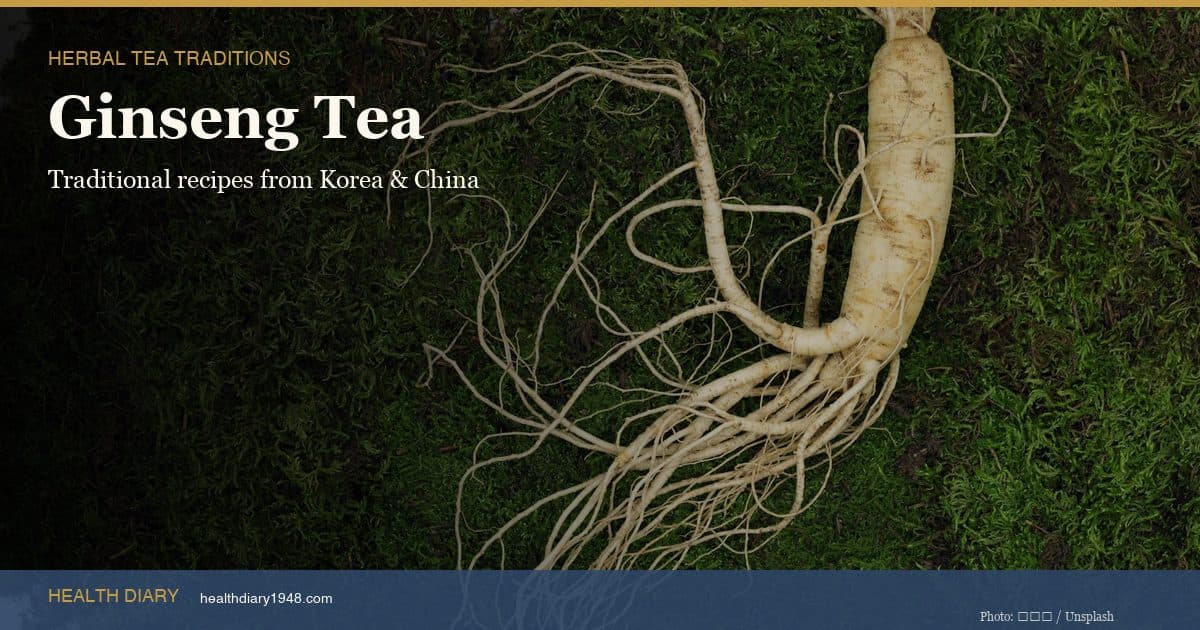
Ginseng Tea Recipe Guide: Traditional Preparation Methods from Korea and China
Learn how to prepare traditional ginseng tea the Korean and Chinese way — three classic recipes, tea forms, steeping tips, and the cultural traditions behind this beloved wellness drink.
Medical Disclaimer: This content is for educational and informational purposes only and is not medical advice. The information presented is not intended to diagnose, treat, cure, or prevent any disease. Always consult a licensed healthcare practitioner before starting any new herbal practice or supplement. Statements regarding traditional herbal use have not been evaluated by the FDA.
Affiliate Disclosure: This article contains affiliate links. We may earn a commission if you purchase through these links, at no additional cost to you. We only recommend products we believe align with our editorial standards.
For thousands of years, ginseng root has been at the heart of tea culture across Korea, China, and communities that carry those traditions around the world. Whether simmered slowly in a clay pot on a winter evening or steeped in warm water alongside goji berries on a quiet afternoon, ginseng tea is one of the most enduring folk traditions in Asian herbal culture. This guide covers three traditional preparation methods — Korean insam-cha, Chinese ginseng honey tea, and American ginseng cool tea — along with practical guidance on choosing the right ginseng form, water temperature, and steeping technique.
Individual responses to herbal teas vary considerably, and the information here reflects cultural tea practices rather than clinical recommendations. If you have health concerns, please consult a licensed healthcare provider before incorporating any new herbal preparation into your routine.
Types of Ginseng Used in Traditional Tea
Not all ginseng is the same, and traditional tea cultures across Asia have long distinguished between varieties based on their perceived energetic qualities. Understanding these differences helps you choose the right type for the season, the occasion, and your personal preference.
Korean Red Ginseng (Panax ginseng, steamed and dried) is considered warming in character within Korean and Chinese folk traditions. The root is steamed at high temperatures and then dried, which transforms its ginsenoside profile — the active saponin compounds — into a richer, more complex composition. Research published in Molecules (Piao et al., 2020) confirmed that steaming at 95–100°C for 2–3 hours significantly alters the distribution of ginsenosides, producing rare compounds such as Rg3 and Rh2 that are largely absent in unprocessed root. Red ginseng tea has a deep amber color and an earthy, slightly bitter warmth that many traditionally associate with autumn and winter use.
White Ginseng (Panax ginseng, air-dried without steaming) retains a lighter ginsenoside profile closer to the fresh root, with a milder, more delicate flavor. It is commonly used in Chinese ginseng honey tea traditions and is widely available as dried slices in East Asian herb shops.
American Ginseng (Panax quinquefolius, Xi Yang Shen) occupies a different role in the tea traditions of Chinese-American communities and practitioners of Chinese herbal folk culture. In contrast to the warming quality associated with Asian ginseng, American ginseng is viewed through a folk lens as cooling and yin-nourishing — meaning it is thought to be especially suitable during warm months or for individuals who tend to feel overheated. Research on its phytochemistry confirms a distinct ginsenoside composition compared to Asian varieties, with higher concentrations of certain protopanaxadiol-type ginsenosides.
Traditional Korean Ginseng Tea (Insam-Cha)
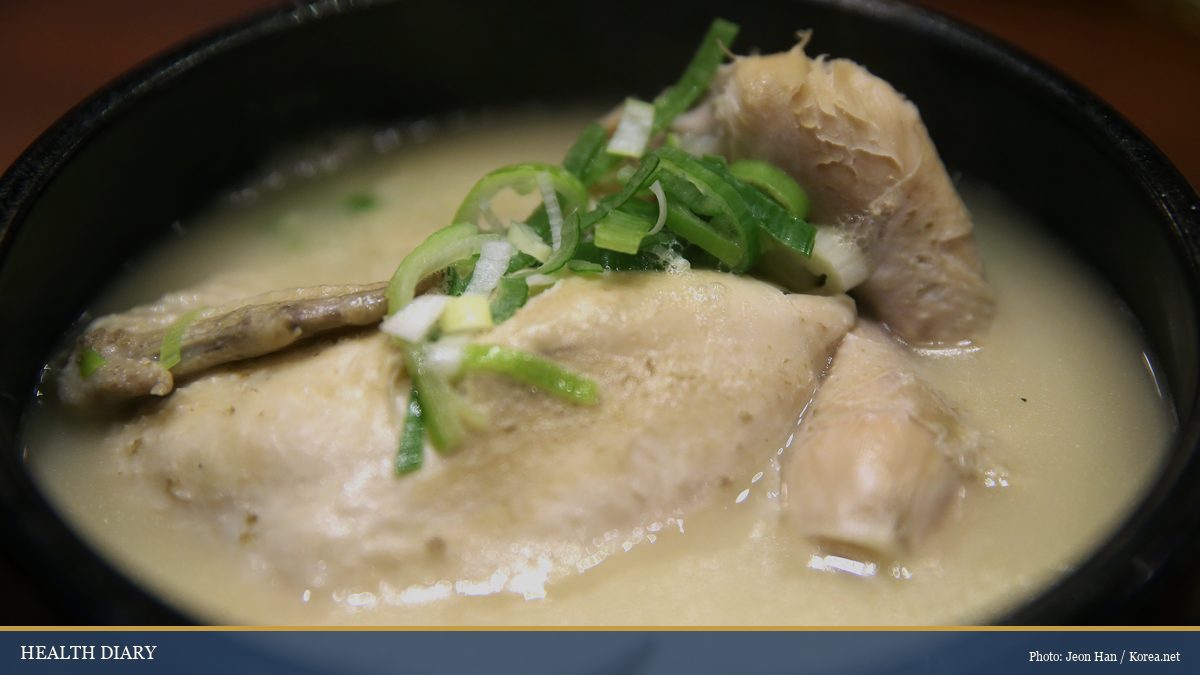
Korean insam-cha (인삼차) is among the most deeply rooted folk tea traditions on the Korean peninsula. Historical records document ginseng cultivation in the Koryo period (918–1392 CE), with Kaesong becoming a center of ginseng trade and preparation by the 11th and 12th centuries. The practice of decocting ginseng root with jujube dates and sweetening with honey is described in Korean court records and has been maintained as a folk tradition for winter warming and post-illness recovery.
The traditional Korean preparation involves simmering whole or sliced ginseng root — fresh (sinsam, 생삼) or dried (baeksam) — for an extended period to extract the root's character fully into the water. The slow simmer, rather than a rapid boil, is considered important in folk practice: at temperatures above 95°C, some compounds in the root may degrade, which aligns with findings from extraction research showing that excessive heat can reduce the stability of certain ginsenosides (Kim et al., Food Chemistry, 2024).
How to Make Korean Insam-Cha
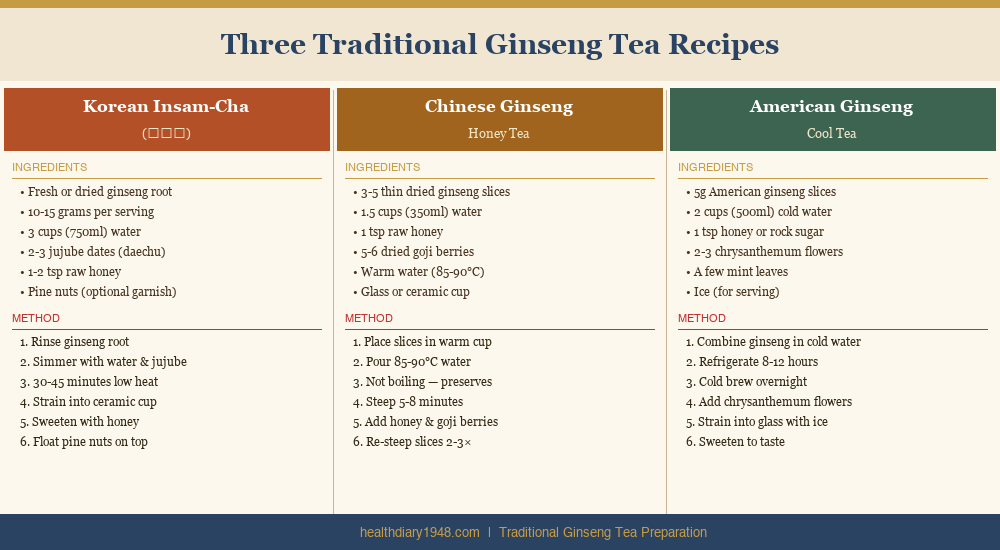
Ingredients (serves 2):
- 10–15 grams fresh or dried ginseng root (or 2–3 slices of dried root)
- 3 cups (750 ml) water
- 2–3 jujube dates (daechu, 대추), dried
- 1–2 teaspoons raw honey, added after pouring
- A small handful of pine nuts (optional, traditional garnish)
Method:
- Rinse the ginseng root or slices gently under cold water.
- Place root and jujube dates in a small earthenware or stainless pot with 3 cups of water.
- Bring to a gentle simmer over low-to-medium heat. Do not allow a rolling boil.
- Simmer for 30–45 minutes, allowing the liquid to reduce slightly and deepen in color.
- Strain into a ceramic cup or traditional Korean tea bowl.
- Allow to cool slightly, then stir in honey to taste.
- Float a few pine nuts on the surface as a traditional garnish.
In Korean folk practice, this tea is traditionally prepared as a warming drink during winter months and during recovery periods after illness or fatigue. The ginseng slices can often be eaten after brewing. Individual responses vary considerably; what works well for one person may not suit another, and personal experimentation under practitioner guidance is always recommended.
Chinese Ginseng Honey Tea
In Chinese folk tea culture, a simpler and more restrained approach to ginseng tea has long been practiced — particularly in the afternoon as a gentle restorative. Rather than a long decoction, this method involves steeping thin dried ginseng slices in water that is warm but not boiling, then pairing the tea with honey and goji berries (wolfberries).
The preference for water below boiling is not arbitrary. Extraction studies published in the Korean Journal of Crop Science found that the highest total ginsenoside content in ginseng water extracts was obtained at 85°C rather than at full boiling temperature, and that excessive heat caused degradation of antioxidant compounds. Traditional tea practice arrived at similar conclusions through generations of observation: ginseng steeped in near-boiling water was noted to produce a harsher, more bitter result than the same root steeped gently.
How to Make Chinese Ginseng Honey Tea
Ingredients (serves 1):
- 3–5 thin dried white ginseng slices
- 1.5 cups (350 ml) water, heated to 85–90°C
- 1 teaspoon raw honey
- 5–6 dried goji berries (wolfberries)
Method:
- Warm a glass or ceramic cup with a small splash of hot water; discard.
- Place dried ginseng slices and goji berries in the cup.
- Pour 85–90°C water over the slices. If you do not have a thermometer, allow boiled water to rest for 3–4 minutes before pouring.
- Steep for 5–8 minutes.
- Stir in honey after steeping, not before — honey added to very hot water may lose some of its delicate aromatic qualities.
- The ginseng slices can be re-steeped 2–3 times throughout the day, with each subsequent steep producing a lighter, more subtle cup.
In Chinese folk tradition, the combination of ginseng with goji berries has been practiced for centuries, as both were prized ingredients in classical herbal texts for their complementary warming and nourishing qualities. Individual experiences vary considerably.
American Ginseng Cool Tea
Within Chinese-American herbal folk culture — particularly in communities in California, New York, and Canada — American ginseng (Panax quinquefolius) has long held a distinct place as a summer preparation. Known in Chinese as Xi Yang Shen (西洋参, literally "Western Ocean Root"), it was adopted into the Chinese herbalist tradition in the 18th century, valued for properties that traditional practitioners described as complementary but distinct from Asian ginseng.
Where Asian ginseng is traditionally viewed as warming and stimulating to yang energy, American ginseng is described in Chinese herbal folk tradition as cooling and yin-nourishing — suitable for use during summer heat, in warmer climates, or when a gentler preparation is preferred. The Smithsonian Center for Folklife and Cultural Heritage has documented the deep cultural significance of American ginseng in both Indigenous North American traditions and in Chinese-American community practices, noting its role as an item of major trade between North America and China from the early 1700s onward.
The cold-brew preparation, rather than heat infusion, preserves the natural character of American ginseng and produces a delicate, mildly sweet tea well suited to warm-weather drinking.
How to Make American Ginseng Cool Tea
Ingredients (serves 2):
- 5 grams American ginseng slices (Xi Yang Shen)
- 2 cups (500 ml) cold filtered water
- 1 teaspoon honey or rock sugar (optional)
- 2–3 dried chrysanthemum flowers (optional, traditional pairing)
- A few fresh mint leaves (optional)
Method:
- Place American ginseng slices in a clean glass jar or pitcher.
- Add cold filtered water and the chrysanthemum flowers if using.
- Cover and refrigerate for 8–12 hours, or overnight.
- In the morning, strain through a fine mesh strainer into a glass.
- Add honey or rock sugar if desired, and serve over ice.
- The strained slices can be used once more for a second, lighter brew.
In folk tradition, chrysanthemum is paired with American ginseng as a complementary cooling herb, and the combination is particularly popular as a summer afternoon drink in Chinese-American households and herb shops. Individual responses vary considerably; some people find this combination very gentle, while others may notice it is not suitable for their constitution.
How to Choose Ginseng for Tea
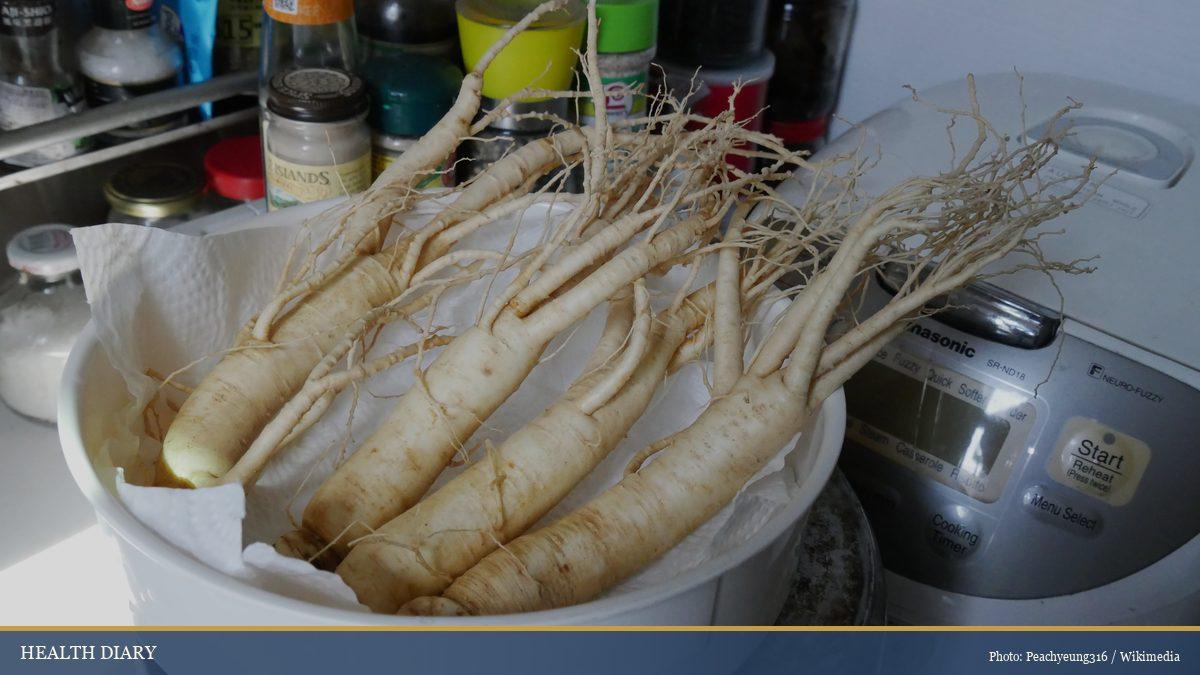
The form of ginseng you choose affects the flavor, preparation time, and character of your tea. Each form has its own traditional context.
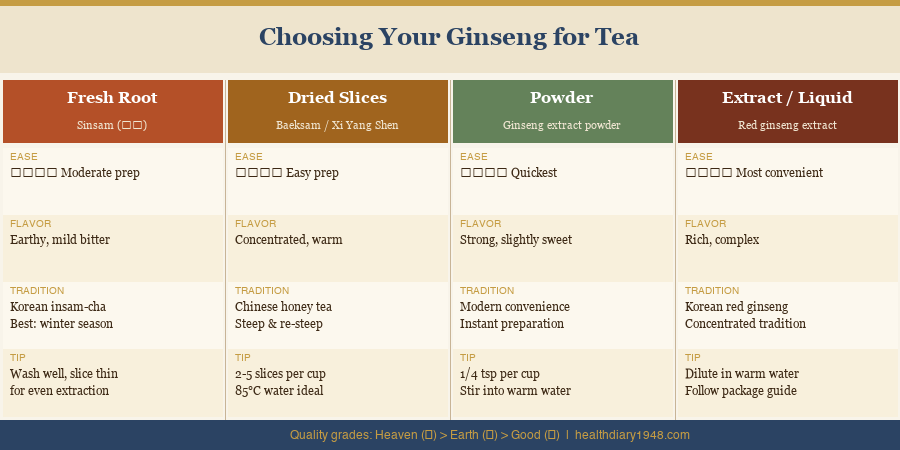
Fresh Root (Sinsam) produces the most vibrant and aromatic tea, with a bright earthiness and mild bitterness. It requires the most preparation — washing, slicing, and a longer simmer — and is best suited to the Korean insam-cha method. Fresh root is most readily available in Korean specialty grocery stores, particularly in autumn and winter.
Dried Slices are the most versatile form for home tea preparation. They are available in most Asian herb shops as both white ginseng (air-dried) and red ginseng (steamed and dried). Dried slices can be steeped in the Chinese method, simmered in the Korean method, or cold-brewed for American ginseng cool tea. They keep well for months when stored in a cool, dry place.
Powder is the most convenient option and dissolves readily in warm water. The trade-off is that the brewing experience is simplified — there are no slices to re-steep, and the flavor tends to be one-dimensional compared to whole root or slices. It is well suited to mornings when time is limited.
Liquid Extract — particularly Korean red ginseng extract (hongsam jeong, 홍삼정) — is highly concentrated and traditionally diluted in a small amount of warm water. It is popular in contemporary Korean wellness culture and produces a rich, complex tea with minimal preparation. Quality Korean red ginseng extract will list a standardized ginsenoside content on the label.
When purchasing any ginseng for tea, traditional quality grading distinguishes between Heaven grade (天), Earth grade (地), and Good grade (良), with Heaven-grade roots being the most prized for size, shape, and age. For everyday tea preparation, Earth or Good grade dried slices from a reputable Asian herb shop or specialty retailer offer good value and consistent quality. Look for product from established growing regions: South Korea (Geumsan County is particularly noted), Jilin Province in China, and Ontario, Canada for American ginseng.
How Do You Brew Ginseng Tea? Steeping Tips and Guidelines
A few practical guidelines drawn from traditional tea culture and supported by extraction research:
Water temperature matters. For hot ginseng tea preparations, 85–90°C is the traditional and research-supported sweet spot. Water at full boiling temperature (100°C) can make the tea harsher and more bitter, and some research suggests it may reduce the stability of certain antioxidant compounds in the root. If you do not own a temperature-controlled kettle, allow freshly boiled water to rest uncovered for 3–4 minutes before using.
Simmer, do not boil. For the Korean decoction method, maintaining a gentle simmer rather than a rolling boil is the folk tradition recommendation — and aligns with research on ginsenoside extraction, which shows that prolonged high heat can be counterproductive.
Re-steep your slices. Dried ginseng slices have enough character for 2–3 steepings. Each subsequent steep produces a lighter, more delicate cup. Many practitioners recommend drinking the first steep in the morning and re-steeping through the day.
How often to drink. Traditional folk practice in both Korea and China tends toward moderate, regular use — one to two cups per day, particularly in the morning or early afternoon. Evening consumption of warming ginseng tea (especially red ginseng) is traditionally discouraged in folk practice, as some people find it stimulating enough to affect sleep. Individual responses vary considerably.
Ceramic or glass is preferred. Traditional Korean and Chinese tea culture avoids metal brewing vessels for delicate root teas. A ceramic pot, earthenware vessel, or glass teapot is the culturally preferred choice and produces no unwanted flavor interference.
Frequently Asked Questions
Can I drink ginseng tea every day?
Many people incorporate ginseng tea into a regular daily routine as part of a general wellness practice. Traditional folk culture in Korea and China typically involves moderate, consistent use rather than occasional large quantities. That said, individual responses vary considerably, and some people find that daily use of warming ginseng teas — particularly red ginseng — is not well suited to their constitution or the season. The NCCIH notes that short-term use (up to six months) appears safe for most adults, while long-term safety is less established. Consult a healthcare provider if you have any concerns.
What does ginseng tea taste like?
Ginseng tea has a distinctive earthy, slightly bitter, and mildly sweet flavor that is difficult to compare to anything else. Red ginseng tea tends to be richer and more complex, with a warm, slightly resinous quality. White ginseng is milder and more delicate. American ginseng cold brew produces the gentlest flavor of all — lightly sweet and subtly vegetal. Adding honey softens bitterness considerably, and pairing with jujube dates or goji berries introduces natural sweetness and complementary herbal notes.
Does ginseng tea interact with any medications?
Yes — this is an important consideration. Ginseng may interact with warfarin (a blood thinner), diabetes medications, and some blood pressure treatments, according to NCCIH. If you take any of these medications, or if you are preparing for surgery, speak with your doctor or pharmacist before making ginseng tea a regular practice. Ginseng may also affect blood sugar levels, which is relevant for people managing diabetes.
Is ginseng tea safe during pregnancy or breastfeeding?
Traditional folk practice and current safety guidance both recommend caution. NCCIH and most integrative health practitioners advise against regular ginseng use during pregnancy or breastfeeding due to insufficient safety data, and because some animal studies have raised questions about potential effects. Consult your obstetrician or midwife before using any herbal tea preparation during pregnancy.
What is the difference between Korean red ginseng tea and American ginseng tea?
The primary differences lie in the ginsenoside composition of the root, the processing method, and the traditional folk characterization of each type. Korean red ginseng is steamed and dried, producing a warming, deeply flavored tea with a richer ginsenoside profile including rare compounds formed by heat processing. American ginseng is air-dried and traditionally characterized as cooling and yin-nourishing in Chinese folk tradition — making it a preferred summer preparation. The two are distinct herbs with different flavor profiles, and traditional practice uses them in different seasonal contexts.
Important Considerations
As with any herbal preparation, a few considerations are worth keeping in mind before making ginseng tea a regular part of your routine:
- Drug interactions: Ginseng may interact with blood thinners (warfarin), blood sugar medications, and antidepressants. Speak with a healthcare provider if you take any prescription medications.
- Pre-surgery caution: Some integrative practitioners recommend discontinuing ginseng use two weeks before surgery due to its potential effects on blood clotting and blood sugar.
- Pregnancy and breastfeeding: Exercise caution; consult a qualified healthcare provider.
- Children: Not recommended for infants or young children without professional guidance.
- Sleep sensitivity: Some individuals, particularly those sensitive to stimulating herbs, may find that warming ginseng tea (especially red ginseng) affects sleep if consumed in the evening.
- Quality variability: Ginseng products vary widely in quality and ginsenoside content. Purchase from reputable suppliers, and look for products that disclose standardized ginsenoside percentages.
- Individual variation: Individual responses vary considerably; what works well for one person may not suit another.
References
- National Center for Complementary and Integrative Health (NCCIH). Asian Ginseng: Usefulness and Safety. U.S. Department of Health and Human Services. Accessed June 2026.
- Piao X-L et al. (2020). Diversity of Ginsenoside Profiles Produced by Various Processing Technologies. Molecules, 25(20), 4transformation. PMC7582514.
- Kim S et al. (2024). Ginsenoside stability and antioxidant activity of Korean red ginseng (Panax ginseng C.A. Meyer) extract as affected by temperature and time. LWT — Food Science and Technology. ScienceDirect.
- Baeg I-H, So S-H. (2013). The world ginseng market and the ginseng (Korea). Journal of Ginseng Research, 37(1), 1–7. PubMed PMID: 23717154.
- Smithsonian Center for Folklife and Cultural Heritage. The Mysterious Powers of American Ginseng. Smithsonian Institution. Accessed June 2026.
- Korean Food Foundation (한식재단). Traditional Korean Tea Culture — Insam-cha. hansik.or.kr. (Native-language reference: Korean folk tea tradition documentation.)
About This Article
Written by: Health Diary Editorial Team — specialists in traditional Asian herbal tea culture and wellness practices.
Editorial review: This article has been reviewed by the Health Diary editorial team for clarity, structure, and adherence to our sourcing standards. Key claims were cross-checked against NCCIH, NIH PubMed, and the Journal of Ginseng Research where applicable. It is not a clinical review and should not replace consultation with a licensed healthcare practitioner.
Reviewed on: June 16, 2026.
Editorial process: We cite peer-reviewed and government sources where possible. When a clinical reviewer is added to this article, attribution will appear here with verifiable credentials.
This article reflects traditional cultural tea practices. It is not medical advice. Consult a healthcare provider if you have health concerns.