Traditional Vietnamese Herbal Traditions: Thuốc Nam, Home Gardens, and Folk Remedies
A pillar guide to traditional Vietnamese herbal traditions — thuốc Nam vs thuốc Bắc, the history from Tuệ Tĩnh to Đỗ Tất Lợi, kitchen herbs, home preparation, and safe use.
Medical Disclaimer: This content is for educational and informational purposes only and is not medical advice. It reflects traditional Vietnamese cultural practices and folk wellness traditions and is not intended to diagnose, treat, cure, or prevent any disease. Always consult a licensed healthcare practitioner before starting any new herbal practice, dietary change, or supplement. Statements regarding traditional herbal use have not been evaluated by the FDA.
Affiliate Disclosure: This article may contain affiliate links. We may earn a commission if you purchase through these links, at no additional cost to you. We only recommend products we believe align with our editorial standards.
Walk through any Vietnamese village at dawn and you will find the country's oldest wellness system growing quietly in the yard: a pot of purple-backed perilla by the doorstep, a patch of pennywort near the well, lemongrass along the fence, and a fish-mint bed in the shade. For most of Vietnam's history, the family garden was also the family pharmacy. This everyday, home-rooted approach to plants is what Vietnamese people call thuốc Nam — literally "Southern medicine" — and it sits at the heart of one of Southeast Asia's richest herbal traditions.
Traditional Vietnamese herbal traditions are not a single recipe book. They are a layered inheritance: an indigenous folk practice built on native plants, a scholarly tradition adapted from Chinese medicine, and a modern pharmacopeia documented by twentieth-century scientists. This guide is a hub for that whole landscape. We will trace where thuốc Nam came from, meet the historical figures who shaped it, walk through the kitchen herbs that double as remedies, look at how families prepare them at home, and — because this is health content — examine what modern research suggests and where caution is essential. Along the way you will find links to deeper profiles of individual Vietnamese herbs so you can follow whichever thread interests you.
What Is Thuốc Nam, and How Does It Differ from Thuốc Bắc?
To understand Vietnamese herbal medicine, you first have to understand a distinction that English-language wellness writing almost always skips. Vietnamese traditional medicine flows in two intertwined streams: thuốc Nam and thuốc Bắc. The words mean "Southern medicine" and "Northern medicine," and the compass points are drawn relative to China.
Thuốc Bắc — "Northern medicine" — is the tradition adapted from Chinese medicine over centuries of dynastic exchange. It relies on classical theory (Yin-Yang, the Five Elements, careful formula pairing) and on prepared herbs, many historically imported: dried roots, barks, and tonic ingredients weighed out and combined by trained practitioners. Thuốc Nam — "Southern medicine" — is the indigenous Vietnamese folk tradition, built on the plants of a hot, wet, tropical land and on remedies simple enough for an ordinary household to prepare. According to a review of traditional medicine in Vietnam, thuốc Nam uses native ingredients that are often fresh or only lightly dried, while thuốc Bắc draws on the Chinese-derived materia medica (Tefara & Balasundaram, 2023).
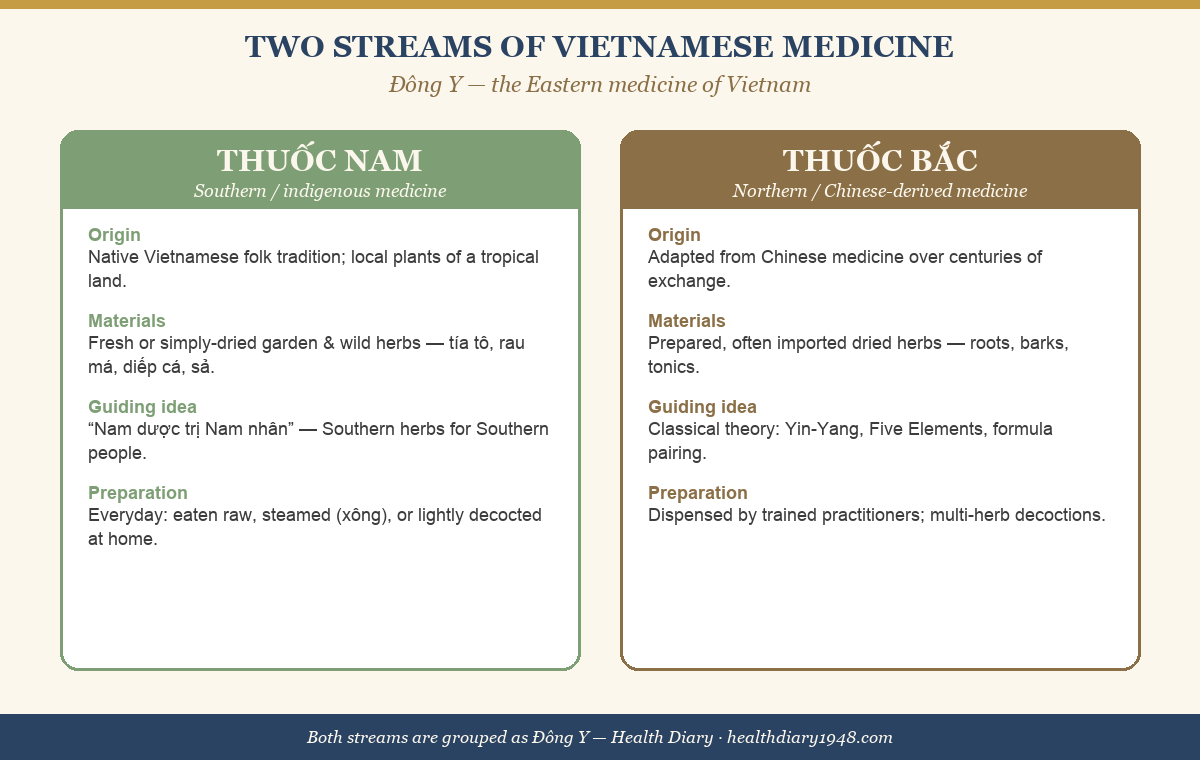
From roughly the seventeenth century onward, both streams were grouped together under the umbrella term Đông y — "Eastern medicine" — to distinguish the whole from newly arriving Western medicine (EthnoMed, University of Washington). So the two are not rivals so much as siblings. A rural grandmother reaching for fresh pennywort is practicing thuốc Nam; a practitioner dispensing a multi-herb tonic decoction is working in the thuốc Bắc idiom; both belong to Đông y. What makes the Vietnamese tradition distinctive is how much of it stayed close to the ground — accessible, edible, and grown at home.
How Did Vietnamese Herbal Medicine Take Shape Over the Centuries?
The identity of thuốc Nam owes a great deal to three named figures whose work you can still trace today. The first is Tuệ Tĩnh (born 1330), a Zen monk and physician of the fourteenth century who is honored across Vietnam as the ông tổ thuốc Nam — the founding father of Southern medicine. Tuệ Tĩnh gave the tradition its rallying idea in a single phrase: "Nam dược trị Nam nhân" — Southern medicine to treat Southern people. It was a quietly radical claim. Rather than depending on imported Chinese herbs, he argued, Vietnamese bodies shaped by a tropical climate were best served by the plants growing around them. His compilation Nam dược thần hiệu ("Miraculous Effects of Southern Medicines") organized 182 conditions with thousands of remedies and hundreds of native herbs, many recorded in chữ Nôm, the old Vietnamese script (Sức khỏe & Đời sống, Vietnam Ministry of Health outlet).
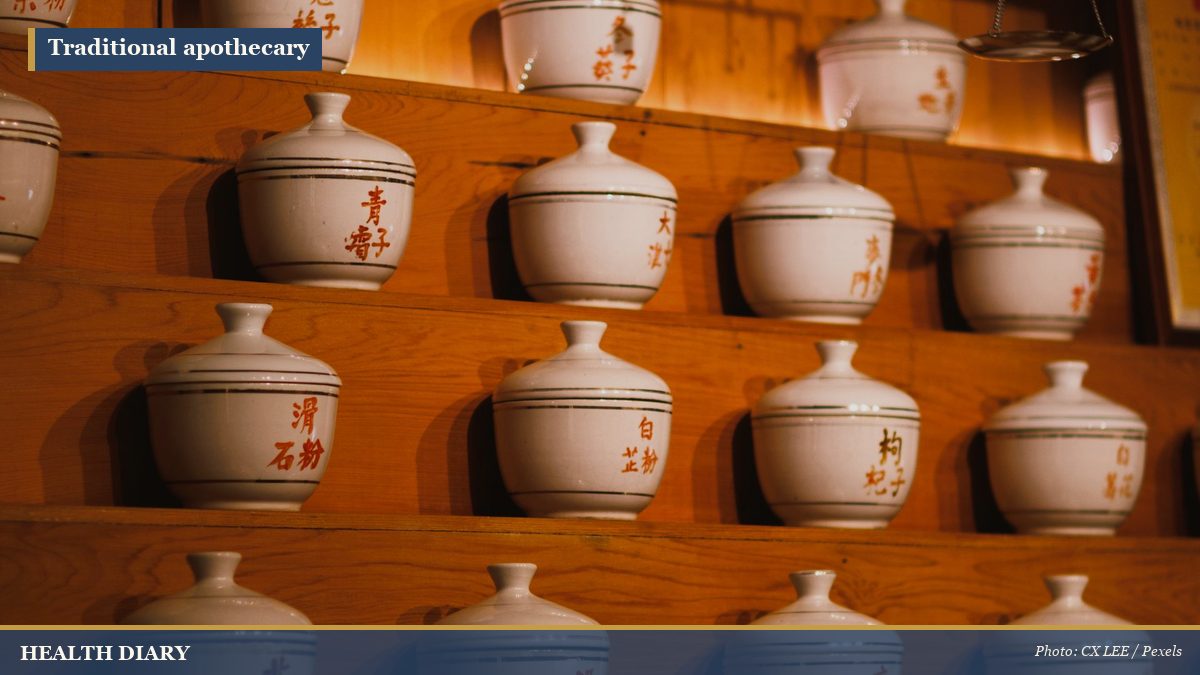
Four centuries later, Hải Thượng Lãn Ông — the pen-name of Lê Hữu Trác (1724–1791) — became the tradition's great synthesizer. Over more than forty years of practice he assembled Hải Thượng Y Tông Tâm Lĩnh, a sweeping 28-volume, 66-book medical encyclopedia that gathered theory, case records, formulas, and, importantly, a code of medical ethics (y đức) that still frames how Vietnamese practitioners talk about their duty to patients. In 2023 UNESCO recognized him among its honored world cultural figures (Traditional Medicine Hospital, Ho Chi Minh City).
The tradition's modern anchor is Đỗ Tất Lợi (1919–2008), the pharmacologist whose encyclopedia Những cây thuốc và vị thuốc Việt Nam ("Medicinal Plants and Herbs of Vietnam") documented more than seven hundred Vietnamese remedies with their botanical names, chemistry, traditional uses, and dosages. First published in 1962 and repeatedly expanded, it earned the Ho Chi Minh Prize and remains the reference standard that bridges folk knowledge and laboratory science (Đỗ Tất Lợi, digitized edition, Internet Archive). Between these three — a fourteenth-century monk, an eighteenth-century scholar, and a twentieth-century scientist — you can see the whole arc of Vietnamese herbal tradition: from spiritual and practical roots, to systematic theory, to modern documentation.
Why Did Vietnam Keep a Medicine Garden at Every Home?
If thuốc Nam has a signature institution, it is the vườn thuốc nam — the Southern-medicine garden. In the countryside, families traditionally cultivated a corner of the yard with plants that were food and remedy at once, so that a fever, an upset stomach, or a small wound could be met with something already growing steps from the kitchen. This was not merely folklore. Vietnam's Ministry of Health formalized the idea by defining an official list of roughly seventy Southern-medicine plants to be grown as a "model herb garden" (vườn thuốc nam mẫu) at commune-level health stations across the country (Tra Cứu Dược Liệu, Ministry of Health list).
That policy is worth pausing on. It reframes the humble kitchen garden as a recognized layer of primary care — a first, gentle line of everyday wellness sitting beneath the clinic and the hospital. It also explains why so many Vietnamese "herbs" are simply vegetables. The line between the salad bowl and the medicine cabinet was never sharply drawn. To understand Vietnamese longevity culture more broadly, including how these garden foods figure in aging well, see our companion guide to Vietnamese longevity traditions.
What Are the Everyday Herbs of the Vietnamese Kitchen?
The genius of thuốc Nam is that its most important "remedies" arrive at the table as flavor. The plate of fresh herbs (rau sống) served alongside noodle soups and rice-paper rolls is, in a sense, a daily wellness ritual disguised as garnish. Here are the plants that appear again and again — each one a doorway into a deeper tradition.
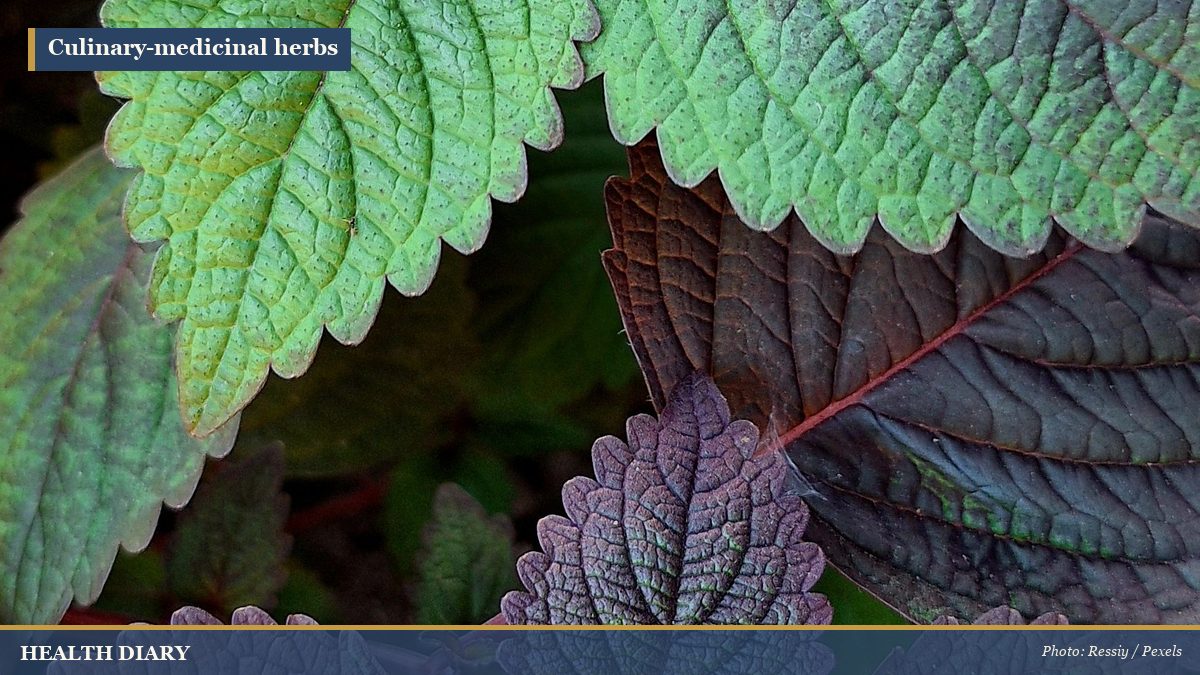
- Perilla (tía tô, Perilla frutescens) — the fragrant leaf with green tops and deep purple undersides, traditionally added to congee and broths when someone feels a chill coming on. Read its full story in our perilla leaf tradition guide and, for the brewed version, our perilla leaf tea traditions.
- Pennywort (rau má, Centella asiatica) — better known in English as gotu kola, blended into a cooling green drink on hot days and long associated in folk practice with skin and calm. Explore it in our gotu kola profile and the Vietnam-specific gotu kola in Vietnamese traditions.
- Fish mint (rau diếp cá, Houttuynia cordata) — a pungent, citrusy leaf eaten raw and valued in folk cooling remedies; see our fish mint tradition guide.
- Lemongrass (sả, Cymbopogon citratus) — the aromatic stalk that flavors soups and, crucially, the herbal steam bath; more in our lemongrass profile.
- Artichoke (atisô) — grown in the cool highlands around Đà Lạt and brewed into Vietnam's beloved cooling tea; see our artichoke tradition guide and Vietnamese artichoke tea guide.
- Lotus (sen, Nelumbo nucifera) — leaf, seed, and stamen all enter Vietnamese kitchens and calming teas; read our lotus leaf tradition guide.
- Moringa (chùm ngây, Moringa oleifera) and pandan (lá dứa, Pandanus amaryllifolius) — the first a nutrient-dense leaf cooked into soups, the second an aromatic leaf that scents rice and drinks. See our moringa profile and pandan tradition guide.
Many of these same plants find their way into the slow-simmered restorative broths that are a cornerstone of Vietnamese home cooking. For that thread, see our guide to traditional Vietnamese herbal soups.
How Do People Prepare Vietnamese Herbal Remedies at Home?
Vietnamese folk preparation favors methods that a household can manage without special equipment. Three recur across the tradition.
Xông (herbal steam). A pot of water is simmered with aromatic leaves — lemongrass, perilla, kaffir lime leaf, sometimes pennywort or basil — and the person leans over the pot under a blanket to breathe the fragrant steam. Xông is one of the most recognizable Vietnamese folk practices, traditionally used to feel refreshed and clear when a person is under the weather. It asks nothing but a pot, some leaves, and a towel.
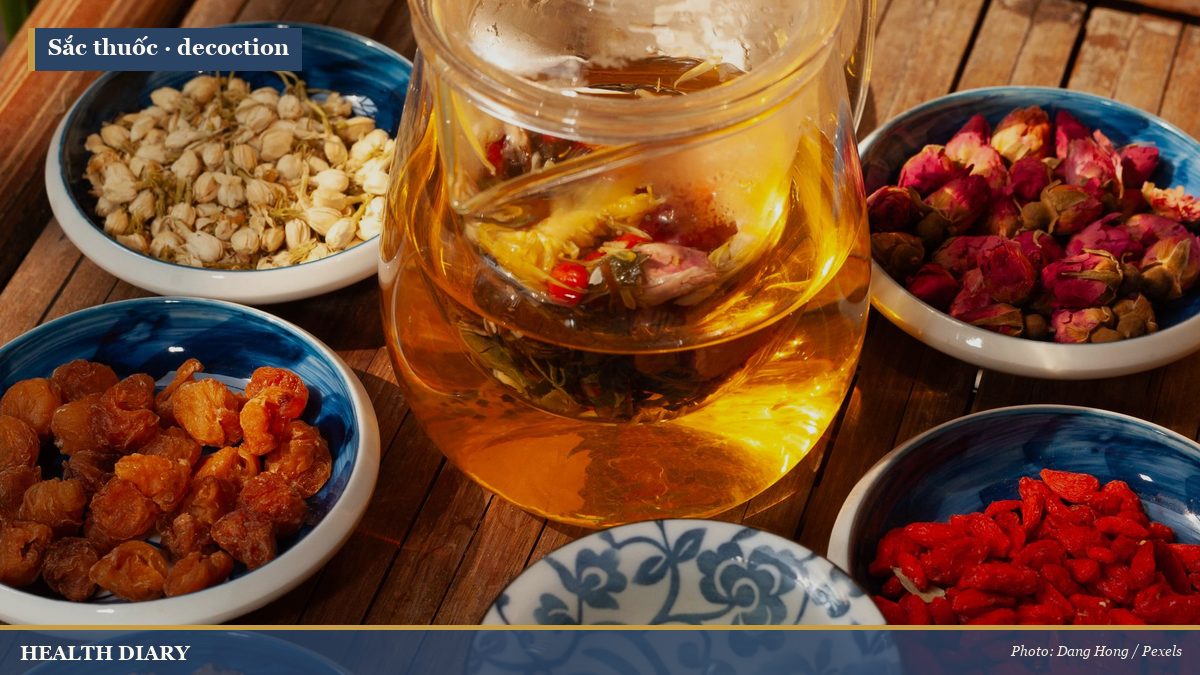
Sắc thuốc (decoction). This is the classic method for tougher materials — roots, barks, seeds, and dried herbs. The ingredients are simmered slowly in water, often reduced through more than one pass, to draw their compounds into a concentrated dark liquid that is sipped warm. Decoction is the everyday workhorse of both thuốc Nam and thuốc Bắc.
Ngâm rượu (herbal maceration). Herbs, roots, or fruits are steeped in rice spirit for weeks or months to create an aromatic tincture traditionally taken in very small amounts. Because it involves alcohol, this method is the one to approach most cautiously and never a fit for everyone.
Beyond these, the simplest "preparation" of all is eating the plant fresh — the raw-herb plate, the pennywort drink, the pandan-scented dessert. Individual responses vary considerably; what works well for one person may not suit another, and personal experimentation is always best done under the guidance of a qualified practitioner.
What Does Modern Research Suggest About These Herbs?
It would be a mistake to read tradition as proof, and an equal mistake to dismiss it. Over the last few decades, laboratory science has begun to examine the everyday plants of thuốc Nam, and the early picture is intriguing though still preliminary. Most of this work is in cells and animals rather than large human trials, so it points to plausible mechanisms rather than established outcomes.
- Perilla (tía tô) is rich in rosmarinic acid, perillaldehyde, and flavonoids such as luteolin. A 2025 review in Foods describes its antioxidant and anti-inflammatory activity in laboratory models, with rosmarinic acid dampening inflammatory signaling and scavenging reactive oxygen species (Perilla frutescens review, 2025).
- Fish mint (rau diếp cá) has been the subject of an ethnopharmacological review in Frontiers in Pharmacology, which catalogs antiviral and anti-inflammatory activity attributed to its flavonoids and essential oil in experimental settings (Houttuynia cordata review, 2021).
- Lemongrass (sả) owes much of its studied activity to citral, which makes up the bulk of its essential oil and has shown antibacterial, antifungal, and antioxidant effects in the laboratory (Cymbopogon citratus phytopharmacology notes).
- Pennywort (rau má) contains triterpenes such as asiaticoside, long studied for wound-related and calming applications. Vietnamese clinical sources emphasize moderation — a common guideline is not to drink concentrated pennywort continuously for more than about six weeks without professional guidance (Vinmec, rau má overview).
The honest summary is this: the traditional uses of these plants are being explored by science, some early findings are encouraging, and none of it replaces medical care. Where a herb has a well-documented profile, that is a reason for interest, not a promise of results.
Important Limitations and Considerations
Because herbs are gentle in reputation, it is easy to forget they are pharmacologically active — and that "natural" is not a synonym for "safe." A responsible reading of the Vietnamese herbal tradition has to include its cautions.
- Herb–drug interactions. Plant compounds can interact with medications, sometimes through the same liver enzymes that process pharmaceuticals. The NCCIH notes, for example, that some herbs alter drug metabolism enough to matter clinically, and that combinations with blood thinners deserve particular care (NCCIH, herb–drug interactions). If you take prescription medication, talk with your doctor or pharmacist before adding herbal preparations.
- Quality and identity of the material. Herbal safety begins with knowing exactly what plant you have. The WHO's guidance on herbal processing stresses accurate botanical identification and control of contaminants, because misidentification and adulteration are real risks in unregulated markets (WHO herbal processing guidelines). Buy from reputable sources and be wary of unlabeled products.
- Pregnancy and breastfeeding. Several traditional herbs are specifically discouraged during pregnancy. If you are pregnant, trying to conceive, or nursing, do not begin any herbal regimen without professional advice.
- Children and older adults. Dosing that suits a healthy adult may not suit a child or a frail elder; these groups warrant extra caution and practitioner input.
- Serious illness is not a home-remedy problem. Folk practices are a complement to, never a substitute for, medical diagnosis and treatment. Persistent, severe, or worsening symptoms need a clinician — not a garden remedy.
- Dosage and duration. As the pennywort example shows, even familiar plants carry traditional limits on how much and how long. More is not better.
Individual experiences vary considerably. The safest way to explore this tradition is slowly, in small amounts, with attention to how your own body responds and with a licensed practitioner in the loop.
Frequently Asked Questions
What is the difference between thuốc Nam and thuốc Bắc?
Thuốc Nam ("Southern medicine") is the indigenous Vietnamese folk tradition, built on native plants that are often used fresh or lightly dried and simple enough to prepare at home. Thuốc Bắc ("Northern medicine") is the tradition adapted from Chinese medicine, relying on classical theory and prepared, often imported herbs dispensed by trained practitioners. Both are grouped together under the umbrella term Đông y (Eastern medicine).
Who is considered the father of Vietnamese herbal medicine?
Tuệ Tĩnh, a fourteenth-century Zen monk and physician, is honored as the founding father of thuốc Nam. He is remembered for the principle "Nam dược trị Nam nhân" — Southern medicine to treat Southern people — and for compiling native remedies in his work Nam dược thần hiệu. The later scholar Hải Thượng Lãn Ông and the modern pharmacologist Đỗ Tất Lợi are the tradition's other towering figures.
Are Vietnamese kitchen herbs really used as medicine?
Yes. In thuốc Nam the line between food and remedy is intentionally blurred. Everyday herbs such as perilla, pennywort, fish mint, and lemongrass appear both on the dinner plate and in folk preparations. Vietnam's Ministry of Health even defined a list of roughly seventy medicinal plants to be grown at commune health stations, reflecting how central these plants are to everyday wellness.
What is xông, the Vietnamese herbal steam?
Xông is a folk practice in which aromatic leaves — commonly lemongrass, perilla, and citrus leaves — are simmered in water, and the person breathes the fragrant steam under a towel or blanket. It is traditionally used to feel refreshed and clear-headed. As with any practice, individual responses vary, and it should be done carefully to avoid burns from hot water or steam.
Can I use these herbs if I take prescription medication?
Talk to your doctor or pharmacist first. Herbal compounds can interact with medications, sometimes by affecting how the liver processes drugs. This is especially important if you take blood thinners, blood-pressure or diabetes medication, or any medicine with a narrow safety margin. "Natural" does not mean free of interactions.
Are Vietnamese herbal remedies safe during pregnancy?
Some traditional herbs are specifically discouraged during pregnancy, and safety data for many others is limited. If you are pregnant, nursing, or trying to conceive, do not start any herbal regimen without first consulting a qualified healthcare practitioner.
Where can I learn about specific Vietnamese herbs?
This article is a hub. For deeper profiles, follow the links throughout — for example our guides to perilla leaf, gotu kola (pennywort), fish mint, lemongrass, lotus leaf, artichoke, moringa, and pandan, plus the tea and soup traditions that use them. Each profile covers traditional use, preparation, and safety in more detail.
A Note on Tracking Your Wellness Journey
Traditional Vietnamese herbal culture has always been observational. A grandmother watched which foods settled the stomach in the rainy season and which drinks cooled the body in the heat, then adjusted with the calendar and the person in front of her. That habit of gentle, patient attention translates well to modern life. If you decide to explore any of these herbs, it helps to notice — ideally in a simple journal or app — how a given tea, broth, or steam actually makes you feel over days and weeks, rather than expecting a single dramatic change. If you are curious where your own preferences fit within Vietnam's herbal landscape, you might enjoy our short interactive Vietnamese herbs quiz linked with this article. Tracking is not about chasing outcomes; it is about knowing your own patterns.
A Soft Closing Note
The traditional herbal culture of Vietnam is less a catalog of remedies than a way of living close to plants — growing a few of them by the door, folding them into meals, brewing them when the weather turns, and passing the knowledge down as casually as a recipe. Its enduring appeal is its modesty: a medicine you can eat, grow, and understand. Approached with curiosity and respect for its limits, it offers a beautiful window into how one culture has cared for itself for seven centuries. Some people explore this tradition by starting with a single familiar herb — a cup of perilla tea, a bowl of herbal soup — and letting one thread lead to the next through the guides linked here.
About This Article
Written by: Health Diary Editorial Team — a group of writers focused on traditional Asian wellness, herbal history, and culturally grounded, responsibly sourced health content.
Editorial review: This article has been reviewed by the Health Diary editorial team for clarity, structure, and adherence to our sourcing standards. Key claims were cross-checked against NCCIH, NIH PubMed/PMC, WHO guidance, and native-language Vietnamese sources including the Ministry of Health outlet Sức khỏe & Đời sống and Vietnamese traditional-medicine institutions. It is not a clinical review and should not replace consultation with a licensed healthcare practitioner.
Reviewed on: July 18, 2026.
Editorial process: We cite peer-reviewed and government sources where possible, alongside primary historical references such as the works of Tuệ Tĩnh, Hải Thượng Lãn Ông, and Đỗ Tất Lợi. When a clinical reviewer is added to this article, attribution will appear here with verifiable credentials.
References
- Tefara NA, Balasundaram L. Traditional Medicine in Vietnam. PriMera Scientific Medicine and Public Health. 2023. primerascientific.com
- Thai HC. Traditional Vietnamese Medicine: Historical Perspective and Current Usage. EthnoMed, University of Washington. 2003, rev. 2011. ethnomed.org
- Người được mệnh danh là "ông tổ" thuốc Nam (Tuệ Tĩnh). Sức khỏe & Đời sống (Vietnam Ministry of Health). 2022. suckhoedoisong.vn
- Hải Thượng Lãn Ông Lê Hữu Trác – đại danh y, nhà văn hóa xuất sắc. Bệnh viện Y học Cổ truyền TP. Hồ Chí Minh. yhct.vn
- Đỗ Tất Lợi. Những cây thuốc và vị thuốc Việt Nam (Medicinal Plants and Herbs of Vietnam). First published 1962. archive.org
- Danh lục 70 cây thuốc sử dụng trong cơ sở khám bệnh, chữa bệnh bằng y học cổ truyền (Ministry of Health list). Tra Cứu Dược Liệu. tracuuduoclieu.vn
- Comprehensive Review of Perilla frutescens: Chemical Composition, Pharmacological Mechanisms, and Industrial Applications. Foods. 2025. PMC11988686
- Wu Z, Deng X, Hu Q, et al. Houttuynia cordata Thunb: An Ethnopharmacological Review. Frontiers in Pharmacology. 2021. frontiersin.org
- Machraoui M, Kthiri Z, Ben Jabeur M, Hamada W. Ethnobotanical and phytopharmacological notes on Cymbopogon citratus (DC.) Stapf. Journal of New Sciences, Vol. 55. jnsciences.org
- Rau má có tác dụng gì với sức khỏe? Vinmec. vinmec.com
- WHO guidelines on good herbal processing practices for herbal medicines (TRS 1010, Annex 1). World Health Organization. who.int
- Herb–Drug Interactions: What the Science Says. NCCIH, National Institutes of Health. nccih.nih.gov
This article is for educational purposes only and reflects traditional Vietnamese cultural practices. It does not constitute medical advice. Consult a qualified healthcare provider before starting any herbal practice or making changes to your health routine.