Gotu Kola in Vietnamese Culture: Traditional Drinks, Recipes, and Wellness Uses
Explore how Vietnamese culture uses gotu kola (rau ma) daily — as a refreshing street drink, smoothie, salad herb, and folk wellness staple, with traditional recipes.
Medical Disclaimer: This content is for educational and informational purposes only and is not medical advice. The information presented is not intended to diagnose, treat, cure, or prevent any disease. Always consult a licensed healthcare practitioner before starting any new herbal practice or supplement. Statements regarding traditional herbal use have not been evaluated by the FDA.
Affiliate Disclosure: This article contains affiliate links. We may earn a commission if you purchase through these links, at no additional cost to you. We only recommend products we believe align with our editorial standards.
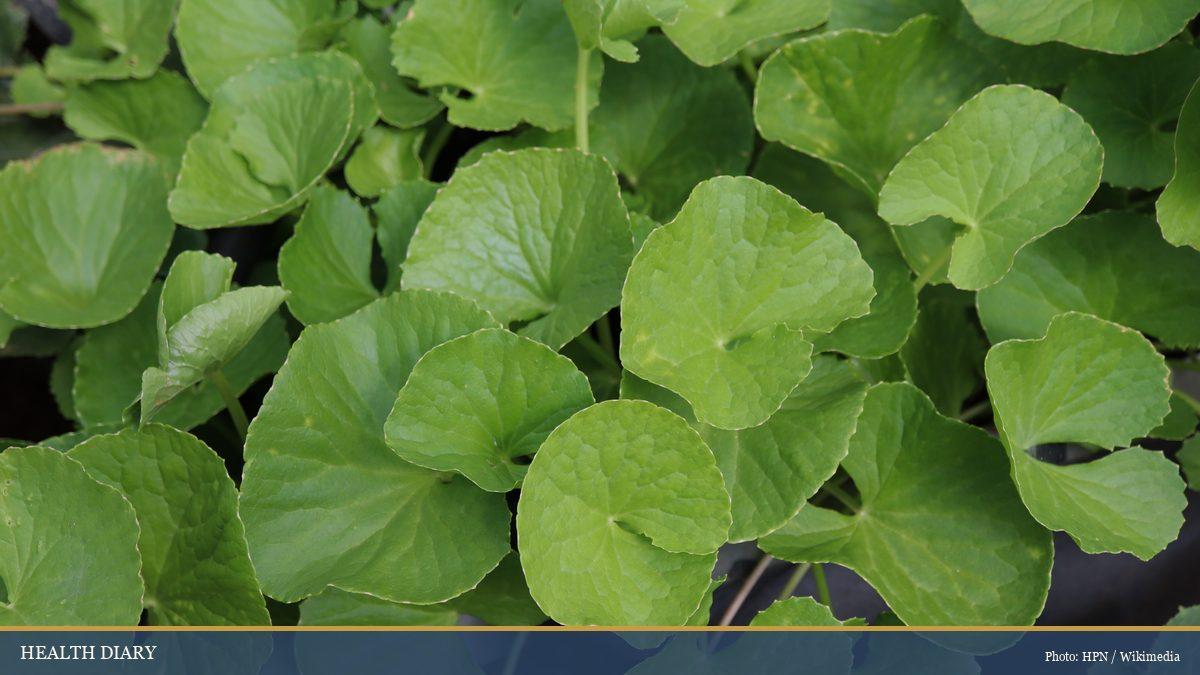
Walk through any Vietnamese market on a warm afternoon and you will almost certainly find it: small bundles of low-growing green leaves, coin-shaped, sold for a few thousand dong alongside basil and perilla. At street stalls nearby, vendors blend these same leaves with cold water to produce a vivid green drink that Vietnamese people have been enjoying for generations. The herb is rau má — known internationally as gotu kola (Centella asiatica) — and it holds a unique place in Vietnamese food and folk wellness culture that goes far beyond its reputation as a supplement in Western markets.
This article explores how Vietnamese culture actually uses rau má in daily life: as a refreshing drink, a smoothie, a salad herb and cooking ingredient, and a folk wellness staple passed down through generations.
Gotu Kola in Vietnamese Culture
In Vietnam, rau má is not an exotic supplement — it is an everyday ingredient. The name rau má (loosely translated as "horse leaf" or sometimes linked to a folk etymology of "tiger grass") is so familiar that most Vietnamese people simply consider it part of the landscape of daily eating, alongside morning glory and water spinach.
Botanically, Centella asiatica grows naturally across Vietnam from north to south. The Vietnam-Korea Institute of Science and Technology (VKIST) documents its nationwide distribution, noting it thrives especially well in humid lowland areas [1]. This abundance has made rau má accessible at every market year-round, consumed by people of all ages.
In Vietnamese folk tradition, rau má carries the informal title of a "longevity herb" — an herb associated with cooling the body, refreshing the system during hot months, and maintaining everyday vitality. Vietnamese grandmothers traditionally associate it with summer wellness, recommending fresh rau má juice when the heat climbs and the body feels sluggish. Folk classification describes it as tính mát (cool in nature), making it the go-to herb when the body feels overheated during Vietnam's long, humid summers.
Vinmec International Hospital's health information resources confirm this cultural pattern: rau má is consumed in multiple ways across Vietnamese daily life — as a fresh drink, eaten raw in salads, added to soups, and used as a table herb alongside grilled foods [2]. Individual responses to seasonal herbs vary, as Vietnamese tradition itself acknowledges.
Nuoc Rau Ma: The Classic Vietnamese Gotu Kola Drink
Perhaps the most iconic Vietnamese use of rau má is nước rau má — the classic gotu kola juice served at street stalls across the country, especially during summer months. Sức Khỏe & Đời Sống (the Ministry of Health-affiliated health publication) documents the traditional preparation [3]:
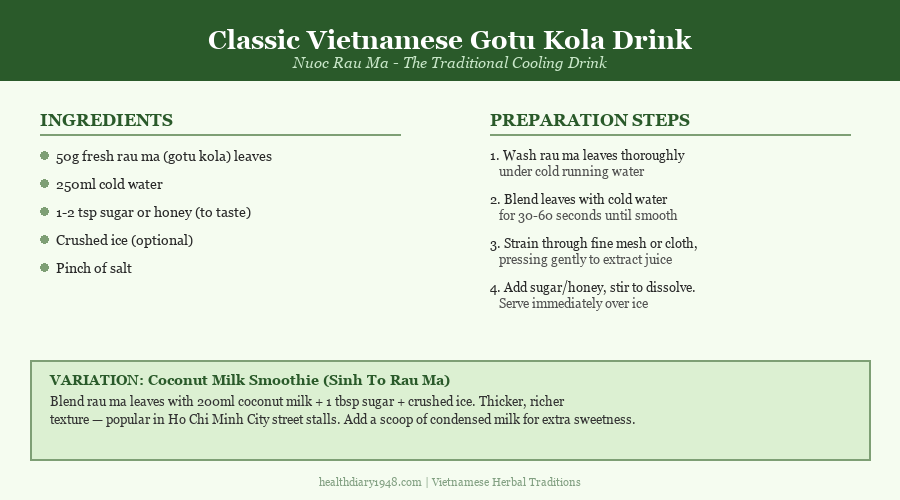
- Leaves: 40–50g of fresh rau má leaves, thoroughly washed
- Water: 250ml cold water
- Sweetener: 1–2 teaspoons of sugar or a small amount of honey
- Optional: a small pinch of salt, crushed ice
The preparation is simple: blend the washed leaves with the water for 30–60 seconds until smooth, then strain through a fine cloth or mesh strainer, pressing gently to extract all the liquid. The resulting juice is a vivid, fresh green — quite unlike anything from a supplement capsule. Serve immediately over crushed ice.
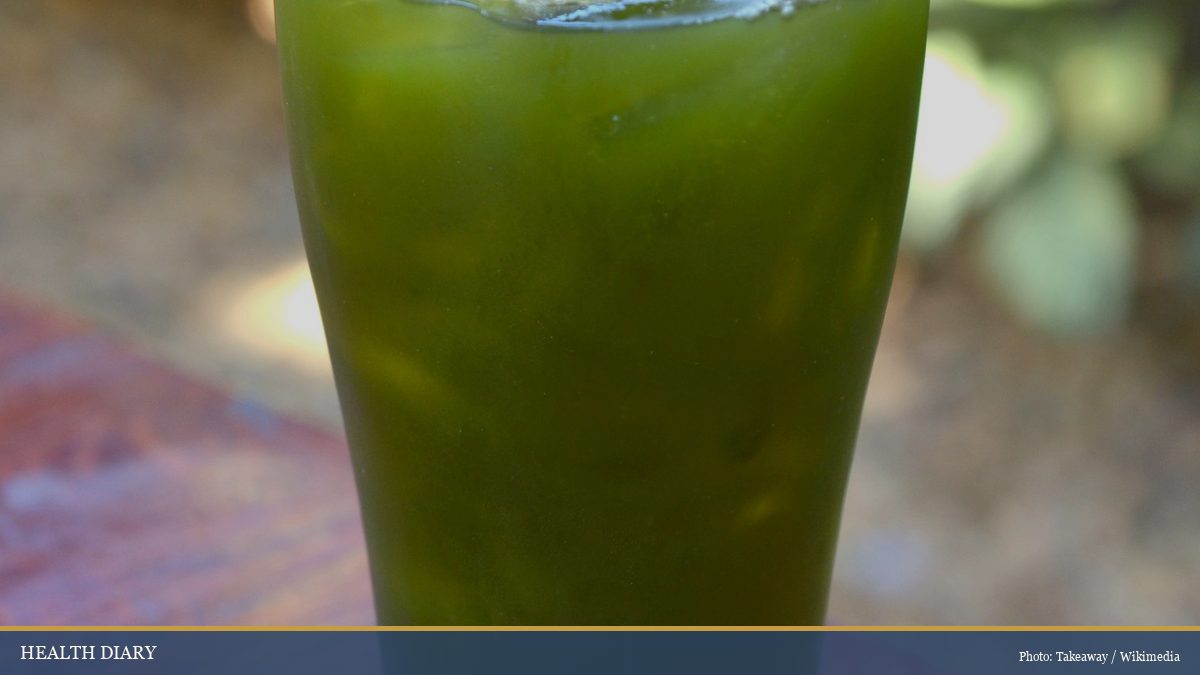
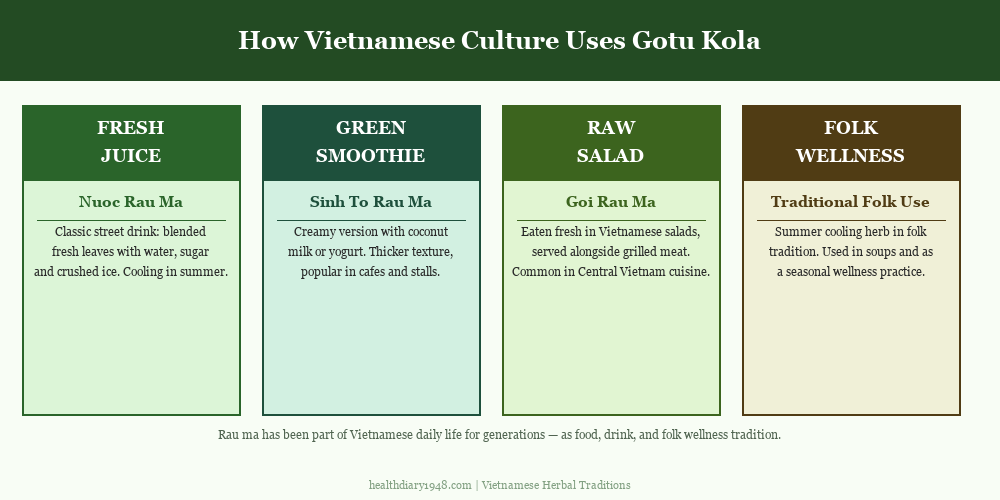
Street vendors across Ho Chi Minh City, Hanoi, and Hue sell cups of nước rau má from early morning, often from mobile carts or small stalls near markets. The drink is rarely consumed as a "wellness product" in the Western sense — it is simply a refreshing part of daily life, the way iced coffee or tea might be elsewhere. In Vietnamese folk belief, drinking nước rau má during hot months is considered a practical way to keep the body comfortable in the heat.
Individual responses to cooling herbs vary considerably — some people find the drink deeply refreshing; others with sensitive digestive systems may prefer smaller quantities.
How to Make Gotu Kola Smoothie (Sinh To Rau Ma)
A richer, creamier variant of the basic juice has become popular in Vietnamese cafes and street stalls: sinh tố rau má — the gotu kola smoothie.
The difference from plain juice is the addition of coconut milk and a thicker consistency:
- 40–50g fresh rau má leaves, washed
- 150ml coconut milk (or full-fat coconut cream for a richer result)
- 1 tablespoon sugar (or condensed milk for a sweeter, more traditional taste)
- A generous amount of crushed ice
Blend everything together until smooth and thick — no straining needed, as the coconut milk integrates the leaf fiber into a pleasantly thick texture. The result is somewhere between a smoothie and a milkshake: green, fragrant, and satisfying.
A yogurt variant has also gained popularity in urban Vietnamese cafes: substitute half the coconut milk with plain yogurt for a slightly tangy, probiotic-friendly version. Some cafes in Ho Chi Minh City add a scoop of condensed milk to the coconut version for extra sweetness — a combination that works particularly well for those who find the pure herb taste slightly bitter.
The smoothie differs from the plain juice in flavor profile: the coconut milk rounds out the slight bitterness of rau má and adds fat-soluble nutrients. It is also more filling, making it a common breakfast or afternoon snack rather than just a thirst-quenching drink. Individual preferences vary considerably — some people prefer the cleaner, brighter flavor of the plain juice; others enjoy the richness of the coconut version.
How Do Vietnamese People Use Gotu Kola in Cooking?
Beyond drinks, rau má appears in Vietnamese cooking in several forms — most of which are not well-known outside Vietnam.
Gỏi rau má (raw salad herb): In the simplest and most traditional use, young rau má leaves are eaten raw as part of the plate of fresh herbs (đĩa rau sống) that accompanies many Vietnamese meals, especially grilled dishes. Central Vietnamese cuisine particularly favors rau má alongside bò nướng (grilled beef) — the cool, slightly bitter leaves balance the richness of the meat.
In soups and broths: Rau má is sometimes added to light soups, particularly vegetable broths prepared during hot months. It wilts quickly and releases its characteristic green color and mild flavor into the broth. Vinmec notes this as a traditional use for maintaining everyday vitality during summer [2].
With grilled meats: In Central Vietnam (Hue, Da Nang), rau má is part of the standard herb plate for grilled pork and beef dishes. The Vietnamese approach to herb plates is quite different from Western garnishing — the herbs are eaten in quantity alongside each bite, not merely decorating the plate. Rau má's cooling folk quality is considered a pleasant counterpoint to the warmth of grilled and marinated meats.
Seasonal cooking emphasis: Vietnamese home cooks tend to use more rau má in summer and less in cooler months — reflecting the herb's traditional folk classification as seasonally appropriate cooling food. This intuitive, seasonal approach is a characteristic feature of Vietnamese culinary tradition.
Traditional Folk Uses of Rau Ma in Vietnam
Beyond eating and drinking, Vietnamese folk tradition has long associated rau má with a range of everyday wellness practices. These are cultural practices passed down through generations — not clinical claims, and they should be understood in that context.
Summer cooling folk practice: Vietnamese grandmothers traditionally prepare fresh rau má juice for family members during hot spells, believing the herb's cooling nature (tính mát) helps the body adapt to summer heat. Sức Khỏe & Đời Sống documents this as the most common folk application [3].
Prickly heat folk remedy: A traditional Vietnamese folk preparation for summer skin discomfort involves straining fresh rau má juice (with a small amount of sugar) and drinking it during periods of heat rash or prickly heat. VKIST documents this folk practice as part of the herb's traditional profile in Vietnamese communities [1].
Vietnamese grandmother wisdom — the "giải nhiệt" principle: The concept of giải nhiệt (clearing heat, literally "releasing heat") is central to how Vietnamese folk tradition understands rau má. This is not the same as reducing a clinical fever — it is a folk concept about maintaining comfortable, balanced body temperature through diet during hot months. Rau má, along with other cooling foods like bitter melon and lotus seeds, forms part of the traditional Vietnamese summer diet designed around this principle.
These are folk traditions and cultural practices. They are not evidence-based clinical claims, and individual experiences vary considerably — what one person finds refreshing and comfortable, another may find unsuitable for their constitution or digestive sensitivity.
Cultivating Rau Ma at Home
One practical aspect of rau má's Vietnamese popularity is how easily it grows. Vinmec's cultivation notes confirm what Vietnamese home gardeners have known for generations [2]:
- Soil: Moist, rich soil with good drainage. Rau má naturally grows near streams and in moist lowlands in Vietnam — replicate this with consistently damp (not waterlogged) potting mix.
- Light: Partial shade is ideal. Direct afternoon sun can stress the plant; morning sun with afternoon shade works well for pot or window box cultivation.
- Container: A window box or shallow pot (20cm+ depth) works well. The plant spreads laterally via runners, so width matters more than depth.
- Watering: Keep consistently moist — rau má is one of the more water-demanding culinary herbs. A weekly deep watering plus regular misting suits it well indoors.
- Harvesting: Harvest young leaves (the freshest, most tender growth) before the plant flowers. Once rau má flowers, the older leaves become tougher and slightly more bitter. Pinching back flower heads encourages continuous leaf production. For the best-tasting nước rau má, use leaves harvested the same morning — freshness matters significantly for flavor and color.
- Temperature: Being a tropical Southeast Asian plant, rau má prefers warm conditions. Bring indoors in winter in temperate climates.
Growing rau má at home is a rewarding way to ensure consistent freshness for drinks — store-bought rau má, while available in Vietnamese and Asian grocery stores, rarely matches the flavor and vivid green color of leaves used within hours of harvest.
Frequently Asked Questions
What is rau ma in English?
Rau má is the Vietnamese name for Centella asiatica, known in English as gotu kola, Indian pennywort, or Asiatic pennywort. The leaf is small and round with a slightly scalloped edge, growing low to the ground on thin stems. It has no caffeine and is unrelated to kola nut despite the similar-sounding English name.
How do Vietnamese people drink gotu kola?
The most traditional preparation is nước rau má — fresh leaves blended with cold water, strained, and served with sugar and crushed ice. A creamier version called sinh tố rau má adds coconut milk for a smoother, richer texture. Both are available at Vietnamese street stalls and cafes, particularly during summer months. Traditional Vietnamese sources document 40–50g of fresh leaves per serving as a typical home preparation.
Is rau ma safe to drink every day?
Fresh rau má juice in moderate culinary amounts (as typically consumed in Vietnam) is generally considered well-tolerated. However, the NIH LiverTox database documents rare cases of liver injury associated with concentrated gotu kola supplementation [4]. Vietnamese traditional sources also caution that people with cold constitutions (chronic loose stools, weak digestion) should limit intake. Concentrated extracts or capsules are a different matter from culinary fresh juice. Consult a healthcare practitioner if you have existing liver or digestive concerns.
Can I grow gotu kola at home outside Vietnam?
Yes — rau má grows readily in pots or window boxes given moist soil, partial shade, and warmth. It spreads via runners and produces continuous harvests of young leaves when managed well. In temperate climates, it can be grown as a warm-season annual or brought indoors during winter. Asian grocery stores also commonly stock fresh rau má leaves for those who prefer not to grow their own.
Does gotu kola taste bitter?
Fresh rau má has a mild, slightly grassy flavor with a faint bitterness — less pronounced than many bitter herbs. The bitterness becomes more noticeable in older leaves (especially after the plant has flowered) and in concentrated extracts. When blended with water and a small amount of sugar, the flavor is pleasant and refreshing. The coconut milk smoothie variant almost completely masks any bitterness, making it a popular choice for those new to the herb.
About This Article
Written by: Health Diary Editorial Team — a small editorial group researching traditional wellness practices, herbal traditions, and Vietnamese food culture. Our articles draw on peer-reviewed literature, government health-agency resources, hospital health information portals, and Vietnamese-language primary sources.
Editorial review: This article has been reviewed by the Health Diary editorial team for clarity, structure, and adherence to our sourcing standards. Key claims were cross-checked against NCCIH, NIH PubMed, Vinmec International Hospital, VKIST (Vietnamese government science institute), and Sức Khỏe & Đời Sống (Ministry of Health-affiliated publication) where applicable. It is not a clinical review and should not replace consultation with a licensed healthcare practitioner.
Reviewed on: June 16, 2026.
Editorial process: Cultural and folk-use claims are attributed to Vietnamese-language primary sources rather than secondary English summaries. We distinguish between folk traditions (presented as cultural practice) and clinical evidence (presented with study references). This article reflects Vietnamese folk traditions. It is not medical advice. Consult a healthcare provider for health concerns.
References
- VKIST — Vietnam-Korea Institute of Science and Technology. Cay rau ma (Centella asiatica L. Urb.): Cay duoc lieu gia tri va san co cua Viet Nam. https://vkist.gov.vn/vi/post/cay-rau-ma--centella-asiatica--l-urb--cay-duoc-lieu-gia-tri-va-san-co-cua-viet-nam-683.htm
- Vinmec International Hospital. Rau ma: Cong dung va cach su dung an toan. https://www.vinmec.com/vi/tin-tuc/thong-tin-suc-khoe/dinh-duong/rau-ma-cong-dung-va-cach-su-dung-an-toan/
- Suc Khoe & Doi Song (Ministry of Health publication). Nuoc Rau Ma — Tac dung, Cach Lam va Luu Y. https://suckhoedoisong.vn/nuoc-rau-ma-tac-dung-cach-lam-va-nhung-luu-y-169230526162831617.htm
- National Institutes of Health, National Library of Medicine. Centella asiatica — LiverTox: Clinical and Research Information on Drug-Induced Liver Injury. NBK603561. https://www.ncbi.nlm.nih.gov/books/NBK603561/
- Puttarak P et al. Effects of Centella asiatica (L.) Urb. on cognitive function and mood related outcomes: A Systematic Review and Meta-analysis. 2017. PMC5587720. https://pmc.ncbi.nlm.nih.gov/articles/PMC5587720/
- Memorial Sloan Kettering Cancer Center. Gotu Kola — Integrative Medicine herb monograph. https://www.mskcc.org/cancer-care/integrative-medicine/herbs/gotu-kola