Lotus Leaf: Vietnam's Sacred Plant and Its Traditional Wellness Uses
Educational guide to lotus leaf (lá sen / Nelumbo nucifera leaf) — Vietnam's national flower in traditional medicine, TCM classification (He Ye 荷叶), nuciferine alkaloid research, the 2022 human RCT on fat reduction, antioxidant flavonoids (quercetin, kaempferol), traditional Vietnamese preparations (trà lá sen, cơm nắm lá sen), and important safety considerations for cold-constitution individuals and drug interactions.
Medical Disclaimer: This content is for educational and informational purposes only and is not medical advice. The information presented is not intended to diagnose, treat, cure, or prevent any disease. Always consult a licensed healthcare practitioner before starting any new herbal practice or supplement. Statements regarding traditional herbal use have not been evaluated by the FDA.
Affiliate Disclosure: This article contains affiliate links. We may earn a commission if you purchase through these links, at no additional cost to you. We only recommend products we believe align with our editorial standards.
Vietnam's national flower is not merely a symbol of purity and resilience — it is a plant whose broad green leaf has been woven into the country's culinary traditions, folk medicine, and seasonal wellness rituals for centuries. While the world often celebrates the lotus flower or its seed, Vietnamese traditional medicine and everyday life have long found special value in the leaf itself: brewed as a cooling summer tea, wrapped around rice to perfume and preserve it, and documented in classical Đông y texts as a clearing, cooling herb for hot-weather ailments.
This guide focuses specifically on the leaf of Nelumbo nucifera — known in Vietnamese as lá sen, in TCM as hé yè (荷叶). It covers what traditional Vietnamese and Chinese medicine say about the leaf, how it has been prepared and used across generations, what early modern research has begun to suggest about its bioactive compounds, and the important considerations anyone should know before incorporating it into their daily routine.
The Sacred Leaf at the Heart of Vietnamese Culture
In Vietnam, the lotus (sen) holds a place unlike any other plant. Chosen as the national flower, it is a symbol of purity — rising from muddy pond water to bloom in pristine white and pink — and of strength, of endurance through difficulty. Temples, pagodas, and traditional architecture across the country incorporate lotus motifs; Buddhist imagery places the Buddha seated on a lotus throne; and Vietnamese poetry and song return to sen again and again as a metaphor for moral virtue.
This cultural reverence extends naturally to the plant's uses. The lotus is one of those rare plants where virtually every part carries traditional significance: the flower petals, the stamens, the seeds, the root (rhizome), the seed pod, and the leaf all appear in Vietnamese culinary and medicinal traditions. The leaf in particular has a dual life — as a food vessel and as a medicinal herb.
In Hue, the former imperial capital, cơm hạp lá sen — fragrant rice with lotus seeds, shrimp, chicken, and vegetables, carefully steamed inside a fresh lotus leaf — was once a royal dish during the Nguyen Dynasty. The leaf imparts a subtle floral fragrance to the rice while cooking, and the wrapped parcel echoes the visual form of a blooming flower when unwrapped. This dish continues to represent Hue's refined culinary heritage today. Across Vietnam, cơm nắm lá sen — hand-pressed rice parcels wrapped in dried lotus leaf — remains a traditional portable food, particularly in rural and festival contexts where the leaf's natural fragrance and mild antimicrobial properties served a practical preservation role before modern packaging.
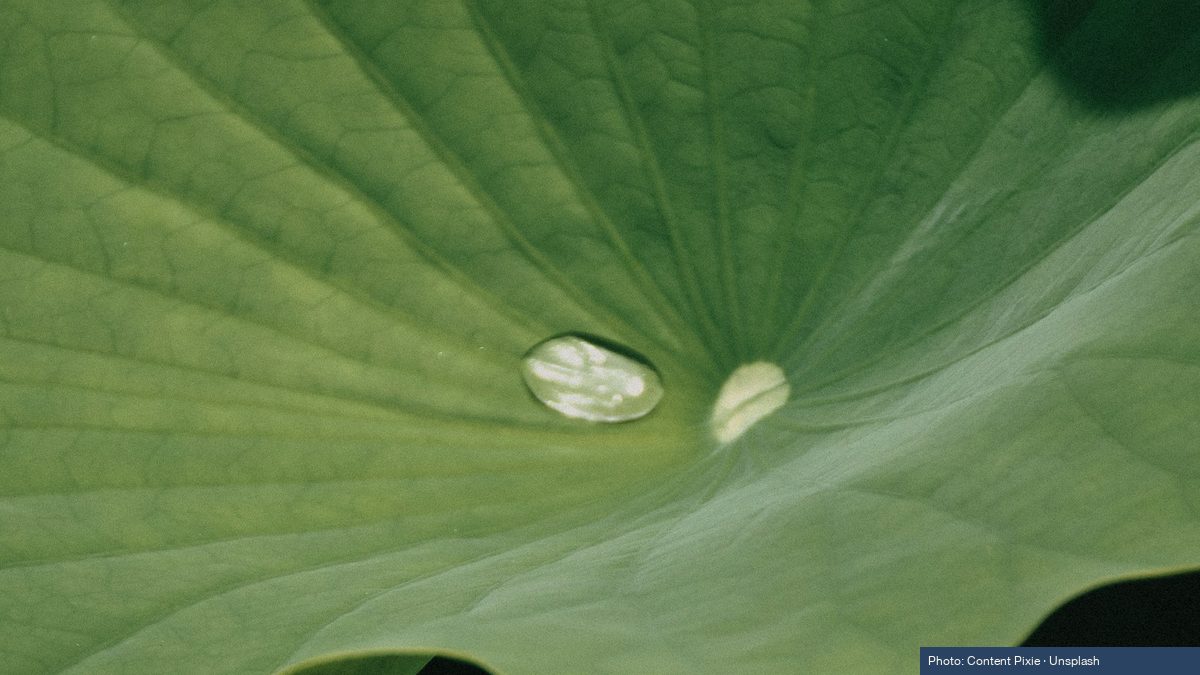
Beyond the table, the large rounded leaf — which can reach 30–60 cm in diameter, dark green on top and lighter green below, with a waxy, water-repellent surface — has been gathered throughout summer and autumn, dried, and stored for use in tea preparations year-round.
What Traditional Vietnamese Medicine Says About Lotus Leaf
In Vietnamese traditional medicine (y học cổ truyền, sometimes called Đông y in its Sinicized form), lotus leaf occupies a specific place in the pharmacopeia of cooling and heat-clearing herbs. Vinmec International Hospital's traditional medicine reference classifies it as having vị đắng và hơi chát, tính mát — a bitter, slightly astringent taste and a cooling thermal nature [1]. Some Vietnamese clinical sources — including the traditional medicine department at Bệnh viện Nguyễn Tri Phương — describe the nature as tính bình (neutral), leaning cool [2]. This slight variation is common in traditional herbal classification systems, where regional practice and individual practitioner tradition can produce nuanced differences in how an herb is categorized.
The core traditional functions attributed to lotus leaf in Vietnamese practice include:
- Giải nhiệt — clearing summer heat; traditionally indicated during the hot months for symptoms associated with overheating
- Lương huyết — cooling the blood; addressing heat-related hemorrhagic patterns such as nosebleeds, bloody stools, and excessive menstrual flow
- Cầm máu — hemostasis; traditionally used in dried or charred form for bleeding conditions
- Trấn tĩnh — calming the spirit; mild sedative-like effects included in some Vietnamese traditional references for insomnia and restlessness
- Hạ lipid máu — lowering blood lipids; a more recently documented application that aligns with modern research on the leaf's alkaloid content
The Chinese Traditional Medicine pharmacopeia classifies 荷叶 (hé yè) with similar but not identical language: Nature = Neutral (some modern references say slightly cool), Taste = Bitter, Meridian tropism = Liver, Spleen, and Stomach [3]. The TCM functions are: Clear Summer-Heat and Resolve Dampness; Raise Clear Yang (supporting the Spleen's ascending function, symbolically echoing the lotus rising from muddy water); and Cool the Blood and Stop Bleeding. The Chinese Pharmacopoeia classifies He Ye as non-toxic and lists it as a food-medicine dual-use substance.
A practical point worth noting: traditional Vietnamese and Chinese sources both caution against lotus leaf use in individuals with what they describe as a cold constitution (thân hàn / tỳ vị hư hàn) — a pattern typically marked by chronic loose stools, fatigue, cold extremities, and weak digestion. For these individuals, a cooling herb may aggravate existing imbalances. This caution appears consistently across both Vietnamese and Chinese traditional sources and is a genuine piece of traditional wisdom that English-language articles on lotus leaf rarely capture.
How Lotus Leaf Has Been Prepared in Vietnamese Traditions
The diversity of lotus leaf preparations in Vietnamese tradition reflects the plant's deep integration into both everyday life and ceremonial practice.
Trà Lá Sen — Lotus Leaf Tea
The most common everyday preparation. Dried lotus leaves are brewed with hot water and consumed as a cooling tea, particularly during summer (mùa hè). Vietnamese tradition specifically positions lotus leaf tea as a seasonal beverage — a heat-clearing drink for the hot months — rather than a year-round supplement. Fresh or dried leaves can be used; dried leaves are more commonly available in markets outside lotus-growing regions. The tea has a mild, slightly grassy-floral flavour with a subtle bitterness. It is often combined with other cooling herbs such as chrysanthemum flowers or dried longan for different traditional purposes [2].
Bệnh viện Nguyễn Tri Phương's traditional medicine reference describes one preparation for sleep support using one dried lotus leaf, decocted and consumed before sleep — a specific and practical instruction grounded in traditional clinical experience rather than general wellness marketing [2].
Cơm Lá Sen — Lotus Leaf Rice
The culinary use of lotus leaves to wrap and steam rice is one of the most culturally distinctive Vietnamese preparations. In Hue's royal tradition, cơm hạp lá sen represents the refined integration of culinary craft and botanical knowledge — the leaf acts as both a natural cooking vessel and a flavoring agent, its volatile aromatic compounds infusing the rice with a subtle lotus fragrance during steaming. The visual presentation — the wrapped parcel opened to reveal fragrant rice, echoing a blooming lotus — carries deep symbolic resonance in a culture that values the lotus as a spiritual emblem.
Decoction and Powder Preparations
For more targeted traditional medicinal applications, Vietnamese practice describes decoctions (sắc) — typically one fresh or dried leaf boiled in water until reduced to a concentrated dose, taken once or twice daily. Dried and powdered lotus leaf was also traditionally used. Some preparations combined lotus leaf with rice (cháo lá sen — lotus leaf congee) for digestive applications. Medlatec's reference notes that timing relative to meals matters: preparations are typically consumed 30 minutes after eating to avoid digestive discomfort [4].
He Ye Tan — The Charred Form
Chinese TCM practice makes an important distinction that Vietnamese tradition echoes: lotus leaf charred until black (荷叶炭, hé yè tàn) has specifically enhanced hemostatic properties, used for bleeding conditions [3]. This is a pharmacological transformation through processing — the charring chemically alters the leaf's active compounds in ways that redirect its therapeutic application. It is a concept common in TCM (炮制, páo zhì — the science of herbal preparation and modification) that most Western herbal accounts do not address.
What Early Research Has Begun to Explore
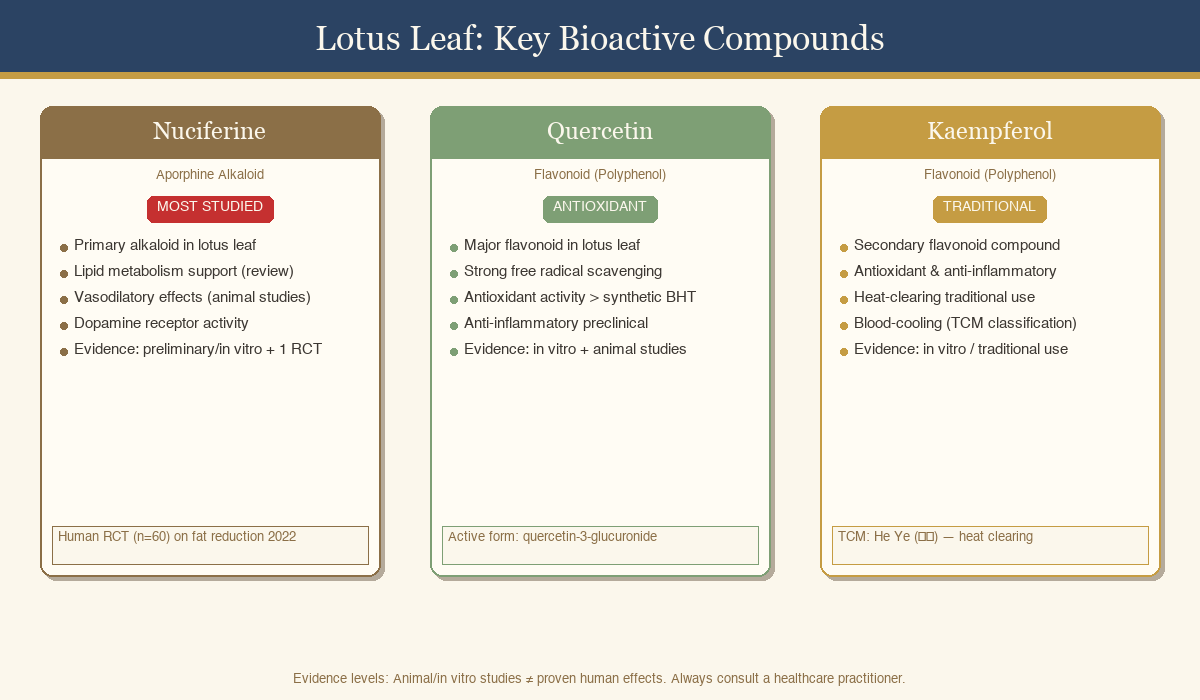
Modern scientific interest in lotus leaf has focused on two main chemical families: alkaloids (primarily nuciferine) and flavonoids (primarily quercetin and kaempferol). The research landscape is still developing, and it is important to distinguish clearly between what preliminary laboratory and animal studies suggest versus what human clinical evidence has demonstrated.
Nuciferine — The Primary Alkaloid
Nuciferine is the major aporphine alkaloid in lotus leaf and has attracted substantial research attention. A 2022 comprehensive review in Pharmacological Research summarized existing preclinical and clinical literature on nuciferine, identifying potential anti-obesity, anti-dyslipidemia, anti-hyperglycemic, anti-hypouricemic, and anti-inflammatory effects [5]. The mechanisms proposed include regulation of lipid metabolism pathways, modulation of gut microbiota, and dopamine receptor activity. The review also noted nuciferine's pharmacological profile shows some similarity to certain antipsychotic drugs — a finding that raises both potential therapeutic interest and safety questions that require further investigation.
A 2022 animal study published in PMC examined nuciferine's vasodilatory properties in rat thoracic aorta tissue, finding that it acts through the NO/cGMP signaling pathway, potassium channel opening, and calcium channel inhibition [6]. The authors proposed nuciferine as a lead compound for antihypertensive drug development — but it is essential to note this was a rat tissue model, and the translation to human clinical benefit has not been established.
Human Clinical Evidence — A Notable 2022 RCT
One of the more significant recent developments is a 2022 randomized double-blind controlled trial — a relatively rare study design in the lotus leaf research literature — involving 60 overweight patients (BMI 24–28) [7]. The active compound studied was quercetin-3-glucuronide derived from sun-dried lotus leaves. Over a 12-week intervention, participants receiving the lotus leaf extract showed significant whole-body fat reduction in both sexes, with men specifically showing reduced visceral fat and decreased waist circumference compared to the control group.
This is meaningful as it represents human evidence — not just animal data — for one specific bioactive compound from lotus leaf. However, several important caveats apply: the sample size (60 participants) is modest; the study used a specific standardized extract, not raw leaf tea; and independent replication has not yet been published. Researchers and practitioners alike would want to see further trials before drawing strong conclusions.
Antioxidant Flavonoids
A 2015 analytical chemistry study in Molecules identified 14 flavonoids in lotus leaves, including quercetin, kaempferol, and several novel compounds not previously documented in the plant [8]. The enriched flavonoid fraction demonstrated antioxidant capacity exceeding the synthetic antioxidant BHT in DPPH radical-scavenging tests (4695.3 vs. 3612.3 μmol TE/g). The authors concluded these compounds merit exploration as food supplements or pharmaceutical products — though laboratory antioxidant measurements do not automatically translate to clinically meaningful antioxidant effects in the human body.
Across all of this research, the honest summary is: lotus leaf contains pharmacologically interesting compounds, particularly nuciferine and quercetin derivatives; some preliminary human evidence for fat-related effects exists (2022 RCT); and vasodilatory and antioxidant properties show promise in laboratory settings. None of this constitutes proof that lotus leaf tea treats or prevents any disease. Individual responses to lotus leaf preparations vary considerably, and the research is sufficiently early-stage that anyone with health conditions should consult a healthcare practitioner rather than self-experimenting based on preliminary findings.
How Some People Incorporate Lotus Leaf Today
Traditional Vietnamese summer wellness practices offer a natural template for incorporating lotus leaf in ways that remain close to the tradition's spirit and seasonal logic.
Simple Lotus Leaf Tea
The most accessible approach follows traditional practice directly. Dried lotus leaves — available in Vietnamese herbal markets, specialty tea shops, and online — are brewed with hot water for 5–10 minutes. Some people prefer a lighter steep; others find the slight bitterness enjoyable. Traditional Vietnamese preparation sometimes includes a small piece of dried ginger for added warmth, or a few chrysanthemum flowers for additional cooling effects in summer. The tea is typically consumed unsweetened or with minimal honey.
Vietnamese tradition specifically suggests this tea during hot months — aligning with the herb's cooling classification. Drinking a cooling herb heavily during cold months is not traditional practice and does not align with classical recommendations.
Using Lotus Leaves in Cooking
For those drawn to the culinary dimension, cooking with lotus leaves offers a way to engage with the tradition's food-medicine continuum. Wrapping rice in dried or fresh lotus leaves before steaming imparts a mild floral aroma, and the ritual of opening the parcel at the table carries something of the tradition's aesthetic sensibility. Dried lotus leaves for cooking are widely available at Asian grocers in Vietnamese communities.
Commercial Extracts
Standardized lotus leaf extracts — often standardized for nuciferine content — are increasingly available as capsules. These deliver a higher and more consistent dose of active compounds than traditional tea preparations, which changes the pharmacological profile significantly. The 2022 RCT used a standardized extract rather than raw leaf tea; the fat-reduction effects were observed at a specific quercetin-3-glucuronide dose that may not be achievable from casual tea brewing.
Individual experiences with lotus leaf vary considerably — what some people find refreshing and pleasant, others may find too bitter or too cooling for their constitution. Observing how your body responds over time, particularly if you have a cold-type constitution as described in traditional Vietnamese medicine, is more informative than general claims about lotus leaf's properties.
Important Considerations Before Use
Lotus leaf is classified as non-toxic in the Chinese Pharmacopoeia and has a long history of use as both food and medicine. However, several considerations are important for anyone planning to use it beyond casual culinary amounts.
- Cold constitution and digestive sensitivity — Traditional Vietnamese and Chinese sources consistently identify people with cold-constitution patterns (chronic loose stools, fatigue, cold extremities, weak digestion) as poor candidates for habitual lotus leaf use. The cooling nature of the herb may aggravate these patterns over time. If you recognize these characteristics in yourself, consult a practitioner familiar with traditional medicine before regular use [2].
- Menstruation and pregnancy — Vietnamese and Chinese traditional sources both advise against lotus leaf use during menstruation, with concerns about potential effects on menstrual cycle regularity. During pregnancy, safety data is insufficient for confident recommendations; the traditional hemostatic indications and the lack of adequate safety studies in pregnant populations suggest consultation with a healthcare provider before use [1].
- Blood sugar medications — Research suggests lotus leaf compounds may have mild anti-hyperglycemic effects. People on insulin or oral hypoglycemic agents (sulfonylureas, metformin) should monitor their blood sugar more closely if using concentrated lotus leaf extracts and consult their prescribing physician before adding it to their routine.
- Blood pressure medications — The vasodilatory activity of nuciferine identified in animal models raises the theoretical possibility of additive effects with antihypertensive medications. This has not been confirmed in human studies, but caution is reasonable for people already taking blood pressure medication.
- Cardiovascular and psychiatric medications — Nuciferine's dopamine receptor activity and its pharmacological profile resembling certain antipsychotic compounds suggest the possibility of interactions with medications for cardiovascular conditions or psychiatric conditions. Consult your prescriber before using concentrated lotus leaf extracts if you take medications in these categories.
- Standardized extracts vs. traditional tea — The dose of active compounds in a traditional tea preparation differs substantially from a standardized nuciferine extract capsule. Most of the cautions above are most relevant for concentrated extracts. Occasional culinary use of lotus leaf in cooking carries minimal concerns for most healthy adults. The boundary between food and medicine in lotus leaf tradition is genuinely blurred — but it matters for safety assessment.
- Quality and sourcing — Commercial lotus leaf products vary significantly in plant origin, harvest time (summer/autumn leaves are traditional), processing method, and active compound concentration. If seeking specific health effects, products with standardized nuciferine or flavonoid content are more reliable than undifferentiated dried leaf.
Frequently Asked Questions About Lotus Leaf (Lá Sen)
What is lá sen and how is it different from lotus flower or lotus seed?
Lá sen refers specifically to the leaf of Nelumbo nucifera — the large, round green leaf that grows on the water surface, reaching 30–60 cm in diameter. Vietnamese and Chinese traditional medicine treat the different parts of the lotus plant as having distinct properties: the flower (hoa sen), seeds (hạt sen), rhizome (ngó sen), seed pod, and leaf all have separate traditional classifications and uses. The leaf is classified primarily as a cooling, heat-clearing herb and is the specific part used for trà lá sen (lotus leaf tea). The seed is classified differently — nourishing and calming — and the rhizome is treated as a food with blood-cooling properties. They are not interchangeable in traditional practice.
Can I drink lotus leaf tea every day, and is it safe long-term?
Traditional Vietnamese practice positions lotus leaf tea as a seasonal beverage — specifically a summer cooling drink — rather than a year-round daily supplement. Occasional use is generally considered safe for most healthy adults. For daily long-term use, particularly of concentrated extracts, there are several relevant considerations: cold-constitution individuals may experience adverse effects; people on medications for blood sugar, blood pressure, or psychiatric conditions should consult their prescriber; and the research base is not yet robust enough to give clear guidance on optimal long-term dosing. Individual responses vary considerably — some people find regular lotus leaf tea gently refreshing, while others do not tolerate it well.
What does the research say about lotus leaf and weight management?
Early research is cautiously encouraging but not conclusive. A 2022 randomized double-blind controlled trial (60 participants) found that a standardized lotus leaf extract — active compound: quercetin-3-glucuronide from sun-dried leaves — produced significant whole-body fat reduction over 12 weeks, with men showing additional reduction in visceral fat [7]. This is meaningful as human evidence, but the sample size is small and independent replication has not yet been published. Preclinical (animal and cell) studies on nuciferine and lipid metabolism are more extensive but cannot be directly extrapolated to human benefit. Lotus leaf preparations should not be considered a substitute for evidence-based weight management approaches including dietary changes and physical activity.
Who should not use lotus leaf preparations?
Traditional sources consistently identify several groups who should exercise caution or consult a practitioner before use: people with a cold-type body constitution (chronic loose stools, cold extremities, weak digestion); women during menstruation (potential effects on menstrual regularity); pregnant women (insufficient safety data); and people taking medications for blood sugar, blood pressure, or psychiatric or cardiovascular conditions (potential pharmacological interactions, primarily with concentrated extracts). People with known hypersensitivity to lotus or related plants should avoid it entirely — anaphylactic reactions, though rare, have been reported with lotus preparations.
How does Vietnamese lotus leaf tradition differ from Chinese TCM use?
There is considerable overlap — the Vietnamese Đông y tradition absorbed significant elements of Chinese medical theory, and 荷叶 (hé yè) in TCM and lá sen in Vietnamese practice share core concepts: cooling/neutral nature, heat-clearing function, blood-cooling and hemostatic applications. The main differences are cultural and culinary: Vietnamese tradition has a particularly rich food-medicine integration around lotus leaf — the royal cơm hạp lá sen of Hue, the everyday cơm nắm lá sen, and the summer drink culture of trà lá sen. Vietnamese practice also places stronger emphasis on the seasonal specificity of lotus leaf use (primarily summer) compared to the TCM approach, which addresses specific pattern indications year-round. The charred form distinction (He Ye Tan) is more explicitly articulated in the TCM pharmacopeia but acknowledged in Vietnamese practice as well.
Exploring Lotus Leaf Further
For those drawn to Vietnamese herbal traditions, lotus leaf offers a particularly accessible entry point — the plant is visually iconic, culturally resonant, and available through Vietnamese grocery and herb markets in most cities with Vietnamese communities. The culinary pathway (cooking with lotus leaves, brewing seasonal lotus leaf tea in summer) aligns closely with authentic tradition and carries minimal risk for most healthy adults.
If you are interested in tracking your personal responses to lotus leaf preparations over time, consistent observation across several weeks tends to be more informative than a single-day impression. Variables worth noticing might include energy levels during hot weather, digestive comfort (especially relevant if you have any tendency toward cold-type digestion patterns), and general sense of seasonal wellbeing. Health Diary's tracking features are designed exactly for this kind of personal observation over time — distinguishing what genuinely shifts in your experience from what stays the same.
You can explore related Vietnamese herbal traditions in our companion guides on gotu kola (rau má) and perilla leaf (tía tô), and connect to the broader Chinese herbal tradition through our entries on chrysanthemum — another heat-clearing herb with significant crossover to Vietnamese summer practice.
A Note on Traditional Wisdom and Modern Life
The lotus leaf's journey from royal Hue kitchen to modern wellness supplement illustrates a pattern common across traditional herbal medicine: an ingredient that existed for centuries in a specific cultural context — seasonal, culinary, practical — gets extracted, concentrated, and repackaged as a daily supplement with health claims that stretch far beyond what the tradition itself described.
Traditional Vietnamese medicine did not prescribe lotus leaf tea as a year-round daily supplement for weight loss or lipid management. It prescribed seasonal cooling, occasional hemostatic applications in specific clinical patterns, and culinary use of the leaf as part of a broader nutritional and sensory tradition. These are meaningfully different things. The modern research is genuinely interesting and some of it — particularly the 2022 RCT on fat reduction — points to specific effects worth exploring further. But the honest picture is one of early-stage science, not proven medicine.
The most durable contribution of Vietnam's lotus leaf tradition may simply be the seasonal wisdom: that summer is the time to drink cooling herbal preparations; that the landscape itself — the green lotus ponds that dot the Vietnamese countryside from Hanoi to the Mekong Delta — offers cues about what to drink and when; and that the line between food and medicine, when drawn through generations of careful observation, is often in the right place.
About This Article
Written by: Health Diary Editorial Team — a small editorial group researching traditional wellness practices, herbal traditions, and quantified-self methods. Our articles draw on peer-reviewed literature, government health-agency monographs (NIH PubMed), Vietnamese hospital and health-authority sources (Vinmec, Bệnh viện Nguyễn Tri Phương, Medlatec), TCM pharmacopeia references, and primary native-language Vietnamese sources.
Editorial review: This article has been reviewed by the Health Diary editorial team for clarity, structure, and adherence to our sourcing standards. Key claims were cross-checked against PMC/PubMed peer-reviewed publications, Vietnamese clinical hospital sources, and TCM pharmacopoeia references. It is not a clinical review and should not replace consultation with a licensed healthcare practitioner. When a clinical reviewer is added to this article, attribution will appear here with verifiable credentials.
Reviewed on: June 14, 2026.
Editorial process: All claims about modern evidence are linked inline to peer-reviewed publications or authoritative Vietnamese hospital/government sources. Where human clinical evidence is limited (most lotus leaf research), we describe it that way rather than overstating preclinical findings. Traditional Vietnamese medicine perspectives are sourced directly from Vietnamese hospital and clinical sources rather than through English-language intermediaries, to preserve cultural authenticity and avoid colonial reframing of traditional knowledge.
References
- Vinmec International Hospital. Lá sen có tác dụng gì? (Vietnamese health-authority source). https://www.vinmec.com/vie/bai-viet/la-sen-co-tac-dung-gi-vi
- Bệnh viện Nguyễn Tri Phương — Traditional Medicine Department. Công dụng của lá sen. https://bvnguyentriphuong.com.vn/y-hoc-co-truyen/cong-dung-cua-la-sen
- Me & Qi TCM Herb Knowledge Base (Chinese Pharmacopoeia classification). He Ye (Lotus Leaf) — TCM Herb. https://www.meandqi.com/knowledge-base/herbs/he-ye
- Medlatec Medical System. Lá sen — dược liệu điều trị hiệu quả nhiều bệnh lý. https://medlatec.vn/tin-tuc/la-sen--duoc-lieu-dieu-tri-hieu-qua-nhieu-benh-ly-s51-n31724
- Wan Y, Xia J, Xu JF et al. (2022). Nuciferine, an active ingredient derived from lotus leaf, lights up the way for the potential treatment of obesity and obesity-related diseases. Pharmacological Research, 175. https://pubmed.ncbi.nlm.nih.gov/34826599/
- Deng H, Xu Q, Sang X-T et al. (2022). Study on the vasodilatory activity of lotus leaf extract and its representative substance nuciferine on thoracic aorta in rats. PMC9581309. https://pmc.ncbi.nlm.nih.gov/articles/PMC9581309/
- Ye L, Wang X, Konno T et al. (2022). Fat reducing effects of Nelumbo nucifera leaf extract in overweight patients. Natural Products Research. https://pubmed.ncbi.nlm.nih.gov/34852695/
- Zhu M-Z, Wu W, Jiao L-L, Yang P-F, Guo M-Q. (2015). Analysis of Flavonoids in Lotus (Nelumbo nucifera) Leaves and Their Antioxidant Activity. Molecules, 20(6). PMC6272455. https://pmc.ncbi.nlm.nih.gov/articles/PMC6272455/