Chrysanthemum (Ju Hua) in Traditional Eastern Medicine: A Beginner's Guide
Educational guide to chrysanthemum (Chrysanthemum morifolium, 菊花 Ju Hua) — China's Four Premier Cultivars (Hangju, Gongju, Chuju, Boju), classical TCM context, modern peer-reviewed bioactive research, traditional brewing techniques, herbal pairings (goji, hawthorn), and important safety considerations including ragweed allergy cross-reactivity.
Medical Disclaimer: This content is for educational and informational purposes only and is not medical advice. The information presented is not intended to diagnose, treat, cure, or prevent any disease. Always consult a licensed healthcare practitioner before starting any new herbal practice or supplement. Statements regarding traditional herbal use have not been evaluated by the FDA.
Affiliate Disclosure: This article contains affiliate links. We may earn a commission if you purchase through these links, at no additional cost to you. We only recommend products we believe align with our editorial standards.
The dried flower the Chinese call Ju Hua (菊花) is one of the most familiar daily herbs in East Asia — sold in tea shops, dropped into soups, paired with goji berries in countless thermoses, and traditionally associated with the autumn Double Ninth Festival. What is less familiar to most English readers is that "chrysanthemum" in Traditional Chinese Medicine (TCM) is not a single herb. It is at least four distinct premier cultivars, used differently for different patterns, with different bioactive profiles. This guide walks through what classical Traditional Eastern Medicine (TEM) says about chrysanthemum, the four major Chinese cultivars, what modern peer-reviewed research has begun to suggest, how the flower is traditionally prepared, and the safety considerations any newcomer deserves to know.
Why Chrysanthemum Has Endured for Two Thousand Years
Chrysanthemum appears in the Shennong Bencao Jing (神农本草经, Divine Farmer's Materia Medica) — the foundational Chinese herbal text compiled around the first to second centuries CE — where it was placed in the superior class. Classical sources also referred to the herb by the older name 节华 (jié huá) and held that long-term use could "利血气,轻身,耐老延年" (benefit blood circulation, lighten the body, and promote longevity).
It is important to distinguish medicinal chrysanthemum from the ornamental garden chrysanthemums common in Western horticulture. Memorial Sloan Kettering Cancer Center's monograph notes that multiple species are used medicinally, including Chrysanthemum morifolium, Chrysanthemum indicum, C. sinense, and C. japonense [1]. The flower has been used in TCM since the Qin and Han dynasties for inflammation, headaches, hypertension, and respiratory complaints — though, as we'll see, modern clinical evidence for many of these uses remains preliminary.
The Double Ninth Festival (重阳节) on the 9th day of the 9th lunar month traditionally marks chrysanthemum's peak season, and chrysanthemum tea drinking remains one of the most enduring autumn rituals in Chinese culture.
How Traditional Eastern Medicine Views Chrysanthemum
The People's Political Consultative Conference (CPPCC) authoritative article on chrysanthemum tea summarizes the herb's classification as follows [2]:
- Taste and nature: sweet and bitter, slightly cool (味甘、苦, 性微寒)
- Channel affinity: Lung and Liver channels (归肺、肝经)
- Four traditional functions: 疏风 (disperse wind), 清热 (clear heat), 明目 (brighten the eyes), 解毒 (resolve toxin)
Within this classical framework, chrysanthemum is most often applied to four kinds of pattern: wind-heat early-stage colds, eye conditions associated with what classical sources called "liver-channel wind-heat" or "liver-fire rising," dizziness with heat features, and skin infections or pustules [2]. Notice the consistent theme — clearing rather than tonifying. Unlike astragalus or ginseng (qi tonics) or dang gui (a blood tonic), chrysanthemum belongs to the family of herbs classical practice uses to disperse, cool, and discharge.
This matters practically because the contraindication profile is essentially the inverse of tonic herbs: chrysanthemum tea is poorly suited to anyone with a cold-deficient constitution or active cold/flu symptoms — the very people who often benefit most from warming tonics.
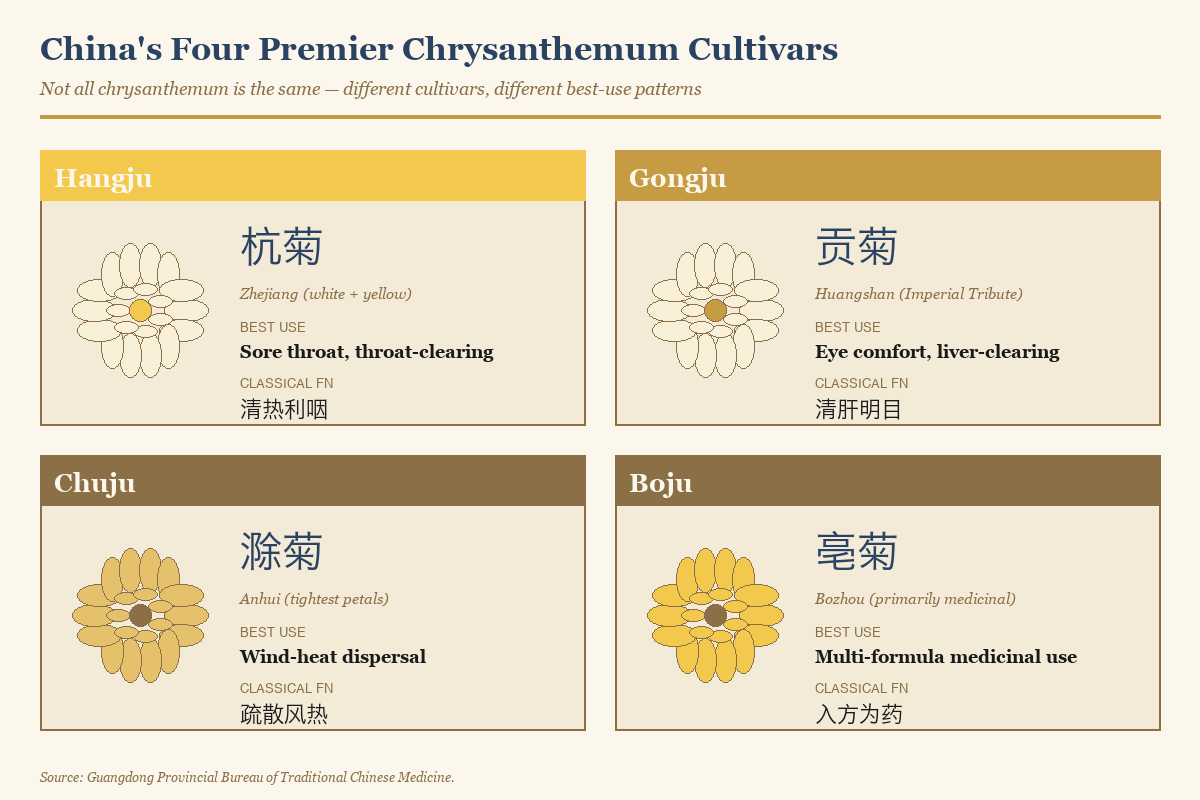
The Four Premier Chinese Cultivars — Not All Chrysanthemum Is the Same
The Guangdong Provincial Bureau of TCM identifies four cultivars as China's "Four Famous Chrysanthemums," each with a slightly different best-use pattern [3]:
- 杭菊 (Hangzhou chrysanthemum) — comes in white and yellow varieties from Zhejiang. The Guangdong Bureau notes Hangju has the strongest heat-clearing and throat-benefit effects: "杭菊清热利咽的效果最强,咽喉肿痛时,喝点杭菊最好" — for sore throat, Hangju is the preferred choice [3].
- 贡菊 (Tribute chrysanthemum / Huangshan) — historically presented as imperial tribute, also called Huiju. Milder cooling than Hangju and "清肝明目、养肝养眼的作用更突出" — best for liver-clearing and eye-nourishing applications [3].
- 滁菊 (Chuju / Anhui) — has the tightest petals among Chinese chrysanthemums. "滁菊疏散风热的效果最强" — most powerful for dispersing wind-heat, addressing early-stage cold symptoms with dry throat and dizziness [3].
- 亳菊 (Bozhou chrysanthemum) — primarily medicinal use rather than daily tea.
This is one of the more concrete examples of why "herb name + benefits" articles in English often miss the structure of the source tradition. A pharmacist trained in TCM would not write "drink chrysanthemum tea for X" — they would ask which cultivar, processed how, paired with what.
What Does the Research Say About Chrysanthemum?
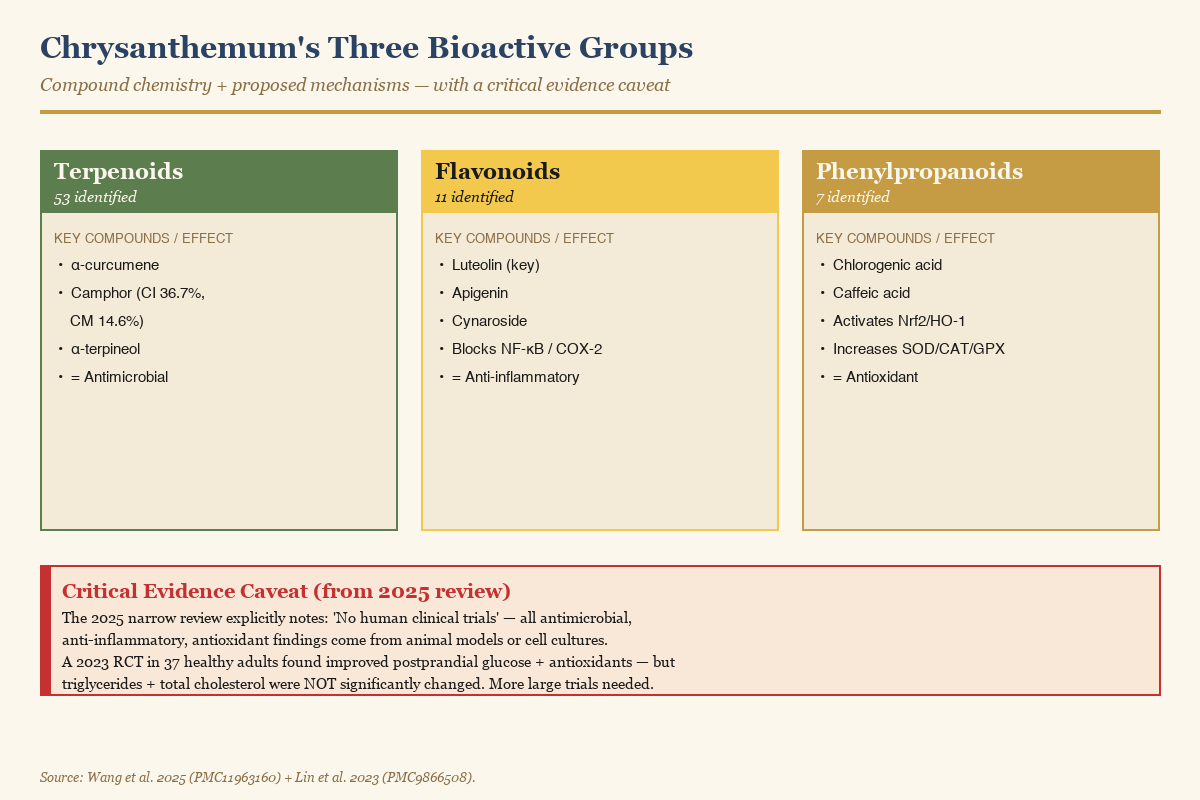
Modern research on chrysanthemum focuses on its flavonoid and phenolic chemistry. A 2025 peer-reviewed narrow review in Frontiers in Pharmacology catalogued the three major compound groups across C. morifolium and C. indicum [4]:
- Terpenoids (53 identified) — including α-curcumene, camphor, and α-terpineol; primarily responsible for antimicrobial activity. C. indicum contains notably more camphor (around 36.69%) than C. morifolium (around 14.56%), which correlates with stronger antimicrobial effects in lab assays.
- Flavonoids (11 identified) — luteolin and apigenin are the most studied; these drive most of the anti-inflammatory effects.
- Phenylpropanoids (7 identified) — chlorogenic acid and related compounds contribute antioxidant activity.
The proposed mechanisms are reasonably consistent across studies: anti-inflammatory effects via NF-κB suppression (MSK monograph) [1]; NLR3 inflammasome inhibition (more prominent with C. indicum); AMPK-SIRT1 pathway modulation (more prominent with C. morifolium); and antioxidant activation through the Nrf2/HO-1 pathway with increases in endogenous SOD, CAT, and GPX enzyme activity [4].
The most important caveat from that same 2025 review: the authors state directly that there are essentially "no human clinical trials" supporting the antimicrobial and immunomodulatory claims at the time of publication — all the supporting evidence comes from animal models or cell cultures [4]. They explicitly call for pharmacokinetic studies and standardization protocols.
One clinical trial worth knowing about: a 2023 randomized controlled study of 37 healthy adults examined a chrysanthemum extract rich in cynaroside (>30%) and apigenin (5%) given alongside a high-fat meal [5]. The extract significantly reduced postprandial blood glucose at one hour and improved several antioxidant markers (total antioxidant capacity, SOD, and glutathione increased; malondialdehyde decreased). However, triglyceride and total cholesterol changes were NOT statistically significant between groups. The authors note the study used healthy participants (not dyslipidemic patients), had a modest sample size, and used a short observation window — limitations that warrant confirmation through larger, longer trials [5].
The honest summary is that chrysanthemum has well-characterized bioactive chemistry, plausible anti-inflammatory mechanisms in lab settings, and some early human clinical signal for postprandial glucose and antioxidant markers. The leap from "biologically interesting" to "clinically proven for everyday use" remains incomplete.
How Do People Use Chrysanthemum?
Traditional Chinese tea preparations dominate everyday use. The Guangdong TCM Bureau offers specific brewing guidance [3]:
Chrysanthemum Tea — Brewing Basics
Use roughly 5–6 dried flower heads per cup. Pour 80°C water (not boiling — boiling water destroys some of the volatile aromatics that contribute to flavor). Rinse the flowers briefly with the first short pour and discard. Then steep again for the actual cup. Limit to 2–3 infusions total — extended steeping reduces aromatic quality without adding much benefit.
Common Herbal Pairings
The CPPCC source documents several traditional pairings used for specific purposes [2]:
- Chrysanthemum + goji berry — the most common daily pairing, often described as suitable for those with prolonged eye strain
- Chrysanthemum + hawthorn — traditionally used by people focused on lipid and blood-pressure context
- Chrysanthemum + apricot kernel — addresses cough patterns with phlegm
- Chrysanthemum + seed fat (sterculia seed) — for sore throat patterns
None of these pairings constitute medical claims; they are cultural-culinary patterns observed for centuries that some people find pleasant. The hawthorn pairing in particular reflects how the herb is positioned in Chinese household practice rather than any settled clinical recommendation.
Chrysanthemum in Classical Multi-Herb Formulas
Chrysanthemum appears in numerous classical formulas, most famously paired with mulberry leaf (桑叶) in the Tang dynasty wind-heat dispersing formula Sang Ju Yin (桑菊饮, "Mulberry & Chrysanthemum Decoction"). In this role, chrysanthemum is one ingredient among several rather than the lead, and the formula is meant for early-stage warm-disease patterns rather than long-term daily use.
Cooking with Chrysanthemum
Beyond tea, dried chrysanthemum is added to clear broths, congees, and sometimes desserts. Compared with daily tea use, culinary additions tend to use smaller amounts and a wider range of pairings.
Individual responses vary considerably; what works well for one person may not suit another, and personal experimentation under practitioner guidance is always recommended.
Important Limitations and Considerations
Chrysanthemum is among the gentler TCM herbs by clinical standards, but it is not consequence-free. The most important considerations:
- Ragweed and Asteraceae allergy — chrysanthemum is in the same plant family as ragweed, daisies, and chamomile. MSK explicitly warns against use for individuals with known ragweed allergy [1]. Contact dermatitis and photosensitivity reactions have been documented, particularly among occupational handlers.
- Immunosuppressive medications — MSK documents a case report of toxic drug levels in a transplant patient using chrysanthemum, presumably through interference with drug metabolism [1]. Transplant recipients and those on systemic immunosuppressants should avoid chrysanthemum products.
- CYP3A4 and P-glycoprotein substrates — MSK flags potential interactions with medications metabolized through these pathways [1]. The list includes some statins, antifungals, certain antihypertensives, and others.
- Cold-constitution individuals — Because chrysanthemum is classified as slightly cool, the CPPCC source advises against habitual use by those with cold-deficient constitution: chrysanthemum tea may aggravate cold-related fatigue, abdominal discomfort, or loose digestion [2].
- Active cold or flu with throat inflammation — Despite the wind-heat dispersing tradition, the CPPCC source flags caution during full-blown infectious illness, particularly with throat inflammation [2].
- Pregnancy — CPPCC advises against habitual chrysanthemum tea during pregnancy, citing risk of gastrointestinal irritation from cold-natured herbs [2].
- Children — Traditional caution about chrysanthemum's cooling nature in children's developmental yang qi [2]. Modern interpretation: do not give cooling herbal teas to young children as a habit.
- Atopic / allergic individuals — As above, cross-reactivity with other Asteraceae plants is a documented risk [1][2].
- Quality variability — Commercial dried chrysanthemum varies meaningfully in cultivar, processing, and freshness. Bright, intact flowers with their natural aromatic scent are generally preferred over discolored, fragmented, or oddly sweet-smelling product.
- No proven cancer benefit — MSK is direct: "Chrysanthemum has not been shown to treat or prevent cancer," despite some laboratory cytotoxicity findings [1]. Marketing copy that suggests otherwise is making a stronger claim than the evidence supports.
These limitations are not meant to discourage exploration. They are the realistic context any reader deserves before forming expectations.
Frequently Asked Questions About Chrysanthemum
Can I drink chrysanthemum tea every day?
Many people in China and Vietnam enjoy chrysanthemum tea daily, particularly during warm months or when experiencing eye strain. Moderate daily consumption appears well tolerated for most healthy adults. However, chrysanthemum belongs to the Asteraceae (daisy) family — those with allergies to ragweed, daisy, or related plants should exercise caution. Individual responses vary considerably.
What does chrysanthemum tea taste like?
Chrysanthemum tea has a light, floral flavour that is mildly sweet with a subtle herbal note. The taste varies noticeably between cultivars — Hangzhou Bai Ju (white) tends to be more delicate and sweet, while Chu Ju (yellow) has a slightly more pronounced herbal character. It is typically enjoyed plain or with a small amount of rock sugar.
What is chrysanthemum traditionally used for in TCM?
In Traditional Chinese Medicine, chrysanthemum (Jú Huā / 菊花) is classified as a cooling herb associated with the liver and lung meridians. It is traditionally used to dispel wind-heat, brighten the eyes, and calm liver yang rising — conditions that, in Western terms, loosely correspond to heat-related headaches, eye irritation, and early-stage cold or flu symptoms.
Is chrysanthemum tea safe during pregnancy?
Chrysanthemum tea in typical culinary quantities is generally considered low risk, but concentrated extracts or high amounts have not been adequately studied in pregnant populations. As a precaution, pregnant women should consult their healthcare provider before regular consumption.
What is the best chrysanthemum variety for tea?
The four premier cultivars traditionally prized in China are Hangzhou Bai Ju (白菊花, Zhejiang), Chu Ju (滁菊, Anhui), Gong Ju (贡菊, Huizhou), and Bo Ju (亳菊, Bozhou). Hangzhou Bai Ju is the most widely available internationally and is a reliable starting point for those new to chrysanthemum tea.
A Note on Tracking — Where Health Diary Comes In
Traditional Eastern wellness practice has always emphasized observation over time. Classical practitioners assessed patterns — sleep, energy, complexion, eye comfort, headaches, sensitivity to wind, throat condition, seasonal response. That practice maps surprisingly well onto modern habits like journaling and habit tracking.
For someone using chrysanthemum, tracking a few signals over a few weeks is more informative than relying on day-to-day impressions. Useful things to record might include:
- Eye comfort and end-of-day eye strain
- Throat condition (irritation, dryness, soreness)
- Sleep quality
- Headache or dizziness frequency
- Sensitivity to wind, cold, or seasonal allergens
- Digestive response (chrysanthemum's cool nature can aggravate cold-pattern digestion)
If digestive markers shift in a concerning direction (loose stools, abdominal discomfort), the cooling nature of the herb may not be matching your individual pattern. That kind of feedback is exactly what classical practitioners used to adjust formulas.
A Soft Closing Note
Chrysanthemum is one of the most accessible entry points into Chinese herbal tea culture — easy to find, gentle to brew, and visually beautiful. Classical Chinese sources approached it with care: not as a universal daily tonic, but as a clearing herb whose cooling nature was appropriate for some patterns and unsuitable for others. The Four Famous Chrysanthemums of China each have a distinct best-use; treating all chrysanthemum as one herb misses much of the tradition's structure.
If you are curious about traditional wellness practices, the most useful next step is usually slow learning rather than an immediate purchase. Reading reputable sources — peer-reviewed reviews, government TCM authority monographs, classical herbal texts — and observing your own patterns through journaling tend to produce better outcomes than chasing any single ingredient.
Some people explore options like a simple goji-chrysanthemum tea as a small daily ritual; others prefer to focus first on sleep, food, and movement. You can learn more about traditional body constitutions and seasonal wellness rhythms on our companion guides, including our overviews of astragalus, angelica root, and licorice root — all herbs that traditionally appear alongside chrysanthemum in classical Chinese formulas and teas.
About This Article
Written by: Health Diary Editorial Team — a small editorial group researching traditional wellness practices, herbal traditions, and quantified-self methods. Our articles draw on peer-reviewed literature, government health-agency monographs (NCCIH, NIH), academic medical centers (MSK Integrative Medicine), and primary native-language sources from provincial Bureaus of Traditional Chinese Medicine.
Editorial review: This article has been reviewed by the Health Diary editorial team for clarity, structure, and adherence to our sourcing standards. Key claims were cross-checked against NCCIH, NIH PubMed, and LiverTox where applicable. It is not a clinical review and should not replace consultation with a licensed healthcare practitioner. When a clinical reviewer is added to this article, attribution will appear here with verifiable credentials.
Reviewed on: June 8, 2026.
Editorial process: All claims about modern evidence are linked inline to peer-reviewed publications or authoritative government or academic medical sources. Where the evidence is preliminary, mixed, or limited — such as the explicit "no human clinical trials" caveat in the 2025 antimicrobial review, or the 2023 RCT's null findings on triglycerides — we describe it that way rather than glossing over uncertainty. Native-language Chinese sources from Bureaus of Traditional Chinese Medicine and state-affiliated authoritative media are cited alongside English-language peer-reviewed sources to reflect both the cultural and scientific perspectives on this herb.
References
- Memorial Sloan Kettering Cancer Center. Chrysanthemum — Integrative Medicine herb monograph. https://www.mskcc.org/cancer-care/integrative-medicine/herbs/chrysanthemum
- People's Political Consultative Conference Newspaper (人民政协网). 菊花茶的功效和禁忌 (Chrysanthemum Tea Functions and Contraindications). https://www.rmzxw.com.cn/c/2018-05-09/2047793.shtml
- Guangdong Provincial Bureau of Traditional Chinese Medicine (广东省中医药局). 重阳前后, 菊花开尽!降火用滁菊,明目用贡菊,清咽用杭菊 (Chuju for Fire-Reducing, Gongju for Eye-Brightening, Hangju for Throat-Clearing). https://szyyj.gd.gov.cn/zyyfw/ysbj/content/post_4024592.html
- Wang H et al. Exploring the antimicrobial, anti-inflammatory, antioxidant, and immunomodulatory properties of Chrysanthemum morifolium and Chrysanthemum indicum: a narrow review. Frontiers in Pharmacology, 2025. PMC11963160. https://pmc.ncbi.nlm.nih.gov/articles/PMC11963160/
- Lin Q et al. Analysis of Chemical Constituents of Chrysanthemum morifolium Extract and Its Effect on Postprandial Lipid Metabolism in Healthy Adults. 2023. PMC9866508. https://pmc.ncbi.nlm.nih.gov/articles/PMC9866508/