Vietnamese Herbal Soups: Traditional Nourishing Recipes for Wellness
A guide to five traditional Vietnamese herbal soups — canh rau ngót, canh khổ qua, canh gừng, canh bí đỏ, and canh lá lốt — exploring their seasonal roles, key herbs, and the centuries-old food-wellness tradition behind them.
What Are Vietnamese Herbal Soups?
In Vietnamese home kitchens, soup is never an afterthought. Every family meal — cơm gia đình — centers on a bowl of canh, a clear, herb-scented broth that anchors the table alongside rice, a protein dish, and pickled vegetables. But a particular category of these broths stands apart: the Vietnamese herbal soup, or canh thuốc, in which specific plants, roots, and vegetables are chosen not merely for flavor but for the nourishing qualities generations of Vietnamese families have attributed to them.
These soups are not folk remedies administered in isolation. They are everyday dishes — appearing on weekday dinner tables, carried to hospital visits, prepared for new mothers, and simmered in summer to ease the heat. The line between nourishing food and intentional wellness is blurred by design: in Vietnamese culinary philosophy, the kitchen and the garden pharmacy have always shared the same boundary.
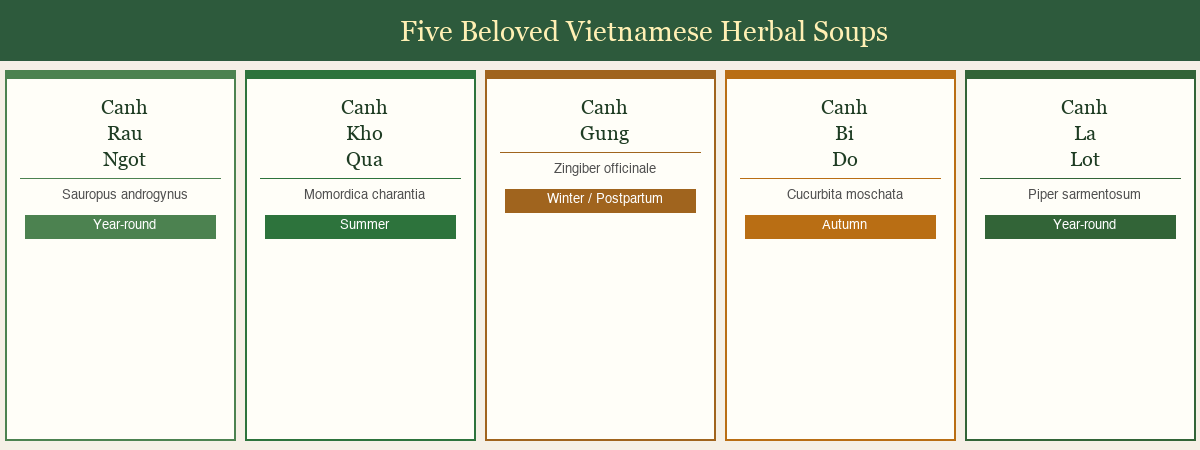
This article introduces five of the most beloved Vietnamese herbal soups: canh rau ngót, canh khổ qua, canh gừng, canh bí đỏ, and canh lá lốt. Each has its own seasonal context, its own traditional story, and its own cast of herbs and vegetables with long histories of use in Vietnamese home cooking.
The Role of Soup in Vietnamese Wellness Tradition
Vietnamese culinary tradition draws on a deep understanding of âm dương — the balance between cooling (âm) and warming (dương) forces in food and in the body. This framework, adapted from broader East Asian philosophy and woven into centuries of local practice, shapes which soups Vietnamese families cook and when. A summer meal calls for cooling greens; postpartum recovery calls for warming ginger; the transition into autumn invites the grounding sweetness of pumpkin.
This is not a rigid medical system applied to cooking, but a living folk tradition — practical, seasonal wisdom passed from mothers to daughters, refined across generations. The soups described in this article represent that wisdom: dishes traditionally prepared for specific life stages and seasons, grounded in local herbs and vegetables.
Research into many of these plants has expanded in recent decades. Studies on ginger's bioactive compounds [PMID 31151279] and on lá lốt's phytochemical profile [PMID 32620264] have begun to document properties that Vietnamese kitchens have long recognized intuitively. Modern science and ancestral food knowledge here move toward the same understanding — though the soups were always made for the table, not the laboratory.
Five Beloved Vietnamese Herbal Soups
Canh Rau Ngót: The Everyday Nourishing Soup
Canh rau ngót is perhaps the most ubiquitous of Vietnamese herbal soups — a simple, clear broth made from rau ngót leaves (Sauropus androgynus, sometimes called sweet leaf or katuk) simmered with minced lean pork. The soup is light, naturally sweet, and a staple of the Vietnamese family table throughout the year, though it is especially welcomed in hot weather for its cooling, refreshing quality.
Rau ngót is nutritionally remarkable among leafy vegetables. Research has documented its high protein content relative to other greens, leading to its nickname as "the multivitamin plant" across Southeast Asia [PMID 26413127]. Vietnamese tradition notes its rich vitamin C content — reportedly comparable to or exceeding citrus fruits — alongside B vitamins and significant mineral content. In Vietnamese folk knowledge, rau ngót is considered cooling (tính mát), making canh rau ngót a natural choice for summer family meals [Thuốc Dân Tộc].
The preparation is intentionally simple: a handful of rau ngót leaves, stripped from the stem, dropped into a light pork-bone or minced-pork broth seasoned with fish sauce. The leaves soften quickly, releasing their gentle sweetness into the broth. Served hot over rice, it is the taste of an ordinary Vietnamese evening — comforting in its familiarity, nourishing in its quietude.
Key herb: Rau ngót (Sauropus androgynus)
Traditional pairings: Minced pork (thịt xay), pork rib stock
Seasonal context: Year-round, especially summer
Vietnamese folk quality: Cooling (mát), cleansing
Canh Khổ Qua: Bitter Melon and Summer Cooling
Canh khổ qua nhồi thịt — bitter melon stuffed with seasoned pork and simmered in a clear broth — is one of the most distinctive and culturally layered soups in the Vietnamese repertoire. The dish appears at family tables throughout southern Vietnam during the hot months, prepared with deliberate intention: bitter melon's pronounced bitterness is understood in Vietnamese folk tradition as a cooling, purifying quality, appropriate for the heat and humidity of summer.
The bitter melon (Momordica charantia, khổ qua in Vietnamese) has an extensive history of traditional use across Southeast and East Asia. Its bioactive compounds — including charantin, momordicoside, and polypeptide-P — have drawn significant scientific interest. A 2021 review documented bitter melon among the top ten plants used globally in traditional management of blood sugar concerns [PMID 33475054, Curr Med Chem]. Additional research has isolated cucurbitane-type triterpenoids with potential vascular health properties [PMID 28621938].
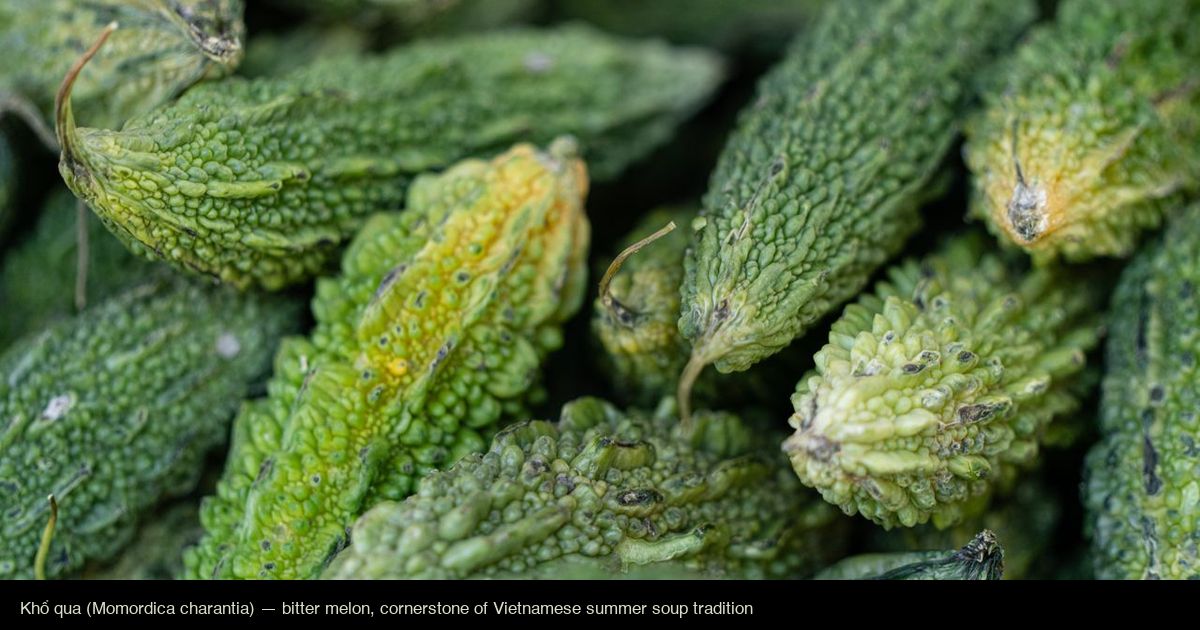
For canh khổ qua, the preparation transforms the raw fruit's sharp bitterness into something more nuanced: the melon is hollowed and filled with a seasoned pork mixture (minced pork with glass noodles, mushroom, and shallot), then gently simmered until the melon softens and the broth takes on a mild bittersweet character. The name itself encodes a traditional Vietnamese life philosophy — "khổ qua" means "hardship passes" — and the soup is sometimes served during Tết (Vietnamese New Year) as an expression of hope that difficulties will resolve.
Key herb/vegetable: Khổ qua (Momordica charantia)
Traditional pairings: Minced pork, glass noodles, dried mushroom
Seasonal context: Summer, Tết
Vietnamese folk quality: Cooling (mát), bitter-cleansing
Canh Gừng: Warming Ginger Broth
Canh gừng — ginger broth — occupies a specific and revered place in Vietnamese wellness food: it is the archetypal soup of the postpartum period and the cold season. In the weeks following childbirth, Vietnamese mothers traditionally consume warming foods to restore strength, support circulation, and balance what is understood as the body's post-delivery cooling state. Ginger sits at the center of this restorative practice.
The warming properties of ginger (Zingiber officinale) are among the best-documented in herbal food research. Gingerols and shogaols — the primary bioactive compounds in fresh and dried ginger respectively — have been shown to exert anti-inflammatory and antioxidant effects [PMID 26228533]. A 2024 review confirmed that ginger's antioxidant and anti-inflammatory properties are provided primarily by gingerol, shogaols, paradol, and zingerone [PMID 38903613]. These properties align closely with what Vietnamese kitchen tradition has attributed to ginger across centuries of postpartum and cold-weather cooking.
Canh gừng in its simplest form is a clear broth built on a base of generous fresh ginger — bruised or sliced — simmered with chicken, pork ribs, or eggs. Fish sauce and a little salt season the broth; green onion adds freshness. The result is intensely warming, gently spiced, and deeply comforting. Generations of Vietnamese families have traditionally prepared this soup for new mothers, for anyone recovering from cold or fatigue, and for winter evenings when warmth is the primary nourishment required.
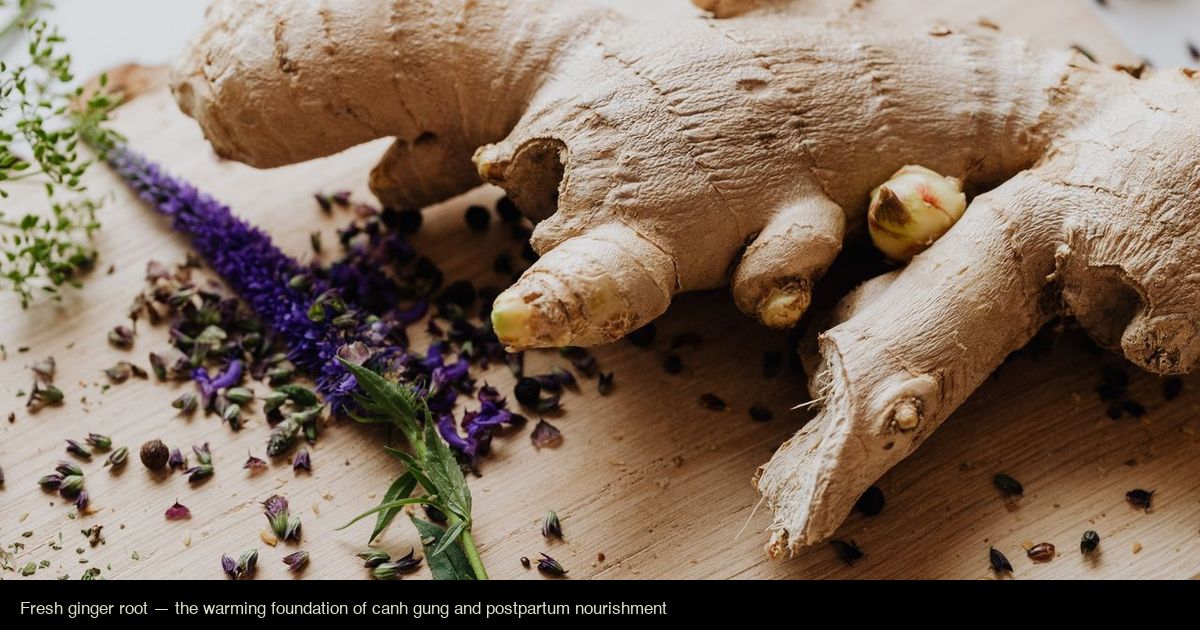
Key herb: Gừng (Zingiber officinale)
Traditional pairings: Chicken, pork ribs, eggs
Seasonal context: Winter, postpartum recovery
Vietnamese folk quality: Warming (ấm), restorative
Canh Bí Đỏ: Autumn Pumpkin and Ginger
Canh bí đỏ — Vietnamese pumpkin soup — bridges the transition from summer's cooling foods into autumn's grounding warmth. The autumn pumpkin, or bí đỏ (Cucurbita moschata), is naturally sweet and substantial, lending a golden color and velvety body to a broth that feels entirely different from the light summer soups that preceded it. Combined with ginger and simmered with pork ribs or dried shrimp, canh bí đỏ becomes a deeply nourishing bowl suited to the cooler, mellower Vietnamese autumn.
Pumpkin is nutritionally generous: it is a significant source of beta-carotene (which the body converts to vitamin A), potassium, and vitamin C. Research has confirmed that heat treatment — such as simmering in soup — generally improves the bioavailability of carotenoids in squash and pumpkin [PMID 34441559], meaning canh bí đỏ may deliver these nutrients more effectively than raw preparations.
Vietnamese cooks traditionally pair bí đỏ with ginger in this soup, a pairing that reflects the seasonal shift: pumpkin provides grounding sweetness and nutrition, while ginger adds gentle warmth to counterbalance the cooling shift in weather. The result is a soup that feels both seasonal and intuitive — a natural bridge between summer and winter eating.
Key herb/vegetable: Bí đỏ (Cucurbita moschata) with gừng (ginger)
Traditional pairings: Pork ribs, dried shrimp, coconut milk (southern variation)
Seasonal context: Autumn
Vietnamese folk quality: Nourishing (bổ dưỡng), grounding
Canh Lá Lốt: Betel Leaf and Traditional Joints Comfort
Canh lá lốt — a soup or broth featuring lá lốt (Piper sarmentosum, sometimes called wild betel leaf) — holds a distinctive place in Vietnamese folk wellness food. Lá lốt is perhaps best known internationally as the leaf used to wrap grilled beef (bò lá lốt), but its role as a soup ingredient is equally significant in traditional Vietnamese cooking, particularly in preparations associated with joint and muscle comfort.
Vietnamese folk tradition classifies lá lốt as a warming herb (tính ấm) with a pungent, aromatic flavor [Thuốc Dân Tộc]. Traditionally prepared for conditions associated with cold-damp joint stiffness — what Vietnamese medicine terms "phong hàn" — lá lốt soups and preparations have been used by generations of Vietnamese families for this purpose. Modern phytochemical research has documented that Piper sarmentosum contains essential oils, alkaloids, flavonoids, and lignans with anti-inflammatory and antipyretic properties [PMID 32620264]. A 2022 meta-analysis additionally found significant effects on blood pressure parameters across animal and human studies [PMID 36091787].
Canh lá lốt is typically prepared with minced pork or beef, fish sauce, and a generous amount of lá lốt leaves. The leaves release a complex, slightly peppery aroma into the broth. The soup may be enriched with additional warming ingredients such as galangal or black pepper. It is a year-round dish in Vietnamese homes, but particularly valued in cool or damp weather when its warming character is most welcome.
Key herb: Lá lốt (Piper sarmentosum)
Traditional pairings: Minced pork or beef, galangal, black pepper
Seasonal context: Year-round, especially cool/damp weather
Vietnamese folk quality: Warming (ấm), joint-comforting in folk tradition
Key Herbs and Vegetables in Vietnamese Soup Traditions
Across the five soups above, a clear pattern emerges: Vietnamese herbal soup tradition works with a relatively small vocabulary of ingredients, each with well-defined folk properties and specific seasonal roles. The table below summarizes the primary herbs and vegetables featured:
- Rau ngót (Sauropus androgynus) — Cooling, high protein among leafy greens, vitamin C-rich. Everyday family vegetable with traditionally mát (cooling) classification.
- Khổ qua (Momordica charantia) — Bitter, cooling. One of the most studied plants in traditional Asian food culture for its bioactive compounds including charantin and momordicoside.
- Gừng (Zingiber officinale) — Warming, pungent. Gingerols and shogaols are among the most researched bioactive compounds in food-herb science. Central to postpartum and cold-weather Vietnamese soups.
- Bí đỏ (Cucurbita moschata) — Sweet, grounding. Rich in beta-carotene (provitamin A), potassium, and fiber. Cooking improves carotenoid bioavailability.
- Lá lốt (Piper sarmentosum) — Warming, aromatic. Contains alkaloids and flavonoids with documented anti-inflammatory properties. Traditional folk use for joint and cold-damp conditions.
These are not rare botanical specimens — they are sold in every Vietnamese market, grown in kitchen gardens, and woven into the daily cooking vocabulary of Vietnamese homes across the country and around the world. Their wellness associations are embedded in culinary tradition rather than isolated in therapeutic prescription.
Seasonal Soup Traditions in Vietnam
One of the most elegant aspects of Vietnamese herbal soup tradition is its seasonal intelligence. The soups Vietnamese families prepare shift naturally with the calendar, matching the body's changing needs with the foods that local wisdom has found most nourishing for each time of year.
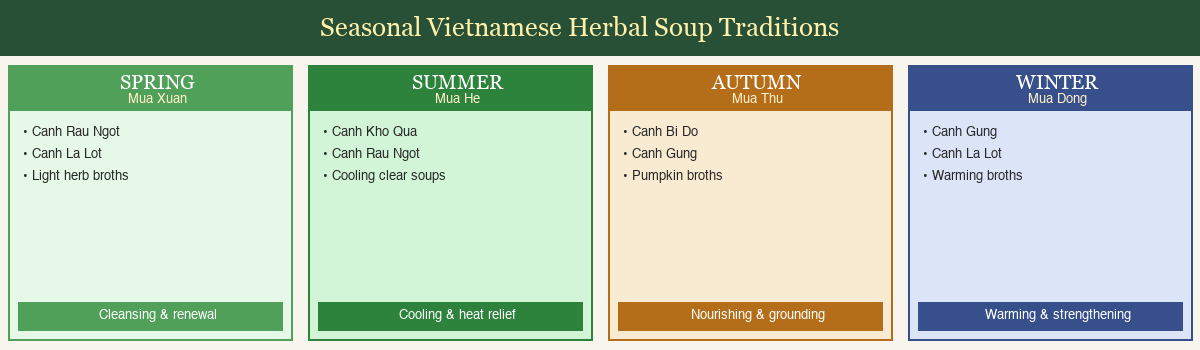
Spring (Mùa Xuân) is a transitional time, and Vietnamese soups reflect this: lighter herb broths, canh rau ngót to refresh after winter's heavier fare, and canh lá lốt continued from the cold season. Spring soups tend toward cleansing and gentle renewal.
Summer (Mùa Hè) brings the heat and humidity of Vietnam's tropical season, and the family table responds with cooling soups. Canh rau ngót and canh khổ qua nhồi thịt are summer staples — both understood to help the body manage heat. Clear broths are preferred; heavy or warming soups are set aside until the cool months return.
Autumn (Mùa Thu) calls for the nourishing warmth of canh bí đỏ. As temperatures drop and the harvest brings pumpkins and squash to the market, Vietnamese kitchens transition toward soups with more body and sustenance. Ginger reappears as a key ingredient, signaling the seasonal shift toward warming foods.
Winter (Mùa Đông), though milder in southern Vietnam than in the north, brings canh gừng to the forefront. Ginger-forward soups, lá lốt broths, and warming bone-broth-based preparations support the body through the cold season. In northern Vietnam, where winters can be genuinely cold, the warming soup tradition is particularly strong.
Beyond seasons, Vietnamese herbal soup tradition also follows life stages: canh gừng for new mothers, light canh rau ngót for the elderly or the recovering, and richer canh bí đỏ for growing children. This life-stage attentiveness is one of the most distinctive features of Vietnamese food-wellness culture — soups are chosen not just for the season but for the person.
How to Make a Basic Vietnamese Herbal Broth at Home
The foundation of nearly every Vietnamese herbal soup is the same: a light, clear broth (nước dùng) built on bone or meat stock, seasoned simply with fish sauce, a little sugar, and salt. This base is then personalized with whichever herbs and vegetables define the particular soup being made. Here is a basic approach applicable to any of the five soups in this article:
- Build the stock: Simmer 300–400g of pork neck bones or chicken bones in 1.5 liters of water for 30–45 minutes. Skim foam as it rises to keep the broth clear. Add a bruised shallot and a small piece of ginger to the stock pot from the start — this baseline warming and aromatic quality is standard in Vietnamese home cooking.
- Season the broth: After skimming, season with 1–2 tablespoons of fish sauce (nước mắm), ½ teaspoon sugar, and salt to taste. The broth should be lightly savory — more delicate than a Western stock, allowing the herb ingredients to remain in the foreground.
- Add your main herb or vegetable: Each soup has its own timing. Bitter melon (pre-stuffed) needs 15–20 minutes of gentle simmering. Rau ngót leaves cook in 3–5 minutes and should be added at the end to preserve color and texture. Pumpkin cubes take 10–15 minutes. Lá lốt adds its aroma quickly; add toward the end.
- Finish and serve: Vietnamese herbal soups are served immediately after cooking, ladled hot into individual bowls. Green onion, a few drops of sesame oil, and ground white pepper are common finishing touches. The soup is served alongside rice, not as a standalone course.
The simplicity of this process is the point. Vietnamese herbal soup is not a complex preparation requiring specialist ingredients or elaborate technique. It is everyday cooking — approachable, seasonal, and made with whatever grows in the garden or appears at the morning market.
Frequently Asked Questions
What makes Vietnamese herbal soups different from regular Vietnamese soups?
Vietnamese herbal soups (canh thuốc or canh dưỡng sinh) are distinguished by the intentional selection of specific herbs, roots, and vegetables chosen for their traditionally understood nourishing qualities — not just for flavor. Examples include rau ngót for its cooling reputation, gừng for its warming properties, and lá lốt for its folk association with joint comfort. Regular Vietnamese soups (canh thường) may use similar techniques but without this specific herb-selection intention.
Are Vietnamese herbal soups safe for everyone?
The soups described in this article are traditional family foods consumed regularly by millions of Vietnamese people. As with any food, individual factors matter: people with specific health conditions or taking medications should consult a healthcare provider before making any dietary changes. One note regarding rau ngót: research has documented safety concerns with excessive raw consumption (bronchiolitis obliterans in case reports from Taiwan and Japan); the traditional Vietnamese preparation — briefly cooked in hot broth — is the appropriate and safe form.
Can I find these ingredients outside Vietnam?
Yes. All five main ingredients are available in Vietnamese and Asian grocery stores worldwide. Rau ngót and lá lốt are commonly stocked in Vietnamese diaspora markets and sometimes available frozen. Bitter melon (khổ qua) is widely found in Asian, Indian, and Caribbean grocery stores. Ginger and pumpkin are available globally. Online specialty suppliers also carry dried and fresh Vietnamese herbs.
Is canh gừng specifically for postpartum use, or can anyone drink it?
Canh gừng is a warming, nourishing soup traditionally prepared for new mothers in Vietnamese culture, but it is enjoyed by anyone during cool weather or as a warming, restorative dish. It is particularly common in northern Vietnam during winter months. The soup's warming character (from gingerols and shogaols in the ginger) makes it most appropriate in cool weather or when the body feels cold or fatigued.
How bitter is canh khổ qua? Is it palatable for newcomers to Vietnamese food?
Canh khổ qua has a distinctive bitterness that is intentional — this bittersweet quality is considered its defining characteristic and its folk value. The stuffed-pork preparation softens the bitterness considerably compared to raw bitter melon, and the pork filling adds savory richness that balances the soup. For newcomers, a small portion alongside rice is a gentle introduction. Many people find the bitterness pleasant once the palate adapts, and the soup is considered an acquired taste that becomes deeply satisfying over time.
What is the best way to learn to cook these soups authentically?
The best introduction to Vietnamese herbal soups is through a Vietnamese family kitchen. For those learning independently, starting with canh rau ngót (the simplest, most everyday preparation) or canh bí đỏ (forgiving and naturally sweet) is recommended before moving to the more complex canh khổ qua nhồi thịt. Vietnamese cooking videos by home cooks — particularly those cooking for family rather than restaurants — typically reflect the authentic family-kitchen approach most closely aligned with these traditional soups.
References
- Bunawan H, et al. (2015). Sauropus androgynus (L.) Merr. Induced Bronchiolitis Obliterans: From Botanical Studies to Toxicology. Evidence-Based Complementary and Alternative Medicine. PMID: 26413127
- Aumeeruddy MZ, Mahomoodally MF. (2021). Global documentation of traditionally used plants in the management of diabetes. Curr Med Chem. PMID: 33475054
- Tuan et al. (2017). Cucurbitanes from Momordica charantia — inhibitory activity on VSMC proliferation. Journal of Natural Products. PMID: 28621938
- Balachandran PP, et al. (2015). Gingerols and Shogaols: Important Nutraceutical Principles. Phytochemistry. PMID: 26228533
- Mao QQ, et al. (2019). Bioactive Compounds and Bioactivities of Ginger. Foods. PMID: 31151279
- Zhao Y, et al. (2024). Ginger's antioxidant, anti-inflammatory, and immunomodulatory activities. Frontiers in Nutrition. PMID: 38903613
- Bunawan H, et al. (2020). Piper sarmentosum Roxb.: A review on its botany, traditional uses, phytochemistry, and pharmacological activities. Journal of Ethnopharmacology. PMID: 32620264
- Othman et al. (2022). Effects of Piper sarmentosum Roxb. on hypertension and diabetes mellitus: systematic review and meta-analysis. Frontiers in Pharmacology. PMID: 36091787
- Domingues A, et al. (2021). Effects of cooking on carotenoids in Cucurbita. Foods. PMID: 34441559
- Thuốc Dân Tộc editorial team (2023). Rau Ngót — Tác dụng và bài thuốc dân gian. thuocdantoc.vn/benh/rau-ngot [native-vi]
- Thuốc Dân Tộc editorial team (2023). Lá Lốt — Tác dụng dân gian và y học cổ truyền. thuocdantoc.vn/benh/la-lot [native-vi]