Pandan: Asia's Aromatic Green and Traditional Uses
Explore pandan (lá dứa), Southeast Asia's most beloved aromatic herb — from its signature 2-acetyl-1-pyrroline fragrance to traditional Vietnamese and regional wellness uses.
Medical Disclaimer: This content is for educational and informational purposes only and is not medical advice. The information presented is not intended to diagnose, treat, cure, or prevent any disease. Always consult a licensed healthcare practitioner before starting any new herbal practice or supplement. Statements regarding traditional herbal use have not been evaluated by the FDA.
Affiliate Disclosure: This article contains affiliate links. We may earn a commission if you purchase through these links, at no additional cost to you. We only recommend products we believe align with our editorial standards.
Imagine walking through a Vietnamese market in the early morning: beneath the hum of vendors and the scent of bánh mì, there drifts something softer — a warm, green, almost popcorn-like sweetness that feels both familiar and exotic. That aroma belongs to lá dứa, the pandan leaf. Long, blade-shaped, and vibrantly green, pandan (Pandanus amaryllifolius) is arguably the most important aromatic herb in Southeast Asian cooking — and one of the most deeply woven into the food cultures of Vietnam, Malaysia, Thailand, Indonesia, and the Philippines. Often called Asian Vanilla in Western food writing, pandan's fragrance is unique, irreplaceable, and botanically fascinating: the same aroma compound found in fragrant basmati rice exists in pandan leaves at concentrations 20 to 22 times higher.
Beyond the kitchen, pandan has a long history in Vietnamese traditional wellness practices. Vietnamese herbalists have used it for generations to cool the body, ease discomfort, and add a calming note to everyday life. This article explores both dimensions — the scientific and the traditional — with appropriate nuance about what the research does and does not yet confirm.
Background: Southeast Asia's Most Beloved Aromatic Herb
Pandan (Pandanus amaryllifolius Roxb.) belongs to the family Pandanaceae and is native to tropical Southeast Asia, where it has been cultivated for centuries across what is today Vietnam, Malaysia, Thailand, Indonesia, and the Philippines. The plant grows as a shrubby perennial, reaching 40–80 cm in height, with long, strap-like leaves arranged in a spiral rosette — the same architectural form seen in its relatives, the screw pines.
Unlike most fragrant plants, pandan produces essentially no flowers or viable seeds in cultivation. It is propagated entirely by cuttings, meaning every pandan plant in gardens and markets around the world is a clone descended from a long lineage of human cultivation. This near-sterility also makes P. amaryllifolius botanically unusual: it is, in effect, a domesticated plant kept alive entirely by human hands across millennia.
In Vietnam, pandan is called lá dứa (literally "pineapple leaf," for the visual resemblance of the plant's crown to a pineapple top) or cây cơm nếp ("sticky rice plant"), a name that speaks directly to its kitchen role. In Malaysia and Indonesia it is daun pandan; in Thailand, bai toei; in the Philippines, pandan. Across all these cultures, the leaf is used in fundamentally the same way: tied in a knot and simmered in rice, extracted as juice for color and flavor in desserts, or bruised and steeped into beverages. The commonality speaks to an ancient, shared Southeast Asian food heritage predating modern borders.
The Asian Vanilla label comes from Western food writers who found pandan the closest local analogue to vanilla — both are used primarily as background aromas in sweets and both are green-plant-derived. The comparison has limits (pandan is more vegetal, less floral), but it helped introduce the herb to Western audiences when Southeast Asian cuisine began gaining international attention in the 2010s.
What Is Pandan Used for in Vietnamese and Southeast Asian Traditions?
In Vietnamese traditional wellness practice, lá dứa is classified according to the framework of Đông y (Eastern wellness traditions as practiced in Vietnam), which draws from both Chinese medical theory and indigenous Vietnamese herbal knowledge. According to sources including HelloBacsi and Sức Khỏe Việt, lá dứa is traditionally described as:
- Tính vị (nature and taste): slightly bland taste (vị hơi nhạt), warm nature (tính ôn), fragrant aroma, non-toxic
- Kinh (meridians entered): Liver (Can), Spleen (Tỳ), and Kidney (Thận)
Based on these classical properties, Vietnamese herbalists have traditionally incorporated pandan into folk approaches for a range of concerns:
- Cooling and detoxification (thanh nhiệt, giải độc): Fresh leaf tea or decoctions were traditionally used to help cool the body in warm weather and ease mild heat-related discomfort.
- Urinary support (lợi tiểu): Pandan leaf decoctions were used as a traditional diuretic remedy, particularly for mild urinary discomfort.
- Joint and muscle comfort: Warm pandan-infused oil was traditionally applied topically to joints and muscles experiencing aches — particularly useful in folk care for the elderly.
- Relaxation and mild sleep support: The aromatic nature of pandan is traditionally considered calming; leaf decoctions were given to those experiencing mild anxiety or restless sleep.
- Blood sugar support (hỗ trợ tiểu đường): Folk wellness practice has used pandan leaf decoctions as a supplementary approach in diabetes management, though this use requires careful qualification (see the research section below).
- Scalp and hair care: Leaf extracts used topically on the scalp to address dandruff and dryness — a use documented across multiple Southeast Asian traditions.
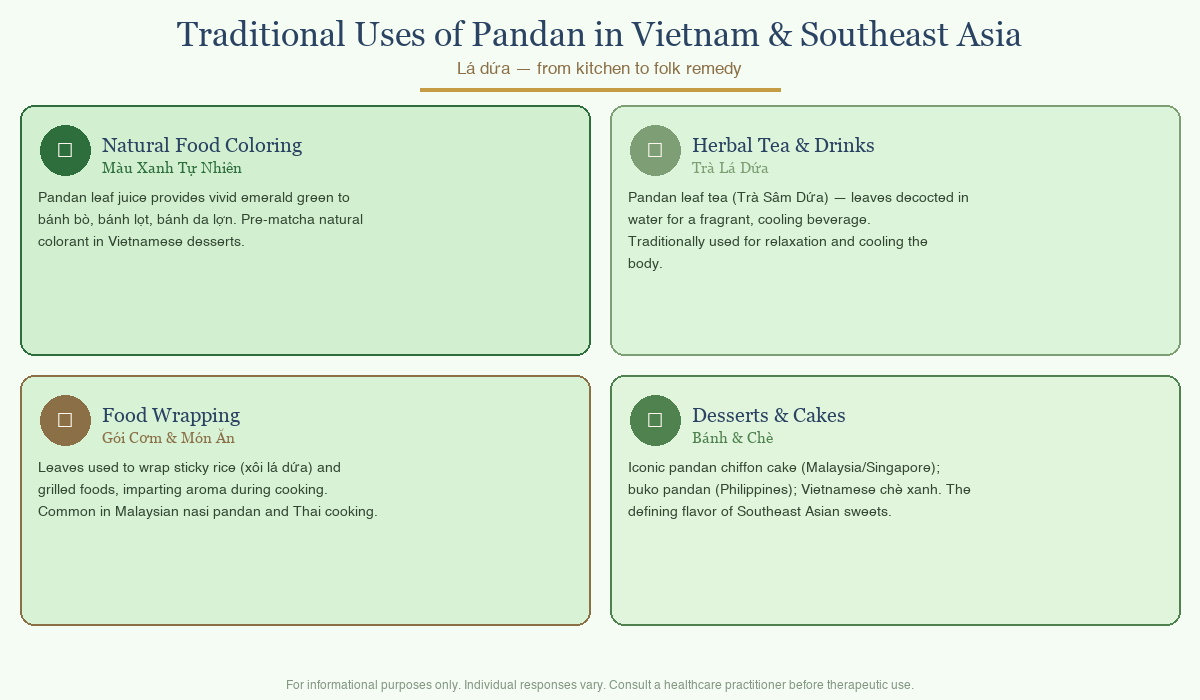
Across the broader region, pandan's traditional roles overlap considerably. In Malaysia and Indonesia, it is simmered with rice (nasi pandan) to add fragrance. In Thailand, it wraps grilled chicken (gai hor bai toei) to infuse aroma during cooking. In the Philippines, it flavors buko pandan dessert and is made into pandan water consumed for general refreshment. The leaves are also widely used as natural insect repellents — tucked into closets, drawers, and (famously) Vietnamese taxi dashboards to deter insects and freshen the air.
Individual responses to traditional herbal approaches vary considerably; what works well in one person's wellness routine may not suit another, and personal exploration under practitioner guidance is always recommended.
Key Compounds and What Research Suggests
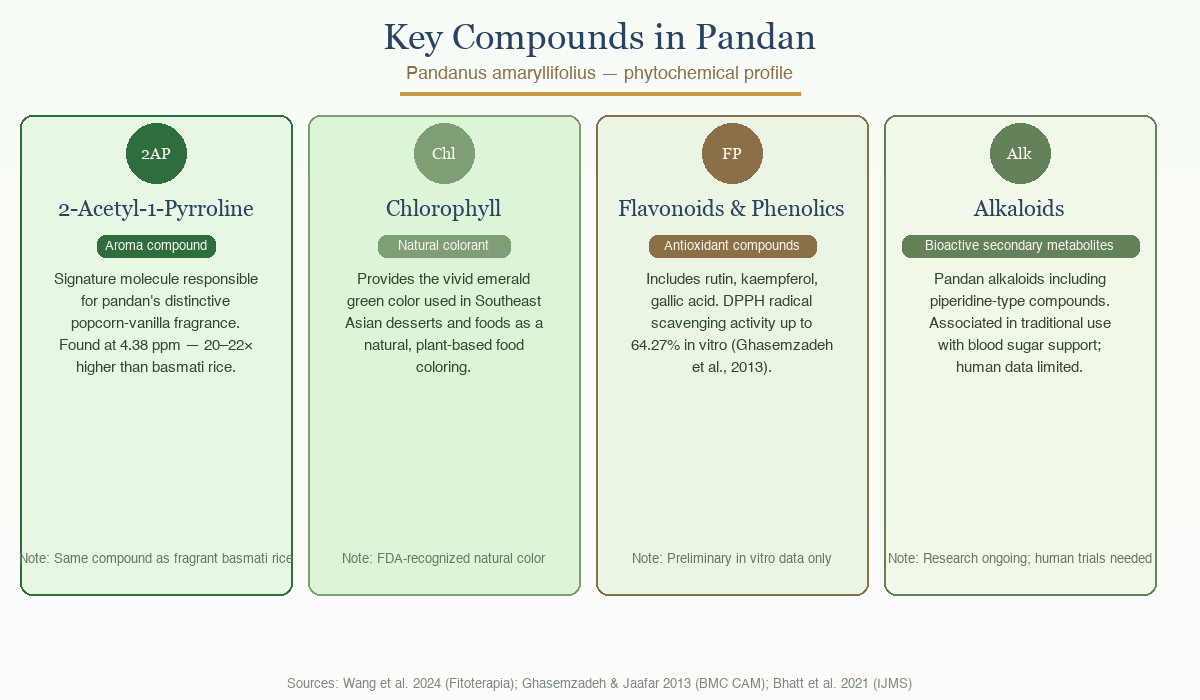
Modern phytochemical analysis of Pandanus amaryllifolius has identified over 100 bioactive compounds, with several receiving particular scientific attention. A 2024 comprehensive review published in Fitoterapia (Wang et al., PMID 39053743) summarized the plant's phytochemistry and pharmacological activities.
2-Acetyl-1-Pyrroline (2AP) — The Signature Aroma
The most distinctive compound in pandan is 2-acetyl-1-pyrroline (2AP), the heterocyclic molecule responsible for its characteristic popcorn-vanilla-meets-floral scent. Remarkably, 2AP is the same compound that gives fragrant basmati and jasmine rice their characteristic aroma — yet pandan accumulates it at concentrations of approximately 4.38 ppm, which is 20 to 22 times higher than even the most aromatic basmati rice varieties, according to a 2021 study in the International Journal of Molecular Sciences (Bhatt et al., PMID 34203477). This extraordinary concentration explains why a single pandan leaf can perfume an entire pot of rice.
The biosynthetic pathway for 2AP in pandan turns out to be different from that in fragrant rice, despite the identical end product — a finding that has genuine scientific novelty and has attracted interest from plant biochemists studying aroma evolution.
Phenolic Compounds and Antioxidant Activity
Pandan leaves contain measurable quantities of phenolic compounds including gallic acid, ferulic acid, and flavonoids such as rutin and kaempferol. A 2013 study published in BMC Complementary and Alternative Medicine (Ghasemzadeh & Jaafar, PMID 24289290) profiled pandan extracts from different regions of Malaysia and found DPPH radical scavenging activity of up to 64.27% and ferric reducing antioxidant power (FRAP) of 517.2 μmol Fe(II)/g. The same study demonstrated that extracts inhibited MCF-7 breast cancer cell proliferation by up to 78.3% in vitro.
Important context: These are in vitro (test tube) findings with concentrated extracts. In vitro antioxidant activity does not directly translate to equivalent effects in the human body. No clinical trials have established that consuming pandan produces measurable antioxidant benefits in humans, and the anticancer cell line data reflects laboratory conditions far removed from human cancer treatment. These findings are preliminary and require further investigation before any therapeutic claims can be made.
Alkaloids and Blood Sugar — Very Preliminary
Pandan contains bioactive alkaloids, and several animal and in vitro studies have examined potential hypoglycemic (blood-sugar-lowering) effects. Results have suggested that leaf extracts may inhibit alpha-glucosidase enzymes involved in carbohydrate digestion, which could theoretically slow postprandial blood sugar rises. The 2024 Fitoterapia review notes that hypoglycemic activity has been demonstrated in pharmacological studies, though the authors explicitly call for more research and caution that current evidence is insufficient to guide clinical use.
No adequately powered human clinical trials have confirmed blood sugar benefits of pandan leaf in people with diabetes or pre-diabetes. Anyone managing blood sugar with medication should exercise particular caution, as adding botanical approaches without medical oversight carries interaction risks.
Chlorophyll — The Natural Colorant
The vivid emerald green of pandan-colored foods comes from chlorophyll, the same photosynthetic pigment found in all green plants. Pandan juice provides one of the most vibrant natural green colorants used in food — prized precisely because it resists fading better than many synthetic green dyes when exposed to moderate heat in baking. This is a straightforward culinary application with no particular health claims attached.
How Do People Use Pandan Leaves?
Pandan is first and foremost a culinary herb, and the vast majority of people encounter it through food rather than as a health supplement. Understanding the range of culinary and everyday uses provides important context for any discussion of traditional wellness applications.
In the Vietnamese Kitchen
In Vietnam, lá dứa is so embedded in the culinary landscape that many cooks keep a small pandan plant on the balcony or in the kitchen garden for constant fresh supply. Key uses include:
- Rice flavoring: A knotted pandan leaf added to the rice cooker water infuses the grains with subtle fragrance, transforming everyday steamed rice into something special — particularly enjoyed with coconut milk as xôi lá dứa.
- Dessert coloring and flavoring: The green juice extracted from blended pandan leaves is the traditional way to color and flavor bánh bò (honeycomb cake), bánh lọt (pandan jelly noodles in coconut milk), bánh da lợn (layered steamed cake), and countless varieties of chè (sweet soups). Before matcha and synthetic green food dye became accessible, pandan juice was the definitive natural green colorant in Vietnamese desserts.
- Pandan tea (Trà lá dứa): Several fresh or dried pandan leaves simmered in water for 10–15 minutes produce a fragrant, pale green beverage consumed hot or iced. This is the most common wellness preparation in Vietnamese households.
Across Southeast Asia
The cultural breadth of pandan use across the region is remarkable:
- Malaysia and Singapore: The pandan chiffon cake — a light, airy sponge cake colored green with pandan juice and flavored with pandan extract and coconut milk — is considered a national icon in Singapore and a beloved staple in Malaysia. It represents a mid-20th century fusion of American chiffon cake technique with indigenous Southeast Asian flavors.
- Thailand: Pandan-wrapped chicken (gai hor bai toei) is a classic street food where the leaves act as both natural wrapping and aromatic infuser during deep frying.
- Philippines: Buko pandan — a dessert salad of young coconut meat, pandan-flavored jelly, and cream — is a celebration staple.
- Indonesia: Pandan joins turmeric, galangal, and lemongrass in the aromatic base layer of many Javanese and Balinese dishes.
Individual cooking and usage habits vary widely across households and regions; experimentation and personal taste are key to finding the right approach for your own kitchen.
Forms and Preparations
Pandan is available in several forms, each with different flavor intensity and practical applications:
- Fresh leaves: The gold standard. Available in Asian grocery stores, usually sold in small bunches. Flavor is most vibrant, most aromatic. Best for tea, rice cooking, and extracting juice.
- Pandan juice / extract (homemade): Fresh leaves blended with a small amount of water, then strained through cloth. The resulting bright green liquid is used directly in batters, custards, and dessert syrups. Keeps refrigerated for 3–5 days.
- Pandan extract (commercial): Bottled pandan extract sold in Asian supermarkets. Varies widely in quality — many contain artificial green coloring and minimal actual pandan. Look for products where pandan juice or pandan leaf is listed as a primary ingredient.
- Dried pandan leaves: Used for tea and slow-cooking applications where color is less important than fragrance. Loses some vibrancy of fresh leaves but retains aroma compounds reasonably well.
- Pandan powder: Ground dried pandan leaf, sold as a natural food coloring powder. Used in baking where dry ingredients are preferred. Color tends toward muted green rather than vivid emerald.
- Concentrated supplement extracts: A small market of standardized pandan leaf capsules and liquid extracts has emerged targeting blood sugar support interest. These concentrated preparations are different in character from culinary quantities of the herb and carry greater uncertainty about safety and interactions.
Important Considerations and Safety
As with all traditional herbs, understanding the safety profile of pandan requires distinguishing between culinary amounts and concentrated extracts, and between food use and supplemental or therapeutic intent.
Food Amounts — Generally Considered Safe
Pandan leaves used in culinary quantities — a leaf or two in rice, a few tablespoons of juice in a dessert recipe, a cup of pandan leaf tea — have been consumed by millions of people across Southeast Asia for generations without documented harm at population level. Food-amount use is generally considered safe for most adults. For pregnant women, consuming pandan in ordinary food quantities is widely regarded as acceptable within traditional practice, though concentrated pandan supplements during pregnancy have not been studied and should be avoided without medical guidance.
Concentrated Extracts — Less Certainty
Standardized supplements and high-dose extracts are a different matter. The alkaloid content of pandan leaves, which may underlie some traditional wellness uses, has not been thoroughly characterized for safety at supplemental doses. A toxicology study examining water extract from pandan roots in rats found no acute or chronic toxicity at tested doses; however, root preparations may differ significantly from leaf preparations in composition, and animal safety data does not automatically translate to humans.
Those interested in pandan supplements rather than culinary use should consult a qualified healthcare practitioner familiar with botanical wellness practices before starting, particularly given the preliminary state of human clinical evidence.
Drug Interactions
No well-documented drug interactions with culinary pandan consumption have been established. However, given the potential hypoglycemic effects suggested in animal studies, individuals taking diabetes medications (insulin, metformin, sulfonylureas) should be aware that high-dose pandan supplementation could theoretically compound blood-sugar-lowering effects. This is speculative based on animal data, but caution is prudent. Similarly, individuals on blood pressure medications should discuss botanical supplementation with their prescribing physician.
Digestive Sensitivity
Traditional Vietnamese herbalism notes that individuals with a cold or weak digestive constitution (tỳ vị hư hàn) — characterized by easy bloating, loose stools, or chronic digestive sensitivity — may experience worsening digestive symptoms with regular pandan consumption, particularly as a decoction or tea. This aligns with the traditional classification of pandan as having a warm nature that may be inappropriate for those with already cold digestive patterns.
Children and Elderly
No specific safety data exists for pandan supplements in children. Culinary use in age-appropriate foods is the accepted norm across Southeast Asia. Elderly individuals taking multiple medications should, as a general principle, consult their healthcare provider before adding any herbal supplement to their routine.
Individual responses to any herbal preparation vary considerably; what suits one person's constitution may not suit another's, and the guidance of a knowledgeable healthcare practitioner is always the recommended starting point.
Frequently Asked Questions
What does pandan taste and smell like?
Pandan has a distinctive fragrance often described as a blend of vanilla, fresh grass, floral notes, and a subtle popcorn-like sweetness. This unique aroma comes from 2-acetyl-1-pyrroline (2AP), the same compound responsible for the fragrance of basmati rice — though pandan contains it at concentrations more than 20 times higher. The flavor is mild, green, and slightly sweet, making it a versatile background note in both savory and sweet dishes.
Is pandan the same as lemongrass or vanilla?
No — pandan, lemongrass, and vanilla are entirely different plants from different botanical families. Pandan (Pandanus amaryllifolius) is a Pandanaceae family member native to Southeast Asia. It is compared to vanilla because of its warm, sweet aromatic character, but its flavor profile is distinctly greener and more herbal. Lemongrass has a citrus-forward fragrance, while pandan is closer to sweet grass with floral undertones. They are often used together in Southeast Asian cooking but are not interchangeable.
Can I drink pandan leaf tea every day?
Many people in Vietnam and across Southeast Asia enjoy pandan tea regularly as part of their daily routine. In traditional practice, moderate consumption of one to two cups per day is considered appropriate for most healthy adults. That said, individual constitutions vary — those with cold or sensitive digestion, pregnant individuals, or people taking medications for diabetes or blood pressure should discuss regular pandan tea consumption with a healthcare practitioner before making it a daily habit.
What is pandan used for traditionally in Vietnam?
In Vietnamese traditional wellness practice, lá dứa has been used for several purposes: cooling the body in summer heat, providing mild urinary support as a gentle diuretic, calming mild nervousness and promoting restful sleep, and as a folk approach alongside dietary management for blood sugar. Topically, warm pandan-infused oil has been applied to ease joint and muscle discomfort. These are traditional wellness applications passed down through generations — not medical treatments, and not substitutes for healthcare.
Does pandan really help with blood sugar?
Animal studies and in vitro research have suggested that pandan leaf extracts may inhibit enzymes involved in carbohydrate digestion, potentially slowing postprandial blood sugar rises. However, as of 2024, no adequately conducted human clinical trials have confirmed blood sugar benefits of pandan in people with diabetes or pre-diabetes. Traditional folk use for blood sugar has a long history across Southeast Asia, but this should be understood as a traditional practice, not a clinically validated treatment. Anyone managing diabetes with medication must not adjust their treatment based on herbal use without physician oversight.
Is pandan safe during pregnancy?
Using pandan in normal culinary amounts — as a food flavoring or in traditional cooking — is widely considered acceptable during pregnancy within Southeast Asian traditional practice, and there is no documented evidence of harm from food-amount consumption. Concentrated pandan supplements, standardized extracts, or high-dose decoctions during pregnancy have not been studied and should be avoided without medical guidance. When in doubt, consult your obstetrician or midwife.
Where can I buy pandan leaves?
Fresh pandan leaves are available at most Asian grocery stores, particularly those serving Vietnamese, Malaysian, Thai, Filipino, or Indonesian communities. Frozen pandan leaves can be found year-round in many Asian supermarkets. Pandan extract and dried pandan are available online and in specialty food stores. For culinary use, fresh leaves provide the best aroma and color; for tea, dried leaves work well and are more convenient for daily use.
A Note on Wellness Tracking
One of the most overlooked aspects of exploring traditional herbs is how little attention most people pay to their own responses over time. Pandan tea tastes pleasant, has deep cultural roots, and fits easily into a daily routine — but whether it contributes to your sense of wellbeing is something only consistent, honest observation can reveal.
Some people find that a cup of warm pandan tea in the evening genuinely contributes to a sense of calm before sleep; others notice no particular effect. Tracking your own experience — sleep quality, digestion, energy, mood — over several weeks gives you data that no population-level study can provide about your individual constitution. Apps and wellness journals can help with this kind of self-observation, and Health Diary is designed with exactly this kind of personal tracking in mind.
If you are considering pandan as part of a broader wellness approach, remember that traditional practices like this work best as one element within a wider lifestyle — alongside balanced nutrition, movement, rest, and regular healthcare check-ups.
About This Article
Written by: Health Diary Editorial Team — specialists in traditional Asian wellness practices and evidence-based herbal content.
Editorial review: This article has been reviewed by the Health Diary editorial team for clarity, structure, and adherence to our sourcing standards. Key claims were cross-checked against NCCIH, NIH PubMed, peer-reviewed journals (Fitoterapia, BMC Complementary and Alternative Medicine, International Journal of Molecular Sciences), and Vietnamese health authority resources (HelloBacsi, Medlatec, Sức Khỏe Việt). It is not a clinical review and should not replace consultation with a licensed healthcare practitioner.
Reviewed on: June 14, 2026.
Editorial process: We cite peer-reviewed and government sources where possible. When a clinical reviewer is added to this article, attribution will appear here with verifiable credentials.
References
- Wang W, Ren Z, Zheng S, Wu H, Li P, Peng W, Su W, Wang Y. Botany, phytochemistry, pharmacology, and applications of Pandanus amaryllifolius Roxb.: A review. Fitoterapia. 2024;178:106144. PMID: 39053743. doi:10.1016/j.fitote.2024.106144
- Bhatt V, Barvkar VT, Furtado A, Henry RJ, Nadaf A. Fragrance in Pandanus amaryllifolius Roxb. Despite the Presence of a Betaine Aldehyde Dehydrogenase 2. International Journal of Molecular Sciences. 2021;22(13):6875. PMID: 34203477.
- Ghasemzadeh A, Jaafar HZE. Profiling of phenolic compounds and their antioxidant and anticancer activities in pandan (Pandanus amaryllifolius Roxb.) extracts from different locations of Malaysia. BMC Complementary and Alternative Medicine. 2013;13:341. PMID: 24289290.
- Lá dứa có tác dụng gì? Cách dùng và liều dùng. HelloBacsi Editorial Team. Available at: hellobacsi.com. [Accessed June 2026]
- Công dụng của lá dứa và cách sử dụng an toàn, hiệu quả. Medlatec Health Platform. Available at: medlatec.vn. [Accessed June 2026]
- Lá dứa có tác dụng gì? Tìm hiểu một số bài thuốc trị bệnh hay. Sức Khỏe Việt. Available at: suckhoeviet.org.vn. [Accessed June 2026]