Genmaicha (玄米茶): Japan's Nutty Brown Rice Green Tea
Discover genmaicha — Japan's beloved brown rice green tea with a nutty roasted aroma, naturally lower caffeine than sencha, and a working-class origin story stretching back to the Edo period.
Medical Disclaimer: This content is for educational and informational purposes only and is not medical advice. The information presented is not intended to diagnose, treat, cure, or prevent any disease. Always consult a licensed healthcare practitioner before starting any new herbal practice or supplement. Statements regarding traditional herbal use have not been evaluated by the FDA.
Affiliate Disclosure: This article contains affiliate links. We may earn a commission if you purchase through these links, at no additional cost to you. We only recommend products we believe align with our editorial standards.
Pick up a bag of genmaicha and you will notice something immediately: mixed in with the dark, needle-like green tea leaves are pale tan grains — some of them split open like tiny popped kernels. Smell the dry blend and you are met with something that belongs equally to a tea garden and a kitchen: grassy green tea layered beneath warm toasted grain, a hint of nuttiness that recalls roasted rice or popcorn fresh from a pan. This is genmaicha (玄米茶) — Japan's brown rice green tea — and it is unlike any other tea in the world.
Genmaicha is made by combining Japanese green tea leaves (typically bancha or sencha) with roasted brown rice (genmai, 玄米). The result is a cup that is gentler and warmer than straight green tea, with a naturally lower caffeine level and a flavour profile that many people find immediately approachable. It has been a staple in Japanese homes for generations — first among those who needed an economical everyday drink, and now among anyone who appreciates a cup that is comforting without being heavy.
Origins and History: Japan's Working-Class Tea
Genmaicha's origins trace back to the Edo period (1603–1868), when tea merchants in Japan began mixing roasted brown rice with green tea leaves as a practical solution to economic hardship. Rice was far cheaper and more abundant than quality tea leaves. Adding roasted genmai to the blend effectively stretched the tea supply, making a full pot of tea accessible to households who could not afford to brew straight bancha or sencha in generous quantities [Nio Teas, Genmaicha History].
This origin gave genmaicha its lasting nickname: binbō-cha (貧乏茶) — literally poor person's tea. It was the everyday tea of workers, merchants, farmers, and urban families during periods of economic hardship. The rice did not merely extend the volume; it also transformed the flavour into something gentler and warmer — accidentally creating a new kind of tea that people grew genuinely fond of.
Over time, the practical necessity faded but the taste persisted. By the modern era, genmaicha had spread across all social classes. It became the standard hot drink served at Japanese restaurants, in school cafeterias, and in homes across the country. What began as a necessity of the poor became a beloved everyday comfort — one of Japan's most widely consumed teas, available in convenience stores alongside premium varieties from specialist tea merchants in Kyoto and Shizuoka.
Today, genmaicha appears in cafes from Tokyo to London, in canned form in Japanese vending machines, and in specialty food shops worldwide. Its popcorn tea nickname — derived from the occasional grains that pop open during the roasting process, resembling tiny kernels — has helped it find a new generation of enthusiasts abroad who are drawn to its distinctive appearance and warm aroma.
How Genmaicha is Made: Rice Meets Leaf
The production of genmaicha involves two distinct processes that are then combined. Understanding this double process helps explain why the tea tastes the way it does.
The green tea base is most commonly bancha — leaves harvested in the later summer or autumn flushes, from more mature parts of the Camellia sinensis plant. Bancha is lower in caffeine and catechins than the prized early-spring first-flush leaves used for gyokuro or high-grade sencha, which is precisely what makes it an economical and widely available base. Some producers use sencha as the base for a slightly higher-grade genmaicha with more refined flavour; a premium variant called matcha-iri genmaicha adds a dusting of matcha powder over the rice-tea blend for extra richness and a faint green tinge in the cup [byFood, What is Genmaicha].
The rice component uses mochigome — glutinous sticky rice — which is soaked, steamed, dried, and then roasted at high heat. During roasting, the starches in the rice toast and caramelise, producing the signature nutty aroma. A small percentage of grains puff and pop during this process, creating those distinctive white popcorn pieces visible in the dry blend. The roasted rice is then mixed with the green tea leaves, typically in roughly equal proportions by volume.
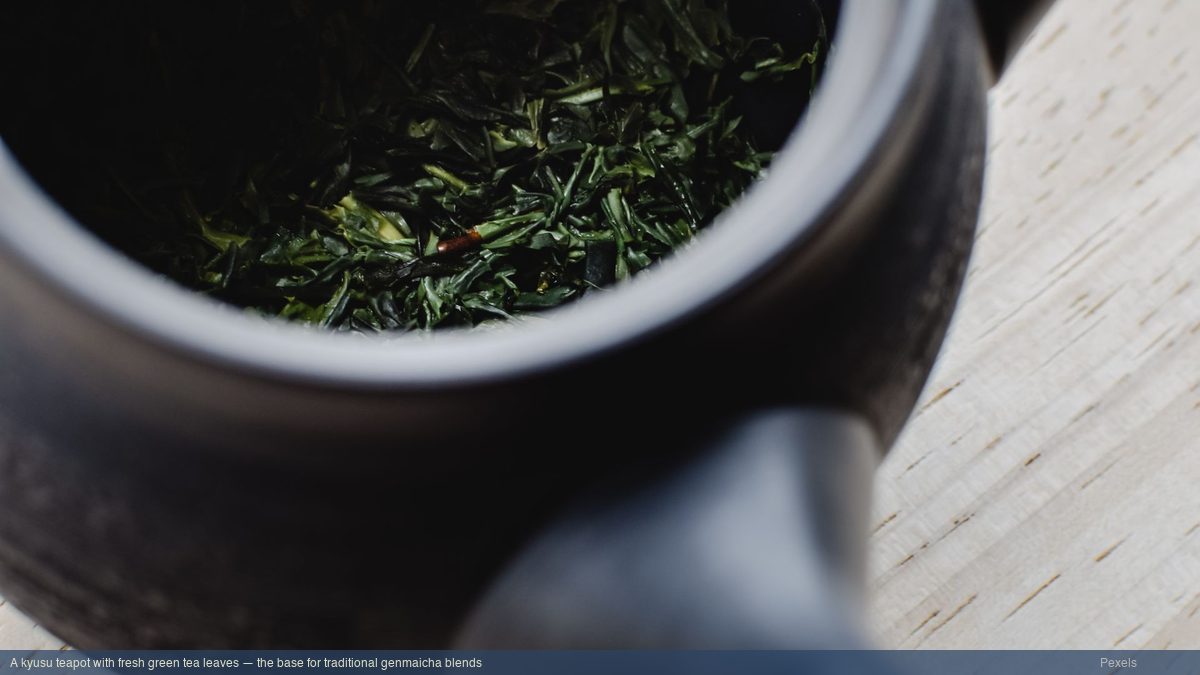
The final product is a blend that carries two flavour profiles at once: the light grassy vegetal character of green tea, softened considerably by dilution with the rice, and the toasted warming notes of the roasted genmai. The tea brews to a pale golden-yellow colour — lighter and warmer in hue than straight sencha, which tends toward a deeper green.
What Are the Key Compounds in Genmaicha?
Genmaicha's compound profile is shaped by both of its components: the green tea leaves contribute the polyphenols, amino acids, and caffeine familiar from any Japanese green tea, while the roasted rice brings its own set of phytochemicals that pure green tea lacks entirely.
Catechins and EGCG
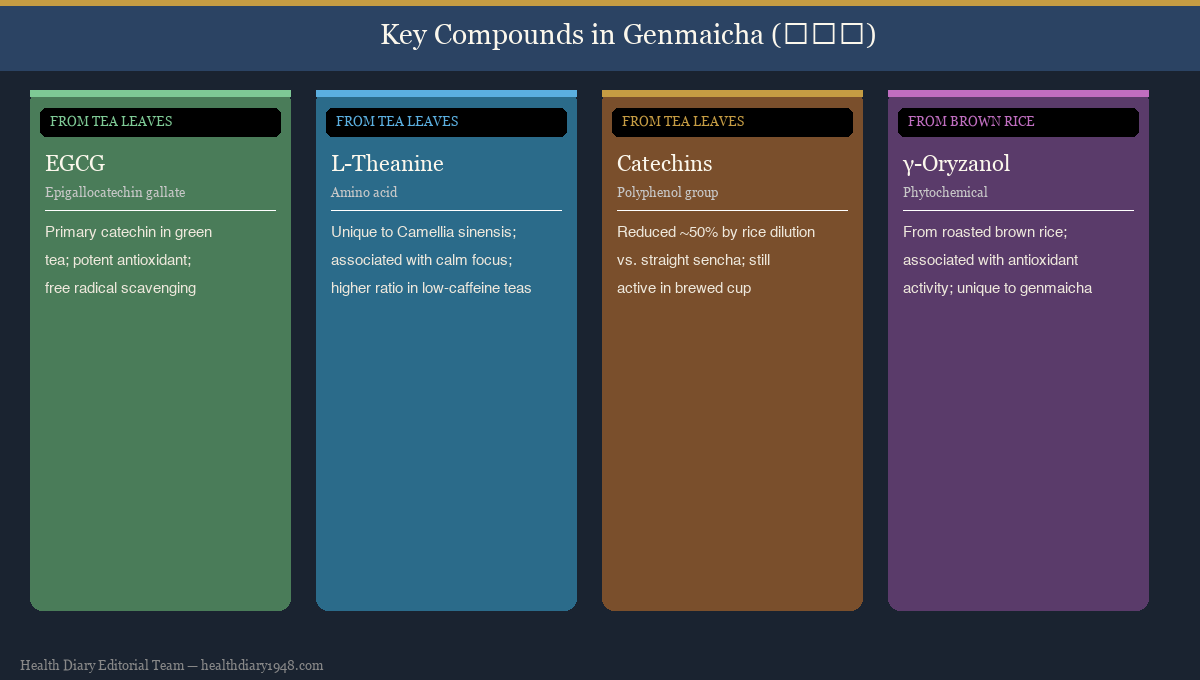
The most studied compounds in green tea are the catechins — a family of polyphenols of which EGCG (epigallocatechin gallate) is the most abundant and most researched. EGCG functions as a potent antioxidant, with phenolic groups enabling free radical scavenging activity in the body [Singh et al., Biochemical Pharmacology, 2011]. These catechins are responsible for much of the astringency characteristic of straight green teas.
In genmaicha, catechin levels are meaningfully lower than in straight sencha or bancha, because the roasted rice — which contains no catechins at all — effectively dilutes the tea component in each cup. A blend of roughly equal parts rice and leaves means you are brewing with half the tea material compared to a cup of pure green tea from the same weight. This explains why genmaicha is less astringent and less bitter than sencha, making it easier to drink for those who find straight green tea too sharp.
L-Theanine
L-Theanine is an amino acid found almost exclusively in Camellia sinensis — the tea plant. It is associated with a state of calm alertness and is known to partially modulate the stimulating effects of caffeine when both are present in the same beverage. In genmaicha, L-theanine levels are lower than in high-grade green teas like gyokuro or shade-grown sencha, again because the rice dilutes the tea component. However, because genmaicha's caffeine is also reduced, the ratio of theanine to caffeine may be proportionally preserved or even enhanced — which is significant given that research on low-caffeine green tea has found that higher theanine:caffeine ratios were associated with greater stress reduction [Unno et al., Nutrients, 2017].
Caffeine — Naturally Lower
Genmaicha contains roughly 15–30 mg of caffeine per cup — approximately half the amount found in a comparable cup of straight sencha, which typically ranges from 30–50 mg [Nio Teas]. This reduction occurs for two reasons: bancha leaves (the most common base) naturally contain less caffeine than younger first-flush leaves, and the rice dilutes the tea proportion in the blend. The caffeine in genmaicha comes entirely from the tea leaves; roasted brown rice contributes zero caffeine.
This lower caffeine level is one reason genmaicha has long been the tea of choice across generations in Japanese households — suitable for the elderly, for children in modest quantities, and for adults who enjoy tea later in the day.
γ-Oryzanol and Rice Phytochemicals
Roasted brown rice contributes compounds that straight green tea does not contain at all. γ-Oryzanol (gamma-oryzanol) is a phytochemical found in rice bran associated with antioxidant activity. Brown rice also retains vitamin E and GABA (gamma-aminobutyric acid) content from the bran layer, though roasting may reduce some of these. The Japan Standard Food Composition Table maintains a dedicated nutritional entry for genmaicha infusion as a distinct category from standard green tea, recognising its unique compositional profile [Japan MEXT Food Database, 2023].
How Do People Enjoy Genmaicha Today?
Genmaicha occupies a comfortable middle ground in the Japanese tea landscape: unpretentious enough for casual daily drinking, distinctive enough to delight newcomers. The ways people enjoy it have expanded considerably beyond the original simple hot brew.
Traditional hot brewing is the most common approach in Japan. A small teapot or kyusu is used with water at around 80°C and a steep of one to two minutes. The resulting cup is pale golden-yellow, with a clean nutty aroma and a smooth flavour. Many Japanese households keep a thermos or large pot of genmaicha available throughout the day as the standard household tea — it is drunk with meals, offered to guests, and served as an after-work wind-down drink.
Iced genmaicha has grown popular, particularly in summer. Cold-brewed genmaicha — made by steeping the leaves and rice in cold water in the refrigerator overnight — produces a naturally sweet, smooth cup with the nutty character intact but without any bitterness. Some Japanese cafes serve it over ice as a house iced tea year-round.
Matcha-iri genmaicha (抹茶入り玄米茶) is a widely available variant in Japan in which a small amount of matcha powder is added to the standard genmaicha blend. This creates a cup with the warming toasty notes of genmaicha plus a deeper umami richness from the matcha, and a light green colour in the brew. It is available at most Japanese supermarkets and convenience stores.
Culinary uses have emerged as genmaicha has gained international attention. The roasted, nutty flavour works well in cooking — added to rice water for a subtle flavour, used as a base for a warm dipping sauce, or incorporated into baked goods where a toasty-grain note is desired.
Individual responses to genmaicha vary considerably. Some people find the flavour mild and comforting; others prefer the sharper character of straight sencha. Personal taste exploration is always the best guide.
What Does the Research Say About Genmaicha?
Direct research on genmaicha as a specific beverage is limited compared to the large body of literature on green tea generally. Most of what can be said about genmaicha's potential wellness interest draws from studies on its component compounds — the green tea catechins and L-theanine — while acknowledging that genmaicha contains these at lower concentrations than stronger green teas.
The most directly applicable study for genmaicha's profile is a 2017 trial published in Nutrients examining low-caffeine green tea in healthy adults over a four-week period. Participants consuming the low-caffeine green tea showed significantly lower salivary α-amylase activity — a physiological marker of stress — compared to those drinking standard green tea. They also reported improved sleep quality, reduced early-morning awakening, and lower accumulated fatigue by Monday mornings. The researchers attributed these outcomes partly to the higher theanine-to-caffeine ratio in the low-caffeine variant [Unno et al., Nutrients, 2017]. Genmaicha, with its naturally lower caffeine from rice dilution and bancha base, shares this low-caffeine profile — though the study was not conducted on genmaicha specifically.
For the EGCG catechins present in genmaicha's tea component, a comprehensive review in Biochemical Pharmacology documented mechanisms by which EGCG may support antioxidant activity in healthy cells, noting its potent free radical scavenging capacity [Singh et al., 2011]. The NCCIH — the U.S. National Institutes of Health's complementary health division — notes that green tea consumed as a beverage is generally considered safe for most adults, and notes some preliminary evidence for modest effects on cholesterol levels and cardiovascular markers in some populations, while emphasising that findings remain mixed and more research is needed [NCCIH, Green Tea].
In practical terms: genmaicha is not a concentrate, supplement, or extract. It is a diluted blend of green tea and roasted rice. The wellness interest in genmaicha is best understood as the enjoyment of a warm, low-caffeine, polyphenol-containing beverage within a regular daily routine — not as a therapeutic intervention. Individual experiences with any food or beverage vary considerably.
How to Brew Genmaicha at Home
One of genmaicha's appealing qualities is how forgiving it is to brew. Unlike gyokuro — which demands precisely cooled water and careful timing — or matcha — which requires a specific whisk and bowl — genmaicha is approachable for daily home preparation.
Basic Hot Brewing Method
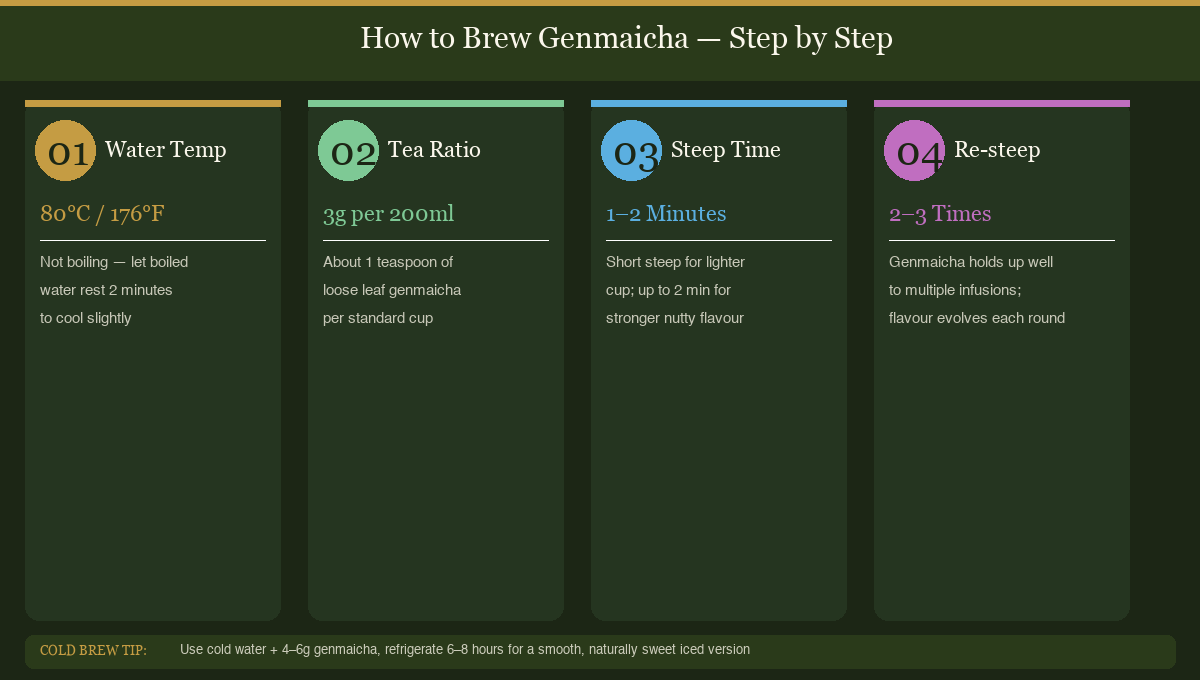
- Water temperature: Heat water to 80°C (176°F). If you are using a kettle that brings water to a full boil, simply let it rest for 2 minutes before pouring. Cooler water than a full boil helps preserve the delicate grassy notes from the tea leaves while allowing the roasted rice character to come through cleanly.
- Leaf and rice ratio: Use approximately 3 grams of loose genmaicha per 200 ml of water (roughly 1 teaspoon). A generous ratio will produce a more robust, nuttier cup; reducing to 2 grams will give a lighter, more subtle brew.
- Steep time: Steep for 1 to 2 minutes. One minute yields a pale, delicate cup where the grassy green tea notes are more forward; 2 minutes draws out more of the toasted rice depth. Avoid steeping beyond 3 minutes — oversteeping can introduce a flat, papery quality from the rice.
- Second and third infusions: Genmaicha steeps well 2–3 times. Add fresh 80°C water for 30–45 seconds on the second steep. The flavour evolves — the first steep is nutty and grassy, subsequent steeps become lighter and slightly sweeter as the roasted compounds are exhausted.
Cold Brew Genmaicha
For an iced version, add 4–6 grams of genmaicha to 500 ml of cold or room-temperature water in a pitcher. Cover and refrigerate for 6–8 hours (or overnight). The cold extraction produces a smooth, naturally sweet cup with no bitterness and a gentle nutty fragrance. This method is particularly well-suited to summer and requires no special equipment.
Food Pairings
In Japan, genmaicha is commonly served alongside simple foods: onigiri (rice balls), senbei (rice crackers), lightly seasoned vegetables, and Japanese sweets (wagashi). The roasted grain notes in the tea complement the mild saltiness of rice-based snacks naturally. Outside Japan, it pairs well with foods that share toasted, nutty, or lightly savory qualities — roasted nuts, simple grain-based pastries, mild aged cheeses, or plain biscuits.
Genmaicha Through the Seasons
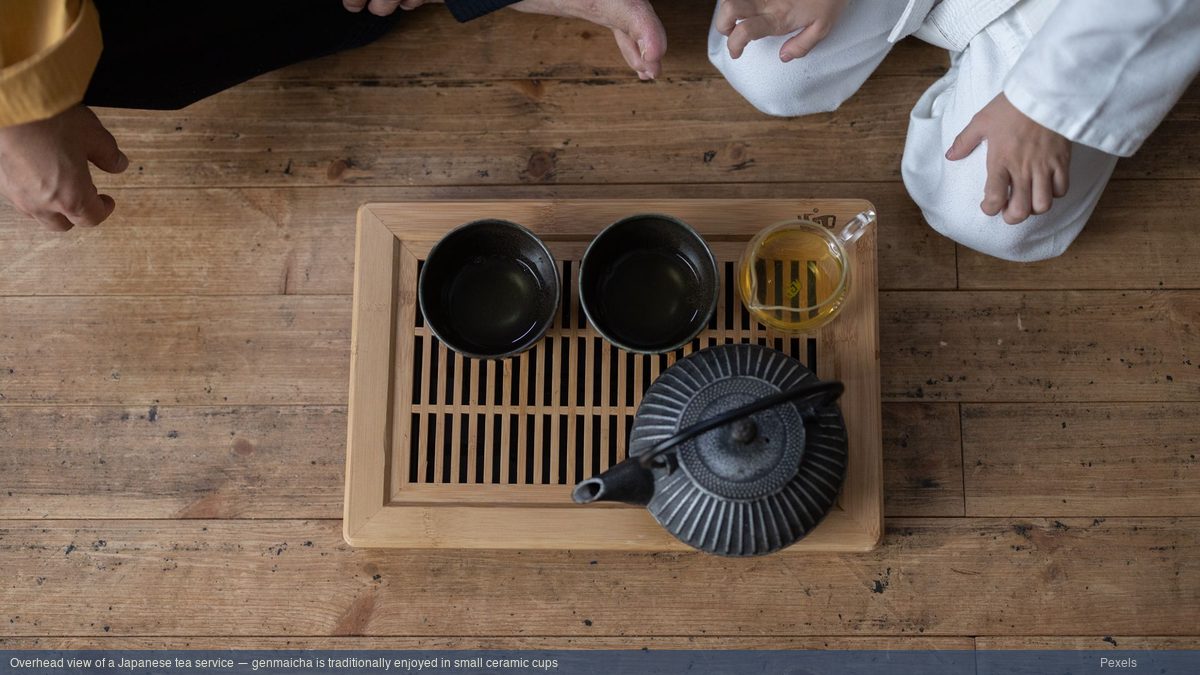
Although genmaicha is enjoyed year-round in Japan, it has a particular association with the cooler months. The warmth of the roasted rice aroma — evocative of autumn harvests and grain drying in the late-season sun — makes a hot cup of genmaicha feel especially appropriate as the weather turns cooler.
In Japan, the autumn months see heightened interest in genmaicha as households transition from iced cold-brew summer teas to warm daily cups. The tea pairs particularly well with the foods of the autumn season: roasted sweet potatoes, mushroom-based dishes, soba noodles, and the mild sweetness of season-appropriate wagashi. Winter brings the same association — a hot pot of genmaicha simmering in the kitchen is a common feature of Japanese home life in the colder months.
Spring and summer use shifts more toward iced preparations. Cold-brew genmaicha becomes a popular household drink as temperatures rise, often replacing iced barley tea (mugicha) or bottled green tea as the daily household cold drink.
This seasonal rhythm reflects genmaicha's essential character: a tea that adapts to the moment, serves all ages, and fits naturally into everyday life rather than being reserved for special occasions.
Important Considerations
Genmaicha is generally regarded as one of the most accessible and gentle Japanese teas available. Its low caffeine profile and diluted catechin content make it less likely than stronger teas to cause issues for most people. Nevertheless, a few considerations are worth noting.
- Caffeine content: While genmaicha contains only 15–30 mg of caffeine per cup — far less than coffee or standard green tea — individuals with documented caffeine sensitivity may still notice mild effects. Those who choose to avoid all caffeine (for medical reasons, during pregnancy, etc.) should be aware that genmaicha is not caffeine-free.
- Drug interactions: The NCCIH notes that green tea beverages at normal consumption levels rarely cause drug interactions; concerns are primarily with concentrated green tea extract supplements [NCCIH]. Genmaicha as a diluted beverage presents a lower catechin load than straight sencha. Anyone taking nadolol, atorvastatin, warfarin, or other medications with known green tea interactions should discuss their tea consumption with a healthcare provider.
- Lower catechin content vs. straight green tea: Those seeking genmaicha primarily for its catechin or EGCG content should be aware that the rice dilution significantly reduces polyphenol concentration compared to sencha or matcha. Genmaicha is not a substitute for stronger green teas if concentrated catechin intake is the primary goal.
- Pregnancy and breastfeeding: The low caffeine content makes genmaicha more compatible with pregnancy than most caffeinated teas. Current guidance from health authorities generally considers low-to-moderate caffeine intake safe during pregnancy, but pregnant individuals should follow their healthcare provider's specific guidance on total daily caffeine across all sources.
- Children: Genmaicha has long been served to children in Japan given its very low caffeine. Parents should still consider a child's total daily caffeine intake from all beverages and foods.
- Rice allergen: Individuals with rice allergies or sensitivities should note that genmaicha contains roasted brown rice as a core ingredient — not simply a trace.
- Individual responses vary considerably: Some people find the nutty toasted character deeply comforting; others find it bland or unusual. Flavour preferences are personal, and responses to any beverage — whether related to taste, digestive comfort, or caffeine sensitivity — differ from person to person. What suits one individual's daily routine may not suit another's.
Frequently Asked Questions
What does genmaicha taste like?
Genmaicha has a distinctive dual character: the light grassiness of Japanese green tea combined with a warm, nutty, roasted-grain flavour from the brown rice. The overall impression is softer and less astringent than straight sencha, with a toasty warmth that many people describe as comforting. The tea brews to a pale golden colour rather than the vivid green of matcha or the darker gold of hojicha. Some people detect a very faint natural sweetness in a well-brewed cup, particularly after a short steep.
Is genmaicha lower in caffeine than regular green tea?
Yes, significantly lower. A cup of genmaicha typically contains around 15–30 mg of caffeine, compared to 30–50 mg for standard sencha and up to 70 mg for matcha. The reduction comes from two sources: bancha leaves (the common base) naturally contain less caffeine than first-flush sencha leaves, and the roasted rice — which contains zero caffeine — dilutes the tea proportion in every cup. This makes genmaicha one of the lower-caffeine options within the Japanese green tea family.
Why is genmaicha called popcorn tea?
During the roasting process, a small number of the glutinous rice grains used in genmaicha puff and split open under the heat, resembling tiny kernels of popped corn. When you look at loose-leaf genmaicha, these pale, popped pieces are visible among the darker roasted rice grains and green tea leaves. The resemblance to popcorn — and the fact that they give the dry blend a slightly playful, dotted appearance — gave genmaicha its affectionate international nickname of popcorn tea.
Can I drink genmaicha every day?
For most healthy adults, genmaicha consumed in typical quantities (1–3 cups daily) is generally considered safe. Its very low caffeine content and diluted catechin profile make it one of the gentler caffeinated teas for daily consumption. Japanese tradition has served it to all age groups for generations at these quantities without notable concerns. As with any food or beverage, individual health circumstances vary — those with specific conditions, who are pregnant, or who take certain medications should consult a healthcare practitioner for personalised guidance.
What is the difference between genmaicha and hojicha?
Both are accessible, lower-caffeine Japanese teas with roasted character, but they are made differently. Hojicha is roasted green tea — the leaves themselves are roasted at high heat, which transforms their colour, aroma, and caffeine content. Genmaicha is a blend of unroasted (or lightly processed) green tea leaves mixed with separately roasted brown rice — the leaves are not themselves roasted. Hojicha has a deeper caramel, coffee-like roasted aroma; genmaicha has a lighter, grassy-nutty character where both the tea and rice flavours remain distinct. Hojicha typically has even less caffeine (~7–15 mg/cup) than genmaicha.
What is matcha-iri genmaicha?
Matcha-iri genmaicha (抹茶入り玄米茶) is a variant of standard genmaicha with a small amount of finely ground matcha powder added to the blend. The matcha deepens the flavour with a rich umami note and turns the brewed cup a distinctive pale green — the visual contrast of the green-tinted liquid with the floating rice grains is part of its appeal. The matcha addition also raises the catechin content slightly compared to plain genmaicha. It is widely available in Japan and has become popular internationally as a distinctive tea for those who enjoy both genmaicha and matcha.
A Note on Tracking Your Tea Habits
If you are exploring genmaicha as part of a broader wellness routine — perhaps as a lower-caffeine afternoon alternative or a warm evening drink — tracking your habits over time can help you observe patterns in your own experience. Our Health Diary wellness platform allows you to log daily practices, including tea rituals, alongside sleep quality, energy levels, and general wellbeing notes.
There is no claim here that genmaicha will produce any specific outcome for any individual. The research on low-caffeine green tea and the compounds it contains is preliminary and often conducted in specific populations. What matters most is how your own daily habits and choices affect your sense of wellbeing — and that is deeply personal. Individual responses vary considerably; what works as part of a satisfying daily ritual for one person may not suit another, and that is entirely normal.
About This Article
Written by: Health Diary Editorial Team — researchers and writers specialising in Japanese wellness traditions, tea culture, and evidence-based wellness content.
Editorial review: This article has been reviewed by the Health Diary editorial team for clarity, structure, and adherence to our sourcing standards. Key claims were cross-checked against NCCIH green tea guidance, PMC peer-reviewed literature on EGCG and low-caffeine green tea (Unno et al. 2017; Singh et al. 2011), the Japan MEXT Standard Food Composition Table, and specialist Japanese tea sources. It is not a clinical review and should not replace consultation with a licensed healthcare practitioner.
Reviewed on: June 14, 2026.
Editorial process: We cite peer-reviewed and government sources where possible. When a clinical reviewer is added to this article, attribution will appear here with verifiable credentials.
References
- Unno K, Noda S, Kawasaki Y, et al. (2017). Reduced Stress and Improved Sleep Quality Caused by Green Tea Are Associated with a Reduced Caffeine Content. Nutrients. 9(7):777. https://pmc.ncbi.nlm.nih.gov/articles/PMC5537891/
- Singh BN, Shankar S, Srivastava RK. (2011). Green tea catechin, epigallocatechin-3-gallate (EGCG): mechanisms, perspectives and clinical applications. Biochemical Pharmacology. 82(12):1807–1821. https://pmc.ncbi.nlm.nih.gov/articles/PMC4082721/
- National Center for Complementary and Integrative Health (NCCIH). Green Tea: Usefulness and Safety. U.S. National Institutes of Health. https://www.nccih.nih.gov/health/green-tea
- Japan Ministry of Education (MEXT). Standard Tables of Food Composition in Japan — Genmaicha (玄米茶) infusion. Food Composition Database, 2023. https://fooddb.mext.go.jp/details/details.pl?ITEM_NO=16_16041_7
- Nio Teas. Genmaicha History — The Origins of Brown Rice Green Tea. https://nioteas.com/blogs/genmaicha/genmaicha-history
- Nio Teas. A Scientific Approach to Genmaicha Caffeine Level. https://nioteas.com/blogs/genmaicha/genmaicha-caffeine
- byFood. What is Genmaicha? Japanese Popcorn Tea. https://www.byfood.com/blog/what-is-genmaicha-japanese-popcorn-tea-p-650
- My Japanese Green Tea. Analyzing Japanese Tea Nutrition Data. https://www.myjapanesegreentea.com/analyzing-japanese-tea-nutrition-data