Daily Herbal Tea Traditions: How Asia Weaves Tea Through Everyday Life
Explore daily herbal tea traditions across Asia — the morning cup, the after-meal pot, boricha, all-day ocha, Guangdong liangcha, and Vietnam's sidewalk tea — and how tea became an everyday rhythm.
Medical Disclaimer: This content is for educational and informational purposes only and is not medical advice. The information presented is not intended to diagnose, treat, cure, or prevent any disease. Always consult a licensed healthcare practitioner before starting any new herbal practice or supplement. Statements regarding traditional herbal use have not been evaluated by the FDA.
Affiliate Disclosure: This article contains affiliate links. We may earn a commission if you purchase through these links, at no additional cost to you. We only recommend products we believe align with our editorial standards.
Across much of Asia, tea is not a special occasion — it is the quiet background hum of an ordinary day. It marks the moment of waking, punctuates meals, fills the gap between tasks, and softens the slide into evening. Where a formal tea ceremony might happen now and then, the everyday cup happens five or six times before dark, so routinely that most people barely notice they are doing it.
This article is about that everyday rhythm — not the ceremonial tea rituals of Asia and not a catalogue of the many herbal teas themselves, but the simple daily habit of reaching for a cup. We will follow tea through the hours of a typical day, see how Korea, Japan, southern China, and Vietnam each turned it into something close to drinking water, and consider what research does and does not say about a daily tea practice.
Why Everyday Tea Became the Rhythm of Daily Life in Asia
Long before tea was refined into ceremony, it was simply the safest, most pleasant thing to drink. Boiling made the water safer, and a handful of leaves or roasted grain made it worth looking forward to. Over centuries that practicality hardened into habit, and habit into culture — a cup became the natural punctuation of daily life: something to offer a guest, to share with a neighbor, to hold while the mind settles.
Part of what makes the habit so durable is that it asks very little. It needs no tea room, no teacher, no free hour. It fits into the cracks of an ordinary schedule — the minutes while the kettle boils, the pause after lunch, the wind-down after the dishes. Because it is small and repeatable, it survives where more elaborate practices fade. In that sense, daily tea is less a wellness project than ordinary infrastructure, as woven into the day as brushing your teeth.
What Does a Full Day of Tea Look Like in Asia?
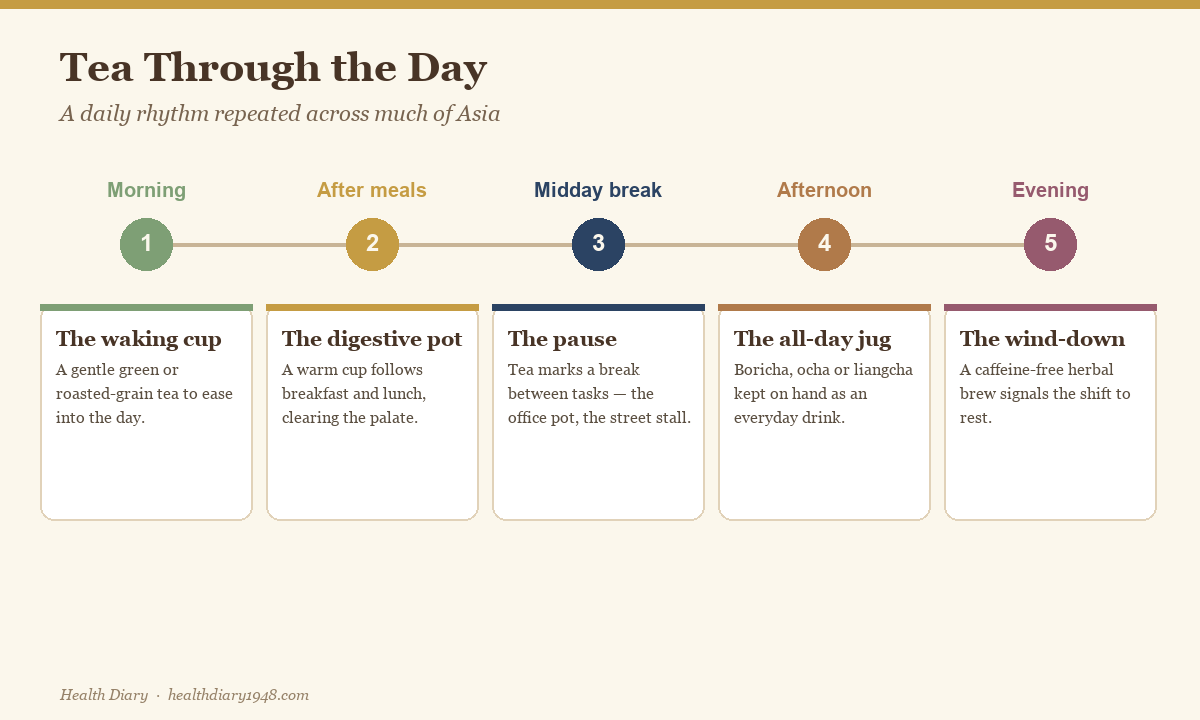
The clearest way to understand everyday tea is to follow it from morning to night. No single household does all of this, and details shift from country to country, but the overall shape — tea as a companion to each part of the day — is remarkably consistent across the region.
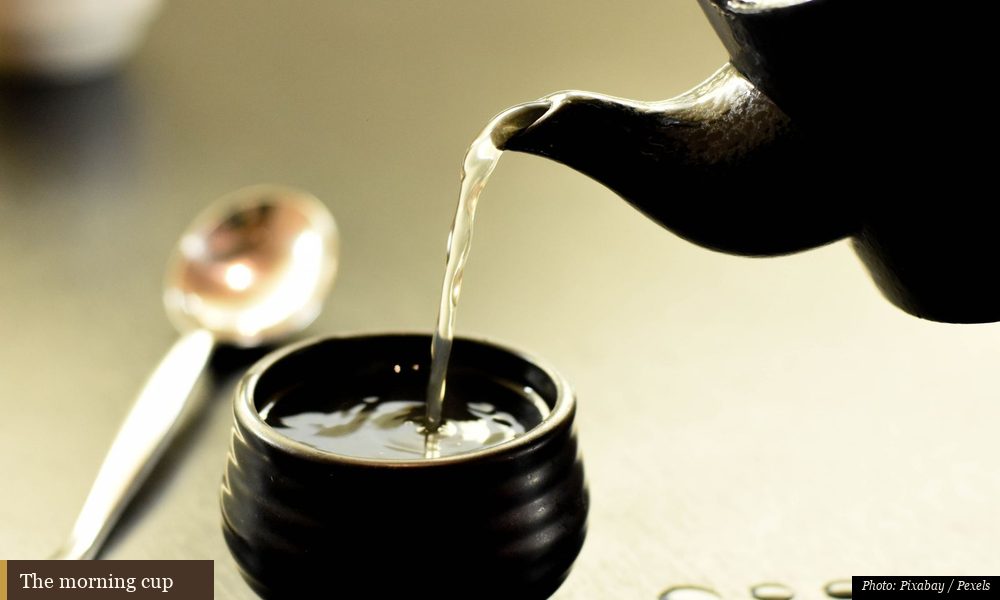
- The waking cup. The day often begins with something warm and gentle — a light green tea, roasted grain tea, or plain leaf tea before or with breakfast. It is less about caffeine than about a small, familiar ritual to ease into the morning.
- After meals. Tea follows food almost automatically. A pot appears at the end of breakfast and lunch, a warm counterpoint that clears the palate and marks the shift back to the day.
- The mid-morning and afternoon break. Between tasks, tea becomes a reason to pause — a quiet interval in Japan, the sidewalk stall in Vietnam, the shared office pot almost everywhere.
- The evening wind-down. As the day closes, many people turn to something gentler — a caffeine-free herbal infusion or a light brew — to mark the move from doing to resting.
Strung across the hours, these cups form a kind of daily metronome. Each is unremarkable on its own, but together they give the day a steady, comforting cadence.
Tea That Stands in for Water: Everyday Habits Across the Region
In several cultures the daily habit goes one step further: tea is not an addition to water but a replacement for it. What sits in the jug or flask all day is not plain water but a light, often caffeine-free brew.
In Korea, that role belongs to boricha (보리차), roasted barley tea. It is drunk year-round — hot in winter, chilled in summer — and so ordinary that many families keep a jug in the fridge and call it, half-jokingly, "water." Because it is naturally caffeine-free, it slots into the day without limit: with meals, between them, and last thing at night. More in our guide to Korean barley tea.
In Japan, everyday green tea — ocha — plays a similar all-day part. Japan's agricultural ministry describes tea as woven through ordinary life: served with meals, offered to welcome a guest, and poured as a small gesture of hospitality throughout the day. [6] Roasted grain and twig teas such as barley tea and genmaicha are common evening choices because they are lighter and lower in caffeine.
In southern China, the Cantonese habit of liangcha (涼茶, "cool tea") reflects the hot, humid Lingnan climate. The Guangdong provincial record calls herbal tea an everyday drink families rely on across the seasons — "to guard against dryness in autumn and winter, and to clear damp-heat in spring and summer" — a habit named national intangible cultural heritage in 2006. [4] The old brews are simmered long and slow in a well-used clay pot, then sipped as an ordinary part of the week.
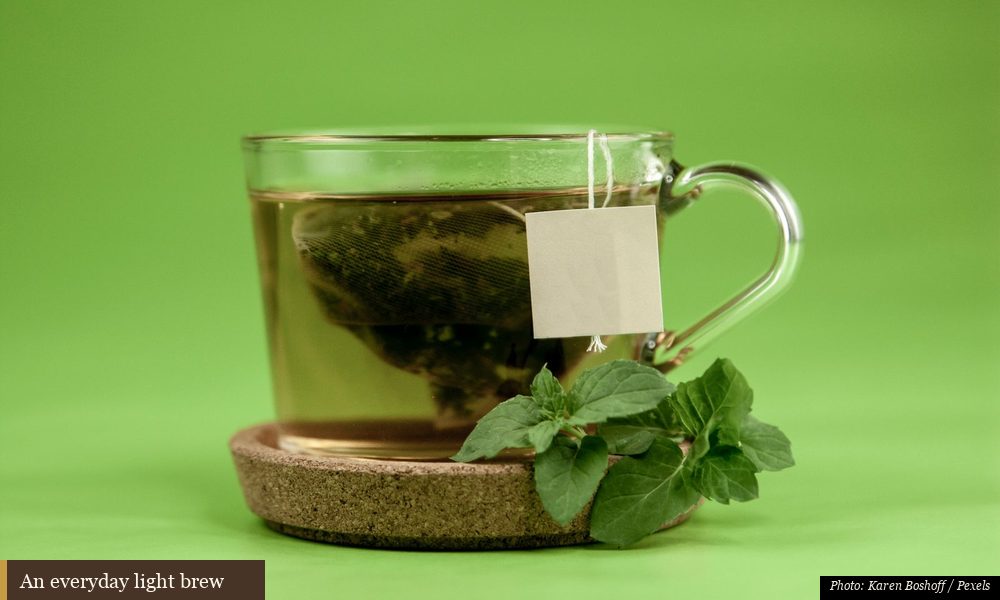
In Vietnam, the everyday face of tea is the ấm trà at the front of the alley and the ever-present glass of trà đá (iced tea) at the roadside stall. Vietnam's national newspaper describes tea as threaded through daily life from countryside to city, north to south — a pot offered to any guest, and fresh green tea (chè xanh) steeped in a big pot and shared communally. [7] The sidewalk trà đá stall, where a few cents buys a glass and an hour of conversation, may be the most democratic daily tea habit in the region.
Individual experiences vary considerably; what feels like a natural all-day drink to one person may be too much caffeine, or simply not to taste, for another.
Why Do People Drink Tea After Meals?
Of all the daily tea moments, the after-meal cup may be the most universal. From a Cantonese yum cha lunch to a Vietnamese family dinner to a Japanese meal finished with green tea, a pot arriving at the end of the food is close to automatic across the region.
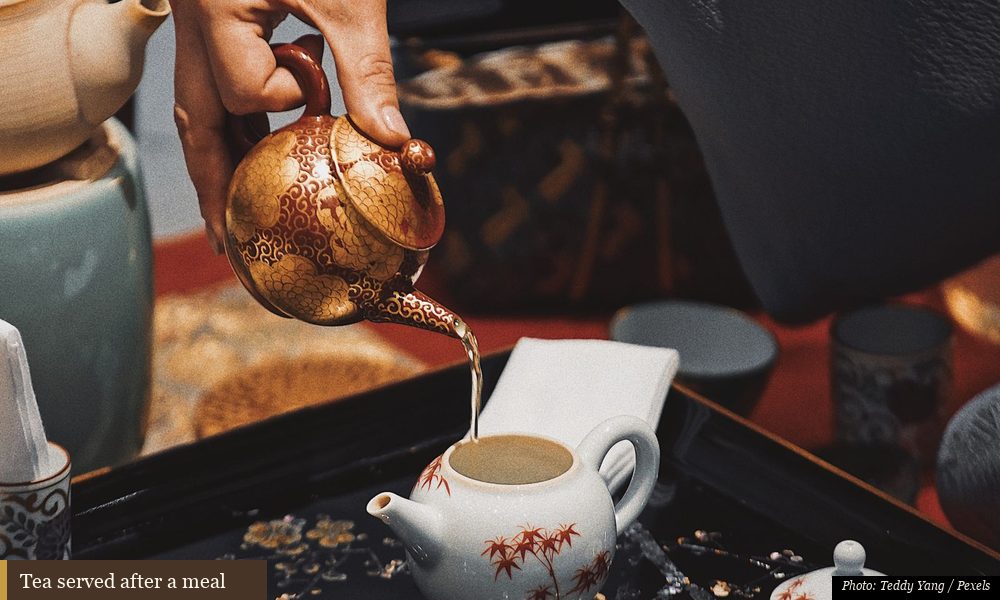
Much of the appeal is sensory and social rather than medicinal. A warm, slightly astringent cup cleanses the palate after rich or oily food and gently signals that the meal is over and conversation can begin. In traditional thinking across East Asia, warm drinks after eating are often felt to sit more comfortably than cold ones. Many people simply find a cup a pleasant way to round off a meal — a habit centuries deep. Worth noting: tea drunk with meals can affect how the body absorbs some minerals, a point we return to below.
How Can You Build Your Own Daily Tea Rhythm?
You do not need to be born into any of these cultures to borrow the habit. The idea is not to add one heroic "wellness tea" but to let tea quietly mark the parts of your day, the way it does across Asia. A few practical starting points:
- Anchor tea to things you already do. A cup after breakfast, a pot after lunch, a mug at your afternoon slump — attaching tea to an existing moment is what turns it into a habit rather than a chore.
- Match the caffeine to the hour. Keep real tea (green, oolong, black) to the first half of the day, and shift to caffeine-free options — roasted barley, ginger, chrysanthemum, or other herbal infusions — as evening approaches.
- Keep a jug going. Borrow the boricha trick: brew a large pot of a mild, caffeine-free tea and keep it on hand, hot or chilled, as your default drink instead of plain water.
- Let one cup be screen-free. Pick a single daily cup — often the afternoon one — to drink without a phone in hand, giving your attention a genuine pause.
- Wind down with a gentle brew. An evening herbal tea can become a signal that the day is closing, part of a calmer pre-sleep routine.

None of this needs special equipment or expertise; it reframes a drink you probably already reach for as a series of small, deliberate pauses. Individual experiences vary considerably; what works well for one person may not suit another, and personal experimentation under practitioner guidance is always recommended.
What Does the Research Say About Drinking Tea Every Day?
Because everyday tea is so common, it has drawn genuine scientific interest — though the findings are best read as encouraging context, not health claims. Two questions matter most for a daily habit: does tea count as hydration, and does habitual tea intake track with anything over time?
On hydration, one common worry is that caffeinated tea might be drying. A randomized controlled trial in the British Journal of Nutrition tested it: healthy men drank four to six cups of black tea a day and were compared with the same volume of water. The researchers found no significant differences in blood or urine hydration markers — at these everyday amounts, black tea hydrated the participants much like water. [1] For a daily habit, moderate tea can reasonably count toward fluid intake.
On long-term patterns, tea is one of the largest dietary sources of flavonoids — plant compounds studied for their possible role in health. A large Danish cohort followed 56,048 people for 23 years and found that a moderate habitual flavonoid intake was associated with lower all-cause and cardiovascular mortality, the relationship leveling off around 500 mg per day. [2] This is an observational association within a whole dietary pattern, not proof that tea itself drives outcomes — but the kind of finding that makes an everyday tea habit an easy, low-risk one to keep. The National Center for Complementary and Integrative Health adds a fair caution: while tea is part of complementary health traditions worldwide, the evidence for specific effects remains mixed and varies by preparation. [3] The strongest case for daily tea is a modest one — a pleasant, hydrating, flavonoid-rich habit that fits easily into ordinary life.
Important Limitations and Considerations
A daily tea habit is a gentle one, but drinking tea from morning to night does raise a few practical cautions:
- Caffeine across the whole day. The very thing that makes all-day tea pleasant — small cups, often — can add up. Caffeine later in the day may disturb sleep for sensitive people; shifting to caffeine-free brews such as roasted barley or herbal infusions by afternoon is a simple safeguard.
- Tea on an empty stomach and iron absorption. The tannins in tea can reduce how well the body absorbs non-heme (plant) iron. People prone to low iron may prefer tea between meals rather than with iron-rich food, and go easy on strong tea first thing on an empty stomach.
- Herb–drug interactions. "Herbal tea" covers a huge range of plants, some of which can interact with medications. If you take prescription drugs — blood thinners, blood-pressure or diabetes medication, and others — check with a pharmacist or doctor before making a particular herbal tea a daily fixture.
- Pregnancy and breastfeeding. Caffeine is usually limited during pregnancy, and not every herb is considered suitable. If you are pregnant or breastfeeding, ask a healthcare practitioner which daily teas are appropriate for you.
- Quality and sourcing vary. Leaf grade, freshness, and processing differ widely between products, and so does what ends up in your cup.
- Individual response varies. A rhythm that feels effortless for one person may not suit another. Treat everyday tea as a pleasant habit to explore, not a guaranteed outcome.
Frequently Asked Questions
Is it healthy to drink tea every day?
For most people, a moderate daily tea habit fits comfortably into a healthy routine. Tea is hydrating at everyday amounts and is a major source of dietary flavonoids, which large observational studies associate with favorable long-term patterns. These are associations rather than guarantees, and individual responses vary — those who are pregnant, take medications, or are sensitive to caffeine should check with a healthcare practitioner.
Does drinking tea count as water?
Largely, yes. A randomized trial found that black tea at four to six cups a day hydrated participants much like plain water, despite its caffeine. Caffeine-free options such as roasted barley tea count even more straightforwardly toward daily fluids. Very strong or very large amounts of caffeinated tea are a different matter, so moderation still applies.
What tea do people in Asia drink throughout the day?
It varies by country. Koreans often keep caffeine-free roasted barley tea (boricha) on hand all day; Japanese households drink everyday green tea (ocha) with meals and switch to lighter roasted teas at night; southern Chinese families drink cooling herbal brews (liangcha); and in Vietnam, iced green tea (trà đá) and fresh green tea are everyday staples. The common thread is a light, unfussy drink taken often.
When is the best time of day to drink tea?
There is no single right answer, but a useful rule of thumb is to keep caffeinated teas to the first half of the day and switch to caffeine-free herbal or roasted-grain teas in the afternoon and evening. Many people enjoy a cup after meals and a gentle brew before bed. Choose times that fit your own sleep and energy patterns.
Can I drink herbal tea before bed every night?
Many people enjoy a caffeine-free herbal tea as part of a nightly wind-down, and for most it is a pleasant, low-risk habit. Choose genuinely caffeine-free infusions, keep the volume modest so it does not disrupt sleep with late-night trips to the bathroom, and check any specific herb against your medications or pregnancy status if relevant.
A Note on Finding Your Own Rhythm
The appeal of everyday tea is that it is personal. The cup that suits your mornings may be quite different from the one that suits your evenings, and the rhythm that feels natural to you will not look exactly like anyone else's. If you are curious which tea style might fit your temperament and daily routine, you can explore that in a light, reflective way and let it point you toward where to begin — rather than copying someone else's habit wholesale.
A Soft Closing Note
Daily tea traditions are living, ordinary practices — shaped over centuries across Korea, Japan, China, and Vietnam, and carried not in grand ceremonies but in the small, repeated act of pouring a cup. Their quiet value lies in the rhythm itself: a warm drink to wake up with, a pot to share after a meal, a break in the afternoon, a gentle brew at night. You do not need to master anything to borrow that rhythm. Keep a favorite tea within reach, let it mark the parts of your day, and let the everyday cup become one of the calmer, steadier habits you keep.
About This Article
Written by: Health Diary Editorial Team — specialists in traditional Asian wellness research, tea culture, and everyday healthy habits.
Editorial review: This article has been reviewed by the Health Diary editorial team for clarity, structure, and adherence to our sourcing standards. Key claims were cross-checked against NCCIH, NIH PubMed, and peer-reviewed literature, as well as native-language Chinese, Japanese, Vietnamese, and Korean sources on everyday tea habits. It is not a clinical review and should not replace consultation with a licensed healthcare practitioner.
Reviewed on: July 18, 2026.
Editorial process: We cite peer-reviewed and government sources where possible. When a clinical reviewer is added to this article, attribution will appear here with verifiable credentials.
This article explores daily tea traditions as a cultural and lifestyle practice. It is not medical advice.
References
- Ruxton CHS, Hart VA. "Black tea is not significantly different from water in the maintenance of normal hydration in human subjects: results from a randomised controlled trial." British Journal of Nutrition, 2011;106(4):588-595. pubmed.ncbi.nlm.nih.gov/21450118
- Bondonno NP, et al. "Flavonoid intake is associated with lower mortality in the Danish Diet, Cancer, and Health Cohort." Nature Communications, 2019. PMC6692395
- National Center for Complementary and Integrative Health (NCCIH). "Tea." U.S. Department of Health and Human Services. nccih.nih.gov/health/tea
- 广东省情网 (Guangdong Provincial Gazetteer Office). "【粤故事】'自讨苦吃',它才是岭南饮品中的'扛把子'." dfz.gd.gov.cn (Chinese-language source on Guangdong liangcha)
- Linus Pauling Institute, Micronutrient Information Center, Oregon State University. "Tea." lpi.oregonstate.edu/mic/food-beverages/tea
- 農林水産省 (Ministry of Agriculture, Forestry and Fisheries, Japan). "日本茶を楽しむ方法." maff.go.jp (Japanese-language source on everyday green tea)
- Báo Nhân Dân. "Thấp thoáng văn hóa trà Việt." nhandan.vn (Vietnamese-language source on everyday tea culture)