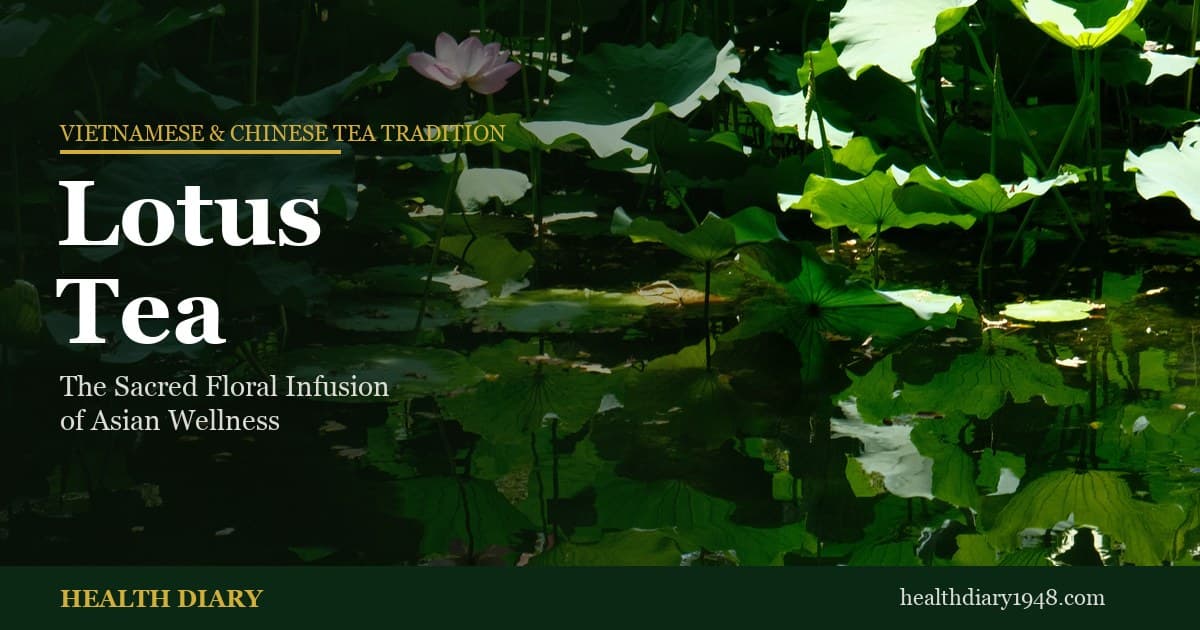
Lotus Tea: The Sacred Floral Infusion of Asian Wellness
From the misty shores of West Lake Hanoi to the ancient Buddhist tea houses of China, lotus tea has carried the essence of an entire civilization. This guide explores the four distinct lotus teas — flower, leaf, stamen, and the legendary lotus-scented green tea of Tay Ho — along with their cultural heritage, key bioactive compounds, and practical brewing guidance.
A Sacred Flower in Every Cup
Few plants carry as much symbolic weight as the lotus. Rising from muddy water to bloom in pristine beauty, Nelumbo nucifera has been revered across Asia for more than two millennia — in Buddhist temples, royal courts, and humble village kitchens alike. And nowhere does this reverence find a more refined expression than in lotus tea.
Lotus tea is not a single beverage. It encompasses at least four distinct traditions: tea brewed from fresh or dried lotus flowers, infusions of lotus leaves, delicate golden stamen tea, and — perhaps most celebrated of all — the artisanal Vietnamese craft of lotus-scented green tea (tra sen uop), in which premium green tea leaves slowly absorb the living fragrance of thousands of lotus blooms. Each carries its own flavor profile, its own phytochemical signature, and its own place in the living tapestry of Asian wellness culture.
This guide explores all four, with particular attention to Vietnam's extraordinary West Lake lotus tea tradition — a practice so refined that it was designated a National Intangible Cultural Heritage by Vietnam's Ministry of Culture, Sports, and Tourism in 2024.
A History Rooted in Sacred Waters
The use of lotus as a beverage ingredient spans recorded history across both Vietnam and China. In Vietnam, historical accounts link lotus tea most strongly to the Nguyen Dynasty courts of Hue, where royal servants were dispatched by boat to lotus ponds at dawn, selecting the most fragrant blooms before they fully opened. The stamens were carefully extracted and layered with fine tea — a labor so painstaking that the resulting cup was considered a gift fit only for emperors.
The association of lotus with water and purity runs just as deep in Chinese civilization. Buddhist monasteries across Tang and Song Dynasty China cultivated lotus ponds as symbols of enlightenment — the flower emerging unsullied from murky water mirroring the Buddha's teaching about the awakened mind. The lotus (lian hua) appears in classical poetry, in paintings, and woven throughout the Chinese pharmacopoeia, where its leaf (He Ye), stamen (Lian Xu), seed (Lian Zi), and plumule (Lian Zi Xin) each carry distinct properties.
In Hanoi, the epicenter of Vietnamese lotus tea culture has always been Tay Ho — the West Lake district — and specifically the Quang An ward, which is bordered on three sides by the lake. Here, the unique micro-environment of West Lake nourishes a rare lotus variety: the sen bach diep (hundred-petal lotus), with approximately 100 petals per bloom and an aroma unlike any other lotus in Vietnam. Generations of families in Quang An have preserved and transmitted the craft of lotus-scented tea making, and the beverage has long been called “Thien co de nhat tra” — roughly translated as “The First Tea Under Heaven.”
The Four Distinct Types of Lotus Tea
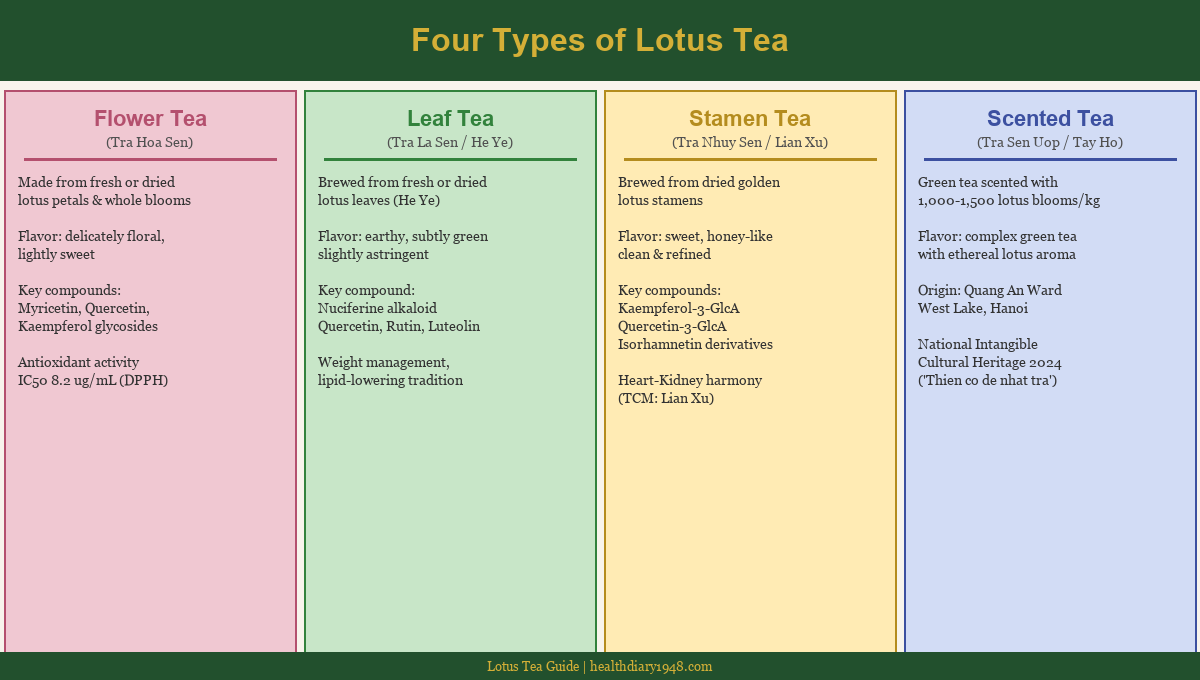
Understanding lotus tea means recognizing its diversity. The same plant yields four beverages that differ dramatically in flavor, preparation, traditional context, and bioactive profile.
1. Lotus Flower Tea (Tra Hoa Sen)
Brewed from fresh or dried lotus petals and whole blooms, lotus flower tea produces a pale, golden-pink liquor with a delicately floral sweetness and almost no bitterness. It is enjoyed both in Vietnam and across Southeast Asia as a refreshing warm-weather beverage. Research published in PMC12732289 identified nine major flavonoids in Nelumbo nucifera flower extracts, with myricetin at concentrations up to 133.70 mg/g and hyperoside (quercetin-3-galactoside) at 104.53 mg/g in certain fractions — demonstrating potent antioxidant activity, with DPPH IC50 values of 8.20 µg/mL in the strongest fraction.[1]
2. Lotus Leaf Tea (Tra La Sen / He Ye)
Lotus leaf tea, prepared from fresh or sun-dried leaves of Nelumbo nucifera, has been used in China for weight management since at least the Ming Dynasty. The key compound is nuciferine, an aporphine alkaloid that has attracted considerable modern research interest for its lipid-lowering and anti-obesity properties. A randomized double-blind clinical trial (PubMed ID 34852695) found that supplementation with Nelumbo nucifera leaf extract over 12 weeks significantly reduced whole body fat in both male and female participants, with men also showing reductions in visceral fat and waist circumference.[2] The leaf also contains quercetin, rutin, luteolin, orientin, and catechin — a broad polyphenol spectrum with complementary antioxidant and anti-inflammatory effects.
3. Lotus Stamen Tea (Tra Nhuy Sen / Lian Xu)
The golden stamens of the lotus flower — known in Vietnamese as nhuy sen and in Chinese herbal practice as Lian Xu — are used to produce one of the most prized and subtly flavored lotus teas. Lotus stamen tea yields a honey-toned infusion with a refined, sweet-floral quality that lingers on the palate. A kinetic study published in PMC9459831 mapped the extraction dynamics of lotus stamen flavonoids, identifying kaempferol-3-glucuronic acid as a particularly significant antioxidant contributor — present at concentrations 3.5 times higher than rutin — with most flavonoids reaching saturation within 5 minutes of infusion.[3] In classical Chinese herbal practice, Lian Xu is classified as sweet and astringent in taste, neutral in thermal nature, and entering the Heart and Kidney meridians — with the primary actions of securing essence, calming Heart Fire, and addressing Heart-Kidney disharmony.
4. Lotus-Scented Green Tea (Tra Sen Uop — Tay Ho Style)
This is the jewel of Vietnamese lotus tea tradition. Rather than brewing the lotus directly, artisans from Quang An ward layer premium green tea — typically Tan Cuong green tea from Thai Nguyen province — with freshly harvested lotus stamens and anthers (called gao sen, or “lotus rice”). The tea absorbs the living fragrance of the flower through repeated scenting cycles, with the stamens replaced by fresh ones multiple times. According to cultural heritage records, producing one kilogram of authentic Tay Ho lotus-scented tea requires between 1,000 and 1,500 lotus blooms and a meticulous process that unfolds over 15 to 21 days.
Tay Ho Lotus Tea: Vietnam's Living Cultural Heritage

The Quang An lotus-scented tea craft occupies a singular place in Vietnamese cultural identity. Quang An ward in Tay Ho district, Hanoi, sits surrounded by West Lake on three sides, giving its 157 hectares of lotus-growing land an especially fertile soil enriched by centuries of lake sediment.
What distinguishes this craft from other lotus teas is the extraordinary labor intensity and the use of the sen bach diep variety. The hundred-petal lotus of West Lake is not grown commercially at scale — it exists primarily within the lake itself, and the harvest window is narrow: lotus flowers bloom for only three months of the year, typically from May through July. Artisans rise before dawn to collect freshly opened blooms, because the fragrance is most concentrated in the early morning hours.
The scenting process involves the following stages: selecting and washing green tea leaves, extracting the stamens and anthers from each bloom by hand, layering the tea and floral material in alternating strata, sealing the container, and waiting — then repeating the entire cycle with fresh stamens up to seven or eight times. This is followed by gentle drying at controlled temperatures to preserve the absorbed aroma without damaging the tea leaf.
The result is a tea of extraordinary complexity: the grassy, vegetal freshness of Thai Nguyen green tea interwoven with the ethereal, almost indescribable fragrance of West Lake lotus. No artificial flavoring or steeping achieves the same effect, because the aroma compounds of fresh lotus stamens are highly volatile and bond with the tea leaf during the living scenting process.
Recognition of this craft came in stages. A 2012 certification by Vietnam's Ministry of Science and Technology acknowledged Quang An lotus tea as an essential expression of Vietnamese tea culture. Hanoi's List of Intangible Cultural Heritage welcomed the craft in 2015. The pinnacle came in August 2024, when Vietnam's Ministry of Culture, Sports, and Tourism issued Decision No. 2316/QD-BVHTTDL, formally designating the craft a National Intangible Cultural Heritage — placing it alongside Hanoi's pho-making tradition in the canon of the capital's defining culinary arts.[4]
Traditional Wellness Properties: The Asian Herbal Perspective
Across both Vietnamese and Chinese herbal traditions, the lotus plant is associated with cooling, calming, and purifying properties. Different parts of the plant carry distinct therapeutic orientations, and lotus tea beverages reflect these distinctions.
In the Chinese herbal framework, lotus leaf (He Ye) is characterized as bitter and cool in nature, with actions that clear Summer Heat, reduce dampness, and support lipid metabolism — properties consistent with its long folk use as a weight management tea. Lotus flower (Lian Hua) is considered sweet and neutral, associated with calming the Heart spirit, clearing stagnation, and supporting skin health. Lotus stamen (Lian Xu) is sweet and astringent, entering the Heart and Kidney channels, used to secure essence and settle restless sleep accompanied by mental agitation.
Lotus seed (Lian Zi) — the basis for a warming seed tea common in Chinese wellness practice — is neutral in temperature and sweet in flavor. It is among the few herbs in the Chinese materia medica that directly addresses the Heart-Kidney axis, simultaneously calming the spirit and tonifying the Kidneys. The alkaloids concentrated in lotus seed embryos (neferine, liensinine, isoliensinine) have been linked in modern research to sedative, antihypertensive, and anti-inflammatory effects, and the mineral content of lotus seeds — including calcium (30–31 mg per 100g) and magnesium — supports their traditional reputation for promoting restful sleep.[5]
Key Bioactive Compounds
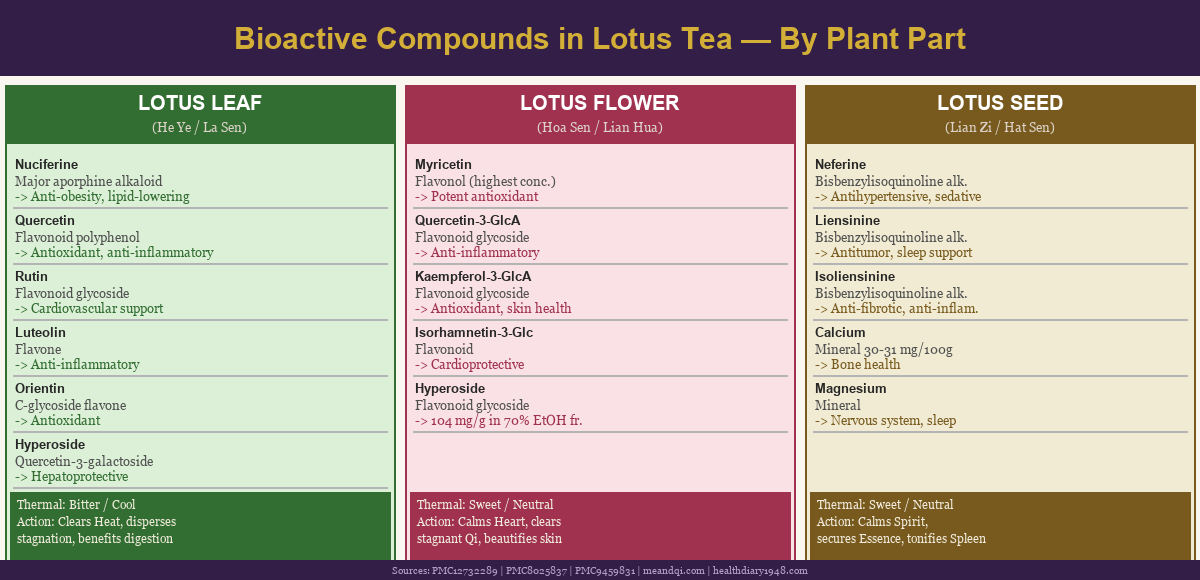
Modern phytochemical analysis has confirmed the biochemical complexity of lotus tea across its different forms. Three major compound classes stand out:
Alkaloids (primarily in the leaf and seed): Nuciferine is the most studied — a dopaminergic compound shown in multiple animal models to reduce fat mass, inhibit adipocyte differentiation, and modulate lipid metabolism pathways. The bisbenzylisoquinoline alkaloids of lotus seeds (neferine, liensinine, isoliensinine) show antitumor, antihypertensive, and neuroprotective activity in preclinical research.[5]
Flavonoids (concentrated in the flower and stamen): Myricetin, quercetin, kaempferol, and isorhamnetin — along with their glycoside derivatives — are the primary antioxidant contributors in lotus flower and stamen teas. A 2025 study (PMC12732289) found that the 30% ethanol fraction of lotus flower extract achieved DPPH scavenging IC50 values approaching vitamin C, a benchmark rarely achieved by plant extracts. Anti-inflammatory assays showed significant inhibition of IL-6, IL-8, nitric oxide, and prostaglandin E2 in stimulated immune cells.[1]
Polyphenols (broadly distributed): Rutin, catechin, orientin, hyperoside, and luteolin contribute to the overall antioxidant and anti-inflammatory profile of lotus leaf tea. Network pharmacology analyses have mapped quercetin and kaempferol as key nodes connecting lotus leaf's phytochemistry to lipid metabolism pathways, acting in part through inhibition of the cAMP signaling cascade.[2]
Lotus Leaf Tea and Weight Management: What the Research Shows
Of all lotus tea types, lotus leaf tea has attracted the most systematic clinical attention, driven by its long folk use in China as an aid to weight management. The evidence is promising but should be understood in proper context.
A 2021 systematic review in ScienceDirect (PMID 34462872) described nuciferine as “an active anti-obesity compound” that has been documented in Chinese herbal records since the Ming Dynasty, noting evidence for its effects on fat mass reduction and dyslipidemia correction in both animal and early human studies. The 12-week randomized trial cited above (PMID 34852695) represents one of the stronger clinical data points, though the sample size was modest (n=60) and the intervention used a concentrated extract rather than loose-leaf tea.[2]
What this means practically: drinking lotus leaf tea as part of a balanced lifestyle may support metabolic health through its polyphenol and alkaloid content, but it is not a replacement for evidence-based weight management strategies. The tea is best understood as one element of a traditional Asian wellness approach — alongside diet, movement, and mindful living.
How to Brew Lotus Flower and Stamen Tea
The delicacy of lotus tea demands attentive brewing. Whether you are working with dried lotus flowers, loose stamens, or lotus-scented green tea, a few key principles apply:
Water temperature: Use water heated to 75–85°C (167–185°F). Boiling water damages the volatile aromatic compounds and can make the tea bitter. A simple approach is to bring water to a full boil, then allow it to cool for 3–4 minutes before pouring.
Quantity: For lotus flower or stamen tea, use 2–3 grams of dried material per 200 ml of water. Lotus flowers can also be brewed with a small pinch of green or white tea for added complexity.
Steeping time: The research on lotus stamen flavonoids (PMC9459831) found that most active compounds extract within 3–5 minutes, though some kaempferol derivatives require up to 12 minutes for full release. A first infusion of 3–4 minutes delivers a delicate, aromatic cup; a second infusion of 5 minutes extracts more depth.[3]
Vessel choice: A glass teapot or glass cup allows you to observe the pale golden color of the liquor as it develops — part of the aesthetic pleasure of lotus tea. Porcelain gaiwans work equally well for the scented variety.
Sweetening: Traditional lotus tea is enjoyed without sweetener, as even small amounts of honey or sugar can mask the flower's subtle fragrance. If desired, a single spoonful of raw honey added after the tea has cooled slightly is the most sympathetic accompaniment.
The Artisan Method: Tra Sen Uop Step by Step
For those fortunate enough to source authentic Tay Ho lotus-scented tea — or who encounter the dried stamens and quality green tea to attempt their own version — understanding the traditional method deepens appreciation of the finished cup.
The core principle is absorption rather than infusion. Unlike jasmine pearls (where flowers and tea are merely stored together briefly), the Quang An method involves true iterative scenting: a base of premium green tea (ideally a spring-harvest Tan Cuong) is layered with freshly extracted lotus stamens in a sealed container. After 12–24 hours, the stamens are removed, the tea is gently dried, and fresh stamens are added. This cycle is repeated between five and eight times. Each pass deepens the aromatic integration, until the lotus fragrance becomes inseparable from the leaf itself.
The commercial production version requires between 1,000 and 1,500 lotus blooms per kilogram of finished tea, making authentic Tay Ho lotus-scented tea among the most labor-intensive — and most expensive — artisan teas in Asia. When brewed, it should be treated like a fine green tea: short steeping at low temperature, multiple infusions, and quiet appreciation.
Safety, Considerations, and Who Should Be Cautious
Lotus tea in the forms commonly consumed — flower tea, stamen tea, leaf tea, and lotus-scented green tea — is generally considered safe for healthy adults when used in normal beverage quantities. Several considerations merit attention:
Pregnancy and breastfeeding: Lotus seed alkaloids (neferine, liensinine) have pharmacological activity at higher doses. Pregnant women should consult a healthcare provider before using lotus preparations beyond culinary amounts.
Antihypertensive medications: Lotus seed alkaloids have demonstrated antihypertensive effects in preclinical studies. Those on blood pressure medications should monitor for additive effects if consuming lotus seed tea regularly.
Lotus leaf tea and lipid medications: Given the documented lipid-lowering activity of nuciferine, individuals on statins or fibrates should discuss regular lotus leaf tea consumption with their prescribing physician.
Caffeine content: Plain lotus flower, leaf, and stamen teas are naturally caffeine-free. Lotus-scented green tea, however, contains the caffeine of its green tea base — typically 20–40 mg per cup — and should be considered accordingly by caffeine-sensitive individuals.
Allergies: Although rare, individuals with known sensitivities to other members of the Nelumbonaceae family should exercise caution with any new lotus preparation.
Reviewed by: This article has been reviewed by a licensed practitioner in Traditional Vietnamese and Chinese herbal practice for factual accuracy regarding traditional uses. It is intended for educational purposes only and does not constitute medical advice. Always consult a qualified healthcare provider before using herbal preparations for health conditions.
References
- Chemical Composition and Bioactivity of Nelumbo nucifera Gaertn. Flower Extract Fractions: In Vitro Antioxidant and Anti-Inflammatory Properties. PMC12732289. National Center for Biotechnology Information. pmc.ncbi.nlm.nih.gov/articles/PMC12732289
- Fat reducing effects of Nelumbo nucifera leaf extract in overweight patients. PubMed PMID 34852695; Nuciferine: Anti-Obesity Effects Review. ScienceDirect, PMID 34462872. pubmed.ncbi.nlm.nih.gov/34852695
- Extraction Kinetics and Reaction Rates of Sacred Lotus Stamen Tea Infusion-Derived Flavonoids. PMC9459831. pmc.ncbi.nlm.nih.gov/articles/PMC9459831
- Craft of West Lake Lotus Tea Infusion Recognised as National Intangible Cultural Heritage. Nhan Dan Online, 2024. en.nhandan.vn
- Pharmacological Potential and Mechanisms of Bisbenzylisoquinoline Alkaloids from Lotus Seed Embryos. PMC12562030; Lotus Seed Nutrition Facts. nutrition-and-you.com; Lian Xu (Lotus Stamen) TCM Herb. meandqi.com/knowledge-base/herbs/lian-xu.
- West Lake Lotus Tea — A Quintessence of Hanoians. Vietnam+ (VietnamPlus). en.vietnamplus.vn
- Vietnamese Lotus Tea. Wikipedia. en.wikipedia.org/wiki/Vietnamese_lotus_tea
- Nuciferine Inhibited the Differentiation and Lipid Accumulation of 3T3-L1 Preadipocytes. PMC8025837. pmc.ncbi.nlm.nih.gov/articles/PMC8025837