

Traditional Chinese Herbal Traditions: A Complete Guide to TCM Herbs
A pillar guide to traditional Chinese herbal traditions — the history, theory, herb families, jun-chen-zuo-shi formulas, preparation, and safety behind TCM herbs.
Medical Disclaimer: This content is for educational and informational purposes only and is not medical advice. The information presented is not intended to diagnose, treat, cure, or prevent any disease. Always consult a licensed healthcare practitioner before starting any new herbal practice or supplement. Statements regarding traditional herbal use have not been evaluated by the FDA.
Affiliate Disclosure: This article contains affiliate links. We may earn a commission if you purchase through these links, at no additional cost to you. We only recommend products we believe align with our editorial standards.
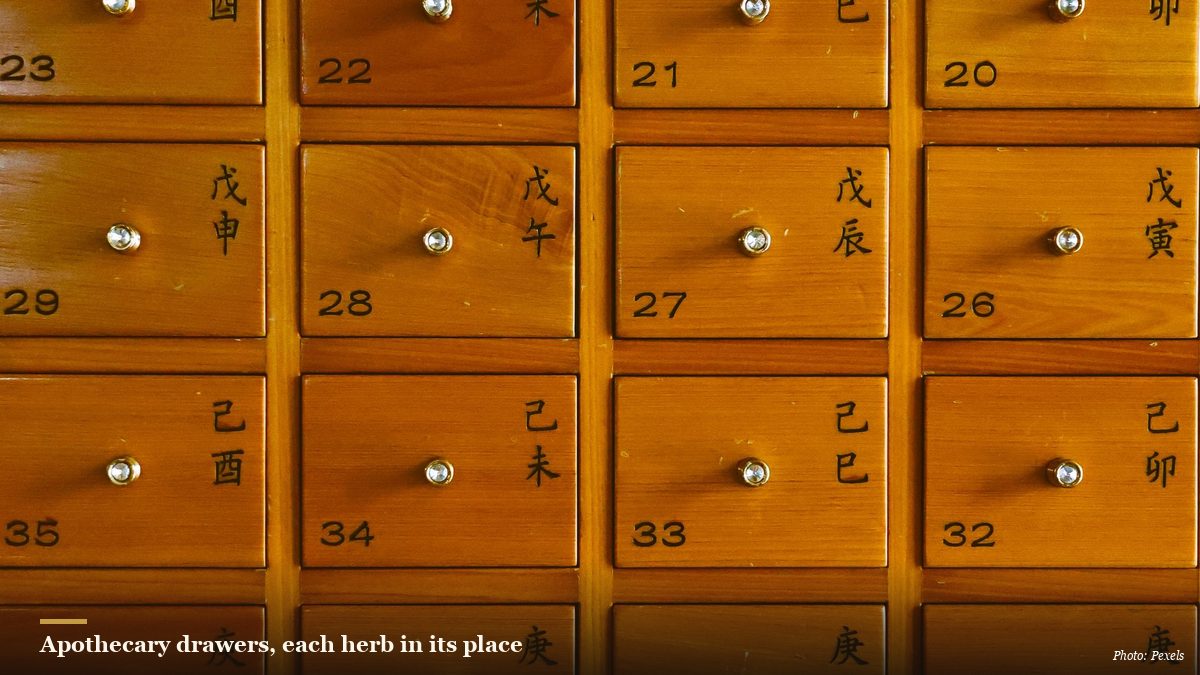
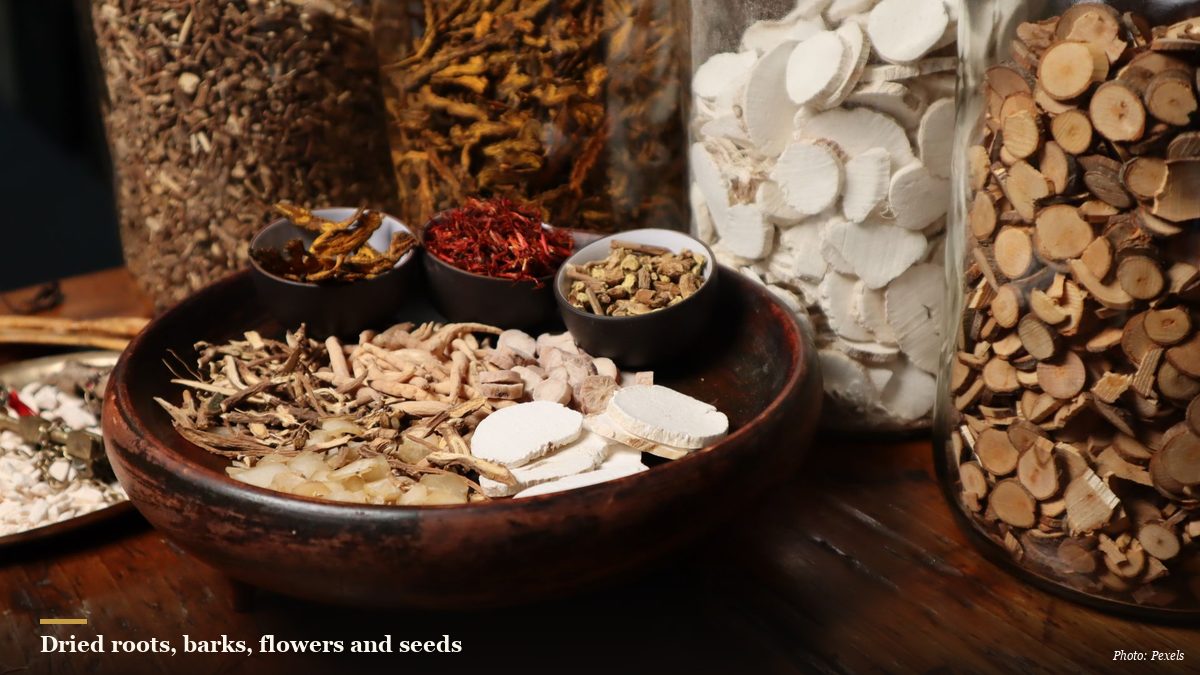
Walk into an old Chinese apothecary and the first thing you notice is the wall — a honeycomb of tiny wooden drawers, each labeled in brushstroke characters, each holding a different root, bark, flower, seed, or dried fruit. A practitioner reads a person's constitution, then draws from a dozen of those drawers to assemble a single, personalized formula. That scene, repeated across two thousand years of Chinese history, is the living heart of what we call traditional Chinese herbal traditions: not a shelf of single “superfoods,” but an entire grammar for understanding plants, people, and the relationship between them.
This guide is a map of that grammar. It traces where the tradition came from, the ideas that organize it, the way herbs are classified and combined, how they have traditionally been prepared, and what modern research has — and has not — been able to say about it. Along the way, it links out to deeper articles on the individual herbs and concepts that make up the wider system, so you can follow whichever thread interests you most. Think of this page as the trunk of the tree; the linked articles are the branches.
Why Chinese Herbal Traditions Have Endured for Millennia
Chinese herbalism is one of the oldest continuously practiced systems of plant knowledge on Earth. Its written record begins with the Shennong Bencaojing (“The Divine Farmer's Classic of Materia Medica”), compiled around the first to second century CE from far older oral traditions and attributed to the mythical emperor-farmer Shennong, who legend says tasted hundreds of plants to learn their effects. The Shennong Bencaojing catalogued 365 substances — one for each day of the year — and sorted them into three grades according to how nourishing or how potent they were.9 Crucially, it was here that the enduring vocabulary of “four natures and five flavors” was first set down in writing.5
Fifteen centuries later, the tradition reached a kind of summit in the Bencao Gangmu (“Compendium of Materia Medica”), assembled by the Ming-dynasty physician Li Shizhen. Li spent roughly three decades reading some eight hundred earlier medical works and traveling to verify plants firsthand. His compendium, first drafted in 1578 and printed in Nanjing in 1596, ran to 52 volumes describing 1,892 distinct substances — 374 of them newly documented by Li himself — alongside more than eleven thousand prescriptions and over a thousand illustrations.10 The Bencao Gangmu is why so many herbs still central to Chinese kitchens and wellness cabinets today carry an unbroken paper trail back to the sixteenth century and beyond.
What kept the tradition alive was not nostalgia but usefulness within a coherent worldview. Chinese herbalism never treated a plant as a list of isolated compounds; it treated it as a set of tendencies — warming or cooling, rising or descending, drying or moistening — that could be matched to a person's pattern and to the season. That systems-thinking is exactly what allowed the tradition to absorb new plants over centuries without losing its internal logic, and it is why the same organizing ideas still frame how these herbs are discussed in the modern Chinese wellness literature.
What Are the Core Ideas Behind Traditional Chinese Herbalism?
You cannot really understand a Chinese herb formula without a feel for the ideas underneath it. Four concepts do most of the work, and each has its own detailed guide in this collection.
Yin and yang describe the two complementary aspects of any living process — cool/still/inward (yin) and warm/active/outward (yang). In herbal terms, a person running “hot and dry” and a person running “cold and damp” call for very different plants, even for the same complaint. The whole logic of balancing opposites is explored in our guide to yin-yang theory.
Qi is the animating vitality that classical texts describe flowing through the body. Many of the most prized Chinese herbs are grouped by how they are traditionally understood to affect qi — replenishing it, moving it when it stagnates, or settling it when it rises out of place. The concept, and the debates around it, are unpacked in our guide to the concept of qi.
The five elements — wood, fire, earth, metal, and water — form a second organizing layer, mapping the five yin organ systems (liver, heart, spleen, lung, kidney) onto a web of “generating” and “restraining” relationships.13 A practitioner might choose a herb for the “wood” (liver) system precisely because of how that system is thought to influence “earth” (digestion). Our guide to five elements theory walks through the cycles in detail.
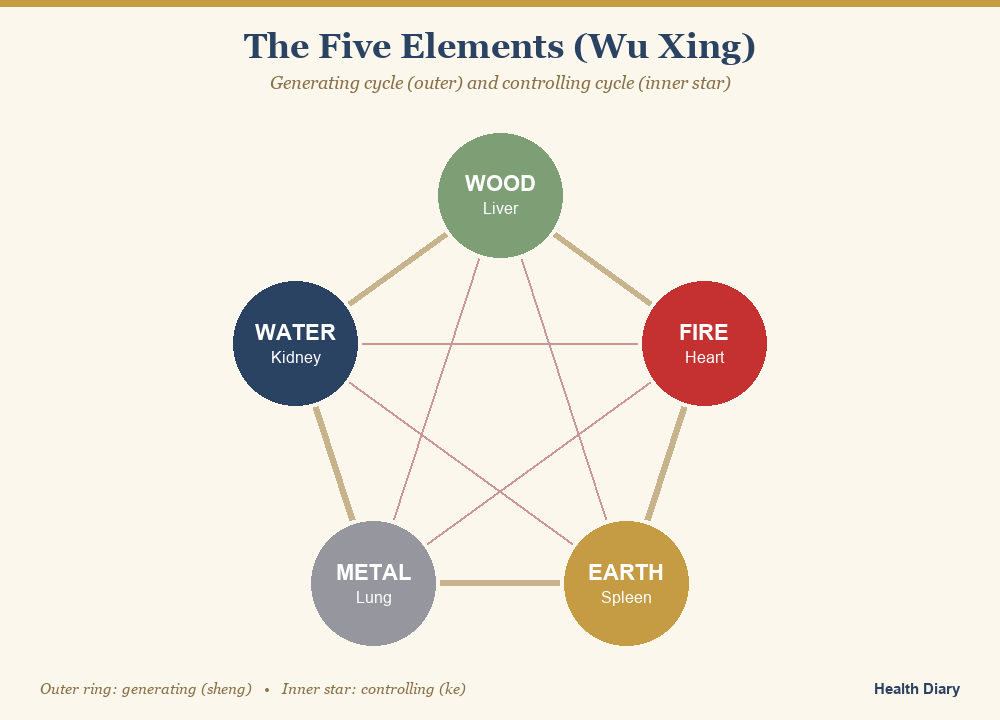
The meridians are the network of channels along which qi is said to travel. This matters for herbs because each is traditionally assigned a “channel tropism” — the meridians and organ systems it is believed to reach. That idea is the subject of our guide to meridian theory. Together, these four concepts turn a pile of plants into a navigable map, and in Chinese thought yin-yang expresses opposition while the five elements explain generation and restraint — two lenses that interlock rather than compete.13
How Does TCM Describe the Properties of a Herb?
When a classically trained herbalist picks up a root, they are reading a short profile that has almost nothing to do with calories or vitamins. This profile — often called “property theory” — is considered the basic framework that guides how Chinese materia medica is applied and studied, and it acts as the bridge between abstract philosophy and a concrete prescription.4 It has several parts.
The four natures (si qi) place each herb somewhere on a temperature scale: cold, cool, warm, or hot, with a neutral middle. A warming herb is traditionally matched to a cold pattern, and a cooling herb to a hot one — a simple, elegant matching principle first codified in the Shennong Bencaojing.13
The five flavors (wu wei) — sour, bitter, sweet, pungent, and salty — are less about literal taste and more about the direction of action each flavor is thought to encourage: pungent disperses, sour gathers, bitter drains downward, sweet harmonizes and nourishes, salty softens. Flavor and nature are read together, so “warm and pungent” behaves very differently from “warm and sweet.”
Channel tropism (gui jing) records which meridians and organs the herb is believed to enter, while ascending, descending, floating, and sinking describe the direction it is thought to move the body's energetics — lifting what has sagged, or directing action downward and inward.4 Interestingly, modern chemists have begun testing whether these old categories track anything measurable: one study of spleen-meridian herbs found that a plant's classical yin-versus-yang designation correlated with real differences in its chemical makeup, even if it did not predict antioxidant activity.6
The Main Families of Chinese Herbs
Rather than an alphabetical list, the Chinese materia medica is traditionally organized by what a herb does within the body's patterns. Understanding these families is the fastest way to make sense of hundreds of individual plants. Here are the ones most relevant to everyday wellness, each with a familiar example from this collection.
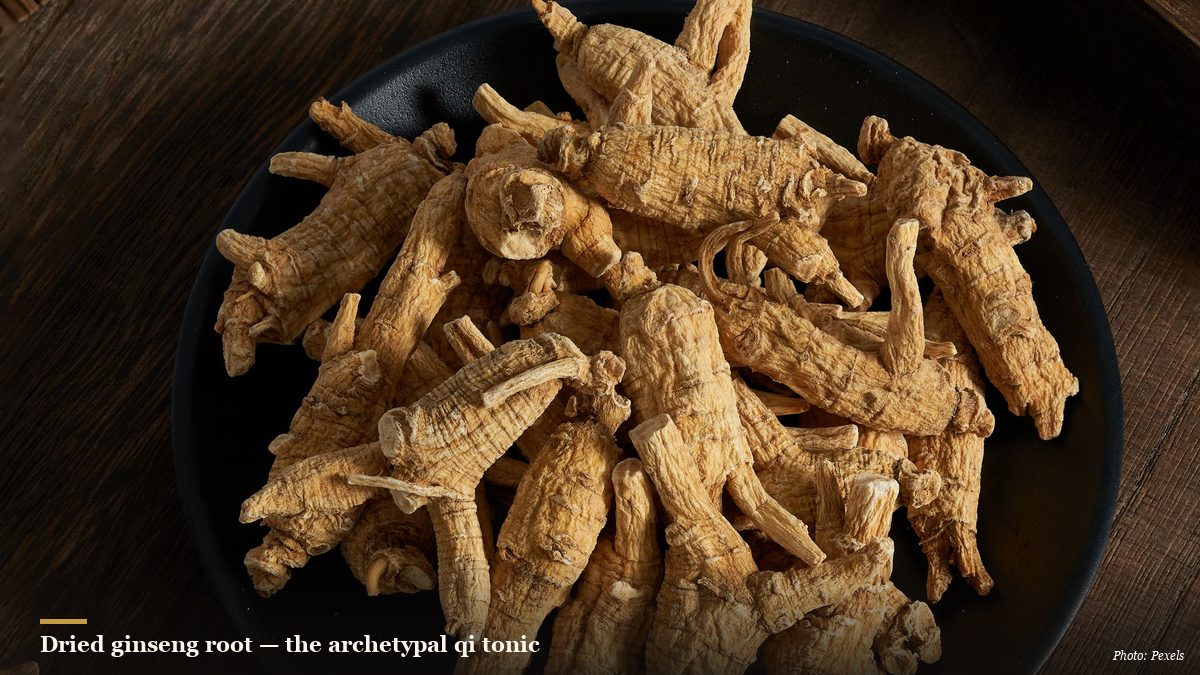
- Qi tonics (bu qi) — herbs traditionally used to replenish vitality and stamina. The archetype is ginseng (Panax ginseng, ren shen), the single most storied herb in the whole tradition; you can also read its cultural profile in our overview of ginseng in traditional Eastern medicine. Another cornerstone of this family is astragalus (huang qi), a mild, sweet root long added to nourishing soups.
- Blood tonics (bu xue) — plants traditionally associated with nourishing what TCM calls “blood.” Angelica root (dang gui) is the best known, and features in countless women's-wellness formulas.
- Yin and essence tonics — moistening, restorative herbs. The bright red goji berry (gou qi zi) sits here, prized for eye and kidney nourishment and easy enough to eat by the handful.
- Calming, spirit-settling herbs (an shen) — used in routines oriented toward rest and steadiness. The revered reishi mushroom (lingzhi) is traditionally placed near this group, valued for its association with a settled mind.
- Heat-clearing and surface-releasing herbs — cooling plants used seasonally. Chrysanthemum flower (ju hua), brewed as a fragrant tea, is a gentle everyday example.
- Harmonizing herbs — plants that blend a formula together. Licorice root (gan cao) is the great harmonizer, appearing in more classical formulas than almost any other herb.
These families are not rigid boxes — many herbs belong to more than one — but they show how the tradition thinks in terms of roles rather than isolated benefits.
What Is the Jun-Chen-Zuo-Shi Formula Principle?
Here is where Chinese herbalism most clearly parts ways with the “one herb, one benefit” habit of Western supplement marketing. In the classical tradition, herbs are rarely taken alone. They are composed into formulas the way a ruler composes a court, following a principle called jun-chen-zuo-shi — sovereign, minister, assistant, and envoy — a framework whose roots reach back to the Huangdi Neijing (the “Yellow Emperor's Inner Classic”).11
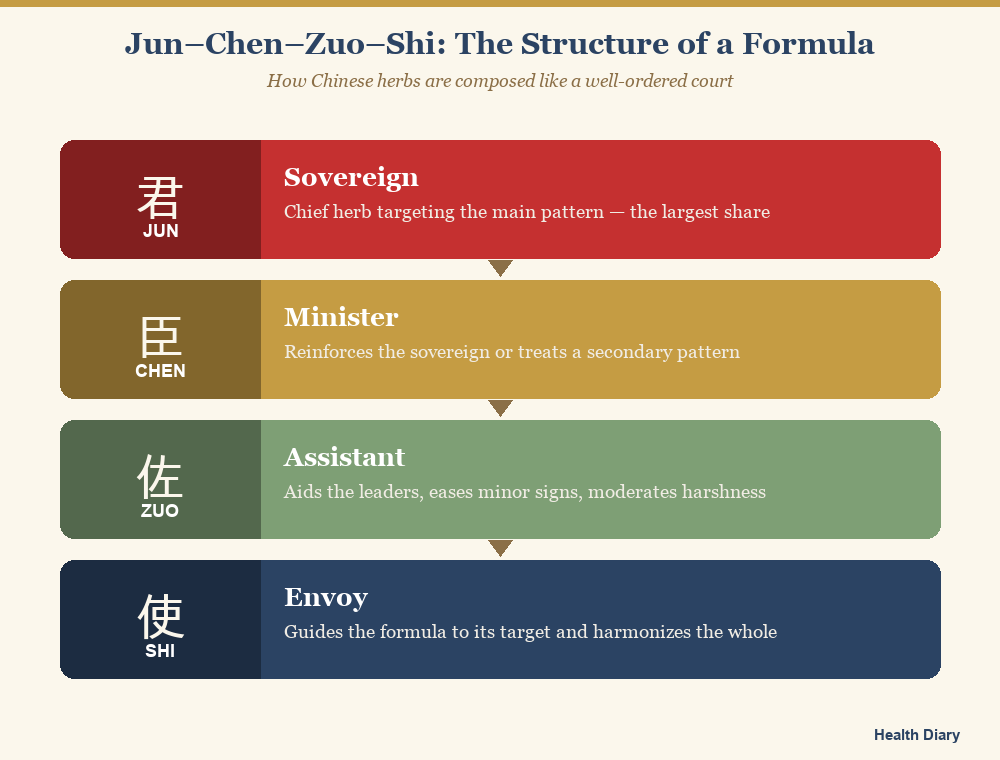
- Jun (sovereign) is the chief herb, aimed at the main pattern and usually present in the largest amount.
- Chen (minister) reinforces the sovereign or addresses a secondary pattern.
- Zuo (assistant) aids the leading herbs, treats minor accompanying signs, or moderates the harshness of a strong ingredient.
- Shi (envoy) guides the formula toward its target and harmonizes the whole — the role licorice root so often plays.
As one Nanjing University of Chinese Medicine analysis notes, the Yuan-dynasty physician Li Gao later formalized the hierarchy of proportions, insisting that the sovereign herb carry the greatest weight so that the formula stays orderly.11 A popular explanation in the People's Daily puts it plainly: combining herbs this way (a practice called pei wu) is meant both to increase synergy and to balance or soften the potency of the strongest members — the defining reason a thoughtfully built formula is considered more than the sum of its parts.12 It is a strikingly modern idea: manage a complex system by orchestrating several inputs, not by maximizing one.
How Are Chinese Herbs Traditionally Prepared?
The most iconic preparation is the tang, or decoction — a formula of raw herbs simmered in water, sometimes for an hour or more, then strained and drunk warm. Different herbs are added at different times: dense roots and shells go in early for a long simmer, while delicate aromatic flowers are added near the end so their volatile character is not lost. Many herbs are also “processed” (pao zhi) before use — roasted, honey-fried, or steeped in wine, vinegar, or ginger juice — steps traditionally intended to change a herb's character, strengthen a desired action, or temper a harsh one.
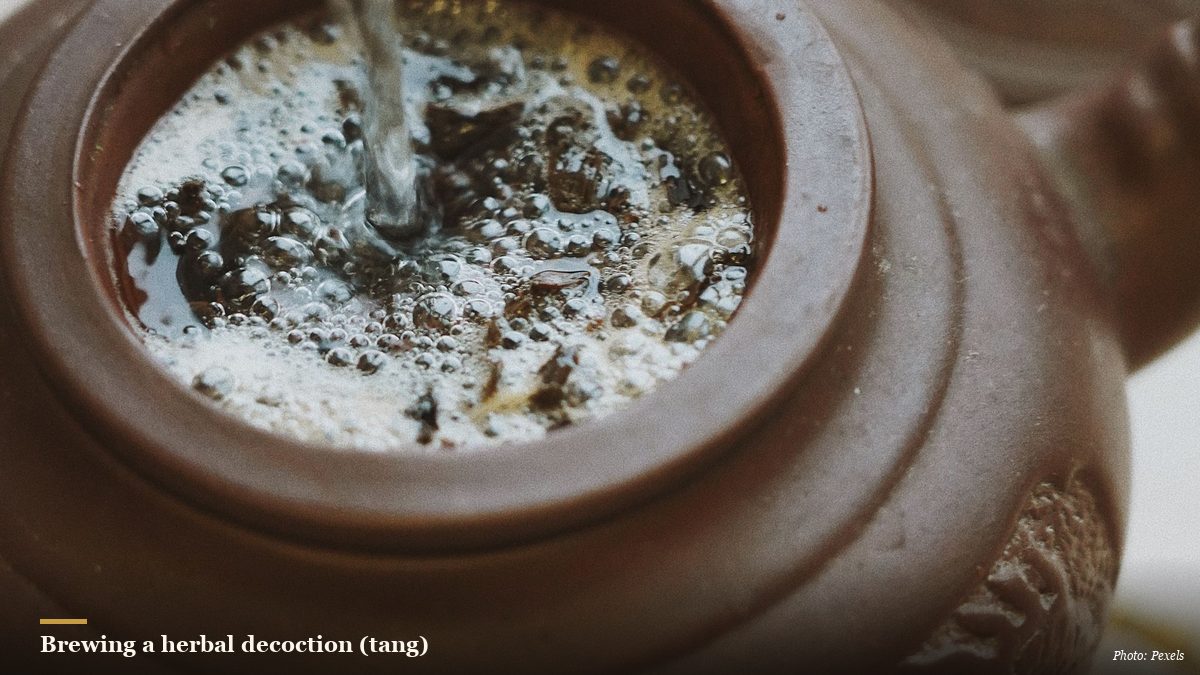
Beyond the decoction, the tradition developed a whole pharmacy of forms: honeyed pills (wan) for slow, gentle use; powders (san); medicinal wines (jiu); pastes and syrups (gao); and, in everyday life, the simplest forms of all — herbs dropped into soups, porridges, and teas so that nourishment and daily eating blur together. This food-as-wellness overlap is one reason so many Chinese herbs, from goji berries to jujube dates, live as comfortably in the kitchen as in the apothecary.
None of this is a prescription for self-treatment. Traditional preparation methods evolved hand-in-hand with trained diagnosis, and the specific herbs, proportions, and processing were always chosen for an individual pattern. Individual experiences vary considerably; what suits one person's constitution may be poorly matched to another's, and any herbal practice is best undertaken with the guidance of a qualified practitioner.
What Does Modern Research Say About Chinese Herbs?
Modern science approaches this tradition from two directions at once, and the honest summary is that the picture is still developing.
On one side, researchers are using tools like network pharmacology to ask whether the old property categories map onto real chemistry and biology — treating “four natures and five flavors” as a hypothesis to be tested rather than a doctrine to be accepted or dismissed. Early work suggests some classical groupings do correlate with measurable molecular patterns, though translating that into confirmed human outcomes remains a long road.5
On the other side, health authorities urge caution about overclaiming. The U.S. National Center for Complementary and Integrative Health notes that while some components of Chinese medicine such as acupuncture and tai chi have shown promise for certain conditions, studies of Chinese herbal products themselves have had mixed results, and firm conclusions about effectiveness are often limited by study quality.1
At the same time, the tradition's global footprint keeps growing. In 2019 the World Health Organization, for the first time, added a dedicated Traditional Medicine chapter to the 11th revision of the International Classification of Diseases (ICD-11), compiling thousands of standardized terms drawn from Chinese, Japanese, Korean, and Vietnamese traditions.2 The WHO frames this less as an endorsement of efficacy than as a way to standardize terminology and finally gather comparable international data on how these practices are used.3 In other words, the world is measuring the tradition more carefully than ever — which is exactly why responsible sources resist tidy promises in either direction.
Important Limitations and Considerations
Traditional Chinese herbalism is a rich cultural and lifestyle system, not a substitute for professional medical care. Several cautions deserve real attention before anyone experiments with herbs.
- Herb–drug interactions are genuine and sometimes serious. A review of anticoagulant and antiplatelet interactions found that ninety single Chinese herbs accounted for more than three hundred documented drug–herb interactions, most of them pharmacodynamic and rated moderate to severe — with raised bleeding risk from herbs including danshen, dong quai (angelica), ginger, and licorice when combined with blood thinners such as warfarin.8 If you take any prescription medication, talk to your doctor before using Chinese herbs.
- Quality and purity vary widely. Investigations have found some imported Chinese herbal products contaminated with undeclared pharmaceuticals, heavy metals such as arsenic, lead, and cadmium, or pesticides, and cases where one herb was mistakenly substituted for another have caused serious harm.1 Standardization and quality control across the sector remain inconsistent.7 Buy only from reputable suppliers who provide third-party testing.
- Do not self-prescribe complex formulas. The jun-chen-zuo-shi logic exists precisely because herbs interact; assembling or adjusting a multi-herb formula without training can produce an unbalanced, potentially harmful result.
- Pregnancy, breastfeeding, and children. Many traditional herbs have not been adequately studied in these groups, and some are traditionally contraindicated in pregnancy. Consult a qualified practitioner first.
- Surgery. Several herbs can affect bleeding and anesthesia; disclose all herbal use to your surgical team and stop as advised beforehand.
- Work with credentialed practitioners. Health authorities recommend checking a practitioner's training and certification — in the U.S., for example, through the National Certification Commission for Acupuncture and Oriental Medicine — rather than relying on herbal self-diagnosis.1
Individual experiences vary considerably, and the safest path into this tradition is a slow, informed one taken alongside your regular healthcare.
Frequently Asked Questions
What is the difference between traditional Chinese herbalism and Western herbal supplements?
Western supplements are usually sold as single ingredients marketed for a single benefit. Traditional Chinese herbalism instead classifies each plant by qualities like temperature, flavor, and the channels it enters, then combines several herbs into a personalized formula built around the jun-chen-zuo-shi (sovereign-minister-assistant-envoy) structure. The emphasis is on matching a whole formula to a person's pattern rather than on one herb's effect.
Are Chinese herbs safe to take with my regular medications?
Not always. Some Chinese herbs can interact meaningfully with prescription drugs — several are associated with increased bleeding risk alongside blood thinners such as warfarin, for example. Because interactions can be moderate to severe, you should always tell your doctor or pharmacist about any herbs you are considering before combining them with medication.
What are the “four natures and five flavors”?
They are the core descriptors of a herb in Chinese property theory. The four natures place a herb on a temperature scale — cold, cool, warm, or hot (with neutral in between) — while the five flavors (sour, bitter, sweet, pungent, salty) describe the direction of action each flavor is thought to encourage. Together they help a practitioner match a herb to a person's pattern.
Do I have to believe in qi to use Chinese herbs?
Belief is not really the point for a curious newcomer. Concepts like qi, yin-yang, and the five elements are the traditional language the system uses to organize plants and patterns. You can appreciate that organizing logic — and enjoy herbs like goji berry or chrysanthemum as part of daily life — while remaining agnostic about the underlying philosophy and while keeping conventional medicine as your primary care.
How are Chinese herbal formulas usually taken?
The classic form is a decoction: raw herbs simmered in water and drunk warm. But the tradition also uses honeyed pills, powders, medicinal wines, syrups, and — most familiar of all — herbs cooked into soups, porridges, and teas. The right form depends on the herbs and the intended use, which is one more reason personalized guidance matters.
Is there scientific evidence that Chinese herbs work?
The evidence is mixed and still developing. Some laboratory and network-pharmacology research finds that traditional herb categories correlate with real chemical patterns, and certain practices within Chinese medicine have shown promise in trials. However, health authorities note that studies of Chinese herbal products themselves are often limited by quality, so strong effectiveness claims are not warranted. Treat bold promises with healthy skepticism.
Can I use Chinese herbs during pregnancy?
Many traditional herbs have not been well studied in pregnancy, and some are traditionally avoided during it. This is not an area for self-experimentation. If you are pregnant or breastfeeding, consult both your obstetric provider and a qualified herbal practitioner before using any herbal preparation.
Where should I start if I'm new to Chinese herbal traditions?
A gentle entry point is through the everyday, food-like herbs — goji berries, chrysanthemum tea, jujube dates — that carry little risk when used as ordinary foods. Reading the linked guides to individual herbs and to the core concepts (yin-yang, qi, the five elements, the meridians) will give you the vocabulary to understand what a practitioner is doing before you ever visit one.
A Note on Tracking Your Wellness Journey
One idea that traditional Chinese herbalism and modern wellness share is that patterns matter more than single moments. A practitioner reads how your energy, sleep, digestion, and mood shift across days and seasons — and you can bring that same attentiveness to your own routine. Keeping a simple record of how you feel as you explore gentle herbal teas or seasonal foods can help you notice what genuinely suits you and what does not, information that is far more useful to share with a practitioner than a vague memory. This is exactly the kind of gentle, long-view self-observation the Health Diary approach is built around.
A Soft Closing Note
Traditional Chinese herbal traditions are best appreciated not as a shortcut or a quick fix but as a two-thousand-year-old way of paying close attention — to plants, to seasons, and to the particular person in front of you. Whether you arrived here curious about a single herb or about the whole system, the branches of this collection are yours to wander: the founding theories of yin and yang and the five elements, or the storied herbs like ginseng and reishi that gave the tradition its reputation. Explore slowly, stay curious, and let a qualified practitioner and your own regular healthcare guide any step you take.
About This Article
Written by: Health Diary Editorial Team — researchers specializing in Asian wellness traditions, herbal history, and food culture.
Editorial review: This article has been reviewed by the Health Diary editorial team for clarity, structure, and adherence to our sourcing standards. Key claims were cross-checked against NCCIH, NIH PubMed / PMC peer-reviewed literature, and the World Health Organization, with native-language (中文) verification of classical provenance through the Journal of Nanjing University of Chinese Medicine, People's Daily, and standard 中医基础理论 texts. It is not a clinical review and should not replace consultation with a licensed healthcare practitioner.
Reviewed on: July 18, 2026.
Editorial process: We cite peer-reviewed and government sources where possible. When a clinical reviewer is added to this article, attribution will appear here with verifiable credentials.
References
- National Center for Complementary and Integrative Health (NCCIH). “Traditional Chinese Medicine: What You Need To Know.” 2024. https://www.nccih.nih.gov/health/traditional-chinese-medicine-what-you-need-to-know
- Reggars J, et al. “Incorporation of complementary and traditional medicine in ICD-11.” BMC Med Inform Decis Mak. 2022. PMC9248085. https://pmc.ncbi.nlm.nih.gov/articles/PMC9248085/
- World Health Organization. “Traditional medicine (Classifications FAQ).” WHO. https://www.who.int/standards/classifications/frequently-asked-questions/traditional-medicine
- Wang Y, et al. “Property theory of Chinese materia medica: Clinical pharmacodynamics of traditional Chinese medicine.” J Tradit Chin Med Sci. 2022. https://www.sciencedirect.com/science/article/pii/S2095754822000060
- Li X, et al. “The characterization of traditional Chinese medicine natures and flavors using a network pharmacology integrated strategy.” J Pharm Anal. 2024. PMC11068986. https://pmc.ncbi.nlm.nih.gov/articles/PMC11068986/
- Fung FY, Linn YC. “The Yin-Yang Property of Chinese Medicinal Herbs Relates to Chemical Composition but Not Anti-Oxidative Activity: An Illustration Using Spleen-Meridian Herbs.” Evid Based Complement Alternat Med. 2018. PMC6249273. https://www.ncbi.nlm.nih.gov/pmc/articles/PMC6249273/
- Liu SH, et al. “Current Status and Major Challenges to the Safety and Efficacy Presented by Chinese Herbal Medicine.” Medicines (Basel). 2019. PMC6473719. https://www.ncbi.nlm.nih.gov/pmc/articles/PMC6473719/
- Tsai HH, et al. “A Review of Potential Harmful Interactions between Anticoagulant/Antiplatelet Agents and Chinese Herbal Medicines.” PLoS ONE. 2013. PMC3650066. https://www.ncbi.nlm.nih.gov/pmc/articles/PMC3650066/
- “Shennong Bencaojing 神农本草经 (The Divine Farmer's Classic of Materia Medica).” China Knowledge — historical Chinese literature reference. http://www.chinaknowledge.de/Literature/Science/bencaogangmu.html
- “Bencao Gangmu 本草纲目 (Compendium of Materia Medica), Li Shizhen, 1596.” Historical text overview. https://en.wikipedia.org/wiki/Bencao_Gangmu
- 李飞. “方剂君臣佐使中的君药辨析 (Analysis of the sovereign herb within the jun-chen-zuo-shi structure of formulas).” 南京中医药大学学报 (J Nanjing Univ Chin Med). 2021. https://xb.njucm.edu.cn/cn/article/pdf/preview/10.14148/j.issn.1672-0482.2021.0481.pdf
- “中药配伍为何讲究‘君臣佐使’(杏林寻宝——中华传统医药漫谈).” 人民日报海外版 (People's Daily Overseas Edition). 2016-04-08. http://paper.people.com.cn/rmrbhwb/html/2016-04/08/content_1668619.htm
- “中医基础理论 — 四气五味、阴阳五行学说 (Basic Theory of Chinese Medicine).” 中医世家 (standard textbook reproduction). https://www.zysj.com.cn/lilunshuji/jichulilun/44-2-4.html


