

Goji Berry in Traditional Eastern Medicine: A Beginner's Guide
Educational overview of goji berry (Lycium barbarum, 枸杞子) — classical TCM context from Shennong Bencao Jing onward, the three medicinal parts of the plant, modern peer-reviewed research (LBP, zeaxanthin, 2023 lipid meta-analysis), traditional preparations, and key safety considerations.
Medical Disclaimer: This content is for educational and informational purposes only and is not medical advice. The information presented is not intended to diagnose, treat, cure, or prevent any disease. Always consult a licensed healthcare practitioner before starting any new herbal practice or supplement. Statements regarding traditional herbal use have not been evaluated by the FDA.
Affiliate Disclosure: This article contains affiliate links. We may earn a commission if you purchase through these links, at no additional cost to you. We only recommend products we believe align with our editorial standards.
The small red berries known in English as goji have travelled an unusual route — from Chinese imperial pharmacopeias, to Himalayan trekkers' trail snacks, to the smoothie bowls of modern wellness culture. Along the way, much of the original context has been compressed into marketing buzzwords. This guide steps back to look at what classical Traditional Eastern Medicine (TEM) — specifically Traditional Chinese Medicine (TCM) — actually says about goji, what modern peer-reviewed research has begun to suggest, how the berry is traditionally prepared, and the safety considerations any newcomer deserves to know.
Why Goji Berries Have Endured for Two Thousand Years
The earliest written reference to goji appears in the Shennong Bencao Jing (神农本草经, Divine Farmer's Materia Medica), a foundational Chinese herbal text compiled around the first to second centuries CE from much older oral traditions. In that work, goji is placed in the superior class — a designation reserved for substances classical practitioners considered safe enough for regular use and associated with promoting longevity rather than treating acute disease [1]. The Beijing Bureau of Traditional Chinese Medicine quotes the classical line directly: "久服轻身不老、耐寒暑" — long-term use is said to lighten the body, slow aging, and improve tolerance of cold and heat [2].
In the 16th century, the Ming Dynasty pharmacologist Li Shizhen catalogued the plant in Bencao Gangmu (本草纲目), distinguishing each part by season — spring leaves (天精草), summer flowers (长生草), autumn berries (枸杞子), and winter root bark (地骨皮) [1]. The Chinese name for the berry, Gou Qi Zi (枸杞子), is the form most people encounter today.
One geographic note worth knowing: among the many regional varieties cultivated across China, Ningxia goji (宁夏枸杞) is the only variety officially recognized in the Pharmacopoeia of the People's Republic of China as medicinal grade [1]. Cultivation history in the Ningxia region exceeds five centuries, and Li Shizhen himself wrote that "all goji used for medicine nationwide are produced in Ningxia."
How Traditional Eastern Medicine Views Goji
In TCM theory, herbs are described along several axes — temperature, taste, and channel affinity. According to the Beijing Bureau of TCM monograph, goji is classified as follows [2]:
- Taste and nature (性味): sweet, neutral (味甘, 性平)
- Channel affinity (归经): Liver, Kidney, and Lung channels (肝、肾、肺经)
- Traditional functions: 滋补肝肾, 益精明目 — to nourish the Liver and Kidney channels, and to "brighten the eyes" by replenishing what classical sources called jing (essence)
These categories do not map neatly onto Western anatomy. A TCM practitioner using these terms is describing patterns of energy and function rather than organs in the biomedical sense. Within that framework, goji has historically been recommended for individuals classical sources described as having "Liver-Kidney yin deficiency" — patterns that often presented as dizziness, blurred vision, lower-back weakness, or tinnitus. Whether or not these patterns map cleanly to any modern clinical category is a separate question; the traditional indications are what they are.
Goji is also one of the herbs traditionally placed in the 药食同源 (yào shí tóng yuán) category — literally "medicine and food share a common source" — a culinary-medicinal philosophy that treats certain foods as gentle daily tonics rather than acute medicines [2]. This is why goji shows up in soups, congees, and teas more often than in concentrated extract form within traditional households.
The Three Medicinal Parts of the Plant
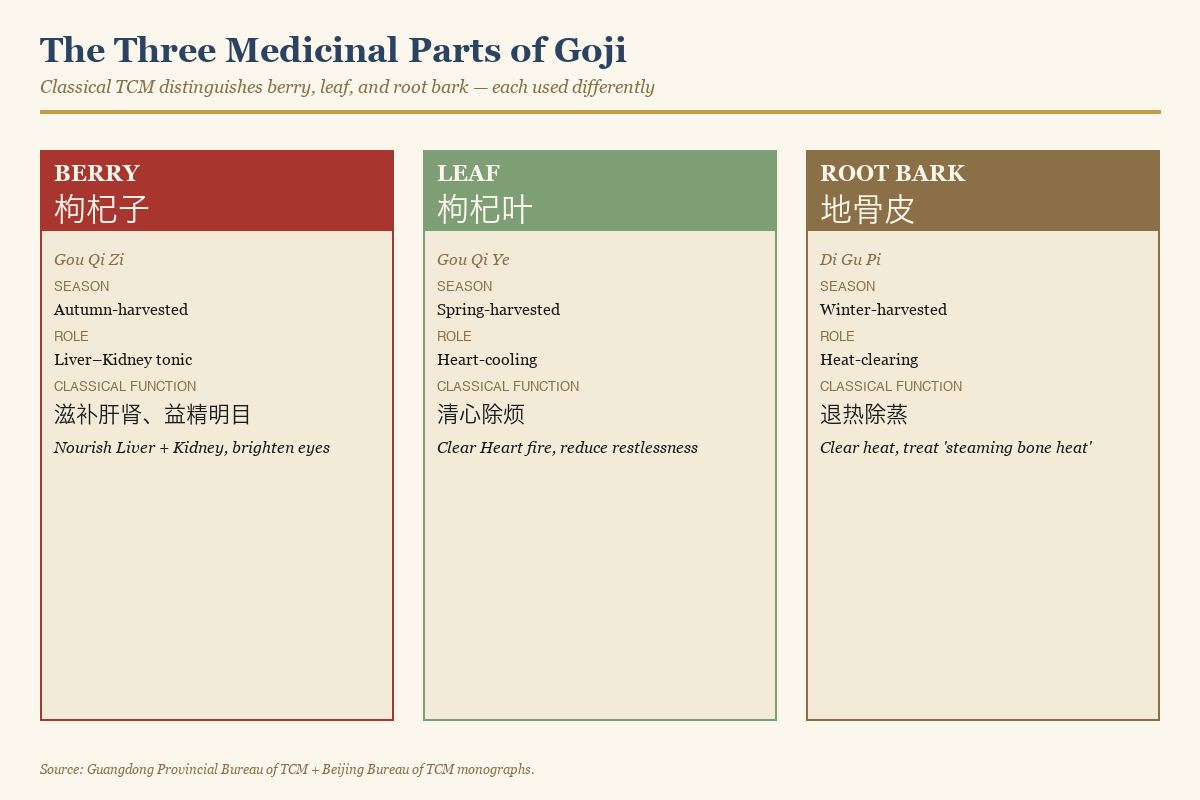
While modern consumers know goji almost exclusively as the dried red berry, classical Chinese sources distinguish three medicinal parts of the plant, each used differently. The Guangdong Provincial Bureau of TCM summarizes them as follows [3]:
- Berry (枸杞子): the form most familiar globally — classically used as a Liver-Kidney tonic and eye-brightening herb
- Leaf (枸杞叶): described as 清心除烦 — clearing Heart fire and reducing what classical texts called restless vexation
- Root bark (地骨皮): described as 退热除蒸 — clearing heat and addressing what traditional sources called "steaming bone heat" (low-grade chronic heat patterns)
Almost all of the modern research on goji has focused on the berry. The leaf and root-bark uses remain primarily within traditional practice contexts.
What Modern Research Has Begun to Suggest
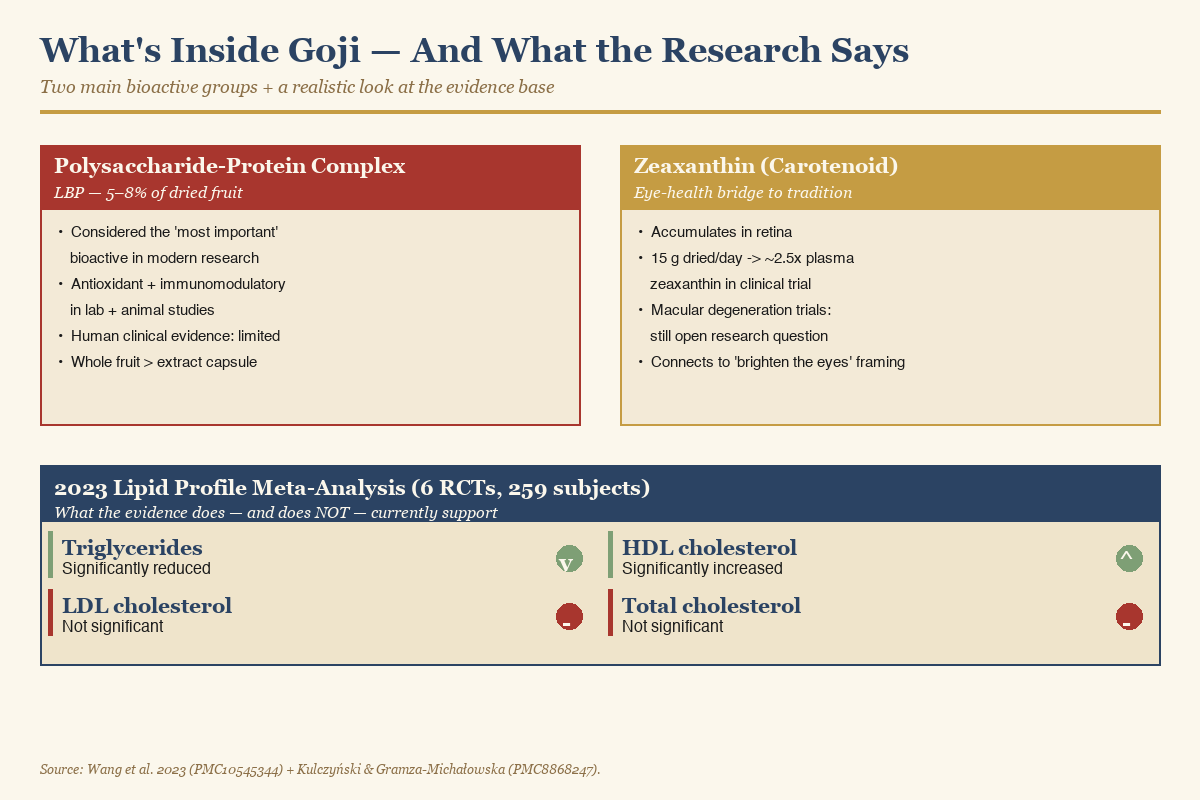
Modern research on goji concentrates on two main areas: the polysaccharide-protein complex (LBP), which makes up roughly 5–8% of the dried fruit, and the carotenoid zeaxanthin, a compound that accumulates in the retina [4].
Eye health. Zeaxanthin is the most biologically plausible bridge between traditional "eye brightening" claims and modern science. One clinical trial referenced in the functional-food review found that consuming approximately 15 grams of dried goji daily produced a roughly 2.5-fold increase in plasma zeaxanthin levels [4]. Whether that translates into clinical benefits for macular degeneration or other eye conditions in larger trials is still an open research question.
Lipid profiles. A 2023 systematic review and meta-analysis of randomized controlled trials, drawing on 5–6 RCTs with 259 total subjects, found that goji supplementation produced a statistically significant reduction in triglyceride concentration (mean difference 0.14 mmol/L, with no heterogeneity between studies) and a modest increase in HDL cholesterol [5]. By contrast, changes in LDL cholesterol and total cholesterol were not statistically significant, with high between-study heterogeneity. The authors flagged several limitations: small per-trial sample sizes (40 to 67 participants), unclear risk of bias, and predominantly healthy volunteers rather than dyslipidemic patients. They concluded that "further large-scale studies are needed" [5].
Antioxidant activity. Trials have reported increases in endogenous antioxidant enzyme activity (SOD and GSH-Px) after goji consumption [4]. The clinical significance of these biomarker changes in otherwise healthy people is uncertain.
Cancer claims. Memorial Sloan Kettering Cancer Center's herbal monograph is unusually direct here: "Clinical studies have not been conducted to evaluate the anticancer potential of lycium" [6]. Laboratory studies have identified polysaccharides that may influence immune response or radiation-therapy effects, but laboratory plausibility is not human clinical evidence, and current marketing claims often overshoot what the data supports.
MSK summarizes the overall picture with appropriate caution: "The safety and efficacy of lycium for chronic diseases has not been established" [6].
How Some People Incorporate Goji
Traditional preparation methods, as catalogued by the Guangdong TCM Bureau, span hot infusions, soups, pastes, and dried snacks [3]. The most common forms today include:
Hot-Water Infusion
The simplest preparation: 20–30 dried berries steeped in hot water, sometimes paired with other tonic herbs such as Chinese dates (红枣, hong zao), chrysanthemum flower (菊花, ju hua), or astragalus root (黄芪, huang qi). The combination chosen often reflects the individual constitution being addressed in classical practice.
Goji in Soups and Broths
A classical lamb-and-goji broth — typically 150 g of meat and around 20 g of dried goji, simmered for roughly 30 minutes — is a winter preparation aligned with goji's "Liver-Kidney tonic" classification [3]. Adding a small amount of goji to chicken broth, congee, or hot pot is one of the most common daily uses across Chinese households.
Food-Therapy Pairings
The Beijing TCM Bureau highlights a classical preparation of goji + steamed Chinese yam (枸杞子拌山药), often with a little honey, as a gentle daily tonic for individuals with weak digestion and poor appetite [2]. The pairing logic is straightforward in traditional thinking: yam supports the spleen channel while goji nourishes Liver-Kidney.
Dried Berries as Snack
Eating a small handful of dried goji directly is one of the most popular modern forms. Quality and storage matter: brightly colored, dry, and aromatic berries are generally preferred over dusty, sticky, or unusually red ones (which may indicate added coloring or sulfur treatment in lower-grade products).
Standardized Extracts and Capsules
Goji is also sold as standardized polysaccharide extract in capsule form. Worth noting from the 2023 meta-analysis: in the lipid-profile RCTs, whole-fruit consumption alongside a healthy diet produced more pronounced effects than isolated polysaccharide capsules [5]. That is consistent with the broader food-versus-supplement pattern seen across nutrition research.
Important Limitations and Considerations
Goji is gentler than many tonic herbs, but it is not consequence-free. The most important considerations:
- Anticoagulants (warfarin) — MSK has documented multiple cases of elevated INR in patients on warfarin who added goji products to their routine [6]. Anyone on blood-thinning medication should discuss goji with their prescribing clinician before starting.
- CYP3A4 / CYP2C9 / CYP2C19 substrates — Goji extract may influence the metabolism of medications processed by these enzymes [6]. This list includes some statins, antidepressants, antihypertensives, certain antifungals, and various other prescriptions. Drug-interaction screening is worth doing if you take regular medication.
- Food allergies — lipid transfer protein cross-reactivity — Allergic and rare anaphylactic reactions have been documented, particularly in individuals with Mediterranean-origin food allergies to peach, tomato, or related plants [4]. The shared allergen is a class of plant proteins called lipid transfer proteins. If you have known peach or tomato allergy, treat goji with the same caution.
- Spleen deficiency with loose stool — Traditional TCM practice cautions against goji use in individuals with what classical sources called "spleen-deficient pattern with loose stool" (脾虚便溏者慎服) [2]. The modern translation: people with chronic loose digestion or weak appetite may find that goji aggravates rather than helps.
- Excessive use can cause "上火" — Even within traditional practice, overconsumption is associated with what TCM calls excessive internal heat patterns, often described as mouth sores, irritability, or warmth-related discomfort [2]. Traditional practice favors small, consistent daily amounts over large doses.
- Pregnancy and breastfeeding — Insufficient high-quality safety data exist for routine recommendation. Most professional sources suggest consulting a practitioner rather than self-experimenting.
- Active infection or fever — Traditional practice avoids tonic herbs (including goji) during acute febrile illness, since classical theory views tonics as inappropriate when "pathogenic factors" are still active [3].
- Diabetes medications — Some research suggests goji may influence fasting glucose. People on insulin or sulfonylureas should be aware of possible additive effects and discuss with their care team.
- Quality and contamination — Studies have evaluated pesticide and metal residues in goji from various origin regions; quality varies meaningfully between producers. Buying from reputable sources with traceable origin is one practical safeguard.
These limitations are not meant to discourage exploration. They are the realistic context any reader deserves before forming expectations about a herb whose evidence base is still developing.
A Note on Tracking — Where Health Diary Comes In
Traditional Eastern wellness practice has always emphasized observation over time. Classical practitioners assessed patterns, not isolated symptoms — sleep, digestion, mood, energy, eye comfort, recovery, seasonal response. That practice maps surprisingly well onto modern habits like journaling and habit tracking.
For someone curious about goji, tracking a few signals over a few weeks is more informative than relying on day-to-day impressions. Useful things to record might include:
- Subjective energy levels through the day
- Sleep quality and morning grogginess
- Eye comfort and end-of-day eye strain
- Digestion (especially relevant given the spleen-deficiency caveat above)
- How you respond across seasons or weather changes
Patterns observed over weeks tell a story that any single morning cannot. That principle is older than goji itself.
A Soft Closing Note
Goji is a fascinating subject because it sits comfortably in both the kitchen and the herbal cabinet — neither a miracle berry nor a marketing invention. Classical Chinese sources never positioned it as a cure for anything. They positioned it as a small daily tonic suited to particular patterns, often blended with other foods, taken in modest amounts over long stretches of time.
If you are curious about traditional wellness practices, the most useful next step is usually slow learning rather than an immediate purchase. Reading reputable sources — peer-reviewed reviews, government TCM authority monographs, classical herbal texts — and observing your own patterns through journaling tend to produce better outcomes than chasing any single ingredient.
Some people explore options like adding a small daily amount of goji to a soup or tea ritual; others prefer to focus first on sleep, food, and movement. You can learn more about traditional body constitutions and seasonal wellness rhythms on our companion guides.
About This Article
Written by: Health Diary Editorial Team — a small editorial group researching traditional wellness practices, herbal traditions, and quantified-self methods. Our articles draw on peer-reviewed literature, government health-agency monographs (NCCIH, NIH, China and provincial Bureaus of TCM), and classical herbal texts.
Editorial review: This article has been reviewed by the Health Diary editorial team for clarity, structure, and adherence to our sourcing standards. It is not a clinical review and should not replace consultation with a licensed healthcare practitioner. When a clinical reviewer is added to this article, attribution will appear here with verifiable credentials.
Reviewed on: June 4, 2026.
Editorial process: All claims about modern evidence are linked inline to peer-reviewed publications or authoritative government or academic medical sources. Where the evidence is preliminary, mixed, or limited, we describe it that way rather than glossing over uncertainty. Native-language Chinese sources from provincial Bureaus of Traditional Chinese Medicine are cited alongside English-language peer-reviewed sources to reflect both the cultural and the scientific perspective on this herb.
References
- Niu Y et al. Health benefits of wolfberry (Gou Qi Zi, Fructus barbarum L.) on the basis of ancient Chinese herbalism and Western modern medicine. PMC8051317. https://pmc.ncbi.nlm.nih.gov/articles/PMC8051317/
- Beijing Bureau of Traditional Chinese Medicine (北京市中医管理局). 药食同源:枸杞子 (Medicine-Food Homology: Goji). Official monograph. https://zyj.beijing.gov.cn/ylfw/ysbj/202012/t20201203_2156384.html
- Guangdong Provincial Bureau of Traditional Chinese Medicine (广东省中医药局). 枸杞养生 — TCM properties and preparation methods. Official wellness column. http://szyyj.gd.gov.cn/zyyfw/ysbj/content/post_3755328.html
- Kulczyński B, Gramza-Michałowska A. Health Benefits and Applications of Goji Berries in Functional Food Products Development: A Review. PMC8868247. https://pmc.ncbi.nlm.nih.gov/articles/PMC8868247/
- Wang Z et al. L. barbarum (Lycium barbarum L.) supplementation for lipid profiles in adults: A systematic review and meta-analysis of RCTs. 2023. PMC10545344. https://pmc.ncbi.nlm.nih.gov/articles/PMC10545344/
- Memorial Sloan Kettering Cancer Center. Lycium — Integrative Medicine herb monograph. https://www.mskcc.org/cancer-care/integrative-medicine/herbs/lycium