Qi Explained: Understanding Vital Energy in Eastern Thought
What is qi? Explore the meaning of qi (chi), its philosophical roots, the main types of qi in traditional Chinese medicine, and an honest look at the science.
Medical Disclaimer: This content is for educational and informational purposes only and is not medical advice. Qi is presented here as a cultural and philosophical framework, not as a scientifically measured form of energy or a description of how the body physically works. The information presented is not intended to diagnose, treat, cure, or prevent any disease. Always consult a licensed healthcare practitioner before starting any new herbal or wellness practice. Statements regarding traditional practices have not been evaluated by the FDA.
Affiliate Disclosure: This article contains affiliate links. We may earn a commission if you purchase through these links, at no additional cost to you. We only recommend products we believe align with our editorial standards.
Almost every conversation about traditional Asian wellness eventually arrives at one small word: qi (气/氣, sometimes written chi). Acupuncturists talk about moving it, qigong teachers about cultivating it, feng shui about how it flows through a room. Yet ask ten people what qi actually is and you will get ten different answers — a mysterious life force, a kind of electricity, plain old breath, or something too vague to pin down at all.
This guide, part of our Traditional Wellness Systems series, untangles the concept. We will trace where the idea of qi came from, how Chinese philosophy used it as the basic fabric of everything, how traditional medicine sorted it into named types inside the body, and how it travelled across East Asia. Throughout, we keep an honest line in view: qi is one of the oldest and richest ideas in Chinese thought, but it is a philosophical framework, not a substance any instrument has ever measured. Its companions on yin and yang and the Five Elements fill in the surrounding worldview.
What Does Qi Actually Mean?
The word is older than any theory built on it. In its earliest use, qi meant something very physical: breath, air, vapour, steam. The traditional character 氣 pictures rising vapour over the grain radical 米 (rice) — the visible steam off cooking food, or the mist rising from a valley at dawn. From that concrete image grew a vast abstraction.

According to the Stanford Encyclopedia of Philosophy's survey of Chinese metaphysics, qi "was originally taken as one of several kinds of stuff, connected with air and breath, but it eventually became the dominant label for the basic stuff of the world." In other words, qi came to name whatever it is that things are made of and the animating movement within them — closer to "matter-energy in motion" than to any single object. English has no clean equivalent, which is why translators reach for hyphenated phrases like "vital energy," "material force," or "psychophysical stuff."
The intuition is not uniquely Chinese. Ancient Greek philosophy spoke of pneuma (breath, the animating air), and Indian yoga of prana (life-breath) — both, like qi, starting from the observation that breathing and being alive arrive and depart together. That shared starting point is worth remembering: qi began as an attempt to name the difference between a living body and a still one, not as a claim about a measurable field.
Where Does the Idea of Qi Come From?
Qi runs through the founding texts of Chinese thought. Daoist classics treat it as the breath of the cosmos: the Zhuangzi describes human life as "a gathering of qi" — birth as its condensation and death as its dispersal. The Yijing (Book of Changes) supplied the language of ceaseless transformation in which qi is always shifting between its yin and yang tendencies. As the Stanford survey puts it, yang labels "the tendency to expand and dominate" while yin labels "the tendency to draw things in by yielding" — qi is what expands and contracts.

The idea reached its most systematic philosophical form much later, with the Song-dynasty thinker Zhang Zai (1020–1077). He built an entire cosmology on qi alone: "The Supreme Emptiness of necessity consists of vital energy. Vital energy of necessity integrates to become the myriad things." On this view even empty space is not truly empty — it is qi in a rarefied, dispersed state, which condenses into visible things and eventually disperses back again, like water freezing to ice and melting once more. Nothing is created or destroyed; qi only changes its density. This is the philosophical backbone that traditional medicine inherited and applied to the human body.
What Are the Main Types of Qi in Traditional Chinese Medicine?
When Chinese medicine borrowed qi, it did something practical with the abstraction: it distinguished several functional kinds of qi by where they come from and what they do. A striking passage in the Huangdi Neijing (Yellow Emperor's Inner Classic) shows the logic. The Yellow Emperor asks why essence, qi, fluid, humour, blood, and vessels get six different names when he had assumed they were "just one qi" (一气耳). His physician Qi Bo answers that they are indeed one vitality expressed in different roles — defining qi itself as that which "warms the skin, fills the body, and moistens the hair, like the soaking of mist and dew."
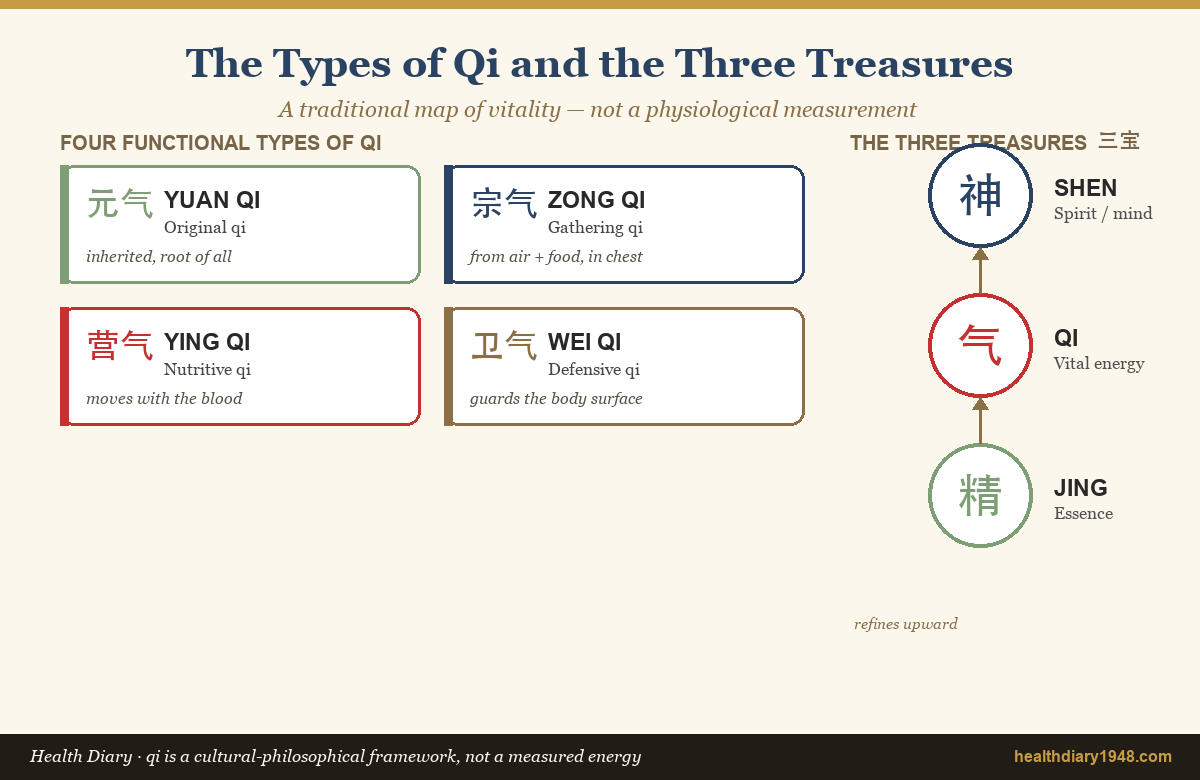
Later medical writing organized that single vitality into a handful of named types. The most commonly taught are:
- Yuan qi (元气), "original qi." The most fundamental kind, said to derive from the prenatal essence (先天之精) inherited from one's parents and stored in relation to the kidneys. A primer from the Guangdong Provincial Administration of Traditional Chinese Medicine describes it as rooted at the "gate of life" below the navel and distributed through the sanjiao (triple burner) to every organ — the root from which the other types are replenished.
- Zong qi (宗气), "gathering qi." Formed after birth in the chest by combining the clear air drawn in by the lungs with the food essence extracted by the spleen and stomach. It is traditionally linked to breathing and to the beat of the heart and vessels.
- Ying qi (营气), "nutritive qi." The nourishing aspect that travels with the blood inside the vessels, said to carry sustenance to the tissues.
- Wei qi (卫气), "defensive qi." The protective aspect that circulates at the body's surface, traditionally described as warming the flesh and governing the opening and closing of the pores against wind and cold.
A fifth term, zheng qi (正气), "upright qi," names the body's overall healthy vitality as opposed to xie qi (邪气), "pathogenic qi." Its famous slogan — "正气存内,邪不可干", "when upright qi is preserved within, pathogens cannot invade" — captures the traditional view that resilience comes from a well-supplied interior rather than from fighting each threat individually. These categories are descriptive vocabulary within a traditional system; they are not organs or fluids modern anatomy would recognize under these names.
How Does Qi Move Through the Body?
In traditional theory, qi is not static; it circulates. It is said to travel along the meridians (经络) — the network of channels that also organizes acupuncture — reaching every region on a roughly daily cycle. Health, in this vocabulary, is smooth and abundant flow; discomfort is framed as qi that is deficient, stagnant, or moving in the wrong direction. Much of acupuncture, massage, and qigong is described as an effort to keep that flow even.
Qi also sits inside a famous triad, the "Three Treasures" (三宝): jing (精, essence), qi (气), and shen (神, spirit). The classical image is a ladder of refinement — dense bodily essence transforms into circulating qi, which in turn nourishes the clarity of spirit and mind. This jing–qi–shen model underlies many Chinese longevity traditions, where "conserving essence, cultivating qi, and settling the spirit" is offered as a recipe for a long, steady life. As always, this is a traditional map of well-being, not a physiological measurement.
What Does Modern Research Say About Qi?
Here honesty matters most. No scientific instrument detects "qi," and the concept is not part of modern physiology. Qi is a framework built from centuries of careful observation and philosophical reasoning — valuable as a cultural lens, but not a validated biological mechanism.
Researchers sympathetic to the tradition have tried to bridge the gap. One open-access analysis, "An Approach to the Nature of Qi in TCM," restates the classical two-source model — qi from the "innate vital substance one inherits from one's parents" plus "the food essence and fresh air one receives from air, water and food" — and proposes that qi correlates with bioenergy. That remains a hypothesis, not a demonstrated equivalence, and should be read as an attempt to translate an old idea into modern terms rather than proof of one. More cautiously, a 2022 network-pharmacology study in Plants examined eight "qi-invigorating" herbs and found their distinctive compounds cluster around energy-metabolism and mitochondrial pathways — an example of research operationalizing qi as a function to test, without claiming to have found a qi substance.
The broader verdict from public-health bodies is sober. Reviewing traditional Chinese medicine, the U.S. National Center for Complementary and Integrative Health notes that mind-body practices such as tai chi may help quality of life and certain pain conditions, but that for Chinese herbal products "because many studies have been of poor quality, no firm conclusions can be made about their effectiveness." The theory of qi behind those therapies has been studied even less directly. The fair summary: qi is a culturally rich way of thinking about vitality, closer to a proverb than to a protocol.
How Do People Try to Nourish Qi?
Within the tradition, "cultivating qi" (养气) is less about a supplement and more about habits that the framework associates with steady vitality. Common approaches include:
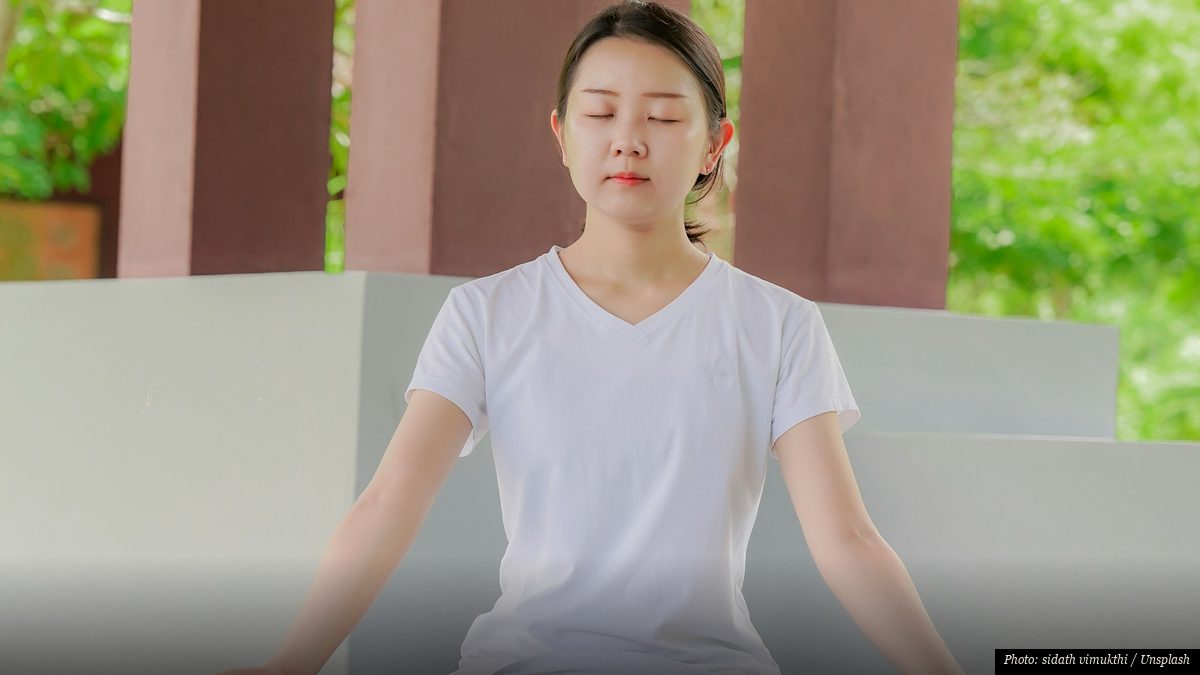
- Breath and slow movement. Qigong literally means "qi work," and tai chi is often described as moving qi through coordinated posture and breathing. These are the practices with the most modern evidence for general well-being, even where the qi vocabulary is set aside.
- Conscious breathing. Many Asian breathing traditions treat slow, deep respiration as the most direct way to "gather" qi — fitting, given that qi began as a word for breath.
- Food and rest. Because so-called acquired qi is said to come from food and air, traditional advice emphasizes regular meals, gentle "qi-tonic" foods, and adequate sleep. Herbs such as ginseng have long been classed as qi tonics in this system.
- Beyond China. The concept travelled with Chinese culture: it is ki (気) in Japan — woven into Kampo medicine and martial arts — gi (기) in Korea, and khí in Vietnam, each tradition adapting the same root idea.
Individual responses vary considerably; what one person finds calming or energizing may do little for another, and any practice involving herbs or vigorous exercise is best explored under qualified guidance rather than self-prescribed.
Important Limitations and Considerations
- A framework, not a diagnosis. "Low qi" or "stagnant qi" are traditional descriptions, never a substitute for medical evaluation. Persistent fatigue, pain, or breathlessness can signal conditions a clinician should assess.
- Qi is not measurable energy. Marketing that promises to sell, charge, or scientifically measure your qi is not grounded in evidence; treat such claims with caution.
- Herbs are pharmacologically active. "Qi-tonic" herbs can interact with medications and are not automatically safe because they are traditional. Discuss them with a professional, especially before surgery.
- Pregnancy, breastfeeding, and children. Safety data for many traditional herbs and intensive practices in these groups is limited; professional guidance is essential.
- Quality varies. NCCIH has documented contamination of some imported herbal products with undeclared ingredients or heavy metals — source carefully.
- Never delay conventional care. A qi-based lens can sit alongside modern medicine but is not a replacement for it.
Frequently Asked Questions
What is qi in simple terms?
Qi is a traditional Chinese idea for the vital "stuff" and animating movement within living things and the wider world — originally the same word as breath or vapour. It is best understood as a philosophical framework for talking about vitality, not as a physical energy that can be measured.
Is qi the same as chi?
Yes. "Chi" and "qi" are two romanizations of the same Chinese word 气. "Qi" follows the modern pinyin system used in mainland China; "chi" is an older spelling still common in English. They refer to exactly the same concept.
What are the main types of qi?
Traditional Chinese medicine most often names yuan qi (original, inherited qi), zong qi (gathering qi formed in the chest from air and food), ying qi (nutritive qi that moves with the blood), and wei qi (defensive qi at the surface). A further term, zheng qi, describes overall healthy vitality that resists illness.
Is qi scientifically proven?
No. Qi is not part of modern physiology, and no instrument measures it. Some practices associated with qi, such as tai chi and qigong, have their own clinical evidence for well-being, but that evidence does not confirm the existence of qi as an energy.
How is qi related to yin and yang?
Qi is the underlying vitality, and yin and yang describe its two complementary tendencies — contracting and expanding, cooling and warming. In practice they are taught together: qi is what moves, and yin-yang is the pattern of how it moves.
A Note on Tracking Your Own Energy
You do not need to believe in qi as a literal force to borrow its most useful habit: paying attention to your own vitality. When do you feel most energized or most depleted? How do breath, movement, food, and sleep shift the way a day feels? A structured tool like Health Diary can make those rhythms visible over weeks and months — no metaphysics required, just honest notes about what genuinely helps you feel steady.
A Gentle Closing Note
Qi began as the simplest of observations — that a breathing body differs from a still one — and grew into one of the most far-reaching ideas in Chinese thought, a single word for the vitality that fills, moves, and connects things. Taken as physiology, it does not survive the laboratory; taken as a cultural lens, it remains a graceful way to notice flow, balance, and rhythm in a life. Understood honestly for what it is, qi is worth knowing — and it opens the door to the wider map of meridians, yin and yang, and the Five Elements that traditional wellness systems are built upon.
About This Article
Written by: Health Diary Editorial Team — researchers and writers focused on traditional Asian wellness practices and the modern evidence around them.
Editorial review: This article has been reviewed by the Health Diary editorial team for clarity, structure, and adherence to our sourcing standards. Key claims were cross-checked against NCCIH, peer-reviewed literature, and classical Chinese sources. It is not a clinical review and should not replace consultation with a licensed healthcare practitioner.
Reviewed on: July 17, 2026.
Editorial process: We cite peer-reviewed and government sources where possible. When a clinical reviewer is added to this article, attribution will appear here with verifiable credentials.
References
- Perkins, F., et al. "Chinese Metaphysics." Stanford Encyclopedia of Philosophy.
- National Center for Complementary and Integrative Health (NCCIH). "Traditional Chinese Medicine: What You Need To Know."
- Li, X.-T., & Zhao, J. "An Approach to the Nature of Qi in TCM — Qi and Bioenergy." In Recent Advances in Theories and Practice of Chinese Medicine, IntechOpen, 2012.
- 《黄帝内经·灵枢·决气》 (Huangdi Neijing, Lingshu ch. 30, "Jue Qi / Distinguishing the Qi"), classical text.
- 广东省中医药局 (Guangdong Provincial Administration of Traditional Chinese Medicine). "元气、原气、真气、正气的内涵及相互关系" (The Meanings and Relationships of Yuan Qi, Original Qi, True Qi, and Upright Qi).
- Tran, M. N., et al. "Molecular Mechanisms Underlying Qi-Invigorating Effects in Traditional Medicine." Plants (Basel) 11(19), 2022.