

Ginseng in Traditional Eastern Medicine: A Beginner's Guide
A beginner's overview of how Traditional Eastern Medicine has historically viewed ginseng — varieties, traditional uses, modern research, and how some people incorporate it into wellness routines. Educational, not medical advice.
Medical Disclaimer: This content is for educational and informational purposes only and is not medical advice. The information presented is not intended to diagnose, treat, cure, or prevent any disease. Always consult a licensed healthcare practitioner before starting any new herbal practice or supplement. Statements regarding traditional herbal use have not been evaluated by the FDA.
Affiliate Disclosure: This article contains affiliate links. We may earn a commission if you purchase through these links, at no additional cost to you. We only recommend products we believe align with our editorial standards.
For more than two thousand years, ginseng has occupied a distinctive place in Traditional Eastern Medicine, particularly within Traditional Chinese Medicine (TCM) and Korean herbal traditions. Its dried roots — often gnarled, aromatic, and reminiscent of tiny human figures — have been valued, debated, and meticulously categorized in classical texts long before modern laboratories existed.
This guide walks through what TCM practitioners traditionally understood about ginseng, the different varieties recognized today, how some people incorporate it into daily routines, and what contemporary research has begun to suggest. It is written for curious newcomers, not as treatment guidance.
Why People Have Been Drawn to Ginseng for Centuries
Modern wellness culture often searches for one ingredient that promises broad benefits. In Eastern medicine, ginseng has long been described in broader terms — a herb associated with overall vitality rather than a single organ or symptom. The Chinese name rénshēn (人参), literally "human root," reflects the way classical herbalists viewed the plant: as something that interacts with the whole body rather than a narrow target.
It is worth being precise here. In TCM thinking, ginseng is traditionally used to support what classical practitioners called qi, an idea that does not map cleanly onto Western physiology. Some people might experience subtle differences in energy or recovery; others may notice nothing at all. Individual responses vary widely, and lifestyle factors — sleep, hydration, food, stress — likely matter more than any single herb.
The cultural reach of ginseng is also part of the story. From imperial Chinese pharmacopeias to modern Korean cuisine, the root has moved through medicine, food, and ceremony. Understanding that history can help newcomers approach it with curiosity rather than the binary "miracle or scam" framing that dominates supplement marketing.
How TCM Views Ginseng
In TCM theory, herbs are categorized along several axes:
- Temperature — warm, neutral, cool, or cold. Ginseng is generally classified as warm or slightly warm, depending on the variety and processing method.
- Taste — sweet and slightly bitter in the case of ginseng.
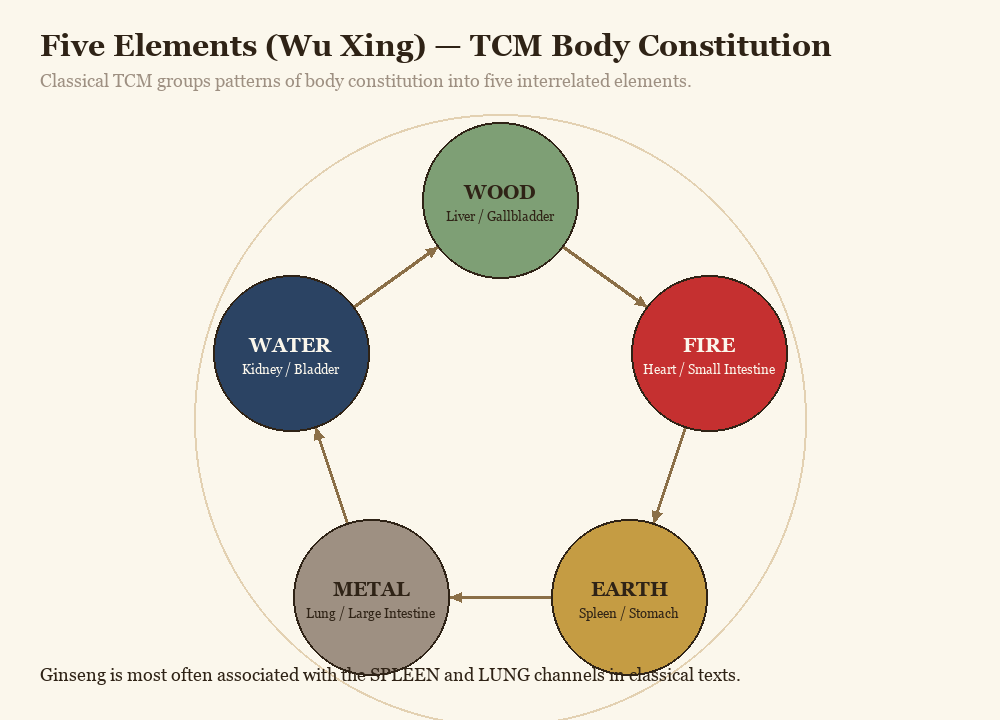
- Channel affinity — the meridians and organ systems an herb is traditionally said to influence. Ginseng is most often associated with the Spleen and Lung channels in classical texts, with some references to the Heart channel as well.
A practitioner working in this framework might describe ginseng as a "tonic herb" — meaning it is traditionally used to support what classical sources called depleted states. In modern language, this is closer to the concept of fatigue, low stamina, or recovery rather than disease treatment.
Importantly, classical TCM does not recommend ginseng for everyone. Practitioners are taught to evaluate the individual's overall pattern, often called body constitution, before suggesting any tonic herb. Some people might find a warm, stimulating herb unsuitable for their constitution; others may report it feels balancing. This is precisely why generic "ginseng is good for energy" advice can be misleading — context matters in traditional practice.
The Main Varieties You Will Hear About
When people say "ginseng," they often mean very different plants. The most commonly discussed varieties in modern wellness conversations include:
1. Asian Ginseng (Panax ginseng)
Native to Korea, China, and parts of Russia. In TCM, this is the variety classical texts most often describe. It is generally regarded as warming and stimulating.
2. Korean Red Ginseng
Technically the same species as Panax ginseng, but processed differently — typically steamed and dried, which gives the root its distinctive reddish color. Some practitioners suggest the steaming process may alter how the body responds to the herb compared with raw white ginseng.
3. American Ginseng (Panax quinquefolius)
Native to North America, including the eastern United States and Canada. In TCM, American ginseng is classified differently from its Asian cousin: traditionally described as cool rather than warm. Some practitioners suggest American ginseng may suit individuals who feel restless or warm-natured, while Asian ginseng may suit those who feel cold or fatigued — though again, this is general framing, not personalized advice.
4. Siberian "Ginseng" (Eleutherococcus senticosus)
Despite the marketing name, this is a different plant entirely — it is not in the Panax genus. Some products sold as "Siberian ginseng" come from this herb, which has its own traditional uses but should not be confused with true ginseng in classical TCM.
What Modern Research Has Begun to Suggest
Some preliminary studies have examined ginseng for various wellness applications. Small clinical trials and reviews have explored whether ginseng extracts may have effects related to fatigue, mental performance, and immune function. Reviews published in journals indexed on PubMed have generally noted:
- Findings are often mixed or inconclusive
- Sample sizes in many studies are small
- Standardization of ginseng preparations varies widely between studies
- More rigorous research is needed before drawing firm conclusions
This means it is fair to say that some preliminary research suggests potential associations, but it would not be accurate to claim ginseng has proven clinical effects for any specific condition. If you are reading marketing copy that promises definitive medical outcomes, that is a flag worth pausing on.
For readers who like primary sources, peer-reviewed literature on PubMed and similar databases provides a starting point — though navigating those can be its own learning curve, and a single positive study should never be taken as the final word.
How Some People Incorporate Ginseng
In traditional practice, ginseng is rarely taken as a daily isolated supplement. Classical preparations typically combine it with other herbs to balance its warming nature or target a specific pattern. Modern usage looks different and often simpler.
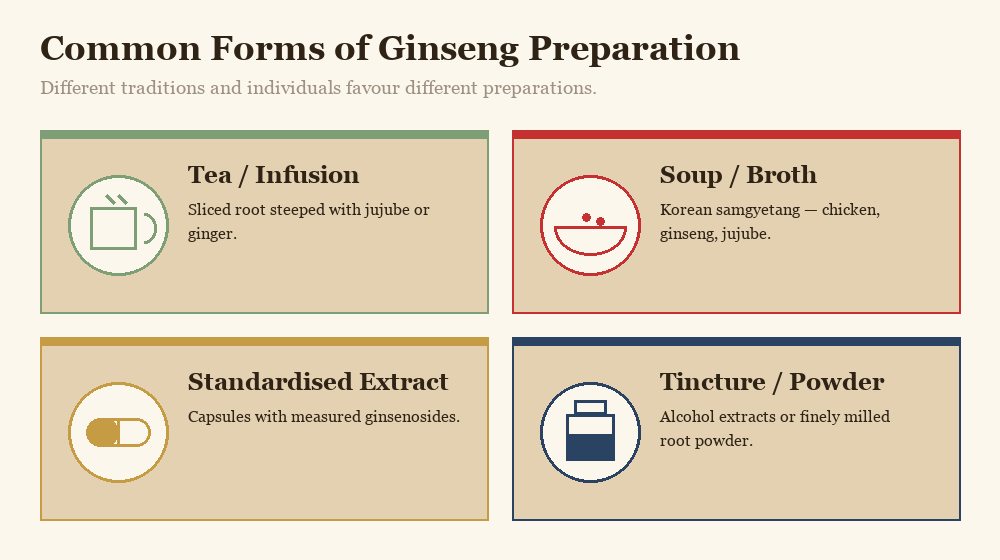
Some common ways people who use ginseng describe their routines include:
Brewed as Tea or Infusion
Slices of dried ginseng root steeped in hot water, sometimes with other ingredients such as Chinese dates (jujube), licorice root, or fresh ginger. Some people enjoy this as an afternoon ritual rather than a daily medical regimen.
As Part of a Soup or Broth
Korean samgyetang — a chicken soup featuring whole ginseng root, garlic, jujube, and glutinous rice — is one well-known culinary preparation. Eaten especially during summer in Korean tradition, it is part of the food-as-wellness philosophy common across Eastern cultures.
Standardized Extracts or Capsules
Modern supplements often deliver ginsenosides — compounds isolated from the root — in capsule or liquid form. Standardization varies, and not every product contains what its label suggests. Independent third-party testing (USP Verified, NSF Certified, ConsumerLab) is one signal some shoppers look for when comparing brands.
Tinctures and Powders
Alcohol-based tinctures and powdered extracts are also available, used in smaller doses and often combined with other herbs in formulas drawn from classical sources.
Important Limitations and Considerations
Reading about a herb valued for two millennia can make it feel safe by default. It is not necessarily so. Some considerations worth knowing:
- Drug interactions — ginseng may interact with anticoagulants (blood thinners), some diabetes medications, certain antidepressants, and others. Anyone on prescription medication should discuss with a qualified practitioner before adding ginseng.
- Pregnancy and breastfeeding — most professional sources advise caution and consultation rather than self-experimentation.
- Children — ginseng is not generally recommended for children outside of supervised traditional practice.
- Individual constitution — as noted above, classical TCM does not view ginseng as universally beneficial. Some people might experience symptoms such as restlessness, headaches, or digestive discomfort, which traditionally suggests the herb is not matching the constitution well. May not work for everyone.
- Quality variability — the supplement market is uneven. Two products labeled "ginseng" can differ enormously in actual potency, country of origin, processing method, and adulterants. Cheaper is not always worse, and more expensive is not always better.
- Time horizon — traditional practice often involves cycles (taking, then pausing) rather than continuous daily use. Some traditions caution against year-round consumption without breaks. Results can vary depending on lifestyle, season, and individual constitution.
These limitations are not meant to discourage exploration. They are the realistic context any reader deserves before forming expectations.
A Note on Tracking — Where Health Diary Comes In
One reason traditional Eastern medicine has resonated with the modern quantified-self community is its emphasis on observation over time. Classical practitioners assessed patterns, not isolated symptoms. They asked about sleep, digestion, mood, energy, recovery, and how a person felt across seasons.
Tracking those signals — the way some people use a sleep diary, mood tracker, or habit journal — is a reasonable way to evaluate whether any new wellness practice (including a herb like ginseng) is matching your individual context.
A few signals readers sometimes record:
- Daily energy levels, before and after a routine change
- Sleep quality and subjective restfulness
- Digestion and appetite patterns
- Mood and stress markers
- Recovery from exercise or workload spikes
- How you respond to seasons and weather changes
When these signals are tracked consistently for a few weeks, it becomes easier to see whether a routine is helping, neutral, or unhelpful for your situation. That is more useful than relying on the day-to-day impression of "I think I feel a bit better." It is also more aligned with how traditional practitioners themselves used to assess change.
A Soft Closing Note
Ginseng is a fascinating subject in part because it sits at the intersection of food, medicine, philosophy, and culture. It is not a magic herb, and it is not a replacement for consistent sleep, movement, hydration, and mental rest. People working within TCM tradition have long been clear about that — ginseng was never meant to compensate for a depleted lifestyle. It was meant to support someone whose lifestyle was already supportive.
If you are curious about traditional wellness practices, the most useful next step is usually slow learning rather than an immediate purchase. Reading reputable sources, talking with a licensed practitioner, and observing your own patterns through journaling tend to produce better outcomes than chasing any single herb.
You can learn more about traditional body constitutions on our companion guide, and if you would like to track wellness signals over time, our journaling tools may help structure that practice. Some people explore options like keeping a simple notebook; others find a structured journal more sustainable.
About This Article
Written by: Health Diary Editorial Team — A small editorial group researching traditional wellness practices, herbal traditions, and quantified-self methods. We publish educational content reviewed by licensed practitioners.
Reviewed on: May 7, 2026.
Editorial process: All content goes through a two-stage review (author research and medical reviewer signoff) before publication. We cite peer-reviewed and government sources where possible. See our Editorial Process page for details.