
The Complete Guide to Ginseng: Varieties, History, and Modern Research
A comprehensive, evidence-balanced guide to ginseng — covering classical Traditional Eastern Medicine context, the four varieties (Asian, Korean Red, American, Siberian), modern peer-reviewed research, traditional preparations, and safety considerations.
Medical Disclaimer: This content is for educational and informational purposes only and is not medical advice. The information presented is not intended to diagnose, treat, cure, or prevent any disease. Always consult a licensed healthcare practitioner before starting any new herbal practice or supplement. Statements regarding traditional herbal use have not been evaluated by the FDA.
Affiliate Disclosure: This article contains affiliate links. We may earn a commission if you purchase through these links, at no additional cost to you. We only recommend products we believe align with our editorial standards.
Few plants have generated as much fascination, ceremony, and confusion as ginseng. For more than two thousand years it has been classified, debated, brewed, steamed, gifted, faked, and prescribed across East Asia — and in the last few decades, increasingly tested in clinical laboratories. The result is a herb with one of the longest documented histories in human medicine and, paradoxically, a body of modern evidence that is still surprisingly thin in places.
This complete guide covers what classical Traditional Eastern Medicine texts say about ginseng, the major varieties you will encounter (and one impostor that is not actually ginseng at all), how some people incorporate it into modern routines, what contemporary peer-reviewed research has begun to suggest, and the safety information any newcomer deserves before opening a packet. It is written as educational reading for curious adults, not as treatment guidance.
Why Ginseng Has Endured for Two Thousand Years
The first written description of ginseng appears in the Shennong Bencao Jing (神農本草經, the Divine Farmer's Materia Medica), a foundational Chinese herbal text compiled between the first and second centuries CE from much older oral traditions. The text classified medicinal substances into three grades — superior, intermediate, and inferior — based on perceived toxicity and use case. Ginseng was placed in the superior class: herbs traditionally considered safe enough for regular use and associated with promoting longevity rather than treating acute disease.
That early classification matters because it shaped how ginseng was prescribed for the next two millennia. Classical practitioners did not view ginseng as a remedy for one symptom. They viewed it as a tonic — something integrated into a broader pattern of preparation, lifestyle, and seasonal awareness. The Chinese name rénshēn (人参), literally "human root," reflects the way the gnarled root was perceived as resembling a tiny human form, and the cultural reverence that followed.
Ginseng's reach extends well beyond China. Korean herbal tradition developed its own distinctive processing methods (which we'll cover in the varieties section). The plant became economically and politically significant; at various points in history, wild ginseng was so valuable that harvest was tightly regulated by imperial decree. The journey from forest floor to imperial pharmacopeia to modern supplement shelf is one of the more interesting arcs in the history of any single plant.
How Traditional Eastern Medicine Views Ginseng
To make sense of ginseng's classical reputation, it helps to understand how Traditional Eastern Medicine (TEM) — and within it, Traditional Chinese Medicine (TCM) — organizes herbs. Practitioners describe herbs along several axes:
- Temperature — warm, neutral, cool, or cold. Asian ginseng (Panax ginseng) is classified as warm to slightly warm. American ginseng (Panax quinquefolius) is classified as cool.
- Taste — ginseng is described as sweet and slightly bitter.
- Channel affinity — meridians and organ systems an herb is traditionally said to influence. Ginseng is most often associated with the Spleen and Lung channels, with some references to the Heart channel.
In this framework ginseng is a "qi tonic" — historically described as restoring depleted vitality rather than treating a named disease. A peer-reviewed survey of classical formulas notes that ginseng was traditionally said to "tonify five vital organs" (spleen, lung, heart, kidney, liver) and was used for "restorative, tonic, nootropic, and anti-aging" purposes within classical practice [1].
Crucially, classical practitioners rarely prescribed ginseng alone. The most influential ginseng-containing formula, Sijunzi Tang (四君子湯, "Four Gentlemen Decoction"), pairs ginseng with three other herbs to create what tradition calls a balanced qi-tonifying foundation. A broader formula, Sipjeondaebo-tang (十全大補湯), builds on that base with eight additional herbs including angelica and rehmannia for cases of more pronounced depletion [1]. Single-herb ginseng decoction (Doksam-tang) historically appeared mainly in acute or serious illness contexts.
Historical decoction methods used roughly 3 to 9 grams of dried root simmered in 720 to 960 mL of water, though emergency single-herb preparations reportedly used much higher quantities [1]. This is worth knowing because modern standardized extracts typically deliver far less raw root by weight, and direct comparisons across formats can be misleading.
One more nuance: classical TCM does not view ginseng as universally beneficial. Practitioners assess an individual's body constitution first. A person with a warm constitution might find Asian ginseng aggravating, while finding American ginseng better suited — and vice versa. This is precisely why generic "ginseng is good for energy" advice misses much of what the tradition actually says.
The Main Varieties of Ginseng
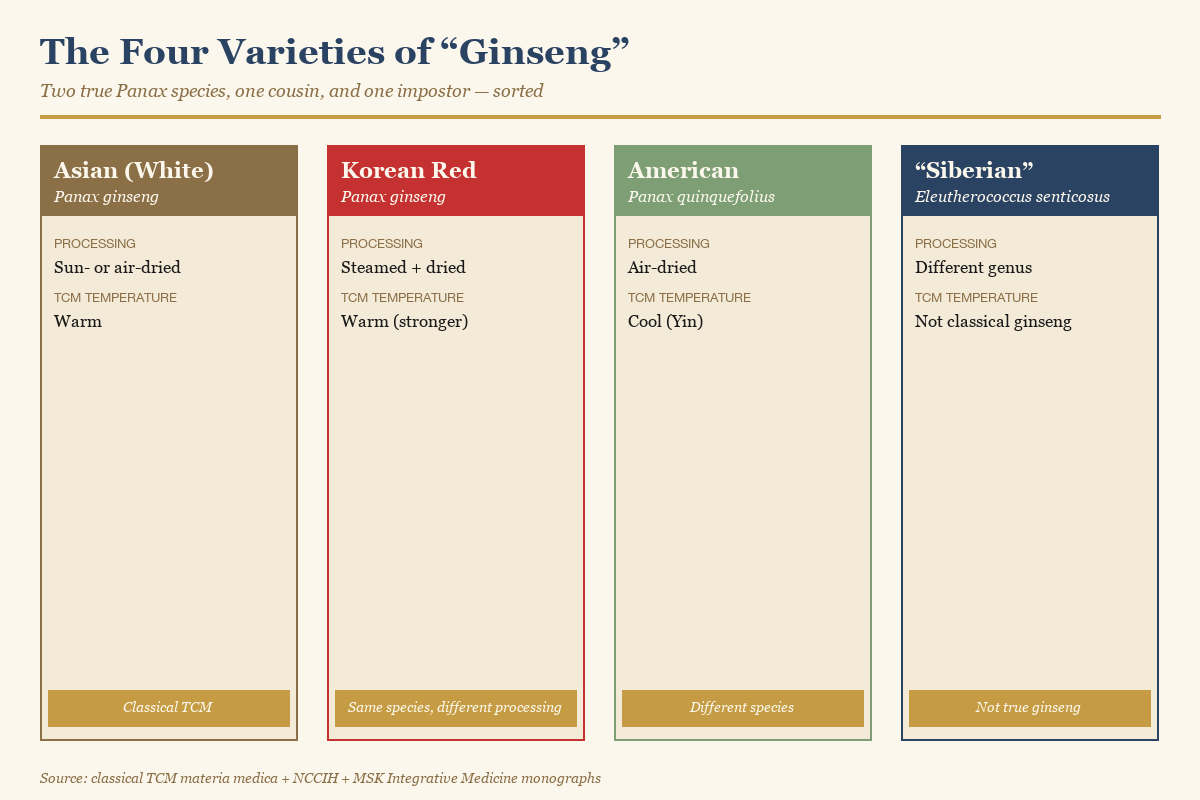
When people say "ginseng," they may mean very different plants. Sorting these out matters both for traditional use and for modern product selection.
Asian Ginseng (Panax ginseng) — White
Native to Korea, China, and parts of the Russian Far East, Panax ginseng is the variety most often described in classical Chinese texts. When the root is washed and dried without steaming, the product is called white ginseng. In TCM, this form is generally considered warm and stimulating. The US National Center for Complementary and Integrative Health (NCCIH) notes that Asian ginseng has been "promoted for stress, cognitive function, flu, fatigue, athletic performance, diabetes, aging, asthma, and anxiety" — though it explicitly stresses that promotion is not the same as proven effectiveness [2].
Korean Red Ginseng (KRG)
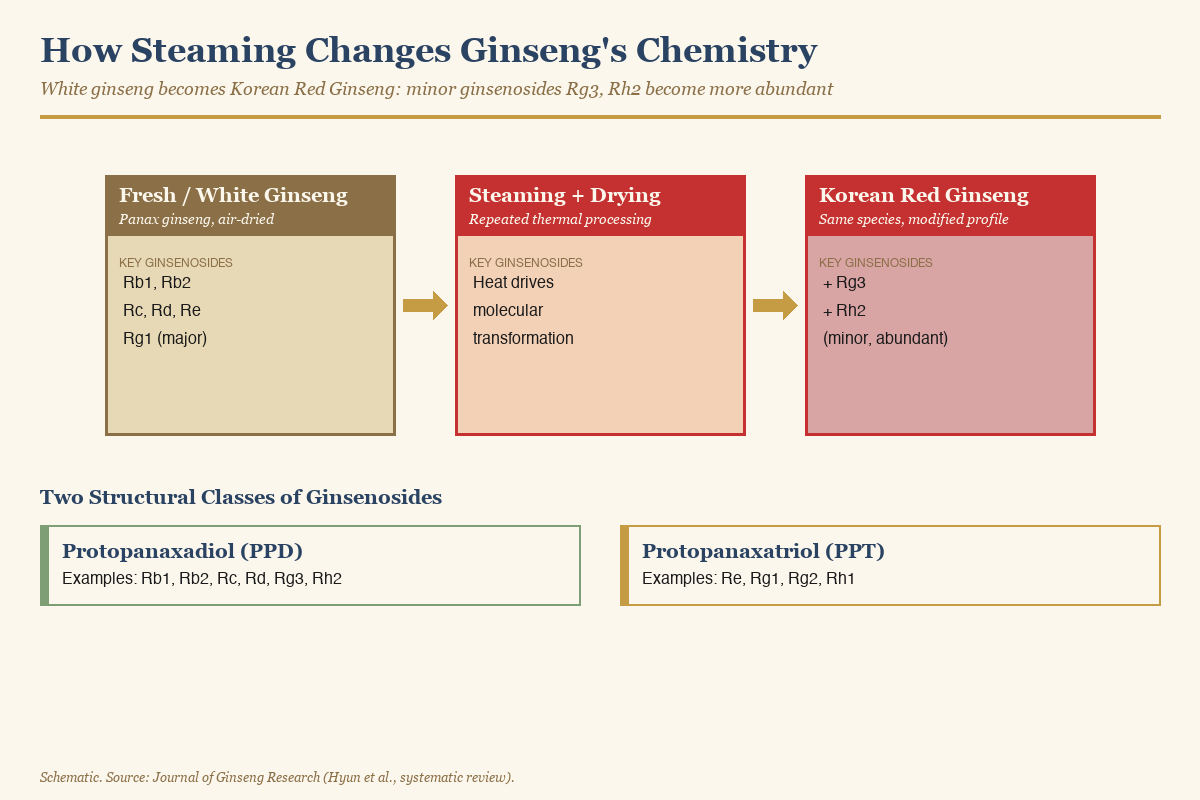
This is technically the same species as Asian ginseng — Panax ginseng — but processed differently. The roots are repeatedly steamed and dried, a method that gives Korean Red Ginseng its distinctive reddish color and longer shelf life. A peer-reviewed review in the Journal of Ginseng Research notes that steaming alters the ginsenoside profile: minor compounds such as ginsenoside Rg3 and Rh2 become more abundant after thermal processing compared with raw white ginseng [3]. Approximately 200 distinct ginsenosides have been identified to date, falling into two structural classes called protopanaxadiol (PPD) and protopanaxatriol (PPT) [3]. Whether the steaming-induced compound shifts translate to different clinical outcomes in humans is an active research area.
American Ginseng (Panax quinquefolius)
Native to the eastern United States and parts of Canada, American ginseng is a different species and is classified very differently in traditional practice. Memorial Sloan Kettering Cancer Center's herbal monograph notes that in TCM, American ginseng is used to "nourish Yin," whereas Asian varieties are considered warming — opposite ends of the traditional temperature spectrum [4]. Some practitioners suggest American ginseng may suit individuals who feel warm-natured, restless, or "hot" in TCM terms, while Asian ginseng may suit those who feel cold or depleted. This is general framing, not personalized guidance.
What "Siberian Ginseng" Is (and Isn't)
Despite the name, Siberian ginseng (Eleutherococcus senticosus) is not in the Panax genus at all. It is a separate plant with its own traditional uses in Russian and Northeast Asian folk medicine, but it does not appear in classical Chinese ginseng formulas. Modern labeling regulations in some countries have tightened around the name. If a product matters to you for traditional reasons, check the Latin name on the label — Panax ginseng, Panax quinquefolius, or Eleutherococcus senticosus tells you exactly which plant you are buying.
What Modern Research Has Begun to Suggest
Ginseng is one of the most studied herbs in modern complementary medicine — and yet, the overall picture remains preliminary. A 2023 umbrella review in Frontiers in Pharmacology that aggregated 19 separate meta-analyses concluded that the body of evidence is constrained by methodological problems. Of those 19 reviews, the authors classified five as low-quality and fourteen as critically low-quality. They wrote that "there is still a lack of a high-quality synthesis of the existing evidence" and that "the methodological quality of studies needs to be improved considerably" [5].
With that caveat established, here is what some of the better-conducted research suggests, area by area.
Cognitive function. NCCIH summarizes the cognition literature cautiously: a small amount of research has suggested potential improvements in middle-aged adults but not in young adults, with most trials having fewer than 200 participants and shorter than three-month durations [2]. A 2024 systematic review and meta-analysis published on PubMed found that ginseng did not have a positive effect on overall cognition, attention, or executive function across the pooled studies it examined [6]. Anyone reading marketing copy that claims ginseng definitively improves memory or focus is reading a stronger claim than the current evidence supports.
Fatigue. Results here are mixed and depend heavily on context. A 2022 meta-analysis of randomized controlled trials reported significant reductions in cancer-related fatigue with ginseng [7], and oncology integrative guidelines have begun to acknowledge American ginseng specifically for this use case [4]. NCCIH notes a "small beneficial effect" on general fatigue, while emphasizing limitations in the underlying trials [2]. The honest summary is that disease-related fatigue (especially in cancer survivors) has the more positive signal; healthy-population general fatigue evidence is weaker.
Athletic performance. NCCIH is direct on this: research does not show that Asian ginseng improves athletic performance [2]. The popular framing of ginseng as an endurance booster for healthy young adults does not have strong clinical backing.
Erectile function. Some research suggests possible benefit; the data are limited but more consistent than in some other areas. The mechanism research highlights ginsenosides' interaction with nitric oxide synthesis [8], though clinical translation is far from settled.
Metabolic markers. Some studies suggest ginseng may influence blood glucose and cholesterol values, but NCCIH characterizes the diabetes evidence as "inconclusive and conflicting" [2]. Importantly, this same property — possible blood-glucose lowering — is why ginseng is flagged as a drug-interaction concern for people on insulin or sulfonylureas.
Antioxidant activity. Korean Red Ginseng has shown effects on antioxidant markers (SOD, CAT, GPx enzyme activities, GSH levels) and oxidative stress markers (MDA, ROS) in clinical and preclinical settings, but the review authors caution that absorption mechanisms of ginsenosides in humans are not fully understood [3].
The honest takeaway is this: ginseng is a biologically active plant whose ginsenosides clearly do something at the molecular level, and some preliminary clinical signals exist for narrow indications. But the leap from "biologically interesting" to "clinically proven for general use" has not been completed by the evidence base as a whole.
How Some People Incorporate Ginseng
Modern usage looks very different from classical multi-herb decoction. Below are the forms most often encountered today, with traditional context where relevant.
Brewed as Tea or Light Decoction
Sliced dried root steeped in hot water — often with Chinese dates (jujube), licorice root, or fresh ginger — is one of the gentler ways some people incorporate ginseng. The infusion is typically lighter than a traditional medicinal decoction, which used 3–9 g of root simmered for longer durations [1]. Many people enjoy it as an afternoon ritual rather than a daily medical regimen.
Samgyetang — Ginseng as Food
Korean cuisine offers one of the most distinctive culinary preparations: samgyetang (삼계탕), a soup of whole young chicken stuffed with glutinous rice, garlic, jujube, and a whole ginseng root, simmered until tender. It is traditionally eaten on sambok days — the three hottest days of the lunar calendar — guided by the Korean principle yi yeol chi yeol (以熱治熱), "fight fire with fire." The idea is that warming food during peak heat helps the body adjust rather than overwhelm it. Whether or not modern physiology endorses that framing, the dish itself is a clear example of the food-as-wellness philosophy that runs through Eastern traditions.
Standardized Extracts and Capsules
Most Western consumers encounter ginseng as a standardized extract in capsule or tablet form. Typical short-term dosing in the clinical literature ranges from approximately 0.5 to 2 grams of root equivalent (around 200 to 600 mg of extract), with peak plasma concentrations reached approximately four hours after a dose [9]. Standardization across brands varies, and not every product reliably contains what its label claims. Third-party verification programs (such as USP Verified, NSF Certified, or ConsumerLab) are one signal some shoppers use when comparing supplements.
Tinctures and Powders
Alcohol-based tinctures and finely milled powders are also common. Powders can be added to teas, broths, or honey. Tinctures typically use smaller dose volumes but can deliver concentrated active compounds. In both cases, traceability of source and processing is the main quality question.
One framing worth noting: in classical practice, ginseng was rarely consumed daily for indefinite periods. Cycles of use and pause — often aligned with season — were the traditional pattern, not year-round daily supplementation.
Important Limitations and Considerations
Reading about a herb valued for two millennia can make it feel safe by default. It is not necessarily so. The most important considerations:
- Surgery — Memorial Sloan Kettering's monograph advises discontinuing ginseng at least one week before any planned surgery, primarily due to platelet-aggregation effects and bleeding risk [8]. This is one of the most important practical points for anyone considering routine use.
- Blood thinners (anticoagulants) — Ginseng inhibits platelet aggregation. Both Asian and American ginseng have been documented to interact with warfarin; American ginseng has been shown to antagonize warfarin's effect in humans [4][9].
- Diabetes medications — Because ginseng may lower blood glucose, combining it with insulin or sulfonylureas can produce additive hypoglycemic effects [8][2].
- MAOIs and certain antidepressants — Documented interactions with monoamine oxidase inhibitors include reports of manic-type symptoms [8].
- CYP3A4-metabolized medications — Asian ginseng induces the CYP3A4 enzyme, which can reduce blood levels and therefore effectiveness of certain HIV antiretrovirals, antihypertensives, statins, and several antidepressants [9].
- Pregnancy and breastfeeding — NCCIH does not recommend Asian ginseng during pregnancy or breastfeeding, citing inadequate safety data and animal studies suggesting some ginseng compounds may cause birth defects [2].
- Infants and children — Not recommended for routine use outside of supervised traditional practice [2].
- Autoimmune conditions — Ginseng may worsen autoimmune disorders by altering immune system activity; people with conditions such as lupus, rheumatoid arthritis, or multiple sclerosis are typically advised to avoid it unless under practitioner guidance [2].
- Common side effects — The most frequently reported adverse effect is insomnia; others include headaches, blood pressure changes, digestive upset, skin reactions, and in rare cases vaginal bleeding [9][2]. Severe reactions (serious rash, liver injury, allergic reactions) are rare but documented.
- Individual constitution — In TCM framing, ginseng is not universally beneficial. Some people might experience symptoms such as restlessness, headaches, or digestive discomfort, traditionally interpreted as a sign the herb is not matching the constitution well. Results can vary depending on lifestyle, season, and individual constitution. May not work for everyone.
- Quality and adulteration — The supplement market is uneven. Two products labeled "ginseng" can differ substantially in actual ginsenoside content, country of origin, processing method, and presence of contaminants. Cheaper is not always worse, and more expensive is not always better.
- Time horizon — Traditional practice often involves cycles (taking, then pausing) rather than continuous year-round use. NCCIH notes that short-term oral use (up to 6 months) at recommended amounts appears safe for most adults, but long-term safety has not been well characterized [2].
These limitations are not meant to discourage exploration. They are the realistic context any reader deserves before forming expectations about a herb whose evidence base is still maturing.
A Note on Tracking — Where Health Diary Comes In
One reason traditional Eastern medicine has resonated with the modern quantified-self community is its emphasis on observation over time. Classical practitioners assessed patterns, not isolated symptoms. They asked about sleep, digestion, mood, energy, recovery, and how a person felt across seasons. That practice maps surprisingly well onto modern habits like journaling, sleep tracking, and mood logging.
Tracking those signals is a reasonable way to evaluate whether any new wellness practice — including a herb like ginseng — is matching your individual context. A few signals readers sometimes record:
- Daily energy levels, before and after a routine change
- Sleep quality and subjective restfulness
- Digestion and appetite patterns
- Mood and stress markers
- Recovery from exercise or workload spikes
- How you respond to seasonal weather changes
When these signals are tracked consistently for a few weeks, it becomes easier to see whether a routine is helping, neutral, or unhelpful for your situation. That is usually more informative than relying on a day-to-day "I think I feel a bit better" impression. It is also closer to how traditional practitioners themselves used to assess change.
A Soft Closing Note
Ginseng sits at the intersection of food, medicine, philosophy, and commerce. It is not a magic herb, and it is not a replacement for consistent sleep, movement, hydration, and mental rest. Classical practitioners were clear about that: ginseng was never meant to compensate for a depleted lifestyle. It was meant to fit into a lifestyle that was already supportive.
If you are curious about traditional wellness practices, the most useful next step is usually slow learning rather than an immediate purchase. Reading reputable sources — peer-reviewed reviews, NCCIH and Memorial Sloan Kettering monographs, classical herbal texts — and observing your own patterns through journaling tend to produce better outcomes than chasing any single herb.
Some people explore options like keeping a simple notebook for that purpose; others find a structured journal more sustainable. You can learn more about traditional body constitutions and seasonal wellness rhythms on our companion guides, and our journaling tools can help structure observation over time if that is useful for you.
About This Article
Written by: Health Diary Editorial Team — a small editorial group researching traditional wellness practices, herbal traditions, and quantified-self methods. Our articles draw on peer-reviewed literature, government health-agency monographs (NCCIH, NIH), and classical herbal texts.
Editorial review: This article has been reviewed by the Health Diary editorial team for clarity, structure, and adherence to our sourcing standards. It is not a clinical review and should not replace consultation with a licensed healthcare practitioner. When a clinical reviewer is added to this article, attribution will appear here with verifiable credentials.
Reviewed on: June 4, 2026.
Editorial process: All claims about modern evidence are linked inline to peer-reviewed publications or authoritative government / academic medical sources. Where the evidence is preliminary or mixed, we describe it that way rather than glossing over uncertainty. We cite primary research and government sources in preference to secondary blog content.
References
- Yang Y et al. Ginseng in Traditional Herbal Prescriptions. Journal of Ginseng Research. PMC3659587. https://pmc.ncbi.nlm.nih.gov/articles/PMC3659587/
- NCCIH. Asian Ginseng: Usefulness and Safety. National Center for Complementary and Integrative Health, NIH. https://www.nccih.nih.gov/health/asian-ginseng
- Hyun SH et al. The Antioxidant Activities of Korean Red Ginseng (Panax ginseng) and Ginsenosides: A Systemic Review through In Vivo and Clinical Trials. Journal of Ginseng Research. PMC7790892. https://pmc.ncbi.nlm.nih.gov/articles/PMC7790892/
- Memorial Sloan Kettering Cancer Center. Ginseng (American) — Integrative Medicine herb monograph. https://www.mskcc.org/cancer-care/integrative-medicine/herbs/ginseng-american
- Moo EV et al. Ginseng and Health Outcomes: An Umbrella Review. Frontiers in Pharmacology. PMC10351045. https://pmc.ncbi.nlm.nih.gov/articles/PMC10351045/
- Effects of Ginseng on Cognitive Function: A Systematic Review and Meta-Analysis. PubMed 39474788, 2024. https://pubmed.ncbi.nlm.nih.gov/39474788/
- Wang Y et al. Effects of Ginseng on Cancer-Related Fatigue: A Systematic Review and Meta-analysis of Randomized Controlled Trials. Integrative Cancer Therapies, 2022. PubMed 35184068. https://pubmed.ncbi.nlm.nih.gov/35184068/
- Memorial Sloan Kettering Cancer Center. Ginseng (Asian) — Integrative Medicine herb monograph. https://www.mskcc.org/cancer-care/integrative-medicine/herbs/ginseng-asian
- StatPearls. Ginseng. NIH National Library of Medicine bookshelf. https://www.ncbi.nlm.nih.gov/books/NBK538198/