
Mugwort (Ngải Cứu) Guide: Moxibustion, Cooking & Safety
Mugwort (ngải cứu, yomogi, ssuk, ài cǎo) explained: the pan-Asian Artemisia herb behind moxibustion, spring rice cakes and omelettes — its species, uses, research and safety.
Medical Disclaimer: This content is for educational and informational purposes only and is not medical advice. It is not intended to diagnose, treat, cure, or prevent any disease. Always consult a licensed healthcare practitioner before using herbs, especially during pregnancy. Statements regarding traditional herbal use have not been evaluated by the FDA.
Affiliate Disclosure: This article may contain affiliate links. We may earn a commission if you purchase through these links, at no additional cost to you. We only recommend products we believe align with our editorial standards.
Few plants are as woven into the fabric of East Asian life as mugwort. It is the bitter-fragrant green folded into springtime rice cakes, the "moxa" burned in traditional therapy, the leafy bundle hung over doorways at midsummer festivals, and the omelette herb on Vietnamese dinner tables. Known in China as ài cǎo (艾草), in Japan as yomogi (ヨモギ), in Korea as ssuk (쑥), and in Vietnam as ngải cứu, mugwort is a genuinely pan-Asian herb with one foot in the kitchen and one in the apothecary. This profile is part of our wider guide to Asian herbal traditions.
What Is Mugwort?
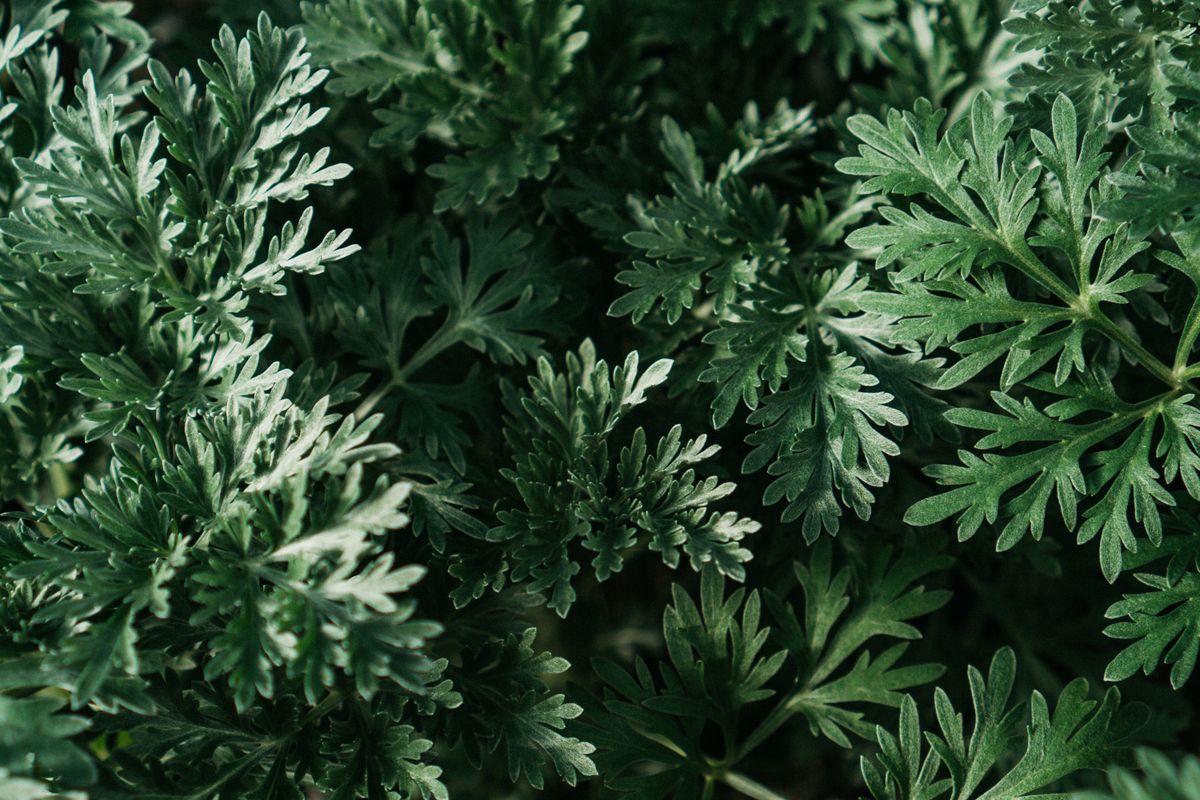
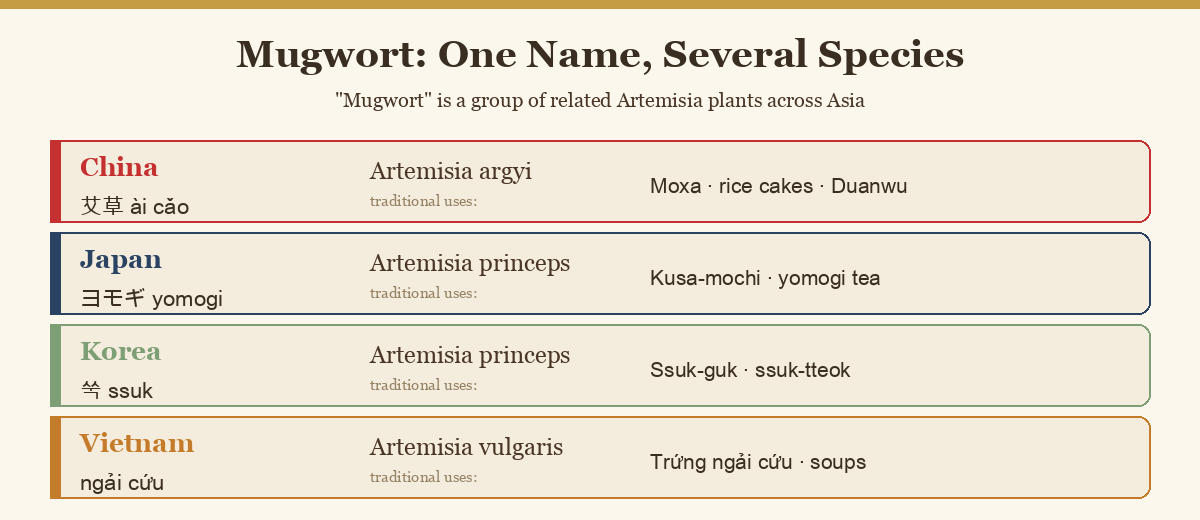
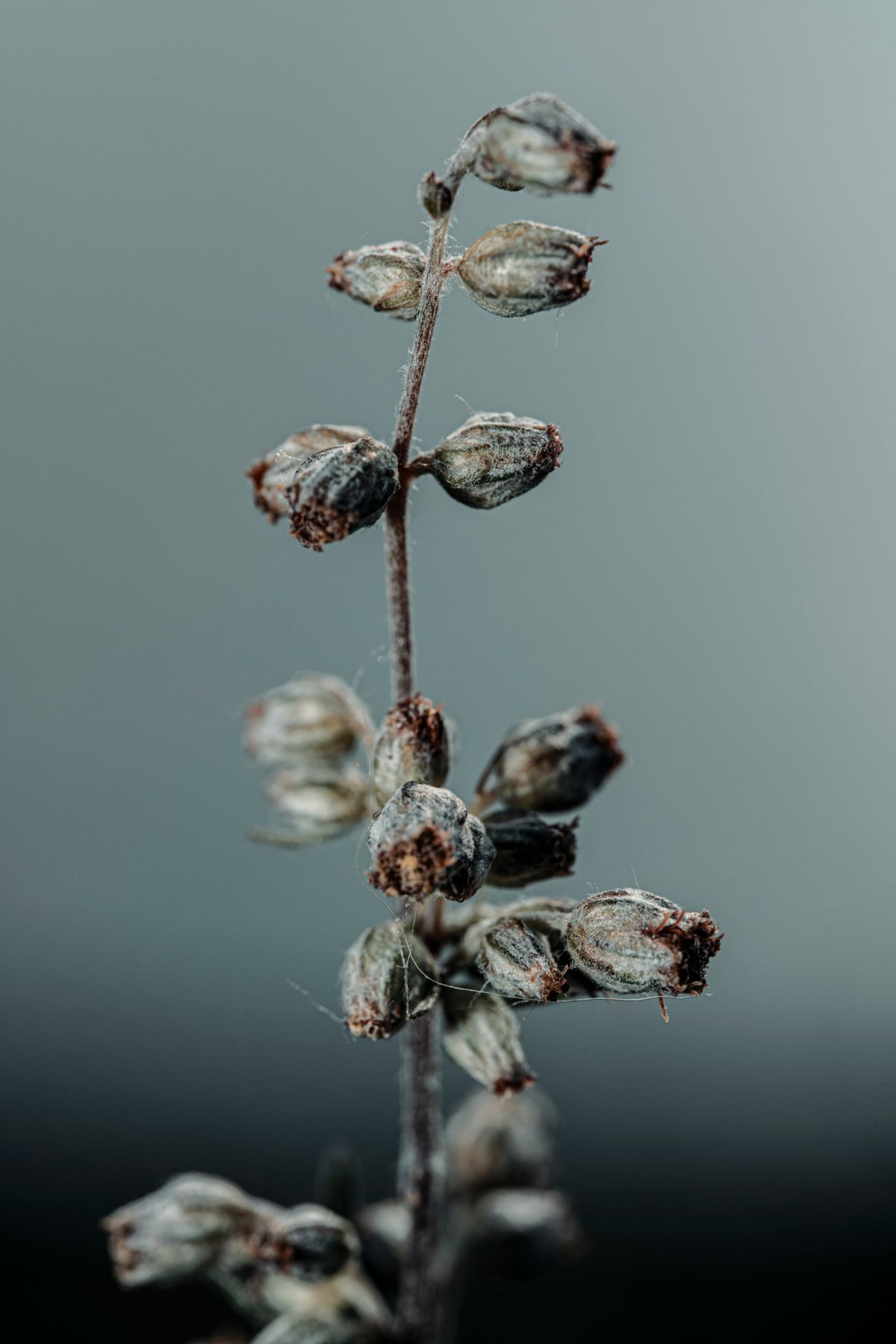
Mugwort is an aromatic plant in the daisy family (Asteraceae), with silvery-green, deeply lobed leaves and a distinctive bitter, camphor-and-sage aroma from its volatile oils. One thing most articles get wrong is treating "mugwort" as a single species — it is really a small group of closely related Artemisia plants. East Asian moxa and cooking mugwort is usually Artemisia argyi (China) or Artemisia princeps (Japan and Korea), while Vietnamese-language sources typically identify ngải cứu as Artemisia vulgaris (Ekiert et al., 2020). Getting this species-complex right is part of understanding why regional uses differ slightly.
Mugwort is so central to European and Asian herbal history that it earned the Latin nickname mater herbarum — "mother of herbs" — and was written about by Dioscorides, Pliny, and Galen in the West and catalogued for centuries in East Asian herbals (Ekiert et al., 2020).
Mugwort in the Kitchen: A Pan-Asian Green
Cooking is where mugwort truly comes alive, and each culture has its own signature dish:
- Vietnam — trứng ngải cứu, a fragrant mugwort omelette, plus mugwort soups; the young leaves are a familiar bitter-warm green (Tuổi Trẻ).
- Japan — kusa-mochi / yomogi-mochi (草餅), soft green rice cakes coloured and flavoured with pounded yomogi, and yomogi tea (Foodslink, ヨモギ).
- Korea — ssuk-guk (쑥국, mugwort soup) and ssuk-tteok (쑥떡, mugwort rice cake), classic springtime foods.
- China — young leaves folded into green rice cakes and seasonal greens, especially around the Qingming and Duanwu festivals.
The flavour is bitter, grassy, and herbaceous with a sage-like edge; blanching the young leaves and mixing them into rice cakes or eggs mellows the bitterness into something aromatic and spring-like.
What Is Moxibustion?
Beyond the kitchen, mugwort's most famous role is in moxibustion (艾灸, お灸, and the Vietnamese practice of burning ngải cứu). Dried, aged mugwort is processed into a fluffy material called "moxa" (もぐさ), which is shaped into cones or sticks and burned on or near acupuncture points to warm them — either directly, or indirectly over a slice of ginger or a layer of salt.
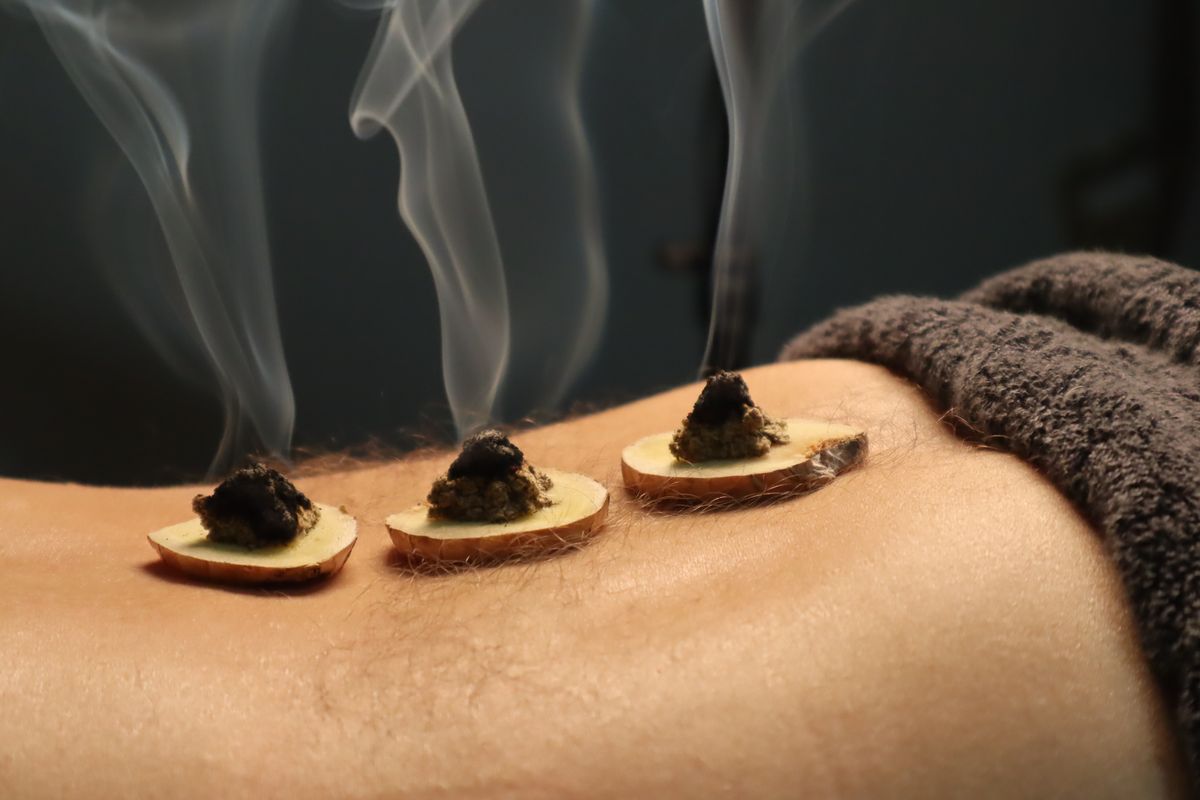
It is important to be honest about the evidence here. An overview of systematic reviews found that the clearest — though still limited — signal for moxibustion is in helping turn breech-position babies before birth; for most other uses the evidence is described as equivocal or insufficient, and many of the underlying trials were of poor quality (Lee, Kang & Ernst, 2010). Moxibustion is a meaningful cultural practice with a long history, but it should be understood as traditional care with mixed modern support, not a proven medical treatment. If you try it, do so with a trained practitioner, since the burning material carries a real risk of burns and the smoke can irritate the airways.
Mugwort in Folk Custom and Ritual
Across the region, mugwort is a plant of protection. At the Duanwu Festival in China (端午) and Tết Đoan Ngọ in Vietnam, bundles of mugwort and calamus are hung over doorways to ward off ill fortune and pests during the hot, "poisonous" heart of summer — a custom that also has a practical basis, since the leaf's aromatic oils genuinely help repel insects (China Civilization Net). In the West, its ancient links to the goddess Artemis gave it a long association with women and childbirth.
What Does Modern Research Say?
Laboratory studies have identified mugwort's signature compounds — the flavonoids eupatilin and jaceosidin, along with an essential oil rich in monoterpenoids like 1,8-cineole and camphor — and reported antioxidant and anti-inflammatory activity in cell and animal models (Artemisia argyi review, 2024). Genus-wide reviews describe similar antioxidant activity across Artemisia species while also flagging the toxicology of one of its compounds, thujone (Sharifi-Rad et al., 2022).
As with most traditional herbs, though, this is largely preclinical evidence rather than robust human trials. Mugwort is a fascinating, well-studied plant chemically, but its long list of traditional uses should be read as heritage and food culture, not as clinically proven benefits. Individual responses vary considerably.
Is Mugwort Safe?
Culinary amounts of mugwort in rice cakes, soups, or tea are widely eaten and generally well tolerated. There are, however, some genuine cautions worth knowing:
- Pregnancy. Mugwort is traditionally an emmenagogue and has historical associations with pregnancy loss, and it contains thujone; it is widely advised to avoid medicinal or concentrated amounts in pregnancy. (Note that some Vietnamese folk traditions frame it as "an thai" — pregnancy-calming — which directly conflicts with this caution, so the safest course is to avoid concentrated use and consult a professional) (Medical News Today).
- Thujone. This compound is neurotoxic in large amounts and is concentrated in the essential oil, not the small quantities in food — another reason to avoid mugwort oils and high-dose extracts (Sharifi-Rad et al., 2022).
- Allergy. Mugwort is a major pollen allergen and cross-reacts with ragweed and, in "birch–mugwort–celery" oral allergy syndrome, with certain foods; people with Asteraceae allergies should be cautious (Medical News Today).
- Moxa smoke and burns. Burning moxa can irritate the airways and cause burns; use only with a trained practitioner in a ventilated space.
Frequently Asked Questions
What is mugwort (ngải cứu)?
An aromatic Artemisia herb used across Asia both as a bitter culinary green (omelettes, soups, rice cakes) and as the "moxa" burned in traditional moxibustion.
What is moxibustion?
The practice of burning dried mugwort "moxa" on or near acupuncture points to warm them. It is a traditional therapy; modern evidence is mixed and clearest only for breech-baby positioning.
Can you eat mugwort?
Yes — young leaves are widely eaten in Vietnamese omelettes, Japanese and Korean rice cakes, and soups. They are usually blanched to soften the bitterness.
Is mugwort safe during pregnancy?
Medicinal or concentrated amounts are commonly advised against in pregnancy because of its emmenagogue reputation and thujone content. Consult a healthcare professional.
What does mugwort taste like?
Bitter and grassy with a camphor-and-sage note; it mellows considerably once blanched and cooked into rice cakes or eggs.
Are mugwort and wormwood the same?
They are related Artemisia plants and both contain thujone, but they are different species and not interchangeable.
The Bottom Line
Mugwort is one of Asia's great multi-purpose plants — food, medicine cabinet, and doorway charm all at once. Its culinary side is delicious and safe in ordinary amounts, its moxibustion tradition is culturally rich but only modestly supported by research, and its safety picture (pregnancy, thujone, allergy) deserves genuine respect. Enjoy the spring rice cakes and the fragrant omelettes, treat the medicinal and moxa uses with informed caution, and you will appreciate why so many cultures call it the "mother of herbs." For more, see our traditional wellness practices guide.
Editorial Review
Written by: Health Diary Editorial Team — writers and researchers focused on making traditional Asian wellness knowledge clear, accurate, and culturally grounded.
Editorial review: This article has been reviewed by the Health Diary editorial team for clarity, structure, and adherence to our sourcing standards. Claims were cross-checked against peer-reviewed reviews, a medically-reviewed consumer health source, and native-language (Chinese, Japanese and Vietnamese) sources; we take care to distinguish the several Artemisia species and to flag the pregnancy caution. It is not a clinical review and should not replace consultation with a licensed healthcare practitioner.
Reviewed on: August 4, 2026.
References
- Ekiert H, et al. Significance of Artemisia vulgaris L. (Common Mugwort) in the History of Medicine and Its Possible Contemporary Applications. Molecules. 2020. https://pmc.ncbi.nlm.nih.gov/articles/PMC7583039/
- A review of the research progress on Artemisia argyi Folium. Naunyn-Schmiedeberg's Arch. Pharmacol. 2024. https://link.springer.com/article/10.1007/s00210-024-03122-7
- Sharifi-Rad J, et al. Artemisia spp.: An Update on Its Chemical Composition, Pharmacological and Toxicological Profiles. Oxid. Med. Cell. Longev. 2022. https://onlinelibrary.wiley.com/doi/10.1155/2022/5628601
- Lee MS, Kang JW, Ernst E. Does moxibustion work? An overview of systematic reviews. BMC Res. Notes. 2010. https://pmc.ncbi.nlm.nih.gov/articles/PMC2987875/
- Mugwort: Uses, side effects, and more — Medical News Today (medically reviewed). https://www.medicalnewstoday.com/articles/mugwort
- ヨモギ(蓬)の栄養成分と効能 — Foodslink. https://foodslink.jp/syokuzaihyakka/syun/vegitable/yomogi3.htm
- 端午节为什么要挂艾草 — 中国文明网 (China Civilization Net). http://www.wenming.cn/wmdjr_299/dwj/cs/202306/t20230616_6622115.shtml
- Tác dụng bất ngờ của món trứng ngải cứu — Tuổi Trẻ. https://tuoitre.vn/tac-dung-chua-benh-bat-ngo-cua-mon-trung-ngai-cuu-20240409220054694.htm


