Sencha (煎茶): Japan's Everyday Green Tea
Discover sencha — Japan's most beloved everyday green tea, accounting for around 80% of the country's tea production, with its fresh steamed aroma, bright green colour, and centuries of daily wellness tradition.
Medical Disclaimer: This content is for educational and informational purposes only and is not medical advice. The information presented is not intended to diagnose, treat, cure, or prevent any disease. Always consult a licensed healthcare practitioner before starting any new herbal practice or supplement. Statements regarding traditional herbal use have not been evaluated by the FDA.
Affiliate Disclosure: This article contains affiliate links. We may earn a commission if you purchase through these links, at no additional cost to you. We only recommend products we believe align with our editorial standards.
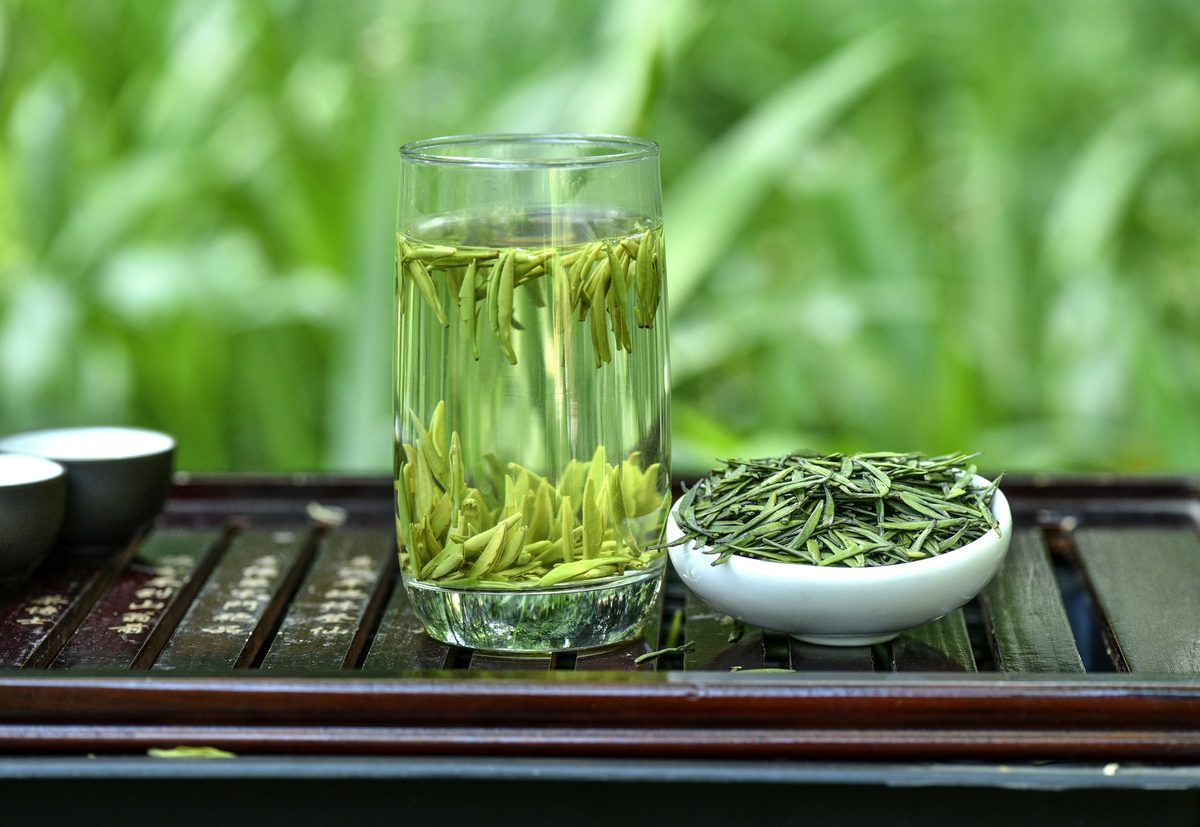
Open a canister of high-quality sencha and the scent alone is distinctive: fresh, grassy, faintly marine — something between new-mown hay and the sea on a calm morning. Look at the leaves and you will see tight, dark-green needles that have been rolled and dried into uniform shapes. Pour hot water over them and within sixty seconds the liquid turns a luminous yellow-green, the aroma lifts, and you have something that has been prepared in essentially the same way in Japanese homes for nearly three hundred years.
Sencha (煎茶) is Japan's most consumed tea by a wide margin, accounting for roughly 80% of the country's total green tea production. It is the tea most Japanese people grew up with, the tea served in ordinary homes every day, and the tea that defines what most people outside Japan mean when they say "Japanese green tea." Unlike the shaded, stone-ground matcha that attracts global attention, or the ceremonial gyokuro reserved for formal occasions, sencha is fundamentally a tea of everyday life — brewed quickly, drunk freely, and appreciated not for its exclusivity but for its freshness and clarity.
What makes sencha distinctive among the world's green teas is its processing method: the freshly harvested leaves of Camellia sinensis are steamed immediately after picking to halt oxidation, then rolled and dried. This steaming step — rather than the pan-firing used in Chinese green teas — locks in the vivid green colour, the characteristic grassy-marine aroma, and the specific balance of polyphenols that sencha drinkers recognise.
From Field to Cup: What Makes Sencha Different
To understand sencha, it helps to understand what it is not. Matcha, gyokuro, and kabusecha are all shade-grown teas: the plants are covered with netting for several weeks before harvest, which drives up chlorophyll and L-theanine while reducing catechins. Sencha is non-shaded — the plants grow in full or partial sunlight, which produces a more balanced and somewhat more astringent profile than the sweeter, creamier shade-grown varieties.
After harvesting, the processing sequence for sencha is precise and swift:
- Steaming (mushime): Freshly picked leaves are steamed for 20–120 seconds (depending on the target grade). This is the critical step that prevents the enzymes responsible for oxidation from browning the leaf — the same reason that Chinese pan-fired teas such as longjing turn yellower and earthier, while sencha stays vivid green and retains its fresh marine character.
- Cooling and primary rolling (hiire): The steamed leaves are cooled, then passed through rollers that begin the shaping process while gently removing moisture.
- Main rolling (honnen): Leaves are rolled repeatedly under pressure and heat into the characteristic tight needle shape, concentrating the leaf's soluble compounds close to the surface for efficient extraction when brewed.
- Drying (kanso): Final drying reduces moisture to below 5%, stabilising the tea for storage and shipment.
The result is a leaf that, when brewed at the right temperature — typically 70–80°C rather than boiling — releases a clean, bright, slightly vegetal cup with a natural umami depth and a refreshing astringency that clears the palate cleanly.
History and Cultural Significance: Senchado and Everyday Japan
Tea arrived in Japan from China in the 8th and 9th centuries, initially as a therapeutic preparation used by Buddhist monks. For several centuries, the dominant form was a powdered tea similar to matcha, used in Zen Buddhist rituals and later formalised into the highly stylised chadō (茶道) — the Way of Tea — by tea masters including Sen no Rikyū in the 16th century.
The history of sencha as a distinct category begins with Nagatani Soen (永谷宗円), a tea producer from Uji, south of Kyoto, who in 1738 developed the rolling-and-drying technique that became the basis for modern sencha production. His method preserved the leaf's colour and freshness far better than earlier approaches, producing a tea that was visually striking and clean in flavour. Within decades, this new-style sencha had spread across Japan and displaced older processing methods for most everyday consumption [Nio Teas, Sencha History].
Parallel to the development of sencha as a product, a distinct tea culture emerged around it. The monk Baisao (売茶翁, 1675–1763) — whose name literally means "tea-selling old man" — wandered Kyoto selling sencha from a portable kit, deliberately positioning his informal outdoor tea service as a counterpoint to the rigid formalism of the chadō schools. Baisao championed sencha as the tea of scholars, artists, and free-thinkers: a tea to be enjoyed in nature, in conversation, and in creative contemplation rather than in the constrained postures of the formal tea room. His practice inspired a following that eventually codified into senchado (煎茶道) — the Way of Sencha — a distinct aesthetic tradition that spread widely during the Edo period (1603–1868) and remains practiced today [My Japanese Green Tea, Senchado].
Where chadō emphasises austere wabi-sabi aesthetics and precise choreography, senchado tends toward a more elaborate visual culture — fine Chinese-style porcelain, scholar's objects, ink paintings, and an atmosphere of refined leisure rather than Zen austerity. Both traditions persist in Japan today, practiced by different communities and appreciated for different reasons.
By the Meiji era (1868–1912), sencha had become unambiguously the everyday tea of Japan across all social classes. The post-war development of mechanical tea-processing equipment and the expansion of Shizuoka, Kagoshima, and Uji as major tea-producing regions transformed sencha from a craft product into an industrial one — without eliminating the artisanal end of the market. Today, Japan produces hundreds of named sencha varieties, and the gap between a supermarket teabag and a premium first-flush shincha from a specialist farm can be as wide as the gap between instant coffee and a competition espresso.
Key Compounds in Sencha
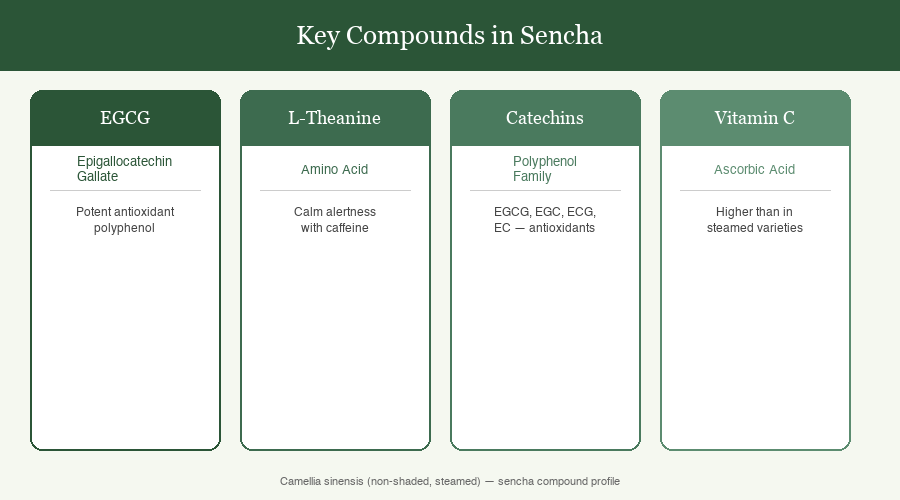
Sencha's compound profile reflects its non-shaded, steamed processing. Because the leaves receive full sunlight during growth, catechins are produced at higher levels than in shade-grown teas — but because steaming (rather than heat-drying) preserves more of the leaf's vitamin C, the overall compound picture is distinctive among global green teas.
Catechins and EGCG
Catechins are a family of polyphenols responsible for much of green tea's astringency and its antioxidant activity. In sencha, the dominant catechin is EGCG (epigallocatechin gallate), which typically represents 50–70% of total catechin content. EGCG has been the most intensively studied polyphenol in green tea research, with a large body of laboratory and epidemiological literature examining its free radical scavenging activity and anti-inflammatory properties at a cellular level [Singh et al., Biochemical Pharmacology, 2011].
Because sencha is grown in full sunlight, its catechin content is typically higher than in shade-grown teas like gyokuro or matcha — which is partly why sencha is more astringent. Standard sencha brewed for one minute contains roughly 100–130 mg of total catechins per 200 ml cup, though this varies considerably by grade, brewing temperature, and steeping time.
L-Theanine
L-Theanine is an amino acid found almost exclusively in Camellia sinensis. It is associated in research with a state of relaxed alertness and is understood to interact with caffeine in ways that may modify the stimulating effects of caffeine alone. In shade-grown teas, L-theanine accumulates at very high levels because shading suppresses the conversion of theanine to catechins; in sencha, which is not shaded, theanine levels are lower than in gyokuro or matcha but higher than in oxidised black teas. A widely cited 2008 study published in Biological Psychology by Owen et al. found that the combination of L-theanine and caffeine together produced better sustained attention and improved alertness than either compound alone [Owen et al., Biological Psychology, 2008]. Sencha naturally contains both compounds, which is part of why it has long been associated with a clear-headed, focused state rather than the jitteriness sometimes associated with coffee.
Caffeine
A standard cup of sencha contains approximately 30–50 mg of caffeine per 200 ml serving — comparable to a moderate cup of black tea, and roughly half the caffeine of a typical espresso. The precise amount varies by grade (first-flush shincha tends to be higher; later-harvest sencha lower), brewing temperature, and steeping time. Because caffeine is more soluble at higher temperatures, brewing sencha at 70°C rather than 90°C meaningfully reduces caffeine extraction in addition to producing a sweeter, less astringent cup.
Vitamin C
One compound that distinguishes steamed Japanese green teas from pan-fired Chinese green teas is their vitamin C (ascorbic acid) content. The steaming process, which is gentler than pan-firing, preserves a larger proportion of the leaf's heat-sensitive vitamin C. Sencha is a notable dietary source of vitamin C — the Japan Standard Food Composition Table records 19 mg per 100 g of sencha infusion (brewed at standard strength) [Japan MEXT Food Composition Database, 2023]. This contributes to the antioxidant profile of the brewed tea and partly accounts for sencha's reputation as a year-round wellness beverage in Japan.
Chlorophyll
The vivid green colour of both the dry sencha leaf and the brewed liquor comes from chlorophyll, which is preserved in high quantities by the rapid steaming process. Chlorophyll has no established bioactive significance in brewed tea at normal consumption levels, but its presence is a practical quality indicator: high chlorophyll content correlates with fresh, high-quality leaves and effective steaming. A yellowed or brownish sencha indicates either old stock, poor processing, or exposure to light and air during storage.
How Do People Drink Sencha Today?
Sencha occupies a unique position in Japanese daily life: it is simultaneously the most ordinary and most respected of the country's everyday teas. A Japanese household might have a box of convenient teabags in the kitchen for quick preparation and a small stock of prized loose-leaf sencha in an airtight tin for moments worth slowing down for.
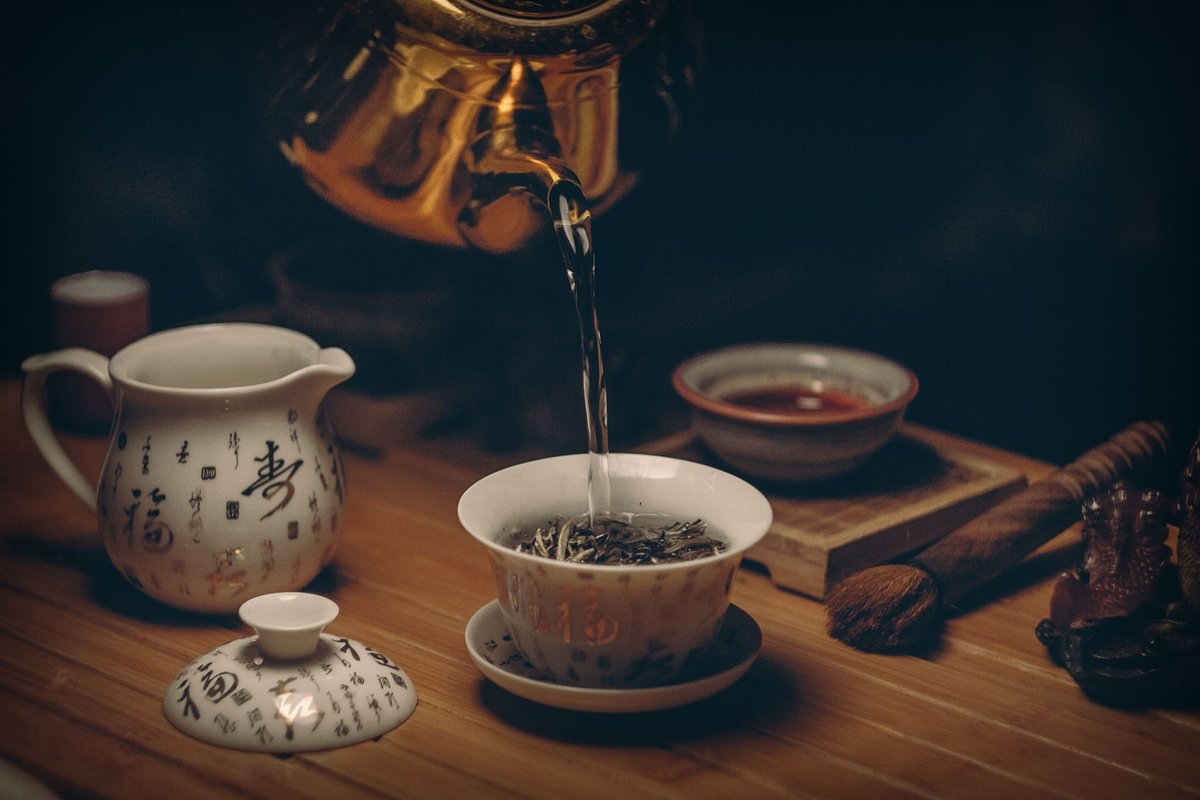
Home brewing remains the dominant mode of consumption. Most Japanese homes that drink sencha regularly have a kyusu — a small side-handled teapot, typically ceramic, in the 200–400 ml range — used specifically for sencha and other green teas. The kyusu's side handle allows pouring without touching the hot pot body, and the small internal strainer (or separate mesh insert) keeps leaves in the pot. Water is heated to 70–80°C, leaves are added, and the tea is poured into small ceramic cups within 60–90 seconds. This is not a ceremony but a practical daily ritual, performed dozens of times a week in ordinary kitchens.
Office and convenience culture has made bottled sencha one of the most purchased beverages in Japan. Canned and bottled ready-to-drink sencha from brands such as Suntory, Ito En, and Kirin is sold in vending machines on every Japanese street corner and in convenience stores (konbini) nationwide. These products are typically unsweetened — the Japanese market strongly prefers sugarless bottled tea — and represent a huge proportion of Japan's per capita tea consumption outside the home.
Restaurant service: Sencha is the standard complimentary hot tea served at most Japanese restaurants, including sushi bars, ramen shops, and family restaurants. The quality varies considerably — from basic teabags in casual settings to fresh-brewed loose-leaf sencha at premium establishments — but the expectation that hot green tea will be available at no cost is deeply embedded in Japanese dining culture.
Iced and cold-brewed sencha has grown significantly as a summer alternative. Cold brewing — steeping loose-leaf sencha in cold water in the refrigerator for 6–8 hours — produces a naturally sweet, smooth cup with lower caffeine and less astringency than hot-brewed sencha, because cold water extracts catechins and bitter compounds more slowly. This technique has spread beyond Japan as specialty tea culture has grown internationally.
International specialty tea culture: Outside Japan, sencha has become a standard offering at specialty tea shops alongside matcha and gyokuro, introduced to markets in Europe, North America, and Australia primarily through Japanese restaurant culture and the growing interest in Japanese wellness traditions. The "Japanese green tea" most widely encountered abroad is typically a form of sencha, whether loose-leaf or in high-quality teabags. Individual responses to sencha's flavour vary — some people find the fresh vegetal character immediately appealing, while others accustomed to black tea or Chinese green teas need time to adjust to its distinctively grassy, marine notes.
What Does the Research Say About Sencha?
The research picture for sencha specifically — as distinct from green tea generally or its isolated compounds — is mixed in terms of clinical evidence, but well-developed in terms of compound characterisation and population-level observation.
The most established area of research concerns EGCG and antioxidant activity. A comprehensive review published in Biochemical Pharmacology by Singh et al. (2011) documented the mechanisms by which EGCG may support antioxidant activity in healthy cells, with detailed evidence of its free radical scavenging capacity in laboratory models [Singh et al., 2011]. The translation of these in-vitro findings to human health outcomes remains an active research area.
For the L-theanine and caffeine combination, a notable human study by Owen et al. (2008) in Biological Psychology found that combined L-theanine (100 mg) and caffeine (50 mg) improved sustained attention, self-reported alertness, and accuracy on demanding cognitive tasks compared to placebo, with the combination outperforming either compound in isolation [Owen et al., 2008]. A typical 200 ml cup of sencha provides roughly 30–50 mg of caffeine and 15–30 mg of L-theanine — lower doses than in the study, but in a similar ratio.
At a population level, Japanese epidemiological research has generated consistent associations between green tea consumption and various health markers. A J-STAGE prospective cohort study by Kuriyama et al. (2006) following over 40,000 adults in Miyagi Prefecture found that higher green tea consumption (5+ cups daily) was associated with lower all-cause and cardiovascular mortality over an 11-year follow-up period, with larger associations in women than in men [Kuriyama et al., J Epidemiol, 2006]. This type of observational research cannot establish causation — green tea drinkers in Japan differ from non-drinkers in many lifestyle dimensions — and does not directly inform what any individual might experience from daily sencha consumption. Nevertheless, it has sustained scientific and public interest in Japanese green tea for over two decades.
The NCCIH at the U.S. National Institutes of Health notes that green tea consumed as a beverage is generally considered safe for most adults, acknowledges some preliminary evidence for modest effects on cholesterol levels in certain populations, and emphasises that most findings from green tea supplements or extracts should not be directly applied to brewed tea consumption [NCCIH, Green Tea]. Sencha as a brewed beverage delivers compounds in a diluted, bioavailable form very different from concentrated green tea extracts.
The honest summary is that sencha is a well-characterised, historically consumed beverage with a consistent compound profile and a favourable general safety record. Whether it confers specific, measurable benefits for any individual depends on factors — genetics, diet, lifestyle, health status — that current research cannot predict at the individual level. What the evidence supports is that moderate daily consumption of brewed sencha is a well-established part of Japanese wellness tradition and is consistent with a healthy adult dietary pattern.
Brewing Guide: Getting the Best from Sencha
Sencha is more temperature-sensitive than most teas. The catechins responsible for astringency extract rapidly at high temperatures; the amino acids (including L-theanine) that give sencha its umami sweetness extract at lower temperatures. Getting the water temperature right is the single most impactful brewing variable.
Basic Hot Brewing Method
- Water temperature: Heat water to 70–80°C (158–176°F). If using a standard kettle, boil water and let it rest for 3–4 minutes before using. If you have a temperature-control kettle, set it to 75°C. Lower temperatures (68–72°C) favour sweetness and umami; higher temperatures (78–82°C) emphasise the grassy astringency. Fukamushi (deep-steamed) sencha can be slightly more forgiving at higher temperatures than asamushi.
- Leaf ratio: Use 3–4 grams of loose sencha per 200 ml of water (roughly 1 heaped teaspoon to 1 tablespoon depending on the grade). This is higher than most Western loose-leaf tea guidelines — sencha extracts quickly and efficiently, so a shorter steep with more leaf is better than a longer steep with less.
- Steep time: Steep for 45–90 seconds. First infusions are typically 45–60 seconds for high-grade sencha and up to 90 seconds for standard grades. Do not leave leaves in the water longer than 2 minutes — over-extraction produces a flat, bitter cup dominated by catechin astringency.
- Pour fully: When the steep is complete, pour all the liquid out of the kyusu or teapot, leaving no water behind. Residual water continues extracting and will make the second infusion bitter.
- Multiple infusions: Sencha is typically brewed 2–3 times. The second infusion, with slightly hotter water (75–80°C) and a shorter steep (20–30 seconds), often produces the sweetest cup. The third infusion is lighter and more delicate, with almost no astringency.
Cold Brew Sencha
For a summer preparation, add 5–6 grams of sencha to 600 ml of cold or room-temperature water in a pitcher or glass bottle. Cover and refrigerate for 6–8 hours (or up to overnight). Cold extraction produces a naturally sweet, smooth cup with clear green-yellow colour, reduced bitterness, and noticeably lower astringency than hot-brewed sencha. This is an excellent introduction to sencha for those who find the hot-brewed version too sharp.
Teaware
A ceramic kyusu (急須) teapot with a built-in strainer is the traditional Japanese vessel and works exceptionally well. Unglazed Tokoname clay (from Aichi Prefecture) is considered ideal because it absorbs trace bitterness from the tea over time, smoothing the flavour of subsequent brews. A simple glass teapot or a fine-mesh strainer over any heatproof vessel works perfectly well for everyday brewing. Avoid stainless steel infuser baskets with large holes, which can allow fine sencha particles through into the cup.
Grades and Varieties
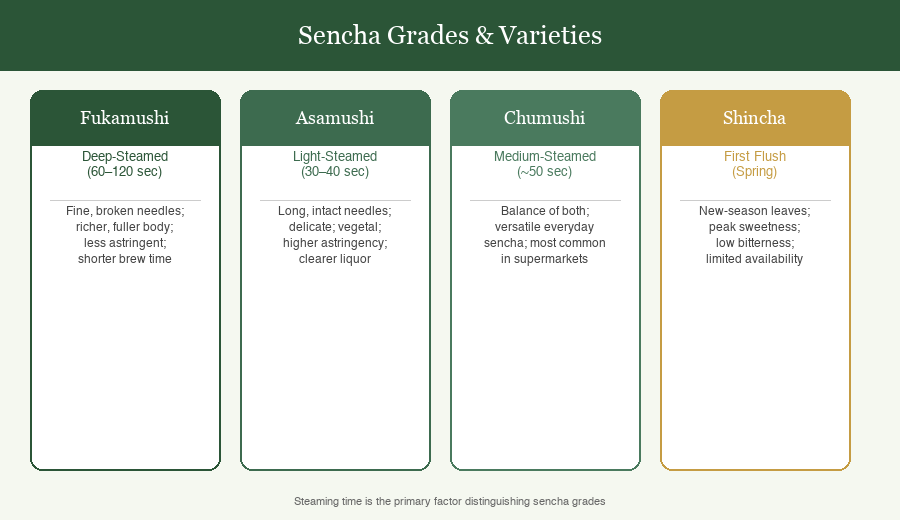
Sencha is not a single uniform product. The category encompasses a wide range of quality levels and processing styles, each producing a distinct drinking experience.
By Steaming Duration
Asamushi (浅蒸し, "light-steamed", 20–40 seconds) produces long, intact, elegant needles. The cup is clear, pale golden-green, delicate, and slightly more astringent — the preferred style in some traditional tea-growing regions and among purists who value an unmanipulated expression of the leaf's natural character.
Chumushi (中蒸し, "medium-steamed", 40–60 seconds) represents the mainstream. Most sencha sold in Japanese supermarkets and exported abroad falls in this range. The balance between freshness and body is considered approachable for most palates.
Fukamushi (深蒸し, "deep-steamed", 60–120 seconds) has become increasingly popular since the 1970s, particularly in the Shizuoka region. The extended steaming breaks down the leaf structure, producing fine, powder-like particles and a shorter brewing time. The resulting cup is notably richer, darker green, fuller in body, and less astringent than asamushi. Many people find it immediately accessible, though it produces a cloudier liquor than the other grades.
Shincha — The New Season Tea
Shincha (新茶, "new tea") is the first-flush harvest of the year, typically picked in late April to early May in Japan. The leaves that have spent winter accumulating amino acids and other compounds release them in the first spring growth. Shincha is characterised by exceptional freshness, a pronounced sweetness, lower bitterness than later-harvest sencha, and a lively aroma. It is sold for a short window each spring and often commands premium prices. Japanese tea culture treats shincha's arrival as a seasonal event, much as wine culture treats the Beaujolais Nouveau release — a reason to celebrate the new harvest.
Regional Varieties
Different Japanese prefectures produce sencha with recognisable regional characteristics. Uji (Kyoto) sencha, from the birthplace of modern sencha production, tends toward delicate, refined profiles. Shizuoka sencha — from Japan's largest tea-producing prefecture — covers a wide range, from supermarket basics to premium artisanal lots. Kagoshima sencha, from the southern tip of Kyushu, benefits from a warmer climate that produces earlier harvests and a rounder, less astringent profile. Yame (Fukuoka) is known for high-grade sencha with complex umami depth, positioned between standard sencha and gyokuro in its character.
Important Considerations
- Caffeine content: Sencha contains a meaningful amount of caffeine — approximately 30–50 mg per cup. This is moderate by global beverage standards but relevant for individuals with caffeine sensitivity, those who are pregnant, or those managing specific health conditions. Brewing at lower temperatures (68–72°C) and shorter steep times reduces caffeine extraction.
- Drug interactions: The NCCIH notes that green tea at normal dietary consumption levels rarely causes clinically significant drug interactions; concerns are primarily associated with concentrated green tea extract supplements rather than brewed beverages [NCCIH]. Individuals taking nadolol or other beta-blockers, anticoagulants, or certain statins with documented green tea interactions should discuss their tea habits with a healthcare provider.
- Iron absorption: Catechins in green tea can bind to non-haem iron (the form found in plant foods) and reduce its absorption when consumed together. Those who depend on plant-based iron sources may benefit from not drinking sencha with or immediately after iron-rich meals.
- Storage: Sencha's quality deteriorates faster than most teas. Exposure to air, light, heat, and moisture all degrade the catechins and chlorophyll rapidly, producing a flat, yellow, stale tea. Store in an airtight, opaque container in the refrigerator (remove and allow to reach room temperature before opening to prevent condensation) or in a cool, dark cupboard. Consume within 2–3 months of opening.
- Pregnancy and breastfeeding: Moderate caffeine intake (under 200 mg daily total across all sources) is generally considered compatible with pregnancy by most health authorities, but individual guidance from a healthcare provider is always appropriate.
- Individual responses vary considerably: Some people find sencha's flavour immediately appealing; others find it too vegetal or astringent. Some people are more sensitive to caffeine than others. What constitutes a comfortable daily amount differs from person to person, and adjusting brewing parameters is always the first step before reducing quantity.
Frequently Asked Questions
What does sencha taste like?
Sencha has a fresh, grassy, slightly vegetal character with a clean astringency and a natural umami sweetness, particularly in higher-grade versions. It is often described as having a "marine" or "oceanic" note — something between fresh grass and a light sea breeze. Brewed at lower temperatures (70°C), the sweetness becomes more prominent; at higher temperatures, the astringency increases. The colour of a well-brewed cup is a clear yellow-green. First-flush shincha tends to be sweeter and more fragrant than later-harvest sencha, which is somewhat more robust.
How is sencha different from matcha?
Both sencha and matcha come from Camellia sinensis leaves grown in Japan, but they differ in almost every other respect. Matcha is made from shade-grown leaves that are stone-ground into a fine powder and whisked into water — you consume the whole leaf. Sencha is made from non-shaded leaves that are steamed, rolled into needles, and brewed in water that is then poured off — you consume only the infusion. Matcha is richer, creamier, higher in L-theanine and chlorophyll, and sweeter due to shading; sencha is fresher, clearer, more astringent, and more directly expressive of the leaf's natural unshaded flavour. Matcha belongs to the formal tea ceremony (chadō); sencha belongs to everyday life and to the distinct senchado tradition.
What is senchado?
Senchado (煎茶道) is the "Way of Sencha" — a Japanese aesthetic tradition that developed in the 18th century around the preparation and appreciation of loose-leaf sencha. Inspired by the monk Baisao and the broader culture of scholarly tea appreciation, senchado developed as an alternative to the more formal chadō (matcha tea ceremony). Where chadō emphasises Zen austerity and precise choreography, senchado tends toward a more elaborate, scholar's aesthetic — fine Chinese-style teaware, ink paintings, scholar's objects, and a spirit of creative contemplation. Both traditions coexist in Japan today and are practiced by different communities for different cultural and personal reasons.
How many cups of sencha is it reasonable to drink daily?
For most healthy adults, 2–4 cups of sencha daily is a level well within the range of typical Japanese consumption patterns and is not associated with adverse effects in the published literature. The main limiting factor for most people is caffeine — at 30–50 mg per cup, 4 cups provides 120–200 mg of caffeine, which is within the range generally considered moderate. The NCCIH considers green tea safe for most adults at these consumption levels. Individual responses to caffeine and to the astringency of green tea vary; there is no single correct amount that suits everyone, and adjusting based on personal tolerance is sensible.
What is the difference between sencha and gyokuro?
Both are high-quality Japanese green teas made from Camellia sinensis, but gyokuro (玉露) is shade-grown for approximately 20 days before harvest, while sencha grows in full or partial sunlight. Shading dramatically raises L-theanine and chlorophyll while reducing catechins and caffeine. The result: gyokuro is sweeter, creamier, more umami-rich, darker green, and less astringent than sencha — and significantly more expensive. Gyokuro is brewed at very low temperatures (50–60°C) for a short steep and is typically consumed in smaller quantities as an occasion tea. Sencha is the everyday tea; gyokuro is the special-occasion premium.
Does sencha go stale?
Yes, more quickly than most teas. Sencha's high chlorophyll content and the freshness that defines its character are sensitive to oxygen, light, heat, and moisture. An opened container left at room temperature and exposed to light will lose much of its freshness within a few weeks — the colour of the dry leaf yellows, the aroma flattens, and the brewed cup becomes dull and lifeless. For optimal freshness, store in an airtight, opaque container in the refrigerator (removing to room temperature before opening) and use within 2–3 months of opening. Vacuum-sealed, unopened sencha in a cool, dark storage area typically maintains quality for 6–12 months from the harvest date.
About This Article
Written by: Health Diary Editorial Team — researchers and writers specialising in Japanese wellness traditions, tea culture, and evidence-based wellness content.
Editorial review: This article has been reviewed by the Health Diary editorial team for clarity, structure, and adherence to our sourcing standards. Key claims were cross-checked against NCCIH green tea guidance, PMC peer-reviewed literature on EGCG and L-theanine/caffeine (Singh et al. 2011; Owen et al. 2008), the Japan MEXT Standard Food Composition Table, J-STAGE epidemiological data (Kuriyama et al. 2006), and specialist Japanese tea sources. It is not a clinical review and should not replace consultation with a licensed healthcare practitioner.
Reviewed on: June 14, 2026.
Editorial process: We cite peer-reviewed and government sources where possible. When a clinical reviewer is added to this article, attribution will appear here with verifiable credentials.
References
- Singh BN, Shankar S, Srivastava RK. (2011). Green tea catechin, epigallocatechin-3-gallate (EGCG): mechanisms, perspectives and clinical applications. Biochemical Pharmacology. 82(12):1807–1821. https://pmc.ncbi.nlm.nih.gov/articles/PMC4082721/
- Owen GN, Parnell H, De Bruin EA, Rycroft JA. (2008). The combined effects of L-theanine and caffeine on cognitive performance and mood. Biological Psychology. 77(2):113–122. https://pubmed.ncbi.nlm.nih.gov/18006208/
- Kuriyama S, Shimazu T, Ohmori K, et al. (2006). Green tea consumption and mortality due to cardiovascular disease, cancer, and all causes in Japan. Journal of Epidemiology. 16(Suppl 1):S96–S102. https://www.jstage.jst.go.jp/article/jea/16/suppl_1/16_suppl_1_S96/_article
- National Center for Complementary and Integrative Health (NCCIH). Green Tea: Usefulness and Safety. U.S. National Institutes of Health. https://www.nccih.nih.gov/health/green-tea
- Japan Ministry of Education (MEXT). Standard Tables of Food Composition in Japan — Sencha (煎茶) infusion. Food Composition Database, 2023. https://fooddb.mext.go.jp/details/details.pl?ITEM_NO=16_16013_7
- Nio Teas. Sencha History — The Origins of Japan's Most Popular Green Tea. https://nioteas.com/blogs/sencha/sencha-history
- My Japanese Green Tea. Senchado — The Way of Sencha. https://www.myjapanesegreentea.com/senchado