Gotu Kola (Rau Má) in Traditional Eastern Medicine: A Beginner's Guide
Educational guide to gotu kola (Centella asiatica / rau má) — Vietnamese traditional medicine context, four key triterpenoid saponins (asiaticoside, madecassoside, asiatic acid, madecassic acid), wound-healing research (supported), 2017 SR+MA cognitive finding (null), modest mood benefit, traditional Vietnamese preparations, and important hepatotoxicity safety considerations (NIH LiverTox Likelihood Score C).
Medical Disclaimer: This content is for educational and informational purposes only and is not medical advice. The information presented is not intended to diagnose, treat, cure, or prevent any disease. Always consult a licensed healthcare practitioner before starting any new herbal practice or supplement. Statements regarding traditional herbal use have not been evaluated by the FDA.
Affiliate Disclosure: This article contains affiliate links. We may earn a commission if you purchase through these links, at no additional cost to you. We only recommend products we believe align with our editorial standards.
Walk through any Vietnamese market on a hot afternoon and you will likely see vendors selling cups of nước rau má — a vivid green drink made from a small, low-growing herb that has been part of Vietnamese, Indian, Chinese, and Sri Lankan traditional medicine for centuries. In English it is most often called gotu kola; in Vietnamese, rau má; in Sanskrit Ayurveda, brahmi (though this name is also used for another plant); in Chinese TCM, jī xuě cǎo (积雪草, "snow grass"). Botanically it is Centella asiatica. This guide walks through what Vietnamese and other Asian traditional medicine systems say about gotu kola, what modern peer-reviewed research has begun to suggest — including some surprisingly null findings on cognition — how the leaf is traditionally prepared, and the important safety considerations including documented hepatotoxicity case reports.
One Important Distinction at the Start
Memorial Sloan Kettering Cancer Center's monograph opens with a clarification that is genuinely useful: gotu kola is not kola nut [1]. Despite the name similarity, gotu kola (Centella asiatica) contains no caffeine and has no stimulant properties. Kola nut (Cola acuminata / Cola nitida) is a different plant, contains substantial caffeine, and comes from West Africa. Marketing copy that suggests gotu kola has stimulant or energy-drink-like properties is often confusing these two unrelated plants.
Why Gotu Kola Has Endured Across Asia
Gotu kola appears in multiple traditional medical systems. The Vietnam-Korea Institute of Science and Technology (VKIST) describes Centella asiatica as a "valuable medicinal plant available throughout Vietnam," noting that the plant is distributed nationwide and is particularly well-suited to climates like Thừa Thiên Huế [2]. In Vietnamese tradition, the plant is treated as both a food (commonly eaten raw in salads, blended into the famous nước rau má drink, or added to soups) and a medicine. The Ho Chi Minh City Institute of Traditional Medicine summarizes its classical Vietnamese functions as giải nhiệt (clearing heat), giải độc (detoxifying), thông tiểu (promoting urination), lợi sữa (promoting lactation), and mát gan ("cooling the liver") [3].
The cultural reach of the herb extends well beyond Vietnam. In Ayurvedic tradition, gotu kola has been used for cognitive support and as a brain tonic for over two thousand years. In Sri Lanka, it has been used in postpartum recovery and as a daily salad green. In Chinese TCM under the name 积雪草, it has been used for skin conditions and detoxification patterns. The cross-cultural consistency of "skin healing, cooling, detoxifying" themes is one of the more striking features of gotu kola's traditional record.
How Traditional Eastern Medicine Views Gotu Kola
Within Vietnamese traditional medicine, gotu kola is classified as a cooling herb — sweet and slightly bitter in taste, cool in nature. The traditional applications catalogued by the Ho Chi Minh City Institute of Traditional Medicine span a wide range [3]:
- Skin conditions — boils (mụn nhọt), prickly heat (rôm sảy mẩn ngứa), wound healing
- Fever reduction (hạ sốt)
- Detoxification (giải độc) — including traditional use for heatstroke (say nắng)
- Hepatic patterns — "cooling the liver" framing, traditional use for jaundice and hepatitis-pattern complaints
- Digestive complaints — diarrhea, gastric discomfort, constipation
- Cardiovascular and women's health applications — promotion of lactation, postpartum recovery support
It is worth noting that traditional indication lists tend to be much broader than what modern clinical evidence supports — this is true for nearly every traditional herb. The traditional record reflects centuries of observation and use; it does not constitute clinical proof of any of these specific applications.
The Bioactive Chemistry
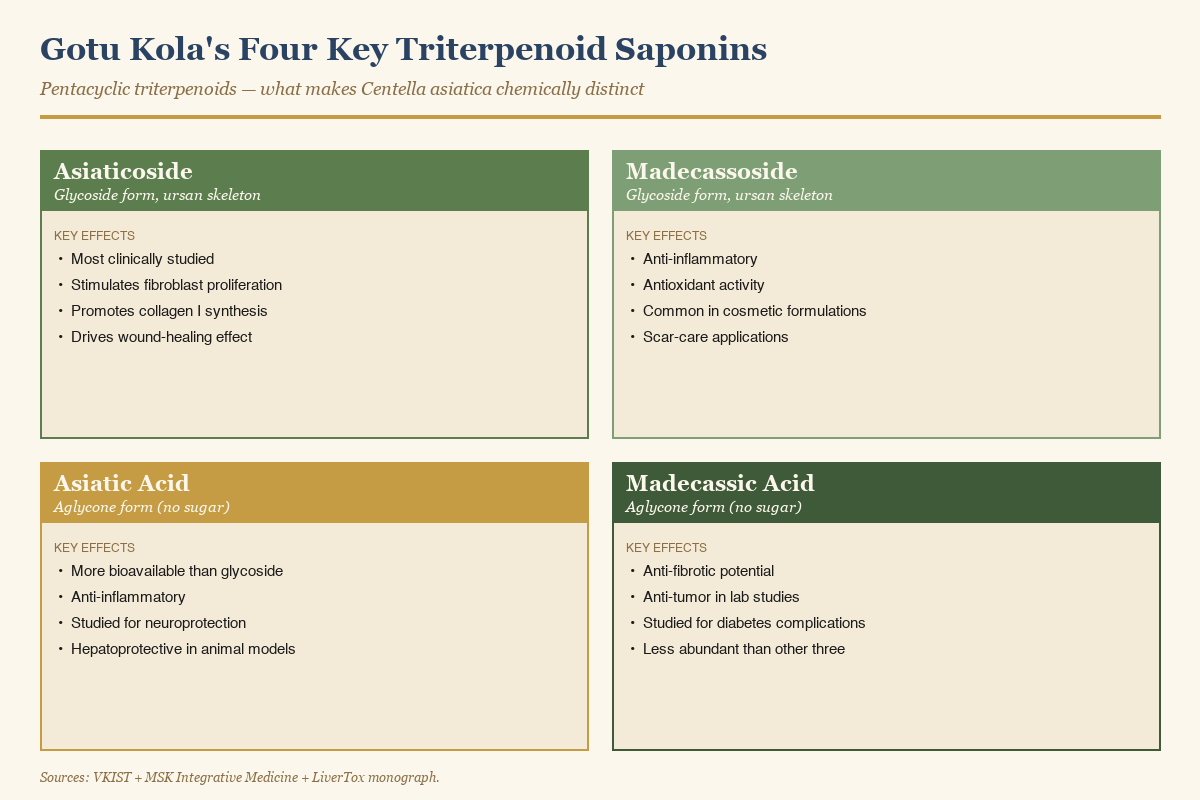
Gotu kola's modern research base centers on a class of compounds called pentacyclic triterpenoid saponins. The VKIST monograph lists the main bioactives [2]:
- Asiaticoside and madecassoside — the principal ursan-skeleton triterpenoid saponins; these are the compounds most often credited for wound-healing and skin-regeneration effects in modern cosmetic and pharmaceutical formulations
- Asiaticoside B — an olean-skeleton variant
- Asiatic acid and madecassic acid — the aglycone forms (the same triterpene structures without their sugar attachments)
- Flavonoids — including quercetin and kaempferol
- Alkaloids, essential oils, and fatty acids
The pentacyclic triterpenoid family is what makes gotu kola unusual: most TCM herbs we have covered so far are dominated by flavonoids or polysaccharides. Gotu kola sits in a different chemical class — closer to ginsenosides (also triterpenes) than to chrysanthemum or perilla flavonoids.
What Does the Research Say About Gotu Kola?
Modern research on gotu kola is uneven — strong on wound healing, mixed on cardiovascular indications, and surprisingly null on the cognitive uses most commonly marketed.
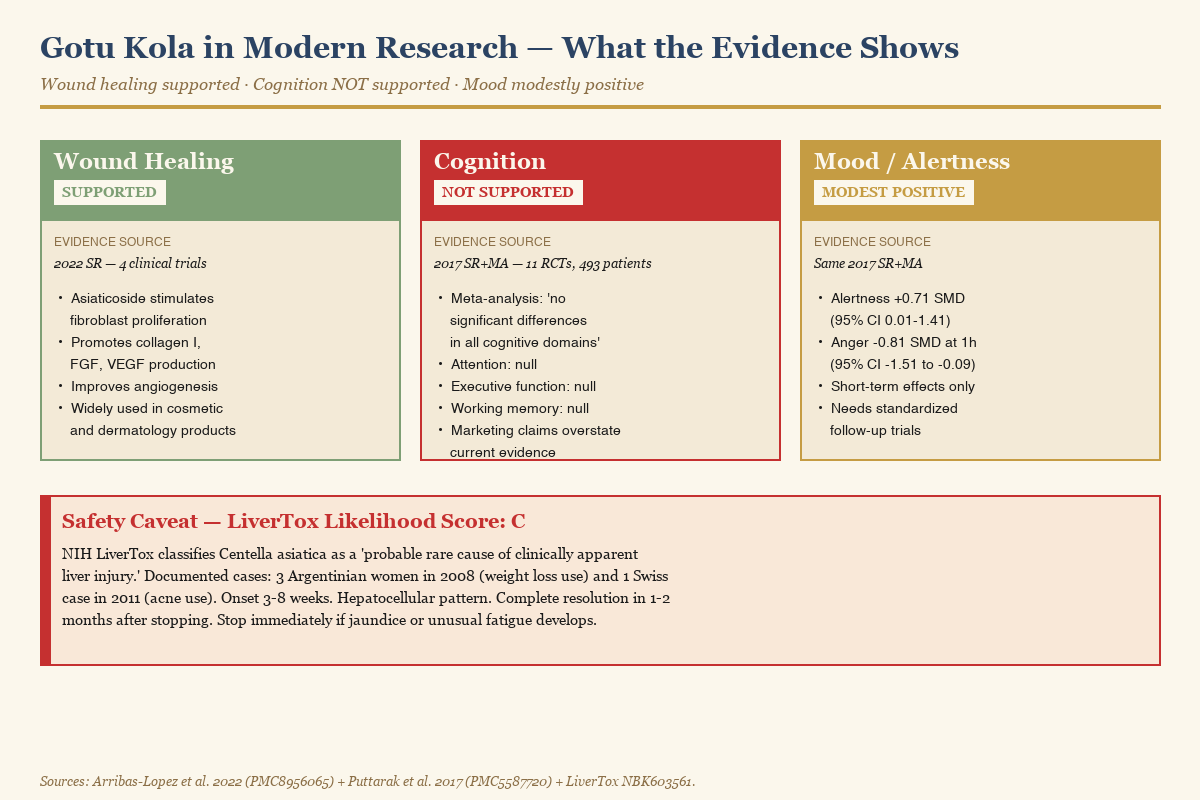
Wound healing — the most validated traditional use. A 2022 systematic review of clinical trials concluded that C. asiatica "might enhance wound healing through improved angiogenesis, potentially via stimulating effects on collagen I, Fibroblast Growth Factor (FGF), and Vascular Endothelial Growth Factor (VEGF) production" [4]. The mechanism is consistent across in vitro, animal, and the small number of human studies: asiaticoside specifically stimulates fibroblast proliferation and collagen synthesis [2]. This is why Centella asiatica extracts now appear widely in modern wound-care formulations and dermatological cosmetics.
Cognitive function — the null finding most consumers do not hear about. Despite a centuries-old Ayurvedic reputation as a brain tonic, the 2017 systematic review and meta-analysis of 11 RCTs (~493 participants) is remarkably direct [5]: "Meta-analysis indicated that there are no significant differences in all cognitive function domains of C. asiatica when compared to placebo." The review found no significant effects across overall cognitive status, attention, executive function, working memory, information processing speed, language, verbal memory, or visual memory. Only a single observation — improved numeric working memory time at 750 mg extract one hour post-ingestion — pointed positively. Anyone reading marketing copy about gotu kola as a "natural nootropic" is reading a stronger claim than the current best meta-analysis supports.
Mood — modest positive signal in the same SR+MA. The 2017 review did identify positive mood findings worth knowing about: alertness increased (standardized mean difference 0.71, 95% CI 0.01–1.41) and anger decreased at one hour post-ingestion (SMD −0.81, 95% CI −1.51 to −0.09) [5]. The authors note these warrant further investigation with standardized protocols. So gotu kola may have something to offer for short-term mood/alertness, even if the cognitive enhancement story does not hold up.
Vietnamese clinical research — gastric ulcer. VKIST cites a Vietnamese clinical study reporting that 93% of patients treated with rau má-based therapy for gastric ulcer showed effectiveness [2]. The full methodology was not detailed in the public-facing summary, but this represents the kind of Vietnamese national clinical research that English-language reviews rarely capture.
Immunomodulation and neurogenesis. Preclinical research has also identified immunomodulatory activity (with potential anti-tumor relevance in laboratory studies) and neurogenesis-supportive effects [2]. These remain preclinical findings; the leap to human clinical effect remains incomplete.
The overall picture: wound healing is the most clinically supported use; cognitive enhancement is not supported by the current best meta-analysis; mood and alertness effects show modest positive signal; everything else is preliminary.
How Do People Use Gotu Kola (Rau Má)?
The Ho Chi Minh City Institute of Traditional Medicine documents several concrete Vietnamese preparations [3]:
Nước Rau Má — The Vietnamese Daily Drink
The most familiar form. Fresh rau má leaves washed, blended with water, optionally with a small amount of sugar or coconut. Traditionally consumed in summer as a cooling drink. The daily dose described in Vietnamese traditional sources is 30–40 g of fresh leaves [3]. This is the form most Vietnamese people encounter daily.
Rau Má for Digestive Discomfort
For abdominal pain or mild diarrhea, Vietnamese tradition uses 30–40 g of fresh rau má, eaten raw or crushed, strained through a cloth, taken with a little salt [3].
Rau Má for Prickly Heat and Skin Rash
For summer skin irritation, Vietnamese tradition uses fresh leaves washed and crushed, the juice strained and drunk with a little sugar [3]. This matches the cooling/clearing-heat traditional framing.
Topical Application — The Most Internationally Recognized Use
Beyond Vietnam, gotu kola's most internationally recognized form is in topical preparations for wound healing, scar care, and dermatological cosmetics — driven by asiaticoside's documented effects on collagen and angiogenesis. The Vietnamese modern industry has built substantial pharmaceutical and cosmetic supply chains around exactly this extract.
Standardized Extracts and Capsules
For systemic use, gotu kola is sold as standardized extracts in capsule or tablet form. LiverTox documents typical oral doses as 60–120 mg/day of purified extracts or 600–1800 mg/day of capsules/powders [6]. These ranges are higher than the 30–40 g/day fresh-leaf intake of traditional Vietnamese practice would translate to in terms of total triterpene exposure, but the comparison is complicated by extract standardization and bioavailability differences.
Individual responses vary considerably; what works well for one person may not suit another, and personal experimentation under practitioner guidance is always recommended.
Important Limitations and Considerations
Gotu kola has one safety topic that warrants close attention: documented rare hepatotoxicity case reports.
- Hepatotoxicity — rare but documented — The NIH LiverTox monograph assigns Centella asiatica a Likelihood Score of C (probable rare cause of clinically apparent liver injury) [6]. Documented cases include three Argentinian women in 2008 who developed jaundice 3–8 weeks after starting gotu kola for weight loss, and a single Swiss case in 2011 from oral use for acne treatment. The injury pattern is hepatocellular with acute hepatitis and granulomatous changes on biopsy. The good news: complete resolution within 1–2 months after discontinuation in all reported cases. The mechanism is unknown — likely idiosyncratic, possibly immune-mediated. Hepatotoxicity remains very rare relative to the herb's widespread use, but the risk is real. Practical implication: if jaundice, unusual fatigue, or right-upper-quadrant abdominal discomfort develops on long-term gotu kola supplementation, stop immediately and consult a healthcare provider.
- Wide CYP450 inhibition — MSK's monograph reports that gotu kola inhibits multiple cytochrome P450 enzymes in vitro: CYP1A2, CYP2C9, CYP2D6, CYP3A4, and CYP2C19 [1]. This is an unusually broad CYP profile. The clinical relevance has not been fully established, but anyone taking multiple prescription medications metabolized through these pathways (which is most medications) should consult a prescriber before adding daily gotu kola extract.
- Skin reactions — Contact dermatitis and skin rash have been reported, especially with topical use [1]. Patch testing before full topical application is reasonable.
- Pregnancy and breastfeeding — Insufficient safety data exist for routine recommendation during pregnancy. Most professional sources advise consultation with a practitioner rather than self-experimentation. Traditional Vietnamese sources also vary in their guidance, and the historical "lợi sữa" (promoting lactation) use is not a basis for daily supplementation in modern wellness contexts.
- Concurrent diabetes medications — Theoretical concerns exist about effects on blood glucose from some preclinical research; people on insulin or sulfonylureas should be cautious about adding concentrated gotu kola extracts.
- Cold-constitution patterns — Because Vietnamese and Chinese tradition classify gotu kola as a cooling herb, classical practice cautions against habitual use by individuals with what traditional sources called "cold-deficient constitution" — typical signs include chronic loose stools, weak digestion, cold extremities. The herb's cooling nature may aggravate these patterns.
- Duration and dose — Even setting aside the rare hepatotoxicity risk, traditional Vietnamese practice does not treat rau má as an indefinite daily supplement. Seasonal use (more in summer for cooling), short-term applications (for specific symptoms), and modest culinary amounts are closer to the tradition than long-term concentrated extract supplementation.
- Quality and standardization — As with most herbal supplements, commercial gotu kola products vary significantly in plant origin, extract concentration, and standardization. The 2017 meta-analysis specifically flagged that only 27% of included RCTs reported plant standardization methods — a striking gap [5].
These limitations are not meant to discourage culinary use of fresh rau má — that is part of Vietnamese gastronomy and unquestionably a cultural good. They are meant to add realistic context to the modern wellness habit of treating concentrated gotu kola extracts as a daily long-term supplement, which is a different practice than the tradition actually describes.
Frequently Asked Questions About Gotu Kola (Rau Má)
Can I drink gotu kola juice every day?
Fresh rau má juice is a popular daily drink in Vietnam, and moderate daily consumption in culinary quantities is generally considered well tolerated by most healthy adults. However, gotu kola has documented hepatotoxicity case reports in the medical literature — the NIH LiverTox database assigns it a Likelihood Score of C for liver injury. Long-term concentrated supplementation without medical supervision is not recommended. Individual responses vary considerably.
Does gotu kola improve memory or cognitive function?
This is one of gotu kola's most commonly cited traditional uses, but the clinical evidence is mixed. A 2017 systematic review and meta-analysis of 11 randomised controlled trials found no significant differences in cognitive function domains compared to placebo. The same review did find modest positive effects on alertness and mood at one hour post-ingestion, but these findings require further research before conclusions can be drawn.
What is rau má traditionally used for in Vietnamese medicine?
In Vietnamese traditional medicine, rau má is classified as a cooling herb used to clear heat (giải nhiệt), detoxify (giải độc), promote urination, cool the liver (mát gan), and support skin health. Fresh juice mixed with a little sugar is a common traditional preparation, particularly during hot months. The typical traditional dose is 30–40g of fresh leaf daily.
Can gotu kola cause liver damage?
Rare but documented cases of liver injury associated with gotu kola exist in the medical literature. The NIH LiverTox database assigns Centella asiatica a Likelihood Score of C — meaning it is a probable rare cause of clinically apparent liver injury. Documented cases involved jaundice onset within 3–8 weeks of use, typically resolving within 1–2 months after discontinuation. The mechanism is thought to be idiosyncratic (unpredictable individual reaction) rather than dose-dependent toxicity in typical culinary amounts.
Is gotu kola safe during pregnancy?
There is insufficient evidence to confirm safety during pregnancy. Given the documented hepatotoxicity potential and lack of adequate safety studies in pregnant populations, most healthcare practitioners advise caution. Consult your healthcare provider before use during pregnancy or breastfeeding.
A Note on Tracking — Where Health Diary Comes In
Traditional Eastern wellness practice has always emphasized observation over time. Classical Vietnamese practitioners assessed patterns — sleep, energy, skin condition, digestive comfort, sensitivity to heat, seasonal response. That practice maps well onto modern habits like journaling and habit tracking.
For someone using gotu kola, tracking a few signals over a few weeks is more informative than relying on day-to-day impressions. Useful things to record might include:
- Skin condition and wound/scar healing if relevant
- Energy levels and alertness (the 2017 SR+MA found short-term alertness improvement)
- Mood (particularly anger or irritability — the SR+MA found short-term reduction)
- Digestive comfort (traditional cold-constitution caution)
- Seasonal response to heat (the cooling-herb traditional framing)
- Any unusual fatigue, right-upper-quadrant discomfort, or skin/eye yellowing — these are signals to stop and seek medical evaluation given the documented hepatotoxicity case reports
Patterns observed across weeks tell a story that any single morning cannot. That principle is older than gotu kola itself.
A Soft Closing Note
Gotu kola sits in an interesting position in Vietnamese and Asian herbal tradition: a daily food, an externally applied skin healer, and an internally consumed cooling drink. The wound-healing evidence is among the more clinically validated of any traditional herb covered in this series. The cognitive-enhancement claims are not supported by the current best meta-analysis. The hepatotoxicity case reports are rare but real. Modern Vietnamese pharmaceutical and cosmetic industries have built substantial supply chains around the asiaticoside extract — a recognition of the herb's clinical promise that also raises the importance of standardization.
If you are curious about traditional wellness practices, the most useful next step is usually slow learning rather than an immediate purchase. Reading reputable sources — peer-reviewed reviews, government health-authority monographs, classical herbal texts — and observing your own patterns through journaling tend to produce better outcomes than chasing any single ingredient. For gotu kola specifically, culinary use of fresh leaves (the nước rau má drink, leaves in salad or soup) is closer to traditional practice than indefinite daily concentrated-extract supplementation.
You can learn more about traditional body constitutions and seasonal wellness rhythms on our companion guides, including our overview of perilla leaf (tía tô) — another foundational Vietnamese herb — and our Chinese herbal entries on astragalus, angelica root, licorice root, and chrysanthemum.
About This Article
Written by: Health Diary Editorial Team — a small editorial group researching traditional wellness practices, herbal traditions, and quantified-self methods. Our articles draw on peer-reviewed literature, government health-agency monographs (NIH LiverTox, NCCIH), academic medical centers (MSK Integrative Medicine), Vietnamese government health and science institutes (Viện Y Dược học Dân tộc TP.HCM, VKIST), and primary native-language sources.
Editorial review: This article has been reviewed by the Health Diary editorial team for clarity, structure, and adherence to our sourcing standards. Key claims were cross-checked against NCCIH, NIH PubMed, and LiverTox where applicable. It is not a clinical review and should not replace consultation with a licensed healthcare practitioner. When a clinical reviewer is added to this article, attribution will appear here with verifiable credentials.
Reviewed on: June 8, 2026.
Editorial process: All claims about modern evidence are linked inline to peer-reviewed publications or authoritative government or academic medical sources. Where the meta-analytic evidence is null — as with cognitive enhancement — we describe it that way rather than glossing over the finding. The documented hepatotoxicity case reports from NIH LiverTox are described in clinical detail because the practical implications (stop on jaundice symptoms, avoid rechallenge) matter for any reader considering long-term use. Native-language Vietnamese sources from the Ho Chi Minh City Institute of Traditional Medicine and VKIST are cited alongside English-language peer-reviewed sources to reflect both the Vietnamese cultural perspective and the international scientific evidence on this herb.
References
- Memorial Sloan Kettering Cancer Center. Gotu Kola — Integrative Medicine herb monograph. https://www.mskcc.org/cancer-care/integrative-medicine/herbs/gotu-kola
- VKIST — Vietnam-Korea Institute of Science and Technology (Vietnamese Government). Cây rau má (Centella asiatica L. Urb.): Cây dược liệu giá trị và sẵn có của Việt Nam. https://vkist.gov.vn/vi/post/cay-rau-ma--centella-asiatica--l-urb--cay-duoc-lieu-gia-tri-va-san-co-cua-viet-nam-683.htm
- Viện Y Dược học Dân tộc Thành phố Hồ Chí Minh (Ho Chi Minh City Institute of Traditional Medicine). Công dụng của Rau Má. https://www.vienydhdt.gov.vn/thuoc-nam/cong-dung-cua-rau-ma.html
- Arribas-Lopez E et al. A Systematic Review of the Effect of Centella asiatica on Wound Healing. 2022. PMC8956065. https://pmc.ncbi.nlm.nih.gov/articles/PMC8956065/
- Puttarak P et al. Effects of Centella asiatica (L.) Urb. on cognitive function and mood related outcomes: A Systematic Review and Meta-analysis. 2017. PMC5587720. https://pmc.ncbi.nlm.nih.gov/articles/PMC5587720/
- National Institutes of Health, National Library of Medicine. Centella asiatica — LiverTox: Clinical and Research Information on Drug-Induced Liver Injury. NBK603561. https://www.ncbi.nlm.nih.gov/books/NBK603561/