Perilla Leaf (Tía Tô) in Traditional Eastern Medicine: A Beginner's Guide
Educational guide to perilla leaf (Perilla frutescens, tía tô / 紫苏 Zi Su) — Vietnamese & Chinese traditional medicine, the three medicinal parts (leaf, stem, seed), modern peer-reviewed research including a rare 2004 human RCT for allergic rhinoconjunctivitis, traditional Vietnamese preparations, and important safety considerations including the 2025 hepatotoxicity threshold.
Medical Disclaimer: This content is for educational and informational purposes only and is not medical advice. The information presented is not intended to diagnose, treat, cure, or prevent any disease. Always consult a licensed healthcare practitioner before starting any new herbal practice or supplement. Statements regarding traditional herbal use have not been evaluated by the FDA.
Affiliate Disclosure: This article contains affiliate links. We may earn a commission if you purchase through these links, at no additional cost to you. We only recommend products we believe align with our editorial standards.
In Vietnam, this purple-and-green aromatic leaf appears on nearly every dinner table — wrapped around grilled meat, slipped into rice paper rolls, scattered over canh chua sour soup, or boiled into a steaming pot used to inhale steam at the first hint of a cold. In Vietnamese it is tía tô; in Chinese, 紫苏 (Zǐ sū); in Japanese, shiso; in Korean, kkaennip; and botanically, Perilla frutescens. This guide walks through what Vietnamese and Chinese traditional medicine say about perilla leaf, what modern peer-reviewed research has begun to suggest, how the leaf is traditionally prepared, and the safety considerations any newcomer deserves to know — including a recent toxicity threshold that most casual "drink perilla tea daily" recommendations leave out.
Why Perilla Has Endured Across East Asia
Perilla is one of the few herbs that genuinely bridges several traditional medicine systems — Vietnamese (Y học cổ truyền), Chinese (TCM), Japanese Kampo, and Korean traditional medicine all use it, though with slightly different cultural framings. In Vietnamese tradition, the Hanoi Department of Health monograph lists multiple names for the plant — tía tô, lá é tía, tử tô, and xích tô — and treats it as one of the most widely used everyday herbs in Vietnamese culinary-medicinal tradition [1].
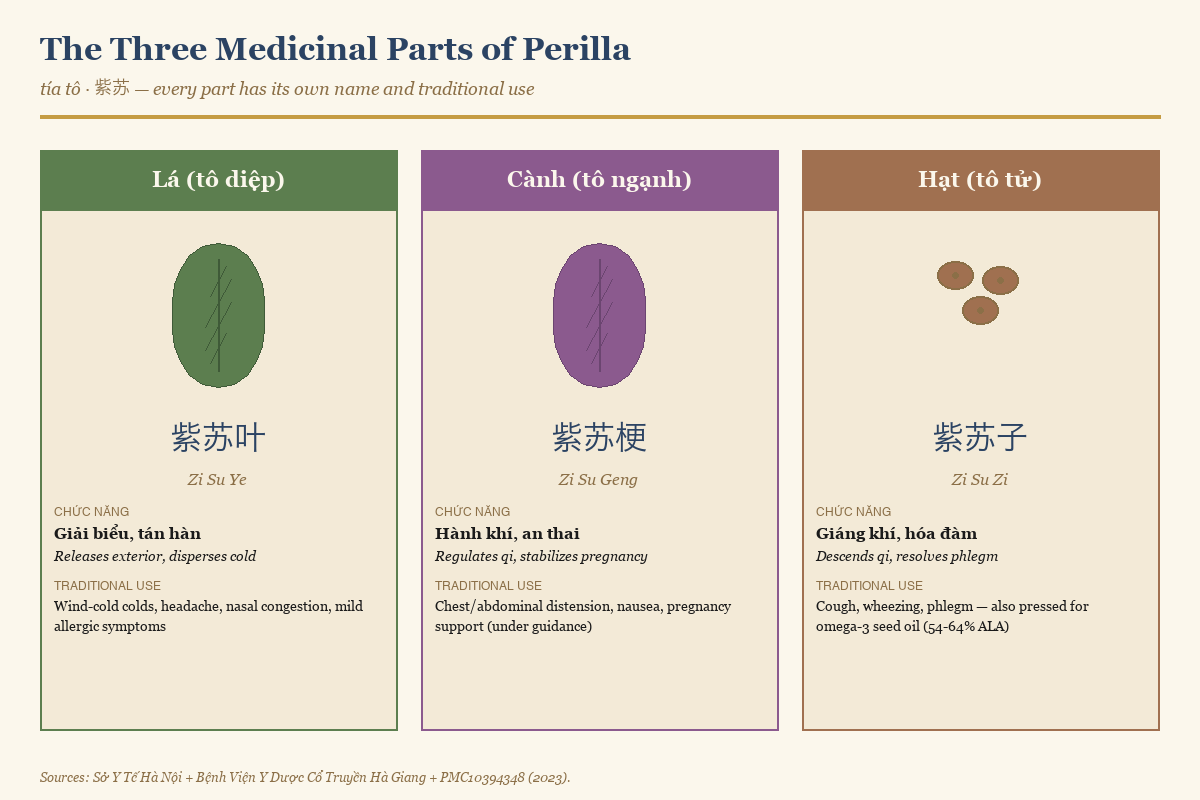
The plant is in the Lamiaceae (mint) family, and the Ha Giang Traditional Medicine Hospital monograph confirms the scientific name Perilla frutescens [2]. Within Vietnamese and Chinese tradition, perilla is one of those rare herbs where every part of the plant has its own name and traditional use [3]:
- Leaf (lá tô diệp / 紫苏叶 Zǐ sū yè) — the most familiar form, used fresh in cooking, infused as tea, or as part of multi-herb formulas
- Stem (cành tô ngạnh / 紫苏梗 Zǐ sū gěng) — milder and sweeter than the leaf, classically considered safer for pregnancy support
- Seed (hạt tô tử / 紫苏子 Zǐ sū zǐ) — pressed for oil that is exceptionally rich in alpha-linolenic acid (54–64% of total fatty acids), positioning it as one of the highest plant-based omega-3 sources known [4]
This three-part distinction matters because most English consumer content treats "perilla" as a single herb. In traditional practice, the part used and how it is prepared change everything.
How Traditional Eastern Medicine Views Perilla Leaf
The Ha Giang Traditional Medicine Hospital summarizes perilla's classical profile as follows [2]:
- Taste and nature: acrid (vị cay), warm (tính ôn)
- Channel affinity: Spleen and Lung channels (tỳ + phế kinh)
Within this classical framework, perilla's main traditional functions involve releasing the exterior (dispersing wind-cold at the surface — used in early-stage colds), regulating qi in the middle burner (treating chest distension, nausea, abdominal bloating), and — uniquely — "an thai" (stabilizing pregnancy), a function traditionally attributed especially to the stem (tô ngạnh) rather than the leaf [1].
The Hanoi Department of Health monograph also notes the traditional use of perilla for what classical sources called "giải độc hải sản" — neutralizing seafood toxin [1]. This is why fresh perilla leaves traditionally appear on Vietnamese seafood tables, particularly alongside crab, shrimp, and shellfish dishes.
Within Chinese TCM tradition, the same three parts are referred to as Zǐ sū yè, Zǐ sū gěng, and Zǐ sū zǐ, and they appear in classical formulas designed for wind-cold patterns with concurrent qi-stagnation symptoms [3].
What Does the Research Say About Perilla Leaf?
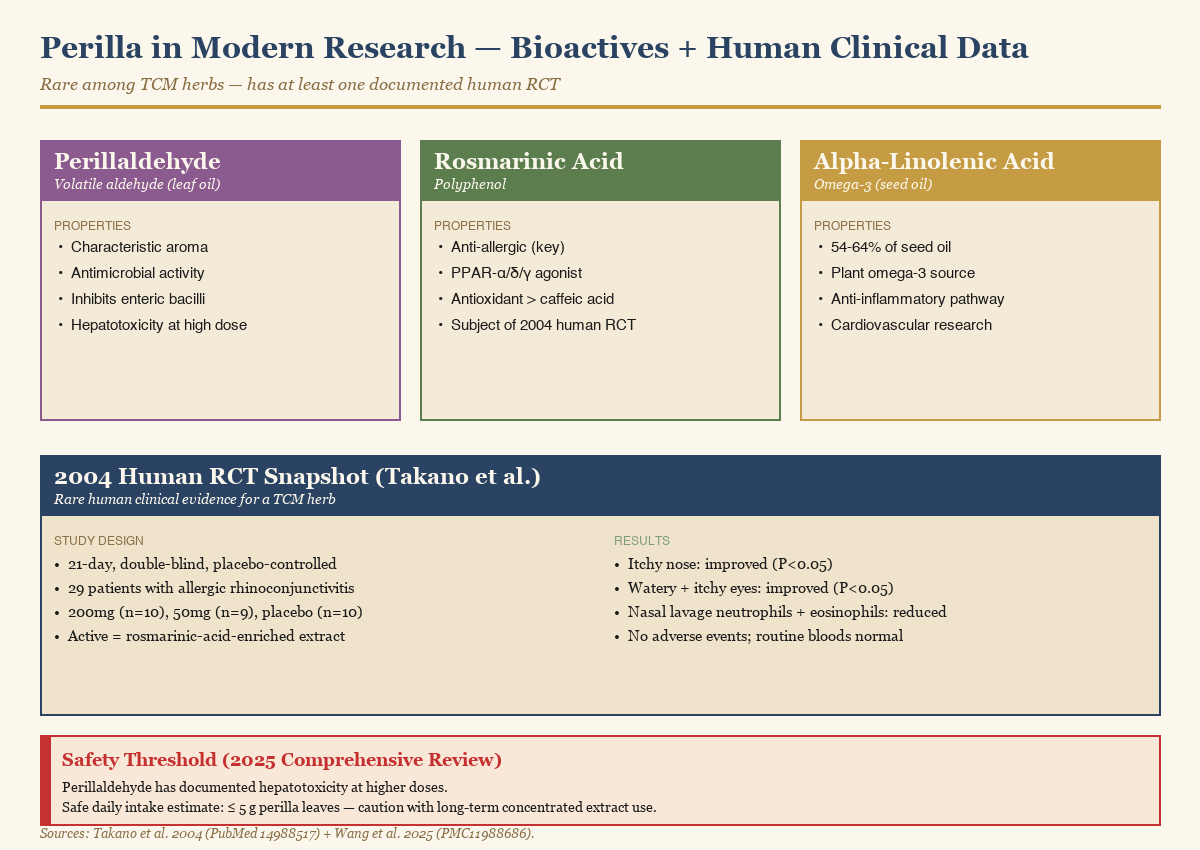
Perilla is one of the more chemically interesting herbs in the traditional Vietnamese-Chinese pharmacopeia. A 2025 peer-reviewed comprehensive review catalogued the main bioactive groups [4]:
- Perillaldehyde — the most characteristic component of perilla leaf essential oil, responsible for the herb's distinctive aroma and antimicrobial activity
- Rosmarinic acid — a polyphenol with documented anti-allergic and antioxidant activity (notably greater free-radical scavenging than caffeic acid)
- Luteolin and apigenin — the principal flavonoid anti-inflammatory compounds
- Alpha-linolenic acid (ALA) — concentrated in seed oil at 54–64% — among the highest plant-based omega-3 contents known
Anti-allergic activity — one of the few human clinical trials. Most TCM herbs have a research base dominated by animal models. Perilla has at least one well-documented human RCT. In a 21-day double-blind placebo-controlled trial published in 2004, researchers tested a perilla extract enriched for rosmarinic acid in 29 participants with mild seasonal allergic rhinoconjunctivitis (high-dose 200 mg, low-dose 50 mg, placebo) [5]. Active treatment significantly improved itchy nose, watery eyes, itchy eyes, and total symptoms (P<0.05). Just as importantly, the researchers also measured an objective immunological change — significantly decreased neutrophils and eosinophils in nasal lavage fluid versus placebo. No adverse events, no significant abnormalities in routine blood tests. This is not a large trial, and it is older, but it directly tests perilla for the use Vietnamese and Chinese tradition has long claimed for it.
Anti-inflammatory mechanism. The 2025 review identifies that perilla's monoterpenoid compounds suppress inflammatory mediators and pro-inflammatory cytokines including TNF-α, IL-1β, and IL-6 — primarily through NF-κB pathway inhibition [4]. Antioxidant activity proceeds through NRF2 pathway activation. Rosmarinic acid specifically shows PPAR-α/δ/γ agonist activity, providing a mechanistic anchor for the anti-allergic effect observed in the human RCT [3].
Antibacterial activity (Vietnamese pharmacology). The Hanoi Department of Health monograph cites Vietnamese pharmacological data showing that water distillates and decoctions of perilla leaf inhibit enteric bacilli, dysentery bacilli, staphylococci, and several skin-disease fungi [1]. This is consistent with the antimicrobial activity of perillaldehyde reported in modern reviews.
Important evidence limitation. The 2023 review on perilla as a traditional medicine and food homologous plant is direct: "toxicity data, pharmacokinetic studies, and human clinical evidence remain insufficient despite extensive laboratory investigations" [3]. The 2025 comprehensive review similarly notes that "most pharmacological evidence remains preclinical; clinical human studies remain lacking" [4]. The 2004 allergic-rhinoconjunctivitis trial is a positive data point, but it is one trial with 29 participants — not yet conclusive evidence for any specific application.
How Do People Use Perilla Leaf?
The Báo Sức Khỏe & Đời Sống (Ministry of Health-affiliated newspaper) documents four common traditional Vietnamese preparations [6]:
Xông hơi tía tô — Perilla Steam Inhalation
A large handful of fresh perilla leaves dropped into a pot of boiling water. The pot is then placed under the feet (or face, with a towel over the head) for steam inhalation. This is one of the most traditional Vietnamese home remedies for the very early stage of a wind-cold pattern cold, often combined with lemongrass, kaffir lime leaves, or ginger [6].
Cháo tía tô — Perilla Rice Congee
White rice cooked to a thin congee, then served hot with shredded young perilla leaves stirred in just before eating. Optionally with scallion. This is the gentle form recommended for elderly individuals, weak constitutions, and children with mild colds [6].
Nước sắc tía tô — Perilla Decoction
15–20 grams of fresh crushed perilla leaves (or 8–12 g dried) steeped in hot water and taken warm [6]. The Hanoi Department of Health source notes the same dosing range for daily use. This is the form most often consumed as a daily herbal tea, though as we'll see below, daily long-term consumption is not without considerations.
Combined Wind-Cold Formula
For more developed cold symptoms with concurrent digestive complaints, traditional Vietnamese practice combines perilla with several other herbs at specific doses: Tía tô 8 g + Trần bì (tangerine peel) 6 g + Hương phụ (cyperus) 8 g + Cam thảo (licorice) 4 g + Gừng (ginger) 2 slices, decocted and taken warm [6]. This combination echoes the classical Chinese formula Hương Tô Tán (香苏散).
Perilla as Culinary Companion
Perilla appears in everyday Vietnamese cooking — wrapped around grilled meat (bún chả), torn into hot sour soups (canh chua), and famously paired with seafood dishes for the traditional "neutralize seafood toxin" purpose described above. In these culinary contexts, perilla is consumed in small amounts as part of varied meals rather than concentrated daily extracts.
Individual responses vary considerably; what works well for one person may not suit another, and personal experimentation under practitioner guidance is always recommended.
Important Limitations and Considerations
Perilla is one of the gentler herbs in everyday Vietnamese-Chinese tradition, but it is not consequence-free, particularly when consumed at concentrated extract doses or for extended periods.
- Hepatotoxicity / neurotoxicity at higher doses — The 2025 comprehensive review specifically flags that "perillaldehyde presents documented hepatotoxicity and neurotoxicity at higher doses, requiring strict dosage control" [4]. The same review estimates a safe daily intake of ≤5 g of perilla leaves to prevent toxicity. This threshold is notable: many casual recommendations for daily perilla tea drinking use 15–20 g of fresh leaves (often described as a "handful"), which is within traditional acute-use range but should not be sustained as a daily long-term habit.
- Pregnancy — Traditional Vietnamese sources note that the stem (tô ngạnh) has traditional "an thai" use, but also caution that the plant should be used carefully during pregnancy [2]. Concentrated extracts and the use of leaf rather than stem are generally avoided. Modern professional sources advise consulting a practitioner.
- Yin-deficient with internal heat patterns — Vietnamese TCM sources note caution for individuals with "heat patterns" — perilla's warm nature can aggravate this kind of constitutional pattern [2].
- Allergy history — The Ha Giang Hospital monograph specifically flags individuals with allergy history as a caution group [2]. Although perilla is itself used for allergic conditions (and the 2004 RCT supports this), people with known reactions to mint-family plants should approach cautiously.
- Excess use side effects — The Hanoi Department of Health monograph cites traditional concerns about excessive perilla use causing fatigue, constipation, and dark urination [1]. These are classical signals of yin damage from overuse of warming herbs.
- Drug interactions — Theoretical concerns exist with antiplatelet/anticoagulant medications due to alpha-linolenic acid content of seed oil and the antiplatelet activity reported for some perilla flavonoids in laboratory studies. People on warfarin, aspirin, or related medications should consult their prescriber before adding perilla seed oil supplements.
- Children — Vietnamese tradition allows mild perilla preparations (especially congee) for children with colds, but concentrated extracts and daily long-term use are not part of traditional practice for children.
- Pharmacokinetic data limitation — As noted, comprehensive pharmacokinetic and long-term safety data for perilla supplementation in humans remain limited [3]. Daily long-term concentrated extract use is therefore an extrapolation beyond the current evidence base.
- Quality variability — Fresh perilla used in traditional Vietnamese cooking is one thing; commercial dried perilla and extract supplements vary meaningfully in cultivar (Vietnamese tía tô, Korean 깻잎, Japanese shiso are different cultivars with different chemistry), processing, and freshness.
These limitations are not meant to discourage culinary use of fresh perilla — that is centuries of tradition and unquestionably part of Vietnamese gastronomy. They are meant to add realistic context to the modern wellness habit of treating perilla tea as a daily long-term tonic, which is a different practice than the tradition actually describes.
Frequently Asked Questions About Perilla Leaf
Is perilla leaf the same as shiso?
Yes and no. Perilla frutescens and its varieties include what is called shiso (紫蘇 / シソ) in Japanese cuisine and tía tô in Vietnamese. The term "shiso" typically refers to the Japanese cultivar used in sushi and as a garnish, while "perilla" is the broader botanical category. Both share similar aromatic compounds, though different culinary traditions have developed distinct uses for regional varieties.
Can I eat perilla leaf raw?
Yes — perilla leaves are commonly eaten raw in Vietnamese, Korean, and Japanese cuisines. In Vietnam, fresh tía tô leaves are served alongside noodle soups and rice dishes. In Korea, kkaennip (깻잎) leaves are eaten as a ssam wrap or side dish. Raw consumption preserves the volatile aromatic compounds that may contribute to its traditional uses.
What is tía tô (perilla) traditionally used for in Vietnamese medicine?
In Vietnamese traditional medicine, tía tô is classified as a warming, aromatic herb used to dispel wind-cold, relieve surface symptoms associated with early-stage illness, ease nausea and abdominal discomfort, and promote sweating. The stem, leaf, and seed are all used and may have slightly different traditional applications.
Does perilla leaf interact with any medications?
Research on drug interactions for perilla is limited. The seed oil contains high levels of alpha-linolenic acid (ALA), which at high supplemental doses may theoretically interact with anticoagulant medications. Whole leaf in culinary amounts is unlikely to present significant interaction risk for most people, but those on blood-thinning medications should consult their healthcare provider.
Is perilla leaf safe during pregnancy?
Perilla leaf in normal culinary amounts — as used in cooking and as a garnish — is widely consumed across East and Southeast Asian cuisines without documented concern. Medicinal doses or concentrated extracts have not been adequately studied during pregnancy. As a general precaution, speak with a healthcare provider before taking any herb in therapeutic doses during pregnancy.
A Note on Tracking — Where Health Diary Comes In
Traditional Eastern wellness practice has always emphasized observation over time. For someone using perilla, tracking a few signals over weeks is more informative than relying on day-to-day impressions. Useful things to record might include:
- Frequency and severity of cold/flu-like episodes over a season
- Allergic symptoms (sneezing, itchy eyes, nasal congestion) — particularly relevant given the 2004 RCT findings
- Digestive comfort (perilla can both help and aggravate depending on pattern)
- Skin condition and any contact reactions
- Energy levels (traditional concern about fatigue from overuse)
- Hydration and urinary patterns (the Hanoi source flagged dark urine as a sign of overuse)
If markers shift in a concerning direction — fatigue, persistent constipation, dark urine — that is a signal to pause and reconsider. That kind of feedback is exactly what classical practitioners used to adjust formulas.
A Soft Closing Note
Perilla is one of the most accessible entry points into Vietnamese-Chinese herbal tradition — it is in almost every Vietnamese kitchen, it costs nearly nothing, and its traditional use is genuinely well anchored in classical sources. The 2004 human clinical trial is one of the rarer pieces of direct evidence available for any TCM herb. At the same time, the 2025 toxicity-threshold concern is exactly the kind of nuance the wellness internet tends to flatten.
If you are curious about traditional wellness practices, the most useful next step is usually slow learning rather than an immediate purchase. Reading reputable sources — peer-reviewed reviews, government health-authority monographs, classical herbal texts — and observing your own patterns through journaling tend to produce better outcomes than chasing any single ingredient. For perilla especially, occasional culinary use of fresh leaves is closer to traditional practice than daily concentrated extract supplementation.
Some people explore options like a hot perilla-and-ginger infusion at the first hint of a winter cold; others use perilla seed oil for its omega-3 content. You can learn more about traditional body constitutions and seasonal wellness rhythms on our companion guides, including our overviews of Chinese herbal traditions: astragalus, angelica root, licorice root, and chrysanthemum — many of which appear alongside perilla in classical multi-herb formulas.
About This Article
Written by: Health Diary Editorial Team — a small editorial group researching traditional wellness practices, herbal traditions, and quantified-self methods. Our articles draw on peer-reviewed literature, government health-agency monographs (NIH, MSK Integrative Medicine, Vietnamese Ministry of Health, provincial health departments), and primary native-language sources.
Editorial review: This article has been reviewed by the Health Diary editorial team for clarity, structure, and adherence to our sourcing standards. Key claims were cross-checked against NCCIH, NIH PubMed, and LiverTox where applicable. It is not a clinical review and should not replace consultation with a licensed healthcare practitioner. When a clinical reviewer is added to this article, attribution will appear here with verifiable credentials.
Reviewed on: June 8, 2026.
Editorial process: All claims about modern evidence are linked inline to peer-reviewed publications or authoritative government health-authority sources. The 2004 RCT on rosmarinic acid for allergic rhinoconjunctivitis is one of the rare human clinical trials available for this herb; we describe its sample size and limitations rather than presenting it as conclusive. The hepatotoxicity concern from the 2025 comprehensive review is described in detail because the safe-intake threshold (≤5 g/day perilla leaves) is practically relevant for anyone considering long-term daily concentrated use. Native-language Vietnamese sources from the Hanoi Department of Health, Báo Sức Khỏe & Đời Sống (Ministry of Health affiliated), and Ha Giang Traditional Medicine Hospital are cited alongside English-language peer-reviewed sources to reflect both the Vietnamese cultural perspective and the international scientific evidence on this herb.
References
- Sở Y Tế Hà Nội (Hanoi Department of Health). Tác dụng chữa bệnh từ cây tía tô — Y học cổ truyền (Healing Effects of Perilla Plant — Traditional Medicine). https://soyte.hanoi.gov.vn/y-hoc-co-truyen/-/asset_publisher/4IVkx5Jltnbg/content/tac-dung-chua-benh-tu-cay-tia-to
- Bệnh Viện Y Dược Cổ Truyền Hà Giang (Ha Giang Traditional Medicine Hospital). TÍA TÔ — Cây thuốc nam. https://bvydcthagiang.org.vn/cay-thuoc-nam/tia-to/
- Yu H et al. Perilla frutescens: A traditional medicine and food homologous plant. 2023. PMC10394348. https://pmc.ncbi.nlm.nih.gov/articles/PMC10394348/
- Wang Y et al. Comprehensive Review of Perilla frutescens: Chemical Composition, Pharmacological Mechanisms, and Industrial Applications in Food and Health Products. 2025. PMC11988686. https://pmc.ncbi.nlm.nih.gov/articles/PMC11988686/
- Takano H et al. Extract of Perilla frutescens enriched for rosmarinic acid, a polyphenolic phytochemical, inhibits seasonal allergic rhinoconjunctivitis in humans. 2004. PubMed 14988517. https://pubmed.ncbi.nlm.nih.gov/14988517/
- Báo Sức Khỏe & Đời Sống (Vietnamese Ministry of Health affiliated newspaper). Bài thuốc chữa cảm bằng tía tô đơn giản mà hiệu quả (Simple and Effective Traditional Cold Remedies Using Perilla). https://suckhoedoisong.vn/bai-thuoc-chua-cam-bang-tia-to-don-gian-ma-hieu-qua-16993229.htm