

How to Prepare Reishi Mushroom: Traditional Methods and Modern Forms
A practical, educational overview of how reishi (lingzhi, Ganoderma lucidum) is traditionally prepared — slices, powder, tincture, dual extract, capsules — with a home brewing walkthrough. Educational, not medical advice.
Medical Disclaimer: This content is for educational and informational purposes only and is not medical advice. The information presented is not intended to diagnose, treat, cure, or prevent any disease. Always consult a licensed healthcare practitioner before starting any new herbal practice or supplement. Statements regarding traditional herbal use have not been evaluated by the FDA.
Affiliate Disclosure: This article contains affiliate links. We may earn a commission if you purchase through these links, at no additional cost to you. We only recommend products we believe align with our editorial standards.
For most of reishi's two-thousand-year history in Traditional Eastern Medicine, how the mushroom was prepared mattered as much as which variety was used. A pot of slowly simmered slices traditionally drew out very different compounds than a quick alcohol soak, and classical practitioners adjusted the preparation to fit the person, the season, and the formula. Today the choices have widened — capsules, dual extracts, tinctures, powders — but the underlying logic still applies.
This guide walks through the main forms of reishi available in modern markets, how each one is traditionally prepared, what some research has begun to suggest about extraction methods, and how some people decide between forms when building a routine. It is written for curious readers rather than as treatment guidance.
Why Preparation Method Matters
Reishi is unusual among medicinal mushrooms because its useful compounds belong to two very different chemical families. The water-soluble fraction includes polysaccharides — long-chain sugars such as beta-glucans — that are often released by long simmering in water. The alcohol-soluble fraction contains triterpenes, including the ganoderic acids that give reishi its famously bitter taste, which are extracted more efficiently using ethanol or a hot-and-cold dual process.
A simple way to picture this: a cup of long-simmered reishi tea may capture much of the polysaccharide profile while leaving most triterpenes behind. A drop or two of alcohol tincture may emphasize triterpenes but contain little of the water-soluble fraction. Many traditional formulas combined reishi with other herbs precisely because no single preparation captured every compound of interest.
This is not a small distinction. Two products both labeled "reishi extract" can deliver meaningfully different ratios of compounds depending on whether they used water, ethanol, or a combination. People comparing brands or trying to interpret studies often miss this point, which can make claims feel contradictory when in fact the products being compared are quite different.
What Traditional Practitioners Have Done
Classical pharmacopeias such as the Shen Nong Ben Cao Jing described reishi being prepared most often as a long decoction — sliced and simmered in water for an extended time, sometimes alongside jujube, goji berries, or licorice to soften the bitterness and broaden the formula. In Japanese kanpo and Korean traditional contexts, similar preparations have been recorded for centuries, with regional variations in pairing herbs and simmering time.
A second traditional form is soup. In Chinese home cooking, sliced reishi is sometimes added to long-simmered broths (湯, tang) along with poultry, ginger, and other tonic herbs. This continues a wider Eastern pattern of food-as-wellness — reishi is treated as nourishment in the context of a meal rather than as a measured medical dose. Korean samgyetang built around ginseng follows a similar philosophy in a different culinary register.
Alcohol-based preparations also have a long history, particularly in Chinese herbal liquors where dried reishi was steeped in grain alcohol for weeks or months. These were traditionally taken in small amounts, often warmed, and were understood as a concentrated and slightly different form than the water decoction. Modern Western herbalists who work with reishi tinctures are continuing a recognizable lineage.
Importantly, classical sources do not describe a single "correct" form. Practitioners chose preparation methods based on what they were trying to support and on the individual constitution of the person taking it. That same flexibility is worth keeping in mind when reading modern marketing copy that promotes one form as objectively best.
Five Common Preparation Forms
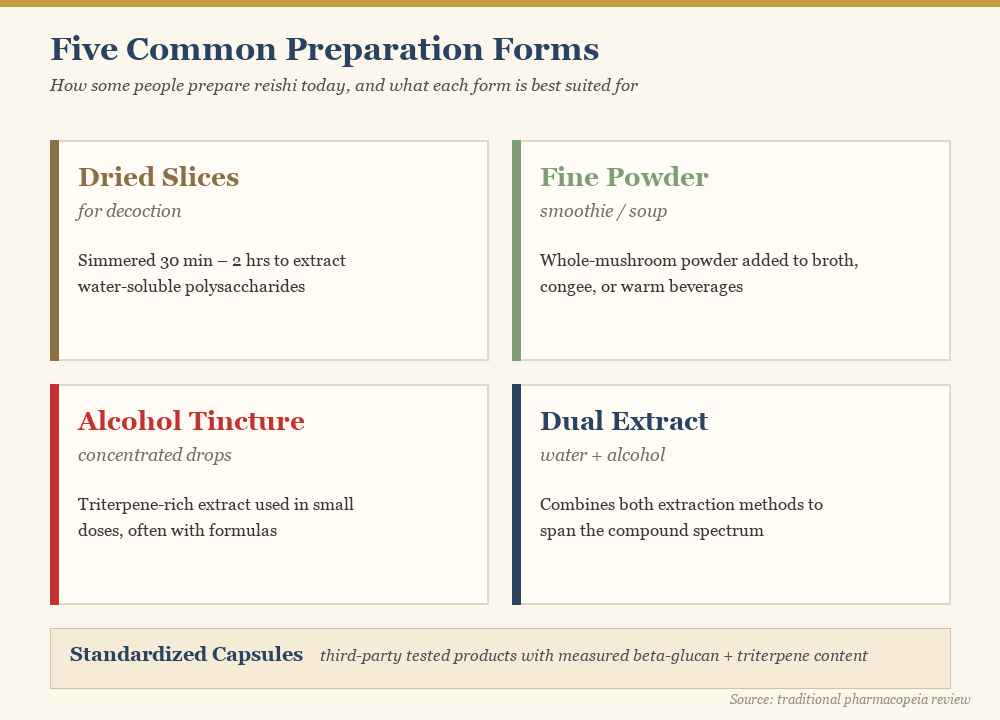
Where modern shoppers often see only "reishi extract" on a label, the underlying landscape is broader. Five preparations are most common today.
Dried Slices for Decoction
Whole or sliced dried reishi caps, simmered in water for thirty minutes to two hours. This is the closest modern form to the classical decoction and is what some people use when they want to brew reishi tea at home. Slices keep well in a dry pantry for many months. Some traditional practitioners suggest the spent slices can be re-simmered once or twice before being discarded, since not all soluble compounds are released in the first brew.
Fine Powder
Whole-mushroom powder, sometimes labeled as "whole fruiting body" rather than mycelium. Powder can be added to broth, congee, smoothies, or warm beverages. It contains the full mushroom without an extraction step, which means it may contain components that have not been broken out of the fungal cell wall and therefore may not all be readily absorbed. Some people enjoy powder for the texture and aroma rather than as a precise extract.
Alcohol Tincture
Dried reishi steeped in food-grade alcohol for several weeks, then strained. Alcohol pulls out triterpenes and other alcohol-soluble compounds more efficiently than water alone. Tinctures are typically taken in small doses — a dropperful or so — and are popular among modern Western herbalists who use them within wider formulas. Some people find a high-quality tincture noticeably more bitter than tea, which is sometimes taken as a rough quality signal.
Dual Extract
A two-stage extraction that combines a hot water decoction with an alcohol soak, then blends the results. Dual extracts aim to capture both the water-soluble polysaccharides and the alcohol-soluble triterpenes in a single product. Many independent mushroom-focused brands have moved to this format as the default, and it is what some herbalists recommend when someone wants a single product rather than a routine of tea plus tincture.
Standardized Capsules
Concentrated reishi extract delivered in capsule form, often with a stated percentage of beta-glucans, triterpenes, or both. Capsules trade some of the ritual of tea preparation for convenience and consistency. Quality varies enormously across brands; third-party testing (USP Verified, NSF Certified, ConsumerLab) and clear specification of active compound content are signals some shoppers look for when comparing options.
What Modern Research Has Begun to Suggest
A growing body of preliminary research has examined how extraction method affects the compound profile of reishi products. Reviews indexed on PubMed have generally noted that hot water extraction emphasizes polysaccharides, ethanol extraction emphasizes triterpenes, and combined methods tend to capture a broader spectrum. This is not yet settled science with consensus dosing recommendations — sample sizes in many human studies remain small, standardization between products is inconsistent, and a large share of the supporting evidence comes from laboratory or animal models rather than rigorous human trials.
A few patterns worth knowing for newcomers:
- Findings are often mixed or inconclusive, particularly for clinical endpoints
- The specific extraction process used in a study may not match what is sold in your local supplement aisle
- A large share of the available data examines isolated compounds rather than whole reishi preparations
- More research is needed before drawing firm conclusions about any specific form
This means it is fair to say that some preliminary research suggests preparation method genuinely matters for the compound profile delivered, while remaining cautious about translating that into product-specific claims. If marketing copy promises definitive medical outcomes from any single preparation, that is a flag worth pausing on.
For readers who like primary sources, the open-access Herbal Medicine: Biomolecular and Clinical Aspects chapter on Ganoderma lucidum on the NCBI Bookshelf is one widely cited starting point. As with any single source, a balanced view comes from reading multiple reviews rather than relying on one positive study.
A Practical Walkthrough: Brewing Reishi Tea at Home
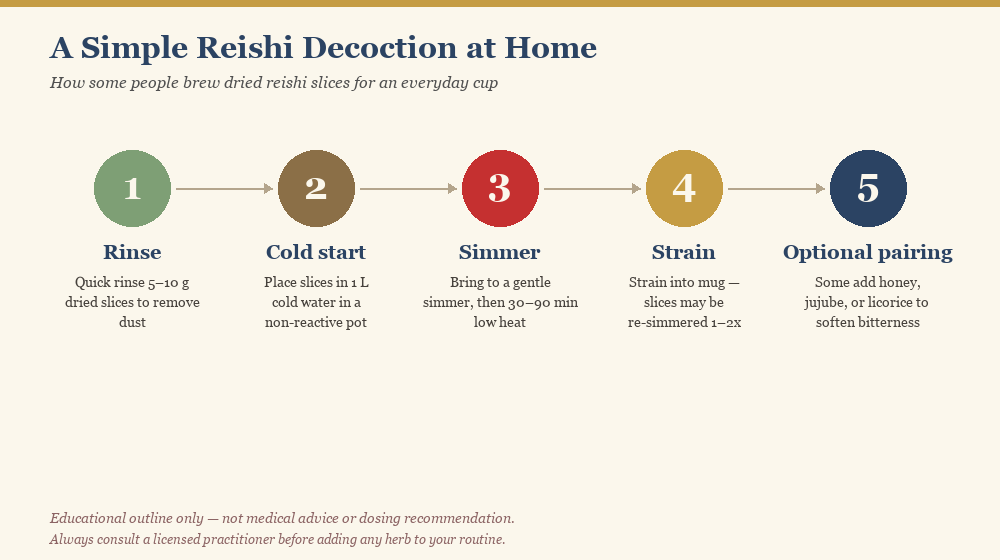
For people who want to start with the most traditional form, a simple decoction is the place to begin. The steps below describe how some people brew reishi slices at home. They are educational only and not dosing guidance — see the limitations section below before adopting any routine.
Choosing Slices
Look for dried slices that are firm, glossy, and free of mold or musty smell. Some sources note that color and weight vary by growing conditions and species, so a heavier or darker slice is not automatically a better one. Reputable suppliers will specify whether the slices are wild or cultivated, and whether they come from the whole fruiting body rather than mycelium grown on grain.
The Decoction Process
A typical home brew uses around five to ten grams of dried slices per liter of water. The slices are placed in cold water in a non-reactive pot (glass, ceramic, or stainless steel), brought slowly to a gentle simmer, and then kept at low heat for thirty to ninety minutes. Longer simmers extract more of the water-soluble fraction but also concentrate the bitterness. Some people pre-soak slices for an hour in cold water before heating to soften them.
The resulting liquid is strained into a mug. The same slices can be re-simmered once or twice with fresh water, since not all soluble compounds release in the first brew. The taste is famously bitter and earthy — many traditional recipes pair reishi with jujube, goji berries, licorice root, or a small amount of honey to make it more drinkable, mirroring how classical formulas combined complementary herbs.
Soup Variation
In Chinese home cooking, sliced reishi is sometimes added to a long-simmered broth with chicken, ginger, dried jujube, and goji berries. This is closer to a nourishing meal than a measured dose and reflects the wider Eastern habit of treating tonic herbs as food rather than as supplement. The slices are usually removed before serving.
Choosing Between Forms
There is no single "best" form of reishi — only forms that suit different goals, lifestyles, and budgets. A few rough signals some people use when deciding:
By Goal
People drawn to the ritual and the broader food-as-wellness philosophy often gravitate toward tea, decoctions, or soup variations. People who want a convenient daily routine without preparation time often prefer capsules or dual extracts. People working with a herbalist on a specific formula may be guided toward tinctures because they integrate more easily with other herbal preparations.
By Lifestyle
Tea and soup take time — the simmering, the straining, the cleaning of the pot. For people whose mornings are tightly scheduled, that ritual is either a positive (deliberate slow time) or a friction point (more likely to be skipped after a week). Capsules and tinctures shift the friction toward product selection rather than preparation. Powders sit in between — quicker than a decoction but still asking for a deliberate moment in the day.
Quality Signals to Check
Regardless of form, several signals separate higher-quality products from the rest. Third-party testing (USP Verified, NSF Certified, or ConsumerLab) is a strong indicator. Clear specification of beta-glucan content (often a stated percentage rather than a vague "high beta-glucan" claim) is another. Whole fruiting body sourcing — rather than mycelium grown on grain — is typically preferred. Country of origin and harvest method are sometimes specified on premium products. None of these by themselves guarantee quality, but the absence of all of them is a useful warning sign.
Important Limitations and Considerations
Reading about a preparation method prized for centuries can make any reishi product feel safe by default. It is not necessarily so, and the limitations below apply to every form discussed above.
- Drug interactions — reishi may interact with anticoagulants and antiplatelets ("blood thinners"), some blood pressure medications, certain diabetes medications, and immunosuppressants. People undergoing chemotherapy should not start reishi without discussing it with their oncology team. Anyone on prescription medication should speak with a qualified practitioner before adding reishi, regardless of form.
- Surgery — because of possible effects on platelet aggregation, several professional sources recommend pausing reishi at least two weeks before scheduled surgery.
- Pregnancy and breastfeeding — safety during pregnancy and breastfeeding has not been thoroughly studied. Most professional sources advise caution and consultation rather than self-experimentation.
- Children — reishi is not generally recommended for children outside of supervised traditional practice.
- Liver health — reishi is generally well tolerated, but rare case reports have described liver-related issues, particularly with non-standardized powders. People with existing liver conditions should be especially cautious about product quality and consult a clinician before trying any form.
- Alcohol content of tinctures — people avoiding alcohol for any reason — recovery, pregnancy, medication interactions — should not assume herbal tinctures are alcohol-free. Many contain substantial ethanol, even at small dropper doses.
- Quality variability between forms — two capsules labeled "reishi" can differ enormously in actual potency, sourcing, and extraction method. The same is true across powders, tinctures, and dual extracts. Cheaper is not always worse, but extremely cheap reishi products often turn out to use grain-grown mycelium rather than the whole mushroom.
- Individual response varies — classical TCM does not view reishi as universally beneficial. Some people may experience symptoms such as digestive upset, mild headaches, dryness in the mouth, or rashes, which traditionally suggests the herb or that particular preparation is not matching the individual constitution well. May not work for everyone.
- Time horizon — traditional practice often involves cycles (taking for several weeks, then pausing) rather than continuous indefinite use. Results can vary depending on lifestyle, season, and individual constitution.
These limitations are not meant to discourage exploration. They are the realistic context any reader deserves before forming expectations about any preparation method.
A Note on Tracking — Where Health Diary Comes In
One reason traditional Eastern medicine has resonated with the modern quantified-self community is its emphasis on observation over time. Classical practitioners assessed patterns, not isolated symptoms. They asked about sleep, digestion, mood, energy, and how a person felt across seasons.
That mindset translates well to evaluating any new preparation. Tracking simple signals — daily energy, sleep quality, digestion, recovery — for a few weeks tends to be more informative than relying on the day-to-day impression of "I think I feel a bit calmer." It is also more aligned with how traditional practitioners themselves used to assess change, and it helps separate a meaningful response from background fluctuation in mood and lifestyle.
Some readers find that a structured journal — capturing one or two short notes a day — produces clearer signal than memory alone. Others find a simple paper notebook is enough. The format matters less than the consistency.
A Soft Closing Note
The form of reishi you choose matters less than the broader framework around it. Reishi is not a magic mushroom in the marketing sense, and no preparation method substitutes for consistent sleep, movement, hydration, and rest. People working within traditional practice have long been clear about that — reishi was never meant to compensate for a depleted lifestyle. It was meant to support someone whose lifestyle was already moving in a supportive direction.
If you are curious about reishi preparation, the most useful next step is usually slow learning rather than an immediate purchase. Reading reputable sources, talking with a licensed practitioner, and observing your own patterns through journaling tend to produce better outcomes than chasing any single product or form.
You can learn more about reishi's classical background on our companion guide, and if you would like to track wellness signals over time, our journaling tools may help structure that practice. Some people explore options like keeping a simple notebook; others find a structured journal more sustainable.
About This Article
Written by: Health Diary Editorial Team — A small editorial group researching traditional wellness practices, herbal traditions, and quantified-self methods. We publish educational content reviewed by licensed practitioners.
Editorial process: All content goes through a two-stage review (author research and medical reviewer signoff) before publication. We cite peer-reviewed and government sources where possible. See our Editorial Process page for details.