

Traditional Evening Herbal Drinks for Relaxation: A Wellness Guide
An educational guide to traditional evening herbal drinks — chamomile, lemon balm, passionflower, valerian, and TCM suan zao ren — their history, traditional profiles, and how some people incorporate them into wind-down routines.
Medical Disclaimer: This content is for educational and informational purposes only and is not medical advice. The information presented is not intended to diagnose, treat, cure, or prevent any disease. Always consult a licensed healthcare practitioner before starting any new herbal practice or supplement. Statements regarding traditional herbal use have not been evaluated by the FDA.
Affiliate Disclosure: This article contains affiliate links. We may earn a commission if you purchase through these links, at no additional cost to you. We only recommend products we believe align with our editorial standards.
Long before sleep trackers and melatonin gummies, people in nearly every corner of the world developed a remarkably similar habit: winding down the evening with a warm herbal drink. Whether it was chamomile steeped in a Roman household, a brewed decoction of suan zao ren (jujube seed) prepared in a Tang dynasty home, or a cup of lemon balm tea set aside by an English kitchen herbalist, the pattern repeats across centuries and continents.
This guide explores the tradition behind evening herbal drinks, how different wellness systems have historically understood them, what contemporary research has begun to suggest, and how some people incorporate them into their routines today. It is written as an educational introduction — not as a prescription or treatment for any sleep condition.
Why Evening Herbal Rituals Have Been Part of Human Culture
The idea of a transition drink — something warm taken between the active day and the quiet of sleep — appears across diverse civilizations independently. In ancient Egypt, preparations including blue lotus were described in early papyri in the context of rest and ease. Classical Roman households brewed valerian root in wine. Medieval European monks documented dozens of plant preparations for what they called "disturbed sleep" or "agitated thoughts at night." Indigenous North American traditions describe passionflower as a plant traditionally used to ease restlessness.
In traditional Chinese medicine (TCM), there are dedicated an shen (安神, "calm the spirit") herbs specifically associated with settling the mind at night — a category rooted in the classical concept of shen (神), often translated as the calm mental presence or settled spirit. Japanese yojō (養生, "nourishing life") philosophy similarly emphasized warm evening preparations to transition the body from yō (陽, active/expansive) toward in (陰, receptive/restorative) states.
This cultural convergence is worth noting. When independent traditions across continents arrive at similar practices without contact, it suggests the practice responds to something genuinely present in human experience — not just placebo or marketing. At the same time, convergence does not equal proof of clinical efficacy. Both can be true simultaneously: a ritual can be historically meaningful and individually variable in its effects.
How Traditional Wellness Systems View Evening Herbs
The framing differs across traditions, but several overlapping ideas emerge:
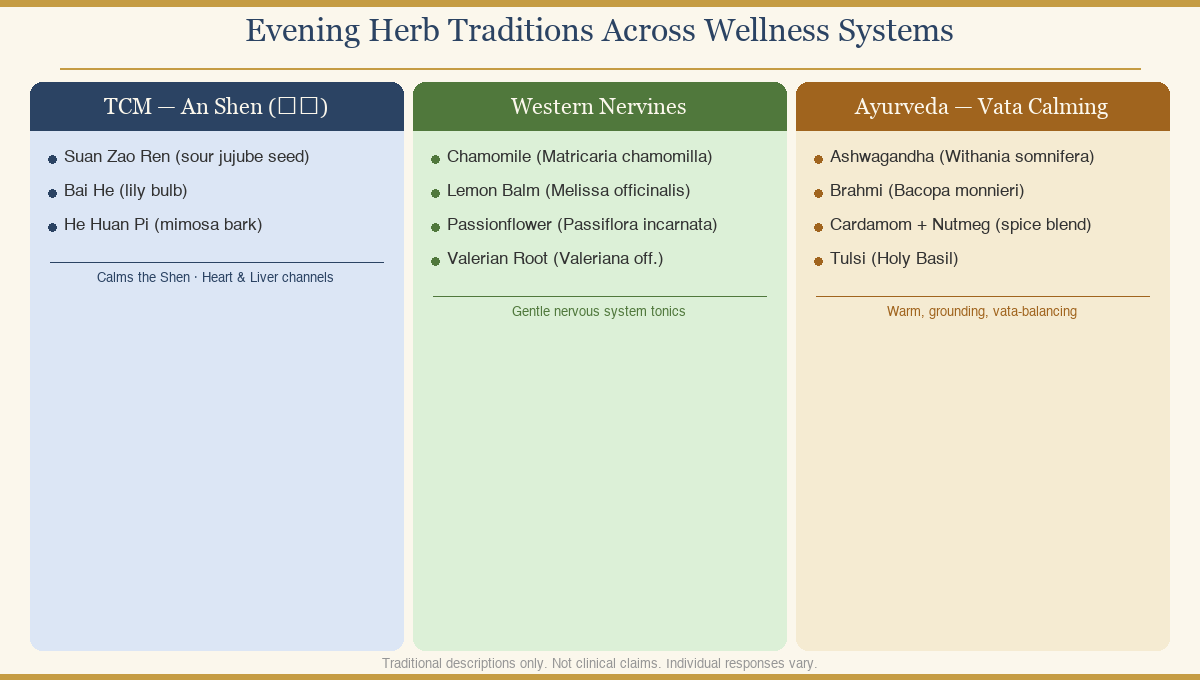
Traditional Chinese Medicine classifies evening calming herbs within the an shen (安神) category. Key herbs traditionally associated with this function include:
- Suan zao ren (酸棗仁, sour jujube seed) — one of the most referenced evening herbs in classical texts, associated with the Heart and Liver channels
- Bai he (百合, lily bulb) — traditionally used for patterns classical descriptions called "restless feelings, disturbed sleep, unsettled emotions"
- He huan pi (合歡皮, mimosa tree bark) — traditionally described as "calming heart qi and relieving constraint"
Western folk herbalism developed a category called "nervines" — plants traditionally understood to support the nervous system through calming or relaxing actions. Chamomile, lemon balm, passionflower, and valerian root are classic Western nervines, described in Culpeper's Complete Herbal (1653), in 19th-century Eclectic medicine, and in contemporary European phytomedicine.
Ayurveda frames evening herbal drinks through the lens of dosha balance. Evening preparations are often described as vata-calming — typically warm, slightly sweet or astringent, and grounding. Ashwagandha warm milk (ashwagandha ksheera paka) and preparations with cardamom, nutmeg, and tulsi are classic examples in this tradition.
Classic Evening Herbs and Their Traditional Profiles
Below are several herbs historically associated with evening use across different traditions. These are educational descriptions of traditional use — not clinical claims.
Chamomile (Matricaria chamomilla)
Perhaps the most universally recognized evening herb in the Western world, chamomile has been documented as a calming preparation since ancient Egyptian times. In European folk herbalism, it is classified as a gentle nervine and mild antispasmodic. The flowers are typically steeped as a short infusion. Its pleasant apple-like aroma comes partly from chamazulene and bisabolol — compounds that have attracted preliminary research interest, though clinical evidence in humans remains mixed and more research is needed before drawing firm conclusions.
Lemon Balm (Melissa officinalis)
A member of the mint family native to the Mediterranean, lemon balm has been used since at least the 10th century in European herbalism for what practitioners described as "lifting the spirits" and easing restlessness at night. It is frequently combined with chamomile or valerian in traditional European blends. Its bright, gentle lemony flavor makes it one of the more palatable evening herbs for newcomers exploring this area for the first time.
Passionflower (Passiflora incarnata)
Native to the Americas, passionflower was traditionally used by several Indigenous nations of the southeastern United States for calming purposes before being adopted into 19th-century American and European herbal practice. It is now recognized in the European Pharmacopoeia as a traditional herb for mild symptoms of mental stress and for occasional restlessness at bedtime — a formal acknowledgment of traditional use, distinct from clinical approval for treating insomnia or anxiety disorders.
Valerian Root (Valeriana officinalis)
Valerian is among the oldest documented evening herbs in Western tradition, with references in ancient Greece and Rome. Its roots were brewed as preparations for what early texts called "unsettled thoughts" and "difficulty achieving rest." Contemporary European Commission E monographs recognize valerian as a traditional herb for mild nervous tension and temporary sleep difficulties. It has a notably strong, earthy aroma — an acquired taste that many people blend with milder herbs to make more approachable.
Suan Zao Ren (Sour Jujube Seed)
Within TCM, suan zao ren holds a particularly prominent place as a classical evening herb. It appears in the foundational formula Suan Zao Ren Tang (酸棗仁湯), described in the Jin Gui Yao Lue (3rd century) for patterns involving "fatigue with inability to sleep." The formula combines it with chuan xiong, zhi mu, fu ling, and gan cao. Classical sources associate suan zao ren with nourishing the Heart and Liver and supporting what older texts called "blood deficiency with disturbed shen." Those interested in classical TCM formulas should ideally consult a licensed practitioner, as combinations are adjusted to individual constitution.
What Modern Research Has Begun to Suggest
Several of these herbs have attracted scientific interest, and preliminary human studies exist for some. The overall picture is mixed, as is common in herbal research:
- Small randomized trials on chamomile have examined sleep quality and anxiety markers; findings are generally positive but limited in scale and need replication
- Passionflower has been studied in some controlled trials for generalized anxiety with preliminary signals, though larger replications are limited
- Valerian root research is arguably the most extensive among Western evening herbs; findings across meta-analyses have been inconsistent, partly due to wide variation in preparations across studies
- Lemon balm studies are generally preliminary, with mostly small-sample findings suggesting potential associations but not confirmed effects
- Suan zao ren research exists primarily in Chinese-language literature; some pharmacological studies have examined its triterpenoid saponins, though high-quality human RCTs are limited in number
An honest summary: for all of these herbs, early-phase research raises interesting possibilities, but the evidence base does not yet meet the standard for clinical recommendations. "Traditional use over centuries" is a distinct category of evidence from "confirmed in rigorous clinical trials" — both are meaningful, but they should not be conflated. Readers looking for primary sources will find relevant entries in the National Institutes of Health's National Center for Complementary and Integrative Health (NCCIH) herb fact sheets, which aim to represent the state of evidence fairly.
How Some People Incorporate Evening Herbal Drinks
In practice, how people use these herbs varies considerably. Here are some common approaches.
A Simple Western Infusion
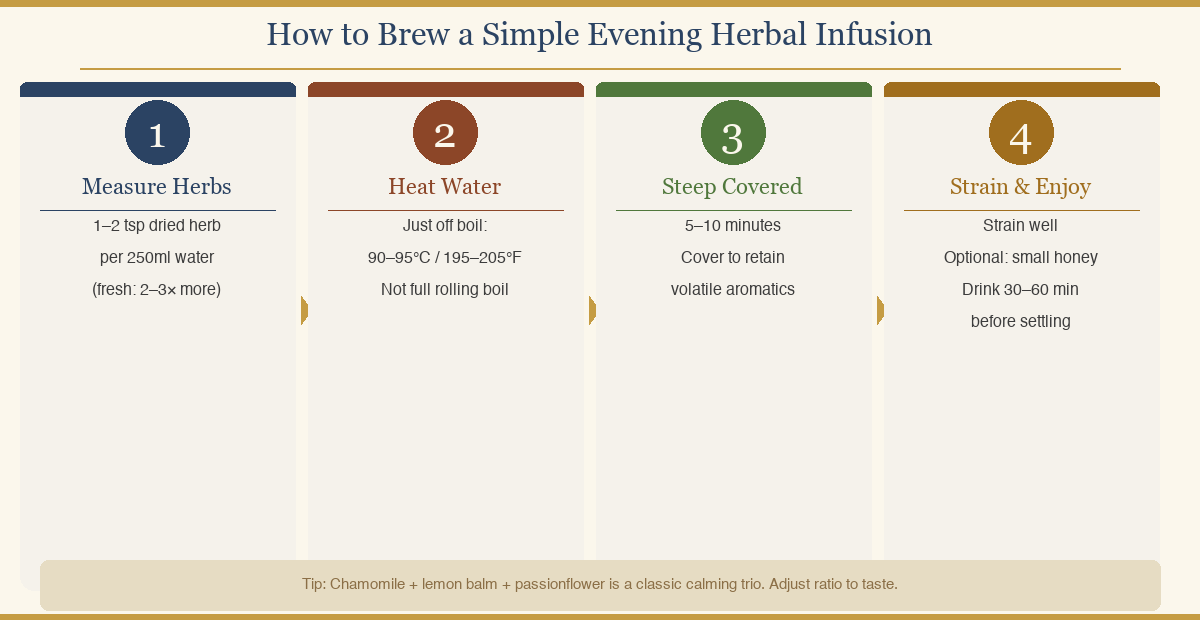
The most common approach is steeping dried chamomile flowers, lemon balm leaves, or passionflower aerial parts in hot water — ideally just off boil, around 90–95°C (195–205°F) — for 5–10 minutes, covered to retain volatile aromatic compounds. A standard starting ratio is 1–2 teaspoons of dried herb per 250ml of water. Many people combine two or three herbs; chamomile, lemon balm, and passionflower are a classic trio in traditional Western evening blends. The ritual of preparation itself — warmth, aroma, stepping away from screens — may contribute as much to the experience as any specific plant compound.
A TCM-Style Suan Zao Ren Decoction
Traditional use of suan zao ren involves simmering the seeds in water for 20–30 minutes, sometimes with classical formula partners such as fu ling (Poria mushroom) or gan cao (licorice root). This is different from a quick steep and reflects the classical emphasis on proper extraction for harder seeds and roots. Prepared alone, suan zao ren decoction has a mild, slightly nutty flavor. The full classical Suan Zao Ren Tang formula involves herb combinations adjusted to individual constitution — ideally evaluated by a licensed TCM practitioner.
Valerian and Passionflower Blends
Because valerian is particularly pungent on its own, it is most often drunk as part of a blend. Traditional European nighttime preparations frequently combine valerian root with hops, passionflower, and lemon balm to soften the taste. These blends are typically prepared as a decoction (valerian root simmered) with the more delicate herbs added off heat for a final steep. Valerian blends are generally taken 30–60 minutes before the intended time to settle for the evening, based on historical usage patterns — though individual response varies considerably.
Adaptogen-Informed Warming Blends
Some people incorporate Ayurvedic ideas into a warming evening drink — combining ashwagandha root powder with warm plant-based milk, a small amount of honey, cardamom, and a pinch of nutmeg. This reflects the Ayurvedic approach of combining herbs with anupana (carrier substances) to support balance. Like other evening herbs discussed here, ashwagandha has attracted some preliminary research attention for stress and sleep-related markers, with results that are encouraging in early studies but require larger replication before conclusions can be drawn.
Important Limitations and Considerations
As with any herbal practice, evening herbs are not universally safe or universally appropriate. Some key points every reader should know before starting:
- Drug interactions — valerian, passionflower, and kava (sometimes included in evening blends) may interact with central nervous system depressants including sedatives, benzodiazepines, and some antidepressants. Lemon balm may theoretically interact with thyroid medications. Anyone on prescription medications should discuss herbal additions with a qualified clinician before starting.
- Sedation risk — some calming herbs, especially valerian, may compound sedation when combined with alcohol or certain medications. Driving or operating machinery after consuming strong valerian preparations is inadvisable.
- Pregnancy and breastfeeding — many evening herbs have insufficient safety data for pregnancy and breastfeeding. Valerian root and passionflower are typically listed as "safety uncertain during pregnancy" in professional references. Consult a qualified practitioner before use in these circumstances.
- Surgery — herbs that may affect the central nervous system or interact with anesthetics (valerian in particular) are generally recommended to be paused at least two weeks before scheduled surgery.
- Children — children respond differently to herbs than adults. Most professional sources advise against self-administering concentrated herbal preparations to children without guidance from a pediatric herbalist or clinician.
- Allergy considerations — chamomile is a member of the Asteraceae (daisy) family; people with ragweed or related allergies may experience cross-reactivity. Reactions range from mild oral tingling to more serious responses in rare cases.
- Individual constitution — as emphasized in all traditional systems, no herb works the same way for every person. If an evening herb seems to increase agitation, cause unusual dreams, or produce digestive discomfort, it may not match your constitution well at this time. This is useful information, not a failure.
- Quality variation — herbs sold under the same name can vary widely in potency, preparation method, and authenticity. Sourcing from suppliers with third-party testing, clear country-of-origin labeling, and transparent ingredient lists is advisable for consistent results.
A Note on Tracking — Where Health Diary Comes In
One thing all traditional wellness systems share — whether TCM's emphasis on seasonal pattern observation, Western herbalism's "watch and wait" approach, or Ayurveda's ongoing dosha assessment — is that response to an herbal practice is observed over time, not assumed from a single experience.
A few signals some people find worth tracking when they begin an evening herbal routine:
- How long it takes to feel ready for sleep, compared to previous weeks
- Subjective sleep quality on nights the herbal drink was included versus nights it was skipped
- Morning energy and mood upon waking
- Any unexpected symptoms — digestive, alertness changes, mood shifts
- How the routine interacts with screen use, meal timing, or exercise
Even simple tracking — a few lines noting the drink, timing, and morning mood — can help distinguish whether an herb is contributing to change or whether the primary driver is the ritual itself (warmth, slowing down, signaling transition). Both are legitimate and worth understanding for your own context. Our journaling and wellness tracking tools at Health Diary are designed to help make this kind of observation easy and sustainable over time.
A Soft Closing Note
An evening herbal drink is a small, low-risk, historically grounded practice. At minimum, the ritual of preparation — stepping away from a screen, holding something warm, taking a few quiet minutes — signals transition in a way that many people find genuinely useful for their wind-down. Whether the herbs themselves are contributing specific compound-mediated effects, or whether the effects are primarily context-driven, is a distinction that likely matters less than whether the practice works well for you personally.
The traditions explored in this guide are not competing with each other. TCM's suan zao ren decoction, Western chamomile tea, and Ayurvedic ashwagandha warm milk are each drawing on centuries of careful observation within different frameworks. They do not all describe the same phenomenon, but they are pointing toward the same human need: a sustainable, low-stimulation transition between the active day and restorative rest.
Start with one simple herb you find appealing. Observe over two or three weeks. Adjust from there. That incremental, observation-based approach is closer to how these traditions actually worked than expecting dramatic results from reading a single article.
About This Article
Written by: Health Diary Editorial Team — A small editorial group researching traditional wellness practices, herbal traditions, and holistic health methods. We publish educational content aligned with our sourcing and editorial standards.
Editorial review: This article has been reviewed by the Health Diary editorial team for clarity, structure, and adherence to our sourcing standards. It is not a clinical review and should not replace consultation with a licensed healthcare practitioner.
Reviewed on: May 25, 2026.
Editorial process: We cite peer-reviewed and government sources where possible. When a clinical reviewer is added to this article, attribution will appear here with verifiable credentials.