Ginger in Asian Traditions: History, Culinary Uses, and Traditional Preparation Methods
Explore ginger's 5,000-year journey through Asian wellness and cuisine — from ancient trade routes to distinct Chinese, Japanese, Korean, and Vietnamese traditions, with traditional preparation methods.
Medical Disclaimer: This content is for educational and informational purposes only and is not medical advice. The information presented is not intended to diagnose, treat, cure, or prevent any disease. Always consult a licensed healthcare practitioner before starting any new herbal practice or supplement. Statements regarding traditional herbal use have not been evaluated by the FDA.
Affiliate Disclosure: This article contains affiliate links. We may earn a commission if you purchase through these links, at no additional cost to you. We only recommend products we believe align with our editorial standards.
Introduction: Asia's Most Universal Wellness Spice
If there is one rhizome that crosses every boundary in Asian culinary and wellness culture, it is ginger — known as sheng jiang (生姜) in Chinese, shoga (生姜) in Japanese, saenggang (생강) in Korean, and gừng in Vietnamese. Cultivated for well over 5,000 years, Zingiber officinale has woven itself so deeply into Asian daily life that it appears at the breakfast table, in the winter tea cup, in postpartum kitchens, and at the sushi counter — all in the same week, across different cultures, for strikingly similar reasons.
This guide traces ginger's path from its origins in South and Southeast Asia, along the ancient Silk Road into China, Japan, Korea, and Vietnam, exploring how each culture developed its own distinct relationship with this knobby, pungent root. We also look at traditional preparation methods — from simmered teas to fermented pickles — and examine how the form of ginger (fresh, dried, or powdered) relates to different traditional culinary and wellness applications. Individual responses to any herbal ingredient vary considerably, and the practices described here reflect cultural traditions rather than clinical guidance.
History of Ginger in Asia
Ginger (Zingiber officinale Roscoe) is believed to have originated in Maritime Southeast Asia, where it was likely first domesticated by Austronesian peoples before spreading westward into the Indian subcontinent. Botanical and linguistic evidence suggests that ginger was already a culturally significant plant in South and Southeast Asia well before 2000 BCE, appearing in ancient Sanskrit Ayurvedic texts under the name shringavera — a compound meaning "shaped like the horn of a stag," a reference to the rhizome's branching form.
By approximately 400 BCE, ginger had reached China, where it entered one of the earliest written records of food practice in East Asia. The Analects of Confucius (Book 10) noted that Confucius "was never without ginger when he ate" — a passage that scholars interpret as reflecting the already-established role of ginger in the Chinese diet during the Spring and Autumn period. The Bencao Gangmu (Compendium of Materia Medica), the landmark 16th-century Chinese pharmacopeia compiled by Li Shizhen, provided a detailed taxonomy distinguishing fresh ginger from dried ginger and their respective traditional applications — a distinction that remains central to Chinese wellness practices today.
The movement of ginger westward through Arab trading networks brought it to the Mediterranean world by the first century CE, and by the medieval period it had become one of the most prized spices in global commerce. During the 15th-century spice trade era that connected Asia with Europe, ginger commanded extraordinary prices — historically second only to pepper in trade volume. This commercial history underscores just how profoundly this single rhizome shaped human civilization, but its deepest roots — and its most nuanced traditional uses — remain in Asia, where it was never merely a luxury spice but a foundational element of everyday cooking and wellness culture.
Ginger in Chinese Tradition
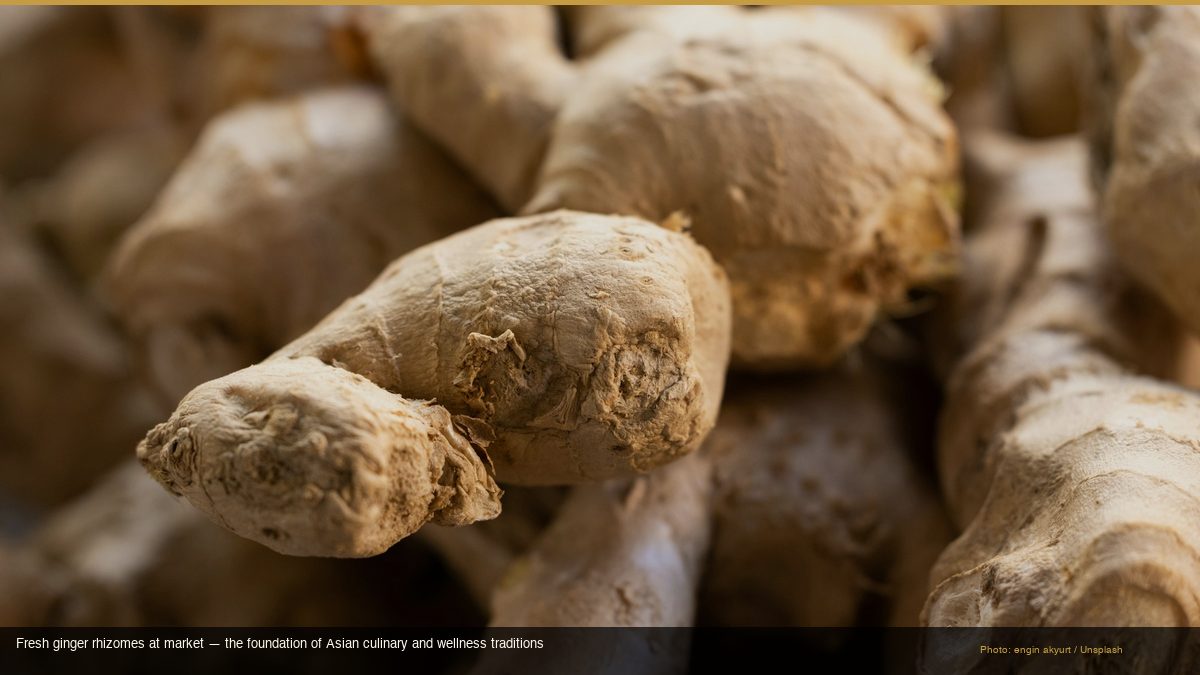
In the framework of Chinese wellness tradition, ginger occupies a particularly well-defined role. Traditional Chinese wellness classifies ginger according to two primary forms, each with different thermal properties: sheng jiang (生姜, fresh ginger) and gan jiang (干姜, dried ginger). These two forms are understood not as interchangeable but as serving distinct purposes within the broader framework of balancing warming and cooling influences in the body.
Sheng jiang (fresh ginger) is described as pungent and slightly warm, and is traditionally associated with releasing exterior wind-cold, warming the middle, and easing nausea — entering what traditional Chinese wellness literature describes as the Lung, Spleen, and Stomach channels. Gan jiang (dried ginger), by contrast, is considered more intensely warming and is traditionally used for deeper cold patterns and Yang deficiency — a distinction that the Bencao Gangmu documented extensively. As a traditional guideline: use sheng jiang for surface-level and digestive concerns; use gan jiang for deep internal cold.
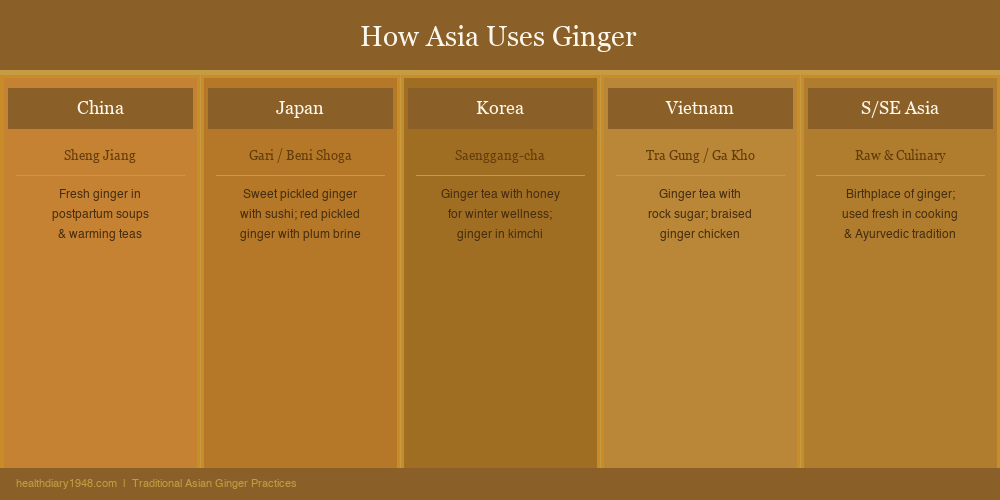
One of the most culturally resonant traditional uses of ginger in China is in postpartum recovery soups. Across Chinese-speaking communities — including in mainland China, Taiwan, Hong Kong, and the diaspora — the weeks following childbirth traditionally involve a practice of eating warming soups featuring ginger, sesame oil, and sometimes rice wine. This tradition, grounded in the belief that childbirth depletes internal warmth, places sheng jiang at the center of the maternal recovery kitchen.
Another widely enjoyed traditional preparation is hong tang jiang cha (红糖姜茶) — brown sugar ginger tea. Fresh ginger is simmered with raw brown sugar (unrefined, with molasses intact) to produce a warming, slightly sweet drink that many Chinese households keep as a go-to remedy during cold weather. This preparation remains common across generations and regions, from Guangdong to Sichuan, underscoring ginger's universal appeal within Chinese culinary wellness culture. Individual experiences with warming practices vary considerably; what is comforting for one person may feel too intense for another.
Ginger in Japanese Cuisine and Wellness
Japan's relationship with ginger (shoga, 生姜) is among the most visually distinctive in the world, expressed most famously through two forms of pickled ginger that have become globally recognized: gari and beni shoga.
Gari (ガリ) is the pale pink, thinly sliced pickled young ginger traditionally served alongside sushi. Historical records, including the Morisada Mankou encyclopedia written in 1837, document that gari was eaten with sushi from the Edo period (1603–1867), originating in the Kanto region around what is now Tokyo. Young ginger is harvested before its skin fully matures, then pickled in sweet rice vinegar — a process that gives gari its characteristic mild sweetness, delicate pink hue, and crisp texture. In sushi culture, gari serves as a palate cleanser between pieces of fish, with its gentle acidity refreshing the mouth without masking the subtle flavors of different preparations.
Beni shoga (紅生姜) is a different tradition entirely, more associated with the Kansai region around Osaka. Unlike gari, beni shoga uses mature ginger pickled in the leftover brine (umezu) from making umeboshi (Japanese salt-preserved plums). This plum brine imparts the vivid crimson color and a sharper, saltier flavor profile compared to the milder gari. Beni shoga is commonly served alongside rich Osaka street foods such as takoyaki and okonomiyaki, where its tartness cuts through the richness of the dishes.
Beyond pickled forms, Japan also has a long tradition of shoga-yu (生姜湯) — literally "ginger hot water" — a simple warming drink made by mixing fresh ginger juice or dried ginger powder with hot water and honey. This drink is traditionally consumed during cold weather or at the onset of a chill, reflecting the same warming-ginger logic seen across other Asian cultures. Seasonal wellness practices in Japan often feature ginger prominently in winter, with the root considered a natural warming ingredient in the context of cold-weather self-care.
Ginger in Korean Tradition (Saenggang)
In Korean culture, ginger (saenggang, 생강) arrived via China during the Three Kingdoms Period (57 BCE–668 CE) and became thoroughly embedded in both culinary and wellness practice by the Joseon Dynasty (1392–1910). Historical records indicate that Korean royal medicine during the Joseon era used saenggang-cha (ginger tea) as a warming remedy for colds, coughs, and sore throats — while commoners adopted the practice broadly as a winter wellness staple.
Saenggang-cha is traditionally prepared by simmering sliced fresh ginger in water until the liquid turns golden and fragrant, then sweetening with honey. The resulting drink has a clear amber color, a warming heat, and a gently spiced sweetness. Korean wellness tradition associates saenggang-cha with promoting circulation — the image of warming cold hands on a cup of ginger tea during a Korean winter is deeply culturally resonant, and the practice remains alive today in both homes and traditional tea houses.
Ginger also plays a less celebrated but equally important role in kimchi fermentation. Traditional kimchi paste (yangnyeom) combines garlic, gochugaru (Korean red chili flakes), ginger, and green onion as foundational aromatics. Fresh ginger contributes both flavor complexity and antimicrobial compounds that support the fermentation environment. The annual kimjang tradition — the communal making of large quantities of kimchi in late autumn before winter — places ginger as one of the essential ingredients prepared in advance by each household.
During Korean traditional holidays, ginger also appears in sikye, a sweet fermented rice drink often flavored with ginger, and in various traditional rice cakes (tteok) that incorporate ginger for warmth and flavor. Individual experiences with ginger's warming qualities vary considerably — some people find it intensely stimulating while others enjoy it as a gentle background note.
Ginger in Vietnamese Folk Tradition
In Vietnamese culture, gừng (ginger) is as foundational to the kitchen as fish sauce. Known in traditional Vietnamese herbal literature as sinh khương (fresh) or can khương (dried), ginger is classified as warm in nature with a pungent taste — properties that mirror the Chinese TCM classification but have been independently codified in Vietnamese folk tradition and documented in classical Vietnamese pharmacopeia.
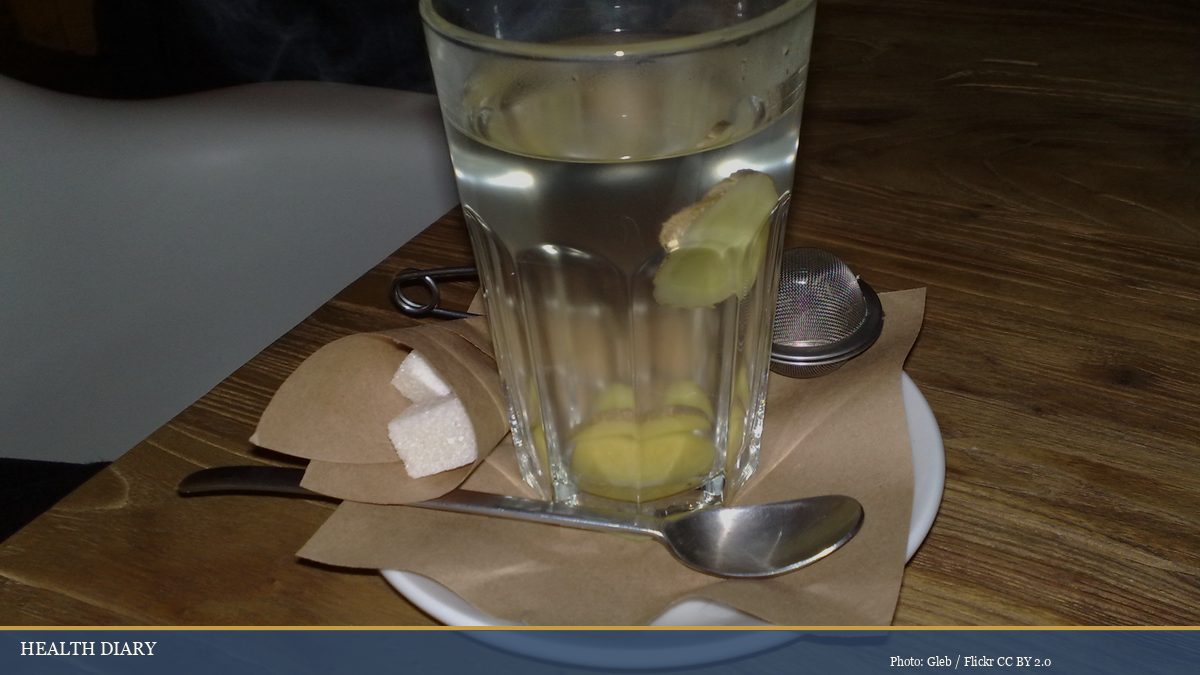
One of the most beloved ginger preparations in Vietnam is trà gừng đường phèn — ginger tea with rock sugar. Unlike Chinese brown sugar ginger tea, this Vietnamese variant uses đường phèn, a crystallized cane sugar with a lighter, more neutral sweetness that allows the ginger's brightness to shine through. The tea is made by simmering ginger slices with rock sugar until dissolved, often with a squeeze of fresh lime. This preparation is especially common in Central and Southern Vietnam and is traditionally offered to guests as a warming welcome drink.
The combination of ginger (gừng) and lemongrass (sả) appears frequently together in Vietnamese folk wellness preparations, particularly as a warm drink for cold and rainy season. Both are considered warming ingredients, and their flavor combination — spicy, citrusy, herbaceous — produces a deeply aromatic tea that many Vietnamese households prepare from late autumn through winter.
In Vietnamese cooking, ginger's most prominent role may be in gà kho gừng — ginger braised chicken. This homestyle dish consists of chicken pieces caramelized in fish sauce with generous quantities of fresh ginger. The kho technique (braising or slow-simmering until reduced) concentrates the ginger's warmth and sweetness into a glossy, fragrant sauce. Gà kho gừng is traditional comfort food associated with Tet (Lunar New Year) celebrations and is among the most recognized Vietnamese dishes that feature ginger as the defining flavor. In Vietnamese folk practice, chewing a small piece of raw ginger root has long been used as a folk strategy for motion sickness during long boat or road journeys — a practice rooted in the root's strong aromatic compounds rather than any formal clinical recommendation.
What Is the Difference Between Fresh, Dried, and Powdered Ginger?
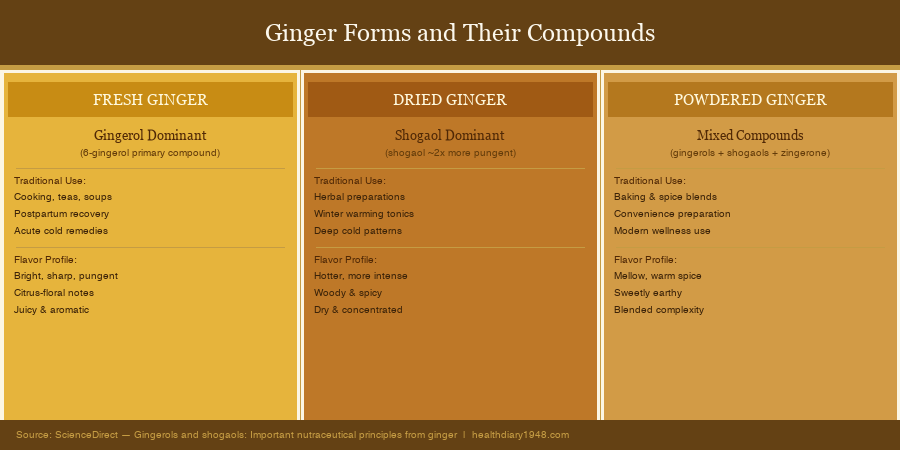
Understanding the differences between fresh, dried, and powdered ginger helps explain why Asian traditions often specify the form of ginger for each use. The three forms are not interchangeable — they have meaningfully different flavor profiles and compound ratios.
Fresh ginger is dominated by gingerols, particularly 6-gingerol, which is the primary compound responsible for fresh ginger's bright, sharp pungency and citrus-floral notes. Research published in Phytochemistry (Prasad & Tyagi, 2015) identifies gingerols and their derivatives as the major bioactive compounds of fresh ginger rhizomes.
Dried ginger undergoes a chemical transformation during dehydration: gingerols lose a water molecule and convert to shogaols via an elimination-dehydration reaction. According to a 2025 study on thermal processing of ginger (PMC12195494), the conversion of 6-gingerol to 6-shogaol involves the loss of the hydroxyl group at the C-5 position, forming a double bond. Shogaols are approximately twice as pungent as their gingerol precursors (approximately 151,000 Scoville heat units), producing the hotter, more intense, woody character of dried ginger. This explains why traditional Asian herbal preparations distinguish fresh ginger from dried — they are genuinely different in compound profile.
Powdered ginger typically contains a mixed profile of gingerols, shogaols, and zingerone (formed via further transformation), with the exact ratio depending on processing temperature and methods. Asian traditions generally associate powdered ginger with modern convenience rather than traditional wellness preparations, which historically specified fresh or whole dried rhizome.
In practice, most traditional Asian recipes that specify ginger mean fresh ginger root unless explicitly stated otherwise. Dried ginger is reserved primarily for herbal decoction preparations in Chinese and Vietnamese traditional wellness contexts, while powdered ginger appears more in baking and modern wellness products.
How Do You Prepare Ginger the Traditional Asian Way?
Across Asian cultures, several preparation methods appear consistently — reflecting convergent wisdom developed independently across centuries of culinary practice.
Simmered Ginger Tea (the Standard Method)
The most common traditional ginger tea method involves simmering fresh ginger slices (typically 3–5 thin slices per cup) in water for 10–15 minutes over medium-low heat. Simmering — rather than merely steeping — extracts a deeper, more concentrated flavor and allows the aromatic compounds to fully develop. Traditional Vietnamese and Chinese preparations both use this method, adding sweetener (rock sugar, brown sugar, or honey) after removing from heat to preserve the sweetener's flavor. The resulting tea is typically consumed warm, never chilled, in keeping with the tradition of ginger as a warming ingredient.
Steep Method (Lighter Preparation)
A gentler alternative common in Japanese shoga-yu preparations uses freshly grated ginger squeezed through a fine cloth, with the extracted juice or pulp added directly to very hot water. This produces a lighter, brighter drink with higher gingerol content (since the liquid was never heated long enough to convert significant gingerol to shogaol). Some people prefer this method for its fresher, more citrus-forward character.
Ginger-Honey Combination
Across Korea (saenggang-cha), Japan (shoga-yu), and Vietnam (trà gừng mật ong), combining ginger with honey is a traditional pairing found in countless folk preparations. The combination is practically elegant — honey's sweetness and its own compound properties complement ginger's warmth, and together they produce a drink that many find more palatable than unsweetened ginger alone.
Brown Sugar Ginger Combination (Vietnamese and Chinese)
Chinese hong tang jiang cha uses raw, unrefined brown sugar (hong tang) for its deeper, molasses-forward sweetness, which pairs well with ginger's intensity. Vietnamese trà gừng đường phèn uses rock sugar for a cleaner, lighter sweetness. Both traditions agree on simmering, not steeping, as the correct method for a full-flavored tea.
Preserving Fresh Ginger
Traditional Asian kitchens developed practical methods for preserving fresh ginger across seasons. Burying ginger in dry sand (a traditional Chinese method), pickling in rice vinegar (Japan), or storing unpeeled in a cool, dry place are all historically documented. Modern refrigeration has replaced most of these methods, but the Japanese tradition of pickling (gari, beni shoga) has achieved permanent cultural status as a culinary form in its own right rather than merely a preservation technique.
Important Considerations About Ginger Use
While ginger has an extensive history of traditional culinary and wellness use across Asia, there are important practical considerations for individuals exploring ginger practices today:
- Potential interactions with medications: Ginger may interact with blood-thinning medications such as warfarin, and with medications for diabetes or blood pressure management. Individuals taking these medications should consult a healthcare practitioner before adding ginger in large or concentrated amounts to their routine.
- Surgery: Some practitioners advise caution with concentrated ginger preparations in the period before surgery, given its potential effects on blood clotting. Always disclose herbal practices to your surgical team.
- Pregnancy and breastfeeding: Ginger has been studied in the context of pregnancy-related nausea, but evidence on safety during breastfeeding remains limited. Consult a healthcare provider before using ginger in supplement form during pregnancy.
- Digestive sensitivity: NCCIH notes that ginger may cause abdominal discomfort, heartburn, or mouth and throat irritation in some individuals, particularly at higher doses.
- Form and dose: The culinary use of ginger in cooking and tea is very different from concentrated supplement capsules. The traditional practices described in this article reflect everyday culinary and beverage use, not pharmaceutical dosing.
- Individual variation: Traditional Asian wellness traditions themselves acknowledge that ginger's warming properties are not appropriate for all constitutional types. In the Chinese wellness framework, individuals with significant internal heat patterns are traditionally counseled to use ginger cautiously. Individual responses vary considerably; what works well for one person may not suit another.
Frequently Asked Questions
What is ginger called in different Asian languages?
Ginger is known as sheng jiang (生姜) in Chinese, shoga (生姜) in Japanese, saenggang (생강) in Korean, and gừng in Vietnamese. Despite the different phonetic forms, the Chinese characters for ginger are shared between Chinese and Japanese — a reminder of the deep historical exchange of botanical knowledge across East Asia.
What is the difference between gari and beni shoga in Japanese cuisine?
Both are forms of Japanese pickled ginger, but they differ in brine, flavor, and context. Gari uses young ginger pickled in sweet rice vinegar — it is mild, slightly sweet, and pale pink, traditionally served as a palate cleanser between pieces of sushi. Beni shoga uses mature ginger pickled in plum brine (umezu) from umeboshi production — it has a vivid red color, sharper saltiness, and is typically served alongside rich street foods like takoyaki.
How do you make traditional Korean saenggang-cha at home?
Traditional saenggang-cha is straightforward: peel and thinly slice 30–40 grams of fresh ginger, simmer in 2 cups of water for 15 minutes until the water turns golden and fragrant, then sweeten with honey to taste. Some Korean recipes add a thin slice of cinnamon bark or a few dried jujube dates for complexity. Strain and serve hot. The traditional practice is to drink it slowly, warming your hands on the cup first.
Is fresh ginger stronger than dried ginger?
It depends on what you mean by "stronger." Fresh ginger has a brighter, sharper flavor dominated by gingerols. Dried ginger converts much of its gingerol to shogaol, a compound that is approximately twice as pungent by Scoville measurement — so dried ginger is actually hotter and more intensely pungent, but with a different, deeper flavor profile. Traditional Asian wellness preparations specifically distinguish between these two forms because they are understood to have different warming properties, with dried ginger considered more intensely warming.
Does ginger interact with any medications?
Yes, ginger may interact with certain medications. According to the National Center for Complementary and Integrative Health (NCCIH), potential interactions include blood-thinning medications (such as warfarin), diabetes medications, and blood pressure medications. If you take any of these, speak with your healthcare provider before incorporating concentrated ginger preparations into your routine. Culinary use of ginger in cooking is a different context from supplement use.
Why is ginger so central to Asian culinary and wellness traditions?
Ginger's central role likely stems from the combination of its compelling sensory properties — its warmth, its pungency, its ability to mask strong flavors — and its practical utility in a kitchen before refrigeration, when its antimicrobial properties (particularly with raw seafood and poultry) would have been practically valuable. The warming sensation ginger produces also made it culturally resonant in climates with cold winters and for communities with philosophical frameworks, like Chinese and Vietnamese wellness traditions, that emphasized internal warmth as a marker of vitality.
A Note on Exploring Asian Ginger Traditions
The ginger practices described in this guide represent living traditions, not museum artifacts. In homes across China, Japan, Korea, and Vietnam today, people still brew ginger tea at the first sign of a chill, add ginger to postpartum soups, and place gari on sushi plates — not because of clinical evidence but because these practices have been woven into daily life across generations. Exploring these traditions is a way of engaging with Asia's deep culinary and wellness heritage. If you are curious to incorporate ginger more deliberately into your routine, starting with traditional preparations — a cup of simmered honey ginger tea, a batch of homemade pickled ginger — offers a direct and authentic entry point into this 5,000-year tradition.
About This Article
Written by: Health Diary Editorial Team — a team of wellness writers and researchers specializing in traditional Asian herbal and culinary practices.
Editorial review: This article has been reviewed by the Health Diary editorial team for clarity, structure, and adherence to our sourcing standards. Key claims were cross-checked against NCCIH, NIH PubMed, and peer-reviewed phytochemistry literature. It is not a clinical review and should not replace consultation with a licensed healthcare practitioner.
Reviewed on: June 16, 2026.
Editorial process: We cite peer-reviewed and government sources where possible. When a clinical reviewer is added to this article, attribution will appear here with verifiable credentials.
This article reflects traditional Asian cultural practices around ginger. It is not medical advice.
References
- National Center for Complementary and Integrative Health (NCCIH). Ginger. U.S. Department of Health and Human Services. Accessed June 2026.
- Prasad S, Tyagi AK. Ginger and its constituents: role in prevention and treatment of gastrointestinal cancer. Phytochemistry. 2015.
- Ginger From Ancient Times to the New Outlook. PMC4377061. PubMed Central. 2015.
- Effect of Thermal Processing by Spray Drying on Key Ginger Compounds. PMC12195494. PubMed Central. 2025.
- Me & Qi Herb Database. Sheng Jiang (Fresh Ginger Rhizome) — TCM Herb Profile. Accessed June 2026.
- Trung Tam Thuoc Dan Toc. Gung — Vietnamese Traditional Herbal Profile. (Native Vietnamese source.) Accessed June 2026.
- My Korean Kitchen. Korean Ginger Tea (Saenggang Cha). Cultural and traditional preparation reference. Accessed June 2026.
- Food in Japan. Gari: Sushi's Perfect Palate Cleanser and Its History. Accessed June 2026.
- Food in Japan. Beni Shoga: The Red Ginger You Need to Know. Accessed June 2026.