Traditional Goji Berry Soup: Ancient Nourishment from Chinese Wellness Kitchens
Explore the ancient tradition of goji berry soup (wolfberry soup) in Chinese wellness kitchens. Discover three classic preparations — Red Date Goji Soup, Pork Rib Broth, and Longan Sweet Soup — plus a home recipe and modern nutritional insights.
What Is Traditional Goji Berry Soup?
Walk into a Chinese home kitchen during the cooler months and you are likely to encounter a familiar sight: a clay pot simmering gently on the stove, its broth the color of amber, small bright berries floating at the surface. These are goji berries — known in Mandarin as gou qi zi (枸杞子), or by their other common name, wolfberries — and the soup they inhabit is one of the oldest living expressions of Chinese food culture.
Traditional goji berry soup is not a single dish but a family of preparations that share one defining ingredient: the dried fruit of Lycium barbarum, a shrub native to the temperate regions of northwest China. From the windswept highlands of Ningxia province, where the premium "Zhongning goji" has been cultivated for centuries, these small red berries have traveled into kitchens across East and Southeast Asia, carried by trade routes, migration, and the universal human search for nourishment.
What unites these preparations — whether a clear pork rib broth from a Cantonese household or a sweet longan dessert soup served after a Taiwanese family dinner — is a philosophy of cooking rooted in food therapy traditions. In this framework, what you eat is inseparable from how you feel, and a thoughtfully prepared soup is a form of everyday care. Goji berries, with their mild sweetness and versatile character, have been a cornerstone of this approach for well over a thousand years.
This article explores the history, preparation traditions, key ingredients, and contemporary understanding of goji berry soups — a nourishing tradition that continues to thrive in kitchens from Shanghai to Singapore.
Goji Berry in Chinese Food Therapy: A Historical Perspective
The story of goji berry in Chinese culinary and wellness traditions stretches back more than two millennia. Early textual references appear in classical Chinese literature, but it was during the Tang Dynasty (618–907 CE) that goji berry cultivation and use in soups, porridges, and tonic preparations became widely documented. Historical accounts describe Buddhist temples in Ningxia where goji vines grew along compound walls, their berries harvested by monks who used them in daily restorative preparations.
The definitive classical source on goji berry is Li Shizhen's Bencao Gangmu (Compendium of Materia Medica), completed in 1578 CE. In this encyclopedic work spanning 52 volumes, Li Shizhen described the berry in detail, noting its properties as sweet in flavor and calm in nature — characteristics that made it suitable for daily consumption rather than only occasional therapeutic use. He documented its traditional role in supporting the liver and kidney channels and noted its use in liquid preparations including decoctions and soups.
The classical Chinese framework of food therapy — shi liao (食疗) or yao shan (药膳, nourishing cuisine) — holds that foods can be categorized by their thermal nature (warming, cooling, neutral), their flavor, and the organ systems they were understood to support. Goji berry falls into the category of foods traditionally used to support what practitioners described as Yin and Blood nourishment, particularly associated with the liver and kidney. This classification informed how the berry was combined with other ingredients in soup preparations.
Records from the Song Dynasty (960–1279 CE) document goji berry in combination with other seasonal ingredients in household cooking, suggesting that by this period, goji soup had become part of ordinary domestic wellness practice rather than exclusively the domain of physicians. By the Ming and Qing dynasties, recipe collections for household use routinely included goji preparations alongside instructions for cooking rice or preparing fermented condiments.
Research published in the Journal of Food Science and Technology (2021, PMC8051317) confirms that wolfberry has documented use in Chinese food therapy extending at least 2,000 years, with formal inclusion in early Chinese pharmacopoeia manuscripts predating the Tang Dynasty. The berry's entry into China's modern official pharmacopoeia — the Chinese Pharmacopoeia 2020 — represents a continuation of this long tradition of formal recognition.
Three Classic Goji Berry Soup Traditions
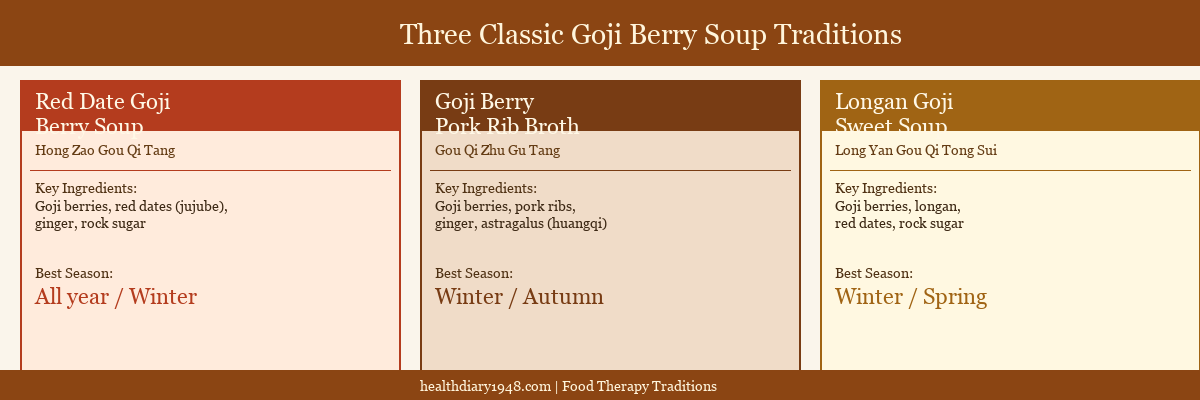
Within the broad category of goji berry soups, three preparations have achieved particular prominence across Chinese-speaking communities. Each reflects a different culinary tradition, uses goji berry in combination with complementary ingredients, and occupies a distinct place in the food therapy framework.
Red Date and Goji Berry Soup (Hong Zao Gou Qi Tang)
The simplest and most widely prepared goji berry soup is the red date and goji berry preparation known in Mandarin as Hong Zao Gou Qi Tang. This soup requires only a handful of ingredients — dried red dates (jujubes, known as hong zao), goji berries, fresh ginger slices, and water, sometimes sweetened with a piece of rock sugar — yet it represents centuries of accumulated kitchen wisdom about how ingredients work together.
Red dates and goji berries are considered natural companions in Chinese food traditions. The dates contribute a deep, caramel-like sweetness and are traditionally understood to complement the liver-nourishing properties attributed to goji berry. Ginger adds warmth to the preparation and aids in the assimilation of the other ingredients, according to classical food therapy principles.
Preparation follows a consistent traditional method: dried red dates are rinsed, optionally deseeded (as the seeds are traditionally considered to promote internal heat), and added to cold water. The ginger goes in at the start. The mixture is brought to a gentle boil and simmered for 45 minutes to an hour. Goji berries are added in the final 15 to 20 minutes to preserve their characteristic red color and prevent them from becoming mushy or releasing excessive tartness into the broth.
The resulting soup is a deep amber color with a naturally sweet flavor. It is consumed warm, typically in small portions of 200–300ml, and is particularly common as an evening preparation. In many Chinese families, this soup is made year-round but more frequently during the cooler months when warming preparations are especially valued.
Variations include the addition of lotus seeds (which contribute a mild, starchy quality), longan flesh (for additional sweetness), or dried lily bulb (for a slightly cooling counterbalance). Some Cantonese versions add a small piece of dried tangerine peel (chen pi) to aid digestion and add a subtle citrus complexity to the broth.
Goji Berry and Pork Rib Broth
The pork rib and goji berry broth represents a more substantial expression of the goji soup tradition — a savory preparation that functions as a main course soup rather than a tonic drink. This style of soup is particularly associated with Cantonese cooking, a culinary tradition renowned for its long-simmered bone broths that are treated as vehicles for nutritive ingredients.
The preparation begins with a blanching step: pork ribs or pork bones are briefly boiled in water for five minutes, then the water is discarded and the bones rinsed clean. This step removes impurities and blood that would otherwise cloud the final broth. The cleaned bones are then placed in a fresh pot of cold water with ginger slices and sometimes a small amount of rice wine, brought to a boil, and reduced to a gentle simmer.
Goji berries are added approximately 30 minutes before the end of cooking. Common additions include Chinese yam (huai shan), which is understood in food therapy traditions to support digestive function, and astragalus root (huang qi), which is traditionally paired with goji berry in preparations intended to nourish Qi and build physical resilience over time. The soup simmers for a total of 90 minutes to two hours until the broth develops a rich, slightly golden color.
The resulting soup has a depth of flavor that comes from the slow extraction of collagen from the bones combined with the characteristic sweetness of the goji berries. It is typically seasoned with salt only at the end of cooking. The soup can be served as a starter or as the centerpiece of a simple home meal alongside steamed rice.
A variant popular in southern China and among diaspora communities in Southeast Asia pairs goji berry with watercress and pork ribs — a combination that is thought to offer a balancing effect, as watercress is considered cooling in food therapy terms while goji berry is warming, making the combined preparation suitable for a wider range of individuals.
Longan and Goji Berry Sweet Soup
The longan and goji berry sweet soup — known in Cantonese as tong sui and in Mandarin as Long Yan Gou Qi Tang — occupies a unique cultural position as a dessert preparation served at the end of a meal or as a restorative snack during cooler evenings. The term tong sui (糖水) literally translates as "sugar water" and encompasses a broad category of Chinese sweet soups and liquid desserts.
Dried longan (known as long yan rou or dragon eye flesh) is the defining ingredient of this preparation. Longan is valued in Chinese food traditions for its rich, honeyed sweetness and its traditional role as a nourishing ingredient for the blood and spirit. Combined with goji berry — which contributes a mild tartness that balances longan's intensity — the soup develops a complex sweetness that is satisfying without being cloying.
The preparation is straightforward: dried longan, goji berries, and red dates are soaked briefly in warm water, then combined in a pot with fresh water and ginger. Rock sugar is used for sweetening, preferred over refined sugar for its perceived gentler quality. The mixture is brought to a boil, then reduced and simmered for 20 to 30 minutes. Goji berries, as with other preparations, are added near the end.
This soup is traditionally served warm and is particularly associated with the Winter Solstice period, when families gather to share warming foods. It is also made during the first weeks of the new year as a nourishing preparation for the transition between seasons. Some versions are served with glutinous rice balls (tang yuan), making it a complete dessert course.
In contemporary Chinese and Singaporean dessert shops, variations of longan goji soup can be found year-round, sometimes served chilled in summer months, though traditional preference remains for warm consumption during cooler seasons.
Key Ingredients and Their Traditional Roles
Understanding goji berry soups fully requires understanding the ingredients traditionally paired with goji berry. Each component in these preparations contributes its own flavor, character, and place within the food therapy framework that has shaped Chinese kitchen wisdom over centuries.

Red Dates (Hong Zao / Jujube)
The dried red date — known botanically as Ziziphus jujuba — is the most common companion to goji berry in soup preparations. In food therapy traditions, red dates are understood to nourish the spleen and stomach, support Qi, and naturally sweeten preparations without requiring added sugar. They contain natural sugars, organic acids, and are a traditional source of vitamins and minerals. When used in soups, they contribute a deep caramel sweetness and a slightly chewy texture that contrasts pleasingly with the softer goji berries.
Longan (Long Yan / Dragon Eye)
Fresh longan is a seasonal fruit in subtropical China, but the dried form — darker, more concentrated, with an intensified sweetness — is used year-round in soups and tonic preparations. In classical food therapy texts, longan is traditionally associated with nourishing the blood and calming the spirit, making it particularly valued in evening preparations. Combined with goji berry, it creates a layered sweetness that characterizes the tong sui tradition.
Ginger (Sheng Jiang)
Fresh ginger appears in virtually all savory goji berry soup preparations and in many sweet ones as well. Its warming nature in food therapy terms is considered essential for facilitating the body's absorption of the other ingredients and for counteracting any potential cooling effect in long-simmered preparations. Ginger also provides aromatic complexity that prevents the soup from tasting flat. In cooking practice, it is typically added as slices at the beginning and removed before serving, or left in the soup as a gentle warming element.
Astragalus Root (Huang Qi)
Astragalus (Astragalus membranaceus) root is one of the most significant herbs in Chinese wellness traditions and appears regularly in combination with goji berry in savory soups. The dried root is sold in thin slices or sticks and is added to the soup at the beginning of cooking, releasing a mild, slightly sweet flavor into the broth. In food therapy traditions, astragalus is considered a principal Qi-nourishing ingredient and is traditionally paired with goji berry when the preparation is intended to support vitality and resilience. The combination appears frequently in winter soups consumed during periods of cold weather or physical recovery.
Rock Sugar (Bing Tang)
Rock sugar is the preferred sweetener for sweet goji berry soups, favored over refined sugar for both its flavor — a clean, mild sweetness — and its traditional perception as gentler and more slowly assimilated. It dissolves slowly during cooking, allowing the cook to adjust the sweetness gradually. In classical kitchen practice, rock sugar is added near the end of cooking to preserve its delicate flavor.
Seasonal Traditions: When to Enjoy Goji Berry Soup
In classical Chinese food therapy, the timing of what you eat is considered as important as what you eat. Foods are matched to seasons based on their thermal properties and the physiological challenges that each season presents. Goji berry, classified as a warming ingredient with neutral to slightly warming thermal properties, is particularly valued during the cooler months.
Winter is traditionally the prime season for goji berry soup consumption. The cooling of external temperatures is understood in food therapy terms to call for preparations that build internal warmth and replenish the deeper reserves of the body's vital energy. Goji berry soups — particularly the pork rib broth and the red date preparation — are consumed more frequently from the first cold nights of late autumn through the end of winter. The Winter Solstice (Dong Zhi) is a particularly important occasion, when families traditionally gather around warming soups.
Spring represents a transition period. As the body adjusts from the concentrated nourishment of winter to the lighter energy of spring, goji berry soups shift toward the sweeter, lighter preparations — longan goji sweet soup and simpler red date broths become more common than the heavy pork rib versions. The warmer season calls for lighter preparations, and the goji berry's naturally cooling counterpart longan provides balance during this transition.
Summer consumption is less traditional for the warming soup preparations, though goji berries continue to appear in cold applications, teas, and lighter rice congees during the warmer months. For those who prefer soups year-round, the watercress and goji pork rib soup is considered more suitable for summer because watercress's cooling properties balance the warming quality of the goji berry.
Autumn brings a return to warming preparations as temperatures begin to fall. In some regional traditions, early autumn is also when the year's goji berry harvest arrives — the berries harvested from late summer through early autumn are dried for use through the year. Food therapy practitioners have long recommended increasing goji berry consumption in early autumn as a preparation for winter.
A Traditional Goji Berry Soup Recipe to Try at Home
The following recipe is a traditional Red Date and Goji Berry Soup — the most accessible entry point into the goji soup tradition. It requires only a few ingredients and approximately one hour of preparation and cooking time.
Ingredients (serves 4)
- 30g dried goji berries (about 3 tablespoons)
- 15 dried red dates (jujubes), rinsed
- 4–5 slices fresh ginger
- 1.5 liters water
- 20–30g rock sugar (to taste)
Optional additions: 15g lotus seeds (soaked 30 minutes), a small piece of dried tangerine peel (chen pi)
Method
- Rinse the red dates under cold water. If desired, remove the pits with a small knife — this step is traditional as it prevents the seeds from contributing excess heat to the preparation.
- Place the red dates, ginger slices, and lotus seeds (if using) in a medium pot with 1.5 liters of cold water. Bring to a full boil over high heat.
- Once boiling, reduce heat to medium-low and simmer for 40 minutes. The dates should become plump and begin to release their color into the broth.
- Add the goji berries. If using dried tangerine peel, add it now as well. Continue to simmer for 15–20 minutes until the goji berries are soft and the broth has deepened to a rich amber-red.
- Add rock sugar and stir until dissolved. Taste and adjust sweetness.
- Serve warm in small bowls. The berries and dates are consumed along with the soup.
Kitchen notes from traditional practice: Adding goji berries in the final 15–20 minutes is deliberate — longer cooking causes them to break down and can make the soup slightly sour. The soup keeps well refrigerated for two to three days and is traditionally reheated before serving rather than consumed cold.
What Modern Research Says About Goji Berry Nutrition
Contemporary nutritional science has examined goji berry with considerable interest, and the findings offer context for understanding why this ingredient has maintained such a central place in food traditions over centuries.

The most studied components of goji berry are the Lycium barbarum polysaccharides (LBPs), complex carbohydrate-protein complexes that comprise approximately 5–8% of the dried fruit by weight. Research published in PMC5758351 identified LBPs as the primary active compounds in the berry, containing 17 amino acids and multiple monosaccharides. Laboratory and animal studies have explored their antioxidant, immunomodulatory, and anti-inflammatory properties, though researchers note that large-scale human clinical trials are still ongoing.
Zeaxanthin, the dominant carotenoid in goji berry at approximately 83% of total carotenoid content, has attracted particular research attention for its potential role in eye health. A study published in Optometry and Vision Science found that daily intake of goji berry was associated with increased plasma zeaxanthin levels. This is consistent with the classical Chinese understanding of goji berry as a food traditionally used to support healthy vision — an association documented in texts spanning from the Tang Dynasty through to modern practice.
Betaine is another compound of research interest. The Chinese Pharmacopoeia 2020 requires that standardized Lycium barbarum contain no less than 0.3% betaine by weight, establishing it as an official marker compound for quality assessment. Betaine occurs naturally in many foods and is the subject of ongoing nutritional research.
From a basic nutritional perspective, goji berries are a source of vitamins C, B1, and B2, along with minerals including potassium, iron, zinc, magnesium, calcium, and selenium. Per 100g of dried berries, they provide significant fiber and protein by dried fruit standards, contributing to their traditional use as a substantive addition to soups rather than merely a flavoring agent.
It is worth noting that most goji berry research has been conducted in laboratory settings or in animal models. While the findings are promising, the scientific community continues to build the evidence base for specific health effects in humans. What can be said with confidence is that goji berry is nutritionally dense and has been safely consumed as a food ingredient across diverse populations for centuries.
From a culinary science perspective, the practice of adding goji berries late in the cooking process — documented in traditional kitchen instructions — appears to be sound. Extended boiling reduces the polysaccharide content and can degrade heat-sensitive vitamins. The traditional 15–20 minute addition window represents an empirically derived balance between flavor development and ingredient preservation.
Frequently Asked Questions
Q: Can I use fresh goji berries in soup instead of dried?
Fresh goji berries are rarely available outside of China's producing regions and have a short shelf life. Dried goji berries are the standard ingredient for soups and are what all traditional recipes call for. Dried berries have a more concentrated sweetness and are available year-round in Chinese grocery stores, Asian supermarkets, and online. When purchasing, look for berries that are plump, uniformly red, and free from clumping — signs of quality and proper storage.
Q: How many goji berries should I use in a soup?
Traditional kitchen practice suggests approximately 15–30 grams of dried goji berries for a pot serving four people. This translates to roughly 2–3 tablespoons. Using too few results in a broth without enough of the characteristic sweetness and color; using too many can make the soup overly sweet and concentrated. Classical Chinese food preparation texts recommend moderation with any single ingredient.
Q: Why should goji berries be added near the end of cooking?
This is one of the most consistently observed rules across traditional goji soup preparations. Extended simmering causes goji berries to break down completely, releasing their seeds and making the soup taste slightly sour or bitter. Adding them in the final 15–20 minutes allows them to become plump and soft, release their color and natural sweetness into the broth, and remain intact enough to eat.
Q: Are there any traditional guidelines about who should avoid goji berry soups?
Traditional Chinese kitchen wisdom notes that goji berry's warming properties make it less suitable during active colds, fevers, or periods of inflammation. Those who tend toward what practitioners call a "heat" constitution — characterized by easily flushing, restlessness, or tendency toward inflammation — are often advised to consume goji berry preparations in moderation. Individuals taking blood-thinning medications should consult a healthcare provider before consuming goji berries in large quantities, as they contain compounds that may interact with anticoagulant medications.
Q: What is the difference between goji berry and wolfberry?
These terms refer to the same plant: Lycium barbarum. "Wolfberry" is the older English name, derived from the Chinese name gou qi (where gou relates to the Chinese word for dog or wolf in classical literature). "Goji" is a transliteration of a regional Chinese dialect pronunciation and became popular internationally in the early 2000s when the berry gained wider attention in Western markets. In culinary contexts, both terms are used interchangeably.
Q: Can I prepare goji berry soup in a slow cooker or pressure cooker?
Both methods are suitable for the savory pork rib version. For slow cooker preparation, add all ingredients except goji berries and cook on low for six to eight hours or high for three to four hours, then add the goji berries in the final 20 minutes. For pressure cooker or Instant Pot preparation, cook the base on high pressure for 30–40 minutes with natural release, then add goji berries and simmer on sauté mode for 10–15 minutes. For the sweet red date soup, stovetop or slow cooker is preferred as the preparation time is short and the delicate flavor benefits from gentle simmering.
References
- Peng Y, et al. (2021). "Health benefits of wolfberry (Gou Qi Zi, Fructus barbarum L.) on the basis of ancient Chinese herbalism and Western modern medicine." Food Science & Technology. PMC8051317. Available at: https://pmc.ncbi.nlm.nih.gov/articles/PMC8051317/
- Li X, et al. (2017). "Lycium Barbarum: A Traditional Chinese Herb and A Promising Anti-Aging Agent." Aging and Disease. PMC5758351. Available at: https://pmc.ncbi.nlm.nih.gov/articles/PMC5758351/
- Potterat O. (2010). "Goji (Lycium barbarum and L. chinense): Phytochemistry, Pharmacology and Safety in the Perspective of Traditional Uses and Recent Popularity." Planta Medica 76(1):7–19.
- Li Shizhen (1578). Bencao Gangmu (Compendium of Materia Medica). Ming Dynasty, China. Chapter on Lycium barbarum.
- National Pharmacopoeia Committee of China (2020). Chinese Pharmacopoeia (Zhongguo Yaodian), 2020 Edition. Entry: Fructus Lycii (Gou Qi Zi). Beijing: China Medical Science Press.
- Baike.baidu.com (2023). 枸杞红枣汤 [Goji Berry Red Date Soup entry]. Baidu Baike Encyclopedia. Available at: https://baike.baidu.com/
- Zysj.com.cn. 枸杞子 [Gou Qi Zi, Chinese Wolfberry]. Traditional Chinese Medicine reference database. Available at: https://www.zysj.com.cn/zhongyaocai/gouqizi/
- Chinesechickenherb.com. "Chinese Chicken Herbal Soup." Daily Cooking Quest. Available at: https://dailycookingquest.com/chinese-chicken-herbal-soup.html
- The Chinese Soup Lady (2022). "Wolfberries (Dried)." Available at: https://thechinesesouplady.com/wolfberries-dried/
- Christine's Recipes (2018). "Chinese Yam Goji and Pork Ribs Soup." Available at: https://en.christinesrecipes.com/2018/03/chinese-yam-goji-and-pork-ribs-soup.html