Lotus Flower in Asian Culture: Symbolism, Traditions, and Traditional Uses
Explore the lotus flower's profound significance across Asian cultures — Buddhist and Hindu symbolism, Vietnam's national flower tradition, and the culinary uses of lotus seeds, root, and leaves from China to Japan to Korea.
Editorial Note: This article explores the cultural, historical, and culinary traditions surrounding the lotus flower (Nelumbo nucifera) across Asia. It is intended for educational and informational purposes only and is not medical advice. The information presented is not intended to diagnose, treat, cure, or prevent any disease or health condition. Always consult a licensed healthcare practitioner before starting any new herbal practice or supplement.
Affiliate Disclosure: This article may contain affiliate links. We may earn a commission if you purchase through these links, at no additional cost to you.
Few plants have shaped the spiritual landscape, culinary traditions, and artistic heritage of Asia as profoundly as the lotus (Nelumbo nucifera). From the sacred ponds of Buddhist temples in Vietnam and Japan to the festive tables of Chinese New Year celebrations, from ancient Sanskrit hymns to Song dynasty philosophical essays — the lotus appears everywhere, carrying layers of meaning that have accumulated over thousands of years of human reverence.
This is not simply a beautiful flower. It is, for hundreds of millions of people across Asia, a living symbol — of purity emerging from muddy origins, of spiritual aspiration, of the possibility of beauty in unlikely places. And unlike many sacred plants that remain purely symbolic, the lotus is also deeply practical: its seeds, root, leaves, flowers, and stamens have been woven into the cuisines and daily rituals of cultures from the Mekong Delta to the Japanese archipelago.
Lotus Symbolism in Asian Traditions
The lotus occupies a unique position in Asian symbolism because its life cycle is so overtly metaphorical. The plant takes root in muddy, murky pond water, yet its flower rises through the surface pristine, unblemished, and radiant. This journey — from darkness and mud to light and beauty — has resonated deeply with Buddhist, Hindu, Confucian, and Taoist thinkers for millennia.
Buddhist Symbolism
In Buddhist tradition, the lotus is perhaps the most central botanical symbol. The image of the Buddha seated upon a lotus throne — the padmasana — appears across the entire Buddhist world, from the earliest Indian cave sculptures to contemporary Vietnamese temple altars. The lotus here represents the state of enlightenment: the practitioner who, like the flower, rises from the mud of suffering and illusion toward the clarity of awakened understanding.
Different lotus colors carry distinct symbolic meanings in Buddhist iconography. The white lotus represents mental purity and spiritual perfection. The pink lotus, most closely associated with the historical Shakyamuni Buddha, symbolizes the highest state of awakening. The blue lotus (utpala) represents wisdom and the conquest of the senses. The red lotus represents the heart, love, and compassion — particularly associated with the bodhisattva Avalokiteshvara (Guanyin in Chinese tradition, Quan Am in Vietnamese).
Buddhist texts from the Pali Canon repeatedly use lotus imagery to describe the nature of liberation. The phrase describing an enlightened one as unaffected by the surrounding world, much as a lotus petal repels water, appears across multiple Buddhist traditions. This self-cleaning property of the lotus leaf, later studied by Western botanists as the "lotus effect," was observed and appreciated in Asia for centuries before modern science explained its microscopic mechanism.
Hindu Symbolism
In Hinduism, the lotus (padma) holds equally central importance. Both Lakshmi, the goddess of prosperity and beauty, and Brahma, the creator god, are depicted seated upon or holding lotus flowers. Vishnu is often described as lotus-eyed (padmanayana), a term of supreme beauty. The Rigveda, among the oldest known religious texts, contains references to the lotus as a symbol of divine creative power.
The lotus in Hindu tradition also carries associations with the chakra system — the seven energy centers of the subtle body are all visualized as lotus flowers with varying numbers of petals, from the four-petaled root chakra to the thousand-petaled crown chakra (sahasrara), which represents the highest state of spiritual realization. This concept later influenced Buddhist tantric traditions as they spread across Asia.
Confucian Moral Philosophy
In the Chinese literary and philosophical tradition, the lotus acquired a specifically Confucian moral dimension through the essay Ai Lian Shuo (On the Love of the Lotus) written by the Song dynasty Neo-Confucian philosopher Zhou Dunyi (1017–1073 CE). This brief but enormously influential text uses the lotus as a metaphor for the morally upright person: one who, like the flower growing from muddy water, remains uncorrupted by the surrounding world, neither obsequiously ingratiating nor eccentrically detached from society.
Zhou Dunyi described the lotus as one that emerges from mud but is not tainted, rinsed in clear water but not seductive — a formulation that became one of the most quoted ideas in classical Chinese literature. This essay cemented the lotus as a symbol of gentlemanly virtue and moral integrity and is still studied in Chinese schools today. It has shaped how generations of Chinese scholars and artists have understood the plant's significance.
The Lotus in Vietnamese Culture
Of all the countries where the lotus holds cultural significance, Vietnam may have the deepest and most intimate relationship with this flower. While the lotus is the official national flower of India, in Vietnam it occupies an equally central place in national identity — recognized by tradition as the country's emblematic flower, appearing on official seals, currency, and countless cultural artifacts.
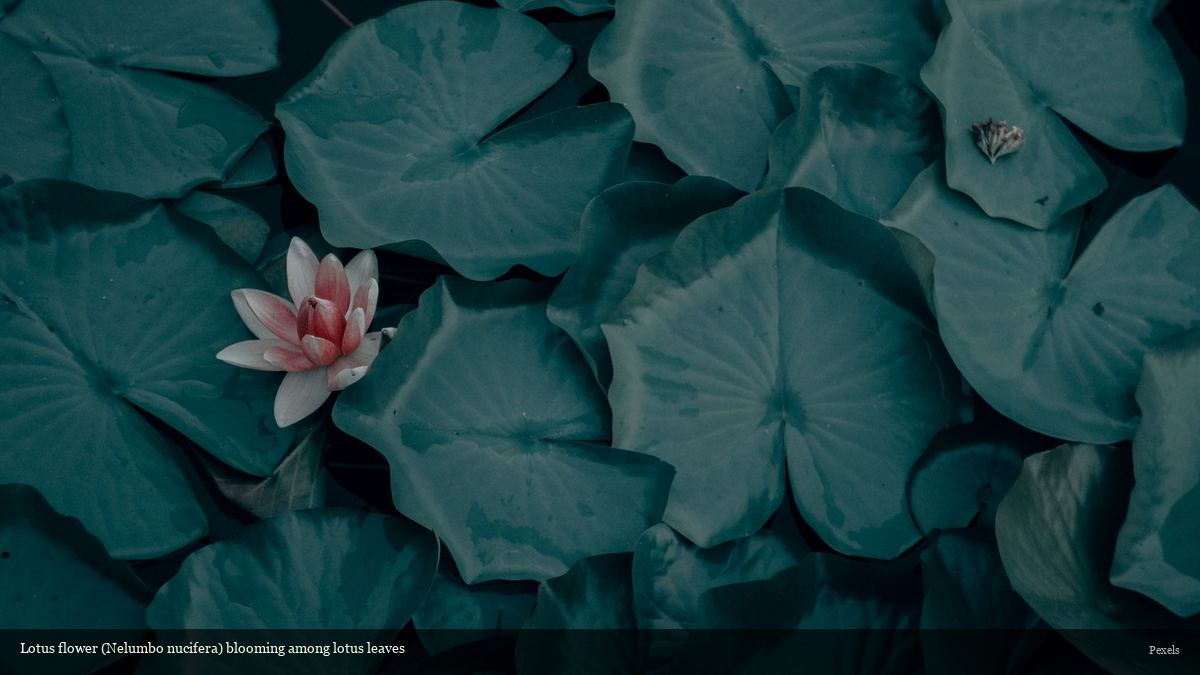
The connection between the Vietnamese people and the lotus runs through centuries of Buddhist practice, as Vietnam's Mahayana Buddhism brought the lotus deeply into temple architecture, iconography, and ritual life. Nearly every Vietnamese Buddhist temple maintains a lotus pond, and the flower appears in the lotus-shaped stupas, columns, and decorative motifs of traditional Vietnamese architecture.
Tay Ho — Hanoi's Lotus Lake
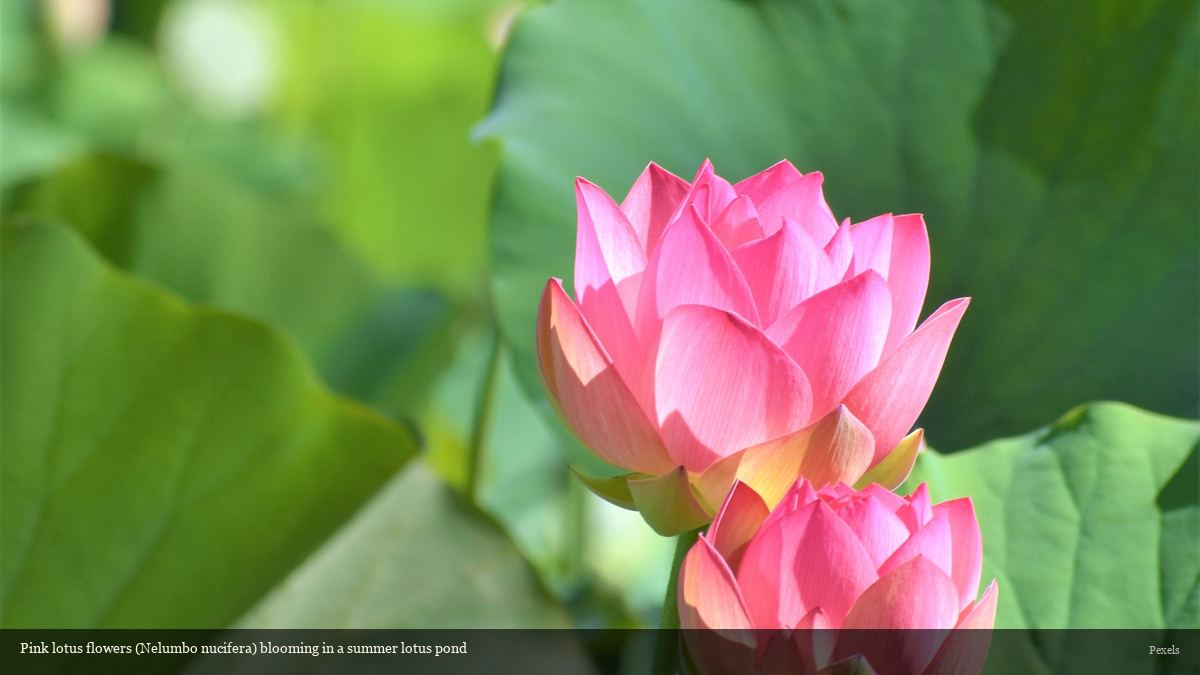
West Lake (Ho Tay, or Tay Ho) in Hanoi is perhaps Vietnam's most famous lotus site. The lake and its surrounding villages have been associated with lotus cultivation for centuries. During the summer lotus season — typically from June through August — the lake's edges bloom with thousands of pink lotus flowers, drawing Hanoians who have practiced the art of lotus appreciation for generations.
The Tay Ho district is particularly renowned for its centuries-old tradition of making tra sen — lotus tea. Craftswomen visit the lotus ponds at dawn, when the flowers are fully open, and place a small quantity of green tea inside the flower's center. The flower is then gently tied closed and left overnight. The tea absorbs the delicate, otherworldly fragrance of the lotus stamens, producing a tea so aromatic and so labor-intensive to produce that it has historically been considered among the most precious teas in Vietnam — traditionally reserved for royalty and honored guests.
Lotus Silk: The Art of Sen Silk
Perhaps the most extraordinary lotus tradition anywhere in Asia is the weaving of to sen, or lotus silk — fabric created from the fine filaments extracted from lotus stems. This exceptionally rare craft, practiced in small communities around Tay Ho in Hanoi and on the shores of Inle Lake in Myanmar, involves pulling the gossamer threads from cut lotus stems, spinning them while still moist, and then weaving them into a fabric said to have a unique softness and natural coolness.
The production is extraordinarily labor-intensive: thousands of lotus stems are required to produce even a small piece of fabric, and the filaments must be extracted within a few minutes of cutting before they dry. The resulting cloth is considered among the finest natural textiles in the world and carries deep cultural significance as an embodiment of the lotus's sacred qualities made tangible in material form.
Lotus in Vietnamese Cuisine
Vietnamese cuisine makes use of nearly every part of the lotus plant. Lotus seeds (hat sen) are a beloved ingredient in both everyday cooking and ceremonial foods, appearing in sweet soups (che hat sen), congee, and festival cakes. The young green seeds eaten fresh from the pod, with their slightly bitter embryo intact, are a seasonal delicacy enjoyed during the summer harvest.
Lotus leaves (la sen) are used to wrap sticky rice (com la sen), imparting a subtle floral fragrance to the rice during steaming — a preparation that appears in both everyday street food and in offerings at Buddhist temples. The large, waxy leaves are also used as natural serving vessels at traditional feasts.
What Are the Traditional Culinary Uses of the Entire Lotus Plant?
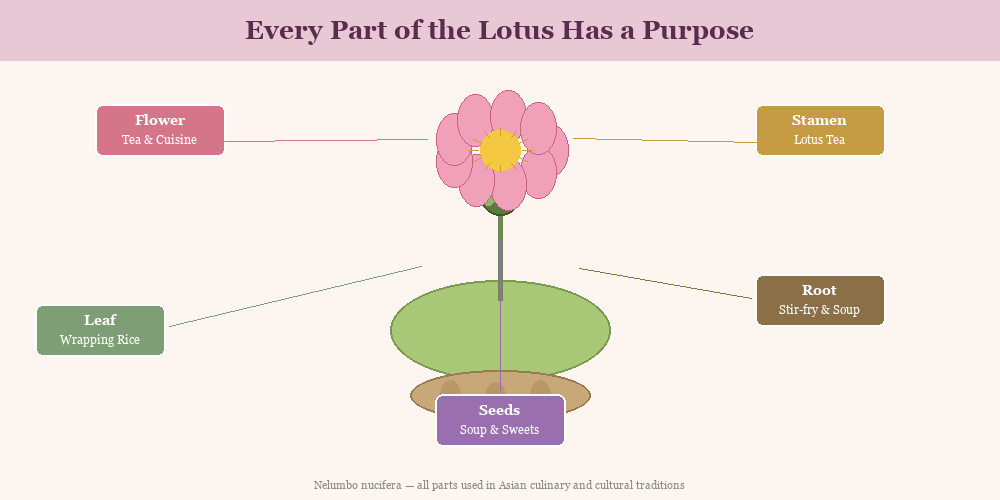
One of the remarkable aspects of the lotus's place in Asian food culture is that virtually no part of the plant goes unused. This total utilization reflects both practical wisdom and a cultural reverence that treats the lotus as a gift whose every expression deserves to be honored.
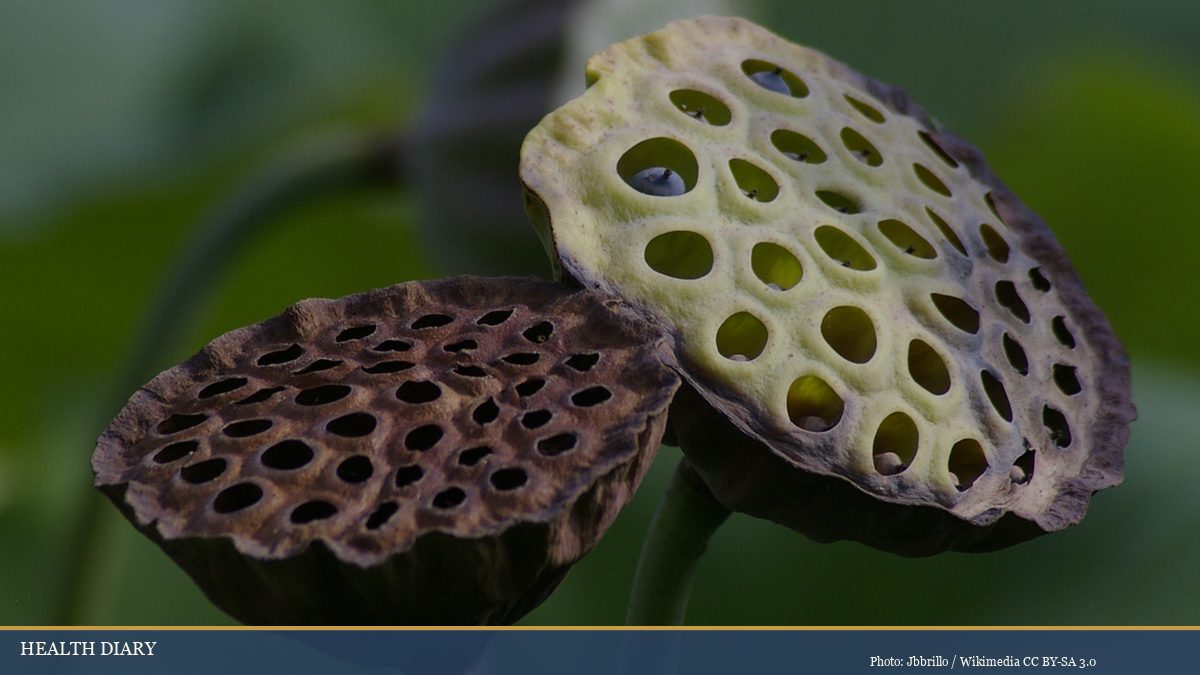
Lotus Seeds (Lian Zi / Hat Sen)
Lotus seeds have a documented culinary and cultural history in China spanning approximately 3,000 years, with references appearing in early Chinese botanical records. Fresh seeds have a mild, slightly sweet flavor with a pleasantly starchy texture. When dried, they become an ingredient in a wide range of preparations across Asian cuisines.
In Chinese cuisine, dried lotus seeds are typically soaked overnight before being added to soups, congee, or sweet dessert soups. Lotus seed paste (lian rong) — made by cooking, mashing, and sweetening the seeds — is one of the classic fillings in Chinese pastries, most notably the mooncakes of the Mid-Autumn Festival and various festive dim sum items. Crystallized lotus seeds are a common Chinese New Year snack across regional traditions. In Vietnamese cuisine, hat sen appear in the sweet soup che ba mau and in glutinous rice preparations for festivals.
The small green embryo at the center of mature lotus seeds — lian xin in Chinese, tam sen in Vietnamese — is traditionally separated and brewed as a tea valued for its distinctly bitter, cleansing flavor. Individual responses to this preparation vary considerably, and it is traditionally consumed in moderation.
Lotus Root (Lian Ou / Cu Sen / Renkon)
The lotus rhizome — the crisp, starchy, hole-riddled root that grows horizontally beneath the pond mud — is among the most distinctive vegetables in Asian cuisine. Its cross-section, revealing a pattern of elegant holes arranged in a circle, has made it an instantly recognizable symbol in Asian food culture and art.
In Chinese cuisine, lotus root (lian ou) appears in stir-fries, soups, and braised preparations. One of the most beloved Chinese preparations is lotus root stuffed with glutinous rice and simmered in a sweet osmanthus syrup — a dish with roots in classical Chinese banquet traditions. At Chinese New Year celebrations, lotus root is a frequent table presence, as its name in Cantonese sounds similar to words connected to continuity, and the holes are sometimes interpreted as symbolizing open-mindedness and clear vision ahead.
In Japan, lotus root (renkon) occupies a specific ceremonial role in the New Year's osechi ryori — the elaborate lacquer-box feast prepared for the first days of January. The holes in the lotus root cross-section are traditionally interpreted as a symbol of an unobstructed view toward the future, making it an auspicious food for welcoming the new year. Japan imports approximately 18,000 tons of lotus root annually, reflecting its widespread use across Japanese cuisines. Lotus root also appears in shojin ryori, the vegetarian Buddhist temple cuisine developed over centuries in Japanese Zen monasteries, where it forms an important protein-rich vegetable component.
Lotus Leaf (He Ye / La Sen)
The large, round lotus leaf functions as a natural culinary wrapping material across Asian cuisines. In Chinese cuisine, the classic preparation he ye ji (lotus leaf chicken) involves marinating chicken with aromatics, wrapping it tightly in lotus leaves, and steaming or baking the parcel. The leaf imparts a subtle grassy, floral fragrance to whatever it encloses. Lo mai gai (lotus leaf glutinous rice packages) is a beloved dim sum staple enjoyed across Southern Chinese cuisine and by Chinese communities worldwide.
Lotus Stamen (Lian Xu / Tam Sen)
The golden stamens of the lotus flower — the thread-like filaments that surround the central seed pod — are harvested for use in lotus tea. The stamens carry the characteristic perfume of the lotus flower in its most concentrated form. In Vietnamese tradition, lotus stamen tea (tra tam sen) is one of the most prized preparations, particularly associated with the lake regions of Hanoi.
Lotus Flower Petals
Lotus petals are used in various Asian cuisines as both edible garnishes and functional ingredients. In Vietnamese cuisine, young lotus petals may be used in salads or as fragrant wrappers. In Korean Buddhist temple cuisine, lotus flowers and petals appear in various ceremonial preparations. Across Southeast Asia, lotus flowers are an essential offering at Buddhist and Hindu shrines, connecting their culinary presence with their spiritual significance.
How Does Chinese Culture Celebrate the Lotus?
China has one of the world's longest and richest relationships with the lotus. Lotus cultivation in China dates to at least the Han dynasty (206 BCE–220 CE), and lotus imagery permeates Chinese art, poetry, architecture, and literature across more than two millennia. The lotus is a subject of some of the most celebrated poems in the classical Chinese canon, appearing in the verses of Tang poets as a recurring symbol of untainted beauty.
At Chinese New Year celebrations, lotus seeds appear in traditional festive foods. The lotus root is a fixture of new year feasting across China's regional traditions. In the culinary frameworks broadly associated with Chinese food culture, lotus root is recognized as a vegetable enjoyed in summer cooling preparations, while lotus seeds are traditionally prepared in warming sweet soups for autumn and winter. Individual responses to all these foods vary, and they are enjoyed primarily as delicious cultural traditions.
The Jiangnan region — the area around the Yangtze River delta encompassing modern Jiangsu and Zhejiang provinces — is historically the center of Chinese lotus cultivation and cuisine. The Hangzhou area in particular has been celebrated for its lotus ponds since at least the Song dynasty, when West Lake (Xihu) became China's most famous aesthetic landscape, its lotus-covered waters immortalized in paintings and poems that defined Chinese ideals of natural beauty.
The Lotus in Japanese Tradition
In Japan, the lotus (hasu in Japanese) arrived with Buddhism in the 6th century CE and has been deeply embedded in Japanese Buddhist culture ever since. Japanese Buddhist temples traditionally maintain lotus ponds, and the blooming of lotus flowers in July and August is celebrated as a significant seasonal event in the traditional Japanese calendar.
The Japanese Pure Land Buddhist tradition, which became the most widely practiced form of Buddhism in medieval Japan, has a particular devotion to the lotus. Pure Land teachings describe the Western Paradise (Jodo) as a land of lotus ponds where the souls of the faithful are reborn in lotus buds — an image of extraordinary beauty that inspired countless works of Japanese art, from the gilded paradise halls of the Heian period to the ink paintings of the Kamakura and Muromachi eras.
Lotus root (renkon) in Japanese cuisine extends beyond the osechi New Year tradition into everyday cooking. It appears in simmered dishes (nimono), tempura, kinpira (a sweet-savory stir-fry preparation), and in vinegared preparations. The lotus root is grown in specialty paddy-like fields (hasu batake) in regions including Ibaraki and Chiba prefectures, where harvest in autumn and winter involves wading through cold water to extract the rhizomes from the mud — an image that carries its own quiet resonance with the lotus's symbolic journey from mud to bloom.
The Lotus in Korean Tradition
In Korea, the lotus holds a central place in Buddhist practice and in the country's tradition of Buddhist temple food (sachal eumsik). Korean Buddhist cuisine — one of the most refined vegetarian food traditions in Asia — makes extensive use of lotus in all its parts.
Lotus root (yeongun) is a beloved ingredient in Korean temple food and in everyday Korean cooking. It appears as a banchan (side dish) most commonly in the form of yeongeun jorim — lotus root simmered with soy sauce, honey, and sesame oil until it becomes glossy, sweet, and deeply flavored. This preparation is a fixture of Korean home cooking and appears at Buddhist temple tables as a symbol of the lotus's meaning: transformed by care and attention into something beautiful.
Yeonpyeon (lotus rice cake) is a traditional Korean rice cake in which a thin slice of lotus root is pressed into the surface of a steamed rice cake — a preparation with roots in Joseon dynasty court cuisine. The lotus flower and its petals also appear in Korean Buddhist ceremonial contexts, and lotus tea (both flower tea and leaf tea) is served at Korean Buddhist temples as a customary offering to visitors.
Frequently Asked Questions
What does the lotus flower symbolize in Asian cultures?
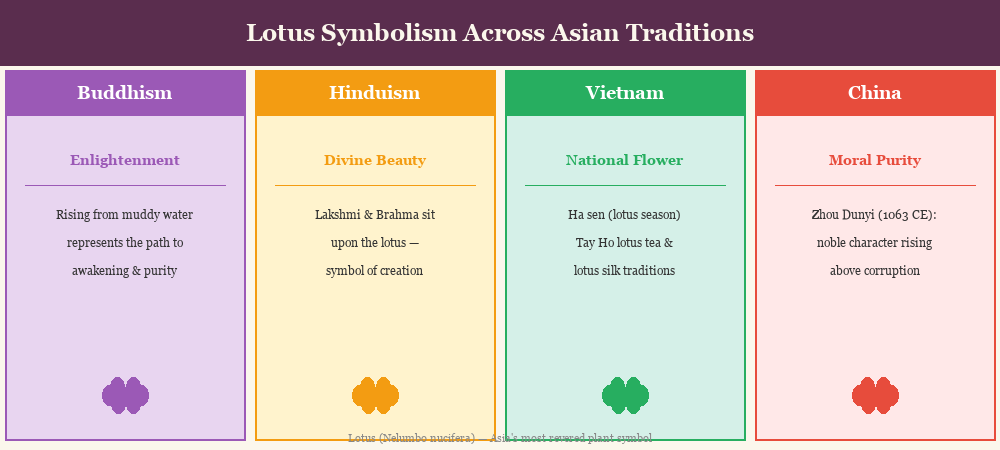
The lotus (Nelumbo nucifera) symbolizes different but related values across Asian cultures. In Buddhist traditions, it represents enlightenment and the journey from ignorance to awakening — mirroring how the flower rises pure from muddy water. In Hinduism, the lotus is associated with divine beauty, creation, and the goddesses Lakshmi and Saraswati. In Chinese Confucian tradition, it became a symbol of moral purity through Zhou Dunyi's celebrated 11th-century essay. In Vietnam, the lotus is embraced as a national symbol representing resilience and purity of character.
What is the lotus's role as Vietnam's national flower?
The lotus holds a special place in Vietnamese cultural identity as the country's most iconic flower. Vietnam's relationship with the lotus runs through centuries of Buddhist practice, agricultural tradition, and artistic expression. The lotus appears on official seals, in architectural ornamentation, in poetry, and in cuisine. The summer lotus season — when fields around West Lake (Tay Ho) in Hanoi bloom in pink — is celebrated as a cultural event, and the traditions of lotus tea and lotus silk weaving are recognized as important elements of Vietnamese intangible cultural heritage.
What parts of the lotus plant are used in Asian cooking?
Virtually every part of the lotus is used in Asian cuisines. The seeds (lian zi / hat sen) are added to soups, congee, and sweets, or ground into lotus seed paste for pastry fillings. The root (lian ou / cu sen / renkon) is stir-fried, simmered in soups, or prepared in vinegared and simmered dishes. The large leaves (he ye / la sen) wrap rice and meat for steaming, imparting a floral fragrance. The stamens (lian xu / tam sen) are used to make fragrant lotus tea. Even the flower petals appear in salads, garnishes, and ceremonial cuisine across the region.
What is lotus root and why does it have holes?
Lotus root is the rhizome (underground stem) of the Nelumbo nucifera plant, which grows horizontally through the mud at the bottom of ponds and lakes. When sliced crosswise, it reveals a distinctive pattern of elongated holes arranged in a circle. These holes are actually air channels — a feature of the plant's anatomy that allows oxygen from the air to reach the root submerged in anaerobic mud. In Japanese New Year tradition, these holes are interpreted symbolically as allowing one to see clearly through to the future, making lotus root an auspicious element of the osechi ryori celebration feast.
What is lotus tea and how is it made?
Lotus tea is a broad category that encompasses several different preparations made from various parts of the lotus plant. The most prized form — particularly associated with Hanoi's West Lake tradition — involves placing quality green tea inside an open lotus flower at dawn, tying the flower closed, and leaving it overnight so the tea absorbs the flower's fragrance. The stamens of the lotus flower can also be dried and brewed directly. A separate preparation is made from the bitter lotus embryo (lian xin / tam sen), brewed as a distinct tea. Individual experiences with lotus tea vary considerably in terms of flavor preference.
Is the lotus the same as a water lily?
No. Though both are aquatic flowering plants, the lotus (Nelumbo nucifera) and water lilies (Nymphaea species) are not closely related. Key differences include: lotus flowers and leaves rise well above the water surface on tall stems, while water lily flowers and leaves generally float on the water's surface; the lotus produces large, edible seeds in a distinctive flat-topped pod, while water lilies do not; and the lotus has an edible, starchy rhizome (lotus root) used extensively in Asian cooking. The two plants are often confused in Western contexts, but they are botanically distinct families.
About This Article
Written by: Health Diary Editorial Team — specialists in Asian cultural traditions, ethnobotany, and traditional wellness practices.
Editorial review: This article has been reviewed by the Health Diary editorial team for clarity, structure, and adherence to our sourcing standards. Key cultural and botanical claims were cross-checked against PubMed/NCBI ethnobotanical literature, Wikipedia's Nelumbo nucifera entry (primary sources referenced therein), and established food culture references. It is not a clinical review and should not replace consultation with a licensed healthcare practitioner.
Reviewed on: June 16, 2026.
Editorial process: We cite peer-reviewed and authoritative cultural sources where possible. When a specialist reviewer is added to this article, attribution will appear here with verifiable credentials.
This article explores lotus cultural traditions. It is not medical advice.
References
- Wikipedia contributors. "Nelumbo nucifera." Wikipedia, The Free Encyclopedia. Accessed June 2026. https://en.wikipedia.org/wiki/Nelumbo_nucifera
- Wikipedia contributors. "Lotus seed." Wikipedia, The Free Encyclopedia. Accessed June 2026. https://en.wikipedia.org/wiki/Lotus_seed
- Wikipedia contributors. "Lotus root." Wikipedia, The Free Encyclopedia. Accessed June 2026. https://en.wikipedia.org/wiki/Lotus_root
- Wikipedia contributors. "Zhou Dunyi." Wikipedia, The Free Encyclopedia. Accessed June 2026. https://en.wikipedia.org/wiki/Zhou_Dunyi
- Wikipedia contributors. "Osechi." Wikipedia, The Free Encyclopedia. Accessed June 2026. https://en.wikipedia.org/wiki/Osechi
- Liu, Y. et al. "Nelumbo nucifera Gaertn.: A review on its phytochemistry, pharmacological activities and ethnobotanical uses." Journal of Ethnopharmacology and related literature via PubMed/NCBI. Accessed June 2026. https://pubmed.ncbi.nlm.nih.gov