Matcha: Japan's Ceremonial Tea, Tradition & L-Theanine
Explore matcha's 800-year history in Japanese tea ceremony, the science of L-theanine and EGCG, ceremonial grades, safe preparation, and what research suggests about calm, focused alertness.
Medical Disclaimer: This content is for educational and informational purposes only and is not medical advice. The information presented is not intended to diagnose, treat, cure, or prevent any disease. Always consult a licensed healthcare practitioner before starting any new herbal practice or supplement. Statements regarding traditional herbal use have not been evaluated by the FDA.
Affiliate Disclosure: This article contains affiliate links. We may earn a commission if you purchase through these links, at no additional cost to you. We only recommend products we believe align with our editorial standards.
Imagine holding a ceramic bowl — rough-textured, slightly uneven, warm in your palms. You raise it, breathe in a deep vegetal fragrance, and take the first sip: a vivid, jade-green liquid that is somehow simultaneously grounding and clarifying. This is matcha (抹茶), Japan's ceremonial powdered green tea, and the experience of drinking it has been described for centuries as a form of meditation in a bowl.
What distinguishes matcha from nearly every other tea in the world is deceptively simple: rather than steeping leaves and discarding them, you consume the entire leaf — ground into a fine powder and whisked into water. That single distinction concentrates every compound the leaf has produced: amino acids, catechins, chlorophyll, caffeine. It is one reason matcha has fascinated both Japanese tea masters and modern researchers alike. This article explores matcha's long history, its unique biochemistry, what contemporary science is beginning to understand, and how people around the world bring it into their daily rhythms.
From Tea Fields to Tea Bowl: A History of Matcha
The story of matcha in Japan begins in 1191, when Buddhist monk Eisai (栄西, 1141–1215) returned from his second journey to China carrying tea seeds and a manuscript he would later expand into Kissa Yōjōki (喫茶養生記, "Drinking Tea for Health"). He presented seeds to the monk Myōe at Kōzan-ji temple in Kyoto, who planted them first at Toganoo and later in the Uji valley — a site that would grow into Japan's most celebrated tea-producing region, a status it holds to this day.
Early on, powdered tea was prepared and consumed in Zen Buddhist monasteries as an aid to long meditation sessions. The sustained focus it afforded — what practitioners described as a clear-minded alertness — aligned naturally with Zen ideals of present-moment awareness. Gradually, tea gatherings became elaborate events among the samurai and aristocracy, complete with Chinese porcelain, ornate rooms, and competitive displays of knowledge.
Then came Sen no Rikyu (千利休, 1522–1591), the tea master who transformed those displays into something far quieter. Under Rikyu's influence, the tea room shrank to a humble hut, Chinese ceramics gave way to rough Korean and Japanese pottery, seasonal wildflowers replaced elaborate arrangements. He called this aesthetic wabi — the beauty found in imperfection, simplicity, and transience. He codified four principles for the gathering: wa (harmony), kei (respect), sei (purity), and jaku (tranquility). Together they formed chanoyu (茶の湯, "hot water for tea"), the Way of Tea.
Central to chanoyu is the concept of 一期一会 (ichigo ichie, "one time, one meeting"). Every gathering, Rikyu taught, is singular and unrepeatable; the host and guests will never again meet in exactly this moment, with these people, in this light, at this season. The tea bowl passes. The moment passes. Treasure it entirely.
Today the tradition continues through schools tracing their lineage directly to Rikyu — Urasenke, Omotesenke, Mushakojisenke — and is recognized by UNESCO as part of Japan's intangible cultural heritage.
What Makes Matcha Different from Regular Green Tea?
Both matcha and conventional green tea come from the same plant, Camellia sinensis. The differences lie entirely in how the plant is grown, harvested, and processed — and those differences are significant.
Shade-growing (覆下栽培, kabuse-saibai): Beginning approximately three to four weeks before the spring harvest, matcha tea plants are covered with bamboo frames and dark cloth or reed screens. This dramatically reduces sunlight reaching the leaves. Deprived of full sun, the plant responds by producing more chlorophyll (causing the intensified emerald-green color) and ramping up synthesis of the amino acid L-theanine, which would otherwise be broken down into catechins by UV exposure. The result is a leaf with markedly higher theanine content and a lower catechin-to-amino-acid ratio than open-grown green tea — which translates to a sweeter, less astringent flavor profile.
Processing into tencha (碾茶): After harvesting, the leaves are steamed to halt oxidation, then dried without rolling — the rolling step that gives sencha its needle shape is deliberately skipped. The dried, unrolled leaves are sorted, have their stems and veins removed, and become tencha, the raw material for matcha.
Stone-grinding (臼挽き, usu-biki): Tencha is slowly ground in granite stone mills. The process generates very little heat (preserving volatile compounds) and produces only 30–50 grams of powder per hour. The resulting particle size — typically 5–10 microns — is finer than talcum powder.
Whole-leaf consumption: When you whisk matcha into water and drink it, you ingest the entire leaf. When you steep a teabag or loose-leaf green tea, most of the leaf's content — including fat-soluble compounds — stays bound in the plant fiber you throw away. This is why matcha's compound concentration differs substantially from steeped green tea.
Key Compounds and What Research Suggests
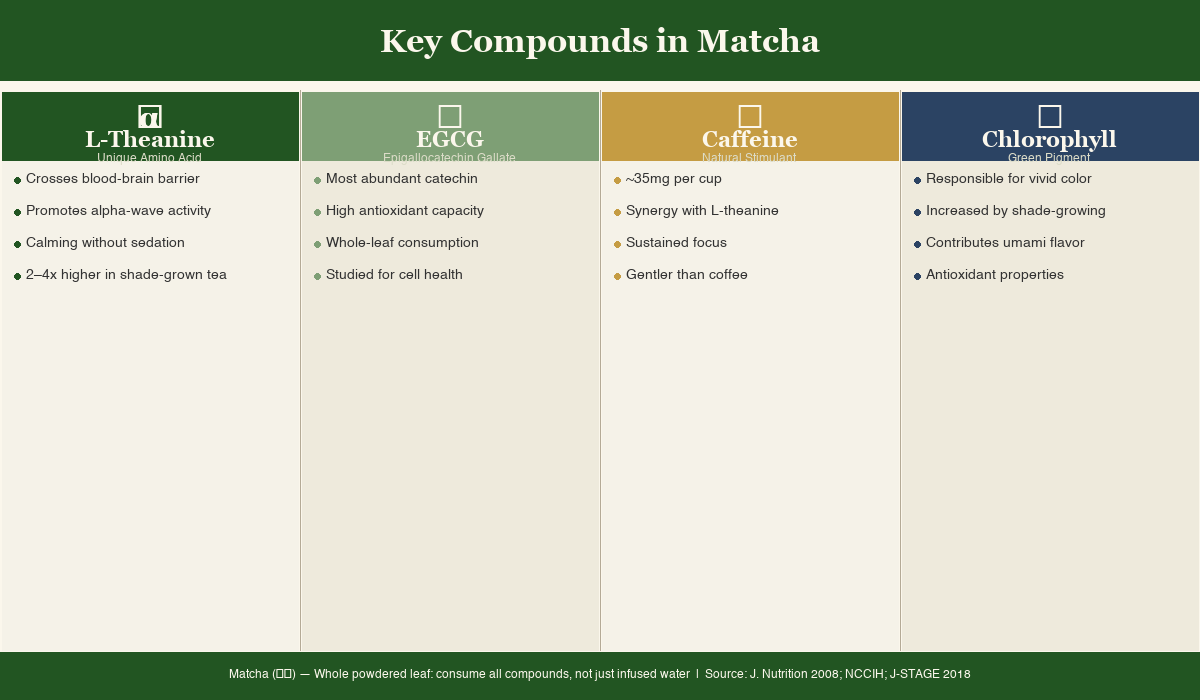
Matcha's biochemistry has attracted genuine scientific attention. Here is what researchers have been examining, with appropriate nuance about the current state of evidence.
L-Theanine and the Alpha-Wave Effect
L-theanine (γ-glutamylethylamide) is an amino acid found almost exclusively in the Camellia sinensis plant. What makes it pharmacologically interesting is its ability to cross the blood-brain barrier and influence neural activity directly. A 2018 publication in the Tea Industry Research Report (J-STAGE, Horie 2018) identified theanine as a primary functional component of matcha, noting that shade-growing concentrates it to 2–4 times the levels found in unshaded green tea.
In a landmark 2008 study published in The Journal of Nutrition, Kelly, Gomez-Ramirez, Montesi, and Foxe examined how L-theanine and caffeine — both alone and in combination — affected brain oscillatory activity and attention task performance. The combined treatment produced lower overall tonic alpha-band power and improved target discriminability compared to placebo. Crucially, neither compound alone produced the same pattern. The researchers concluded that the synergy between the two — the natural ratio found in shade-grown teas like matcha — appeared to enhance the deployment of attentional resources toward visual processing tasks [1].
This aligns with what tea masters have described for centuries as jōzai — a state of calm, clear-headed readiness. The mechanism may be L-theanine modulating glutamate activity and increasing GABA production, softening the anxious edge that caffeine alone can produce while preserving its alerting effect. Individual responses vary considerably; some people find the combination gently focusing, others find even moderate caffeine disruptive.
EGCG and Antioxidant Catechins
Epigallocatechin gallate (EGCG) is the most abundant catechin in green tea and has been one of the most studied polyphenols in nutritional science. Because matcha involves consuming the whole powdered leaf rather than an infusion, its EGCG content per serving is substantially higher than steeped tea.
A frequently cited 2003 study using micellar electrokinetic chromatography found matcha's EGCG concentration to be dramatically higher than a specific commercial Chinese green tea tested for comparison [2]. More recent research published in the Journal of Food Measurement and Characterization (Springer, 2025) confirmed that higher concentrations of EGCG correlate with greater measured antioxidant capacity in matcha, with ceremonial-grade samples outperforming culinary-grade in both phenolic content and CUPRAC antioxidant values [3]. It is worth noting, however, that antioxidant measurements in laboratory conditions do not directly predict how these compounds behave in the human body — research continues, and definitive health claims are not yet established.
Caffeine in Context
A typical bowl of matcha prepared with 2–3 grams of powder contains approximately 35–70 mg of caffeine — roughly half that of a standard espresso but more than most steeped green teas. As noted above, the simultaneous presence of L-theanine may modulate caffeine's effects. People who are sensitive to caffeine, however, should still approach matcha mindfully, as individual tolerance varies widely.
Chlorophyll
The vivid emerald color of quality matcha is primarily due to high chlorophyll content, elevated by shade-growing. While chlorophyll research in humans remains early-stage, the Horie 2018 J-STAGE paper identified it as one of three key compounds (alongside catechins and theanine) that define matcha quality and functional character [4].
How Do People Prepare and Enjoy Matcha?
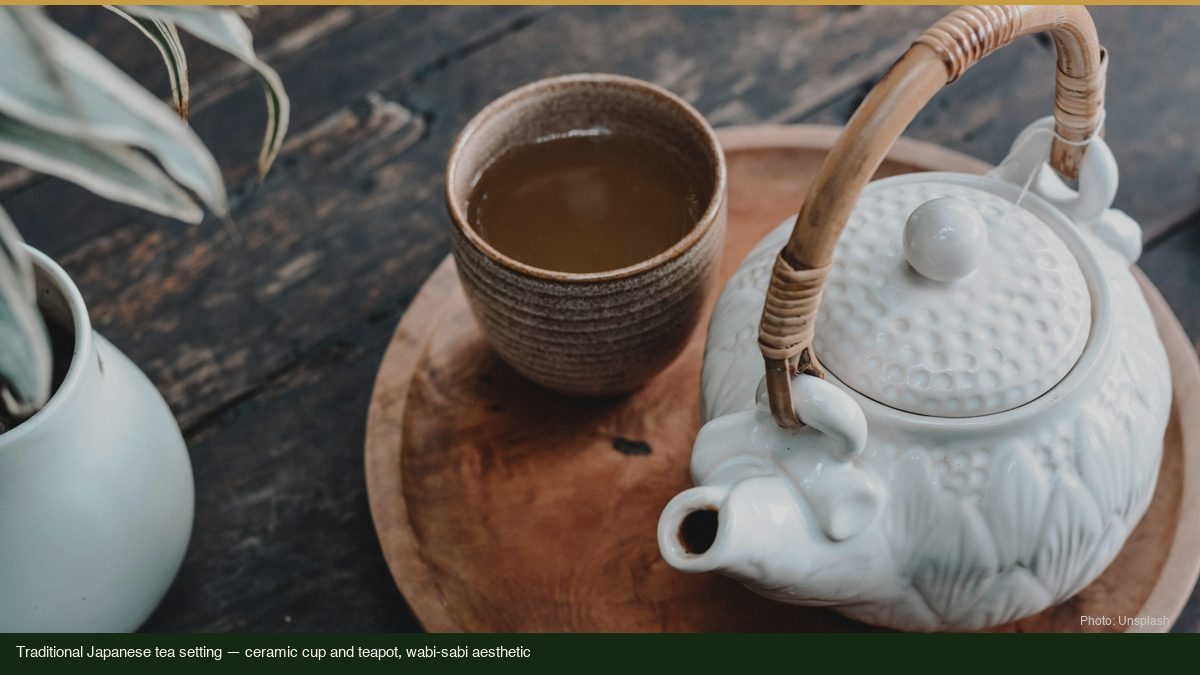
Preparation varies significantly depending on context — and on which tradition you follow.
Traditional Chanoyu Preparation
In formal tea ceremony, two main preparations exist. Usucha (薄茶, "thin tea") uses approximately 2 grams of matcha whisked with 70–80 ml of water at around 80°C (176°F) into a light, frothy consistency. This is the form most commonly encountered. Koicha (濃茶, "thick tea") uses double or triple the matcha with less water, producing a viscous, deeply flavored preparation traditionally shared among guests from a single bowl — an act of communion that embodies the wa (harmony) principle.
The whisk used is a chasen (茶筅), a single piece of carved bamboo split into 80 to 120 fine tines. The motion is a rapid W- or M-shaped stroke designed to incorporate air and produce a fine, stable foam. The bowl — the chawan — is chosen seasonally: deeper, more enclosed bowls in winter to retain heat; wide, shallow bowls in summer to allow cooling.
Contemporary Preparation
Outside the tea room, matcha has found its way into a vast range of preparations: matcha lattes (whisked with steamed oat, almond, or dairy milk), cold-brew matcha, matcha smoothies, and culinary applications from ice cream to pasta. For these uses, culinary-grade matcha — more robust, more astringent, and considerably less expensive than ceremonial grades — is generally preferred, as its stronger flavor holds up against other ingredients.
A simple home preparation: sift 1–2 grams of matcha into a prewarmed bowl, add a small amount of water at 75–80°C (not boiling — high heat increases bitterness), whisk vigorously in a W motion until frothy, then add remaining water or milk. Individual responses to taste and caffeine vary considerably; what one person finds perfectly balanced, another may find too intense or too mild.
Ceremonial Grades and Culinary Uses
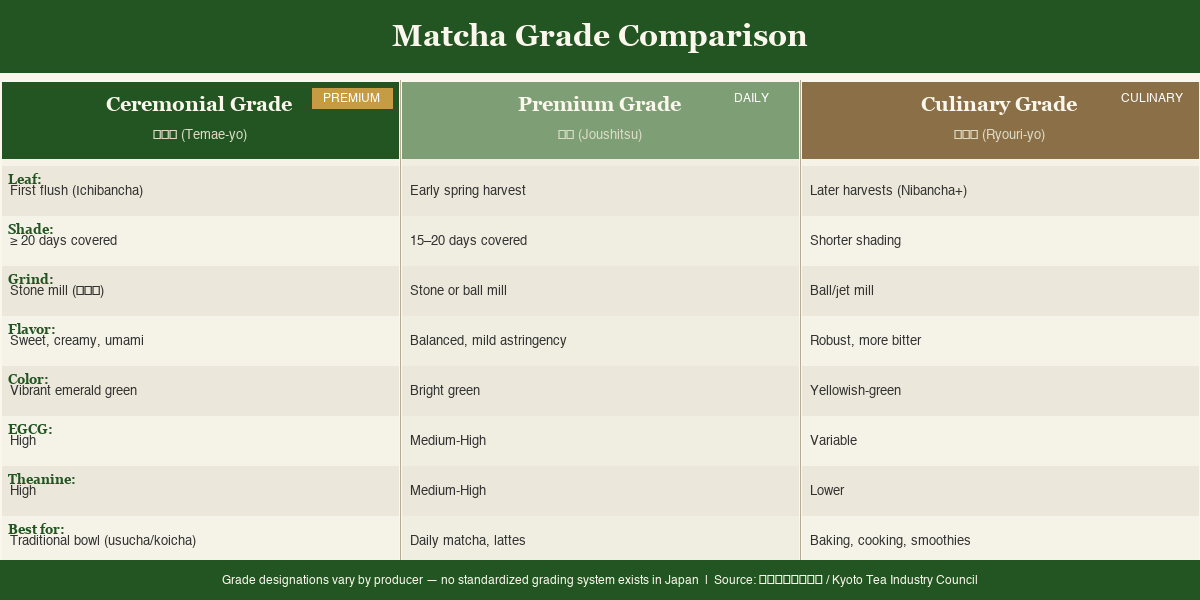
The terms "ceremonial grade" and "culinary grade" are marketing designations rather than regulated categories — no official standardized grading system exists in Japan, as confirmed by the Kyoto Prefectural Tea Industry Council (京都府茶業会議所) [5]. What these terms generally indicate, however, reflects real differences in harvest timing, processing, flavor, and compound concentration.
Ceremonial grade: First-flush leaves (ichibancha, 一番茶), longest shading period (20+ days), stone-ground only, vivid green color, sweet and umami-forward flavor with minimal bitterness. Highest theanine and chlorophyll content. Intended to be enjoyed on its own with water.
Premium grade: Early spring harvest, moderate shading, may combine stone and ball milling. Bright green, balanced flavor. Good for daily matcha preparations and lighter lattes.
Culinary grade: Later harvests (nibancha and beyond), shorter shading, often jet-milled to a coarser particle. More astringent and bitter when tasted alone. Perfectly suited for baking, smoothies, and recipes where matcha flavor competes with other strong ingredients.
When selecting matcha, color is a reliable guide: vibrant, saturated emerald green indicates high chlorophyll from extended shading. Yellowish or grayish-green typically signals lower-grade or older stock.
Important Considerations Before You Begin
Matcha is widely enjoyed as a beverage, but as with any bioactive food, a few considerations are worth understanding before incorporating it regularly.
Caffeine sensitivity: Matcha contains meaningful amounts of caffeine (approximately 35–70 mg per serving). Those who are sensitive to caffeine, have anxiety, irregular heart rhythm, or sleep difficulties should consider their total daily caffeine intake from all sources. Timing matters — matcha late in the afternoon may affect sleep for sensitive individuals.
EGCG from supplements vs. brewed matcha: The National Center for Complementary and Integrative Health (NCCIH) notes that green tea beverages have not raised major safety concerns in adults [6]. However, concentrated green tea extracts in supplement (capsule or tablet) form are a different matter. The NIH LiverTox database documents more than 100 cases of clinically apparent liver injury attributed to green tea extract supplements, primarily affecting women, with symptoms appearing within 1–6 months of use [7]. The European Food Safety Authority (EFSA) concluded that doses of EGCG equivalent to 800 mg or more daily from supplements may be associated with liver enzyme elevations. Drinking brewed matcha — even several cups per day — delivers far lower EGCG doses than concentrated supplements, and brewed tea has not been associated with liver injury in the literature. This distinction is important: matcha the beverage and EGCG the concentrated supplement are not equivalent.
Drug interactions: Green tea products may reduce the effectiveness of certain medications, including nadolol (a beta-blocker used for heart conditions and high blood pressure), atorvastatin (a cholesterol-lowering medication), and raloxifene (used for osteoporosis). If you take any prescription medication, discuss green tea consumption with your prescribing practitioner before making it a daily habit.
Iron absorption: Catechins can bind to non-heme (plant-based) iron, potentially reducing its absorption when consumed together. Individuals with iron-deficiency anaemia may wish to consume matcha between meals rather than with iron-rich foods.
Pregnancy and breastfeeding: NCCIH advises that caffeine intake during pregnancy should not exceed moderate levels. Low-to-moderate caffeine from brewed matcha is generally considered acceptable, but concentrated extract products are not recommended. As always, consult your healthcare provider about specific intake targets during pregnancy or while breastfeeding.
Children: Caffeine-containing beverages are generally not recommended for young children. Culinary matcha in small food quantities (e.g., matcha-flavored treats) is a different context from drinking matcha as a beverage.
Individual responses to matcha vary considerably; what suits one person's daily routine may not suit another's, and personal experimentation under practitioner guidance is always recommended.
Frequently Asked Questions
Can I drink matcha every day?
Many people incorporate 1–2 cups of matcha into their daily routine without issue. Traditional Japanese practices suggest moderate, consistent use. That said, daily caffeine accumulation from all sources is worth monitoring — matcha plus coffee plus other caffeinated beverages can add up. Those with caffeine sensitivity, anxiety, or heart conditions should consult a healthcare practitioner about what level of daily intake is appropriate for them.
What does matcha taste like compared to regular green tea?
High-quality ceremonial matcha has a distinctive flavor profile: vegetal and grassy like green tea, but with a pronounced umami sweetness and a creamy, rounded finish. The bitterness that some people associate with green tea is much reduced in shade-grown matcha because of the higher amino acid content. Culinary-grade matcha is more astringent and robust — more recognizable as "green tea flavor" when used in lattes and baked goods.
Does matcha have more caffeine than coffee?
No. A standard bowl of matcha (2g powder) typically contains 35–70 mg of caffeine, while a single espresso contains approximately 60–80 mg and a drip coffee 80–120 mg. The subjective experience of matcha's caffeine may feel different from coffee's because L-theanine is present simultaneously, which some people report makes the alertness feel smoother and less jittery — though individual experiences vary.
Is matcha the same as green tea extract supplements?
No — and this distinction matters for safety. Drinking matcha as a brewed beverage delivers EGCG in a whole-food matrix alongside water, fiber, and other compounds. Concentrated green tea extract supplements can deliver doses of EGCG that are orders of magnitude higher than any brewed tea, and the NIH LiverTox database has documented liver injury cases associated with high-dose GTE supplements. The NCCIH notes that green tea as a beverage has not been associated with liver injury.
What is the difference between usucha and koicha?
Both are traditional chanoyu preparations. Usucha ("thin tea") is prepared with approximately 2 grams of matcha whisked into 70–80 ml of water — light, frothy, and mildly flavored. Koicha ("thick tea") uses twice as much matcha with slightly less water, producing a dense, intensely flavored paste-like tea traditionally shared communally from one bowl. Koicha requires higher-quality matcha and a smoother, stirring motion rather than vigorous whisking.
Is matcha safe during pregnancy?
Moderate caffeine from brewed matcha is generally considered within acceptable limits during pregnancy, though recommendations vary by country and individual circumstance. Most guidelines suggest keeping total caffeine intake below 200–300 mg per day during pregnancy. One to two cups of matcha falls within this range, but it is important to account for caffeine from all sources. Concentrated matcha or green tea extract supplements are not recommended during pregnancy. Always consult your obstetrician or midwife for personal guidance.
Why does shade-growing matter for matcha quality?
The practice of covering tea plants (覆下栽培, kabuse-saibai) for 20+ days before harvest triggers a cascade of changes in the leaf. Reduced sunlight slows the conversion of L-theanine into catechins (which normally happens under UV exposure), leaving the leaf with higher theanine and lower bitter-catechin ratios. The plant also produces more chlorophyll to capture available light — resulting in the intensified emerald color. These combined effects produce the sweet, umami-rich, low-bitterness flavor profile that defines ceremonial-grade matcha.
A Note on Wellness Tracking
One of the interesting aspects of exploring traditional practices like matcha is that their effects are often personal and cumulative rather than immediately measurable. Some people find that adding a morning matcha ritual changes the quality of their focus or their relationship with the early hours of the day. Others find it makes little perceptible difference. Neither experience is wrong.
If you are curious about how matcha — or any herbal tea or wellness practice — fits into your routine, tracking your own patterns can be genuinely illuminating. Logging sleep quality, mood, and energy levels over several weeks before and after introducing a new habit gives you real data about your individual response, rather than relying on general population averages that may not apply to you. Health Diary was built with exactly this kind of personal health journaling in mind — a place to notice, record, and reflect on your own wellness patterns over time.
About This Article
Written by: Health Diary Editorial Team — specialists in traditional Eastern wellness practices, with a focus on evidence-informed content for general readers.
Editorial review: This article has been reviewed by the Health Diary editorial team for clarity, structure, and adherence to our sourcing standards. Key claims were cross-checked against NCCIH, NIH PubMed, LiverTox, J-STAGE (Horie 2018), and peer-reviewed journals including The Journal of Nutrition and Journal of Food Measurement and Characterization. It is not a clinical review and should not replace consultation with a licensed healthcare practitioner.
Reviewed on: June 14, 2026.
Editorial process: We cite peer-reviewed and government sources where possible. When a clinical reviewer is added to this article, attribution will appear here with verifiable credentials.
References
- Kelly SP, Gomez-Ramirez M, Montesi JL, Foxe JJ. L-theanine and caffeine in combination affect human cognition as evidenced by oscillatory alpha-band activity and attention task performance. J Nutr. 2008;138(8):1572S–1577S. PubMed 18641209
- Weiss DJ, Anderton CR. Determination of catechins in matcha green tea by micellar electrokinetic chromatography. J Chromatogr A. 2003;1011(1–2):173–180. ScienceDirect
- Comparison of culinary and ceremonial matcha green teas: relationship between phytochemical composition and antioxidant properties. J Food Meas Charact. 2025. Springer Nature
- Horie H. 抹茶の品質と機能 (Matcha: Quality and Health Benefits). 茶業研究報告 (Tea Industry Research Report). 2018;126:1. J-STAGE
- 京都府茶業会議所 (Kyoto Prefectural Tea Industry Council). お茶の種類 / 宇治茶を知る. ujicha.or.jp
- National Center for Complementary and Integrative Health (NCCIH). Green Tea: Usefulness and Safety. nccih.nih.gov
- LiverTox: Clinical and Research Information on Drug-Induced Liver Injury. Green Tea. National Library of Medicine / NCBI Bookshelf. NBK547925