Red Date and Longan Soup: A Traditional Chinese Sweet Tonic
Discover hong zao gui yuan tang — the traditional Chinese red date and longan sweet soup. Centuries of kitchen wisdom, cultural context, recipe, variations, and what research says about these two beloved wellness ingredients.
Medical Disclaimer: This content is for educational and informational purposes only and is not medical advice. The information presented is not intended to diagnose, treat, cure, or prevent any disease. Always consult a licensed healthcare practitioner before starting any new herbal practice or supplement. Statements regarding traditional herbal use have not been evaluated by the FDA.
Affiliate Disclosure: This article contains affiliate links. We may earn a commission if you purchase through these links, at no additional cost to you. We only recommend products we believe align with our editorial standards.
There is a kind of soup that does not announce itself loudly. It arrives in a small bowl, amber-colored, gently sweet, fragrant with the warmth of dried fruit — and it carries with it centuries of kitchen wisdom. Red date and longan soup, known in Cantonese households as hong zao gui yuan tang (红枣桂圆汤), is one of the most quietly beloved tonics in Chinese wellness kitchens.
Unlike the bold, sharp herbal bitterness of decoctions, this soup is a pleasure to drink. Children ask for it. Grandmothers prepare it. New mothers are nourished with it. Generations of Chinese families have turned to this simple combination of red jujube dates and dried longan as part of their seasonal and lifecycle rhythms — not because it was prescribed, but because it felt right, and because the tradition said so.
What Is Red Date and Longan Soup?
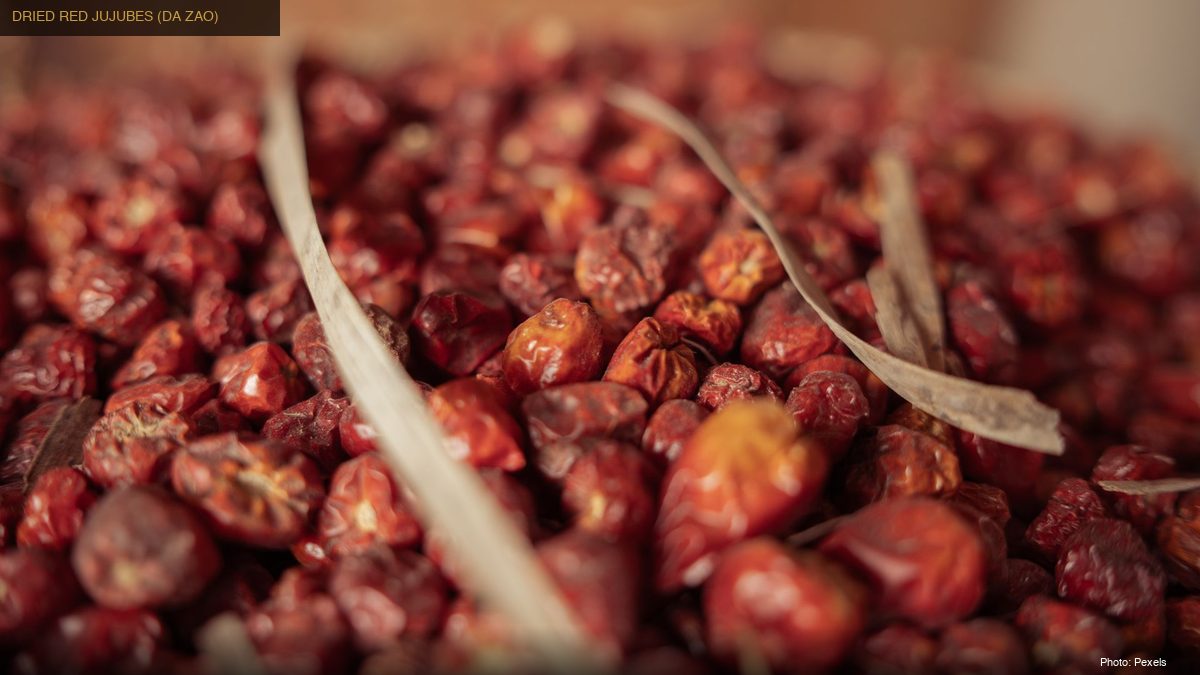
At its core, red date and longan soup is a sweet tonic broth made by simmering dried red dates (Ziziphus jujuba, known as Da Zao in classical Chinese) and dried longan flesh (Dimocarpus longan, known as Gui Yuan or Long Yan Rou) in water with rock sugar. The result is a deeply amber liquid with a gentle sweetness — fruity, slightly caramel-like, and warming.
Unlike savory Chinese soups, this belongs to the category of tong sui (糖水) — literally "sugar water" — the Cantonese tradition of sweet dessert soups served warm after meals or as standalone nourishing drinks. It sits between a dessert and a wellness beverage, a category Western culinary traditions have no precise equivalent for.
The soup typically requires only three ingredients: dried red dates, dried longan, and water. Rock sugar is added to taste. From there, the variations are many — goji berries, lotus seeds, lily bulb, ginger, or snow fungus are common additions, each bringing its own traditional character to the brew.
The History of This Beloved Chinese Tonic
The story of red date and longan soup cannot be separated from the broader history of Chinese food therapy (食疗, shi liao) — the ancient practice of using everyday ingredients as nourishment for the body's seasonal and constitutional needs.
Red dates have been cultivated in China for over 3,000 years. The Shen Nong Ben Cao Jing (神农本草经), one of the oldest classical texts in Chinese wellness tradition, described jujube as "treating pathogenic Qi in the chest and abdomen, calming the middle and nourishing the Spleen." The physician Zhang Zhongjing, writing in the Eastern Han Dynasty, incorporated Da Zao into 58 classical formulas — one of the highest frequencies of any single ingredient in the classical canon. Its role was often harmonizing: smoothing the edges of strong herbs, supporting digestion, and building gentle nourishment over time.
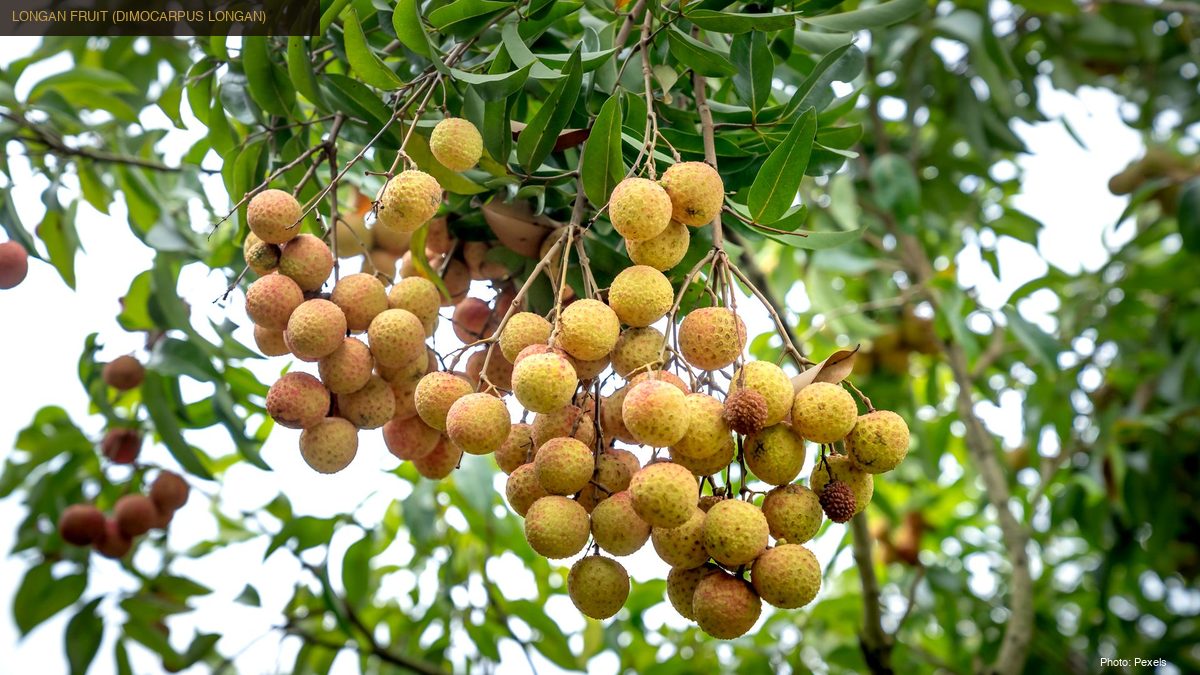
Longan, meanwhile, has deep roots in the subtropical regions of southern China. The fruit's name — long yan (龙眼), meaning "dragon eye" — reflects the translucent white flesh visible through the shell, which resembles an eye. Valued in classical Chinese wellness traditions for nourishing the Heart and calming the spirit, longan was considered a complement to jujube: where jujube builds Qi and harmonizes the Spleen, longan was traditionally seen as more specific to Heart Blood and peaceful sleep.
Their pairing in sweet soup form likely crystallized within Lingnan dietary therapy culture — the food-based wellness traditions of the Pearl River Delta region encompassing Guangdong, Hong Kong, and Macau. The specific combination of red date, longan, lotus seeds, lily bulb, and goji berry sweet soup traces roots to Qing Dynasty texts on food-based health regulation, per Baidu Baike's documentation of Lingnan dietary culture. The simplified two-ingredient version — red dates and longan alone — is likely even older, a folk remedy that existed long before it was codified in any text.
Red Dates and Longan: A Time-Honored Pairing
Why these two ingredients together? In traditional Chinese food thinking, ingredients are paired not just for flavor but for complementary functions. Red dates and longan are described in Chinese wellness circles as 养生双雄 — the "wellness duo" — because their combined profile covers multiple aspects of nourishment that practitioners have valued for centuries.
Red Jujube Dates: The Tonic Foundation
Red dates (Da Zao, 大枣) are classified in classical Chinese wellness texts as sweet in taste and warm in nature. They are said to enter the Spleen, Stomach, and Heart meridians — language that reflects an energetic framework rather than a biomedical one. Their five traditionally described functions are: tonifying the Middle and augmenting Qi, nourishing blood, calming the spirit, harmonizing other ingredients in a formula, and generating fluids.
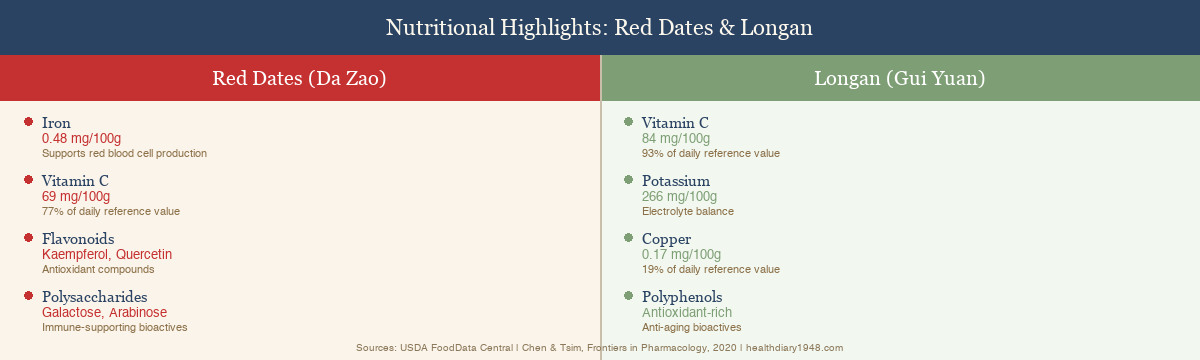
From a nutrition standpoint, research has identified several bioactive compound classes in red dates. A 2020 review by Chen and Tsim in Frontiers in Pharmacology documented approximately 0.48 mg of iron and 69 mg of vitamin C per 100g of fresh jujube fruit. The same review identified three major bioactive categories: flavonoids (including kaempferol and quercetin, which may interact with erythropoietin signaling pathways), polysaccharides (with potential immune-modulating properties), and triterpenic acids (with preliminary anti-inflammatory findings in cell studies). The authors note that Da Zao has been classified as a food-grade substance (药食同源) in China, meaning it occupies the category of "medicine and food homologous" — neither purely a supplement nor purely a food, but something the tradition holds as both.
Da Zao is also notable for its role as a harmonizer. As noted in classical TCM pairing theory documented by Me & Qi's classical reference, Da Zao specifically pairs well with Long Yan Rou (longan) to tonify both Qi and Blood while calming the spirit. It is one of the most "peaceable" ingredients in the Chinese classical repertoire — gentle enough for daily food use, valued enough to appear in major formulas.
Longan: Sweet Fruit from South China
Longan (桂圆, Gui Yuan, or 龙眼肉, Long Yan Rou) is the dried flesh of Dimocarpus longan, a subtropical tree native to southern China, Vietnam, and neighboring regions. In Chinese wellness tradition, longan is classified as sweet and warm, entering the Heart and Spleen meridians. The classical functions attributed to it include nourishing Heart Blood, calming the spirit, benefiting the intellect, and supporting the Spleen.
The 中医世家 (zysj.com.cn) classical Chinese medicine resource describes longan's primary role as benefiting the heart and spleen, supplementing Qi and Blood, calming the spirit, and "moistening" — it was traditionally used for patterns involving heart palpitations, insomnia, forgetfulness, and what classical texts called "neurasthenia" (a general state of depletion and fatigue).
Modern nutritional studies on longan have documented its vitamin C content (approximately 84 mg per 100g of fresh fruit, or about 93% of daily reference values), potassium (266 mg/100g), and copper (0.17 mg/100g, around 19% of daily reference values), according to USDA FoodData Central data. Research has also identified polyphenols and polysaccharides in longan with preliminary antioxidant and immunomodulatory properties, as documented in a comprehensive phytochemical review of Dimocarpus longan published in 2020. As with all food research, these findings are preliminary — they tell us something is there, but clinical translation requires much more study.
Popular Variations of Red Date Longan Soup
The basic red date and longan soup is a canvas. Across Chinese-speaking communities, cooks add ingredients that carry their own traditional associations — each addition bringing a different "energy" (in the Chinese wellness sense), flavor dimension, or textural interest.
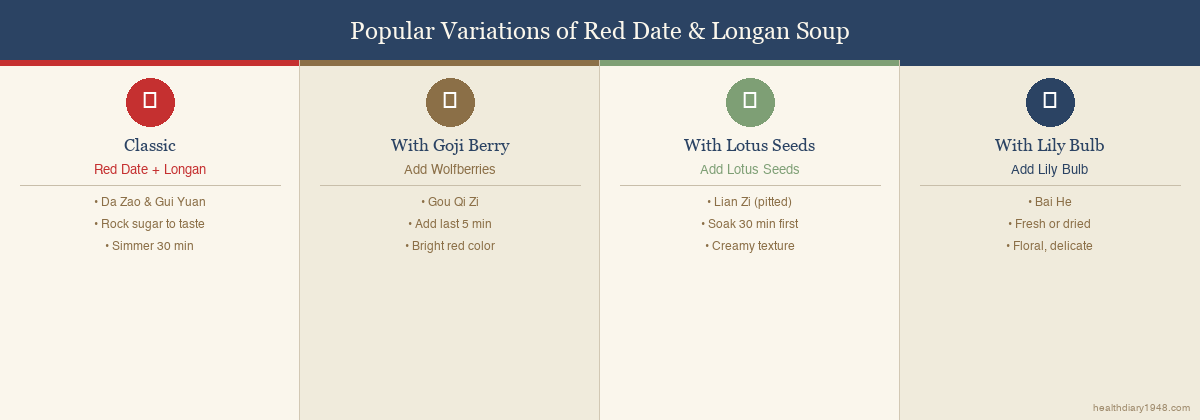
The most common expansions include:
- With Goji Berry (Gou Qi Zi, 枸杞子): Perhaps the most popular addition. Goji berries add a subtle tartness and a brilliant red-orange color. In traditional thinking, they are associated with nourishing the liver and kidneys and supporting eye health. They are always added in the final 5 minutes of cooking to preserve their color and texture.
- With Lotus Seeds (Lian Zi, 莲子): Dried lotus seeds add a creamy, slightly mealy texture. They must be soaked for 30 minutes before cooking and require the longest simmer time. Traditionally associated with calming the spirit and supporting the Spleen. The pitted variety (without the bitter green embryo) is preferred for sweet soups.
- With Lily Bulb (Bai He, 百合): Fresh or dried lily bulb adds a delicate, faintly floral character. It is associated in traditional thinking with moistening the lungs and calming the spirit — making it particularly common in autumn, when dry weather is most pronounced.
- With Fresh Ginger: A slice or two of fresh ginger adds warmth and subtle spice. Particularly common in preparations for postpartum recovery or during menstruation, where warming properties are traditionally emphasized.
- With Rock Sugar (Bing Tang, 冰糖): While all versions include some sweetener, rock sugar is the traditional choice over white granulated sugar. It is believed to be gentler on the digestive system and contributes a clearer, less heavy sweetness to the broth.
Individual responses to each variation differ considerably. What one person finds deeply comforting, another may find too sweet or too warming. Personal experimentation — ideally guided by someone familiar with traditional food therapy principles — is part of the tradition itself.
The Cantonese Tong Sui Tradition
To understand red date and longan soup, you must understand tong sui (糖水) — the Cantonese sweet soup tradition that elevated these simple brewed ingredients into a cultural institution.
Tong sui, meaning "sugar water," is a category of lightly sweetened broths and dessert soups that form the conclusion of Cantonese meals — or stand alone as nourishing snacks at any hour. As Tasting Table's cultural overview of tong sui notes, the tradition has a history dating back hundreds of years and was consumed at the Imperial Court. Its later democratization — sold by street cart vendors in cities across the Pearl River Delta — made it one of the most universally experienced food traditions in Cantonese culture.
Unlike Western desserts designed primarily for pleasure, tong sui carries an intentional nourishing dimension. The sugar itself, in traditional Chinese food thinking, is not merely sweetener — in a warm, humid climate like Guangdong's, sweetness in appropriate amounts is believed to balance the environment's effects on the body. The specific ingredients in each tong sui variety are chosen deliberately: red bean for a summer cooling effect, black sesame for kidney nourishment, red date and longan for warming and calming.
According to cultural documentation, approximately 92% of Chinese households prepare tong sui during Lunar New Year, viewing it as non-negotiable cultural practice. The tradition has traveled with the Cantonese diaspora — to Malaysia, Singapore, Hong Kong's restaurant culture, and Chinese communities worldwide. Red date and longan soup, in particular, occupies a central place because of its reputation as appropriate for family members across ages and in multiple life situations.
In Guangzhou and Hong Kong, tong sui stalls were traditionally open late into the night — a warm bowl after a long evening was as much social ritual as sustenance. Sharing a tong sui was (and remains) a small act of care: bringing a bowl to a tired family member, offering it to a guest, preparing a double portion for someone unwell.
How to Make Traditional Red Date and Longan Soup at Home
The recipe is straightforward. The craft lies in the quality of ingredients and the patience of simmering.
Classic Version (Serves 3–4)
- 15–20 dried red jujube dates (pitted to reduce heating effect)
- 20–25 pieces dried longan flesh (Gui Yuan, not the shelled whole fruit)
- 800–1000 ml water
- Rock sugar to taste (approximately 30–40g, or adjust to preference)
Method:
- Rinse the red dates briefly under cold water. Pit them if not already done — the pit is traditionally removed to reduce the soup's warming intensity.
- Combine red dates and longan flesh in a pot or clay pot with water.
- Bring to a boil over medium-high heat, then reduce to a gentle simmer.
- Simmer for 25–35 minutes until the broth has turned a rich amber color and the dates have softened.
- Add rock sugar in the final 5 minutes, stirring until dissolved.
- Taste and adjust sweetness. Serve warm in individual bowls.
Tips from traditional practice:
- Clay pot (砂锅) is the traditional vessel — clay conducts heat evenly and is said to preserve the delicate fragrance better than metal.
- If adding goji berries, add in the final 3–5 minutes only, to preserve their color and prevent over-softening.
- If adding lotus seeds, soak them for 30 minutes first and add them at the beginning — they take longest to soften.
- The soup can be prepared in larger batches and stored refrigerated for 2–3 days, reheating gently before serving.
A note on sweetness: Traditional preparations tend toward a gentler sweetness than modern dessert sensibilities might expect. The goal is a broth that feels nourishing rather than indulgent — the sweetness should enhance without overwhelming the fruity depth of the dates and longan.
Seasonal and Lifecycle Traditions
In Chinese wellness tradition, food is not merely nutritional — it is seasonal, constitutional, and tied to the rhythms of human life. Red date and longan soup occupies a particular place within several of these traditions.
Autumn and Winter: These are the primary seasons for this soup. Autumn in Chinese wellness thinking is associated with dryness, and warming, nourishing foods are traditionally emphasized as the weather cools. Winter reinforces this tendency — tong sui consumed warm in winter is both literal and symbolic nourishment. The Lingnan dietary therapy tradition, per Baidu Baike's documentation, specifically recommends this soup for winter consumption.
Postpartum Recovery: Red dates and longan are cornerstones of the Chinese postpartum confinement tradition (坐月子, zuo yue zi). During the month following childbirth, Chinese wellness tradition emphasizes warming, nourishing foods to support recovery. As documented by Tian Wei Signature's confinement food resource, red dates and longan are both consumed during this period — their traditional associations with warmth and nourishment aligning with postpartum needs. From a nutritional perspective, vitamin C in both ingredients may contribute to tissue recovery and iron absorption support.
Menstrual Wellness: In Chinese wellness kitchens, red date and longan preparations are commonly offered to women during menstruation. The warming nature of both ingredients, combined with the iron and vitamin C in red dates, fits traditional thinking about supporting the body during this time. Individual experiences vary considerably; what feels comforting for one person may not suit another.
General Family Nourishment: Beyond specific lifecycle moments, this soup is simply something families make. Grandmothers brew it on weekend afternoons. Parents offer it to children as a warm snack. It is not medicine — it is kitchen care, made tangible in a bowl.
What Research Says About Red Dates and Longan
Modern research on both red dates (jujube) and longan has grown considerably in recent decades, though it is important to interpret findings with appropriate context.
On Red Dates (Ziziphus jujuba): A 2020 review in Frontiers in Pharmacology by Chen and Tsim summarized research demonstrating that jujube fruit contains bioactive compounds — particularly flavonoids, polysaccharides, and triterpenic acids — that have shown activity in cell and animal models. The review focused specifically on jujube's potential relevance to iron-deficiency related conditions, noting mechanisms involving erythropoietin (EPO) signaling and heme iron recycling in laboratory settings. The authors noted that jujube has been consumed safely for millennia and appears in modern food-grade category databases. However, they also emphasized that human clinical trials are limited, and these findings should not be extrapolated into health claims for dried jujube consumption.
On Longan (Dimocarpus longan): The 2020 phytochemical review of longan identified polyphenols and polysaccharides with antioxidant, immunomodulatory, and potential anticancer properties in laboratory settings. Longan also contains meaningful amounts of vitamin C (approximately 84 mg/100g per USDA FoodData Central), potassium, and copper — nutrients with established roles in human physiology.
What the research does not say: Neither jujube nor longan research translates to clinical evidence that consuming red date and longan soup will produce specific health outcomes in human beings. The gap between laboratory findings on isolated compounds and real-world food consumption is substantial. Sugar content in the soup is a practical consideration — adding 30–40g of rock sugar creates a beverage with meaningful caloric and glycemic load, which individuals managing blood sugar should factor into their choices.
What tradition offers that research cannot yet quantify: The comfort of a warm bowl, the ritual of preparation, the continuity of shared practice across generations — these are not trivial. Research on food traditions increasingly acknowledges that cultural and emotional dimensions of eating have genuine significance for wellbeing, even when isolated compounds cannot be credited with specific effects. Red date and longan soup has persisted for centuries not because it was scientifically validated, but because the experience of it — warm, sweet, familiar, shared — has felt meaningful to countless families across generations.
Frequently Asked Questions
Can I drink red date and longan soup every day?
Many people enjoy this soup several times a week as part of a general wellness routine, particularly during autumn and winter. Traditional Chinese wellness guidelines suggest consuming it in moderate amounts rather than large quantities at once. However, because it contains rock sugar, those managing blood sugar levels or caloric intake should be mindful of frequency and serving size. Individual responses vary; if you have any ongoing health conditions, consulting a healthcare practitioner is always advisable before making any food a daily habit.
Is red date and longan soup safe during pregnancy?
Red dates and longan are both common foods, but longan in particular is traditionally considered quite warming, and some traditional Chinese wellness guidelines advise caution with large amounts during pregnancy — especially in the early stages. If you are pregnant, please consult your obstetrician or a qualified healthcare practitioner before adding this or any new food or herbal preparation to your regular diet.
What does red date and longan soup taste like?
The soup has a naturally sweet, fruity broth with a gentle caramel-like depth from the dates and a slightly floral sweetness from the longan. It is not intensely sweet — the traditional preparation emphasizes a warm, soothing quality rather than a dessert-level sweetness. With goji berry added, there is a mild pleasant tartness. Most people find it comforting rather than exciting — the appeal is in its familiar warmth rather than complexity.
Does red date and longan soup interact with medications?
Both red dates and longan are consumed as foods, and there are no well-documented drug interactions at typical food consumption amounts. However, if you take blood-thinning medications, diabetes medications, or blood pressure medications, it is always wise to discuss dietary changes with your healthcare provider. Da Zao (red jujube) has been noted in some traditional references for its harmonizing effect in formulas — which is another way of saying it may influence how the body processes other substances.
What is the difference between red date longan soup and red date tea?
Red date tea (hong zao cha) is made primarily from red dates simmered in water — sometimes with ginger or brown sugar — and consumed as a warming drink. Red date and longan soup (hong zao gui yuan tang) adds dried longan flesh, which contributes a distinct fruity sweetness and what traditional Chinese wellness sources describe as Heart-nourishing properties. The soup is generally heartier, sweeter, and associated more with tong sui dessert culture, while the tea is lighter and more commonly drunk as a daily beverage. They have overlapping traditions but distinct identities in Chinese kitchens.
Can children drink red date and longan soup?
In many Chinese families, this soup is considered appropriate for children — often prepared with less sugar and served as a warm weekend treat. The ingredients themselves are foods, not concentrated supplements. That said, children's individual responses vary, and the sugar content should be considered alongside a child's overall diet. For very young children or those with specific health conditions, checking with a pediatrician is a sensible step.
A Note on Finding Quality Ingredients
The quality of red date and longan soup depends heavily on the quality of its ingredients. For dried red dates, look for plump, deeply colored fruits with intact skin — they should feel slightly pliable, not completely dry and shriveled. For dried longan, the flesh should be amber-brown and fragrant, not pale or odorless. Both are available at Chinese grocery stores, Asian supermarkets, and increasingly at specialty wellness shops and online retailers focusing on traditional wellness ingredients.
Rock sugar is preferable to white granulated sugar for traditional preparations — its slightly more complex sweetness and gentler effect on the broth are part of the tradition. Some people explore ready-made packaged versions of this soup, though traditionally brewed preparations generally offer better quality and ingredient transparency.
Individual experiences with this soup vary considerably; what works well for one person may not suit another, and personal exploration — ideally guided by someone familiar with traditional food practices — is part of engaging authentically with this tradition.
About This Article
Written by: Health Diary Editorial Team — researchers and writers specializing in traditional wellness practices across Asia, with a focus on culturally grounded and evidence-contextualized content.
Editorial review: This article has been reviewed by the Health Diary editorial team for clarity, structure, and adherence to our sourcing standards. Key claims were cross-checked against NCCIH, NIH PubMed, USDA FoodData Central, and classical Chinese wellness references including 中医世家 (zysj.com.cn). It is not a clinical review and should not replace consultation with a licensed healthcare practitioner.
Reviewed on: June 15, 2026.
Editorial process: We cite peer-reviewed and government sources where possible. Traditional and cultural claims are sourced from both English-language and native Chinese references. When a clinical reviewer is added to this article, attribution will appear here with verifiable credentials.
References
- Chen J, Tsim KWK. A Review of Edible Jujube, the Ziziphus jujuba Fruit: A Heath Food Supplement for Anemia Prevalence. Front Pharmacol. 2020;11:593655. https://pmc.ncbi.nlm.nih.gov/articles/PMC7726020/
- Phytochemical Constituents and Biological Activities of Longan (Dimocarpus longan Lour.) Fruit: A Review. Journal of Ethnic Foods. 2020. https://www.sciencedirect.com/science/article/pii/S2213453020300331
- Me & Qi. Da Zao (Jujube Fruit) — TCM Herb Knowledge Base. https://www.meandqi.com/knowledge-base/herbs/da-zao
- 中医世家 (zysj.com.cn). 桂圆肉 — 《中药学》. https://www.zysj.com.cn/lilunshuji/zhongyaoxue/1858.html
- 彩牛养生 (cnys.com). 红枣桂圆的功效与作用. https://www.cnys.com/article/126222.html
- Baidu Baike. Red Date, Longan, Lotus Seed, Lily Bulb, and Goji Berry Sweet Soup. Baidu Baike entry
- Tasting Table. Tong Sui: The Sweet Cantonese Treat You Should Know. https://www.tastingtable.com/...
- USDA FoodData Central. Longans, dried. Food ID 169907. https://fdc.nal.usda.gov/
- Tian Wei Signature. Why do mothers take red date longan tea during confinement? https://www.tianweisignature.com/...
- Drugs.com. Jujube Uses, Benefits & Dosage. https://www.drugs.com/npp/jujube.html