Summer Wellness Traditions of Asia: Staying Cool the Traditional Way
A seasonal overview of summer wellness traditions across China, Japan, Korea, and Vietnam — cooling herbal teas, midday rest, light eating, and the traditional idea of nourishing the heart in the hottest months.
Medical Disclaimer: This content is for educational and informational purposes only and is not medical advice. The information presented is not intended to diagnose, treat, cure, or prevent any disease. Always consult a licensed healthcare practitioner before starting any new herbal practice or supplement. Statements regarding traditional herbal use have not been evaluated by the FDA.
Affiliate Disclosure: This article contains affiliate links. We may earn a commission if you purchase through these links, at no additional cost to you. We only recommend products we believe align with our editorial standards.
When the heat of midsummer settles over East and Southeast Asia, daily life quietly changes shape. Markets open earlier and close at noon. Families reach for a cold cup of roasted barley or mung bean water instead of coffee. In many households, the middle of the day is set aside for a nap in the shade rather than errands under the sun. These are not random habits. They are the surviving fragments of centuries-old summer wellness traditions — a shared regional wisdom about how to live gently through the hottest, most draining time of year.
This overview looks at how China, Japan, Korea, and Vietnam have traditionally approached summer, viewed through the lens of Eastern wellness thinking. It touches on cooling herbal teas, food choices, rhythms of rest, and the traditional emphasis on calming the mind and heart in the heat. Think of it as a doorway: from here you can explore more focused topics such as cooling summer foods and staying hydrated in traditional ways.
Why Summer Has Always Called for a Different Kind of Care
Across monsoon and subtropical Asia, summer is not a gentle season. It brings intense sun, high humidity, heavy sweating, poor appetite, restless sleep, and a general feeling of being wrung out. Long before air conditioning and electrolyte drinks, communities across the region developed practical answers to these very real seasonal stresses.
What is striking is how much these answers have in common. From southern China to the Mekong Delta, from the Korean peninsula to the Japanese archipelago, traditional summer practices circle back to the same few ideas: eat lighter and cooler, drink herbal infusions, avoid the fiercest midday sun, rest when the heat peaks, and keep the mind calm. Shaped by observation over many generations, these habits are ones many people still find refreshing and grounding today.
How Does Traditional Eastern Medicine View Summer?
In the framework of Traditional Chinese Medicine (TCM), the year is mapped onto the theory of Five Elements, and each season is linked to one element and one organ system. Summer belongs to Fire (火), and Fire is paired with the Heart (心). This is why classical Chinese texts describe summer as the season to "nourish the heart" — an idea Chinese hospitals and health authorities still repeat in seasonal guidance today, using the phrase yang xin (养心).
In this view, the intense heat of summer — what traditional texts call summer-heat (暑) — is thought to disturb the Heart most of all. Excessive sweating is traditionally said to "consume Heart-qi," leaving a person feeling irritable, sleepless, and mentally scattered. The traditional response has three familiar threads: clearing heat (清热), relieving summer-heat (解暑), and draining dampness (祛湿) from the humid air, all while keeping the mind serene.
It is worth being clear about what this is and is not. Five-Element theory is a traditional interpretive model, not a description of modern physiology. "Fire," "Heart," and "summer-heat" are cultural and philosophical categories rather than clinical diagnoses. Understood that way, they offer a useful lens on why generations organized their summers around cooling, calming, and resting — even if the science of thermoregulation is described in entirely different language.
Cooling Teas and Foods Across the Region
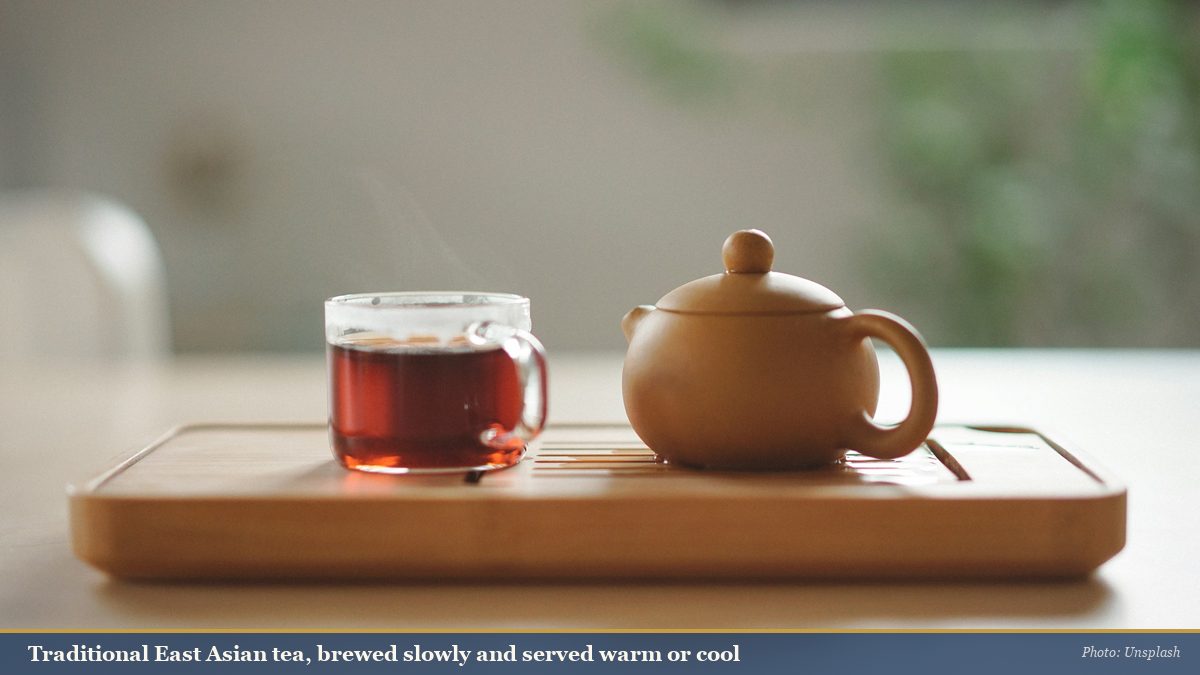
If there is one thread that stitches Asian summers together, it is the cooling drink. Each culture has its own signature, yet the underlying logic — reach for something light, slightly bitter or sour, and traditionally considered "cooling" — is remarkably consistent.
China. Summer in southern China is the season of lü dou tang (绿豆汤), a sweet mung bean soup served chilled, alongside herbal infusions of chrysanthemum (菊花), honeysuckle (金银花), mint (薄荷), and lotus leaf (荷叶). These are the classic "heat-clearing" ingredients named in traditional seasonal guidance.
Vietnam. Vietnamese summers lean on rau má (gotu kola) juice, nhân trần and atisô (artichoke) teas, roasted black-bean water, and chè đậu xanh (mung bean sweet soup). In Vietnamese folk framing these drinks are described as thanh nhiệt, giải độc — clearing heat and cleansing — and are prized simply for being refreshing in the humid south.
Japan. The Japanese summer table features chilled mugicha (roasted barley tea, served caffeine-free by the pitcher) and the beloved umeboshi, a salty-sour pickled ume plum eaten to fend off natsubate (夏バテ), or summer fatigue.
Korea. Korea offers a fascinating twist, explored more below: sour maesil (green plum) syrup drinks and omija (five-flavor berry) tea for cooling, set against the famous hot ginseng-chicken soup samgyetang for restoration.
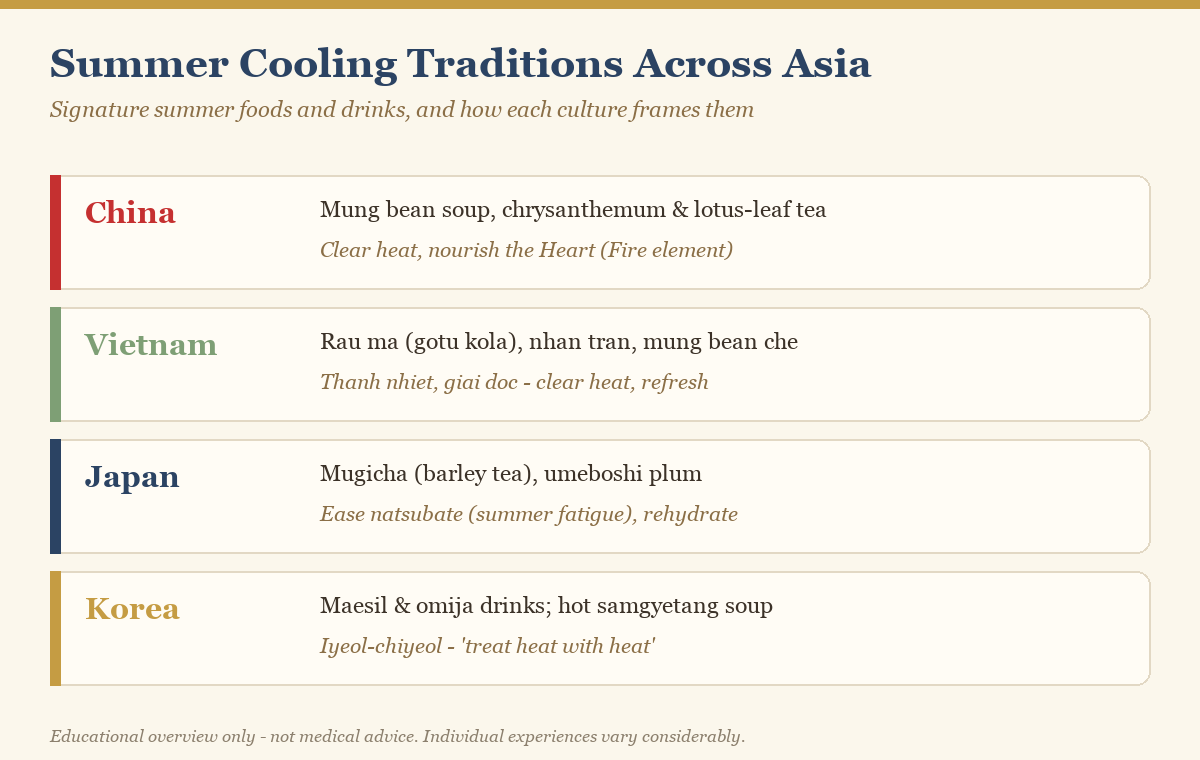
What unites this diverse table is not a single ingredient but a shared instinct: in the heat, favor foods and drinks that feel light, hydrating, and calming rather than heavy, rich, or stimulating.
What Does Modern Research Say About Summer Cooling Foods?
Modern science does not use the vocabulary of "heat" and "Fire," so it is important to separate traditional framing from measured evidence. Where research exists, it is mostly preliminary and focused on individual foods rather than seasonal practice as a whole.
Mung bean is a good example. A 2021 review in BioTechnologia notes that mung bean has traditionally been "used as a mood refresher in summer" and highlights its antioxidant flavonoids, vitexin and isovitexin [1]. Separate laboratory work has isolated antioxidant compounds from mung bean seeds with activity in cell and animal models [2]. These findings help explain why the humble mung bean earned its summer reputation — but they are early-stage, and they do not show that any single food can regulate body temperature or replace basic heat precautions.
The Japanese umeboshi tradition is another interesting case. Its sourness comes largely from citric acid, and it carries meaningful salt and potassium — a combination that echoes the ingredients of an oral rehydration solution, which is why many Japanese sources suggest eating one with water during hot spells. This is a plausible folk hydration aid, though it should be understood as everyday practice rather than a clinical intervention, and its salt content means moderation matters.
The honest summary: these traditions are culturally rich and pleasant, and some of their staple ingredients have interesting nutritional profiles. What they are not is a substitute for the evidence-based basics of hot-weather safety, which we return to below.
How Do People Practice Summer Wellness Day to Day?
Beyond the teapot, traditional summer wellness is really about rhythm. Several practices recur across the region:
- Adjusting the daily clock. Classical Chinese guidance for summer suggests going to bed a little later and rising early, then taking a short midday rest (午休) to recover during the hottest hours — a rhythm still echoed in the long lunch breaks of many hot-climate communities.
- Eating light and often. Rich, heavy meals are traditionally set aside in favor of soups, congee, cooling vegetables, fruit, and small frequent portions that are gentler on a heat-dulled appetite.
- Avoiding the fiercest sun. Outdoor work and errands are traditionally scheduled for early morning or evening, with the midday sun avoided — practical wisdom that predates any thermometer.
- Calming the mind. Because summer is linked to the Heart in TCM, keeping emotions steady and avoiding agitation is considered part of seasonal care. Slow evening walks, quiet tea, and gentle breathing all fit this idea.
- The Korean exception — "fight heat with heat." Korea's iyeol-chiyeol (이열치열, "treat heat with heat") principle holds that because heavy sweating cools the core, a piping-hot bowl of ginseng-chicken soup can restore energy on the hottest days. It is a vivid reminder that these traditions are interpretive, not uniform.
None of this is a rigid prescription. People adapt these habits to their climate, work, and constitution. Individual experiences vary considerably; what feels refreshing and restorative for one person may not suit another, and it is always sensible to adapt seasonal habits to your own circumstances and any medical guidance you have received.
Important Limitations and Considerations
This is the part that matters most, because summer heat is not only a traditional "energetic" concept — it is a genuine health risk. Traditional cooling practices can be pleasant and grounding, but they are not a defense against serious heat illness.
Know the real warning signs. According to the U.S. Centers for Disease Control and Prevention, heat exhaustion can cause heavy sweating, weakness, dizziness, nausea, headache, and a fast, weak pulse. Heat stroke is a medical emergency: body temperature can climb dangerously within minutes, sweating may stop, and confusion, slurred speech, or loss of consciousness can follow [3]. If you or someone else shows signs of heat stroke, call emergency services immediately and begin cooling the person — no herbal tea substitutes for urgent care.
Hydration comes first. Health authorities advise drinking fluids before you feel thirsty, staying in cool or air-conditioned spaces during peak heat, wearing light loose clothing, and avoiding very sugary or alcoholic drinks. Cooling teas can be part of your fluids, but plain water remains the foundation.
Who should take extra care. Older adults, young children, pregnant or breastfeeding women, and people with heart, kidney, or blood-pressure conditions are more vulnerable to heat and should be especially cautious. Salt-rich foods like umeboshi, and diuretic or "cooling" herbal drinks, may not suit everyone — those on medication or managing a health condition should check with a practitioner first.
Herbs are not neutral. Some traditional summer herbs can interact with medications or may be unsuitable during pregnancy, before surgery, or for children. Quality and preparation of herbal products vary widely. When in doubt, consult a licensed healthcare practitioner before making any herbal drink a daily habit.
Frequently Asked Questions
What are the most common summer wellness traditions in Asia?
The most widespread traditions include drinking cooling herbal teas (chrysanthemum and mung bean in China, rau má in Vietnam, roasted barley tea in Japan, plum and omija drinks in Korea), eating lighter meals, resting during the hottest part of the day, avoiding the midday sun, and keeping the mind calm. They vary by country but share the same underlying instinct to cool, hydrate, and slow down.
Why does traditional Chinese medicine link summer to the heart?
In Five-Element theory, summer corresponds to the Fire element, and Fire is paired with the Heart. This is a traditional interpretive model rather than modern physiology. It underpins the classical advice to "nourish the heart" in summer by staying calm, resting well, and avoiding the agitation that heat can bring.
Can cooling herbal teas prevent heatstroke?
No. Cooling teas can be a pleasant part of staying hydrated, and many people find them refreshing, but they are not a safeguard against heatstroke. Genuine protection comes from drinking enough fluids, staying out of extreme heat, resting in cool spaces, and recognizing warning signs early. If serious symptoms appear, seek emergency medical care.
Why do Koreans eat hot soup in summer?
This reflects the principle of iyeol-chiyeol — "treat heat with heat." The traditional idea is that heavy sweating cools the core, so a hot, restorative soup such as samgyetang (ginseng-chicken soup) can replenish energy on sweltering days. It is a cultural counterpoint to the cooling-food logic elsewhere in Asia.
Is a midday nap really part of traditional summer health?
Yes. Classical Chinese seasonal guidance suggests going to bed later, rising early, and taking a short midday rest during summer to recover from the heat. Many hot-climate communities across Asia still structure the day around a break in the hottest hours, and some people find this rhythm genuinely restful.
A Note on Tracking Your Summer Habits
One quiet advantage of these traditions is how observable they are. Whether you are trying an afternoon rest, swapping sugary drinks for a cool herbal infusion, or simply noticing how you feel after a lighter summer meal, small experiments become clearer when you keep track of them. Noting your sleep, hydration, and energy across a hot week can help you learn which seasonal habits actually feel good for you — and which do not. Health Diary is built for exactly this kind of gentle, personal record-keeping.
A Soft Closing Note
Summer wellness traditions across Asia are less a rulebook than an invitation to slow down and pay attention to the season. They remind us that heat asks for a different pace — cooler foods, quieter days, more rest, and a calmer mind. You can explore the specifics in companion pieces on cooling summer foods and traditional ways of staying hydrated. Enjoy these traditions for the comfort and culture they offer, lean on modern heat-safety advice for the parts that truly matter, and let the hottest months be a time to rest well rather than run yourself down.
About This Article
Written by: Health Diary Editorial Team — a group of writers and researchers focused on traditional Asian wellness, herbal culture, and seasonal living, committed to presenting this heritage responsibly and without overstated health claims.
Editorial review: This article has been reviewed by the Health Diary editorial team for clarity, structure, and adherence to our sourcing standards. Key claims were cross-checked against NCCIH, NIH PubMed, and CDC heat-health guidance where applicable. It is not a clinical review and should not replace consultation with a licensed healthcare practitioner.
Reviewed on: July 15, 2026.
Editorial process: We cite peer-reviewed and government sources where possible, and we drew on Chinese, Japanese, Korean, and Vietnamese language sources for cultural accuracy. When a clinical reviewer is added to this article, attribution will appear here with verifiable credentials.
References
- Mehta N., Rao P., Saini R. A review on metabolites and pharmaceutical potential of food legume crop mung bean (Vigna radiata L. Wilczek). BioTechnologia, 2021. https://pmc.ncbi.nlm.nih.gov/articles/PMC9642937/
- Yao Y. et al. Antioxidant and Myocardial Preservation Activities of Natural Phytochemicals from Mung Bean (Vigna radiata L.) Seeds. PubMed, 2016. https://pubmed.ncbi.nlm.nih.gov/27184346/
- U.S. Centers for Disease Control and Prevention. Preventing Heat-Related Illness. CDC Extreme Heat. https://www.cdc.gov/extreme-heat/prevention/index.html
- People's Daily Health / Guangming Daily. 夏至:"趁热"养出好身体 (Summer Solstice seasonal health guidance), 2025. https://news.gmw.cn/2025-06/21/content_38104719.htm