
Oolong Tea Guide: China’s Semi-Oxidised Tea, Types & Brewing
A guide to oolong tea — the partially oxidised Chinese tea between green and black. What it is, how it’s made, famous types like Tieguanyin and Da Hong Pao, and how to brew it.
Medical Disclaimer: This content is for educational and informational purposes only and is not medical advice. It is not intended to diagnose, treat, cure, or prevent any disease. Always consult a licensed healthcare practitioner before making changes to your diet. Statements regarding traditional tea use have not been evaluated by the FDA.
Affiliate Disclosure: This article may contain affiliate links. We may earn a commission if you purchase through these links, at no additional cost to you. We only recommend products we believe align with our editorial standards.
Oolong is the great in-between of the tea world — neither the fresh, grassy green nor the dark, malty black, but a vast and fascinating middle ground that Chinese tea makers have explored for centuries. From the orchid-scented Tieguanyin of Anxi to the roasted, mineral "rock teas" of the Wuyi cliffs, oolong offers more variety than any other single category of tea. This guide explains what oolong is, how it is made, the famous types to know, and how to brew it — part of our wider guide to Asian herbal teas.
What Is Oolong Tea?
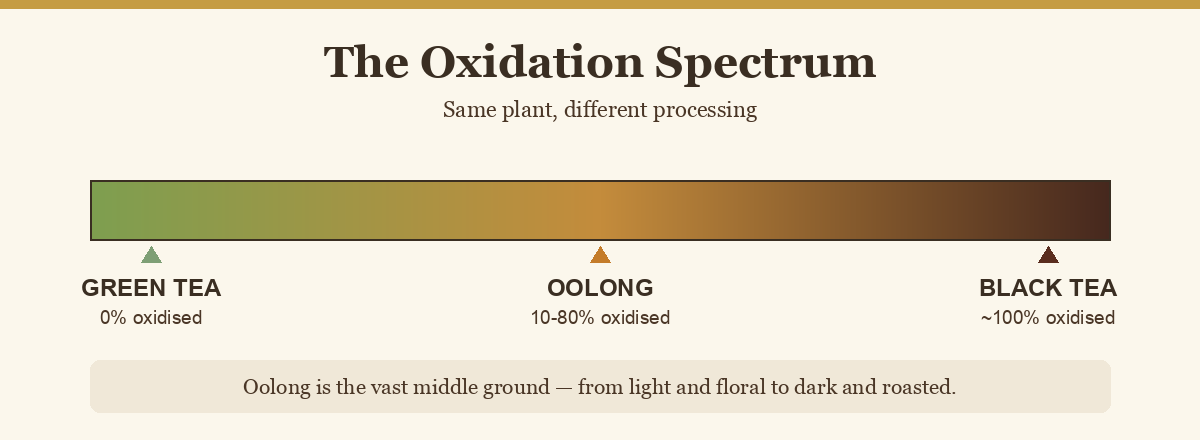
Oolong (乌龙茶, also called qīng chá 青茶 in China) is a partially oxidised true tea — made, like green and black tea, from the leaves of Camellia sinensis. What sets the three apart is not the plant but the processing. Green tea is barely oxidised; black tea is fully oxidised; oolong sits deliberately in between, anywhere from lightly to heavily oxidised, giving it a flavour that can lean green and floral or dark and roasted (Baidu Baike, semi-fermented tea).
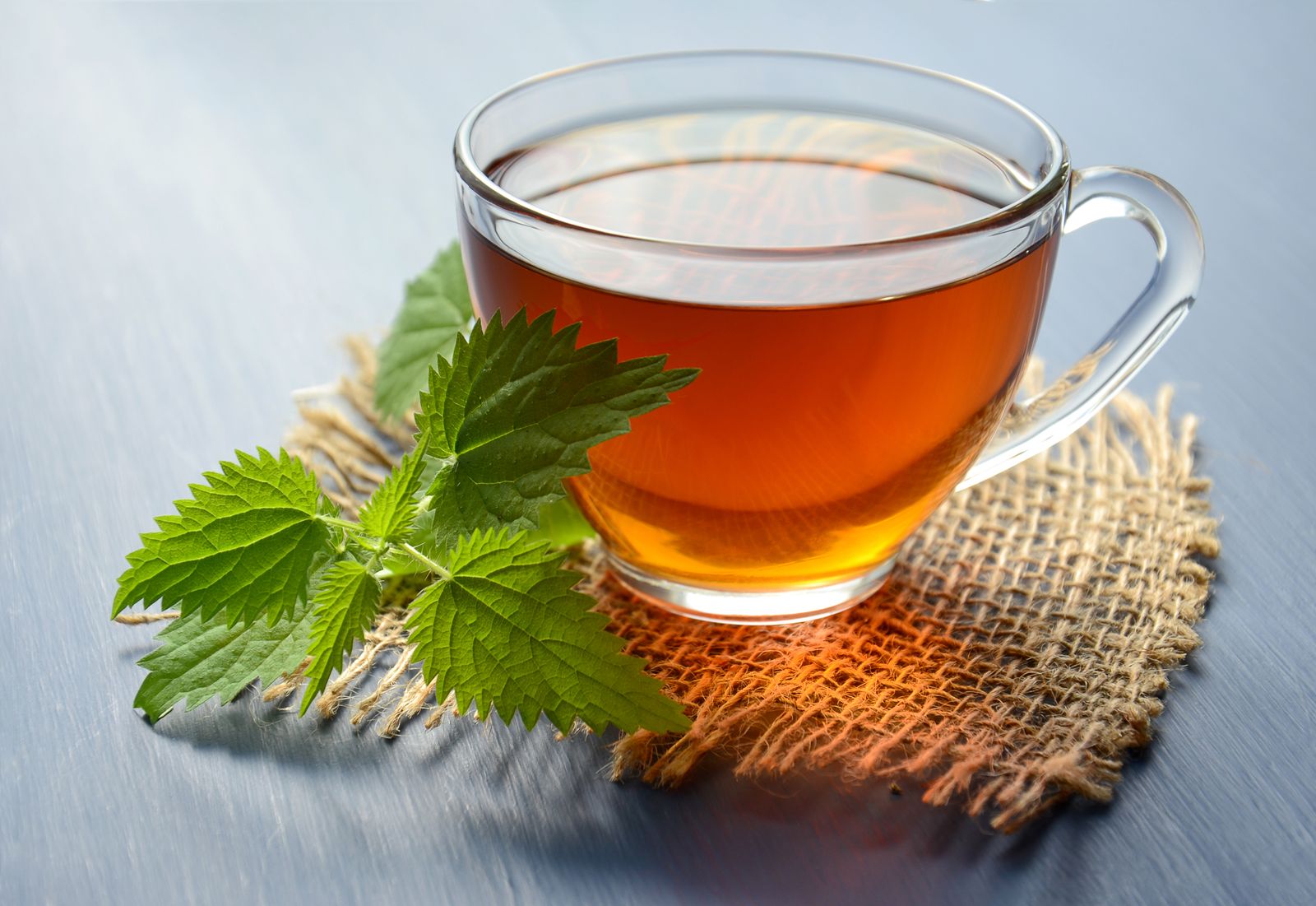
That middle position is exactly what makes oolong so diverse. As Chinese sources put it, oolong "combines the methods of green and black tea, with a quality between the two." Its partial oxidation also produces a distinctive family of compounds called theasinensins — formed when the tea's catechins oxidise and pair up — which are chemically different from the theaflavins that give black tea its character (Weerawatanakorn et al., 2015). If you know Japanese green teas and want to explore further, oolong is a natural next step.
How Is Oolong Made?
The soul of oolong lies in one signature step: zuoqing (做青), the gentle tossing and bruising of the withered leaves. Shaking the leaves ruptures the cells along the edges, letting oxygen reach the enzymes there so oxidation begins at the rim while the centre stays green. This partial, edge-first oxidation is what gives oolong its complexity (Baidu Baike, oolong technique).
The full sequence typically runs: withering (often sun-withering), repeated tossing and resting (zuoqing) to build oxidation, a high-heat "kill-green" to stop it, rolling to shape the leaf, and finally drying and — for many oolongs — roasting. The roast is its own art: a light roast keeps a tea floral and green, while a heavier roast brings caramel, toast, and mineral depth. It is this combination of variable oxidation and variable roasting that gives oolong its enormous range — two teas from the same bush can taste worlds apart depending on how the maker guides these steps. This craftsmanship is part of why Chinese tea processing, oolong included, was recognised by UNESCO as intangible cultural heritage in 2022 (UNESCO).
The Famous Oolongs to Know
Oolong is really a family of very different teas. A few names stand out:
- Tieguanyin (铁观音) — "Iron Goddess of Mercy," from Anxi in southern Fujian. Often lightly oxidised and rolled into tight beads, prized for a bright orchid fragrance.
- Da Hong Pao (大红袍) — "Big Red Robe," the most famous of the Wuyi "rock teas" (yancha 岩茶), grown on the mineral-rich cliffs of northern Fujian. Legend tells of a scholar restored by the tea who draped his red robe over the bushes; only a handful of ancient "mother bushes" survive (Da Hong Pao).
- Dong Ding (冻顶) — a classic Taiwanese oolong from Nantou, traditionally roasted, whose bushes trace back to cuttings brought from Wuyi (Baidu Baike, Dong Ding).
- Phoenix Dan Cong (凤凰单枞) — from Guangdong's Phoenix Mountain, famous for "mimicking" the aromas of fruits and flowers.
Each Wuyi rock tea is even named after its specific tea bush and cliff, a naming tradition that reflects how deeply oolong is tied to place (Wuyi rock tea).
How Do You Brew Oolong?
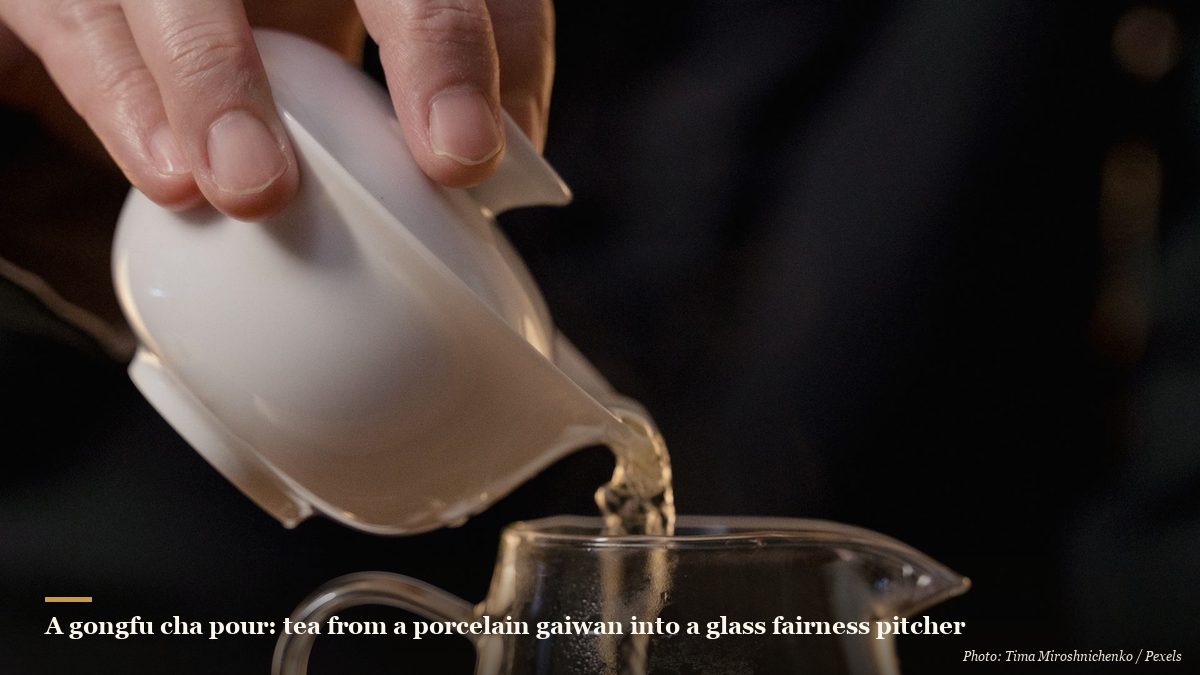
Oolong is the classic tea for gongfu cha (功夫茶), the "skilful" brewing method that uses a small pot or gaiwan, a generous amount of leaf, and many short, successive infusions. A good oolong can be re-steeped five, eight, or more times, revealing new layers of flavour with each cup — which is exactly why it rewards the slow, attentive gongfu style. You can read more in our guides to traditional tea rituals and tea culture in Asia, and compare notes with the daily tea rituals of the region.
If you prefer a simpler approach, use water a little below boiling for lighter oolongs and near-boiling for roasted ones, a rounded teaspoon of leaf per cup, and short steeps you can extend to taste. Individual preferences vary considerably — part of oolong's charm is discovering how you like it.
Caffeine and What's Inside
As a true tea, oolong contains caffeine — very roughly 25–45 mg per cup, placing it between green and black tea — along with the calming amino acid L-theanine and its polyphenols. In broad terms it carries more caffeine than a light Japanese green tea but less than a typical black tea, which is part of why many people find it an easy all-day cup. It is worth knowing that brewing temperature and steeping time affect how much caffeine ends up in your cup at least as much as the type of leaf does, so any single number is only a rough guide (caffeine & L-theanine analysis, 2024). For a caffeine-free option, our cooling herbal teas and chrysanthemum tea guides cover tisanes instead.
What Does Modern Research Say?
Oolong's polyphenols have drawn scientific interest, especially around metabolism — but the honest picture is modest and mixed. An older, often-cited study found that oolong slightly raised energy expenditure and fat oxidation over a few days, though the sample was small and short (Rumpler et al., 2001). However, a rigorous 2023 double-blind trial found that oolong-derived polyphenols on their own did not meaningfully lower post-meal triglycerides; benefits appeared only when caffeine and catechins were combined (Perkin et al., 2023). Stronger effects on body fat and cholesterol so far come mainly from animal studies (Yang et al., 2018).
The takeaway: oolong is a delicious, low-calorie drink with interesting compounds, but it is not a weight-loss treatment. Health authorities describe tea's catechins and caffeine as having, at most, a modest effect on body weight (NCCIH). Enjoy it for the pleasure and ritual first.
Safety and Considerations
- Caffeine. Because oolong contains caffeine, keep an eye on total daily intake, especially in the evening or during pregnancy — health authorities advise limiting caffeine while pregnant (NCCIH).
- Medication interactions. Green and oolong tea can interact with certain medicines, including the beta-blocker nadolol and the statin atorvastatin; check with a pharmacist if you take prescription drugs (MSK).
- Beverage, not extract. Brewed oolong is well tolerated; concentrated tea extracts and supplements are far stronger and have rarely been linked to liver problems (NCCIH).
- Individual responses vary considerably. Sensitivity to caffeine differs from person to person.
Frequently Asked Questions
Is oolong a green tea or a black tea?
Neither — it is its own category. Oolong is a partially oxidised tea that sits between green (barely oxidised) and black (fully oxidised), which is why its flavour can range from light and floral to dark and roasted (Weerawatanakorn et al., 2015).
Is oolong tea good for weight loss?
The evidence is modest and mixed. Some small studies suggest a slight lift in metabolism, but a rigorous trial found oolong polyphenols alone did not lower post-meal blood fats. It is best seen as a pleasant, low-calorie drink rather than a weight-loss treatment (Perkin et al., 2023).
How much caffeine is in oolong tea?
Roughly 25–45 mg per cup — between green and black tea — but the exact amount depends heavily on how hot you brew it and how long you steep, so read any figure as a rough range (caffeine analysis, 2024).
How many times can you re-steep oolong?
Many times. In the gongfu style, a quality oolong is commonly re-steeped five to eight times or more, with the flavour evolving from cup to cup — one of the great pleasures of the tea.
What does oolong tea taste like?
It depends entirely on the type and roast. Lightly oxidised oolongs like Tieguanyin are floral and fresh; heavily roasted ones like Wuyi rock teas are toasty, mineral, and rich. Exploring that range is half the fun.
A Note on Enjoying Oolong
Oolong rewards curiosity more than any rulebook. Try a floral Tieguanyin and a roasted Wuyi side by side, brew the same leaves several times, and notice how the character shifts. If you keep a simple tea journal, jotting which oolongs and steeping styles you enjoy can turn casual sipping into a genuine appreciation. Our Asian herbal teas guide and Chinese herbal traditions hub offer more places to wander next.
About This Article
Written by: Health Diary Editorial Team — writers and researchers focused on making traditional Asian wellness knowledge clear, accurate, and culturally grounded.
Editorial review: This article has been reviewed by the Health Diary editorial team for clarity, structure, and adherence to our sourcing standards. Key claims were cross-checked against peer-reviewed research, NCCIH, and native-language sources where applicable. It is not a clinical review and should not replace consultation with a licensed healthcare practitioner.
Reviewed on: August 4, 2026.
Editorial process: We cite peer-reviewed and government sources where possible, and we present traditional tea as cultural knowledge rather than medical advice — for example, framing oolong's metabolism research as modest and mixed rather than a weight-loss claim.
References
- Weerawatanakorn M, et al. Chemistry and health beneficial effects of oolong tea and theasinensins. Food Sci Hum Wellness. 2015. https://www.sciencedirect.com/science/article/pii/S2213453015000555
- Perkin OJ, et al. Postprandial Metabolic Responses to Oolong Tea-Derived Polymerized Polyphenols (RCT). Am J Clin Nutr. 2023. https://pubmed.ncbi.nlm.nih.gov/37080462/
- Rumpler W, et al. Oolong tea increases metabolic rate and fat oxidation in men. J Nutr. 2001. https://jn.nutrition.org/article/S0022-3166(22)14493-7/fulltext
- Yang CS, et al. Aged Oolong Tea Reduces High-Fat Diet-Induced Fat Accumulation (animal study). Nutrients. 2018. https://pmc.ncbi.nlm.nih.gov/articles/PMC5852763/
- Determination of L-Theanine and Caffeine Contents in Tea Infusions. 2024. https://pmc.ncbi.nlm.nih.gov/articles/PMC12248710/
- NCCIH. Green Tea: Usefulness and Safety. https://www.nccih.nih.gov/health/green-tea
- Memorial Sloan Kettering. About Herbs — tea. https://www.mskcc.org/cancer-care/diagnosis-treatment/symptom-management/integrative-medicine/herbs
- UNESCO. Traditional tea processing techniques and associated social practices in China (2022). https://ich.unesco.org/en/RL/traditional-tea-processing-techniques-and-associated-social-practices-in-china-01884
- Da Hong Pao (Big Red Robe) — history and legend. https://en.wikipedia.org/wiki/Da_Hong_Pao
- 武夷山茶 — Wuyi rock tea (yancha). https://www.wuyishantea.com/chawenhua/hanxingen/0010-5.htm
- 百度百科 — 乌龙茶制作技艺 (oolong / Tieguanyin technique). https://baike.baidu.com/item/乌龙茶制作技艺(铁观音制作技艺)/50947680
- 百度百科 — 冻顶乌龙茶 (Dong Ding oolong). https://baike.baidu.com/item/冻顶乌龙茶/651564


