

Herbal Tea Traditions in Asia: A Country-by-Country Map
A country-by-country map of Asia's herbal tea traditions, from Chinese cooling liangcha and Korean barley tea to Vietnamese voi and Japanese mugicha.
Medical Disclaimer: This content is for educational and informational purposes only and is not medical advice. The information presented is not intended to diagnose, treat, cure, or prevent any disease. Always consult a licensed healthcare practitioner before starting any new herbal practice or supplement. Statements regarding traditional herbal use have not been evaluated by the FDA.
Affiliate Disclosure: This article contains affiliate links. We may earn a commission if you purchase through these links, at no additional cost to you. We only recommend products we believe align with our editorial standards.
When people picture “Asian tea,” they usually think of one plant: Camellia sinensis, the green, oolong, and black teas of China and Japan. But step into an ordinary kitchen in Guangzhou, Hanoi, Seoul, or Osaka and you will often find something quite different simmering on the stove — a caffeine-free brew of roasted grain, dried buds, seeds, flowers, or leaves. These are the everyday herbal tea traditions in Asia, and they are as much a map of a country as its language or its food.
What makes them fascinating is how local they are. Each region grew its own default cup, shaped by climate, the crops in the fields, and centuries of folk practice. Humid southern China leaned into bitter, cooling herbal decoctions; grain-farming Korea and Japan turned roasted barley into the tea they pour like water; Vietnam brewed the leaves of a single village tree. This guide is a country-by-country tour of that map — a look at how herbal tea by country across Asia became a quiet expression of place.
Why Does Every Asian Country Have Its Own Herbal Tea?
The short answer is geography. Traditional wellness systems across Asia share a common instinct — drink what balances your environment — but the environments differ enormously, so the cups do too. In hot, damp climates the goal was to feel cooler and lighter; in colder or drier ones, to feel warm and settled. Layer on top of that whatever grew abundantly — barley in the north, citrus in the south, seaweed by the coast — and you get distinct regional tea traditions rather than one shared recipe.
These drinks also filled a practical role. Long before bottled water and soft drinks, a pot of roasted-grain or herbal infusion was simply the safe, pleasant thing a household drank all day — which is why so many are caffeine-free and gentle enough for children and elders alike. If you have read our guide to traditional Asian herbal teas, which groups teas by purpose, this article takes the opposite cut: it follows the borders on a map.
China: The Cooling Herbal Teas of the South
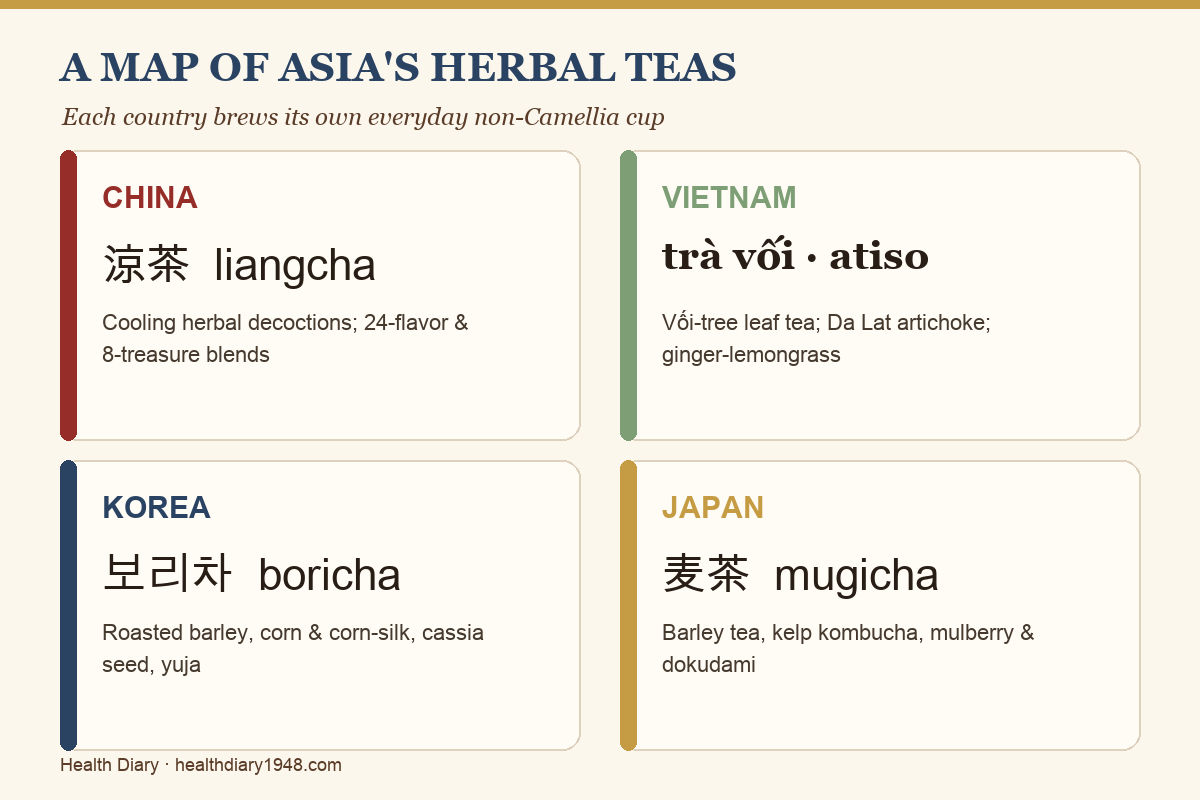
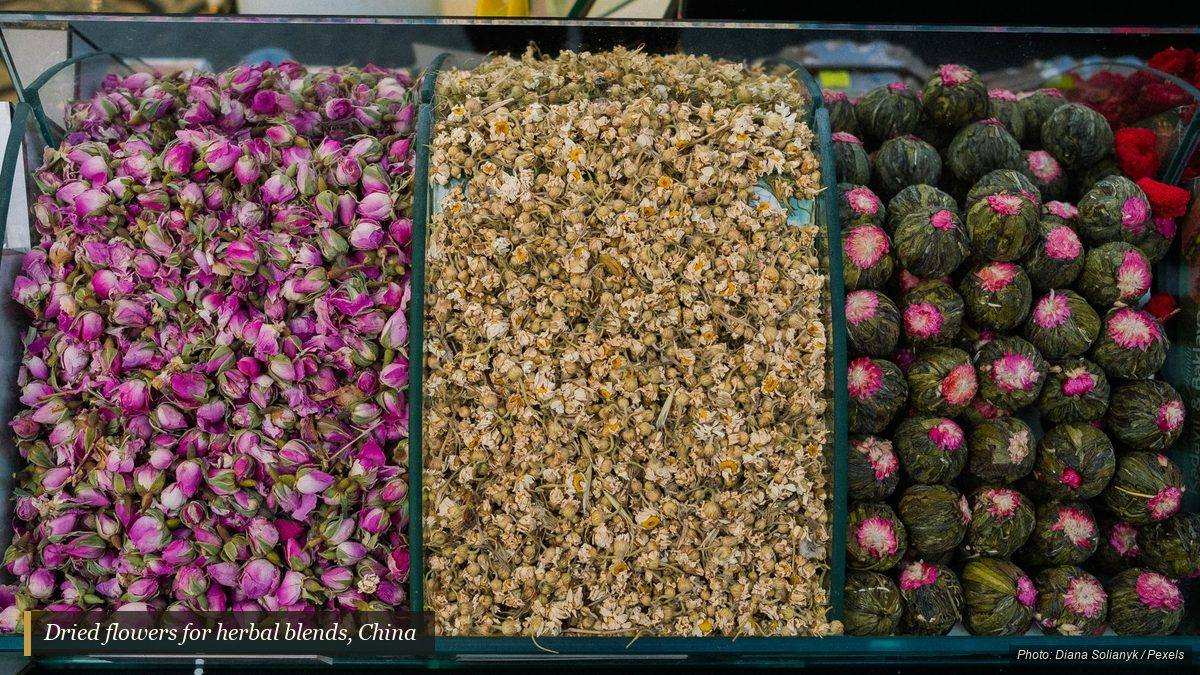
No country has a deeper herbal-tea culture than China, and its most distinctive tradition comes from the humid south. In Guangdong, Hong Kong, and Macau, liangcha (涼茶, “cooling tea”) is a way of life. These are dark, often bitter decoctions of many herbs, brewed to clear what traditional Chinese practice calls internal “heat” — the sluggish, inflamed feeling associated with the Lingnan region’s hot, sticky climate.
The scale of this tradition is remarkable. An ethnobotanical survey of southern Chinese cooling drinks documented 238 botanical taxa from 86 plant families, with roots the most common ingredient and “clearing away heat” the leading traditional use (Liu, Ahmed & Long, 2013). The most famous everyday brand, Wong Lo Kat (王老吉), traces to a Guangdong recipe from 1828, and in 2006 Guangdong herbal tea was inscribed on China’s first National Intangible Cultural Heritage list (Hong Kong ICHO). Classic formulas like ya sei mei (庳四味, “twenty-four flavors”) blend a bitter cabinet of honeysuckle, chrysanthemum, and prunella, while gentler blends such as ba bao cha (八宝茶, “eight-treasure tea”) mix chrysanthemum, goji berries, red dates, and rock sugar into something far sweeter and everyday.
What Grows in Vietnam's Herbal Teacup?
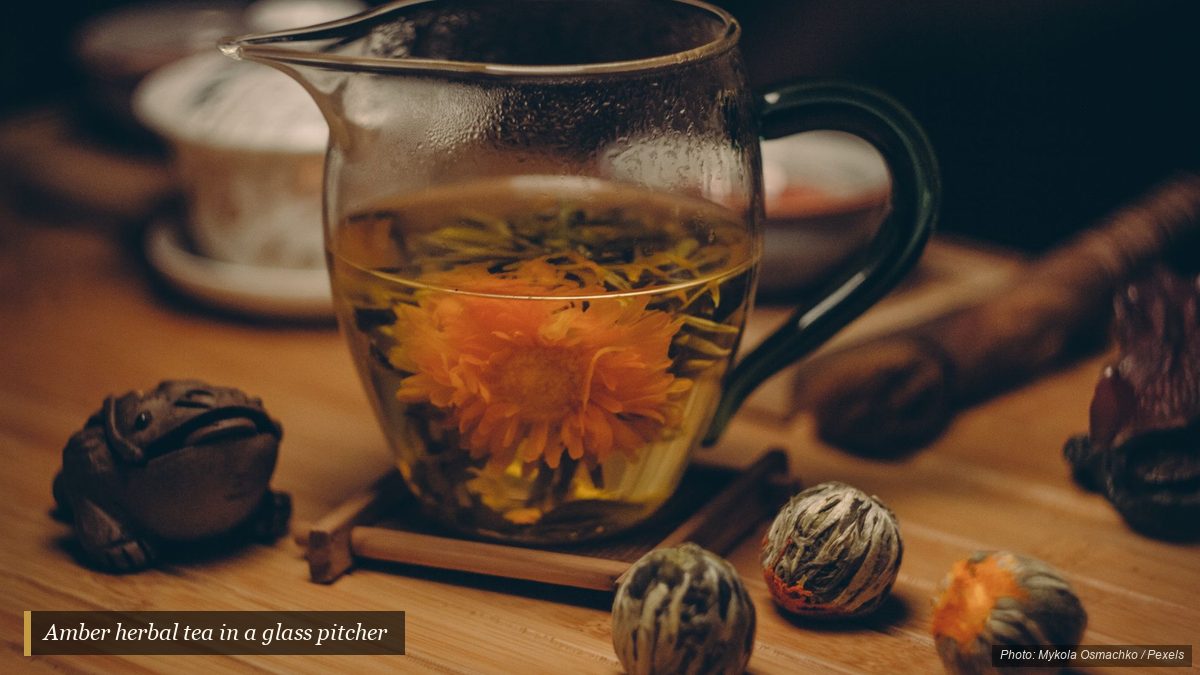
Vietnam’s herbal-tea map is written in its villages. The signature drink is trà vối (vối tea), made from the leaves and flower buds of the vối tree (Cleistocalyx operculatus), which for generations shaded courtyards across the northern countryside. A large pot of vối, brewed light amber and drunk warm or cool, was the classic thirst-quencher of rural life. Vietnamese-language pharmacy research has documented strong antioxidant activity in extracts of the buds, or nụ vối (Tạp chí Dược học).
Move up into the cool highlands and the map changes again. Around Da Lat, artichoke thrives, and trà atiso (artichoke tea) — brewed from the flower, leaf, or root — became a regional specialty, valued in folk practice as a gentle, liver-friendly daily drink; we cover it in depth in our Vietnamese artichoke tea guide. In everyday homes across the country, a fragrant infusion of fresh ginger and lemongrass (trà gừng sả) is the warming, aromatic cup people reach for on cool or rainy days — see our ginger tea guide for more.
Korea: Teas of Roasted Grain and Seed
Korea offers perhaps the clearest example of a whole country’s tea shaped by its crops. Here the everyday “tea” is usually caffeine-free and made from roasted grain or seed rather than tea leaves. The undisputed staple is boricha (보리차), roasted barley tea — nutty, amber, and poured from the fridge like water in summer or served warm all winter. It is so ordinary that in many households it simply is what “water” tastes like; our Korean barley tea guide traces the whole tradition.
Alongside it sits a small family of homely brews. Oksusu-cha (옥수수차), roasted corn tea, and its cousin corn-silk tea turn a farming byproduct into a sweet, comforting cup. Gyeolmyeongja-cha (결명자차), cassia-seed tea, gets its name from a phrase meaning “seed that brightens the eyes” and is a roasty, slightly bitter folk favorite (Kimchimari). And in winter, the bright citrus preserve tea yuja-cha (유자차) is stirred from a honeyed marmalade of Korean citron — a fragrant contrast to all that roasted grain, explored in our yuja-cha guide. Together they form a distinctly Korean rhythm you can read more about in our Korean tea culture guide.
What Herbal Teas Do People Drink in Japan?
Japan is famous for green tea, yet its non-Camellia traditions run just as deep, and they too follow the seasons and the coastline. The everyday summer drink is mugicha (麦茶), roasted barley tea — the Japanese sibling of Korean boricha — brewed by the pitcher, chilled, and handed to children as a caffeine-free alternative to sweet drinks. Its toasty aroma comes from compounds formed during roasting.
Beyond it lies a whole cabinet of folk and coastal teas. Kombucha (昆布茶) — not the fermented Western drink of the same spelling, but a savory infusion of powdered kelp — is a warm, umami-rich cup enjoyed in Japanese homes. Kuwacha (桑茶), mulberry-leaf tea, is a rural favorite, while dokudami-cha (どくだみ茶), made from Houttuynia cordata, is one of Japan’s classic folk “health teas,” brewed from a common garden plant that also grows across Vietnam as diếp cá. For Japan’s roasted leaf teas, our hojicha guide is a natural next stop.
A Quick Look Further South
The map does not stop at East Asia. In Thailand, the vivid blue butterfly-pea flower tea (nam dok anchan) and lemongrass-pandan infusions are everyday refreshments; in Indonesia, the jamu tradition blends turmeric, ginger, and tamarind into fresh tonics. Each deserves its own guide, but they round out the picture: across Southeast Asia too, the local herbal cup mirrors the local soil.
What Does Modern Research Say About These Regional Teas?
Here honesty matters. Most of the reasoning behind these traditions is cultural and historical, not clinical, and the modern evidence is early and mixed. A 2024 review of Chinese herbal teas catalogued their antioxidant and anti-inflammatory constituents while stressing that human evidence remains preliminary and that ingredient quality varies widely (Zhao et al., 2024). Roasted-grain teas like mugicha and boricha are studied mainly for the antioxidant melanoidins formed during roasting, and Houttuynia cordata — the plant behind dokudami tea — has been reviewed for flavonoids with antioxidant activity in cell and animal studies (Wu et al., 2020). Vietnamese research reports antioxidant activity in vối buds. The sensible reading is that these are pleasant, often hydrating cultural drinks with promising but unproven laboratory signals — best enjoyed for what they are, not as remedies. Individual experiences vary considerably.
How Do People Brew These Regional Teas?
One of the quiet joys of this tradition is how forgiving the brewing is. A few country-by-country habits people tend to follow:
- Roasted grain teas (boricha, mugicha, corn tea). Simmer a handful of roasted grain for 5–10 minutes, or steep tea bags, then drink warm or chilled. Very forgiving — stronger or weaker to taste.
- Chinese cooling blends (ba bao cha, gentle liangcha). Rinse the herbs with a splash of hot water, then steep the second pour for 10–15 minutes; sweeten mild blends with a little rock sugar.
- Vietnamese vối and artichoke tea. Brew dried vối leaves or buds in near-boiling water in a large pot; artichoke pieces are usually simmered longer.
- Japanese folk teas (dokudami, mulberry). Roasting or drying tempers their grassy edge; steep dried leaf in hot water and adjust strength gently.
- Korean yuja-cha. Stir a spoonful of yuja marmalade into hot water — no steeping needed.
None of this is prescriptive. Some people love the bracing bitterness of a real liangcha; others prefer the mellow sweetness of eight-treasure tea or barley. Individual responses vary considerably; what works well for one person may not suit another, and personal experimentation under practitioner guidance is always recommended.
Important Limitations and Considerations
Everyday as these teas are, “traditional” does not mean “risk-free for everyone.” A few things worth keeping in mind:
- Cooling teas and a “weak spleen.” In traditional Chinese thinking, strong liangcha is distinctly cold in nature and is not advised in large amounts for people with a weak digestion (“spleen deficiency”), during cold weather, or for those who feel easily chilled — it may leave them feeling worse, not better.
- Licorice, a common liangcha ingredient. Licorice root contains glycyrrhizin, which in large or prolonged amounts can raise blood pressure, lower potassium, and cause irregular heartbeat; it warrants extra caution in pregnancy and with heart or kidney conditions (NCCIH, Licorice Root).
- Cassia seed and folk laxative herbs. Cassia-seed tea and some folk brews have a mild laxative character and may interact with medications or be unsuitable in large amounts; introduce them slowly.
- Pregnancy and breastfeeding. Guidance varies by ingredient. If you are pregnant or nursing, check with a healthcare practitioner before making any herbal blend a daily habit.
- Children and medical conditions. Caffeine-free grain teas are widely shared with children, but strongly herbal or bitter cooling blends are not. Consult a professional if you manage a chronic condition or take regular medication.
- Herb quality varies. Dried buds, seeds, flowers, and multi-herb blends differ widely in freshness and purity, and multi-ingredient formulas can hide unlabeled additions. Buy from reputable sources and rinse dried ingredients before use.
Frequently Asked Questions
What is the most popular herbal tea in Asia?
There is no single answer, because each country has its own default cup. Roasted barley tea is the everyday staple in both Korea (boricha) and Japan (mugicha), cooling herbal decoctions (liangcha) dominate southern China, and vối and artichoke teas are classic in Vietnam. The most “popular” tea really depends on where you are standing.
Are Asian herbal teas caffeine-free?
Many of the everyday ones are. Roasted grain teas like boricha, mugicha, and corn tea, along with most flower, seed, and citron infusions, contain no caffeine, which is exactly why they are served to children and drunk all day. True teas made from Camellia sinensis — green, oolong, black — do contain caffeine, so it is worth checking what a given blend actually contains.
What is the difference between Chinese liangcha and Korean boricha?
They come from opposite instincts. Liangcha is a bitter, multi-herb decoction brewed in humid southern China to feel cooling and clear internal “heat.” Boricha is a simple, single-ingredient roasted barley tea from Korea, mild and nutty, drunk more like everyday water than a remedy. One is a cooling herbal formula; the other is a comforting grain infusion.
Can I drink these regional herbal teas every day?
Many people enjoy the mild caffeine-free ones — barley, corn, gentle eight-treasure blends — daily as an ordinary drink, favoring moderate amounts. Stronger cooling decoctions are usually taken more occasionally. Individual responses vary, so anyone pregnant, taking medication, or managing a health condition should check with a practitioner before making any blend a daily habit.
What do these herbal teas taste like?
It ranges widely. Roasted grain teas are toasty, nutty, and faintly sweet; eight-treasure and yuja teas are floral and sweet; vối and mulberry teas are light and grassy; and a real twenty-four-flavor liangcha is frankly bitter.
A Gentle Note on Tracking Your Tea Habits
Exploring regional teas is a lovely, low-stakes way to travel through a cup, but it is easy to lose track of which ones you enjoyed and how they felt. If you like the idea of a small personal record — noting which teas you reached for and how your evenings or sleep responded — a simple wellness journal like the one we build at Health Diary makes that easy to keep.
A Soft Closing Note
What this map really shows is that there is no single “Asian herbal tea” — there are dozens of local answers to the same human question: what should we drink to feel a little more at ease with our climate and our day? Whether you are drawn to the bitter clarity of a Guangdong cooling tea, the nutty comfort of Korean barley, or the grassy freshness of a Vietnamese village brew, the pleasure lies in the discovery. Let your own taste lead the way, one cup at a time.
About This Article
Written by: Health Diary Editorial Team — writers focused on traditional Asian wellness, herbal teas, and regional food-and-drink traditions, drawing on both classical sources and current research.
Editorial review: This article has been reviewed by the Health Diary editorial team for clarity, structure, and adherence to our sourcing standards. Key claims were cross-checked against NCCIH, NIH PubMed, and peer-reviewed reviews where applicable. It is not a clinical review and should not replace consultation with a licensed healthcare practitioner.
Reviewed on: July 18, 2026.
Editorial process: We cite peer-reviewed and government sources where possible. When a clinical reviewer is added to this article, attribution will appear here with verifiable credentials.
References
- Liu Y, Ahmed S, Long C. Ethnobotanical survey of cooling herbal drinks from southern China. Journal of Ethnobiology and Ethnomedicine, 2013. Link
- Zhao et al. Chemical constituents, health-promoting effects, potential risks and future prospective of Chinese herbal tea: A review. Food Science and Human Wellness, 2024. Link
- Wu Z, et al. Therapeutic potentials of Houttuynia cordata Thunb. against inflammation and oxidative stress: A review. 2020. Link
- Tạp chí Dược học. Nghiên cứu tác dụng chống oxy hóa của nụ vối (Cleistocalyx operculatus). Link
- Hong Kong Intangible Cultural Heritage Office. Herbal Tea — Representative List of the Intangible Cultural Heritage. Link
- National Center for Complementary and Integrative Health. Licorice Root. Link
- Kimchimari. 14 Everyday Korean Teas. Link


