Medical Disclaimer: This content is for educational and informational purposes only and is not medical advice. It is not intended to diagnose, treat, cure, or prevent any disease. He shou wu has been linked to liver injury — read the safety section carefully and always consult a licensed healthcare practitioner before using it. Statements regarding traditional herbal use have not been evaluated by the FDA.
Affiliate Disclosure: This article may contain affiliate links. We may earn a commission if you purchase through these links, at no additional cost to you. We only recommend products we believe align with our editorial standards.
Few herbs in the Chinese tradition carry a reputation as romantic — or as misunderstood — as he shou wu (何首乌). Known in the West as fo-ti and in Vietnam as hà thủ ô, its very name means "Mr. He's black hair," after a legend of an old man whose grey hair is said to have darkened after he took the root. That story has made it one of the most famous "anti-ageing" and "hair" herbs in Asia. But he shou wu is also one of the clearest examples of why traditional preparation and modern safety data both matter — because the raw and prepared forms are not the same, and the herb has been repeatedly linked to liver injury. This profile is part of our wider guide to Asian herbal traditions.
What Is He Shou Wu?
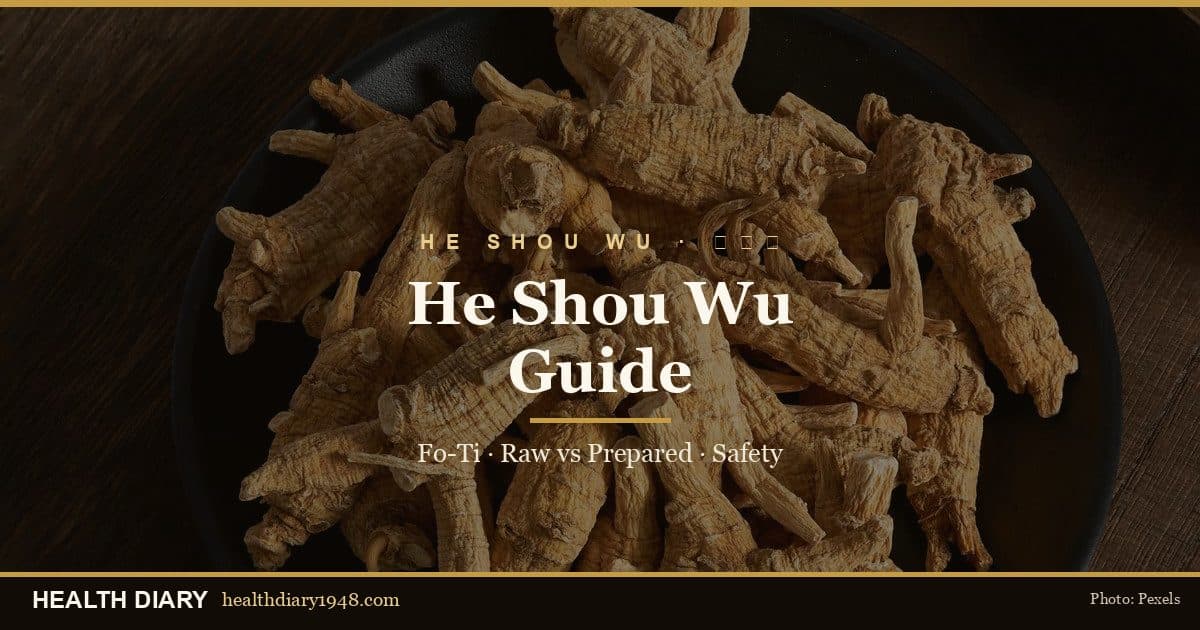
He shou wu is the tuberous root of Reynoutria multiflora (formerly Polygonum multiflorum or Fallopia multiflora), a climbing knotweed native to China. In traditional Chinese medicine it is regarded as a tonic for the "liver and kidney" systems and for "jing" (essence) and "blood" — the framework behind its long association with hair, vitality, and healthy ageing (MSK, Fo-Ti). It is one of the roots most often reached for in East Asian households when people think of graceful ageing.
The plant's Latin name and the legend both hint at its history. The name multiflorum ("many-flowered") describes the plant; the Chinese name records the folk tale of Mr. He. In practice, though, the single most important thing to understand about he shou wu is not its legend but the difference between its two forms.
Raw vs Prepared: Why the Difference Matters
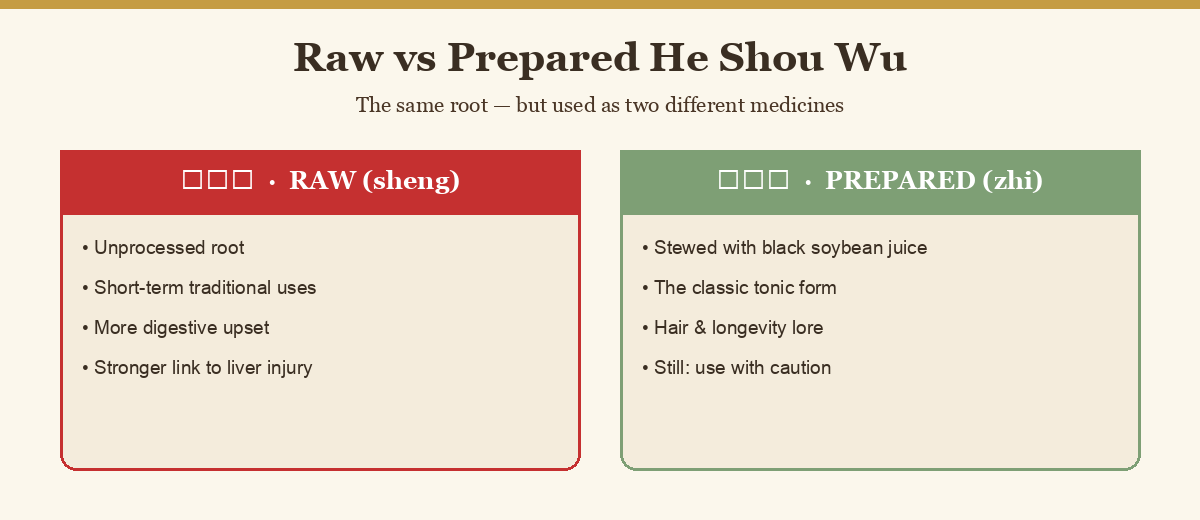
Traditional Chinese medicine draws a sharp line between two versions of the root, and this distinction is central to using it safely:
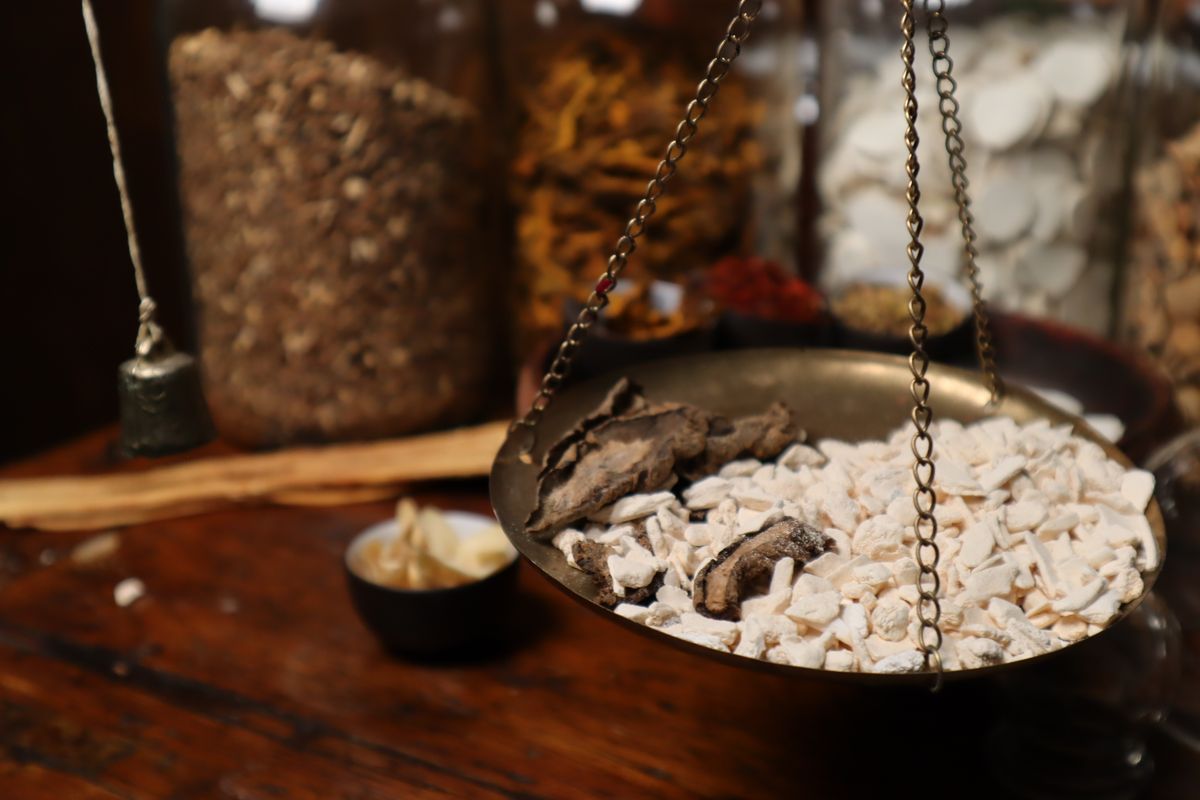
- Raw he shou wu (生首乌, sheng shou wu) — the unprocessed root. Traditionally used for very different, short-term purposes (such as moistening the bowels), it is considered more likely to cause digestive upset and is the form more strongly associated with liver problems.
- Prepared he shou wu (制首乌, zhi shou wu) — the root repeatedly stewed with black soybean juice in a laborious process. This traditional processing (called paozhi) changes the root's chemistry and is the form intended for the classic "tonic," hair, and longevity uses.
Chinese pharmacopoeial and herbal sources treat these as effectively two different medicines with different indications (Baidu Baike, 何首乌). A great deal of confusion — and some of the harm — comes from products that fail to specify which form they contain, or that sell raw root for uses meant for the prepared form.
Is He Shou Wu Safe? The Liver Question
This is the most important section of this article. He shou wu is one of the most frequently reported causes of herb-induced liver injury worldwide, documented in the US National Institutes of Health's LiverTox database and in numerous case reports (LiverTox, NIH). Reported cases range from mild, reversible rises in liver enzymes to severe hepatitis; a minority of severe cases have led to liver failure requiring transplantation or resulting in death.
Research has also identified a genetic risk marker: people who carry the HLA-B*35:01 gene variant appear to be substantially more susceptible to he-shou-wu liver injury, which helps explain why the reaction is idiosyncratic — striking some individuals hard while others take the herb without apparent problem (Polygonum multiflorum hepatotoxicity review). Because you cannot know in advance whether you carry this susceptibility, caution applies to everyone.
Practical safety takeaways:
- Use only clearly labelled prepared (zhi) he shou wu from a reputable source, and avoid raw root unless a qualified practitioner specifically directs it.
- Do not use he shou wu if you have any liver condition, and avoid combining it with alcohol or other liver-stressing substances.
- Stop immediately and seek medical care if you notice signs of liver trouble — fatigue, nausea, loss of appetite, dark urine, pale stools, abdominal pain, or yellowing of the skin or eyes.
- Avoid during pregnancy and breastfeeding, and if you take prescription medication, check with a pharmacist first.
None of this means the herb is inevitably dangerous for everyone — millions have used prepared he shou wu for centuries — but it does mean it deserves far more respect than a casual "hair supplement" framing suggests. Individual responses vary considerably.
What Is He Shou Wu Traditionally Used For?
In classical Chinese medicine, prepared he shou wu is regarded as a warming, nourishing tonic. Its best-known traditional associations are with hair colour and thickness, healthy ageing, and general vitality — the qualities captured in the Mr. He legend (MSK). It appears in traditional formulas alongside herbs like goji, angelica, and rehmannia, and in Vietnam hà thủ ô is a celebrated tonic root, often prepared and sold as a dark, sweetened extract or with black beans and sesame (Nhà thuốc Long Châu, hà thủ ô).
It is important to be honest here: these are traditional uses, not proven medical benefits. The famous hair-darkening reputation, in particular, is not supported by reliable human clinical evidence. Enjoy he shou wu as a piece of living tradition, not as a guaranteed remedy for grey hair or ageing.
What Does Modern Research Say?
Laboratory studies have looked at compounds in he shou wu — notably stilbene glycosides (such as 2,3,5,4′-tetrahydroxystilbene glucoside) and anthraquinones like emodin — and reported antioxidant and other activities in cell and animal models (P. multiflorum review). Interestingly, some of these same anthraquinone compounds are also implicated in the herb's liver toxicity, which is a reminder that "active" and "safe" are not the same thing.
What is largely missing is robust human clinical evidence. There are no large, high-quality trials showing that he shou wu reverses grey hair, extends lifespan, or resolves illness in people. The honest summary is: a long and rich traditional record, promising but preliminary laboratory findings, a real and documented safety signal, and very little clinical proof. That combination argues for curiosity and caution in equal measure.
How Is He Shou Wu Prepared and Taken?
Traditionally, prepared he shou wu is used in decoctions (simmered as part of a herbal formula), in tonic wines, or as a paste or powder combined with foods like black sesame and black beans — ingredients themselves associated in Chinese food culture with dark hair and kidney vitality. In Vietnam, hà thủ ô is commonly sold as a ready-made dark extract or brewed as a tea.
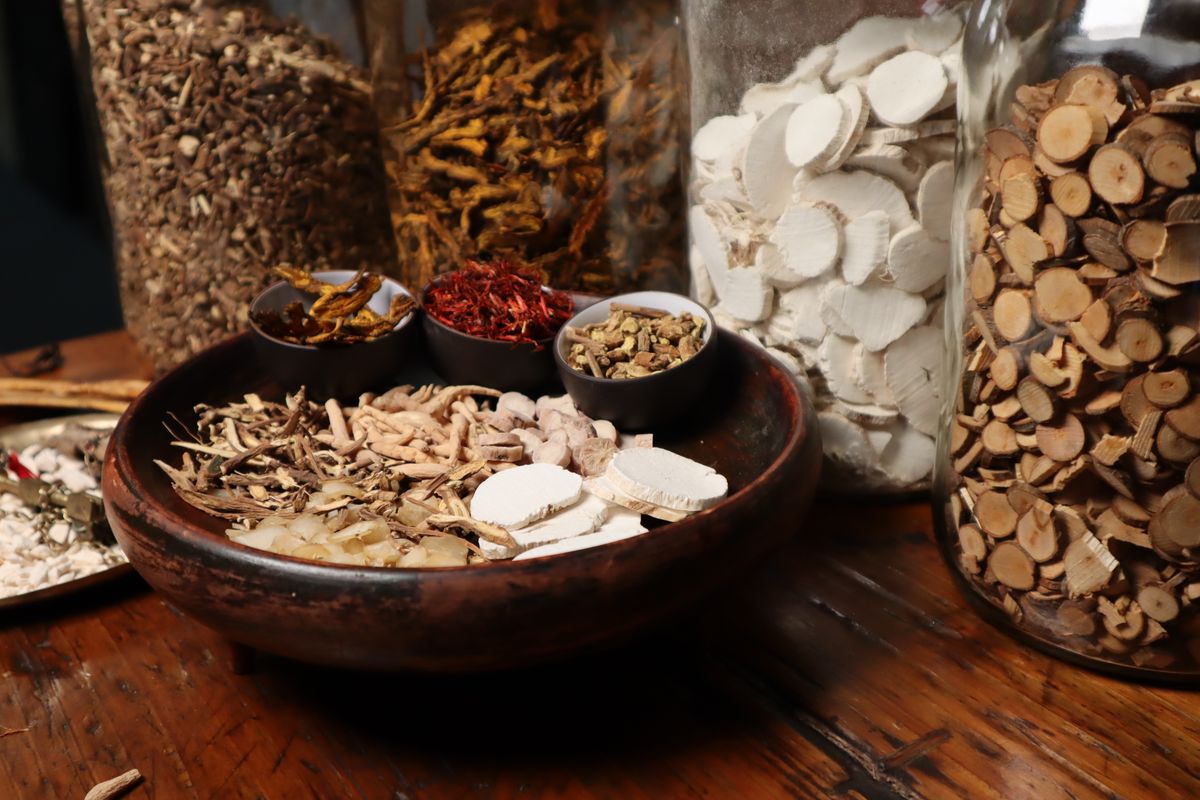
If you choose to try it, favour products that clearly state they use prepared (制/zhi) root, come from a reputable supplier with quality testing, and specify a sensible dose — and treat it as an occasional traditional tonic rather than a daily long-term habit, given the liver considerations above. When in doubt, work with a qualified TCM practitioner rather than self-prescribing. For the wider context of tonic herbs, see our traditional wellness practices guide.
Frequently Asked Questions
Does he shou wu really turn grey hair black?
That is its most famous traditional reputation, but it is not backed by reliable human clinical evidence. Treat the hair-darkening claim as folklore rather than a proven effect.
Is he shou wu the same as fo-ti?
Yes — "fo-ti" is simply the common Western name for the same root, Reynoutria multiflora (formerly Polygonum multiflorum).
Why is he shou wu linked to liver damage?
It is one of the most reported causes of herb-induced liver injury, especially the raw form; a genetic marker (HLA-B*35:01) raises susceptibility in some people. Use only prepared root from a trusted source and stop at any sign of liver trouble.
What is the difference between raw and prepared he shou wu?
Raw (生/sheng) root is unprocessed and more associated with digestive upset and liver risk; prepared (制/zhi) root is repeatedly stewed with black soybean juice and is the form intended for tonic and longevity uses.
Who should avoid he shou wu?
Anyone with a liver condition, pregnant or breastfeeding women, people on prescription medication (without pharmacist advice), and anyone unsure of which form a product contains.
The Bottom Line
He shou wu is a genuinely storied herb — a legend, a longevity symbol, and a fixture of Chinese and Vietnamese tonic traditions. It is also a cautionary tale: the raw and prepared forms differ, the liver-injury signal is real and well documented, and the celebrated hair-and-ageing benefits remain unproven in people. Approached with respect — prepared root only, a reputable source, awareness of the warning signs, and a doctor's input if you take other medicines — it can be appreciated as part of a rich tradition. But it is not a casual supplement, and it should never be treated as one.
Editorial Review
Written by: Health Diary Editorial Team — writers and researchers focused on making traditional Asian wellness knowledge clear, accurate, and culturally grounded.
Editorial review: This article has been reviewed by the Health Diary editorial team for clarity, structure, and adherence to our sourcing standards. Because he shou wu carries a documented liver-injury signal, safety claims were cross-checked against LiverTox (NIH), peer-reviewed reviews, and native-language sources. It is not a clinical review and should not replace consultation with a licensed healthcare practitioner.
Reviewed on: August 4, 2026.
References
- Memorial Sloan Kettering. About Herbs — Fo-Ti (He Shou Wu). https://www.mskcc.org/cancer-care/integrative-medicine/herbs/fo-ti
- LiverTox: Clinical and Research Information on Drug-Induced Liver Injury — He Shou Wu (Polygonum multiflorum). NIH/NCBI. https://www.ncbi.nlm.nih.gov/books/NBK548795/
- Hepatotoxicity of Polygonum multiflorum and HLA-B*35:01 susceptibility (review). PMC. https://pmc.ncbi.nlm.nih.gov/articles/PMC6407402/
- 何首乌 — Baidu Baike (raw 生首乌 vs prepared 制首乌). https://baike.baidu.com/item/何首乌/244101
- Hà thủ ô đỏ và những công dụng đối với sức khỏe — Nhà thuốc Long Châu. https://nhathuoclongchau.com.vn/bai-viet/ha-thu-o-do-va-nhung-cong-dung-doi-voi-suc-khoe.html