Medical Disclaimer: This content is for educational and informational purposes only and is not medical advice. It is not intended to diagnose, treat, cure, or prevent any disease. Always consult a licensed healthcare practitioner before making changes to your diet. Statements regarding traditional tea use have not been evaluated by the FDA.
Affiliate Disclosure: This article may contain affiliate links. We may earn a commission if you purchase through these links, at no additional cost to you. We only recommend products we believe align with our editorial standards.
If China has a national tea, it is Longjing — "Dragon Well" — the flat, jade-green, chestnut-scented tea from the hills around West Lake in Hangzhou. Pan-fired by hand for centuries and once reserved for emperors, Longjing is the most famous of all Chinese green teas. This guide explains what makes it special, its imperial history, how it is made, and how to brew it — part of our wider guide to Asian herbal teas.
What Is Longjing (Dragon Well) Tea?
Longjing (龙井茶) is a pan-fired green tea from Camellia sinensis, famous for its flat, smooth, blade-like leaves and a mellow, gently nutty flavour. Unlike Japanese green teas, which are usually steamed, Longjing is fired in a hot wok — a difference that shapes its whole character. Connoisseurs describe its "four uniques" (色绿香郁味甘形美): green colour, rich aroma, sweet taste, and beautiful shape (Chinese reference, West Lake Longjing).
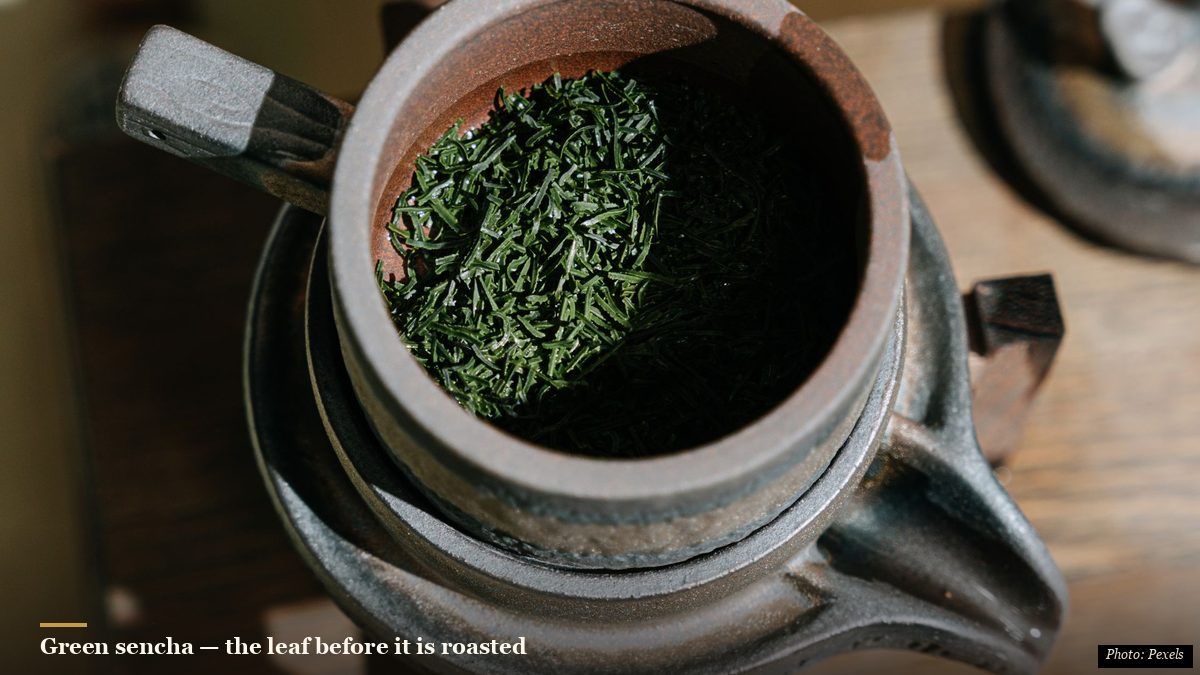
The finest Longjing is West Lake Longjing (西湖龙井), grown in a small protected area around Hangzhou's West Lake. Its signature flat shape comes from pressing the leaves against the wok during firing. If you know the steamed, grassy freshness of Japanese green tea, Longjing offers green tea's other great tradition: pan-fired, toasty, and smooth.
Why Is Longjing So Famous?
Longjing's fame is part flavour, part history. It has been produced since at least the Tang dynasty and rose to prominence in the Ming, but its legend was sealed by the Qing emperor Qianlong, who, on a visit in 1751, is said to have so admired the tea at Lion Peak (狮峰) that he designated eighteen bushes there as imperial "tribute tea" — the famous "18 Imperial Tea Trees" (十八棵御茶), which still stand today (18 imperial trees legend). That story is best enjoyed as cherished legend rather than strict history, but it captures Longjing's status as the emperor's tea.
Today, "West Lake Longjing" is a protected geographical-indication product, and the hand pan-firing craft is recognised as national intangible cultural heritage (China ICH registry). The classic sub-origins are abbreviated 狮 (Shifeng/Lion Peak), 龙 (Longjing village), 云 (Yunqi), 虎 (Hupao), and 梅 (Meijiawu), with Lion Peak considered the very finest. Because true West Lake Longjing comes from such a small area and is picked in a narrow spring window, genuine top-grade tea is scarce — and, unfortunately, widely imitated.
How Is Longjing Made?
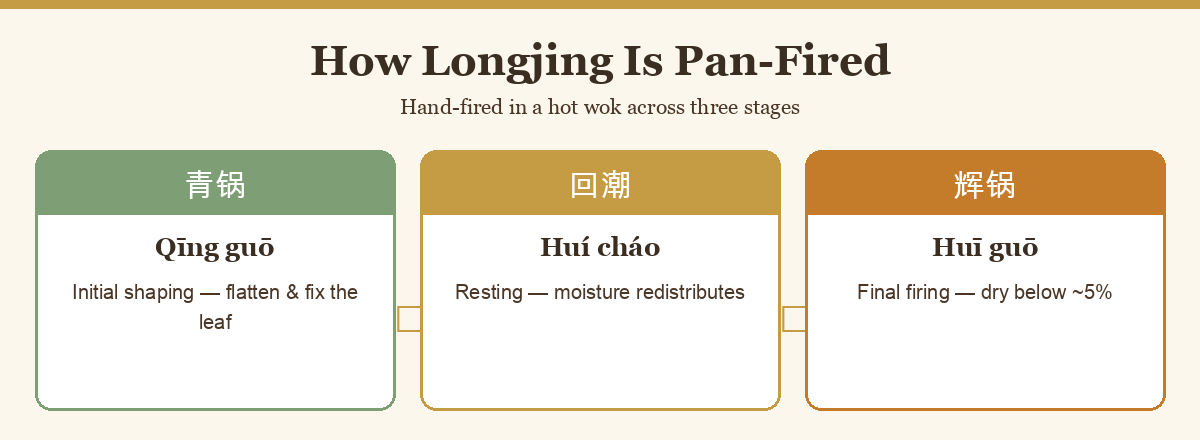
Longjing's magic is in the wok. After a light withering, skilled makers fire the leaves by hand using a repertoire traditionally counted as ten hand movements (十大手法) — shaking, pressing, flicking, and grinding the leaf against the hot pan across several stages, from the first shaping (青锅) through resting and a final firing (辉锅) that brings the moisture down below about 5% (hand-firing technique).
This pan-firing is also chemistry. Compared with steaming, wok-firing tends to yield a tea with more of the sweet, savoury free amino acids and toasty aromatic compounds, which is exactly why Longjing tastes smooth and nutty rather than sharply grassy (fixation methods study, 2022). The hand-firing skill takes years to master and is genuinely difficult to do well, which is part of why the best Longjing is so prized and so hard to fake convincingly.
What Is Pre-Qingming (Mingqian) Longjing?
Among Longjing lovers, timing is everything. Tea picked before the Qingming festival in early April — mingqian (明前) tea — is the most treasured: the buds are tiny and tender, the supply is tiny, and the flavour is at its most delicate. Tea picked a little later, before the Guyu solar term, is yuqian (雨前) and still excellent (Chinese reference). This is why the earliest spring Longjing commands the highest prices — a small, early harvest of a labour-intensive tea.
What Does Modern Research Say?
As a green tea, Longjing contains catechins (chiefly EGCG), the calming amino acid L-theanine, and caffeine (tea polyphenols review, 2019). The best-supported functional finding for green tea is modest: L-theanine together with caffeine may give a small, short-term lift in attention and mood, though a 2025 review stresses the effects are uncertain and mostly come from isolated compounds rather than brewed tea (Payne et al., 2025).
Beyond that, health authorities are careful: green tea's broader benefits remain largely unproven or inconclusive in humans, and definite conclusions cannot yet be drawn (NCCIH). Importantly, the rare liver-injury reports linked to green tea concern concentrated extract supplements, not brewed tea like a cup of Longjing (LiverTox). Enjoy Longjing as a beautiful, everyday green tea — not a remedy. Individual responses vary considerably.
How Do You Brew Longjing?
Longjing is delicate, so handle it gently: use cooler water, around 75–85°C rather than boiling, which would scald the tender leaves and turn the cup bitter. A classic method is to brew it in a clear glass so you can watch the flat leaves dance and slowly sink — use a modest amount of leaf, a short steep, and top up with more water as you drink. It re-steeps well a few times. For the wider ritual, see our tea rituals and tea culture guides.
Safety and Considerations
- Caffeine. Longjing contains caffeine; be mindful in the evening and during pregnancy, when authorities advise limiting caffeine (NCCIH).
- Beverage, not extract. Brewed green tea is not linked to liver injury; concentrated green-tea extract supplements are the concern (LiverTox).
- Medication and iron. Green tea can interact with some medicines and reduce iron absorption; take it between meals if managing low iron, and check with a pharmacist if you take prescription drugs (MSK).
- Authenticity. Genuine West Lake Longjing is limited and often counterfeited; buy from reputable sellers.
- Individual responses vary considerably.
Frequently Asked Questions
What is Longjing (Dragon Well) tea?
Longjing is China's most famous pan-fired green tea, from the West Lake area of Hangzhou. It has flat, jade-green leaves, a nutty-sweet flavour, and is celebrated for its "four uniques" of colour, aroma, taste, and shape (Chinese reference).
Why is Longjing so famous and expensive?
A mix of imperial history (the Qianlong "18 imperial trees" legend), protected West Lake origin, prized sub-regions like Lion Peak, labour-intensive hand pan-firing, and scarce early-spring harvests all drive its prestige and price (imperial trees legend).
What does Longjing taste like?
Mellow, sweet, and gently nutty or chestnut-like, with low astringency — a smoother, toastier profile than steamed Japanese green teas, thanks to pan-firing.
What is pre-Qingming (mingqian) Longjing?
It is Longjing picked before the Qingming festival in early April — the tenderest, most prized, and priciest grade, made from tiny early-spring buds (Chinese reference).
How do you brew Longjing?
Use cooler water (around 75–85°C, never boiling), a modest amount of leaf, and short steeps — ideally in a clear glass so you can watch the leaves unfurl. It re-steeps a few times.
A Note on Enjoying Longjing
Longjing rewards attention to detail — the water temperature, the early-spring harvest, the origin. Brew a good one in a glass, watch the flat leaves sink, and taste why it has charmed emperors and everyday drinkers alike. To keep exploring, our oolong, white tea, and pu-erh guides round out the Chinese tea family, all within our Chinese tea tradition hub.
About This Article
Written by: Health Diary Editorial Team — writers and researchers focused on making traditional Asian wellness knowledge clear, accurate, and culturally grounded.
Editorial review: This article has been reviewed by the Health Diary editorial team for clarity, structure, and adherence to our sourcing standards. Key claims were cross-checked against peer-reviewed research, NCCIH, LiverTox, and native-language sources where applicable. It is not a clinical review and should not replace consultation with a licensed healthcare practitioner.
Reviewed on: August 4, 2026.
Editorial process: We cite peer-reviewed and government sources where possible, separate the Qianlong legend from verifiable heritage facts, and draw the brewed-tea-versus-extract line clearly on safety.
References
- Payne ER, et al. Effects of Tea or l-Theanine + Caffeine on Cognition, Sleep, and Mood: Systematic Review and Meta-Analysis. Nutrition Reviews. 2025. https://academic.oup.com/nutritionreviews/article/83/10/1873/8123998
- Effect of Fixation Methods (pan-firing vs steaming) on Green Tea. 2022. https://www.ncbi.nlm.nih.gov/pmc/articles/PMC9180411/
- Tea Polyphenols in Promotion of Human Health. Nutrients. 2019. https://www.ncbi.nlm.nih.gov/pmc/articles/PMC6356332/
- NCCIH. Green Tea: Usefulness and Safety. https://www.nccih.nih.gov/health/green-tea
- LiverTox: Green Tea (brewed vs extract). NIH/NCBI Bookshelf. https://www.ncbi.nlm.nih.gov/books/NBK547925/
- Memorial Sloan Kettering. About Herbs — Green Tea. https://www.mskcc.org/cancer-care/integrative-medicine/herbs/green-tea
- The Legend of the Eighteen Imperial Tea Trees in Longjing. https://www.toponetea.com/blogs/culture-history/the-legend-of-the-eighteen-imperial-tea-trees-in-longjing
- 西湖龙井 — Chinese reference (four uniques, sub-origins, mingqian). https://zh.wikipedia.org/wiki/西湖龙井
- 西湖龙井制作技艺的十种手工炒法 — hand-firing technique. https://jingyan.baidu.com/article/ab69b270f966742ca6189f78.html
- 西湖龙井炒制技艺 — China intangible cultural heritage registry. https://www.ihchina.cn/project_details/27028