

The Five Elements: A Guide to Wu Xing in Eastern Traditions
Explore the five elements (wu xing): Wood, Fire, Earth, Metal, Water — their origins, the generating and controlling cycles, and how they shape food and seasonal wellness.
Medical Disclaimer: This content is for educational and informational purposes only and is not medical advice. The information presented is not intended to diagnose, treat, cure, or prevent any disease. The five elements framework described here is a cultural and philosophical classification system, not a scientifically verified model of human biology. Always consult a licensed healthcare practitioner before starting any new herbal practice or changing your diet or wellness routine. Statements regarding traditional practices have not been evaluated by the FDA.
Affiliate Disclosure: This article contains affiliate links. We may earn a commission if you purchase through these links, at no additional cost to you. We only recommend products we believe align with our editorial standards.
Walk into a traditional pharmacy in China, Korea, Japan, or Vietnam and you will notice that things come in fives: five flavors on herb labels, five colors in food-therapy charts, five organ systems on an acupuncture poster. Behind all of it sits one of the oldest organizing ideas in Eastern thought — the five elements, or wu xing (五行): Wood, Fire, Earth, Metal, and Water.
This guide is one half of a two-part foundation for our Wellness Systems series. Together with its companion on yin and yang, it covers the vocabulary behind almost everything else we write about: what the five elements are, where the theory came from, how the two famous cycles work, the table of correspondences, and what modern research does and does not say.
What Are the Five Elements (Wu Xing)?
The Chinese term joins wu (五, "five") with xing (行, "to move, to act"). That second character matters: many scholars prefer the translation "five phases," because the theory does not describe five static building blocks the way the Greek elements once did. Each element names a recognizable phase of change that ancient observers saw repeating throughout nature:
- Wood (木) — expansion and upward growth, like a tree in spring
- Fire (火) — culmination and flaring upward, like midsummer heat
- Earth (土) — ripening, centering, and stability, like the harvest
- Metal (金) — contraction, refinement, and letting go, like autumn air
- Water (水) — descent, storage, and stillness, like winter and deep rivers
If yin and yang divide the world into two complementary poles, wu xing divides the process of change into five stages. Everything in the classical worldview could then be sorted into these categories — seasons, directions, colors, flavors, organ systems, emotions, even personality tendencies. It is best understood as a classification language built on analogy.
Where Does Five Elements Theory Come From?
The earliest systematic statement appears in the "Hong Fan" (洪范, "Great Plan") chapter of the Shangshu, the Book of Documents. The passage is remarkably compact: "Of the five elements, the first is water, the second fire, the third wood, the fourth metal, the fifth earth. Water moistens downward; fire flames upward; wood bends and straightens; metal yields and transforms; earth takes seeding and harvest." The same lines assign each element a flavor — salty, bitter, sour, pungent, sweet. That single passage is the seed from which centuries of food and herbal theory grew.
During the Warring States period, the philosopher Zou Yan (邹衍, c. 305–240 BCE) is credited with systematizing the theory and weaving it together with yin-yang thought into a single cosmology that Han dynasty scholars applied to everything from calendars to dynastic succession. In medicine, the framework was codified in the Huangdi Neijing (Yellow Emperor's Inner Classic); a commentary published through Beijing University of Chinese Medicine describes five elements reasoning as the core diagnostic thinking of the Neijing.
How Do the Two Cycles Work? Generation and Control
The real power of the framework — and the reason it survived two millennia — lies in the two cycles that connect the five phases.
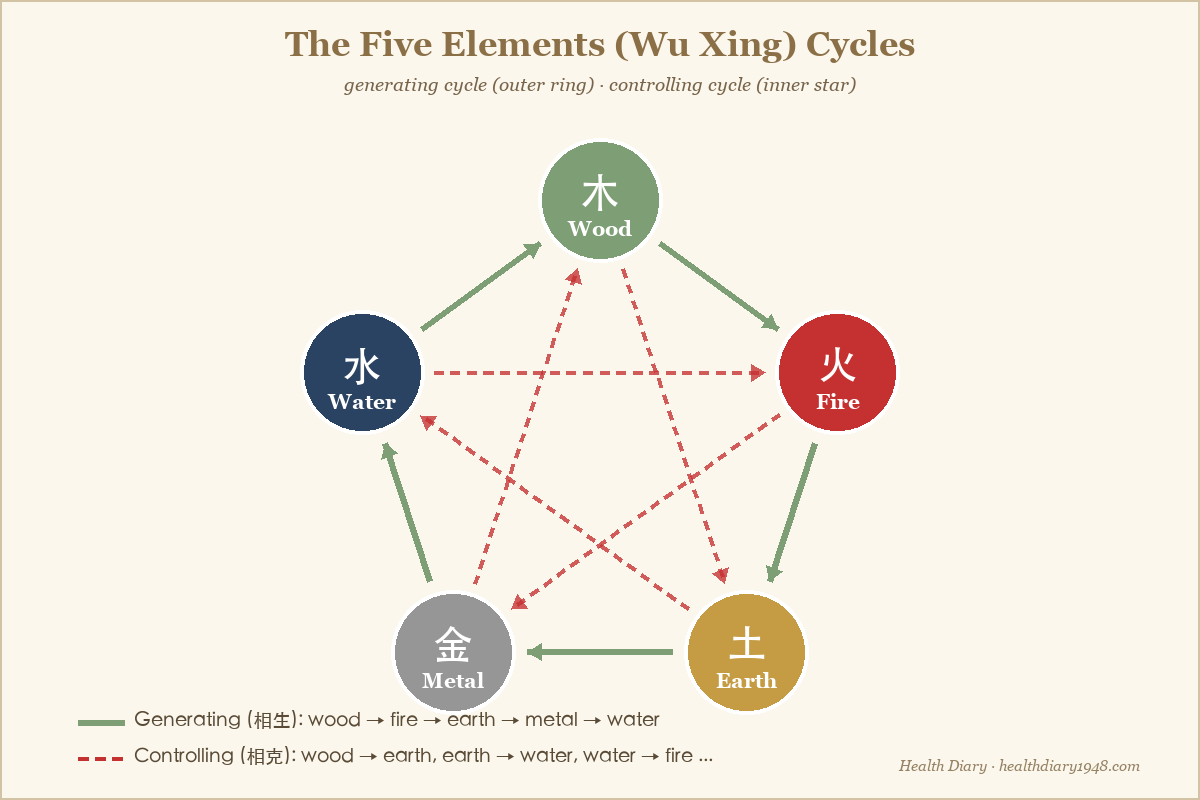
The generating cycle (相生, xiang sheng) moves clockwise around the wheel, each element nourishing the next: wood feeds fire; fire creates earth (as ash); earth bears metal (as ore); metal enriches water (as minerals); and water nourishes wood. Classical texts call the pairs "mother and child."
The controlling cycle (相克, xiang ke) traces a five-pointed star inside the wheel, each element restraining the one two steps ahead: wood breaks up earth; earth dams water; water quenches fire; fire melts metal; and metal cuts wood. Control here is not destruction — it is the check that keeps any one phase from overwhelming the whole.
In a balanced system, every element is simultaneously generated, generating, controlling, and controlled. Classical medicine adds two pathological distortions: overcontrol (相乘, xiang cheng) and reverse control or "insult" (相侮, xiang wu), when the controlled element rebels. The Beijing University commentary stresses that these relationships were always understood functionally — working "through qi, not through substance" (以气不以质) — a reminder that the ancients themselves treated the cycles as a reasoning model, not a material mechanism.
The Table of Correspondences: Seasons, Organs, Flavors, Colors, Emotions
Once the cycles were established, scholars mapped the observable world onto the five phases. The result is the famous table of correspondences, which readers of our omija berry guide — Korea's "five flavor berry" — have already met in miniature:
- Wood (木) — spring · east · green · sour · liver (with gallbladder) · anger · eyes
- Fire (火) — summer · south · red · bitter · heart (with small intestine) · joy · tongue
- Earth (土) — late summer · center · yellow · sweet · spleen (with stomach) · pensiveness · mouth
- Metal (金) — autumn · west · white · pungent · lung (with large intestine) · grief · nose
- Water (水) — winter · north · black · salty · kidney (with bladder) · fear · ears
Worth saying plainly: the table is internally consistent and often poetic — but these are cultural correlations built on analogy, not anatomical findings. The "liver" of the table is a functional category in a classical system, not the organ in a physiology textbook.
How Do the Five Elements Shape Food and Seasonal Wellness?
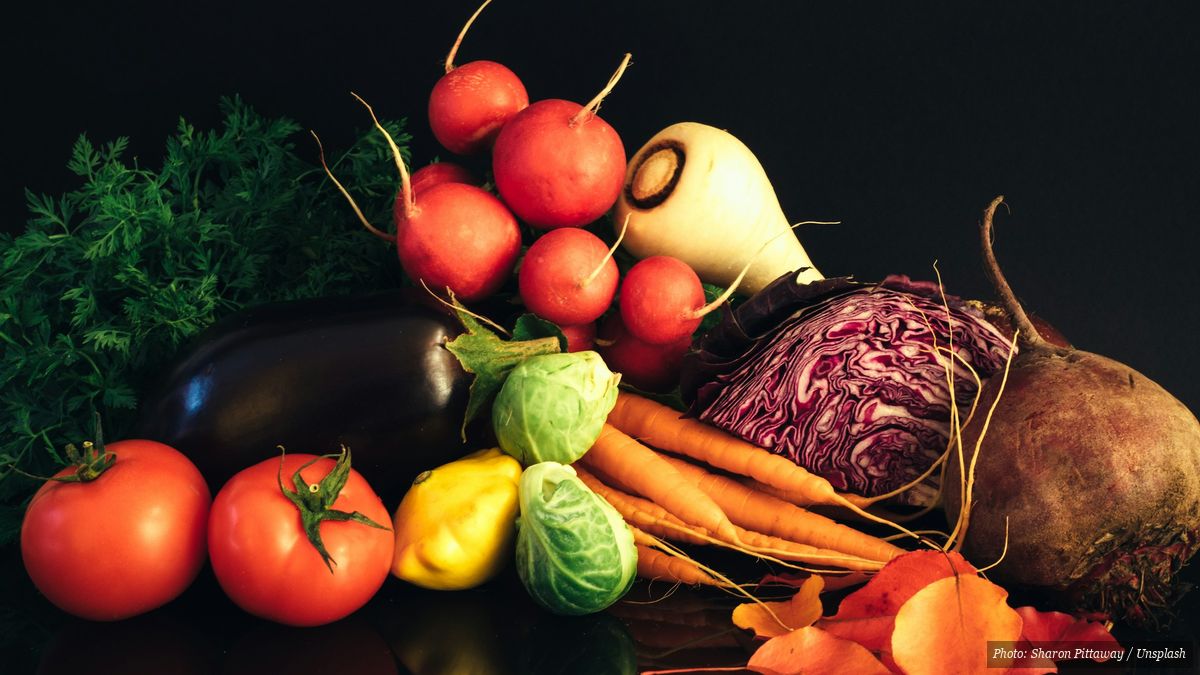
Nowhere is the framework more alive than in the kitchen. The Hong Fan's flavor line became the backbone of traditional food therapy, in which a well-composed meal gently touches all five flavors and, in the popular version, all five colors. A congee topped with red goji berries, yellow millet, dark sesame, white radish, and fresh greens is a five elements lesson served in a bowl.
The same logic drives seasonal eating. Summer belongs to fire, so traditional summer menus lean toward bitter and cooling choices — the pattern in our guides to summer wellness traditions and cooling foods. Winter belongs to water, bringing warming soups, black sesame, and black beans. Late summer, the earth season, favors mildly sweet, easily digested staples such as squash, millet, and red date tea.
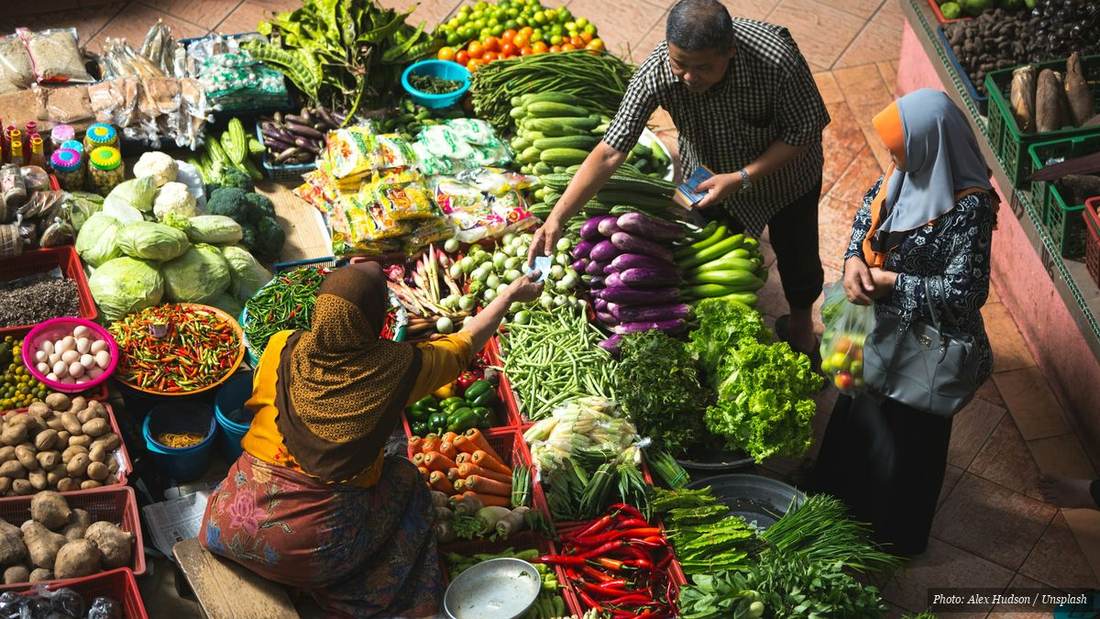
None of this requires believing in the cosmology. Many families follow five-color, five-flavor habits simply as inherited kitchen wisdom that encourages variety on the plate. Individual responses vary considerably; what works well for one person may not suit another, and personal experimentation under practitioner guidance is always recommended.
The Five Elements Beyond China: Kampo, Korean Medicine, and Vietnamese Traditions
In Japan, the theory survives as gogyō (五行). It shaped Kampo, Japan's own herbal tradition, and hides in the modern calendar: Tuesday is "fire day" (火曜日), Wednesday "water day" (水曜日), and so on. In Korea, ohaeng (오행) runs through traditional Korean medicine and its food culture — from temple cuisine's five-color plating to the rhythms in our guide to Korean healthy aging traditions. In Vietnam, ngũ hành shapes Đông y, the five-fruit tray (mâm ngũ quả) offered at Tết, and everyday proverbs about balancing flavors.
Movement traditions carry the framework too: many qigong sequences and some tai chi curricula organize practice around the five phases, pairing each with a season, an organ system, and a quality of movement.
What Does Modern Research Say About the Five Elements?
Here is the honest answer: the five elements framework is a philosophical classification system from the ancient world, and it has not been validated as a biological mechanism. There is no laboratory test for a "wood constitution," and the correspondence table is not a map of physiology.
Even researchers sympathetic to the tradition say as much. A 2020 hypothesis paper in Integrative Medicine Research proposed a systems-theory scheme overlapping with wu xing while stating plainly that its physical interpretation remains speculative rather than demonstrated. A 2023 qualitative study described the five classical "element person" archetypes — the driven but anxious wood type, the enthusiastic but impatient fire type, the easy-going earth type, the exacting metal type, the adaptable water type — and its authors acknowledge a small, single-site sample. A 2024 study reported that counseling based on the five elements emotion-pairing model, added alongside conventional care for post-stroke low mood, was associated with better questionnaire scores — but the design was retrospective and preliminary.
Zooming out, the U.S. National Center for Complementary and Integrative Health notes that for traditional Chinese herbal products in general, "because many studies have been of poor quality, no firm conclusions can be made" about their effectiveness. The most defensible way to value the five elements today is the way historians value Europe's four humors: as an enduring cultural vocabulary that organized centuries of careful observation — worth understanding on its own terms, without mistaking it for modern science.
How Some People Use the Framework Today
Understood as a lens rather than a lawbook, the framework still offers gentle, low-stakes ways to engage with tradition:
- Five-color plates — a playful nudge toward variety: something green, red, yellow, white, and dark at most meals
- Seasonal menus — lighter, cooling choices in summer; warming, slow-cooked ones in winter
- Choosing teas by season — chrysanthemum in warm months, roasted brews in cold ones
- Reflection vocabulary — element archetypes as journaling prompts for stress, energy, and mood across the year, not as diagnoses
Individual experiences vary considerably; these are cultural practices to explore with curiosity, not prescriptions.
Important Limitations and Considerations
- Not a diagnostic system. Element typing is a cultural framework, not a medical diagnosis. Persistent symptoms deserve evaluation by a licensed healthcare professional.
- Herbal products need care. NCCIH cautions that some traditional herbal products have been found contaminated with undeclared drugs, heavy metals, or incorrect herbs. Buy from reputable suppliers and tell your doctor everything you take.
- Medication interactions are real. Herbs chosen "by element" can still interact with blood thinners and other prescriptions — element logic offers no safety information.
- Pregnancy, breastfeeding, and children. Safety data for many traditional herbs is limited in these groups; consult a qualified professional first.
- Do not delay conventional care. A five elements interpretation of a symptom should never postpone seeing a doctor.
Frequently Asked Questions
Are the five elements the same as the four Greek elements?
No. The Greek system described four static substances, while wu xing describes five phases that processes move through — which is why "five phases" is often the better translation. The two systems arose independently.
What is the difference between the generating and controlling cycles?
The generating cycle (相生) describes nourishment: each element feeds the next around the wheel. The controlling cycle (相克) describes restraint: each element checks the one two steps ahead, such as water quenching fire. Classical theory treats both as necessary for balance.
How do I find out my five element type?
There is no scientifically validated test. The element archetypes are cultural categories, and practitioners assess them differently. Treat them as reflective vocabulary rather than a fixed identity — and be skeptical of anyone selling a definitive typing.
How are the five elements used in food?
Traditional food therapy links each element to a flavor (sour, bitter, sweet, pungent, salty) and a color (green, red, yellow, white, dark), then aims for gentle variety across the plate and the calendar — inherited kitchen wisdom that happens to encourage dietary variety.
Is there scientific evidence for five elements theory?
The framework is a philosophical classification, not a testable biological model, and no research has validated its correspondences as physiology. A handful of modern studies have explored element-based personality descriptions and counseling approaches, but they are small and preliminary.
A Note on Tracking Your Seasonal Rhythms
Whatever you make of the cosmology, the five elements tradition encodes one practical habit: paying attention to how your body and mood move with the seasons. Some people keep a paper journal; others use a wellness diary app such as Health Diary to log meals, sleep, and mood alongside the turning year — and look back to see which seasonal habits actually made a difference.
A Gentle Closing Note
The five elements began as a compact observation in an ancient book — water moistens downward, fire flames upward — and grew into a language that still shapes kitchens, pharmacies, calendars, and movement halls across Asia. You do not need to adopt its metaphysics to appreciate what it encourages: eating with the seasons, varying your plate, and noticing your emotional weather. Its companion piece on yin and yang completes the foundation, and our guide to Chinese longevity traditions shows the whole system at work across a lifetime.
About This Article
Written by: Health Diary Editorial Team — a group of writers with backgrounds in cultural wellness, East Asian philosophy, and traditional health practices from across Asia.
Editorial review: This article has been reviewed by the Health Diary editorial team for clarity, structure, and adherence to our sourcing standards. Key claims were cross-checked against NCCIH, NIH PubMed, classical sources including the Shangshu, and Chinese academic commentary where applicable. It is not a clinical review and should not replace consultation with a licensed healthcare practitioner.
Reviewed on: July 16, 2026.
Editorial process: We cite peer-reviewed and government sources where possible. When a clinical reviewer is added to this article, attribution will appear here with verifiable credentials.
References
- 《尚书·周书·洪范》 [Shangshu, Book of Zhou, Hong Fan chapter] — five elements passage, annotated edition. shangshu.5000yan.com
- 张吉 (Zhang Ji). 五行学说是《内经》辨证思维的核心思想 [Five Elements Theory as the Core Reasoning of the Neijing]. 中国中医药报, via Beijing University of Chinese Medicine. bucm.edu.cn
- Zhang, H. I. (2020). A possible representation of Yin Yang five elements (Yin Yang Wu Xing): Hypothesis of Dual Five-Body-Coordination. Integrative Medicine Research. pmc.ncbi.nlm.nih.gov/articles/PMC7473878
- Li, J. J., Yang, X. Y., Zhang, H. J., et al. (2023). The Psychosomatic Traits of "People with the Five Elements in Traditional Chinese Medicine": A Qualitative Study. Biomedical and Environmental Sciences, 36(11), 1068–1078. besjournal.com
- National Center for Complementary and Integrative Health (NCCIH). Traditional Chinese Medicine: What You Need To Know. nccih.nih.gov
- Xie, L., & Zi, Y. (2024). Application of Psychotherapy Based on Five-Element Theory in Traditional Chinese Medicine in Improving the Mental States of Patients with Post-Stroke Depression. Actas Españolas de Psiquiatría, 52(4), 542–548. pmc.ncbi.nlm.nih.gov/articles/PMC11319754
This article explores a traditional philosophical framework for educational purposes. It is not medical advice.


