
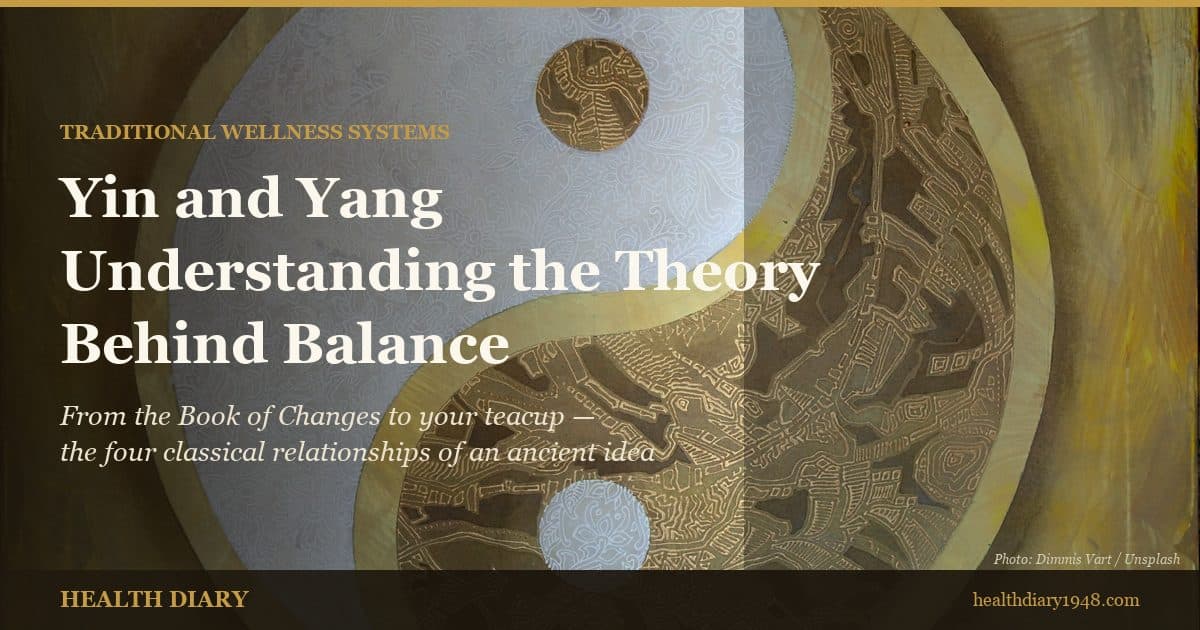
Yin and Yang: Understanding the Theory Behind Balance
Explore yin and yang: where the theory began, what the taijitu symbol shows, the four classical relationships, and how Asian wellness traditions use it.
Medical Disclaimer: This content is for educational and informational purposes only and is not medical advice. Yin and yang are presented here as a cultural and philosophical framework, not as a scientifically verified description of how the body works. The information presented is not intended to diagnose, treat, cure, or prevent any disease. Always consult a licensed healthcare practitioner before starting any new herbal or wellness practice. Statements regarding traditional practices have not been evaluated by the FDA.
Affiliate Disclosure: This article contains affiliate links. We may earn a commission if you purchase through these links, at no additional cost to you. We only recommend products we believe align with our editorial standards.
Few symbols travel as widely as the taijitu — the swirling black-and-white circle most people simply call "the yin yang symbol." It shows up on everything from flags to phone cases, yet the idea behind it is far older and more interesting than its pop-culture afterlife suggests. Yin and yang form one of the oldest conceptual frameworks in Chinese thought: a way of describing how opposite qualities — dark and light, rest and activity, cool and warm — depend on each other, limit each other, and turn into one another.
This article opens our Traditional Wellness Systems series: where yin-yang thinking came from, what the symbol actually shows, the four classical relationships at its heart, and how Asian wellness traditions still use this lens for bodies, foods, and seasons — with an honest look at what yin-yang is (a cultural and philosophical framework) and is not (a proven biological mechanism). Its companion piece on the Five Elements picks up where this one ends.
What Do Yin and Yang Actually Mean?
The words began as landscape descriptions. According to the Internet Encyclopedia of Philosophy's survey of yinyang thought by sinologist Robin R. Wang, the characters appear in oracle bone inscriptions from around the fourteenth century BCE in connection with sunlight and weather. Xu Shen's dictionary (ca. 100 CE) glosses yin (阴) as "closed door, darkness" and yang (阳) as "height, brightness." Their earliest recorded pairing, in the Shijing (Book of Songs), simply describes the shady and sunny sides of the same hill.

That one hill with two faces still captures the core idea. Yin and yang are not substances you can bottle; they are relative qualities that only make sense in pairs. A primer from the Beijing Administration of Traditional Chinese Medicine cites the Ming-era physician Zhang Jingyue's famous compression: "yin-yang is the division of one into two" (阴阳者,一分为二也). Anything can be sorted once you pick a frame of comparison:
- Yin: shade, night, coolness, moisture, rest, descent, the inward and hidden
- Yang: sunlight, day, warmth, dryness, activity, ascent, the outward and visible
Two details are easy to miss. First, the labels are contextual: lukewarm tea is yang next to iced water and yin next to boiling water. Second — and this surprises many first-time readers — classical Chinese thought assigns no moral ranking to the pair. As Wang's survey stresses, there is "no valuational hierarchy": light is not "good" and dark is not "bad." The goal of the framework is balance, not victory.
Where Does Yin-Yang Theory Come From?
The Yijing (Book of Changes) built its sixty-four hexagrams from broken (yin) and solid (yang) lines, turning the pair into a general grammar of change. Daoist classics carried the idea further — chapter 42 of the Laozi pictures all things "carrying yin and embracing yang" — and a dedicated yinyang school flourished in the Warring States period. During the Han dynasty, yin-yang merged with the wuxing (five phases) system we explore in our Five Elements guide, forming the cosmological toolkit later wellness traditions inherited.

The most influential application came in medicine. The Huangdi Neijing (Yellow Emperor's Inner Classic), compiled roughly between the second century BCE and the first century CE, opens its fifth treatise with a famous declaration: 阴阳者,天地之道也,万物之纲纪,变化之父母 — "Yin and yang are the way of heaven and earth, the framework of the ten thousand things, the father and mother of change." From there, the text maps the pair onto seasons, flavors, emotions, and the body, making imbalance between the two its basic vocabulary for describing why a person feels unwell.
What Does the Taijitu Symbol Actually Show?
A historical twist: the symbol is dramatically younger than the idea. Wang's survey notes that no definitive ancient origin exists for the taijitu (太极图, "diagram of the supreme ultimate"). Cosmological diagrams became a scholarly fashion in the Song dynasty (960–1279 CE), associated with the Daoist master Chen Tuan and the philosopher Zhou Dunyi — but the first documented version of the swirling circle we recognize appears in the work of Zhao Huiqian (1351–1395). The familiar form of the world's most famous "ancient" symbol is documented only from the fourteenth century.

Read as a diagram rather than a logo, the taijitu is remarkably precise. The boundary between dark and light is a curve, not a straight line — the two qualities flow into each other rather than confronting each other. Each region swells exactly where the other shrinks, like day turning to night. And each side carries a small dot of its opposite color: within deep rest sits the seed of activity, and vice versa. Nothing, in this view, is purely yin or purely yang.
The Four Classical Relationships Between Yin and Yang
Chinese primers on the theory typically organize yin-yang dynamics into four relationships. They sound abstract at first, but each describes something you have already experienced.
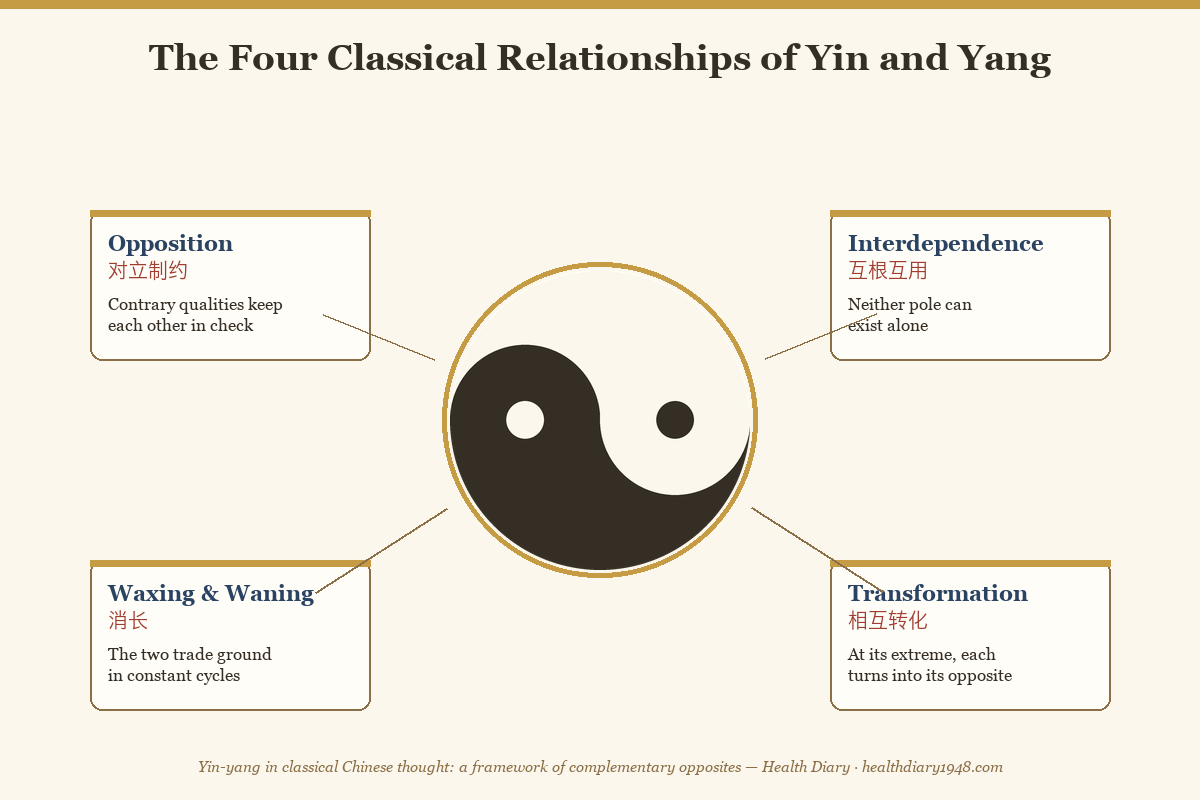
1. Opposition and mutual restraint (对立制约)
Yin and yang are contrary qualities that keep each other in check, the way coolness moderates heat and rest limits exertion. This mutual restraint is what keeps any system — a season, a household, a body — from tipping into extremes.
2. Interdependence (互根互用)
Neither pole can exist alone: "up" means nothing without "down," and you cannot define rest except against activity. Classical texts say yin and yang are each other's root.
3. Waxing and waning (消长)
The two qualities trade ground continuously, like daylight lengthening toward the summer solstice and receding again. Growth on one side is decline on the other, and the ebb and flow itself — not a frozen midpoint — is what "balance" means here.
4. Mutual transformation (相互转化)
Pushed to its extreme, each quality flips into its opposite. The Neijing puts it aphoristically: extreme cold gives rise to heat, and extreme heat gives rise to cold. Midnight is the moment the day begins returning; the peak of summer is the hinge toward autumn.
How Do Traditional Wellness Systems Use Yin and Yang?
Traditional Chinese medicine, Japanese Kampo, and related systems adopted yin-yang as their basic descriptive language — a way of sorting observations about bodies, foods, and weather long before laboratory science existed.
The body. The Neijing describes "clear yang" rising to the head and limbs while "turbid yin" descends into the organs; interior, structure, and fluids read as yin, while surface, function, and warmth read as yang. Someone described as "yang deficient" tends to feel cold and tired; someone "yin deficient" runs hot and restless at night. These are pattern descriptions in a traditional vocabulary — not diagnoses.
Foods and herbs. Traditional food thinking sorts ingredients on a cooling–warming spectrum unrelated to serving temperature. Watermelon, mung bean, and chrysanthemum count as cooling (yin-leaning); ginger, cinnamon, and ginseng as warming (yang-leaning). The Neijing's flavor rule — acrid and sweet flavors disperse outward (yang); sour and bitter flavors drain downward (yin) — sits underneath the cooling foods traditions and cooling herbal teas we have covered elsewhere. A 2018 study in Frontiers in Pharmacology analyzed fifteen herbs classified as "warm" or "cold" and found the sorting partially tracks measurable chemistry, though not antioxidant activity.
Seasons and rhythm. Summer is yang's peak, winter is yin's, and traditional routines adjust — lighter foods and earlier rest in hot months, warming soups and longer sleep in cold ones. Our guides to summer wellness traditions and Asian herbal teas show this logic in action.
Beyond China. The framework traveled with Chinese medicine across East Asia. Japanese Kampo absorbed yin-yang pattern language into its own vocabulary, and Vietnamese tradition speaks of âm and dương, balancing everyday dishes by the same cooling–warming intuition.
What Does Modern Research Say About Yin and Yang?
Honesty matters here: yin and yang are a philosophical classification system, not a verified biological mechanism. No instrument measures "yin," and the framework's claims about the body come from centuries of observation, not controlled experiments.
The U.S. National Center for Complementary and Integrative Health, reviewing traditional Chinese medicine as a whole, reports that mind-body practices such as acupuncture and tai chi may help certain chronic pain conditions and quality of life, while for Chinese herbal products "because many studies have been of poor quality, no firm conclusions can be made about their effectiveness." The theory behind those therapies has been studied even less directly.
Researchers sympathetic to the tradition acknowledge the gap. A 2025 review in the Journal of Traditional Chinese Medical Sciences surveyed attempts to map yin-yang onto redox balance, energy metabolism, and immune regulation, and still concluded that "major gaps persist in mechanistic clarity and the establishment of quantitative metrics." The fairest summary: yin-yang is a culturally rich lens, not a scientific theory — its value today is closer to a proverb than a protocol.
How Some People Apply Yin-Yang Thinking in Daily Life
Stripped of metaphysics, yin-yang works as a gentle audit — where is my life tilted? — useful for noticing lopsided routines.
- Activity and rest. A schedule that is all output (yang) with no recovery (yin) violates the interdependence principle. Slow practices like qigong and tai chi are traditionally framed as cultivating both at once.
- Eating with the seasons. Favoring cooling foods in summer and warming foods in winter is the food-culture expression of waxing and waning — a habit millions follow without naming the theory.
- Tea by time of day. Many traditional tea rituals pair brisker, warming teas with the active morning and gentler infusions with the evening wind-down.
- Evenings as yin time. Dimming lights, slowing pace, and eating lighter at night mirror the framework's advice to let yin rise as the day ends — a rhythm woven through Chinese longevity traditions.
None of this requires believing in qi or memorizing classical Chinese. Individual responses vary considerably; what works for one person may not suit another, and personal experimentation under practitioner guidance is always recommended.
Important Limitations and Considerations
- A lens, not a lab result. Yin-yang is a cultural framework — never a way to self-diagnose or explain away symptoms that deserve medical attention.
- Pattern labels are not diagnoses. Feeling "cold and tired" or "hot and restless" can reflect thyroid conditions, anemia, infection, or other issues a clinician should evaluate.
- Herbal products carry real cautions. NCCIH notes some traditional Chinese herbal products have been found contaminated with undeclared ingredients, heavy metals, or pesticides.
- Medication interactions exist. "Warming" or "cooling" herbs are pharmacologically active plants; anyone taking medication or facing surgery should talk to a clinician first.
- Pregnancy, breastfeeding, and children. Safety data for most traditional herbs in these groups is limited; professional guidance is essential.
- Never delay conventional care. Traditional frameworks can coexist with modern medicine, but they are not substitutes for it.
Frequently Asked Questions
What do yin and yang mean in simple terms?
They are paired labels for opposite, complementary qualities: yin covers the cool, dark, still, inward side of things; yang the warm, bright, active, outward side. The terms originally described the shady and sunny faces of one hill — they only make sense together.
Is the yin and yang symbol religious?
Not inherently. The taijitu grew out of Song-dynasty scholarly diagrams and does appear in Daoist contexts, but yin-yang itself is a general vocabulary used across Chinese medicine, cooking, martial arts, and everyday speech. Most people treat it as cultural, not devotional.
What are yin foods and yang foods?
Traditional food culture sorts ingredients by felt "thermal nature," not serving temperature. Cooling (yin-leaning): watermelon, cucumber, mung bean, chrysanthemum tea. Warming (yang-leaning): ginger, garlic, cinnamon, lamb, ginseng. Modern nutrition does not use these categories, though one 2018 study found the labels partially track chemical composition.
Is yin-yang theory scientifically proven?
No. It is a philosophical classification system, and researchers who study it acknowledge that quantitative validation is still missing. Practices associated with it, like tai chi, have their own clinical evidence, but that evidence does not confirm the underlying theory.
How is yin-yang different from the Five Elements?
Yin-yang divides the world into two complementary qualities; the Five Elements (wuxing) sorts phenomena into five interacting phases — wood, fire, earth, metal, and water. The two merged during the Han dynasty and are usually taught together as the twin grammar of Chinese cosmology.
A Note on Tracking Your Own Balance
If the yin-yang lens appeals to you, the most practical modern translation is paying attention to your own rhythms: when you feel overheated or depleted, how you sleep after active versus restful days, which foods sit well in which seasons. A structured tool like Health Diary can make those patterns visible over months — no metaphysics required, just notes.
A Gentle Closing Note
Yin and yang began as two sides of a hill and grew into East Asia's most durable idea: opposites lean on each other, trade places in cycles, and carry each other's seed. You need not accept it as physiology to appreciate it as wisdom — a reminder, drawn in one curved line, that balance is adjusted, not achieved once. From here, continue with our Five Elements guide to see how this two-part grammar expands into five.
About This Article
Written by: Health Diary Editorial Team — researchers and writers focused on traditional Asian wellness practices and the modern evidence around them.
Editorial review: This article has been reviewed by the Health Diary editorial team for clarity, structure, and adherence to our sourcing standards. Key claims were cross-checked against NCCIH, peer-reviewed literature, and classical Chinese sources. It is not a clinical review and should not replace consultation with a licensed healthcare practitioner.
Reviewed on: July 16, 2026.
Editorial process: We cite peer-reviewed and government sources where possible. When a clinical reviewer is added to this article, attribution will appear here with verifiable credentials.
References
- Wang, R. R. "Yinyang (Yin-yang)." Internet Encyclopedia of Philosophy.
- National Center for Complementary and Integrative Health (NCCIH). "Traditional Chinese Medicine: What You Need To Know."
- Huang, Y., et al. "The Yin-Yang Property of Chinese Medicinal Herbs Relates to Chemical Composition but Not Anti-Oxidative Activity." Frontiers in Pharmacology 9:1304 (2018).
- 北京市中医管理局 (Beijing Administration of Traditional Chinese Medicine). "阴阳的涵义" (The Meaning of Yin-Yang), 2022.
- 《黄帝内经·素问·阴阳应象大论》 (Huangdi Neijing, Suwen ch. 5, "Great Treatise on Yin-Yang Correspondences"), classical text.
- Yang, G., et al. "Yin-yang in modern traditional Chinese medicine: From mechanisms to digital innovation." Journal of Traditional Chinese Medical Sciences 12(4), 2025.


