Traditional Korean Medicine: A Guide to Hanbang Wellness
Explore Traditional Korean Medicine (hanbang) — its history, the Dongui Bogam, Sasang constitutional medicine, Korean acupuncture, herbs, and its place in modern Korea.
Medical Disclaimer: This content is for educational and informational purposes only and is not medical advice. The information presented is not intended to diagnose, treat, cure, or prevent any disease. Always consult a licensed healthcare practitioner before starting any new herbal practice or supplement. Statements regarding traditional herbal use have not been evaluated by the FDA.
Affiliate Disclosure: This article contains affiliate links. We may earn a commission if you purchase through these links, at no additional cost to you. We only recommend products we believe align with our editorial standards.
Introduction: A Living Tradition Beside Modern Medicine
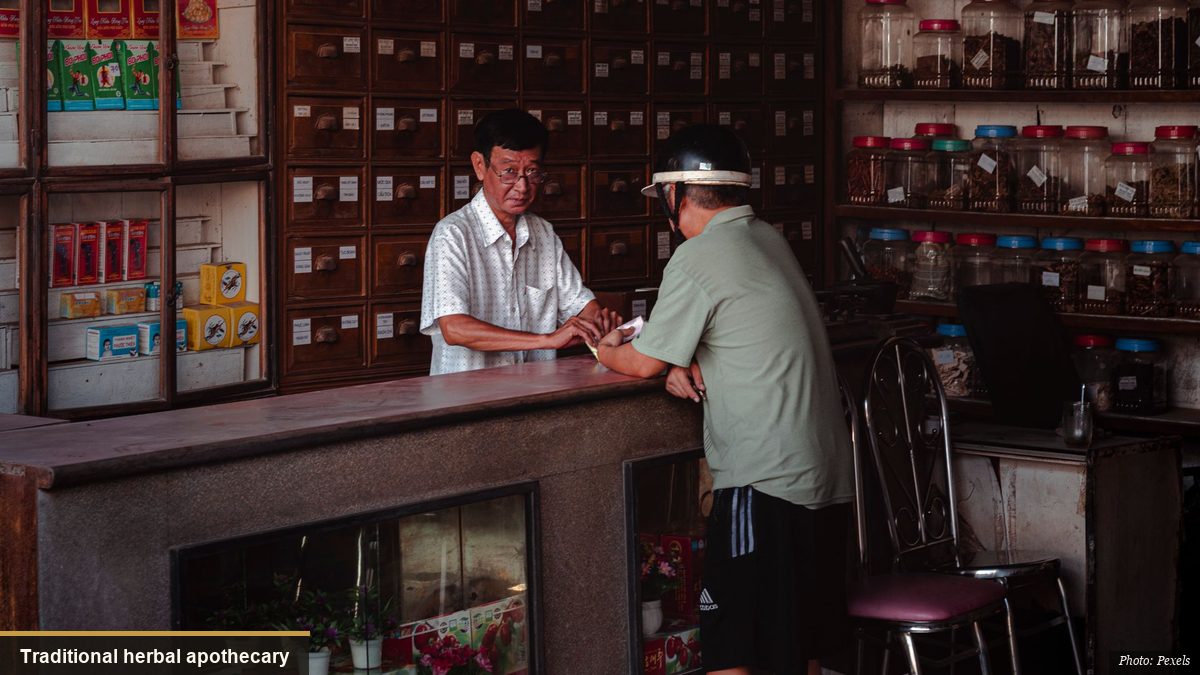
In South Korea, a person feeling run down might visit two very different clinics on the same street. One is a conventional hospital with MRI machines and prescription pads. The other is a Korean medicine clinic, where a licensed practitioner takes the pulse, examines the tongue, asks about temperament and appetite, and may prescribe an herbal decoction or a session of acupuncture. Both are legal, both are covered by the national health insurance system, and both are staffed by professionals who trained for six years to earn their license.
This is Traditional Korean Medicine — known in Korean as hanbang (한방 / 韓方) or, more formally today, hanuihak (한의학 / 韓醫學). It is a wellness tradition that grew from classical Chinese roots but, over many centuries, localized into something recognizably Korean. This guide explores where it came from, what makes it distinct from Chinese and Japanese traditions, its signature contribution of constitutional typology, and how it fits into contemporary Korean life. Throughout, we approach it as a cultural and historical wellness system rather than a set of clinical claims.
What Is Traditional Korean Medicine (Hanbang)?
Traditional Korean Medicine is the indigenous healing tradition of the Korean peninsula, built on the same broad East Asian framework of vital energy, balance, and pattern-based assessment that underlies yin-yang theory and the five elements. Practitioners work with the flow of qi (기, gi) through the body's meridian pathways, and they read the body through observation, pulse, and questioning rather than laboratory tests.
The vocabulary itself tells a story of localization. For most of its history the tradition was written as hanbang using the character 漢 — a reference to China's Han dynasty, much like Japan's Kampo. In 1986, Korean law formally changed the written form to 韓醫學, swapping the character for "Han China" (漢) for the character for "Korea" (韓). It was a small orthographic change with a large symbolic meaning: an official assertion that this tradition, whatever its origins, had become Korea's own.
How Did Korean Medicine Develop Its Own Identity?
Classical Chinese medical learning reached the Korean peninsula more than fifteen hundred years ago and was studied closely for centuries. Yet according to the Encyclopedia of Korean Culture, the peninsula already had its own primitive practices — including stone and bone needling — before Chinese texts arrived, so adaptation rather than wholesale adoption was there from the start.
The decisive move toward independence was the rise of hyangyak (향약 / 鄕藥), meaning "native medicinals." Rather than importing costly Chinese herbs, Korean physicians catalogued the plants growing in their own mountains and fields and worked out how to harvest and prepare them. This effort produced landmark reference works, most notably the Hyangyak Jipseongbang (향약집성방), compiled in 1433 during the reign of King Sejong, and the enormous medical compendium Uibang Yuchwi (의방유취), which ran to hundreds of volumes. By the late Goryeo and early Joseon periods, Korean practitioners were consciously distinguishing their materia medica from China's — a quiet declaration of pharmaceutical self-reliance.
The Dongui Bogam: Korea's Medical Masterwork
No single work embodies this Korean synthesis more than the Dongui Bogam (동의보감 / 東醫寶鑑), often translated as "Principles and Practice of Eastern Medicine." Commissioned by King Seonjo and compiled over roughly sixteen years by the royal physician Heo Jun (허준, 1546–1615), the encyclopedia was completed in 1610 and published in 25 volumes in 1613.
What made the Dongui Bogam revolutionary was its organization. Instead of arranging knowledge by disease, Heo Jun organized symptoms and remedies according to the affected part of the body and its internal landscape, emphasizing prevention and the cultivation of vitality over mere treatment. He also prioritized affordable native hyangyak remedies so that ordinary people, not only the court, could benefit.
In 2009, UNESCO inscribed the Dongui Bogam on its Memory of the World Register — the first medical text ever to receive that recognition. UNESCO noted that it documents medical traditions shared across East Asia while presenting a distinctly Korean systematization, and that it was studied and reprinted for centuries in China and Japan as well as Korea. Four hundred years after its publication, it remains a touchstone reference for Korean medicine practitioners.
What Makes Korean Medicine Different from TCM and Kampo?
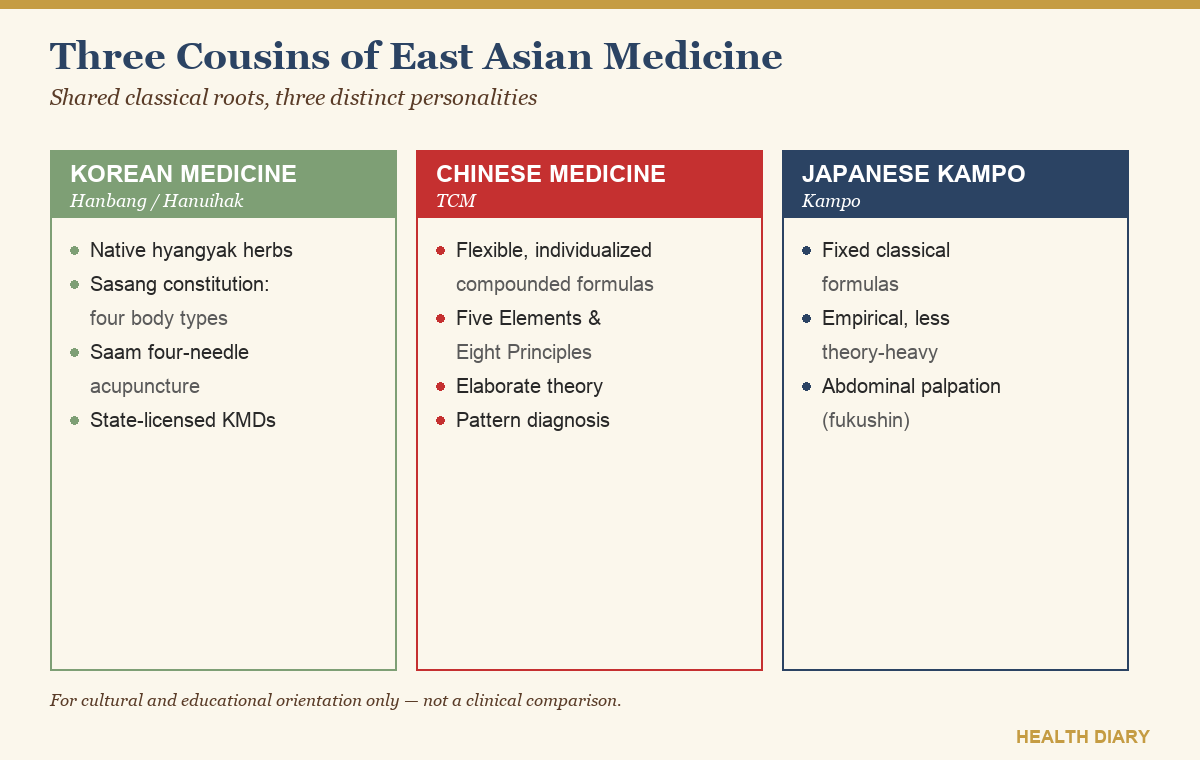
Traditional Korean Medicine, Traditional Chinese Medicine (TCM), and Japanese Kampo are cousins descended from the same classical texts, and they share most of the same herbs and diagnostic vocabulary. But each developed a distinct personality:
- TCM (China) tends toward flexible, highly individualized formulas, compounded fresh for each patient's pattern, within an elaborate theoretical system of the five elements and eight principles.
- Kampo (Japan) moved in the opposite direction, favoring a set of fixed classical formulas and a more empirical, less theory-heavy approach, with distinctive practices like abdominal palpation.
- Korean medicine kept the classical foundation but added its own hyangyak pharmacology, its own acupuncture lineages, and — most distinctively — a system that sorts people into constitutional types and tailors both herbs and diet to those types.
That last feature, constitutional typology, is the single idea most associated with Korean medicine around the world. It deserves its own section.
Sasang Constitutional Medicine: Korea's Signature Idea
Sasang Constitutional Medicine (사상체질의학 / 四象體質醫學) was introduced by the physician and philosopher Lee Je-ma (이제마, 1837–1900) in his 1894 treatise Dongui Susebowon (동의수세보원). Where much of East Asian medicine focuses on the shifting pattern of an illness, Lee proposed that people are born with one of four stable constitutions, and that the same herb, food, or lifestyle can be helpful for one constitution yet unsuitable for another.
A peer-reviewed comparative overview describes the four Sasang types by their organ tendencies and rough population distribution:
- Tae-yang (태양인, "greater yang") — a stronger lung function and weaker liver function; extremely rare in the population.
- Tae-eum (태음인, "greater yin") — a stronger liver and weaker lung; the most common type, roughly half the population.
- So-yang (소양인, "lesser yang") — a stronger digestive (spleen and pancreas) system and weaker kidney function; around a third of people.
- So-eum (소음인, "lesser yin") — a stronger kidney and weaker digestive system; roughly a fifth of people.
A distinctive philosophical point separates Sasang from Chinese tradition. The same comparative review notes that where TCM draws heavily on Taoist harmony with nature, Sasang is rooted in Neo-Confucian thought, with a strongly human-centered outlook that treats emotional temperament as central to health. Lee argued that imbalances of feeling — joy, anger, sorrow, and pleasure — were as important to a person's constitution as any physical sign.
In practice, Sasang divides herbs and foods into groups matched to each constitution, so a practitioner's first task is to identify the person's type before recommending anything. Determining a constitution draws on appearance, voice, temperament, and physical signs, and researchers acknowledge this remains partly subjective — which is why much modern Korean research has gone into building more objective questionnaires and measurements for typing.
Individual responses vary considerably; what suits one person's constitution may not suit another's, and constitutional self-diagnosis is best explored with a qualified practitioner rather than guessed at from a checklist.
Korean Acupuncture Traditions

Acupuncture is one of the most widely used elements of Korean medicine, and Korea developed acupuncture styles that stand apart from the Chinese mainstream. The best known is Saam acupuncture (사암침법), a "four-needle" method attributed to a Buddhist monk-physician who used the pseudonym Saam (舍岩) and is believed to have lived around the 16th to 17th centuries.
As a peer-reviewed clinical overview explains, Saam acupuncture selects just four points from among the classical five-shu (transport) points on the limbs, using five-element relationships to tonify a deficient meridian and drain an excessive one. Its elegance and economy — treating with only a handful of needles — has kept it in active teaching and practice in Korea to this day.
Korea also gave rise to Korean Hand Acupuncture (Koryo Sooji Chim, 고려수지침), a 20th-century micro-system that maps the whole body onto the hands, and to pharmacopuncture, which injects herbal extracts at acupuncture points and was first documented in Korea in the 1960s. According to the U.S. National Center for Complementary and Integrative Health, acupuncture may be helpful for several pain conditions, though it stresses that needles must be sterile and single-use and that treatment should come from a properly trained, licensed practitioner.
Korean Herbs and Everyday Wellness
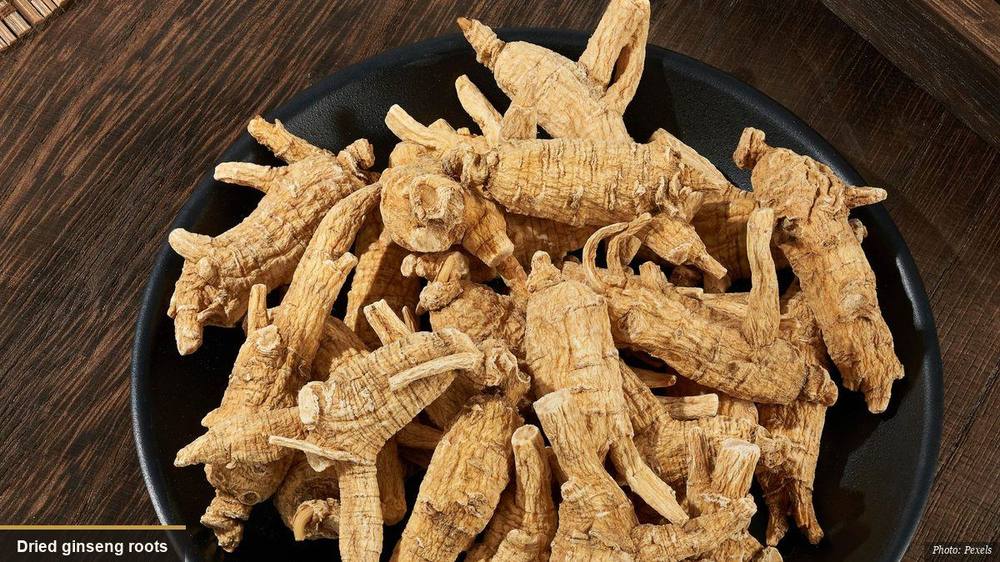
Like its neighbors, Korean medicine keeps one foot in the clinic and one in the kitchen. Several of its most treasured botanicals are woven into daily Korean food and drink, so that "medicine" and "meal" blur together in the tradition of food as everyday self-care.
Korean red ginseng (홍삼, hongsam) is the emblematic Korean herb — steamed and dried Panax ginseng that has been prized on the peninsula for centuries and remains a cornerstone of Korean gift-giving and wellness culture. Omija (오미자), the "five-flavor berry," is brewed into a tart ruby-colored tea said in tradition to carry all five tastes at once. These and other botanicals also appear across Korean tea culture and in the seasonal rhythms of Korean healthy-aging traditions, where warming and nourishing ingredients are chosen to match the season and the person.
Individual responses to herbs vary considerably; those who are pregnant, taking medications, or managing a health condition should consult a qualified healthcare provider before adding herbal preparations to their routine.
How Does Korean Medicine Fit Into Modern Korea?
Perhaps the most striking thing about Korean medicine is its formal, institutional place in one of the world's most technologically advanced healthcare systems. Korea built a dual medical system in the early 1950s, and it has run in parallel ever since. Conventional medicine and Korean medicine each has its own universities, its own national licensing examination, its own hospitals, and its own insurance billing framework.
A Korean Medicine Doctor (KMD, 한의사) completes a six-year university program and a national board examination to practice, entirely separate from the conventional MD track. As documented in the health-services research literature, this separation is enforced in law, and the small but growing number of "dual-licensed" doctors who hold both credentials highlights just how distinct the two professions remain.
The tradition is far from marginal. A nationwide study found that 73.8% of surveyed Koreans had used Korean medicine, with acupuncture the most common service (received by about 90% of users), followed by cupping and moxibustion. In 2017, outpatient Korean-medicine services accounted for roughly 5% of all outpatient medical fees in the country — a substantial share for a traditional system operating inside a modern insurance economy. The Association of Korean Medicine, the profession's national body, represents these licensed practitioners and funds its own policy research institute.
This is coexistence rather than replacement: many Koreans move between the two systems, using conventional medicine for acute and diagnostic needs and Korean medicine for other concerns, a pragmatic pluralism that has become part of everyday Korean life.
Important Limitations and Considerations
Approaching Traditional Korean Medicine responsibly means holding its cultural richness alongside a clear-eyed view of its limits:
- Not a substitute for medical care. Korean medicine is a traditional wellness system, not a replacement for diagnosis and treatment of serious or acute conditions by a licensed physician. Persistent or severe symptoms warrant conventional medical evaluation.
- Herbal quality and interactions. The NCCIH notes that East Asian herbal products have sometimes been found contaminated with heavy metals, undeclared drugs, or the wrong plant, and that herbs may interact with medications such as blood thinners. Source herbs from reputable suppliers and disclose everything you take to your doctor and pharmacist.
- Acupuncture safety. Improperly performed acupuncture can cause infection or injury; only sterile, single-use needles and trained, licensed practitioners should be involved.
- Pregnancy, breastfeeding, and children. Many traditional herbs and practices have not been well studied in these groups; professional guidance is essential.
- Constitutional typing is a traditional framework. Sasang constitution is a cultural classification system, not a validated clinical diagnosis, and typing methods remain partly subjective.
- Individual response varies. What is described here reflects tradition and preliminary research, not guarantees; effects differ from person to person.
Frequently Asked Questions
Is Traditional Korean Medicine the same as Traditional Chinese Medicine?
No, though they are closely related. Both grew from the same classical East Asian texts and share many herbs and concepts, but Korean medicine developed its own native pharmacology (hyangyak), its own acupuncture styles such as Saam, and its own constitutional system (Sasang) that classifies people into four types. Korea also formally recognizes Korean medicine as a distinct licensed profession alongside conventional medicine.
What is hanbang or hanuihak?
Both are Korean names for Traditional Korean Medicine. Hanbang (한방) is the older, everyday term, while hanuihak (한의학) is the more formal academic term. In 1986 the official written form was changed to use the character for "Korea" rather than "Han China," emphasizing the tradition's Korean identity.
What are the four Sasang constitution types?
Sasang Constitutional Medicine, introduced by Lee Je-ma in 1894, sorts people into Tae-yang, Tae-eum, So-yang, and So-eum types based on organ tendencies and temperament. Tae-eum is the most common and Tae-yang the rarest. Herbs and foods are matched to a person's constitution, so identifying the type comes before any recommendation. It is a traditional classification framework rather than a modern clinical diagnosis.
Do Korean medicine doctors need a license?
Yes. A Korean Medicine Doctor (KMD) completes a six-year university degree and passes a national licensing examination, entirely separate from the conventional medical track. Korean medicine services, including acupuncture and herbal medicine, are covered under the national health insurance system.
Is Korean acupuncture different from Chinese acupuncture?
It shares the same foundations but includes distinctly Korean styles. Saam acupuncture uses only four needles chosen through five-element theory, and Korea also developed Korean Hand Acupuncture and pharmacopuncture. As with all acupuncture, safety depends on sterile, single-use needles and a properly trained, licensed practitioner.
Can I explore Korean medicine traditions at home?
The cultural and food-related aspects — enjoying red ginseng, brewing omija tea, and paying attention to seasonal eating — are accessible to anyone curious about Korean wellness traditions. For anything beyond gentle everyday habits, consult a licensed Korean medicine practitioner or your own healthcare provider. Individual responses vary considerably, and professional guidance helps ensure any approach suits your particular situation.
A Note on Everyday Wellness Tracking
One idea Korean medicine and modern wellness share is attentiveness — noticing how your energy, sleep, appetite, and mood shift with the seasons and with what you eat and drink. Whether or not you ever visit a Korean medicine clinic, keeping a simple daily record of these rhythms can help you understand your own patterns over time. Some people explore options like a wellness journal or a habit-tracking routine to make that reflection a gentle daily practice.
A Closing Note
Traditional Korean Medicine is a story of adaptation: a tradition that received classical learning from its neighbors and, over fifteen centuries, made it unmistakably Korean — through the native herbs of hyangyak, the systematizing genius of the Dongui Bogam, the constitutional insight of Sasang, and acupuncture lineages found nowhere else. What is most remarkable is that it did not fade into folklore. It sits today inside a modern insurance system, taught in universities and practiced by licensed doctors, chosen by millions of Koreans as one thread in a pluralistic approach to wellbeing.
Approached with curiosity and honesty — as a cultural heritage rich in observation and philosophy, not a shortcut around modern medicine — Korean medicine offers a fascinating window into how a people have thought about balance, constitution, and the art of living well. This article is educational and does not constitute medical advice; consult a qualified healthcare provider for any health concern.
About This Article
Written by: Health Diary Editorial Team — researchers and writers specializing in traditional Asian wellness traditions and cultural food practices.
Editorial review: This article has been reviewed by the Health Diary editorial team for clarity, structure, and adherence to our sourcing standards. Key claims were cross-checked against NCCIH, NIH PubMed, the UNESCO Memory of the World register, and Korean-language sources including the Encyclopedia of Korean Culture and the Association of Korean Medicine. It is not a clinical review and should not replace consultation with a licensed healthcare practitioner.
Reviewed on: July 17, 2026.
Editorial process: We cite peer-reviewed and government sources where possible. When a clinical reviewer is added to this article, attribution will appear here with verifiable credentials.
References
- Chae H, Lee SJ, Park SH, et al. (2011). Sasang Constitutional Medicine and Traditional Chinese Medicine: A Comparative Overview. Evid Based Complement Alternat Med. PMC3176432
- Ku B, et al. (2022). Factors influencing use of conventional and traditional Korean medicine-based health services: a nationwide cross-sectional study. PMC9208109
- Kim KJ, et al. (2015). A Modern Clinical Approach of the Traditional Korean Saam Acupuncture. Evid Based Complement Alternat Med. PMC4619944
- Kim MJ, et al. (2013). Medical Practices and Attitudes of Dual-Licensed Medical Doctors in Korea. Evid Based Complement Alternat Med. PMC3576794
- National Center for Complementary and Integrative Health. Acupuncture: Effectiveness and Safety. nccih.nih.gov
- National Center for Complementary and Integrative Health. Traditional Chinese Medicine: What You Need To Know. nccih.nih.gov
- The UNESCO Courier (2013). Donguibogam, precious book of Korean medicine. courier.unesco.org
- 한국민족문화대백과사전 (Encyclopedia of Korean Culture). 한의학. encykorea.aks.ac.kr
- Association of Korean Medicine (대한한의사협회). akom.org