
Complete Guide to Ginger: Root of Asian Wellness Tradition
A complete guide to ginger (Zingiber officinale): its botany, pan-Asian history, traditional forms, gingerol and shogaol compounds, research, uses, and safety.
Medical Disclaimer: This content is for educational and informational purposes only and is not medical advice. The information presented is not intended to diagnose, treat, cure, or prevent any disease. Always consult a licensed healthcare practitioner before starting any new herbal practice or supplement. Statements regarding traditional herbal use have not been evaluated by the FDA.
Affiliate Disclosure: This article contains affiliate links. We may earn a commission if you purchase through these links, at no additional cost to you. We only recommend products we believe align with our editorial standards.
Few plants have travelled as far, or embedded themselves as deeply into daily life, as ginger. The knobby, aromatic rhizome of Zingiber officinale turns up in a winter tea cup in Hanoi, a postpartum soup pot in Guangzhou, a strip of pale pink pickle beside sushi in Tokyo, and a spice jar in nearly every kitchen on earth. It has been prized for well over 2,000 years, carried along the Silk Road and the medieval spice routes, and woven into the traditional wellness systems of China, Vietnam, Japan, Korea, and India — usually for strikingly similar reasons.
This complete guide is the hub of our Ginger cluster. It steps back to look at the whole plant: where ginger comes from botanically, how it spread across Asia and the world, how traditional practices classify its different forms, what its aromatic compounds actually are, what modern research has begun to suggest, and how people prepare and enjoy it today. Along the way we point you toward our more detailed companion articles — on ginger across Asian traditions, traditional ginger tea, and ginger chicken soup — so you can dive deeper wherever your curiosity leads. Individual responses to any herbal ingredient vary considerably, and the practices described here reflect cultural tradition rather than clinical guidance.
What Is Ginger, Botanically Speaking?
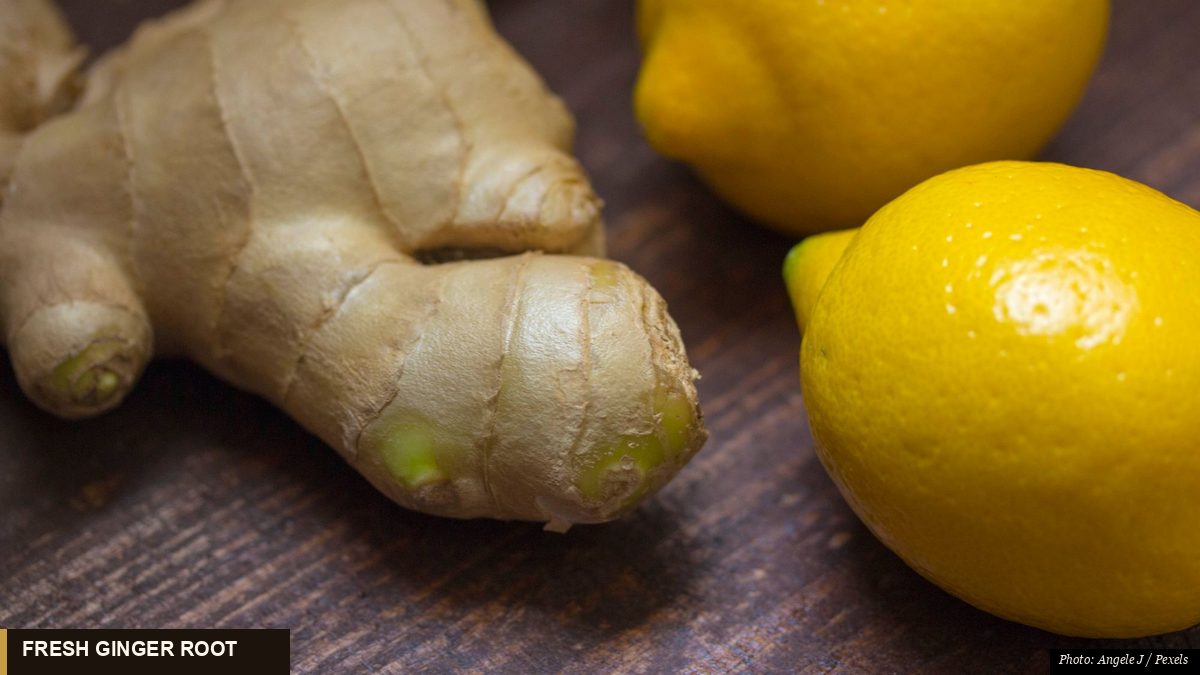
Ginger is the underground stem — the rhizome — of Zingiber officinale Roscoe, a leafy perennial in the family Zingiberaceae. What most people call the ginger "root" is not a true root at all but a rhizome: a horizontal, branching stem that grows just below the soil surface and stores the plant's aromatic oils. Its distinctive palmate, antler-like shape gave ginger its oldest recorded name, the Sanskrit shringavera, meaning "shaped like the horn of a stag."
The Zingiberaceae family is a treasure chest of culinary and traditional aromatics. Ginger's close relatives include turmeric (Curcuma longa), galangal (Alpinia galanga), cardamom, and fingerroot — a botanical kinship that explains why ginger and turmeric so often appear together in warming preparations such as the golden turmeric-ginger drinks found across Asia. All share a similar growth habit and a family resemblance in their pungent, resinous character.
The plant thrives in warm, humid, partially shaded conditions and is propagated not from seed but from pieces of rhizome. It is believed to have originated in Maritime Southeast Asia, likely first domesticated by Austronesian peoples before spreading into the Indian subcontinent, where it entered the written record early. Today ginger no longer exists in a truly wild form — a sign of just how long humans have cultivated it.
How Did Ginger Spread Across Asia and the World?
Ginger's journey is one of the great stories in the history of food. From its Southeast Asian and South Asian origins, it reached China by roughly 400 BCE, where it entered one of the earliest written records of East Asian food culture. The Analects of Confucius famously note that the sage "was never without ginger when he ate" — a passage scholars read as evidence that ginger was already a fixed part of the Chinese table during the Spring and Autumn period.
From China and India, ginger moved west through Arab trading networks, reaching the Mediterranean world by the first century CE. By the medieval period it had become one of the most valuable commodities in global commerce, historically second only to pepper in trade volume. It was among the first Asian spices to reach the Americas during the age of exploration. For a fuller telling of this trade history and the distinct culinary cultures it seeded, see our companion piece on ginger in Asian traditions.
What is remarkable is that everywhere ginger travelled, it was adopted for a similar cluster of purposes: as a warming ingredient, a digestive aid at the table, and a flavor that could tame the strong taste of fish and meat in the era before refrigeration. This convergence — different cultures independently reaching for the same root for the same reasons — is a recurring theme in the study of traditional Chinese herbal traditions and their neighbors.
How Do Traditional Practices View Ginger?
In traditional East Asian wellness frameworks, ginger is a foundational warming ingredient — one of the clearest examples of the yin-yang principle of balancing warming and cooling influences in the body. Where cooling foods are reached for in heat and damp, ginger sits firmly on the warming side of the ledger, which is why it features so heavily in warming winter foods and cold-weather drinks.
What many Western readers do not realize is that traditional Chinese practice does not treat "ginger" as a single ingredient. It recognizes several distinct forms, each with its own character and use. According to the Guangdong Museum of Traditional Chinese Medicine, affiliated with Guangzhou University of Chinese Medicine, the ginger family of remedies divides into at least four members:
- Sheng jiang (生姜, fresh ginger) — pungent and slightly warm; traditionally associated with releasing exterior wind-cold, warming the middle, easing nausea, and transforming phlegm. Considered the form for surface-level chills and digestive upset.
- Gan jiang (干姜, dried ginger) — hotter and more intensely warming; traditionally used for deeper internal cold, warming the middle and, in classical language, "restoring yang and unblocking the vessels."
- Pao jiang (炮姜, roasted dried ginger) — said to "enter the blood level," traditionally associated with warming the channels and settling certain patterns of cold-type bleeding and abdominal ache.
- Wei jiang (煨姜, ginger roasted in ash) — milder and more moderate in character, traditionally leaned on mainly to warm the middle and calm nausea.
This four-form taxonomy is not unique to China. Vietnamese traditional medicine, documented by institutions such as Nguyen Tri Phuong Hospital in Ho Chi Minh City, recognizes a parallel set: sinh khương (fresh), can khương (dried), bào khương (processed-dried, to warm the Spleen and Stomach), and thán khương (charred). The independent survival of essentially the same classification in two neighboring pharmacopeias speaks to how carefully these distinctions were observed. If you enjoy this kind of systems thinking, our guide to the five elements theory explores the broader logic behind it.
Japan inherited the same distinction through kampo (traditional Japanese herbal medicine). In kampo, fresh ginger (shokyo, 生姜) and dried ginger (kankyo, 乾姜) are treated as separate crude drugs — and ginger of one form or another appears in more than half of all classical kampo formulas, according to the pharmacist-authored wellness resource published by Yomeishu.
What Are the Active Compounds in Ginger?
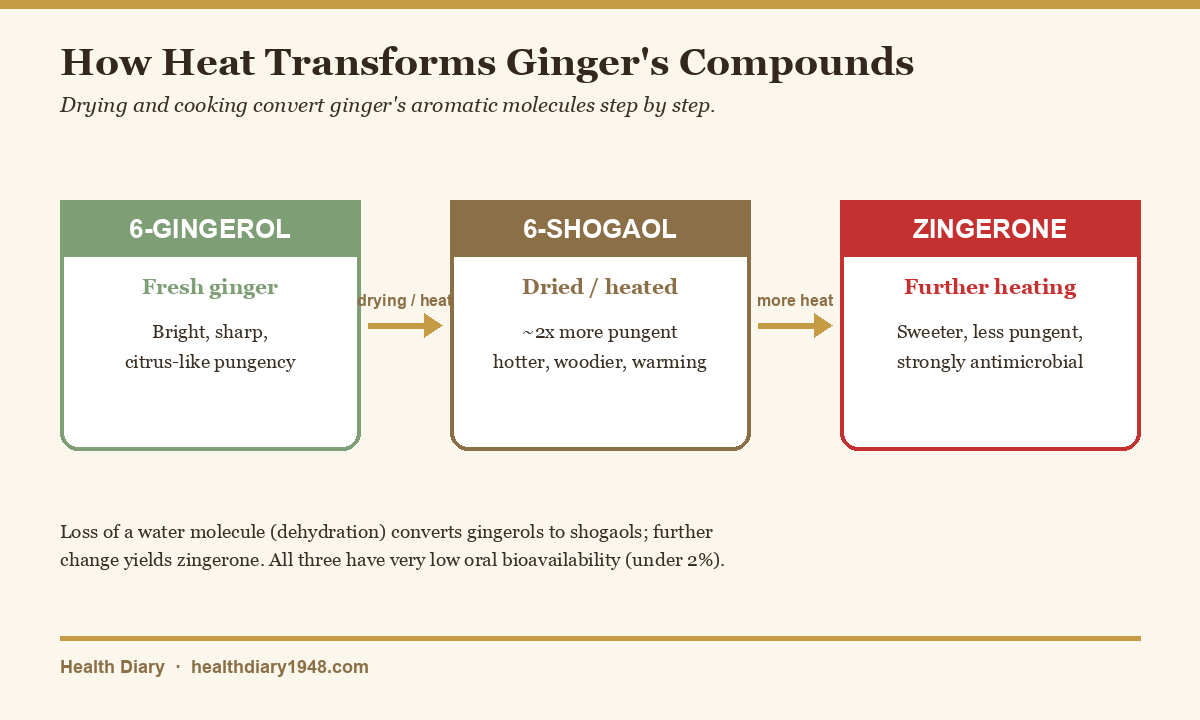
Ginger's warmth and pungency come from a family of oily aromatic molecules, and understanding them explains why fresh and dried ginger behave so differently. The story centers on three related compounds: gingerols, shogaols, and zingerone.
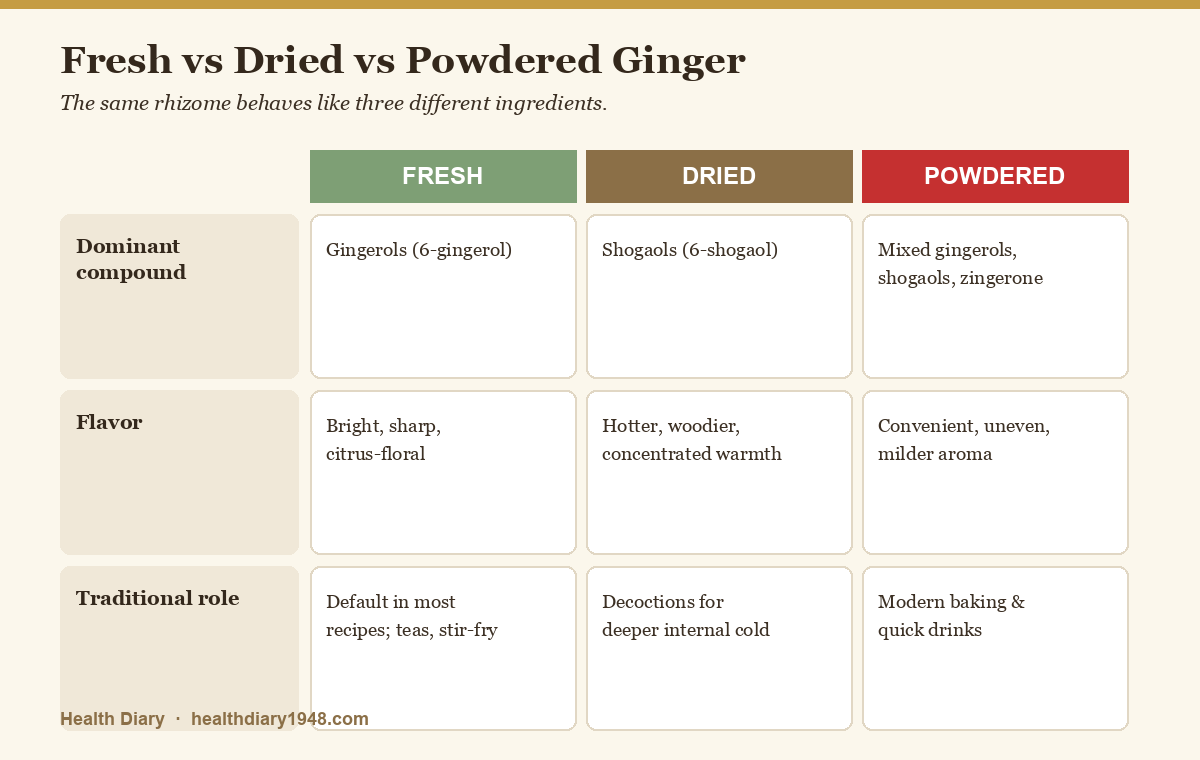
Fresh ginger is dominated by gingerols, especially 6-gingerol, the source of its bright, sharp, faintly citrusy bite. When ginger is dried or heated, a chemical change takes place: gingerols lose a water molecule and convert into shogaols. A 2025 study on the thermal processing of ginger describes how 6-gingerol dehydrates — losing the hydroxyl group at the C-5 position and forming a new double bond — to become 6-shogaol, and how shogaol content rises as temperature and time increase while gingerol content falls. Shogaols are roughly twice as pungent as their gingerol precursors, which is exactly why dried ginger tastes hotter, deeper, and more penetrating than fresh.
Push the heat further and a third compound, zingerone, appears — sweeter and less pungent, and noted in Japanese sources for its strong antimicrobial character. Research published in Frontiers in Pharmacology in 2024 mapped the interconversion of these molecules and found that the conversion of 6-gingerol into 6-shogaol is strongly favored over the reverse, and that 6-gingerol can also cleave into zingerone. Tellingly, that same study reported that all three compounds have very low absolute oral bioavailability — under 2 percent — because they are lipophilic and heavily processed on their first pass through the body. That single figure is a useful reality check: ginger is a food and a flavor first, and its effects on the body are gentle and traditional rather than pharmaceutical.
What Is the Difference Between Fresh, Dried, and Powdered Ginger?
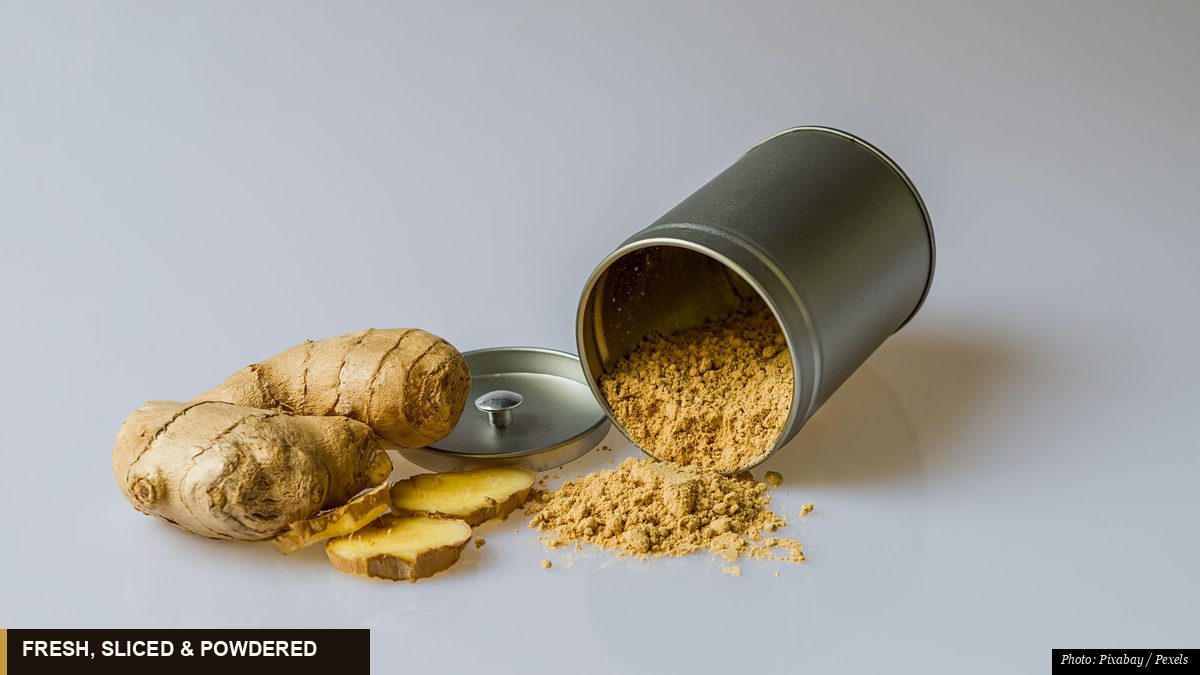
Because of that compound chemistry, the three everyday forms of ginger are genuinely different ingredients — a point traditional recipes have always understood, even without the molecular vocabulary.
- Fresh ginger is juicy and gingerol-rich, with a bright, sharp, citrus-floral pungency. It is the form most Asian recipes mean by default — sliced for tea, grated into marinades, julienned into stir-fries.
- Dried ginger is more shogaol-rich, and therefore hotter and woodier, with a concentrated, warming depth. Traditional Chinese and Vietnamese practice reserves it largely for decoctions aimed at deeper internal cold.
- Powdered ginger carries a mixed profile of gingerols, shogaols, and zingerone depending on how it was processed and dried. It is a modern convenience most associated with baking and quick drinks rather than classical preparations.
The Japanese practical rule captures the tradition neatly: reach for raw ginger in the heat of summer, when its lighter, circulation-promoting character suits the season, and cook or simmer ginger for at least several minutes in winter, when the warming shogaol-forward profile is wanted. For a deeper cultural tour of these forms across five countries, see our detailed guide to ginger in Asian traditions.
What Does the Research Say About Ginger?
Ginger is one of the more heavily studied culinary botanicals, and it is worth being clear-eyed about what that research does and does not show. A comprehensive systematic review published in 2020 gathered 109 randomized controlled trials on ginger and human health — but found that only 43 of them (about 39 percent) met the bar for high-quality evidence, a reminder that "widely studied" is not the same as "definitively proven."
The area with the most consistent signal is nausea and vomiting. The U.S. National Center for Complementary and Integrative Health (NCCIH) states that research suggests ginger may be helpful for nausea and vomiting associated with pregnancy, while noting that evidence for motion sickness is more limited and results for chemotherapy-related and post-surgical nausea are less certain. Memorial Sloan Kettering Cancer Center similarly reports that some studies support the short-term use of ginger for chemotherapy-associated nausea but cautions that larger studies are needed to confirm the effect. Proposed mechanisms include stimulation of saliva, bile, and gastric secretions and possible activity at serotonin (5-HT3) receptors.
Beyond nausea, several meta-analyses have looked at other areas with more mixed results:
- Menstrual discomfort: A 2016 meta-analysis of oral ginger for primary dysmenorrhea found ginger more effective than placebo for pain (a weighted mean difference of about 1.55 cm on a 10 cm scale), with no significant difference from the NSAID mefenamic acid — though the authors rated the overall evidence quality as low.
- Blood-sugar measures: A 2018 meta-analysis of 10 trials in people with type 2 diabetes reported reductions in fasting blood glucose and HbA1c with ginger, framing it cautiously as a possible adjuvant rather than a treatment.
- Osteoarthritis: NCCIH notes that oral ginger supplements may offer modest benefit for knee osteoarthritis symptoms, but much of the research has been of variable quality.
The honest summary is that ginger shows genuine promise in a few areas — pregnancy-related nausea most of all — but that study sizes are often small, methods inconsistent, and firm conclusions premature. None of this changes ginger's centuries-old standing as a comforting food; it simply means the science is still catching up to the tradition.
How Do People Prepare and Enjoy Ginger?
The genius of ginger is its versatility. The same rhizome becomes a drink, a soup, a pickle, a candy, and a background aromatic — often within a single household's week. Here is the landscape, with pointers to our deeper how-to guides.
Teas and Warm Drinks
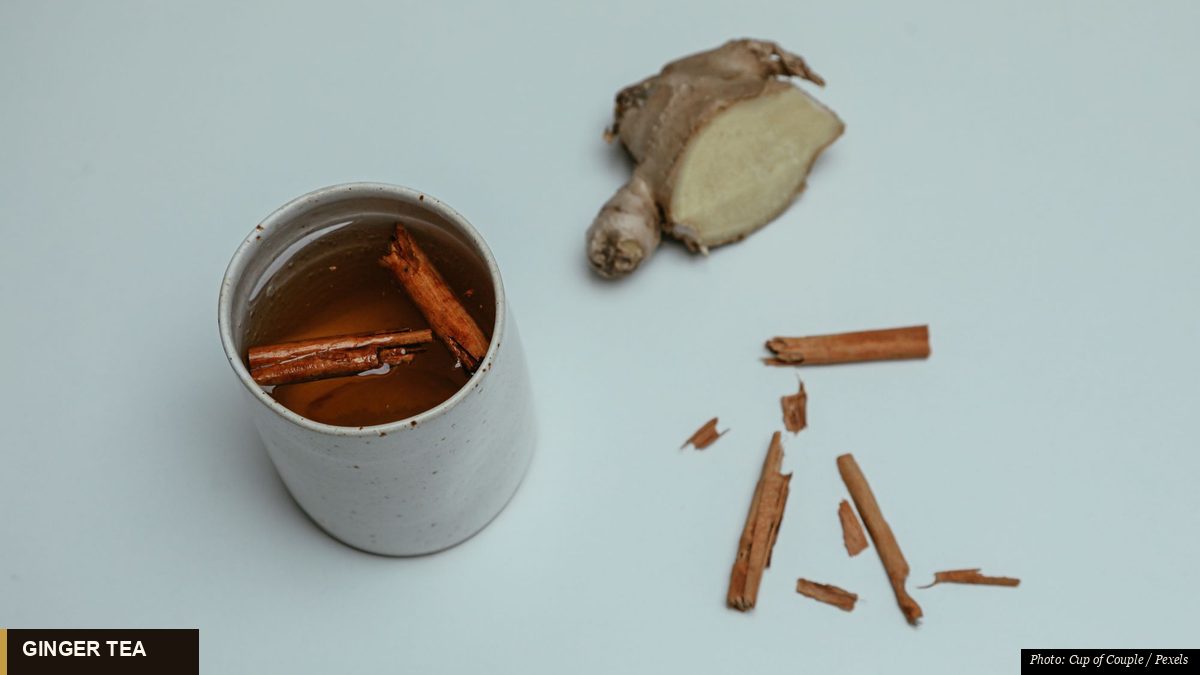
The single most universal preparation is ginger tea: fresh slices simmered in water, usually sweetened with honey, brown sugar, or rock sugar. Chinese hong tang jiang cha (brown sugar ginger tea), Korean saenggang-cha, Japanese shoga-yu, and Vietnamese rock-sugar ginger tea are regional variations on one warming idea. Ginger also pairs beautifully with other botanicals — with jujube in red date tea, and as part of the broader repertoire of winter tea traditions and daily herbal tea rituals across Asia. Our dedicated ginger tea guide walks through the simmer-versus-steep methods in detail.
Soups and Savory Cooking
Ginger anchors countless warming soups — from Chinese postpartum recovery broths to Korean chicken soups and Vietnamese braises. Our guide to ginger chicken soup across Asian traditions explores this in depth, and ginger appears throughout the wider world of traditional Vietnamese herbal soups. As an everyday aromatic, ginger is sliced, smashed, or grated into stir-fries, marinades, and braises, where it both flavors the dish and tempers strong-tasting proteins.
Pickles and Preserves
Japan turned ginger preservation into an art form. Gari, the pale pink pickled young ginger served with sushi, and beni shoga, the crimson salt-pickled ginger heaped on street foods, are the world's most recognizable ginger pickles. Elsewhere, candied and crystallized ginger — sugar-preserved slices with a chewy, spicy sweetness — remains a beloved treat and travel companion.
Whichever preparation you try, remember that ginger's warming intensity lands differently for everyone. In traditional frameworks, people with strong internal heat patterns are counseled to use it more sparingly. Individual responses vary considerably; what works well for one person may not suit another, and personal experimentation under practitioner guidance is always recommended.
Important Limitations and Considerations
Ginger has an extensive record of safe culinary use, but concentrated preparations and supplements deserve real caution. Keep the following in mind:
- Blood thinners and bleeding risk: Ginger inhibits platelet aggregation, and Memorial Sloan Kettering notes that high doses may increase bleeding risk when combined with anticoagulants such as warfarin, with case reports of serious complications. If you take blood thinners, speak with your healthcare provider before using concentrated ginger.
- Surgery: Because of that same effect on clotting, MSK advises stopping concentrated ginger roughly two weeks before scheduled surgery. Always disclose herbal use to your surgical team.
- Diabetes and blood-pressure medication: Ginger may lower blood sugar and interact with diabetes and blood-pressure medicines, so combined use should be monitored by a provider.
- Gallstones: Because ginger may increase bile flow, some practitioners advise those with gallstones to be cautious with concentrated amounts.
- Pregnancy and breastfeeding: NCCIH notes that ginger dietary supplements may be safe in pregnancy but advises consulting a provider first, especially at higher doses; safety during breastfeeding is not well established.
- Digestive sensitivity: In some people, ginger can cause heartburn, abdominal discomfort, diarrhea, or throat irritation, particularly at higher doses.
- Food versus supplement: Everyday culinary ginger in tea and cooking is a very different context from concentrated capsules. The traditions in this guide describe food and beverage use, not pharmaceutical dosing, and individual responses vary considerably.
Frequently Asked Questions
Can I drink ginger tea every day?
Many people enjoy a cup of ginger tea daily as part of a general wellness routine, and traditional practice tends to favor moderate, consistent use over large occasional doses. That said, individual responses vary. If you take blood thinners, diabetes medication, or blood-pressure medicine, or if you have gallstones, check with a healthcare provider before making strong ginger tea a daily habit.
Does ginger interact with any medications?
Yes. Ginger may interact with blood-thinning medications such as warfarin, and with medications for diabetes and blood pressure. According to NCCIH and Memorial Sloan Kettering, concentrated ginger can increase bleeding risk with anticoagulants. If you take any of these, talk with your doctor before adding concentrated ginger or ginger supplements to your routine.
Is fresh ginger stronger than dried ginger?
It depends on what you mean by "stronger." Fresh ginger has a brighter, sharper flavor driven by gingerols. Drying converts much of that gingerol into shogaol, which is about twice as pungent — so dried ginger is actually hotter and more intensely warming, just with a deeper, woodier character. Traditional practice treats the two as different ingredients for exactly this reason.
What is the difference between sheng jiang, gan jiang, and pao jiang?
These are the three main forms of ginger in traditional Chinese practice. Sheng jiang is fresh ginger, used for surface chills and nausea; gan jiang is dried ginger, hotter and used for deeper internal cold; and pao jiang is roasted dried ginger, traditionally associated with warming the channels. Vietnamese and Japanese traditions recognize essentially the same distinctions.
Is ginger safe during pregnancy?
Ginger is among the most-studied natural approaches for pregnancy-related nausea, and NCCIH notes that ginger dietary supplements may be safe during pregnancy. However, safety can depend on dose and form, and evidence during breastfeeding is limited, so it is important to consult your healthcare provider before using ginger supplements while pregnant.
What does ginger taste like, and how do I mellow it?
Fresh ginger is sharp, warm, and citrusy with a peppery bite; dried ginger is hotter and woodier. To soften it, simmer sliced ginger with a sweetener such as honey, rock sugar, or brown sugar, or pair it with jujube, lemongrass, or turmeric. Cooking also rounds out the sharpness by converting some gingerol to mellower compounds.
Can ginger and ginseng be used together?
They are different plants with different traditional roles — ginger is a warming aromatic rhizome, while ginseng is a tonic root explored in our complete guide to ginseng. They appear together in some traditional recipes, but because both can interact with medications, anyone combining concentrated forms should do so with practitioner guidance.
A Note on Tracking Your Own Experience
Because ginger's effects are gentle and highly individual, the most useful thing you can do is pay attention to your own response over time. Some people find a warm cup of ginger tea genuinely comforting on a cold morning or an unsettled stomach; others find strong ginger too heating. Keeping a simple record — what form you used, how much, when, and how you felt afterward — turns vague impressions into something you can actually learn from. This is exactly the kind of gentle self-observation the Health Diary app is designed to make easy, helping you notice patterns in how traditional foods and rituals fit your own routine.
A Soft Closing Note
Ginger endures not because of any single dramatic property but because it is so many things at once: a flavor, a warming comfort, a kitchen workhorse, and a thread connecting cuisines from Guangzhou to Osaka to Hanoi. Its story is a reminder that the most treasured wellness traditions are usually the ones woven quietly into everyday life. If you would like to explore further, a good next step is simply to brew a pot of fresh ginger tea and notice how it feels — then follow our companion guides on ginger tea, ginger soups, and ginger across Asian cultures to go deeper into this remarkable rhizome's 2,000-year tradition.
About This Article
Written by: Health Diary Editorial Team — a team of wellness writers and researchers specializing in traditional Asian herbal and culinary practices.
Editorial review: This article has been reviewed by the Health Diary editorial team for clarity, structure, and adherence to our sourcing standards. Key claims were cross-checked against NCCIH, Memorial Sloan Kettering, NIH PubMed, and peer-reviewed phytochemistry and clinical literature, alongside native-language traditional sources in Chinese, Vietnamese, and Japanese. It is not a clinical review and should not replace consultation with a licensed healthcare practitioner.
Reviewed on: August 3, 2026.
Editorial process: We cite peer-reviewed and government sources where possible. When a clinical reviewer is added to this article, attribution will appear here with verifiable credentials.
This article reflects traditional Asian cultural practices around ginger. It is not medical advice.
References
- Anh NH, et al. Ginger on Human Health: A Comprehensive Systematic Review of 109 Randomized Controlled Trials. Nutrients. 2020.
- Interconversion Pharmacokinetics and Oral Bioavailability of the Major Ginger Constituents [6]-Gingerol, [6]-Shogaol, and Zingerone. Frontiers in Pharmacology. 2024.
- Effect of Thermal Processing by Spray Drying on Key Ginger Compounds. PMC12195494. 2025.
- Chen CX, et al. Efficacy of Oral Ginger for Dysmenorrhea: A Systematic Review and Meta-Analysis. Evidence-Based Complementary and Alternative Medicine. 2016.
- Effects of Ginger on Type 2 Diabetes Mellitus and Components of the Metabolic Syndrome: A Systematic Review and Meta-Analysis of Randomized Controlled Trials. PMC5818945. 2018.
- National Center for Complementary and Integrative Health (NCCIH). Ginger. U.S. Department of Health and Human Services. Accessed August 2026.
- Memorial Sloan Kettering Cancer Center. Ginger — Integrative Medicine, About Herbs. Accessed August 2026.
- 广东中医药博物馆 (Guangdong Museum of Traditional Chinese Medicine). 姜类中药功效对比:生姜、干姜、炮姜、煨姜. (Native Chinese source.) Accessed August 2026.
- Bệnh viện Nguyễn Tri Phương. 4 vị thuốc từ gừng và ứng dụng trong y học cổ truyền. (Native Vietnamese source.) Accessed August 2026.
- 養命酒製造 (Yomeishu). 生姜の効果・効能とは?生と加熱で変わる効果を薬剤師が解説. (Native Japanese source.) Accessed August 2026.


