

Traditional Japanese Herbal Traditions: Kampo & Wellness
A pillar guide to traditional Japanese herbal traditions: Kampo history, fukushin diagnosis, ki-ketsu-sui, signature herbs and formulas, yakuzen, and Japanese tea culture.
Medical Disclaimer: This content is for educational and informational purposes only and is not medical advice. The information presented is not intended to diagnose, treat, cure, or prevent any disease. Always consult a licensed healthcare practitioner before starting any new herbal practice or supplement. Statements regarding traditional herbal use have not been evaluated by the FDA.
Affiliate Disclosure: This article contains affiliate links. We may earn a commission if you purchase through these links, at no additional cost to you. We only recommend products we believe align with our editorial standards.
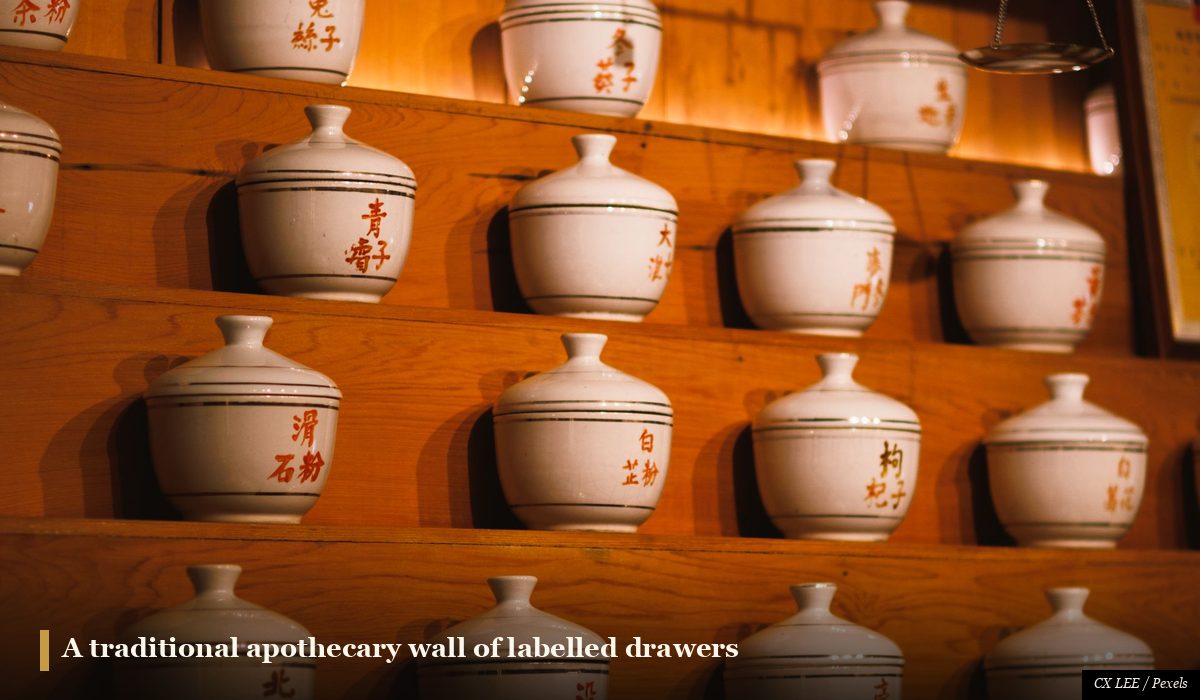
Step into an old Japanese kampo pharmacy and the mood is unmistakably calm and orderly: rows of labelled paper packets, neat tins of dried root and bark, a set of small brass scales, and a practitioner who begins not by asking where it hurts but by gently pressing on your abdomen. That quiet, hands-on moment captures something essential about traditional Japanese herbal traditions. They grew from the same Chinese soil as the rest of East Asian herbalism, yet over centuries of island isolation they were pruned, standardized, and reshaped into something distinctly Japanese — practical, precise, and unusually well integrated with modern medicine.
This guide is a map of that whole landscape. It traces where Japanese herbalism came from, the ideas that organize it, how it quietly parted ways with Chinese medicine, the herbs and formulas at its core, and the everyday food and tea rituals that keep it alive in modern kitchens. Along the way it links out to deeper articles on the individual herbs, teas, and concepts that make up the wider system, so you can follow whichever thread draws you in. Think of this page as the trunk of the tree; the linked guides are the branches.
What Are Traditional Japanese Herbal Traditions?
The heart of Japanese herbal medicine is Kampo (漢方, sometimes written wa-kanpo), a system of standardized herbal formulas that has been practiced in Japan for well over a thousand years and is today woven directly into the country's mainstream healthcare. The word itself tells a story: kan (漢) means “Han Chinese,” and po/ho (方) means “method” or “formula.” The name was coined during the Edo period specifically to distinguish this older herbal tradition from Ranpo (蘭方), the “Dutch method” of Western medicine arriving through the port of Nagasaki.
At its core, Kampo regards the body as an integrated whole whose health depends on smooth, balanced circulation rather than on isolating and attacking a single symptom. A practitioner reads the pattern of the whole person — energy, digestion, sleep, temperature, and the feel of the abdomen — and selects a formula intended to restore equilibrium. For a focused overview of the clinical system itself, our companion article on Kampo and traditional Japanese wellness walks through its concepts in more depth; this hub steps back to show how Kampo, food, and tea together form one continuous culture of care.
What makes the Japanese expression of this shared East Asian heritage distinctive comes down to a few threads we will follow through the rest of this article: a history of deliberate simplification during centuries of isolation, a signature diagnostic method found nowhere else in quite the same form, a compact theory of three circulating substances, and a food-and-tea culture that carries these ideas into daily life. Understanding those threads is the fastest way to appreciate why Japanese herbal traditions feel different from their Chinese and Korean cousins.
How Did Kampo Grow Its Own Roots in Edo Japan?
Chinese medicine first reached Japan in the fifth and sixth centuries, traveling with Buddhism and other continental culture across the Korean peninsula, and then more directly through the Kenzuishi and Kentoshi diplomatic missions of the seventh century. For a long time, what was practiced in Japan closely followed Chinese texts and theory.
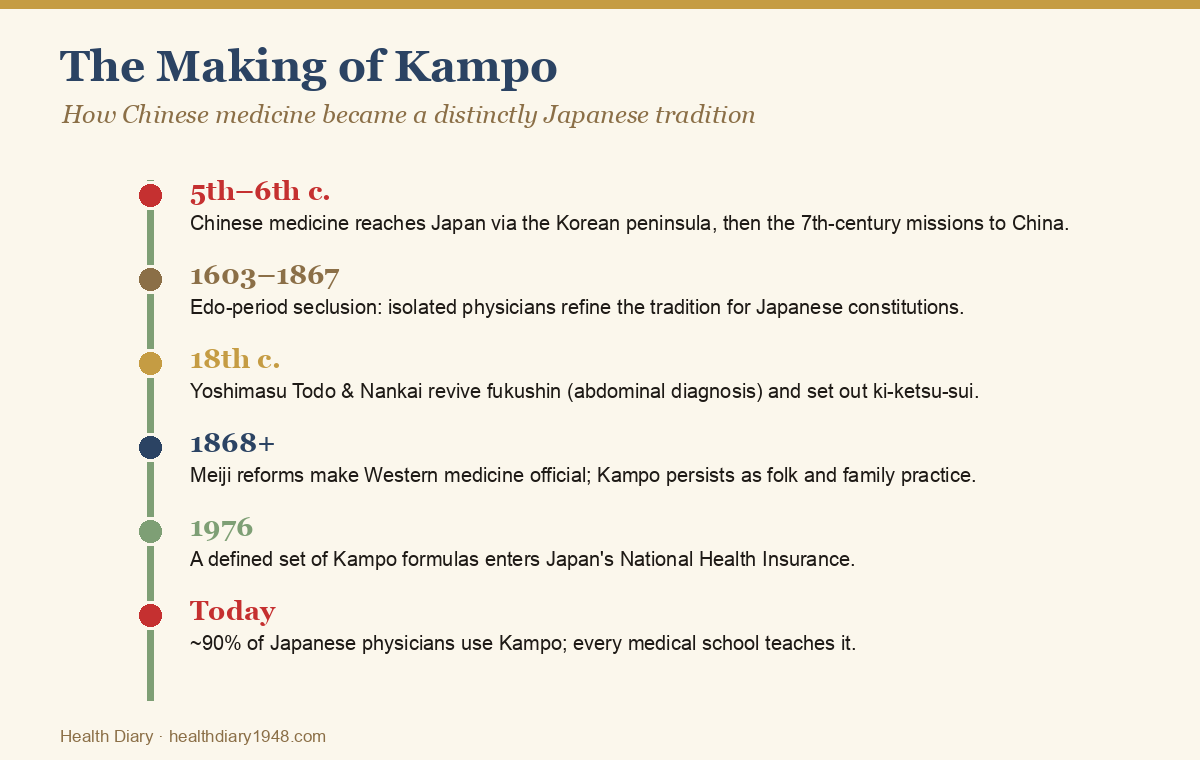
The great divergence came during the Edo period (1603–1867), when Japan's policy of national seclusion largely cut the country off from the Asian mainland. Isolated from a steady stream of Chinese scholarship, Japanese physicians began refining the tradition around their own climate, constitutions, and sensibilities. An influential movement called the Kohoha, or “Ancient Formula School,” rejected what it saw as over-abstract later theory and returned to the oldest classical text, the Shang Han Lun (傷寒論, “Treatise on Cold Damage”), prizing formulas that could be tied directly to observable signs.7 In the process, the sprawling Chinese materia medica of thousands of substances was gradually distilled down to a working core of roughly three hundred crude drugs combined into a few hundred standardized prescriptions.1
Two figures anchor this era. The physician Yoshimasu Todo (吉益東洞, 1702–1773) insisted that clinical decisions rest on what could actually be observed in the patient rather than on theory alone, and championed the classical formulas. His son Yoshimasu Nankai (吉益南涯, 1750–1813) softened that austerity and set out the ki-ketsu-sui theory of three circulating substances, while helping develop the abdominal diagnosis that would become Kampo's hallmark.7 Understanding this history matters because it explains the character of Japanese herbal culture today: pragmatic, standardized, evidence-curious, and comfortable sitting alongside modern medicine rather than in opposition to it.
How Is Kampo Different from Chinese Medicine?
This is the question that most often brings people to Japanese herbal traditions, and there are three clear answers.
The first is fukushin (腹診), or abdominal diagnosis. Where a classical Chinese practitioner leans heavily on pulse and tongue reading, a Kampo practitioner adds a careful, systematic palpation of the belly — feeling for areas of tension, weakness, fullness, or discomfort that are read as signposts toward particular formulas. Although abdominal examination is mentioned in the ancient Shang Han Lun, the method had largely fallen out of use in China; Edo-period Japanese physicians revived and refined it into something central, and the Japan Society for Oriental Medicine still regards it as a defining feature of Japanese practice.10 Modern Kampo research confirms how integral it remains: contemporary studies of digestive conditions still record abdominal tension and related signs through fukushin as part of the diagnostic picture.3
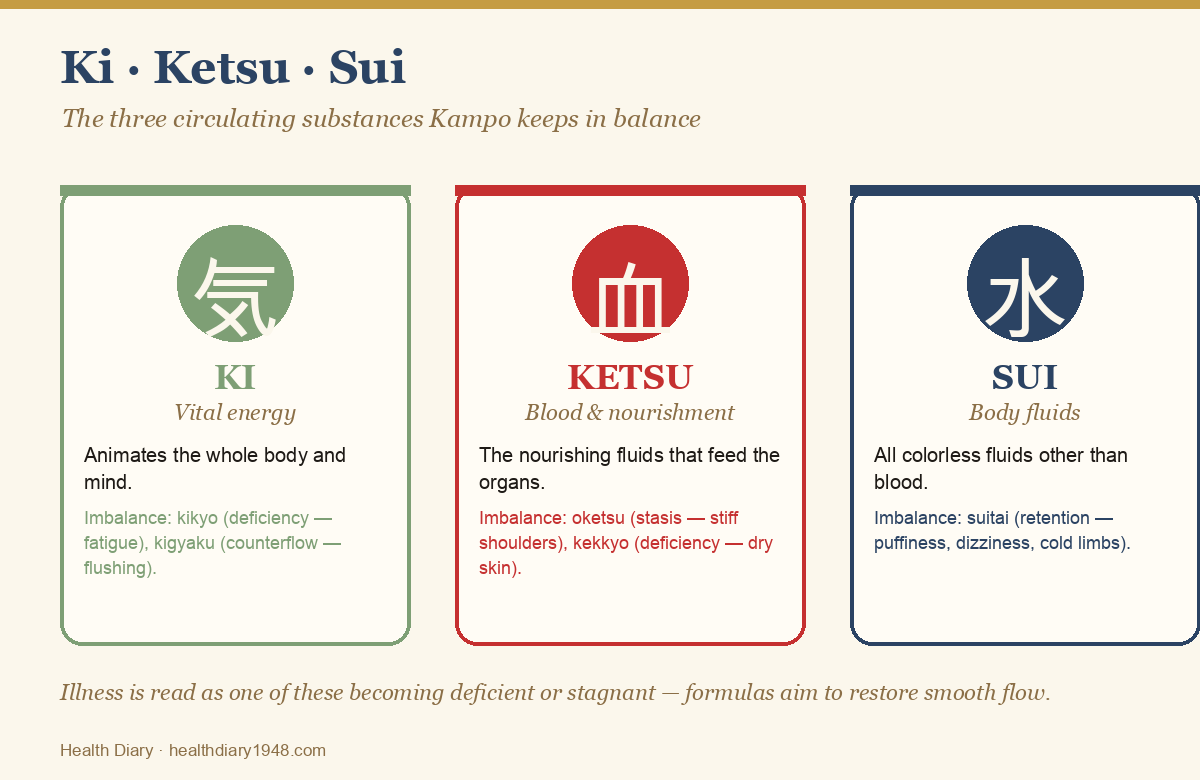
The second difference is the compact theory of ki, ketsu, and sui (気血水) — the three substances a Kampo practitioner watches. Ki is the vital energy of life activity; when it runs low, a person feels the fatigue and heaviness Kampo calls kikyo. Ketsu corresponds loosely to blood but is understood more broadly as the nourishing fluids; its stagnation (oketsu) is linked in traditional terms to headaches, stiff shoulders, and dark complexion. Sui covers the colorless body fluids other than blood, and its pooling (suitai) is associated with puffiness, dizziness, and cold limbs.8 A Kyushu University teaching guide lays out the finer vocabulary — kikyo and kigyaku for ki, oketsu and kekkyo for blood, suitai for fluid — showing how this three-part model does much of the everyday diagnostic work that the fuller Chinese organ-and-five-phase apparatus handles elsewhere.9 The underlying idea of balanced opposites is still the familiar one explored in our guide to yin-yang theory, and the vital energy at the center of it all is the subject of our guide to the concept of qi.
The third difference is standardization. Rather than a fresh, hand-weighed decoction improvised for each visit, modern Kampo relies on a fixed set of classical formulas, most now manufactured as consistent granulated extracts. This is the whole reason Kampo could merge with contemporary healthcare: the entire clinical picture — the patient's sho, or pattern — is matched to a specific, reproducible formula.3 All of this grew out of the Chinese tradition, so if you want the parent system, our pillar on traditional Chinese herbal traditions and our guide to five elements theory map the deeper roots from which Kampo branched.
The Signature Herbs and Formulas of Japanese Wellness
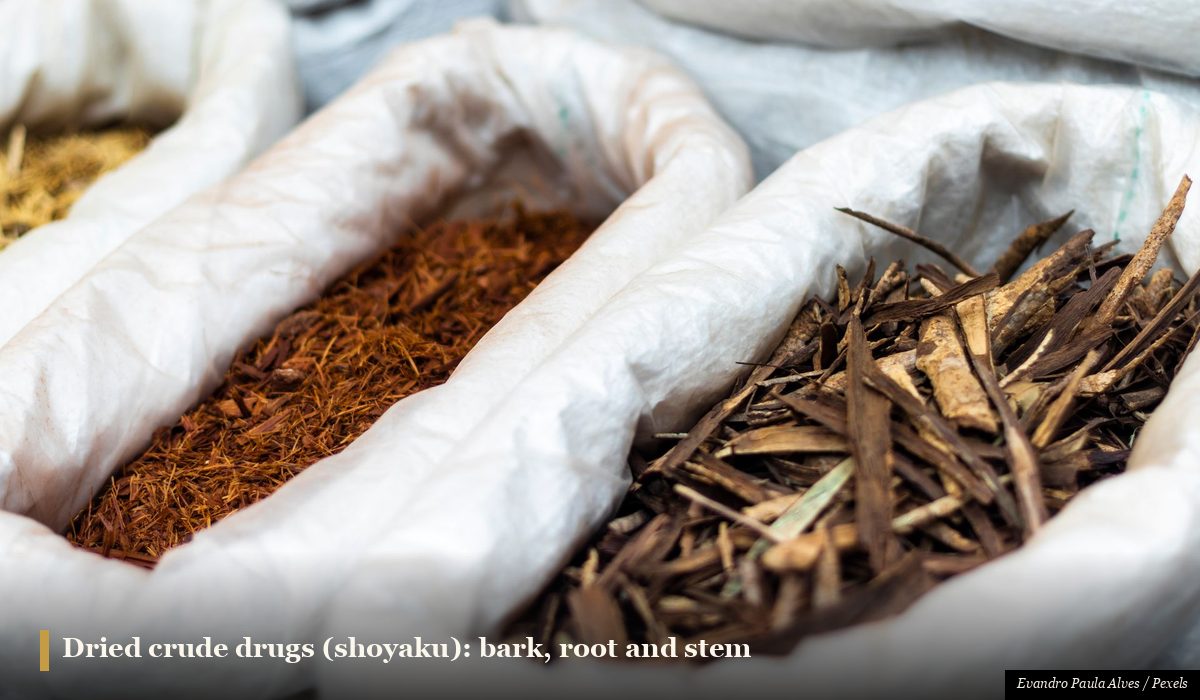
If ki-ketsu-sui is the software of Kampo, the crude drugs and formulas are the hardware. Many core ingredients — ginseng, licorice, ginger, jujube, cinnamon bark — are shared across East Asia, but Japan combines them into its own signature prescriptions and prizes a handful of home-grown botanicals.
Among Japan's own culinary-medicinal plants, two stand out. Shiso (紫蘇, Perilla frutescens) is the fragrant purple-and-green herb that flavors sashimi and pickles and appears in Kampo as so-yo, traditionally associated with the flow of ki; you can read its full story in our profile of shiso in traditional Eastern medicine. Yuzu (柚子, Citrus junos), the intensely aromatic citron, is beloved both in the kitchen and in the fragrant winter-solstice yuzu-yu bath; our guide to yuzu in traditional Eastern medicine explores its seasonal role.
On the formula side, three classical prescriptions show how Kampo thinks. Daikenchuto, a warming blend of Japanese pepper, processed ginger, and ginseng, is traditionally used for the abdomen and is now one of the most-studied Kampo formulas in modern hospitals. Yokukansan, originally a children's remedy, is widely used today for restlessness and irritability. Kakkonto, built around kudzu root, is the formula many Japanese households reach for at the very first chill of a cold. Each is a fixed recipe with a defined target, a reminder that Kampo works through whole formulas rather than single “super-herbs.” Individual responses vary considerably; what suits one person's pattern may be poorly matched to another's, and any herbal formula is best chosen with a qualified practitioner.
What Is Yakuzen, Japanese Medicinal Cuisine?
Perhaps the most appealing feature of Japanese herbal culture is how naturally it lives at the table. Alongside Kampo formulas sits yakuzen (薬膳), also called shokuyo (食養) — the practice of cooking everyday meals tailored to your constitution, condition, and the season. The neat distinction Japanese practitioners often draw is that “kampo is medicine, yakuzen is food”: where Kampo combines crude drugs into prescriptions, yakuzen uses ordinary ingredients guided by the same underlying theory.11
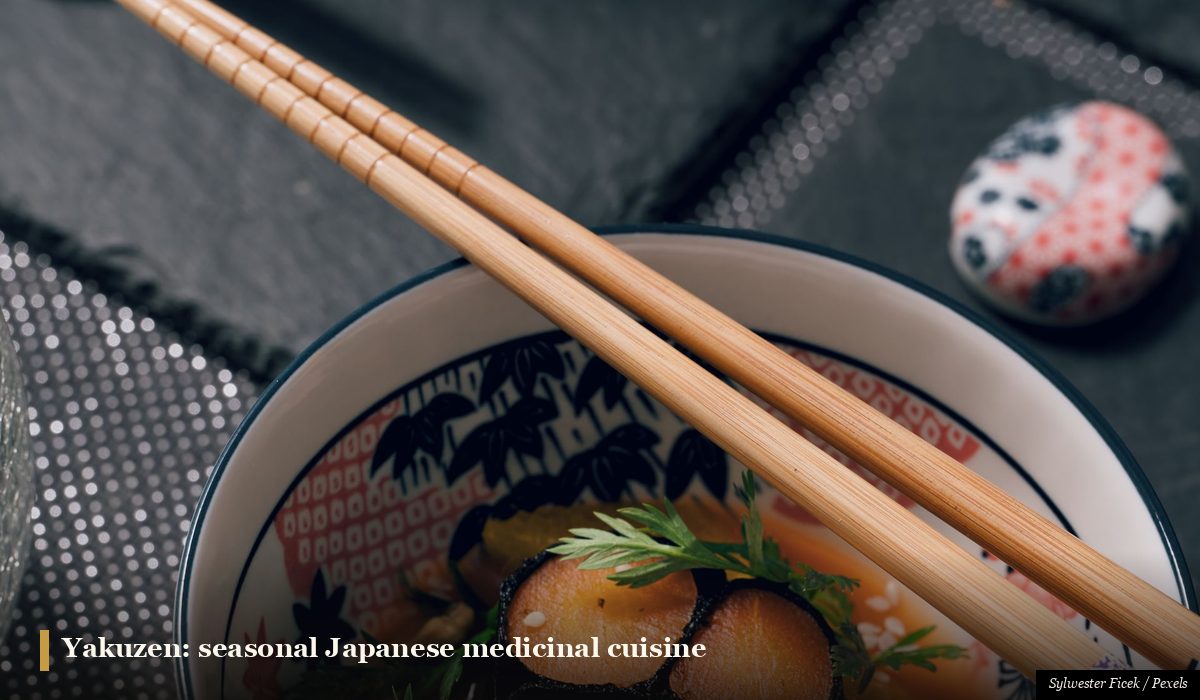
In yakuzen thinking, every food carries a nature (hot, warm, neutral, cool, or cold) and a flavor, and the cook leans on seasonal and local ingredients to counter whatever the season tends to bring. Summer dishes are chosen to cool the body and drain excess damp; winter dishes warm from within and fortify against the cold. Shiso, ginger, yuzu, daikon, and mushrooms all appear here not as medicine but as everyday seasoning with intent. This food-as-wellness overlap is one reason so many Japanese herbs live as comfortably in the kitchen as in the pharmacy — and it is the same philosophy that runs through the broader tradition of Asian food-as-care. Individual experiences vary considerably, and what feels nourishing for one person may sit differently with another.
Japanese Tea Culture and Daily Wellness Rituals
Where yakuzen is the occasional restorative meal, tea is the gentle daily thread of Japanese wellness — and no country has turned the simple act of drinking tea into a more refined ritual. Green tea (Camellia sinensis) arrived from China with Zen Buddhist monks, who valued it for staying alert and settled during long meditation, and Japan then developed an entire family of distinctive teas.
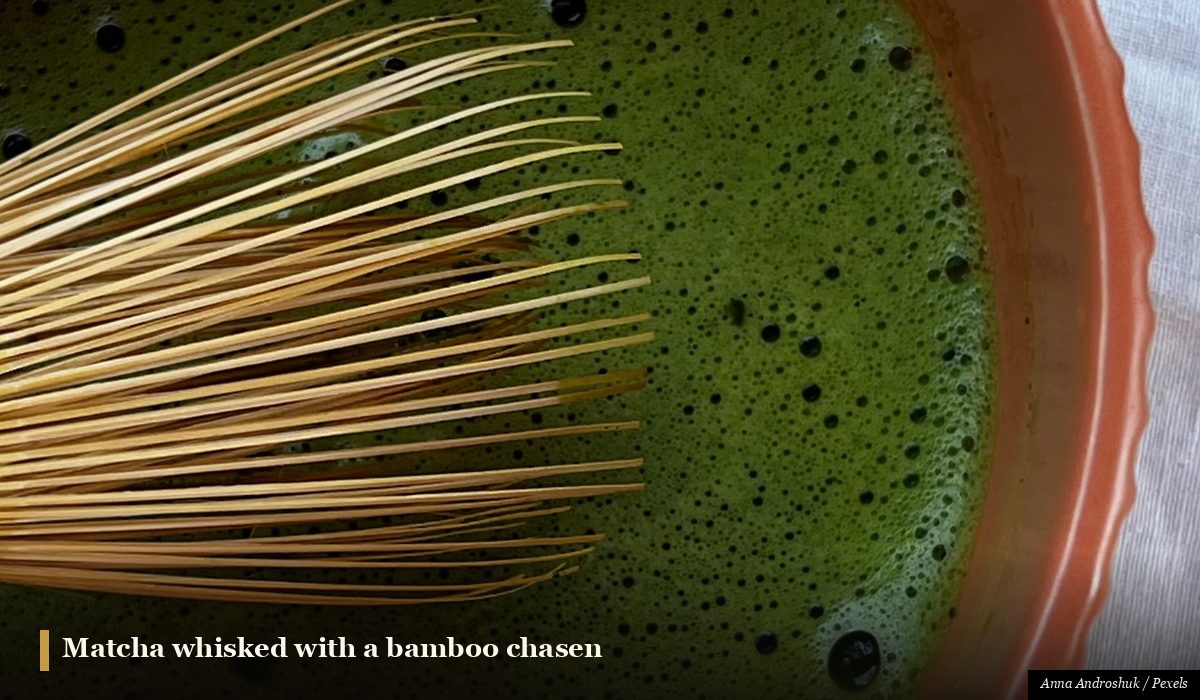
The most ceremonial is matcha (抹茶), the vivid stone-ground powder whisked into a jade-green froth — the tea at the center of the meditative tea ceremony. Our complete guide to matcha covers its cultivation and grades, our profile of matcha in traditional Eastern medicine looks at its cultural role, and our Japanese tea ceremony and matcha guide explores the ritual itself. For everyday drinking there is sencha (煎茶), the bright steamed green tea that is Japan's daily standard — see our guide to sencha in traditional Eastern medicine.
Then come the toasty, low-caffeine comforts. Hojicha (ほうじ茶), roasted until amber and nutty, is the cozy evening tea; explore it in our complete guide to hojicha, our profile of hojicha in traditional Eastern medicine, and our comparison of hojicha versus green tea. Genmaicha (玄米茶), green tea blended with roasted brown rice for a popcorn-like warmth, is profiled in our guide to genmaicha in traditional Eastern medicine, while kukicha (茎茶), the mellow twig tea made from stems, gets its own treatment in our guide to kukicha in traditional Eastern medicine. Each brew carries its own moment in the day, and choosing among them is a small, pleasant form of self-attention. As with any daily ritual, individual experiences vary considerably, and moderation is the sensible starting point.
Ikigai, Shinrin-yoku, and the Wider Wellness Philosophy
Japanese wellness has never been only about what you swallow. Two ideas that have traveled far beyond Japan round out the picture. Ikigai (生き甲斐), loosely “a reason for being,” describes the quiet sense of purpose — in work, relationships, or small daily pleasures — that many observers link to the remarkable longevity of communities like Okinawa. Shinrin-yoku (森林浴), or “forest bathing,” is the simple practice of spending unhurried, screen-free time among trees, coined in Japan in the 1980s and now studied worldwide as a way some people find calming.
Neither is a herbal remedy, but both share Kampo's underlying instinct: that steadiness comes from balance, rhythm, and attention to the whole of a life rather than a single fix. That same philosophy of gentle, lifelong care shapes how many older Japanese approach their routines — a theme we explore in our guide to Japanese healthy aging traditions.
What Does Modern Research Say About Kampo?
Traditional use is one kind of evidence; modern clinical study is another, and Japan is unusual in how seriously it has pursued the second. Since around 2000, Kampo has been folded into the evidence-based-medicine era, with a growing body of randomized trials. One review of the field counted 369 trials comparing Kampo formulas against placebo or other treatments and found that 272 of them — about 74 percent — reported a statistically significant effect of some kind, while cautioning that many studies were small and that more rigorous, internationally published research is still needed.2
A concrete example is daikenchuto: in a clinical study of functional constipation, participants taking the formula saw their weekly bowel movements rise from a median of two to between five and eight over four weeks, with only mild, infrequent loosening of the stool and no reported abdominal pain.4 Findings like these are exactly why Kampo now sits inside mainstream Japanese care: roughly 90 percent of Japanese physicians report using Kampo formulas in daily practice, all of the country's medical schools teach it, and a defined set of formulas has been reimbursable under national health insurance since the tradition was folded into the modern system in the 1970s.1
Even so, responsible sources resist tidy promises. The U.S. National Center for Complementary and Integrative Health notes that studies of East Asian herbal products have produced mixed results and that firm conclusions about effectiveness are often limited by study quality.5 The World Health Organization, meanwhile, added a Traditional Medicine chapter to its ICD-11 classification in 2019 — drawing on Chinese, Japanese, and Korean terminology — explicitly as a way to standardize language and gather comparable data, not as a verdict on efficacy.6 The honest summary is that Kampo is better studied than most traditional herbal systems, yet is still best understood as time-honored practice rather than a guaranteed fix.
Important Limitations and Considerations
Traditional Japanese herbal culture is a rich lifestyle system, not a substitute for professional medical care. Several cautions deserve real attention before anyone experiments with herbs or formulas.
- Herb–drug interactions are genuine. Some Kampo ingredients can interact with prescription medicines — licorice (kanzo), for example, appears in many formulas and can affect potassium and blood pressure with heavy or prolonged use, while several herbs may influence bleeding. If you take any medication, talk to your doctor or pharmacist first.
- Quality and purity vary. Health authorities have found some imported herbal products contaminated with undeclared drugs, heavy metals, or pesticides, and quality control across the wider herbal sector remains uneven.5 Buy regulated Kampo products or use reputable suppliers who provide testing.
- Do not self-prescribe complex formulas. Kampo matches a specific formula to a whole pattern (sho) read through fukushin and other examination; picking a formula from a symptom alone can miss the mark or be poorly suited to your constitution.
- Pregnancy, breastfeeding, and children. Many traditional formulas have not been adequately studied in these groups. Consult a qualified practitioner before use.
- Surgery. Some herbs can affect bleeding or anesthesia; tell your surgical team about any herbal use and pause it as advised beforehand.
- Individual response varies. This is the throughline of the whole tradition. Individual responses vary considerably; what works well for one person may not suit another, and personal experimentation under practitioner guidance is always recommended.
Frequently Asked Questions
What does Kampo mean?
Kampo (漢方) literally means “Han Chinese method,” and it refers to the traditional herbal medicine of Japan — a system of standardized formulas descended from Chinese medicine but developed independently in Japan. The name was coined during the Edo period to distinguish it from Ranpo, the “Dutch method” of incoming Western medicine.
How is Kampo different from traditional Chinese medicine?
The two share ancient roots, but Kampo revived and centered abdominal diagnosis (fukushin), simplified the vast Chinese materia medica into a compact set of standardized formulas, and organizes much of its thinking around three circulating substances — ki, ketsu, and sui. It is also unusually integrated with modern biomedicine: most Japanese doctors prescribe both.
What are ki, ketsu, and sui?
They are the three fundamental substances Kampo watches to judge balance: ki (vital energy), ketsu (the nourishing blood and fluids), and sui (the colorless body fluids other than blood). Illness is understood as one or more of these becoming deficient or stagnant, and formulas are chosen to restore their smooth circulation.
Is Kampo used in modern Japanese hospitals?
Yes. Kampo is remarkably mainstream in Japan: surveys find roughly 90 percent of physicians use Kampo formulas in daily practice, every medical school teaches it, and a defined set of formulas is covered by national health insurance. Doctors typically prescribe Kampo alongside conventional medicine rather than instead of it.
What is yakuzen, and how is it different from Kampo?
Yakuzen (薬膳) is Japanese medicinal cuisine — everyday cooking tailored to your constitution and the season using ordinary ingredients. The simple distinction is “kampo is medicine, yakuzen is food”: both draw on the same theory, but yakuzen expresses it through the daily meal rather than through crude-drug prescriptions.
Which Japanese tea is best for beginners?
Sencha (steamed green tea) is the everyday Japanese standard and a natural starting point, while hojicha (roasted green tea) and genmaicha (green tea with roasted rice) are gentle, low-caffeine, comforting options that many people enjoy in the evening. Individual taste varies, so it is worth sampling a few.
Is Kampo safe to take with my regular medications?
Not always. Some Kampo herbs — licorice among them — can interact with prescription drugs or affect measures like potassium and bleeding. Because interactions can matter, you should always tell your doctor or pharmacist about any Kampo formula or herb you are considering before combining it with medication.
Bringing Japanese Wellness Traditions Into a Modern Routine
One of the most appealing things about Japanese herbal culture is how naturally it fits an ordinary week. You do not need a clinic to keep a tin of hojicha for the evening, stir yuzu into hot water on a cold morning, add shiso to a summer meal, or step outside for a slow walk among trees. These small rituals are where a thousand-year tradition meets a modern life.
Because Kampo is so attuned to individual pattern and seasonal change, it also pairs well with simple self-observation. Noticing how a particular tea, food, or routine actually makes you feel over time — your energy, sleep, digestion, and mood — is very much in the spirit of a tradition built on attentive, personalized care. Keeping a light wellness journal or using a habit-tracking tool can help you spot your own patterns, information that is far more useful to share with a practitioner than a vague memory. This is exactly the kind of gentle, long-view self-observation the Health Diary approach is built around.
A Soft Closing Note
Traditional Japanese herbal traditions are, at their best, a philosophy of quiet attention: to the seasons, to the food on your table, to the tea in your cup, and to the particular body you happen to live in. From a practitioner's careful hand on the abdomen to a bowl of whisked matcha, the through-line is balance and patience rather than quick fixes. You can explore these traditions slowly, one herb or tea at a time, using the linked guides throughout this article as your map — the clinical world of Kampo, the daily pleasure of matcha and hojicha, or the parent tradition of Chinese herbal medicine from which it all grew. And whenever a question crosses from curiosity into personal health, a licensed practitioner is the right companion for the next step.
About This Article
Written by: Health Diary Editorial Team — writers and researchers focused on traditional Eastern wellness, herbal history, and evidence-aware health education.
Editorial review: This article has been reviewed by the Health Diary editorial team for clarity, structure, and adherence to our sourcing standards. Key claims were cross-checked against NCCIH, NIH PubMed / PMC peer-reviewed literature (including reviews of Kampo clinical evidence and pattern diagnosis), and the World Health Organization, with native-language (日本語) verification of historical provenance and core concepts through Tsumura, Kracie, Kyushu University Library, and the Japan Society for Oriental Medicine. It is not a clinical review and should not replace consultation with a licensed healthcare practitioner.
Reviewed on: August 3, 2026.
Editorial process: We cite peer-reviewed and government sources where possible. When a clinical reviewer is added to this article, attribution will appear here with verifiable credentials.
References
- Yu F, et al. Collaboration of Japanese Kampo Medicine and Modern Biomedicine. Evidence-Based Complementary and Alternative Medicine / PMC, 2014. https://pmc.ncbi.nlm.nih.gov/articles/PMC4074977/
- Yamada T, et al. Clinical studies of traditional Japanese herbal medicines (Kampo): Need for evidence by the modern scientific methodology. Integrative Medicine Research / PMC, 2021. https://pmc.ncbi.nlm.nih.gov/articles/PMC8181179/
- Traditional clinical symptoms and signs: Kampo pattern diagnosis in modern gastrointestinal disease. Frontiers in Pharmacology / PMC, 2024. https://pmc.ncbi.nlm.nih.gov/articles/PMC11472708/
- Efficacy and Safety of Daikenchuto for Constipation and Dose-Dependent Differences in Clinical Effects. International Journal of Chronic Diseases / PMC, 2018. https://pmc.ncbi.nlm.nih.gov/articles/PMC5859840/
- National Center for Complementary and Integrative Health (NCCIH). Traditional Chinese Medicine: What You Need To Know. 2024. https://www.nccih.nih.gov/health/traditional-chinese-medicine-what-you-need-to-know
- World Health Organization. Traditional medicine (Classifications FAQ) & ICD-11 Traditional Medicine chapter. 2019. https://www.who.int/standards/classifications/frequently-asked-questions/traditional-medicine
- 株式会社ツムラ (Tsumura & Co.). 漢方の歴史 (History of Kampo). https://www.tsumura.co.jp/kampo/history/
- クラシエ (Kracie). 漢方って何?|歴史、陰陽、気血水 (What is Kampo? History, Yin-Yang, Ki-Ketsu-Sui). https://www.kracie.co.jp/ph/k-therapy/karadakagami/kampo/
- 九州大学附属図書館 (Kyushu University Library). 気血水 — 触れてみよう!漢方医学と漢方薬 (Ki-Ketsu-Sui: An Introduction to Kampo Medicine). https://guides.lib.kyushu-u.ac.jp/c.php?g=775102&p=5560213
- 日本東洋医学会 (The Japan Society for Oriental Medicine, JSOM). Kampo specialist certification and the four examinations, including fukushin. https://www.jsom.or.jp/
- Agriture Inc. What Is Yakuzen? The Meaning, and How It Differs from Kampo. https://agriture.jp/en/sustainable/yakuzen-guide/


